Tuesday, December 08, 2015

Checking in on Cherokee

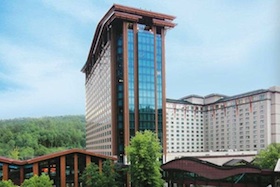
The latest World Series of Poker Circuit stop over at Harrah’s Cherokee in the western corner of the state just completed its 12-event run yesterday. Found it interesting to see that Daniel Weinman, the Atlanta-based player who took second in the very first WSOP-C at Cherokee (which I helped cover), managed to win the Main Event this time around.

Weinman topped a 1,010-entry field to win the ring and a $280,260 first prize. Back in April 2013 there were 856 entries in the event when Weinman finished runner-up. In April 2014 there were 665 entries in the Main, in December 2014 there were 797, then in April 2015 there were 786, meaning this latest field was the biggest Main Event field so far in the five instances the WSOP-C has come to North Carolina.

I remember Weinman well from two years ago thanks to a funny story involving him and Greg Raymer at that year’s Main Event. I shared that one here in a post titled “Giving Away Chips, Rocks.”

After the 2004 WSOP Main Event champion -- who incidentally lives in Raleigh -- was knocked out in 29th by Weinman, “Fossilman” followed his custom and gave his vanquisher the signed fossil he’d been using as a card protector. After Raymer departed, Weinman said to a friend on the rail “This dude just gave me a rock,” then gave the memento to my buddy Rich with whom I was reporting on the event.

I seem to remember later on Weinman asking Rich for it back over Twitter. In any case it was a funny moment amid what I recall a very entertaining tournament and final table, made so in part because of Weinman’s deep run.

I had actually been eyeing this WSOP-C stop earlier this year, thinking maybe this would be one for which I’d be making the drive up into the mountains myself to take a shot in a prelim. But the Brazil trip ran into the first part of the series and I knew I wouldn’t be up to it after getting back.

The good news is Cherokee has proven popular enough for the WSOP-C to keep putting it on the schedule twice per year, and indeed there’s a return engagement scheduled next April. Something to file away.

Labels: , , , , ,

Wednesday, December 02, 2015

Season of the Witch

Sometimes in all-in situations, say, when there’s one last river card to come, players will entertain themselves by calling out specific cards a beat before the card is revealed. “Eight of diamonds!” will shout a player, enacting a kind of prognosticator’s freeroll that gets promptly ignored if wrong, but celebrated if somehow the guess proves correct.

That celebration is usually forgotten fairly quickly, too, as it should be. But it still can add up to a fun moment for those involved, the way it goofily suggests the gambler’s dream of extra-normal powers of perception.

Last week while in Brazil, I was chatting with Reinaldo on Wednesday about the upcoming NFL games. He and I are both in the same Pigskin Pick’em pool and while we’re both far out of the running overall, we’re neck-and-neck with each other, and so are having some fun going back and forth about which of us will end the season with more correct picks out of the 256 total NFL regular season games.

My Carolina Panthers played on Thanksgiving, and somewhat hilariously were an underdog to the Dallas Cowboys despite Carolina being 10-0 going into the game while Dallas was 3-7. The reason for the line, of course, was the fact that Dallas starting QB Tony Romo was back in the line-up, and so far during the year Dallas had lost exactly zero games when he’d played (three) and won exactly zero when he hadn’t (seven).

Laying on a little bit of fan-fueled hyperbole, I pretended to express outrage about the Panthers being somehow disrespected by such a line. But in truth I knew the Panthers outmatched Dallas, even with Romo. “The Panthers will roll tomorrow,” I told Reinaldo. “In fact, they’ll knock Romo out of the game.”

As I mentioned last week, we were able to keep tabs on the T-giving games while at the tournament, and so I greatly enjoyed watching Carolina fulfill my prediction as they jumped in front of Dallas, then continued to pull away as the third quarter neared its close. It was about that time I shot my buddy Rich Ryan a message.

“Saw this coming all the way from South America,” I boasted. “I’m just surprised they haven’t knocked Romo out of the game yet.”

Less than a minute after I hit send, Romo was sacked hard by Thomas Davis, reinjuring his collarbone and having to leave the game. Indeed, his season is over.

“Sick timing brah,” replied Rich before I could even fire back an “ahem” to punctuate the uncanny coincidence of the message.

Reinaldo was impressed as well, and after asking me what the male equivalent of a witch is, promptly called me a warlock. (That picture up above, by the way, is one of your humble scribbler from long ago, one Vera coincidentally found while I was gone.)

Even though I have no particular feelings about Dallas, I’ve always liked Romo. And even if I didn’t, I obviously was not glad to have seen him get hurt. Even so I’ll admit to having experienced the momentary, frivolous pleasure that comes with guessing correctly.

Labels: , , , , , , ,

Thursday, November 19, 2015

Sidestepping the Spoilers

Was listening to last week’s PokerNews podcast today -- not the most recent one, but the “November Nine Recap” one in which Donnie Peters and Rich Ryan broke down the World Series of Poker Main Event final table (Episode #343).

Besides discussing all the key moments from Joe McKeehen’s dominating win, the pair got into some other related topics as well including considering suggestions for improving the WSOP Main Event going forward and whether or not the November Nine experiment has run its course after eight years’ worth of delayed final tables.

Near the very end they played a voice mail from a listener referring back to Donnie’s live tweeting during the final table, and from there came a short discussion of the whole “spoilers” topic. Donnie was one of a few folks tweeting live from the Rio that night, which meant those watching the coverage on the ESPN networks (on a half-hour delay) needed to mute or unfollow those Tweeters if they didn’t want to know ahead of time what they were about to see.

I tried to mute everyone who like Donnie warned they’d be tweeting “spoilers” during the WSOP Main Event final table. It almost worked except for once when someone retweeted a knockout before it had shown up on the teevee (argh!).

I thought of that conversation again just now while watching the World Poker Tour’s live stream of the final table of the WPT Montreal event from the Playground Poker Club. There, too, one can enjoy “cards up” coverage on a half-hour delay. (Side note: The WPT stream shows all players’ hole cards, not just players voluntarily putting chips in the middle like they’ve been doing with the WSOP ME final table. The WSOP should be showing everyone’s cards, too, I think, for the sake of fairness.)

Anyhow, you run into a similar “spoiler” issue following live updates from the event on the WPT site alongside the live stream, as the hand reports are a half-hour ahead of what is being shown. They’re also tweeting live updates about the final table from @WPTLive, which means you can’t follow that and watch the stream without being told about things ahead of time as well. (E.g., that bold five-bet shove by Brian Altman with pocket fours pictured above was partially signaled a half-hour ahead of time via the Twitter feed.)

Just now on the WPT feed play was delayed for a couple of moments while Mike Sexton, Vince Van Patten, and Lynn Gilmartin could be heard adding some commentary for the edited version of the final table that will be shown later -- a phenomenon I wrote about here once before following a WPT final table I helped cover. Kind of wild to think of the many different ways the WPT is covering their event all at once -- live, on a half-hour delay, then yet again in a different, edited way on longer delay.

Over on the European Poker Tour, the issue is handled pretty effectively via an embargo (of sorts) on reporting ahead of the delayed live stream. That can’t prevent non-media folks from tweeting out what’s happening, but the system works pretty well. It also kind of “unifies” the coverage with the live updates, the features on the PokerStars blog, the EPT Live stream, and all of the coverage appearing on other online outlets all operating in tandem rather than one “spoiling” things for any of the others.

I really enjoy watching live streams, and I also like being on social media to share the experience (such as when the WSOP Main Event final table is playing out). Indeed, as I observed last week when discussing the slowness of the WSOP ME FT, the pace of the game with its frequent pauses makes it well-suited to be combined with something like Twitter where spectators can share impressions as they watch. But “cards up” coverage can’t be provided without a delay, which necessarily introduces the possibility for “spoiler” situations.

I like the EPT’s attempt to solve the conundrum. Is there any other way to do so?

Labels: , , , , , , ,

Friday, January 30, 2015

On the Props

Was spending part of today considering all of these Super Bowl prop bets. I was put in the mood to do so after having posted a discussion with Rich Ryan over on PokerNews the focus of which was Super Bowl betting -- this week’s “Inside Gaming” column.

As mentioned there, last year the Nevada sports books took in more wagers than ever before, besting the previous year’s record by a lot. They also profited considerably thanks in part to heavy action on favorite Denver and Seattle ending up crushing, earning more percentage-wise in nearly a decade.

Super Bowl prop bets are significant for the sports books, with many of them longshots and thus great opportunities for the books to win. The lines can be a bit skewy on them, too, which perhaps opens up some opportunities for savvy bettors. But on the whole they’re hard to read (at least for an amateur like me).

Among the items I read today was USA Today’s “19 craziest prop bets for Super Bowl XLIX.” Like a lot of folks this week, they look to Bovada -- the site we online poker players know better as the-one-that-used-to-be-Bodog -- as their source of props. Bovada has more than 500 prop bets listed, with practically every detail regarding what might happen in Arizona on Sunday covered.

These “19 craziest” ones include many with nothing to do with the actual game itself. Those include bets on Katy Perry’s wardrobe during her halftime performance as well as how many times she will be mentioned during the first half, whether or not Idina Menzel will forget a word of the national anthem, Bill Belichick’s hoodie color and type, which team owner (Robert Kraft or Paul Allen) will be shown more often during the game, the number of times Gisele Bundchen (Tom Brady’s wife) will be shown, the number of times deflated balls will be mentioned, the number of viewers, who the Super Bowl MVP will first mention after the game, whether Marshawn Lynch will grab his crotch after scoring a TD, and whether Bill Belichick will smile. Of these I most like the one about whether or not Al Michaels will make any gambling references during the telecast (i.e., to the point spread, over/under, game odds, prop bets).

Even the game-related ones have to do with extracurriculars, like the parlay pairing whether or not Punxsatawney Phil sees his showdow and the game’s outcome, or the one comparing the length of the Silva-Diaz UFC fight and LeGarrette Blount’s rushing attempts. In fact among these “crazy” bets are only four football-only ones -- whether or not Tom Brady will throw a TD or interception first, whether or not one of the kickers will win MVP, which Seattle player will catch their first pass, and how many field goals Seattle will make.

Every one of these feels like a sucker bet, as do many of the other props even if one might legitimately have an edge betting a particular side of them. Heck even the game itself -- which Rich tells me the Football Outsiders guys are describing as historically remarkable in terms of how mathematically even the two teams are talent-wise -- feels especially hard to predict.

Who do you think will win on Sunday? Other than the sports books, that is.

Labels: , , , , , , , ,

Tuesday, September 02, 2014

Short at SHRPO

Poker news over the three-day weekend focused largely on that Seminole Hard Rock Poker Open Championship, a $5,300 buy-in event with three Day 1 flights and unlimited reentries that sported a $10 million guarantee.

They ran a similar event last year right about this time, again culminating a long series of tournaments comprising the “SHRPO,” and after it drew 2,384 entries to build a $11,920,000 prize pool the tourney earned a lot of notice. I was there last year at the time, actually, helping cover the first World Poker Tour Alpha8 event that was happening that same week at the Hard Rock in Hollywood, Florida, and I recall the buzz surrounding the event which Blair Hinkle ultimately won to claim a hefty $1,745,245 first prize.

The return of the “$10 milly” was announced back in May and I remember Rich Ryan then spending one of his “Five Thoughts” looking forward to the sequel while commending the tourney’s organizers for scheduling it after EPT Barcelona (albeit by just a couple of days).

Barcelona ended up breaking all kinds of records, attendance-wise. Then the end of August ultimately became quite crowded on the poker calendar on this side of the pond with events in California (the WPT Legends of Poker), Oklahoma (the WinStar River Poker Series), Mississippi (Beau Rivage Gulf Coast Poker Championship), Colorado (Colorado Poker Championship), Ohio (Labor Day Deepstack), Pennsylvania (Pittsburgh Poker Open Summer Series), and Montreal (Playground Poker Montreal Festival). There might have been others, too, not to mention the WSOP Circuit stops happening on either side as well.

Even so, it was a little surprising to hear they only ultimately drew 1,499 entries for the SHRPO Main Event, meaning an enormous overlay of just over $2.5 million after the tourney organizers honored the $10 million guarantee. The tourney is now down to 18 players. The EPTLive folks will be live streaming the final table tomorrow, I believe, as well as the final table of the Super High Roller today with James Hartigan and Joe Stapleton handling the commentary.

Among the chatter over the last couple of days has been the observation that this represents biggest overlay in poker tourney history, exceeding even that International Stadiums Poker Tour (ISPT) event at Wembley last summer where €589,060 had to be put up to ensure a €1 million first prize. The Seminole’s big overlay has also spurred other interesting conversations about the current state of tournament poker.

Those who think the turnout coming up short at SHRPO indicates something dire about the state of tourney poker in the North America are wrong. The other events listed above all saw healthy turnouts and there’s hardly a shortage of players and/or interest in tournament poker here. Those wondering about the possible negative effects of unlimited entry tournaments upon non-professional players have a point, although I don’t think they really dissuade the non-pros from participating all that much. Meanwhile those speculating about the future of super-big guarantees have a point as well. In any case, one would think the Seminole will probably be a lot more cautious about trying another $10 milly event in the future.

I guess I’m most intrigued by how complicated the reaction to the SHRPO overlay has been. Rather than simply hearing from players rejoicing at free money in Florida, the angles of inquiry and subsequent discussion has gone in all sorts of directions, including some that seem constructive. The fact is, the overlay has highlighted several issues relevant to players, casinos, tourney organizers, and even the media who cover tourneys, bringing to the foreground concerns that have significance to anyone with an interest in tournament poker.

Tournament Director Matt Savage summed up the conversation well in a single tweet, I thought, when he noted that “Poker tournaments are a fragile ecosystem, we (Players, TD’s, and Casinos) need to work together to get them to survive and thrive.”

There is most certainly an “ecosystem” (or special “economy”) in poker, something the rise of tournament poker has made all the more conspicuous over the last decade. And everyone who is part of it affects it in some fashion, whether they work together or not.

Labels: , , , , ,

Friday, July 11, 2014

Poker and “The Truth”

Now’s the time -- probably the only time all summer -- that I’m genuinely missing being out in Las Vegas.

The first days of the Main Event are always intriguing, in particular because they are often the only time all summer you see a certain category of recreational player well represented in the field -- amateurs taking big shots, the “bucket list” guys, and so on -- and as I was saying yesterday I think ESPN has dropped the ball somewhat by ignoring that part of the tournament (especially this year as they are skipping all of the way ahead to Day 4 in their coverage).

That said, it’s true that when the money gets closer, the bubble bursts, and then the last few days play out that things get really fun, even for those of us just watching. Again, part of the enjoyment comes from the fact that some of those amateurs are still in the sucker, their lives being affected in significant ways with every hour that goes by. But the pros rise up, too, and the poker gets more and more intriguing to follow.

And, of course, there’s that hard-to-explain feeling of coming to the end of a long journey with everyone involved -- players, staff, colleagues -- that makes the last days of the WSOP so special each summer. So I’m missing that.

I am enjoying the coverage, though, and in particular got a big kick out of the interview Rich Ryan and Eric Danis got to do yesterday with NBA player Paul Pierce for PokerNews/GPI. Pierce would be an example of that sort of player I’m describing -- the amateur kind of taking a shot, even if for “The Truth” (Pierce’s nick) the bankroll pressure isn’t quite the same as it would be for most.

I loved Pierce’s enthusiasm when talking about why he likes poker (the competitive aspect unsurprisingly is the game’s biggest draw for him). I wrote a little summary of the visit while embedding the video over on Learn.PokerNews -- it’s worth a look if you’re a basketball fan, or even if you just like seeing somebody who enjoys poker talk about why he does.

Click over and watch it, if you are curious: “‘It’s a Beautiful Game’: NBA Star Paul Pierce Talks Poker at the WSOP.”

I was saying something similar here last Friday. I enjoy hearing these positive messages about poker, but I think I also just enjoy watching/hearing people enjoy themselves, no matter what they are doing.

Pierce would bust before the end of the night, but was smiling ear to ear even as he left. ’Cos the truth is, poker really is a beautiful game.

Labels: , , , ,

Tuesday, May 13, 2014

What Is Poker? (Talking OFCP)

I didn’t get a chance to listen to today’s World Series of Poker Conference Call, although did follow the blow-by-blow from Rich Ryan and Kevmath over Twitter as it occurred. Besides the talk of frisbees and dog shows, there was one item that came up during the call-concluding Q&A that caught my attention.

A question arose (I believe) regarding open-face Chinese poker and the possibility of it being introduced sooner or later as a bracelet event. It sounded like WSOP Executive Director Ty Stewart addressed the issue with some reference to the history of the WSOP, adding also that while they don’t fear innovation, there was perhaps some question about OFCP even being “poker” per se. (I’m paraphrasing Kevmath’s paraphrase.)

I remember first learning Chinese Poker and having a similar thought that the game seemed a lot more like gin or even spades or hearts than poker. Others have brought up further points to suggest that OFCP isn’t like other poker games, including the fact that no one bets (in the usual sense) nor are there really opportunities to bluff, with the latter being what some believe to be a fundamental element of the game.

I wrote a little about this debate here back in December when the 2014 schedule was still being made and there was a lot of discussion back and forth about the idea of an OFCP bracelet event. I posted something on Learn.PokerNews as well about it, kind of summarizing the debate as it was being conducted at the time.

Since then I read an interesting point about OFCP made by Ivan Demidov in a post he recently wrote for the PokerStars blog in which he was addressing why the game was so popular.

“A lot of players like the fact that you never have to fold a hand in open-face Chinese poker,” says Demidov.

It’s kind of an obvious point, but a meaningful one, I think. It’s also perhaps another reason why OFCP isn’t so much a “poker” game, as no folding makes it more like other gambling games in which the option not to play is not available. That said, it still shares a lot of affinities including the goal of making hands according to poker hand rankings.

I liked Stewart’s response and how it showed the WSOP seriously thinks about what exactly “poker” is as well as the importance of moving forward with an appropriate reverence for the past.

Meanwhile, what was this about frisbees and dog shows, again?

Labels: , , , , , ,

Tuesday, May 06, 2014

The Tomko Story

Hear about this weird story involving Poker Hall of Famer Dewey Tomko and an anti-online op-ed that appears to have been attributed to him without his consent? (That’s Tomko pictured, natch -- from a Flipchip photo.)

If you haven’t, Nolan Dalla’s blog is a good place to go for an initial introduction to the story. In fact, his blog post “Who’s the Imposter Behind the Dewey Tomko Hoax?” is itself the most interesting part of the story, as there Dalla reports on having asked Tomko directly via phone about the editorial that appeared on the Press of Atlantic City website back in March.

The editorial speaks of the dangers of online gambling, advocating against it with some specious arguments about collusion. The piece is attributed both to Tomko and a person named Bill Byers, but as Tomko told Dalla he knows nothing about the article or why his name has been attached to it. (Meanwhile the article continues to appear on the Press of Atlantic City site without any corrections or disclaimers regarding its authorship.)

Follow links in Dalla’s post for some more backstory to the op-ed and response to it in the poker community. Then check out Rich Ryan’s discussion of the situation over at PokerNews in his “Five Thoughts” piece published today, as well as Haley Hintze’s follow-up on the story at Flushdraw in which she does some detective work to try to start to answer the question posed in Dalla’s post title.

There’s more to the story than is contained in all of these sources, it seems, including details regarding the apparent involvement of figures associated with anti-online gambling lobbying efforts as covered in Haley’s piece.

Kind of funny, actually, how the big dangers some of these folks routinely list when it comes to online gambling/poker -- namely collusion and being able to misrepresent oneself online -- seem also to be tactics possibly being employed by the lobbyists as they work together to create confusion regarding who is saying what about the issue.

(EDIT [added 5/7/14, 8 p.m.]: Well, this one got a lot twistier and odd over the last 24 hours. My original title for the post was purposely ambiguous with its reference, potentially alluding either to the Press of Atlantic City article, Tomko’s seemingly true story as told to Dalla, or the entire complicated “story” being reported on by others. More meanings seem possible now.

The signoff suggesting there may have been some sort of online identity-borrowing going on still seems partly possible, though it doesn’t appear today as though it was a simple case of Tomko’s name being used without his knowledge or permission. [In other words, there’s some question, it seems, regarding his “story.”]

Today the original March op-ed was pulled from the PoAC site, but not before more complications arose suggesting that Tomko may have indeed at least had some knowledge of it and the planned attribution. For those wanting help sorting it out, check out the following posts from today:

  • The Curious Case of Dewey Tomko and the Disappearing Op-ed,” Steve Ruddock
  • Updating the Dewey Tomko Controversy -- What (Apparently) Happened,” Nolan Dalla
  • Dewey Tomko-signed Editorial Yanked from Press of Atlantic City Site,” Haley Hintze)
  • Labels: , , , , ,

    Friday, February 14, 2014

    On “‪#FlippingCoins #$250kaPop”

    Another short writing window for your humble scribbler today after another long day of other duties to tend to, including some here on the now super-slushy farm. Thought I’d sign off the week with reference to a debate that arose a few days ago regarding these “high roller” events.

    The conversation was occasioned by the two big buy-in tourneys that happend at the Aussie Millions last week and which I was writing about a week ago -- the A$100,000 Challenge won by Yevgeniy Timoshenko who earned A$2 million for topping a field of 76 entries, and that LK Boutique A$250,000 Challenge in which Phil Ivey won A$4 million after prevailing in a field that drew 46 entries.

    Both were re-entry events, allowing players to buy back in as many times as they wished up until the start of the second day of play. That led to some eyebrow-raising examples of players spending a lot in Melbourne to play in the tourneys. Daniel Negreanu, for example, bought in five times to the $100K event and another three times to the $250K one. He managed to cash in both and in fact turned a profit overall.

    The debate to which I am referring regarding the high roller events arose over Twitter and primarily involved Negreanu and Dan Shak. In his “Five Thoughts” column this week, Rich Ryan touches on one aspect of that dialogue, namely the one over whether or not these huge buy-in events have an effect on all players. (Do they or don’t they?) But in fact I was intrigued by another issue that arose between Shak and Negreanu during their Twitter exchange.

    During the frenzy of re-entering the $250K, Negreanu at one point tweeted “Doubled up! K9 vs A8 I hit a 9 weee! This is so fun! ‪#FlippingCoins #$250kaPop.” Not long after Shak wrote a number of tweets about the $250K and high rollers, generally speaking.

    Shak actually likes the high roller events (and has a record of doing well in them), but wasn’t crazy about the unlimited re-entry option being available so deep into them as was the case at the Aussie Millions. “Never thought I would say this but what is going on right now is a complete embarrassment to the game and what it means to the value of $,” Shak tweeted amid other comments.

    A couple of days later he and Negreanu got into a conversation and Shak noted to Negreanu “the tweeting and referencing 250k flips is what I had issues with,” adding “you are a role model whether you like it or not and it's my opinion that [it is] not necessary to glorify it to the young.”

    Negreanu of course defended his tweets about “flipping” for a quarter milly while arguing that delivering such messages wasn’t harmful in the way Shak suggested. You can search through the timelines of both for more, including going up and down the conversations emanating from the tweets linked to above.

    Like Shak, I’m somewhat weary of the unlimited re-entry format, generally speaking. I’ll admit to being a bit awe-struck by players dropping so much into these high roller events such as happened in Melbourne. Meanwhile, I’m not sure what sort of effect a player like Negreanu tweeting excitedly about “‪#FlippingCoins #$250kaPop” has on younger, aspiring players, nor how such spectacles might affect broader perceptions about poker’s skill component. But I do get that there is something kind of out-of-whack about it all.

    What do you think? What sort of effect do these six-figure tourneys really have on the larger poker community?

    Labels: , , , ,

    Tuesday, January 07, 2014

    Fading Rich

    I’m a little bit in awe of my friend and colleague Rich Ryan for having the cojones to make and publicize his “10 Poker Predictions” at the start of each year over at PokerNews.

    His list for 2014 includes a few provocative prognostications. He thinks four Russians will win WSOP bracelets this year, for example, which seems like a total that would be over the betting line.

    Rich did correctly call for the Canadians to break through in 2013, however, boldly guessing they’d get at least eight WSOP wins (they won 10, plus two more by Daniel Negreanu at the WSOP APAC and WSOPE). In fact Rich somehow got eight of his 10 predictions for 2013 correct, which seems way over the line I would’ve set for correct picks in his list a year ago.

    One other prediction Rich offers for 2014 is to say that “a ‘well-known’ pro will win the WSOP Main Event.” He then usefully narrows the definition of “a ‘well-known pro” down to just the top 100 players in the current Global Poker Index plus the top 50 players on the all-time money list, guessing that with overlap he’s probably narrowed himself down to about 125 players altogether.

    I think I’ll take the field versus Rich on this one.

    Looking back at the GPI rankings as of July 1, 2013, not one of the eventual November Nine from last year’s Main Event was anywhere near the top 100 on the list. The only one of the group who even appeared in the Top 300 at that time was Amir Lehavot in 273rd.

    Meanwhile, I believe J.C. Tran was already inside the top 50 on the All-Time Money List for tourney earnings when he made last year’s Main Event final table, sitting just inside the top 40 before snaring another $2.1 million-plus for his fifth-place finish. But none of the other ME final tablists was close.

    To be fair to Rich, he does classify this prediction as a “shot” and indeed I think it is probably more than 10-to-1 against he gets it right. Being less ballsy than he, though, I’ll go out on a short limb and make one prediction for 2014 here that he misses this one.

    Labels: , , , , , ,

    Friday, August 23, 2013

    Two Thousand Maniacs!

    A half-century ago, a former English professor turned movie maker named Herschell Gordon Lewis collaborated with a carnival worker named David Friedman to make what at the time were some of the most popular and most vile films to receive wide distribution. They’d already collaborated on a few so-called “nudie cutie” films by then, but it was their launching of what would come to be known as the “gore” genre with 1963’s Blood Feast that ensured them a permanent, curious place in B-movie history.

    Blood Feast presents a crazed food caterer named Fuad Ramses who butchers a lengthy series of victims in preparation for the feast of the film’s title, some sort of sacrificial meal designed to further his worship of an Egyptian goddess, Ishtar. The film stars June 1963 Playboy Playmate Connie Mason whose acting ability is as severely limited as most of the others in the cast. The script is laughable, the direction incompetent, and the story only barely coherent.

    It was an enormous hit. With a budget of $24,500, the film is said to have made about $4 million at the box office, mostly at the hundreds of drive-ins then in operation. All because of the film’s outrageously graphic gore effects and subsequent word-of-mouth that worked a lot more effectively in those pre-VCR days.

    The pair would swiftly produce a second “gore” flick starring Mason, a kind of demented reworking of the famous musical Brigadoon in which some unwitting Northerners get themselves lost in the deep South, ultimately getting lured to a strange town called Pleasant Valley where some sort of centennial celebration is happening. Turns out the town is full of crazies seeking vengeance for a Civil War massacre that occurred at Pleasant Valley a hundred years before. Bad news for the Yankee tourists!

    The film’s title you might have guessed -- Two Thousand Maniacs! It’s better made than Blood Feast, although so are most home movies. It’s also a more genuinely disturbing film, or at least it was when I first saw it as a teenager many years ago. Again with a miniscule budget (just $65K), they filmed it in two weeks down in St. Cloud, Florida. And once again the movie made a huge return at the box office, helping further establish a template for low-budgeted horror that has been followed repeatedly ever since.

    Like Deliverance, The Texas Chain Saw Massacre, The Hills Have Eyes, and countless other “hillbilly horrors” would later do, Two Thousand Maniacs! portrays the South as a nightmarish hell which those from the North should avoid at all costs. Ironically, the film was hugely popular in the South, especially around here in North Carolina where Charlotte and the surrounding towns were a kind of focal point for drive-ins during their heyday.

    Speaking of people traveling south and taking risks, this Seminole Hard Rock Poker Open that got underway yesterday has interestingly grabbed the poker world’s attention, the tournament playing out about three-and-a-half hours south of St. Cloud. Most of the buzz stems from the fact that the $5,000+$300 buy-in event is sporting an eye-popping $10 million guarantee.

    That means in order to make that guarantee they’ll need to attract exactly 2,000 entries. Madness incarnate!

    Or is it? Yesterday saw 634 entrants all told, and it sounds like they’ve already got more than 500 during the first couple of hours today. There are three Day 1 flights. Players who bust the tournament are able to re-enter as many times as they wish, including re-entering on the same day if they’ve yet to reach the dinner break when late registration closes. Those ending one of the first two Day 1s with less than the starting stack can forfeit their stack and re-enter on a subsequent Day 1, too, with the full starting stack.

    Will they make it 2,000 entries? Appears as though they might. In a piece yesterday for PokerNews, Rich Ryan sounds like he thinks they’ll get there, with one of the reasons being the significant growth of poker in Florida of late. Indeed, poker has been booming in the state over the last three years since the passage of legislation to allow for uncapped no-limit games.

    I’ll be traveling down to the SHR this weekend to help report on the first ever Alpha8 tournament being staged there by the World Poker Tour, a $100,000 buy-in event that should attract a few of those maniacs already there for the $10 milly guaranteed. Looking forward to that as well as to get a glimpse of the other action and reunite with my many buds already there.

    Will be on the lookout, though, for any sketchy-looking detour signs on the way down.

    Labels: , , , , , , ,

    Friday, July 19, 2013

    The Turn Changed Nothing

    At one point a couple of weeks ago I was helping cover a pot-limit Omaha event at the World Series of Poker with my friend and colleague Rich. A hand arose in which a player was all in before the flop and at risk, and someone commenting on the hand amused us greatly with his narration as the hand played out before us.

    Not to get too caught up in specifics, the grins began with the commentator uttered the phrase “the turn changed nothing” when in fact the turn card had given the at-risk player a flush draw with one card to come. Rather than changing nothing, the turn had greatly improved his chances, giving him nine more outs to survive.

    To make a short story even shorter, we laughed afterwards about the phrase being misused, then I began repurposing it in various ways.

    “The turn changed nothing,” I’d say, then, adopting the character of a not-so-savvy player and/or observer, I’d add: “I’m still a moron.”

    I suppose in just about every work environment there will develop a special language between workers used both to describe their assigned tasks and perhaps to comment on them, too, sometimes sarcastically. Thus did we start to employ the phrase “the turn changed nothing” as a kind of shorthand for anything worthy of criticism or that struck us as at all funny.

    You know, a little emblem of absurdity, added to the catalogue. Every workplace has got ’em.

    I realize what I’m describing might not make much sense out of context, and now that I’m back home and in an environment where I doubt I’ll ever encounter a spot where I might say “the turn changed nothing” I’m starting to think of the phrase a little differently.

    In truth, in hold’em or Omaha the turn always changes something, except in those rare instances when a player is already drawing dead after the flop, in which case you could say nothing changes with the turn or the the river, at least as far as the outcome of the hand is concerned. I think that was part of the reason why the phrase seemed so funny to us, namely, because it so rarely applies.

    Of course, even in those situations when the flop utterly decides who is going to win a hand, the turn card still brings a hand one step closer to its conclusion, even if only as a formality. When players are drawing dead on the flop, the dealer still deals a turn and a river as though running out a grounder even after being thrown out at first. Although the cards don’t affect the outcome, they are somehow needful nonetheless.

    Last night I was talking to someone about my summer in Vegas who at one point began asking me if it had been a worthwhile, positive experience. At first I wanted to answer jokingly, to laugh at the idea of self-reflection and dismissively characterize the whole time as having “changed nothing.”

    But in fact it was a positive experience, and entirely worthwhile. And besides, it’s never true that what we do changes nothing, even if it seems otherwise.

    Labels: , , ,

    Monday, July 08, 2013

    2013 WSOP, Day 40: Connectivity

    A buzz saw was screeching loudly from across the Amazon room, firing every few minutes in loud, wince-producing bursts like an exaggerated version of a snooze alarm.

    A man with an unlimited supply of throat-closing phlegm was hacking without stop as though approaching a final death rattle, aggressively grabbing the attention in between the construction-related cacophony.

    A doorway to the Amazon room was open and music poured in, flooding the space with still more noise.

    It was a few minutes past three o’clock in the morning. The last final table of the summer at the 2013 World Series of Poker was down to four players, all vying for a bracelet and a cash prize worth more than $850,000. I was there along with my blogging partner Rich and photographer Joe as part of a small team tasked with reporting every hand of pot-limit Omaha being played.

    The noise added somewhat to the challenge. Fatigue was another obstacle to overcome, as we’d been at it for more than 13 hours as Event No. 61 ($10,000 PLO) had raced down from 32 players to the final four, all of us likewise having been working at least several long days in a row (it was my fifth).

    But there was an even bigger obstacle to our getting the news out about what has happening as the remaining players continued to be dealt hand after hand, to make bet after bet, to inch ever closer either to finding a winner or reaching the end of the day’s 11th level at which point -- according to the announced plan -- the tourney would be stopped and resumed again on Tuesday.

    The friggin’ internet, man. It was down. Again.

    For the most part this summer, connectivity hasn’t been too big of a problem for me when reporting from the Rio. While some of my colleagues have been having issues now and then, for whatever reason I’ve mostly steered clear of the difficulties and have remained online without too many interruptions, either using a wireless network or plugging into a hard line (both provided by the WSOP).

    Maybe I’ve just been lucky in terms of where I’ve been stationed over the last three-plus weeks. Another meaning for “picking good spots” in poker, I guess.

    But last night we all lost connectivity for over an hour, just as the event had reached its most frantic and meaningful moments. And the longer we were offline, the more we felt ourselves losing connectivity in other ways, such as with the ability to think rationally.

    At one point an exasperated Rich looked up from his computer at the banner of 1975 Main Event champion Sailor Roberts hanging over our heads. For some reason the picture shows Roberts not playing poker, but talking on a telephone while smoking a cigarette, his face mostly obscured by smoke and the brim of his visor.

    Rich surprised us into laughter as he had a comment to offer.

    “What year is this?!? 2013?!? Sailor Roberts had better internet with his friggin’ dial-up than this!”

    About a half-hour into our struggles, I managed to get back online by tethering with my iPhone and became the sole conduit to the outside world among us for the next stretch. I madly entered hands we’d been recording and saving, uploaded a photo or two, and tried to keep everything straight as the tourney continued to march on rapidly before us. For several minutes I was simultaneously in the recent past, the maddening present, and bracing for an uncertain future.

    I felt like a computer running too programs at once. If it were possible to check my brain’s “Activity Monitor,” all meters would have been in the red, my processor’s usage either nearing or at 100%. If someone asked me at that moment my birthdate, my social security number, my name... I could have frozen up completely.

    As the tournament reached heads-up between Daniel Alaei and Jared Bleznick, internet connectivity was suddenly, inexplicably restored. Even more surprising, heads-up lasted just a single hand, with Alaei winning and the problem of having to delay the event’s conclusion an extra day to accommodate players playing today’s last Day 1 flight of the Main Event suddenly evaporating.

    It’d take some time longer for us to tie all the loose ends and finish out the live blog, and I’d be up more than a hour more after that as my brain finally cooled down enough to permit sleep to come some time after five.

    With the Main Event in full swing, the amount of media now reporting on the WSOP has swelled to probably four or five times the size it had been before, which I assume will increase the chances the plaintive wail of “internet’s down” will be heard many more times over the coming week. And despite the hyperbole I employ above, I ain’t really all that stressed over it, knowing from having gone through similar trials before while reporting that there’s really not much reason to be.

    I’m off today, and I’m going to try to stay mostly unplugged, if I can, keeping the Activity Monitor on both my laptop and brain at low levels. That to the left is my view of the Rio currently, and I mostly plan to keep at this distance until I return tomorrow to help with the coverage.

    Meanwhile for those who remain connected, check over at PokerNews to see how today’s final Day 1 Main Event flight goes.

    Labels: , , , ,

    Saturday, June 22, 2013

    2013 WSOP: Day 24: Year of the Player of the Year

    Was a late one on Friday as I was on Day 3 of Event No. 35, the $3,000 pot-limit Omaha event here at the World Series of Poker where Jeff Madsen led pretty much the entire last day as they played down from 19. Madsen won his third WSOP bracelet and first since winning two in one week as a 21-year-old back in 2006.

    Afterwards my blogging partner Rich and I marveled a little at how many of the WSOP Player of the Year winners seem to be thriving in 2013. In fact, four of them have won bracelets, counting 2004 WSOP POY winner Daniel Negreanu’s Main Event win at WSOP Asia Pacific. Madsen won the WSOP POY in 2006, Tom Schneider (who has won two bracelets this year) won it in 2007, and Erick Lindgren (who won a bracelet this week) won WSOP POY in 2008. Additionally, after the event completed last night, Jess Welman tweeted that seven of the nine WSOP POY winners have made final tables this year.

    I liked Rich’s way of describing the trend. “Year of the Player of the Year,” he said. That pic above, by the way, is from the start of the 2008 WSOP (via Pokerati) and shows Madsen’s WSOP POY banner on the right and Schneider standing in the spot where his poster eventually would be hung that year.

    I’ve been on two events thus far since I’ve arrived, won by Lindgren and Madsen. Good players repeatedly performing well in poker tournaments always inspires lots of talk about the game’s skill component, with results such as the ones we’ve seen at the WSOP this summer often becoming cited examples in a long running argument that the rewards in poker ultimately correspond to players’ relative decision-making abilities -- i.e., that poker is, indeed, “a skill game.”

    Such results do not, however, work as evidence to support arguments minimizing luck’s role in the game. As dominating as Madsen was yesterday, there was a hand in which he was not involved that saw a short-stacked Scott Clements fail to earn a double-up after getting his last chips in on the turn with a 90% chance of winning only to bust in fifth.

    For a good while before that hand, it appeared somewhat likely that Clements -- who like Madsen had won two bracelets prior to this event, both in Omaha games in fact -- would be the one eventually to meet Madsen heads up. Besides being the most accomplished players remaining, they appeared the strongest, too, and so it was hard not to anticipate such a conclusion.

    But Madsen wouldn’t have to worry about Clements from four-handed on down, and after losing his lead momentarily just as heads-up play began with Douglas Corning, Madsen retook the advantage and more or less rolled to the win. That is him on the left from last night, still exhibiting that same characteristic pending-action pose with his left hand on his opposite shoulder as was captured in that banner photo from seven years before.

    Such is often the case, that even in tourneys where a winner’s skill appears to have been unequivocally demonstrated, one still can’t deny the chance element in poker, especially short term. Sure poker “aintluckentirely (as the poker news site says). But it ain’t all skill, either.

    By the way, that Phil Hellmuth blow-up I alluded to in yesterday’s post was in fact directed toward Madsen shortly after the latter had eliminated him.

    Amid Hellmuth’s petulance -- which included him calling Madsen the “worst f***ing player ever” -- Hellmuth asked a question of the tourney’s eventual winner.

    “How do you even have all those chips?”

    Madsen didn’t reply, but the actual answer to such a question is always complicated, no matter how good the player with the chips is.

    I’m back on another PLO event today, picking up Day 1 of the $5K PLO 6-max. (Event No. 41) on which I’ll be reporting from start to finish, an event that no doubt will have Madsen and Clements in the field. The higher buy-in will ensure a number of other strong players will be there as well when play begins later this afternoon. Click on over if you get the chance.

    Labels: , , , , , , , , ,

    Wednesday, June 19, 2013

    2013 WSOP, Day 21: Min Cash, Max Fun

    It was a day of poker playing yesterday for your humble scribbler, not necessarily what I’d expected to do during my one-day respite before joining the PokerNews live reporting team later today. But after arriving Monday night, Rich told me that several guys happened to be off yesterday and were planning a trip downtown to play in a cheap tourney at the Golden Nugget, and I snap-called, glad to have the excuse both to play as well as to hang out with some of the fellas.

    Six of us made the trip -- Rich, Chad, Josh, the two Matts (Whitefield and Yorky Pud), and myself. Was a $125 buy-in no-limit hold’em tourney, part of the Golden Nugget’s month-long Grand Poker Series 2013 that features a ton of different games, including mixed games, a Chinese poker event, a Badugi/BadAcey/BadDeucey event, and other off-the-beaten-path fare.

    Someone suggested a last longer between us at $20 per, and I agreed while insisting I was dead money among the group. I hadn’t played a live tourney in many months, while all of these guys play regularly. Hell, one of them had even won a WSOP bracelet this summer. (No shinola.)

    I had played at the Golden Nugget once before, back in 2009 in a charity tourney hosted by Howard and Suzie Lederer that also involved their old “World Series of BBQ.” (Talk about a blast from the past.) That was the tournament in which I found myself in the embarrassing situation of having Dan Harrington come to my table while I sat with an “M” of 2.

    We joked at one point about the sign advertising the Grand series and the non-specific “Big Chip Stacks” item listed as one of the tourneys’ selling points. The list also included “Great Structures,” and even though we were having some fun inserting those phrases into various absurd declarations (“Me? I only play events with Big Chip Stacks”), the tourney did in fact have a lot of play. Levels were 40 minutes, and with the $10 bonus buy -- “optional,” though everyone took it -- we started with 12,000 chips and blinds of 25/50.

    After not playing for so long, I enjoyed getting reacquainted with the rhythms of tourney play. Was sort of like getting back in front of a class to teach after taking off for the summer. I knew what to do, but at the very start there was that tiny bit of anxiousness about it all that often characterizes such situations.

    I settled in quickly, though, and enjoyed having Josh at my table a couple of seats to my left to chat with here and there. I chipped up a bit during the first three levels to get over 15,000 by the first two-hour break. Then in the fifth level I earned a boost when I came along from the button with a few others following a middle-position player’s raise after being dealt AsTc. The flop came JsQsKs, giving me Broadway and a nut-flush draw to boot. The original raiser -- an aggressive player against whom I’d already won a couple of small pots -- continued with a bet and only I called, then I called another bet from him after an offsuit four fell on the turn.

    The river brought another king to pair the board, and my opponent shoved for 6,700 (about two-thirds the pot, I think). I thought a while before calling, he showed AcKd, and I had just about doubled my starting stack.

    I continued to win a few small pots while mostly sitting tight, the next highlight coming in a hand in which I opened with 7h6h from late position and got a caller from the blinds from another aggressive, more skillful, hoodie-wearing player. Three overcards and two hearts came on the flop, which we both checked, then I turned my flush and ultimately got two streets’ worth of value from him and a surprised look when he saw my hand at showdown.

    Meanwhile Rich busted early, re-entered, then busted again before heading off to play cash. Chad went out as well, with the two Matts also hitting the rail to leave just myself and Josh. I mostly just treaded water during the latter part of the afternoon, making it to dinner break with just over 27,000 which at the time was only around 16 big blinds. Out of the 166 entries about 55 other players made it that far, too, with the top 18 scheduled to get paid.

    Josh was still in, too, with an above average stack, and the two of us met up with others for a dinner at the Hash House a Go Go located across the street at the Plaza. I had a reasonably sized (and tasty) portabello mushroom sandwich and fries, watching in wonder at the other mountainous dishes around the table including multiple orders of Andy’s Sage Fried Chicken and Bacon Waffle Tower. The meal resembled the tourney, with me short-stacked relative to others’ intimidating “towers.”

    After dinner I managed to add chips without putting myself at risk, and with 30 players or so left was sitting at around 40,000 (by then only 12-14 BBs or so). Across the room the Spurs-Heat game was on and it was just about the time Ray Allen hit that game-tying three that I was four-bet jamming, watching the original raiser tank and then fold, then getting a call from the reraiser.

    We both had ace-king and would chop the pot, kind of mirroring the game being tied and heading to overtime, and afterwards the original raiser noted he’d folded a pair and would have won the hand. Not long after we were down to about 25 players when I was all in again with A-K and this time was up against A-9. The board ran out a weird 4-4-4-K-K, and suddenly I was up over 80,000 and well out of the danger zone with an average stack.

    Somewhere in there a highly unfortunate situation arose for one of my opponents. I was in the big blind, and the player to my left open-shoved all in from UTG for about 17,000. It folded around to an elderly gentleman in Seat 5 (the cutoff) with about 12,000 or so, and he declared he was calling.

    He pushed his small stack of chips forward, his small, circular metal card protector sitting on top. It appeared he might have set his cards forward slightly, too, and unfortunately the dealer reached out and slid them into the muck. The player quickly noted what had happened, but it was already too late. The floor was called, and after some discussion it was determined the man’s hand was dead.

    That inspired a torrent of what I imagine to be uncharacteristic language from the senior citizen before he departed, then lots of predictable table talk afterwards especially once the chagrined dealer had left. A few noted they’d seen such occur involving players in the 1 or 10 seats before, but never the 5. All agreed it was a crummy way to bust, but several also pointed out that if he’d used the card protector to protect his cards rather than as a chip stack ornament, it wouldn’t have happened.

    A total of 23 of us made the next break. I had 82,300 while Josh had just taken a hit to fall to around 77,000. Then he had the bad fortune of running A-K into A-A following an ace-high flop to bust in 22nd, earning me the last longer in a fashion not unlike what Josh had endured in the Casino Employee’s Event when he’d finished 12th and Chad won.

    It took a while, but the super-shorties finally ran out of chips and we hit the money around 10 p.m. I had about 15 BBs then, but lost a chunk after doubling up a short-stacked player. He’d pushed with Kd2d and I called from the big blind with pocket fives, and the flop came 8-2-2. Another player said he’d folded eight-deuce.

    I endured a bit longer, then down to around 8 BBs I watched the table fold to a player in the small blind who limped, the same hoodie-wearing one from my first table, in fact. I then jammed from the big blind with A-J, he instacalled, flipping over A-K, and five cards later I was out in 16th for a $258 min-cash, my profit padded a little more by the hundy I’d won for the last longer.

    I came away pleased and with a renewed appreciation for those who do this stuff more than just once in a while. I’d made a few small mistakes, and of course left with the inevitable second thoughts about my exit hand. But I was glad to have played reasonably well and most of all to have kept focused throughout, which is a lot easier said than done.

    I cabbed it back to the home-away-from-home, the others having all long gone. I thought about how tourneys gradually evolve into these elaborate, fascinating puzzles to solve, with players’ approaches toward the task perhaps overlapping in several ways, but all ultimately being unique.

    I probably only had two or three genuinely difficult decisions to make during the entire day and night. In the end, I was only all in and at risk those couple of times with Big Slick on the money bubble prior to my final hand. Of course, my ability to avoid too many crises along the way spoke more to my willingness to fold and patiently await less troubling situations than anything else.

    Like a decent percentage of the field yesterday -- perhaps a third or so -- I have gray hair. And I’ll admit I play like gray-haired guys play a lot of the time. Ultimately it didn’t add up to a winning strategy, although I’d like to think I’d have been able to adapt had I gotten any further along.

    Best of all, though, was I had a lot of fun playing a great game. Had been awhile.

    Now I get to watch others try to figure out these things. I’ll be on the second day of Event No. 32, the $5,000 NLHE 6-max. with lots of big names among the 128 returning. Check over on the PN live blog today to read how the pros do it.

    Labels: , , , , , , , , ,

    Friday, February 15, 2013

    The GPI’s Tinkering

    There are a few different topics floating about the poker world at the moment that seem worth discussing, one of which is that announcement this week by the Global Poker Index that they were “suspending” two players from their rankings thanks to allegations regarding their having cheated at the 2009 Partouche Poker Tour Main Event final table.

    You’ve heard about this already, I imagine, both about the cheating and the GPI’s action, and so I won’t needlessly delve too deeply into the particulars. The players concerned are Jean-Paul Pasqualini and Cedric Rossi who finished first and second, respectively, at that year’s PPT ME final table.

    A video compiled by the player and writer Nordine Bouya was posted a couple of weeks ago and presents what appears to be some fairly damning evidence of collusion occurring between the pair. For a rundown of the story of the video and what it shows, see Haley Hintze’s report over on PokerFuse “2009 Partouche Poker Tour Cheating Allegations Further Tarnish Tour’s Legacy.”

    Yesterday the GPI decided to make a formal announcement regarding their decision to remove Pasqualini and Rossi from their rankings. Actually the 2009 tourney happened outside of the 36-month period on which the current rankings are tabulated, but as Zokay Entertainment CEO Alex Dreyfus spells out in his article on the matter, the primary motivation here is to use the GPI as a mechanism to help discourage cheating and better conditions for players, generally speaking.

    Dreyfus acknowledges that by making such a decision regarding what is otherwise a stats-based ranking system the GPI perhaps puts itself in danger of sliding down a “slippery slope” when it comes to delivering judgments regarding particular players and their eligibility to be considered in the rankings. He also notes that the GPI isn’t even ready to commit to having been convinced that Pasqualini and Rossi did, in fact, cheat, saying that “we are not claiming that we know they cheated” and adding that such a finding is “up to the casinos and the overseeing regulatory bodies to decide.”

    In other words, it’s a somewhat awkward stance being taken here by the GPI to remove a couple of players from their rankings when neither were ever disqualified for cheating from the tourney in question, nor is it even clear there will be any sort of retrospective handling of the matter (e.g., a post-tourney DQ-ing of the players and/or attempt to recover winnings).

    Rich Ryan posted an op-ed over on PokerNews today in which he disagrees with the GPI’s decision to “suspend” Pasqualini and Rossi from the rankings. Rich draws analogies from other sports (baseball, cycling) to talk about how various forms of cheating have affected the record books in those contexts, concluding that he dislikes how making subjective decisions about players’ results being compromised ultimately lessens the overall strength of the GPI’s ability to assess and compare players’ tourney performances.

    I’m mostly with Rich, I think, regarding his stance on the issue. That is to say, I’m not really sure the GPI needs to worry too much about this sort of policing of its rankings, although I also understand where Dreyfus is coming from with his broader goal to use the GPI to help improve the game and the experiences of the players.

    That said, I’m less apt to agree with the assumption that the GPI rankings are in fact wholly objective. Even if the rankings are entirely based on players’ performances, a host of decisions have been made regarding the various criteria for weighing those performances that are, in fact, subjective. It’s a nifty measuring system, no doubt, that certainly works to provide a different and more thorough way of measuring players’ performances than comes from, say, a panel’s votes or by polling players. But as we all know, an entirely objective measure of performance in poker tournaments doesn’t really exist.

    Anyhow, check out Haley’s report and Ryan’s op-ed, and decide for yourself whether the GPI should or should not be “suspending” players from its rankings, or the degree to which the issue even should matter to the poker community.

    Labels: , , , , , , ,

    Wednesday, July 18, 2012

    2012 WSOP, Postlude: Like a Dream

    Like a DreamHome. Vera. Sweetie. Sleep.

    Just waking up here. “You don’t have to write anything today,” Vera told me when she left this morning. I nodded and smiled. Then I slept another six hours.

    The journey back yesterday was fine, with me mostly fading in and out of consciousness during each of the two flights. Was awake enough to notice on both flights the woman sitting beside me was starting Fifty Shades of Grey.

    That last wild night at the WSOP ended with me getting out of the Rio around 1:30 a.m. or so. From there I joined Daniel, Paul, Chad, Sam, Mickey, Joe, Josh C., Rich, and Josh B. at the MGM for a few hours of fun low-limit H.O.R.S.E. -- plus a goofy round of 2-7 triple draw -- and thus didn’t really get to bed until dawn.

    Got up yesterday after perhaps two hours of actual sleep, wrote a post, packed in about 20 minutes, and was on my way.

    As I’ve done in past years, I am going to pull together one of those “Reporter’s Notebook” entries in which I compile all of my Hard-Boiled Poker posts I wrote from the WSOP. Was looking at the earlier compilation posts just now and noticing how each seem to begin with me talking about how much I’d slept the night before. I'll just go ahead and report today that I have slept a solid 14 hours since Vera and I got home from the airport at midnight. And I forced myself to get out of bed knowing I could easily sleep a few more.

    Gonna save the “Notebook” post for tomorrow, though, and instead just add a last little postlude today. One last memory of the WSOP Main Event to share.

    It comes from what turned out to be the last break of Day 7. The breaks were weirdly coming halfway through each level, so this one happened at the midpoint of Level 33. The previous hour or so had seen Jesse Sylvia, the 26-year-old pro, go from near elimination to the chip lead with 14 players left.

    Jesse Sylvia awaiting the final community cards in his big K-Q vs. J-J hand (Photo by Joe Giron of PokerNewsThe big hand for Sylvia had come when he’d reraise-squeeze-shoved from the blinds with K-Q, gotten called by Robert Salaburu who held pocket jacks, and caught a king to win the race. That pic is by Joe Giron of PokerNews who swooped over to catch a shot of Sylvia awaiting the community cards with his supporters. He’d then grab some more pots in non-showdown hands and had nudged out in front when the break arrived.

    Most of the breaks on Day 7 were just 15 minutes (not the usual 20), and so I’d spent almost all of them counting chips or catching up in other ways. I’d even worked through most of the dinner break, too, so when this last break arrived and it was the full 20 minutes, I took the opportunity to go for a short walk which included a visit to the restroom.

    There was a crowd in there, and I remember while walking out noticing Sylvia with a couple of his friends leaving as well. “Is this real life?” someone asked -- I am pretty sure it was Sylvia, in fact -- and excited laughter followed. Not waiting for an answer, the questioner continued. “I mean, this better not be a f*ckin’ dream!”

    Sylvia was interviewed later for the ESPN Poker Edge podcast where he talked about how he roomed with Russell Thomas at the WSOP two years ago and how cool it was for both him and a good friend to have made it all of the way to the final table as they did.

    “I actually feel like I’m dreaming,” he said, “because like… in your dreams the people you know show up… and it's just really weird that [Thomas] is here.”

    Later on while playing H.O.R.S.E., Rich would point out to me a post he’d written about Sylvia way back on Day 2c, kind of a funny one in which he’d been passing by Sylvia’s table and the player had stopped him to say something about wanting his parents to be able to follow his progress in the tournament. This sort of thing will happen from time to time, especially in the Main Event, where players might ask to get included in the counts.

    In Sylvia’s case, he’d actually already by then built a big stack and would’ve probably been included soon, anyway. But Rich was quick to say sure and inserted the funny, brief post about him. Pretty unusual to grab from the thousands a glimpse at the one who would emerge with the most chips by summer’s end.

    As it turned out, his parents and everyone else got to track his progress in great detail over the last few days. And they’ll get to see even more during the next three months once the edited shows begin to appear on ESPN.

    And it’s all real life, not a dream.

    After the break Sylvia would win another big one when knocking out Scott Abrams in 12th place in which he flopped a set, Abrams flopped top pair and a flush draw, and they got Abrams’ significant-sized stack in the middle with two cards to come. Sylvia faded the flush, carried the chip lead to the final ten-handed table, and kept it at night’s end.

    The final nine -- a.k.a. the 'Octo-Nine' -- in the 2012 WSOP Main EventLike most, I’ve yet to learn a lot about the final nine -- or the “Octo-Nine,” as the WSOP has decided to call them -- though have heard repeatedly the phrase “he’s a good guy” used with reference to several. We’ll be hearing more about all of them over the interim, and even if they weren’t known by many before, they’ll all evolve into “notables” soon enough.

    I love thinking about experiencing something so thrilling and unusual that one is moved to ask -- even jokingly -- “Is this real life?” While every summer there’s much at the WSOP that is less than exciting, even the most mundane moments are couched in the context of something special slowly coming together.

    Because some are going to go far. And someone is going to win. And for many who find themselves still around when a tourney is concluding, the experience is going to be so new and exhilarating they might wonder to themselves if it’s real or just a dream.

    I think I will go back to sleep for a short while more. I’ll find out later if I really wrote this or just dreamed I did.

    Labels: , , ,

    Monday, July 16, 2012

    2012 WSOP, Day 50: Racing to the End

    The final four tables at the 2012 WSOP Main EventIt has come fast. The last day of the 2012 World Series of Poker -- save the Main Event final table, to play out in late October -- has arrived.

    Yesterday’s Day 6 was a marathon, made both longer and more challenging by the many breaks taken throughout the day and night.

    I mentioned yesterday how this year ESPN essentially has five “feature” tables around which they can shoot -- the main one in the “mothership” arena, a secondary one to the side, and three more over in what used to be called the “Blue” section but last night was dubbed “Gold.” Those pictures were from when they had gotten down to four tables, with the main, the secondary, and the two on the side.

    They played down from 97 to 27 players yesterday, which meant in addition to those five tables there were six more “outer” tables set up to begin play, but gradually as players busted those were broken, the remaining players reseated, and the tables literally broken down and taken out of the Amazon room.

    The various areas are quite far apart, actually, which was one reason why extra breaks would come up in order to give players time to find their new locations. They’d occasionally switch entire tables sometimes, too, in order to make one or another “featured,” and that do led to the extra 10-minute pauses in the action.

    So it was a long one. All in all, it would take until after 2 a.m. (five two-hour levels plus part of a sixth) to eliminate 70 players and establish today’s final three tables. (I should mention the ESPN folks have been great to work alongside, and we’ve had many occasions to help one another out while making space for each other, too.)

    The knockouts came quickly at the start, though the pace would slow down as the day wore on. There was some minor buzz about all of the “big names” getting knocked out on Day 6, including Gavin Smith, Vanessa Selbst, Jason Somerville, David “ODB” Baker, and 2011 November Niner Sam Holden. At the dinner break I joked on Twitter that there were still big names left, including Martinezalonso, Israelashvili, and Gwennael Grandmougin. Typing those made me think of players from past WSOPs such as Manoj Viswanathan and Meenakshi Subramaniam.

    There will be plenty of intrigue today among the final 27, led currently by Marc Ladouceur who finished 63rd in the Main Event just last year. Also of note is the fact that two women still remain as well, Gaelle Baumann and Elisabeth Hille, with Hille currently fifth in the counts. I will have to look it up to be sure, but I think 2000 might be the last year two women made the final 27 when Annie Duke finished 10th and Kathy Liebert 17th.

    Today may take a while, with the average stack still deep at a little over 61 big blinds, and only four players returning to less than 30 BBs. Who knows, though? I’m remembering 2009 when everyone was sure the 27-to-9 day would be lasting until dawn and they ended up racing to the end by 9 p.m.

    Establishing ground rulesSpeaking of racing, I’d be remiss not to mention the late night chair racing competition that came after all was done last night in which Remko, Rich, B.J., and Ali Nejad invented a competition and executed it in the most hilarious fashion imaginable.

    The contest required participants to run with a dealer’s chair, gathering momentum and then jumping on it at a certain point to see how far they could ride afterwards. Kind of like bobsledding, although the ultimate goal was distance, not speed.

    The order and results could not have been funnier.

    First the sight of Remko, literally a flying Dutchman, establishing the mark to beat.

    Then Rich, despite his best efforts coming up short of Remko’s mark.

    Then B.J., who looked for all the world as though he was about to cruise past Remko when he leaned too far and fell forward, crashing to the sound of laughter all around.

    And finally Ali, there to shoot the last of his ESPN video reports for the WSOP, providing his own commentary then expertly gliding past Remko to victory.

    We were still laughing as we left, racing back to get a few hours rest before today’s Day 7. Like I say, today may take a while. But I’m guessing no matter how long it takes it’ll seem like we’re flying.

    (EDIT [added 7/23/12]: "The Great WSOP Media Chair Race" on YouTube.)

    Labels: , , , , , ,


    Older Posts

    Copyright © 2006-2021 Hard-Boiled Poker.
    All Rights Reserved.