Friday, February 15, 2013

The GPI’s Tinkering

There are a few different topics floating about the poker world at the moment that seem worth discussing, one of which is that announcement this week by the Global Poker Index that they were “suspending” two players from their rankings thanks to allegations regarding their having cheated at the 2009 Partouche Poker Tour Main Event final table.

You’ve heard about this already, I imagine, both about the cheating and the GPI’s action, and so I won’t needlessly delve too deeply into the particulars. The players concerned are Jean-Paul Pasqualini and Cedric Rossi who finished first and second, respectively, at that year’s PPT ME final table.

A video compiled by the player and writer Nordine Bouya was posted a couple of weeks ago and presents what appears to be some fairly damning evidence of collusion occurring between the pair. For a rundown of the story of the video and what it shows, see Haley Hintze’s report over on PokerFuse “2009 Partouche Poker Tour Cheating Allegations Further Tarnish Tour’s Legacy.”

Yesterday the GPI decided to make a formal announcement regarding their decision to remove Pasqualini and Rossi from their rankings. Actually the 2009 tourney happened outside of the 36-month period on which the current rankings are tabulated, but as Zokay Entertainment CEO Alex Dreyfus spells out in his article on the matter, the primary motivation here is to use the GPI as a mechanism to help discourage cheating and better conditions for players, generally speaking.

Dreyfus acknowledges that by making such a decision regarding what is otherwise a stats-based ranking system the GPI perhaps puts itself in danger of sliding down a “slippery slope” when it comes to delivering judgments regarding particular players and their eligibility to be considered in the rankings. He also notes that the GPI isn’t even ready to commit to having been convinced that Pasqualini and Rossi did, in fact, cheat, saying that “we are not claiming that we know they cheated” and adding that such a finding is “up to the casinos and the overseeing regulatory bodies to decide.”

In other words, it’s a somewhat awkward stance being taken here by the GPI to remove a couple of players from their rankings when neither were ever disqualified for cheating from the tourney in question, nor is it even clear there will be any sort of retrospective handling of the matter (e.g., a post-tourney DQ-ing of the players and/or attempt to recover winnings).

Rich Ryan posted an op-ed over on PokerNews today in which he disagrees with the GPI’s decision to “suspend” Pasqualini and Rossi from the rankings. Rich draws analogies from other sports (baseball, cycling) to talk about how various forms of cheating have affected the record books in those contexts, concluding that he dislikes how making subjective decisions about players’ results being compromised ultimately lessens the overall strength of the GPI’s ability to assess and compare players’ tourney performances.

I’m mostly with Rich, I think, regarding his stance on the issue. That is to say, I’m not really sure the GPI needs to worry too much about this sort of policing of its rankings, although I also understand where Dreyfus is coming from with his broader goal to use the GPI to help improve the game and the experiences of the players.

That said, I’m less apt to agree with the assumption that the GPI rankings are in fact wholly objective. Even if the rankings are entirely based on players’ performances, a host of decisions have been made regarding the various criteria for weighing those performances that are, in fact, subjective. It’s a nifty measuring system, no doubt, that certainly works to provide a different and more thorough way of measuring players’ performances than comes from, say, a panel’s votes or by polling players. But as we all know, an entirely objective measure of performance in poker tournaments doesn’t really exist.

Anyhow, check out Haley’s report and Ryan’s op-ed, and decide for yourself whether the GPI should or should not be “suspending” players from its rankings, or the degree to which the issue even should matter to the poker community.

Labels: , , , , , , ,

Friday, September 07, 2012

Partouche Postscript

“They paid it!”

So tweeted Matt Savage, serving as tournament director for the Partouche Poker Tour in Cannes, France this week. Savage was caught in the middle of this week’s controversy over the failure to honor a purported €5 million guarantee for the PPT’s Main Event.

Yesterday PPT’s CEO Patrick Partouche confirmed that from the organizers’ point of view there never had been such a guarantee, and thus the prize pool of about €4.26 million would stand. Partouche further announced that this fifth year of the PPT would be the last, a decision seemingly prompted by distaste at players’ negative response to the news there would be no overlay.

Today we learn the decision has been made by the PPT to add the more than 700,000 Euros to make the prize pool €5 million after all. Such was the news tweeted by Savage.

Again the announcement of the change was made by Patrick Partouche prior to his delivery of the charge to “shuffle up and deal.” A letter including his comments has also begun to circulate, including being posted over on Two Plus Two.

They paid it!' tweets Matt SavageThere Partouche reiterates that the tournament’s official rules never included anything about a €5 million guarantee, although he acknowledges some were misled “by the way this event was promoted in the media and the confusion that since followed.” He then notes that he’s “asked the Partouche group to bear the consequences and make up the difference” and add €736,880 to the prize pool.

There is a French law, apparently, that limits the amount of money a casino can add to a prize pool in this way, so that will have to be sorted out somehow. (That law also makes the whole idea of a “guaranteed” prize pool theoretically hard to fathom.) In any event, players are glad -- especially those who have now made the money, as the cash bubble has already burst.

Just like yesterday’s announcement that the PPT was finished, today’s news caught most by surprise. My friend Benjo -- who like Savage was also kind of caught in the middle yesterday in his role as a reporter -- tweeted when he arrived for Day 4: “Just got in the Cannes casino, got welcomed with the news that Partouche is actually honoring the €5M prize-pool. #wow #rewow”

Patrick PartoucheThe letter containing the announcement continues, with Partouche (pictured at left) adding a few more statements of support for his colleagues (or “troops”) and recognizing that all are prone to mistakes.

“That being said,” he adds, “I cannot now go back on my word and therefore my decision stands and the PPT will be no more.” That reaffirmation remains sad news for many, including staff and media for whom the PPT provided not insignificant employment opportunities.

As I concluded yesterday, it is difficult to judge or assign blame here, although there was obviously a lot of miscommunication regarding the terms of the tournament and that led to significant problems with how it has proceeded this week.

Some are reacting to the news by citing the many other recent examples of miscommunication and/or false (or misleading) “guarantees” such as exemplified by online sites like Full Tilt Poker, UltimateBet, and Absolute Poker, the debacle that was Epic Poker League, and countless other scandals involving various companies and individuals. I don’t really think this incident belongs in the same category of those other egregious failures, actually, although I can understand the inclination to step back and once again talk about poker as a whole being plagued by such.

Just as money is a crucial element of the game -- as some insist, the game is meaningless without it -- perhaps that very fact ensures that conflict and (sometimes) controversy will necessarily ensue. After all, the game itself is a kind of fight over money, one the very rules of which encourage combatants to mislead one another with false promises and deceit.

Labels: , , ,

Thursday, September 06, 2012

No PPT For You!

Partouche Poker TourAm waking today to somewhat dramatic news from the Partouche Poker Tour. After a day’s worth of simmering from players regarding the apparent failure of the PPT to honor a guarantee for this year’s PPT Main Event, the tour’s CEO Patrick Partouche has announced there will be no more PPTs going forward.

News of yesterday’s controversy filtered over the intertubes via forum postings, tweets, and eventually a few articles.

While certain details are disputed, the PPT had apparently been advertising a €5 million guarantee for this year’s Main Event for some time, with print ads, website banners, and statements in interviews suggesting as much.

Ultimately 573 players entered the €8,500 buy-in tournament, with some re-entries as well. When it was announced the top 57 finishers would be dividing prize money totaling €4,264,580, many players vented their displeasure that there would not be an overlay and the supposed “guarantee” wouldn’t be honored.

Lots of back-and-forthing (or tête-à-tête-ing) ensued, much of it sounding as though it involved PPT officials characterizing the “guarantee” as merely an “estimate.” One player, Peter Jetten, even tweeted that “One of the head Partouche people told me ‘this was not a guarantee but a marketing trick.’”

Posters in a thread on the Two Plus Two forum helped document what appeared to have been changes to website banners occurring after the final prize pool had been announced, taken by most as further attempts to remove evidence of earlier claims of the guarantee.

Duhamel is surprisedThere was much speculation about what might happen next, including some entertaining ideas of the PPT switching course and honoring the guarantee. But I don’t believe I saw anyone anticipating PPT CEO Patrick Partouche announcing that the PPT would be shutting down altogether at the conclusion of this week’s Main Event, meaning Season 5 would be its last. A tweet from Jonathan Duhamel expressing his surprise is indicative of many of the reactions I’m seeing in my timeline.

Benjo is at the PPT reporting for Winamax, and he was there jotting down notes as Partouche made his announcement. In his report on the announcement, Benjo quotes Partouche describing the past success of the tour, his dismay at suggestions that his family was dishonest in any fashion, and delivering the message that this would be “la dernière édition du Partouche Poker Tour.”

Partouche also added some complaints about young ego-driven players fueled by a need for recognition while noting further that “la cagnotte de 5 millions d'euros n'a jamais été garantie où que ce soit dans notre communication” -- i.e., the PPT had never made a €5 million guarantee part of its promotion of the Main Event.

The PPT started in 2008 and over five seasons had grown into a well-known and (for some players and media) a well-liked stop on the professional tournament circuit. A few controversies have arisen at Partouche over the years, most notably the disqualification of the German player Ali Tekintamgac from the Main Event final table two years ago following cheating accusations. One gets the sense those earlier incidents helped provide significant context for this week’s conflict between players and tournament organizers, causing some to be less patient with the PPT than they might have been otherwise.

From afar it certainly sounds as though a promise was broken, or at the very least many were misled. Of course, here in the U.S. we’re up to our necks in a presidential campaign at the moment, with “guarantees” being delivered left and right. And unfortunately many of us instinctively understand such promises to be mostly “marketing tricks,” evidence of the ever-widening divide between image and reality in politics.

We like to think that in poker, the meaning of one’s “word” has a special significance. Talk of tournament “guarantees” -- in any language -- is generally understood to mean exactly what it sounds like it means. And in the majority of cases, it does.

To pursue the comparison further, entities like the PPT or other organizations might be said to create their own private realms over which they preside. And players “vote” or at least make known their positions regarding those organizations in various ways, including by putting up buy-ins and in some cases broadcasting their pleasure or annoyance with how the events were governed.

That said, these entities are hardly to be thought of as democracies. Patrick Partouche’s announcement shows that.

(EDIT [added 12:40 p.m.]: A video of Patrick Partouche making the announcement has been posted on YouTube. The first four-and-a-half minutes are in French at which point he switches to English.)

Labels: , ,

Tuesday, May 17, 2011

J’Accuse! Tekintagmac at WPT Championship

The headline from Emile Zola's famous 'J'accuse!' letterDay 4 of the World Poker Tour’s Championship event, a $25,000 no-limit hold’em tournament that once upon a time stood out as one of the few events on the calendar with a greater than $10K buy-in, gets underway later today at the Bellagio. Heading into today’s play, 52 of the original 220 players are still with chips.

Sam El Sayed is the current leader, with Nenad Medic close behind. There are a number of other familiar names left, including David Williams (gunning for a repeat of last year’s WPT Championship triumph), Dave “Devilfish” Ulliott, Doyle Brunson, and several others.

However one player in particular, returning today to a short stack (45th of 52), has gotten an inordinate amount of attention over the first three days of play. I’m referring to Ali Tekintagmac, the German player who was disqualified just prior to the start of the final table of the Partouche Poker Tour Grand Final last November after being accused of cheating.

If you aren’t familiar with Tekintagmac’s story, I gave a summary of it here -- “No Cannes Do: On the Disqualification at Partouche” -- which was in fact a rundown of Benjo’s comprehensive report on the situation. Not only did Benjo cover what was alleged to have happened at Cannes back in September (when the Grand Final played down to a final table) and the disqualification of Tekintagmac in November on the eve of the final table playing out, but he also gives further background on earlier suspicions of Tekintagmac having cheated at events in Europe, too.

At Cannes, Tekintagmac was accused of having collaborated with a couple of faux bloggers during the event in order to gain a competitive advantage. After examining video evidence, PPT officials determined the reporters had been catching glimpses of Tekintagmac’s opponents’ hole cards, then signaling to the German. Many suspected a similar method had been employed by Tekintagmac at earlier events, stretching back (at least) several months into the spring of 2010.

Partouche Poker TourFollowing his disqualification at Partouche, Tekintagmac filed a lawsuit in February against the PPT for €1.5 million, an amount representing first-place prize money plus damages. A French court first considered the case on April 1st of this year, and Benjo was there to report on that preliminary hearing. Here’s his full report (in French), or you can click here for a list of highlights from Benjo in English.

The upshot of what happened at the preliminary hearing was that the PPT has to try to prove once and for all that cheating did occur before anything else can happen. If that can be done, the slander case gets dismissed; if not, it will proceed. Benjo surmises that it will probably be difficult for the tourney officials to prove the cheating, but he also thinks Tekintagmac isn’t likely to win his case either. They’ll be returning to court on June 24th to see how the investigation into the cheating has gone.

As I mentioned, there was a lot of suspicion surrounding Tekintagmac prior to Partouche, which likely led to his receiving closer scrutiny at Cannes. I haven’t seen any tapes or photos from the PPT event, although there have been other items -- such as this video from the final hand of the €3,200 WPT Spanish Championship in May 2010 (won by Tekintagmac, which, not incidentally, earned him his seat in the WPT Championship) -- that have drawn a lot of attention by those interested in what might have happened at Cannes. Players and reporters have shared anecdotes and photos, too, as they’ve considered the likelihood of Tekintagman’s guilt.

The allegations most certainly led to the somewhat altered guidelines for media for the 2011 WSOP which I mentioned last week. I’m guessing they also caused the WSOP to be even more vigilant with regard to handing out credentials, too.

Anyhow, over the last few days it sounds as though Tekintagmac’s appearance at the WPT Championship caused quite a fuss among some of the players and others who believed the “cheater” shouldn’t be allowed to play.

Daniel Negreanu, for one, appears to have embarked on a bit of a campaign at the Bellagio, tweeting about Tekintagmac’s presence, reporting how he’d “called him out,” and suggesting to those running the event that “he should be banned.” Negreanu even took a photo of Tekintagmac, sending it out with the note “This is a picture of the cheater.” Kid Poker then tweeted that he was going to talk to the WSOP officials to try to ensure Tekintagmac wasn’t going to be allowed to play at the Series this summer.

The outrage appears to have died down a bit since Sunday, although I imagine if Tekintagmac were to score a double-up or two early today and somehow make it deeper in the WPT Championship, it will probably revive.

Benjo decried the “mob mentality” being shown by Negreanu and others regarding Tekintagmac, and I tend to agree with that view. It’s definitely a lamentable situation, one that has succeeded both in increasing players’ discomfort and making the business of reporting on tourneys more complicated, too. But it seems to me that it would be even more lamentable to see officials at one event refuse a player’s entry based on yet-to-proven allegations that he cheated in another.

What’s your judgment? (No rushing!)

Labels: , , , , ,

Friday, November 12, 2010

No Cannes Do: On the Disqualification at Partouche (2 of 2)

Partouche Poker TourPicking up again today on the topic of the cheating that occurred during the Grand Final of the Partouche Poker Tour.

Yesterday I shared details of the story, primarily provided by Benjo (in his article for Winamax), of how a player had committed “fraudulent actions” in order to gain an advantage in that tournament. Those actions involved having a couple of accomplices who posed as tournament reporters. These individuals stole glances at the player’s opponents’ hole cards as they stood near the tables, then somehow conveyed information to the player about the hands (by way of signals, I imagine). A review of video recordings confirmed for officials that cheating had occurred, and thus the decision was made to disqualify the player just prior to the start of the tournament’s final table.

While any form of cheating or attempted cheating in a poker tournament certainly would be of interest to media covering the event, this particular story and variety of cheating especially grabs the attention of those of us who report on live events, given the way it employed a couple of “faux” bloggers/reporters in the execution of the scheme. It didn’t work here, but many suspect the player had successfully used the method to cheat in previous tournaments. And since the method depended in part on both the way media credentials are conferred as well as the access reporters are given when covering tournaments, some tourney reporters wonder if perhaps there will be repercussions going forward affecting how they currently do their jobs.

Today I wanted to address the way credentials are handed out as well as the amount of access reporters generally are given when reporting on events. I also wanted to add a word or two about the “ethics” of tournament reporting as I understand them and as I think most conscientious reporters do, too.

Most of my live tournament reporting has been at the World Series of Poker, although I have had the chance to report from EPT and NAPT events as well. In each case, I had to apply for and receive a credential in order to report on the event. Being identified with a particular publication or site is generally mandatory for one to receive a credential. I believe the WSOP will sometimes grant freelancers a one-day pass or provide other, special accommodations, but I’m not sure of the details there.

While working alongside colleagues representing other sites, I haven’t personally experienced much that would suggest to me that the vetting process for handing out credentials is not adequate. That is to say, it has seemed to me that those running these events have practiced due diligence for the most part when it comes to giving out credentials. However, this story did make me recall one incident from a couple of years ago in which I was covering an event at the WSOP and noticed a couple of reporters representing a site I’d never heard of before.

Crowded at the WSOPThe tournament had gotten down to the final three tables, and as I recall it was just myself and a colleague from PokerNews, a few folks from other known sites like CardPlayer, PokerListings, and others, then these two fellows.

Eventually we figured out they were there covering just one player -- in fact, if I’m not mistaken, the website they represented was named after the player. They didn’t seem to be taking many notes or leaving to write on laptops, though, and so it mostly appeared they were just there to support their friend. It seemed awkward to me, though I had no reason to suspect these two were helping the player in any fashion whatsoever beyond simply being there to cheer him on.

Of course, that in and of itself is inappropriate -- that is, for a player to have a couple of “fans” (essentially) right at the table with him while he played -- and I think the WSOP eventually took note. I recall this year hearing frequent announcements to media that they were not permitted to “sweat” players during events. The fact is, there are many, many examples of folks in the poker media who are friends with players. Realizing that it could very well make some players uncomfortable to have reporters in close proximity to the tables who were outwardly supporting one of their opponents, the WSOP took steps to prevent such from happening.

As I say, I think the vetting process is generally fine at the WSOP (where I’ve had the most experience), and while I know this is handled differently from tour to tour, tournament directors obviously need to remain wary of whom they allow access to their events. One imagines the disqualification at Partouche will highlight that necessity going forward.

Speaking of access, it has been my experience that up until the final table -- which is often either removed to a special stage or set aside in some fashion so as to create different conditions for reporters -- those of us charged with writing about events are generally allowed to walk freely between tables and stand wherever we wish nearby so as to record the action.

That said, there are a number of “unwritten” rules most conscientious reporters follow when reporting. Things we can and can’t do, you might say.

We maintain a reasonable distance from the table when watching, remaining as inconspicuous as possible. We move around a lot, not standing behind a single player or at a particular table for too long. We generally do not speak to players, dealers, or anyone else out on the floor, other than perhaps to ask about a previous hand (during a break in the action). We don’t “root” for players, even if we have friends or favorites among them. And we never get involved when a dispute occurs, even if we might know the answer to a question that has arisen.

It’s crucially important, really, for reporters to do everything possible to avoid having any influence whatsoever on the action. I remember once during a WSOP Main Event noticing (along with a couple of other reporters) that at one particular table they were playing with incorrect blinds. If I recall, they had accidentally moved up a level at the one-hour mark rather than playing the level for two hours as scheduled. But we kept it to ourselves; it was an error those running and participating in the event had to figure out, and those of us reporting could not help them do so.

There’s one other “unwritten” rule that I follow, and I think most other reporters do as well. Don’t look at a player’s hole cards. Just don’t.
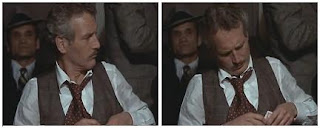
Paul Newman checks his cards in 'The Sting' (1973)Most players are good at protecting their cards, but there are some -- a lot, in fact -- who are not. If you’ve ever played live poker, you’ve probably sat next to someone who can’t seem to keep his or her cards hidden properly. Inexperienced players in particular (whom one encounters quite often at the WSOP) will tend to have trouble keeping their cards covered.

Even so, as a reporter following the action, it is usually a relatively simple matter not to look. Like everything involved with tourney reporting, it takes a bit of training. But after a while it becomes instinctive, and you just don’t look.

Think about it. You see someone’s holding. Then comes the action, and when the player whose cards you’ve seen check-raises big, you know he’s bluffing. Now you, too, better put on your best poker face, not allowing anyone to see by the look in your eyes that someone is trying to pull something here.

As another of my reporter-colleagues noted on Twitter last week, he does “everything humanly possible to avoid” looking at anybody’s cards, because “nothing good comes out of it.” He speaks for me there, and probably for just about every other tourney reporter who has had even a little bit of experience on the floor.

I’m hopeful that since it is presently the case that the great majority of tourney reporters do have ethical standards which include being very careful to avoid influencing action, the cheating that occurred at Partouche does not inspire TDs to reduce reporters’ access going forward. And if the incident perhaps causes those managing events to become more careful about giving out credentials in the future, well, I think that would be a positive development that would in fact decrease any need at present to restrict reporters’ access.

Have to add, though, as intriguing as this PPT story is, I hate that it happened.

Maybe it is because of my experience as a reporter and familiarity with the scene, but when I watched that video of the earlier event -- the one in which it appears cheating is taking place -- I felt a little sick inside. Was like watching some sort of accident caught on tape or something, the kind of thing that fills the viewer with dread. (I can’t even bring myself to show a still or embed it here.)

As Benjo noted, the video doesn’t necessarily prove anything, but knowing what we know about the player and what was judged to have happened in Cannes, it indeed looks “un peu étrange.” More than un peu, actually.

I hate the fact that this incident could cause players to become suspicious of reporters, though would completely understand if it did. But I do believe good will come from it, primarily in the form of greater diligence by all to help ensure the integrity of these events we love to play, cover, and follow.

Labels: , , , ,

Thursday, November 11, 2010

No Cannes Do: On the Disqualification at Partouche (1 of 2)

Partouche Poker TourYou might have heard something about some cheating having occurred during the recently-completed Grand Final of the Partouche Poker Tour in Cannes, and a player who made the final table being disqualified before the tourney’s conclusion as a result. Then again, maybe you didn’t -- the story first broke last Friday (November 5th), and so was understandably eclipsed somewhat over the last few days by the conclusion of the World Series of Poker Main Event.

Needless to say, the story definitely got the attention of those of us who have been involved with reporting on live tournaments. Any form of cheating in professional tournament poker cannot be tolerated, obviously. But here we have an incident which apparently involved a player being aided by faux “reporters” (i.e., accomplices) in order to gain an unfair edge on his opponents. In other words, what happened at PPT not only should affect how poker tourneys are managed going forward, but has the potential to affect the reporting on those tourneys, too.

And -- for those among us who also enjoy a good detective story -- well, this here is the cat’s pajamas.

I wanted to say something about what happened -- in particular to comment on how it has drawn attention to poker reporters’ methods and standards -- though I realized some may not know all of the particulars of the story. Today’s post, then, will provide a summary of that, and tomorrow I’ll come back with a few observations about poker tourney reporting.

To be more specific, what I’d primarily like to do today is share with you what my colleague Benjo wrote last weekend about the cheating that occurred at Partouche. Benjo frequently reports on the European circuit and was there covering the PPT final table last weekend. Thus he has a lot of first-hand knowledge of the details surrounding the disqualification of Ali Tekintamgac, a German player whom I believe has been on the European scene for about a year.

Benjo wrote a long account of the “Affaire Tekintamgac” for Winamax last Saturday in which he reviewed all of the “facts, rumors, and opinions” with which he was familiar. It’s the most comprehensive overview of the incident I’ve seen, made all the more valuable because of Benjo’s own high journalistic standards.

French is actually the one foreign language I have some hope in following. I studied it in the same, non-intensive way most Americans study foreign languages (a few years in high school and college). I also once got to live in France for a year, by the end of which I finally was able to communicate my desires at the Tabac, the pâtisserie, and the TGV station. All of which is to say I can muddle my way through Benjo’s report, the highlights of which I’m sharing here. (Goes without saying, any mistakes in the relating of what Benjo has written are mine.)

The PPT Grand Final was a €8,500 buy-in event that began in September and -- very much like the WSOP Main Event -- played down to a final nine before pausing until November to finish. A total of 764 entered, and Vanessa Selbst continued her fantastic 2010 by winning the event when it was finally concluded last weekend.

On the eve of the final table getting started, it was announced on Friday that Ali Tekintamgac, one of the final nine, had been disqualified for having made it that far through “fraudulent actions.” Eventually it was disclosed that tourney officials had reviewed video recordings of the earlier action and determined that a couple of reporters could be seen viewing Tekintamgac’s opponents’ hole cards, then signaling to Tekintamgac. On his disqualification, ninth-place prize money was then distributed proportionately and added to the top eight spots. Also, I believe that fraud charges are now being pursued against the German player.

WinamaxBenjo begins his article by referring to an incident at the EPT Talinn event in Estonia in which two German reporters were ejected for apparently having been caught peeking at players’ cards, then aiding one or two other players in some fashion by relaying what they’d seen. That was what folks were saying, anyway, although there wasn’t any official announced reason for the reporters’ ejection.

Benjo actually played at EPT Talinn, which took place back in August. He says he’d noticed the two bloggers before they had been ejected. Neither of them were known by other media, and to Benjo they did seem a bit conspicuous, often standing together at a single table. Benjo also says that among the many rumors that were swirling with regard to these two reporters, the name of Tekintamgac kept popping up. Tekintamagac finished 36th in that event.

A couple of weeks later, Tekintamgac was playing in the Partouche Poker Tournament. The two bloggers who had been ejected from Talinn were not present at the Partouche event. (EDIT [added 12:15 p.m.]: Actually, one was present; see Benjo’s comment below.) Tourney officials at the PPT were made aware of what happened at EPT Talinn, however, and so were perhaps therefore more alert to the possibility of an attempt to cheat. As we know, Tekintamgac survived to make the delayed final table at PPT.

A few weeks after that, in October, Benjo read reports of a tournament in Belgium where three more reporters were ejected, and Tekintamgac’s name was mentioned in that article, too. Thus ends what Benjo knew or had heard about prior to the disqualification of Tekintamagac from the PPT last Friday.

In his conversations with other reporters, Benjo learns that allegations of Tekintamgac’s cheating date as far back as EPT San Remo (April), where apparently it was the player himself who was said to have taken the role of reporter, helping out another player. There were also suspicions of his cheating at the Cyprus Poker Classic (August), and reports that he’d been banned from a couple of German casinos for suspected cheating as well.

In other words, there was a lot of suspicion surrounding Tekintamgac for several months prior to his DQ at the PPT, although reporters weren’t wanting to make those suspicions public just yet. In some cases, there wasn’t enough concrete evidence to do so, thus making it imprudent to report anything. Benjo also mentions how some German reporters might’ve been worried about some sort of retaliation from Tekintamagac should they publicize his being a cheater. (Benjo is careful not to insinuate anything here, but rather is just sharing what others had told him.)

Benjo makes reference to Shaun Deeb’s carefully worded post on Two Plus Two from late August in which Deeb noted an incident had occurred at a European event -- he didn’t say which -- and that the media who were involved were ejected for having helped a particular player. Deeb didn’t name names in his post because his primary purpose was to be constructive -- i.e., rather than sensationalize what had happened and get everyone up in arms about the people involved, he just wanted to make sure those who ran tourneys going forward would be more careful about giving out media credentials and watch for this sort of cheating.

Cover your hole cards!Deeb also was warning players to be more aware of their surroundings and to be more careful about protecting their hole cards. One the PPT story broke, Deeb came back into the thread and confirmed that yes, indeed, it was the Talinn incident in which the two reporters were ejected that he was referring to in his original post and that Tekintamgac was the player being helped.

Benjo then refers us to a couple of highly curious items, one of which is a video showing the final hand of the €3,200 WPT Spanish Championship won by Tekintamgac. Benjo directs us to watch the behavior of the media member with the camera standing behind the eventual runner-up, Robert Garcia Santiago, who does appear to be looking at Santiago’s cards, then perhaps even signaling to Tekintamgac.

Benjo is careful to point out that the video doesn’t necessarily constitute evidence of anything untoward. Even so, it is quite eyebrow-raising, given the surrounding context.

The rest of Benjo’s article concerns the possible repercussions of Tekintamgac’s disqualification and the revelation that he used fake “reporters” to cheat, particularly with regard to the functioning of the poker media.

As I said, that’s what I plan to take up tomorrow.

Labels: , , , ,


Older Posts

Copyright © 2006-2021 Hard-Boiled Poker.
All Rights Reserved.