Tuesday, June 28, 2016

That Time I Learned That Jesus Didn’t Love Me

I think any of us who work long enough “in poker” -- as players, staff or tournament organizers, agents, promoters, reporters and “media,” or in other capacities -- end up collecting quite a few stories that we can’t really share, for a variety of reasons.

Some of the stories can’t be told because they involve “sensitive” information never intended to be publicized. Others have to remain hidden because they might endanger a person’s current employment. Still more are kept quiet because they reflect badly on either the one telling the story or others who for whatever reason are judged not to deserve such treatment.

I know over the ten-plus years of this blog I’ve “self-censored” a number of times, although to be honest I wouldn’t suggest any the stories I’ve suppressed were all that scandalous. One of the stories I consciously chose not to tell before I’m gonna share today, as it seems both a little timely and at this far remove fairly innocuous.

My first time covering the World Series of Poker was for PokerNews back in 2008, and as I’ve written about here many times before during those first couple of summers everything seemed especially interesting and exciting thanks largely to the novelty of it all. The interest remained even by the fifth or sixth summer I was there, even if the excitement had waned a bit by then.

Chris Ferguson -- a.k.a. “Jesus” (a nickname I tend not to employ anymore) -- was of course one of the more recognizable “poker celebs” back then. One of the early events I helped cover in 2009 was a $2,500 buy-in pot-limit hold’em/pot-limit Omaha event, and Ferguson played. While at the table he had out his phone and was playing Chinese poker, and I remember writing a live update in which I mentioned this fact.

It was kind of a novel thing back then to see someone on a device playing a different poker game while at the table -- not nearly as ubiquitous as it would soon become -- making for a bit of color worth mentioning amid an otherwise not-so-exciting Day 1. Kind of thing wouldn’t deserve being pointed out even a year later, I’d say, but at that time it was curious enough to include. I seem to recall making a joke in the update about two games not being enough, since the tourney featured PLH and PLO and Ferguson was playing a third game on his phone.

Anyhow, in my next “travel report” post here on the blog, I retold that story and a few others from the day. When referencing Ferguson, I said something about peeking over his shoulder to see him playing Chinese poker, taking a bit of poetic license in the way I described the scene (as though I had captured a little “inside dope”). Truthfully, there was no reason to look all that closely to see what he was playing. In fact, he was talking about the game with Andy Bloch who asked him about it.

In that post I also mentioned an “Approved Electronic Device Rule” the WSOP had in place that year which was not being enforced at all. I explicitly said I didn’t care one way or the other about players being on phones or other devices while playing, but I did note it seemed inconsistent to have a rule that no one heeded and that no one seemed interested in requiring anyone to heed.

There was a short sequel to the story -- this is the part I haven’t told before.

The next day I was back at the Rio where I first heard from a fellow reporter, then from the head of the team something about Ferguson not being happy with my posting about his Chinese poker playing. It was never 100% clear to me whether the objection concerned the live update or my HBP post (it seems like it was the latter, actually), but apparently “Jesus” was concerned enough to have spoken to then-WSOP Commissioner Jeffrey Pollack about it.

This is all very vague in my memory, I’m afraid, but I have a fleeting recollection of Ferguson having said something about how the WSOP shouldn’t allow the reporters to nose around in private business, with there even being some suggestion about credentials being revoked. However severe his objection really was, Ferguson was eventually told whatever he needed to be told, and the matter went no further. Meanwhile I was assured I’d done nothing wrong -- either in the live updates or on my blog -- and not to worry about it.

I also remember being told how Ferguson and I would probably get along quite well -- that we have similar personalities and interests, and seemed like we’d hit it off. Needless to say, I never sought out meeting him to find out if that were true.

I didn’t tell the story at the time partly because I was a little embarrassed by it, even if I shouldn’t have been. As a reporter, I didn’t like being noticed at all, never mind in a negative way. And if given the choice, I would have much rather reported that Ferguson liked me than that he had been made upset by anything I’d done.

I thought about the story again after Ferguson made his inglorious return to the WSOP earlier this month. When asked by PokerNews if he had anything to say regarding his absence since 2010 and/or his feelings regarding what had happened with Full Tilt Poker, he repeatedly responded “I’m just here to play poker.” It was a little like back in ’09, when he didn’t like anyone reporting on his doing anything other than playing in an event.

Ferguson has cashed seven times already this summer, including finishing fourth in an event over the weekend. His appearance at that final table created a bit of a stir, as PokerListings described in detail. He was asked again about whether or not he planned to apologize to the poker community, he responded “What are you talking about? No comment” before walking away.

Howard Lederer has also returned to the WSOP, the prospect of which I wrote about here back in May following his apology (which seemed at the time an unsubtle prelude to his returning). I mentioned in that post how his playing in any events would be a bit like men playing in the ladies event, necessarily producing a lot of unpleasantness and ill will, especially should he be successful. The same obviously goes for Ferguson, and it sounds a lot like that final table scene over the weekend confirmed that prediction.

Of course, while Lederer’s apology caused us to wonder about his sincerity, Ferguson seems unequivocally sincere in his non-avowal of responsibility for what happened at Full Tilt Poker.

No, people aren’t really loving Ferguson very much these days, and his success in WSOP events only seems to be adding still more negativity to a poker community he and others damaged so greatly already. Can’t say I’m that bothered, though, given how I found out long ago “Jesus” didn’t love me.

Image: “Jesus eyes the next table,” Matt Waldron. CC BY 2.0.

Labels: , , , , , , , , ,

Friday, January 03, 2014

Online Poker in the New Year

Been perusing some of the “Top Stories of 2013” lists on the various poker sites, including PokerNews where the reintroduction of online poker in the U.S. claimed the top spot on the list. The only other online poker-related story to make that list was the one concerning the process finally getting started for Americans who played on Full Tilt Poker to petition for the return of their funds (#4).

Of the 10 “most read poker articles” on Pocket Fives during 2013 (presented in two parts: 6-10 and 1-5), none really had to do with online poker.

PokerListings did a list of “The 20 Best Moments in Poker in 2013” (20-16, 15-11, 10-6, 5-1), five of which concerned online poker: “Isildur1 Wins SCOOP $10k Main Event” (#20), “Online Poker Becomes Inclusive to Rec Players” (#13), “Moorman Hits $10m in Career Online Earnings” (#7), “US Full Tilt Poker Player Claims Processed” (#3), and “Online Poker Returns to US” (#1). They also threw in the release of the BET RAISE FOLD documentary (#15), which chronicles online poker’s glory days.

Meanwhile on PL’s list of “The 20 Worst Moments in Poker in 2013” (20-16, 15-11, 10-6, 5-1) six had to do with online poker: “WSOP Fails to Get Online Poker Running by Main Event” (#12), “Delays Continue in Never-Ending durrrr Challenge” (#11), “Full Tilt Poker Remission Process Drags On” (#8), “PokerStars Does Not Get NJ Approval” (#6), “Sheldon Adelson Takes Aim at Poker” (#2), and “Gus Hansen Posts Epic $8.4 Million Loss” (#1).

And of BLUFF’s Top 10 videos of the year (by the great SrslySirius) just one concerned online poker -- a funny satire about the “rogue” U.S. sites presented as a “Shamelessly Honest Online Poker Ad” -- not that the format really lends itself to reports focusing on the online game. Though it does lend itself readily to lots of grins (check all of ‘em out).

(Have to say I’ve yet to listen to the TwoPlusTwo Pokercast’s episode recounting their Top 10 list of poker stories from 2013 -- I’m looking forward to seeing how Mike and Adam constructed their list.)

Glancing at PokerScout’s rankings of online poker traffic here at the start of 2014, PokerStars predictably continues to reign supreme with about eight times the traffic of the nearest competitors with the iPoker network -- which includes sites like William Hill Poker and others -- currently leading the chase pack.

Searching the rankings for U.S.-facing sites, Bodog/Bovada continues to find a place in the upper half of the list (according to PokerScout’s best estimates). But all of the others are unsurprisingly way, way down the page, with traffic in the hundreds (or tens).

I suppose comparing these lists could be said to highlight the American-centric nature of the poker news sites (or at least the ones I tend to visit). In terms of people actually playing online poker, there aren’t too many Americans doing so. Thus stories about online poker have become predictably scarcer on the news sites on which Americans do a lot of the writing and reading. (Indeed, that the return of online poker in the U.S. has topped some lists indicates as much as well.)

That said, it’s interesting also to think about how online poker has moved away from the center of the poker world over the last several years, in particular since Black Friday. I haven’t gone back to see, but I’d wager most “top poker stories” from a few years ago were related to online poker in at least a tangential way, with the online game seemingly affecting just about every aspect of the game not that long ago.

But now online poker is over to the side, big picture-wise. Will be interesting to see if it ever returns to the center, and if so whether that happens sooner or later.

Labels: , , , , , , ,

Thursday, October 17, 2013

The Blessing and the Curse

Woke this morning to watch some of the WSOP Europe live stream on PokerListings, catching most of the final heads-up match of Event No. 3, the €5,300 no-limit hold’em Mixed-Max event in which Darko Stojanovic of France came back to beat Dan O’Brien of the U.S. to win the bracelet.

These live streams are so commonplace now, many of which come on a delay of some sort and feature hole cards. The ability to go back through the program and instantly click back to earlier moments also adds a lot to the experience when following along.

I believe the 2011 PokerStars Caribbean Adventure might have been the first, most prominent experiment with the format, which means we’re going on almost three years’ worth of having it around. One of the first questions that came with the delayed-with-hole-cards format was how it would affect the actual play of tournaments -- that is, when players found out later what their opponents had in hands in which they hadn’t shown, how might they use that additional knowledge going forward?

This Event No. 3 finale this morning presented an interesting moment during O’Brien and Stojanovic’s heads-up battle that brought that issue to the foreground again, a match-changing hand that saw a big bluff succeed.

The “mixed max” format has players carrying stacks forward through the tourney, which meant in this case O’Brien had a healthy 3-to-1 advantage to start the heads-up match with 1,594,000 to Stojanovic’s 507,000.

Stojanovic quickly evened the score, however, after the Parisian turned two pair on just the second hand between them. But a few hands after that O’Brien took back a big chunk to push back out in front, setting up Hand #12 which began with O’Brien at 1,337,000 and Stojanovic with 764,000.

The hand began with a 2x button raise to 20,000 by O’Brien who held Ah5h, then Stojanovic three-bet big to 70,000 with QsJh and O’Brien called.

The flop then came Kd9cAs, giving O’Brien top pair and Stojanovic a gutshot to Broadway. With 142,000 in the middle, Stojanovic led with a huge overbet of 160,000. O’Brien paused at that for a short while, then called, and the pair watch the turn bring a cliché of a “blank card,” the 2c.

This time Stojanovic shoved all in with his last 533,000, and O’Brien took about four minutes before folding.

The live stream commentary was provided by David Tuchman, Max Steinberg, and Jesse Sylvia, and during that lengthy tank Steinberg spoke about how strange Stojanovic’s line was ("That makes no sense") while also developing a convincing argument for why it was very difficult for O’Brien to call, even predicting (correctly) that he would fold.

O’Brien still had the lead after the hand with about 1.1 million while Stojanovic had climbed back to just under 1 million. A few hands more and they were even, then as Stojanovic nudged out into the lead the trio began speculating about what would happen when O’Brien eventually found out about Stojanovic’s bluff.

Steinberg referred to “the blessing and the curse of the 30-minute delay,” something he himself had some experience with after making a couple of final tables during the WSOP this summer. “It’s almost like you don’t want to find out” explained Steinberg with reference to such a hand and the possibility of learning definitively what your opponent had.

About 15 minutes after the hand took place, they explained on the live stream how O’Brien -- in real time -- had spoken to his rail and likely had learned that Stojanovic held Q-J in the most memorable hand of their duel thus far. “He looks sort of down on himself,” speculated Steinberg, and the discussion moved on to consider how (or whether) O’Brien might be affected going forward with the knowledge that had he called the bluff early in the match he very likely would have won the tournament.

The pair would ultimately play 53 hands before Stojanovic won, and so it was probably only for the last dozen or so that O’Brien would have known about the bluff. In truth, it wasn’t obvious on the live stream that he was especially affected by any extra knowledge of the earlier hand, no more so than he might have been by the doubts about it that probably were lingering in his mind anyway. Meanwhile, they were still breaking down the hand right up until the last few hands, with the consensus favoring O’Brien's fold. “It was a good fold with the information he had,” said Steinberg.

I tend to think O’Brien probably felt the same even after getting the additional information. Now I see O’Brien is tweeting that he’s about to jump on the live stream to do some commentary on the Event No. 4 final table and to talk about his match, so I’ll think I’ll jump off here to tune in.

Labels: , , , , , ,

Friday, May 17, 2013

Ambient Noise

Shamus with headphones“Well, I’ve been to one world fair, a picnic, and a rodeo, and that’s the stupidest thing I ever heard come over a set of earphones.” --Major T.J. “King” Kong, Dr. Strangelove

I’ll admit that while I’ve been busy with other things this week, I’ve continued to linger some over that Travis Makar info dump from last Friday regarding the UltimateBet insider cheating scandal, in particular those two lengthy audio files chronicling two meetings involving Russ Hamilton, Dan Friedberg, Sandy Millar, and (on one of them) Greg Pierson.

Been snooping through the files some more, reading various articles and postings, as well as listening to still more audio regarding it all in the form of podcasts.

The most recent episode of the Two Plus Two Pokercast with Haralabos Voulgaris provided some interesting discussion, with Voulgaris providing some interesting tidbits from his experience with UB and some of its principals. However, the lengthy guest spot of Scott “ElevenGrover” Bell mostly had the effect of confusing rather than clarifying (for me, anyway).

I better liked Todd Witteles’s partial breakdown of the recordings on his Poker Fraud Alert show this week. “DanDruff” played clips (mostly from the first part of the first recording) while commenting along the way, which seemed a more constructive exercise.

Finally I heard Witteles’s ex-cohort Bryan Micon’s latest Donk Down show on which appeared both Pokerati’s Dan Michalski and the man in the middle himself, Travis Makar. A mostly maddening hour-and-a-half, I’m afraid, with neither of the hosts having listened to the audio and even Makar saying he wasn’t completely up on what the recordings contained.

Makar expressed a willingness to answer any questions from Micon and Michalski, but neither seemed able to come up with any and thus the show failed to add much of value at all other than to remind us that Makar has still more information (and audio) which may or may not be revealed at a later date.

All of which is to say, the actual significance of the recorded discussions as well as all of the other newly-publicized data obviously remain in need of cogent explanation. And probably will for a good while, I imagine.

I mentioned on Monday how the recordings uncannily recall the Watergate tapes, what with the secretive nature of the recordings being made and the discussants’ talk of covering up previous scandalous behavior while making decisions that will subsequently affect the lives of many others. The ambient noise and interruptions occasionally obfuscating certain exchanges adds further to the similarity.

Every now and then I’ll dig around and listen to those tapes Richard Nixon had made, part of my hobby-like fascination with reading and learning more about the complicated figure. Of course, I almost never do so without also looking a transcript and usually having some sort of additional annotation to help guide me regarding who is saying what and what it all ultimately means.

Given the historical importance of those recordings and the fact that they were made so long ago, it’s easy to locate various aids to understanding that can help make the experience of listening all the more worthwhile. Not to mention even more compelling. (By the way, if you’re curious about the Nixon recordings, the “Nixon Tapes” website is a good place to start.)

* * * * *

Speaking of private meetings conducted during times of crisis, I wrote a new “Pop Poker” column for PokerListings regarding Dr. Strangelove or: How I Learned to Stop Worrying and Love the Bomb, the 1964 darkly-comic satire directed by Stanley Kubrick that is mostly taken up with a U.S. president and his advisors meeting in a “War Room” to discuss and try to deal with the surprise launch of a nuclear attack on the Soviet Union by a deranged general.

The film actually has a couple of significant connections to poker, including the character of Dr. Strangelove (one of three played by Peter Sellars) being partly based on John von Neumann, the Austrian-born mathematician often credited with having written and co-written the works that helped inaugurate the study of modern game theory. Von Neumann wrote about poker in those seminal works, and during the Cold War especially game theory played a particular role when it came to decision-making regarding nuclear weapons.

In fact, as I note at the end of the piece, in Dr. Strangelove the War Room itself features a large circular table around which the president and his advisor sit that was deliberately meant to look like a poker table.

Check out the article, if you’re curious to read more.

Labels: , , , , , , , , , ,

Wednesday, April 24, 2013

More on Mario Puzo

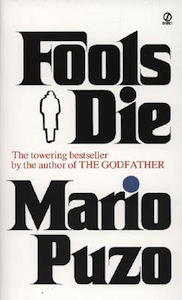
Not long ago I spent some time reading (and rereading) a few titles by Mario Puzo, the author of The Godfather (1969). One consequence was a new Pop Poker piece over at PokerListings that just went up yesterday that focuses primarily on Puzo’s most famous novel and some of the reasons for its appeal to poker players.

Once upon a time while a graduate student I served as a teaching assistant for an especially interesting class titled “American Bestsellers and Their Movies.” We read bestselling American novels going all of the way back to the early 19th century then watched film adaptations, and I got to lead a discussion section and even lecture some. Among the titles we covered were James Fenimore Cooper’s The Last of the Mohicans, Harriet Beecher Stowe’s Uncle Tom’s Cabin, Grace Metalious’s Peyton Place, John Grisham’s The Firm, and a few others, including The Godfather.

It was a fun course to take and to teach, insofar as the novels helped shed a lot of light on American culture thanks to their status as bestsellers, and the films also gave us many ways to explore narrative and the various methods of telling stories. I found it all fascinating, and ended up trying to employ some of the ideas I gathered regarding plot construction and the creation of commercial art when I came to write my novel, Same Difference, which has yet to reach bestseller status or be adapted into film, but I remain patient on both fronts.

Of all the films we watched in the course, The Godfather was easily the most accomplished and probably the only clear cut example of a film representing a greater artistic achievement than the book on which it was based. I always appreciated Puzo’s novel, though, as extremely effective in its plotting and filled with memorable characters and scenes.

There are a couple of needless digressions and other indulgences in the book (all dealt with smartly by the film, actually), as well as other small issues I complained about here and there in the margins of my copy. But overall the book is definitely a triumph of commercial writing and the influential place occupied by the Corleone family in American culture cannot be questioned.

Anyhow, the main reason why I ended up going back and rereading The Godfather was because not long ago I’d picked up a copy of his 1977 nonfiction book Inside Las Vegas. Kind of curious, actually, to think about how Puzo chose not to start churning out sequels to his blockbuster -- and one of the bestselling novels in history -- and instead make his next published title a kind of “coffee table” book in which he explored his fascination with gambling, casino culture, and that adult playground known as Sin City.

Of course, Puzo did stick pretty closely to The Godfather over the next several years, with the breakthrough success of the book profoundly altering his writing career. Soon he’d move from Manhattan to Hollywood where he’d work in an office at Paramount as he assisted director Francis Ford Coppola with the screenplays for both the 1972 adaptation and the 1974 sequel, the latter of which extended the story beyond the scope of the original novel.

From there Puzo then became involved with screenplay writing for other films as well, including co-scripting the first two Superman films. In fact, it would be nearly a decade before Puzo would publish his next novel, Fools Die, which is in fact partly set in Las Vegas.

I ended up writing a lot of additional material about both Inside Las Vegas and Fools Die for the Pop Poker piece, although in the end we decided just to stick with a discussion of The Godfather over there. Meanwhile, for those who are curious, I thought I’d share some thoughts about the latter two books here today.

Going Inside Las Vegas

As I say above, Inside Las Vegas is really a “coffee table” book filled with hundreds of color and black-and-white photographs taken in and around the casinos of Las Vegas from during the mid-1970s. Interspersed along the way are chapter-length essays by Puzo which detail the history of gambling, offer some behind-the-scenes stuff about Vegas casinos and how they run, and also occasionally explore humans’ seemingly innate need to take risks.

The book also contains some highly personal anecdotes about Puzo himself, revealing him to have followed the footsteps of one of his favorite writers, Fyodor Dostoevsky, to become a problem gambler. He even admits in the introduction that he was likely chosen to write the book “because I have the reputation as a degenerate gambler.”

The stories he tells about himself confirm this reputation, showing that he lost so much gambling he basically had reached a point at which he was forced to swear off it altogether. Having become immensely rich from The Godfather book and films, he realizes that ironically he could no longer afford to gamble now that he possesses real wealth.

“Now for the first time in my life, making more money than I have ever made in my life... now I have too much to lose,” he admits.

Like The Godfather, Inside Las Vegas defends gambling as a “natural” vice, “one of the primary drives of mankind.” But Puzo also recognizes its destructiveness, and characterizes the casino games of Las Vegas as eminently unbeatable. “Sure, you may win on some trips,” writes Puzo. “But eventually you will get wiped out.”

Poker was not nearly as popular in the 1970s as it has since become, so it is not surprising to read of Puzo playing nearly every other game in the casino except poker. Thus does he repeatedly succumb to the house’s percentage edge, coming away with the conclusion that while Vegas is great fun, one can only (ultimately) lose while there.

The book provides a subjective, loosely organized study of Las Vegas of the era, with Puzo’s anecdotes populated by a large collection of character sketches of casino managers, pit bosses, floorwalkers, boxmen, stickmen, croupiers, dealers, shills, hosts, junket masters, collectors, and call girls.

I’d recommend it without qualification for the photos alone, but the essays by Puzo add further insight and are quite diverting for those of us with an interest in gambling, casinos, Las Vegas, and/or the 1970s.

People gamble... and Fools Die

At last in 1978, Puzo’s next novel Fools Die would appear, which like The Godfather is a sprawling story with a large cast of characters whose stories intertwine over the course of a couple of decades and five hundred-plus pages.

There’s more sex and less violence in Fools Die than in Puzo’s previous novel, although the overall tone is similarly dark. And this time Puzo more directly explores the culture of gambling, beginning and ending his novel amid the adult-themed excesses of the Las Vegas that captivated him so.

Some of the anecdotes and characters from Inside Las Vegas find their way into Fools Die, with the story focusing initially on a group of gamblers thrown together in Las Vegas, then separating as the story narrows to concentrate upon one of them -- Merlyn -- whose life most obviously parallels Puzo’s own.

Like Puzo, Merlyn is a novelist who eventually writes a best-seller before getting involved in movie-making. He’s also a losing gambler, although avoids the debilitating losses Puzo experienced. Again, poker isn’t really given much prominence in the book, although the baccarat games are sometimes described in terms that resemble the dynamics of a poker table.

While not as carefully plotted as The Godfather and even somewhat experimental in places -- including frequent shifts between first- and third-person narration -- the book offers much of interest to gamblers and poker players. There are numerous quotable lines about gambling throughout, too, including one frequently delivered by the casino owner Gronevelt who wields Don Corleone-like power over his casino, Xanadu, and beyond.

“You have to get rich in the dark,” Gronevelt says, the point being that like was the case with the Corleones in The Godfather, he’s determined it best to operate outside of externally-imposed “systems” if one hopes to get ahead.

I was fairly energized by the first third or so of Fools Die, but to be honest found myself less and less enthused by the latter chapters. Those indulgences and digressions I mentioned popping up in The Godfather happen again in this novel, and while I did find some of them interesting after a while they caused me to become less engaged and not terribly motivated to discover the ultimate fates of Merlyn and the other characters.

There’s a ton of stuff about Hollywood culture and its artist-killing influence, and in fact at times the novel seems to read like a roman à clef-type exposé of particular figures as well as the general corruption of the studio system. And while the introduction of a Norman Mailer-like character, Osano, sparks interest about halfway through, he -- like Mailer -- gets tedious after while.

All of which is to say while I certainly recommend Inside Las Vegas -- especially to readers of this blog -- I’m a little less quick to do so with Fools Die. I’ve yet to explore too much else from Puzo, although I know he’d return again to the topic of Las Vegas in The Last Don, the last of his novels to be published prior to his death in 1999, the story of which explicitly examines mob ties to the origins and growth of Vegas casinos.

For those who have read this far, thanks for permitting me to be like Puzo and indulge in these digressions from that Pop Poker piece. And if you’ve read any of these books (or other titles by Puzo), I’d be curious to hear your thoughts about him, too.

Labels: , , , , , ,

Tuesday, March 05, 2013

Murder in the Cards on CSI

For a while I’ve been planning to create a special “Poker and Pop Culture” page here on Hard-Boiled Poker that will link to the various columns I’ve written under that heading both here and elsewhere, getting them all in one place for easy access.

As I start to get that page together I now have a new entry to include, a write-up of last week’s poker-themed episode of CSI: Crime Scene Investigation that appeared on CBS. I wrote about the show for my “Pop Poker” column on PokerListings, and the article appeared yesterday as “CSI Features Poker Serial Killer (and Tom Schneider).”

I’d known that CSI had an episode involving poker coming up for a few weeks now, having spotted a couple of reports highlighting David Cassidy’s upcoming guest spot on the show as an aging poker champ. As it turned out, Cassidy’s turn was mighty brief as his character gets offed in somewhat gruesome fashion even before the opening credits roll.

I had no idea my buddy (and 2007 WSOP Player of the Year) Tom Schneider was to appear on the episode as well until just a couple of days before it aired. Schneider happened to know the show’s producer who called him up a couple of months back asking about getting a consultant to help them with poker-related details. One thing led to another, and Tom ended up getting recruited to play a poker dealer -- a non-speaking role, but his character in fact is significantly involved in the episode’s twisted plot.

Read the article to learn more about how Schneider got involved in the show and a little more about the premise and story. I purposely avoided getting too detailed with explaining the episode’s plot or revealing any spoilers, since I know folks reading the article might not have seen it and might be curious to do so. I didn’t even get into talking about the two hands of poker that get highlighted in the episode, including the one from the final table of the 1997 Palermo Poker Classic (meant to resemble the WSOP Main Event) that ultimately sets what turns out to be a long-delayed revenge plot into motion.

In that hand a player flops a set of aces, then Cassidy’s character makes runner-runner quads with his pocket kings to win the hand. Here and elsewhere, the script writer, Gavin Harris, throws in a few details that poker players might find distracting as either improbable or not really accurate as far as an individual hand or the playing of a tournament goes. But he does ultimately figure out a whacked-out way to build a whole serial-killer plot out of the playing of a single hand of hold’em, with individual cards providing inspiration for various murderous methods (and in one case, the weapon itself!).

Reading around today, I am seeing how a tennis-themed episode from January featured a tennis racket as a weapon, with Chris Evert, Lindsay Davenport, and Justin Gimelstob among that show’s guest stars. Looks like that show also features some knowing references to the world of professional tennis, not unlike some of what happens with regard to poker and the WSOP in this latest episode, the title of which in fact comes straight from tournament poker, “Last Woman Standing.”

At the end of the PokerListings piece I make a couple of disclaimers about the episode, one of which is to acknowledge that you’ll need to be able to suspend your disbelief a bit to enjoy it. The other is to warn the squeamish about the gore, which frankly amazed me. (I’m thinking of one scene in particular -- anyone who sees the show will know which one.)

I hadn’t really watched CSI much since it first began airing over a decade ago. So while I was aware of general complaints about the show (and prime time graphic violence, broadly speaking) I had no idea how far the standard had moved for what is allowed these days over network teevee.

Some of my academic writing has been about film, including a new article in the latest issue of Paracinema which I mentioned here back in January. Some time ago I found myself focusing on horror films for a while and among the pieces I published were a couple about Halloween III and The Stepfather -- two ’80s horror entries that get grouped with other “slashers” of the day. (If you’re curious about those old articles of mine, click the film titles to read posts over on FilmChaw where I talk a little more about each.) But even with that background, I was still surprised a little by last week’s CSI.

Anyhow, with those warnings having been made, I’ll echo what I say at the end of the PL piece and say that poker players might well find the episode interesting -- and perhaps somewhat different from the usual ways poker tends to pop up in mainstream popular culture.

Labels: , , , ,

Wednesday, December 19, 2012

Holden On...

As I was mentioning over the last few days, the accommodations at the Sands Casino Resort in Bethlehem, Pennsylvania were quite nice and overall the trip was a fun one. I didn’t really get to see the city so much while I was there -- indeed, I remained indoors the entire visit. But the driver of the cab I hired to take me back to the Allentown airport was generous enough to take me around the city for a quick tour of the old steel factories and the bustling downtown area on the way out, and I could see returning to the area for a vacation one day.

Even so, as nice as things were at the Sands, it was even better to wake up in my own bed this morning. And to think that I’ll be mostly sticking close to home here over the next few weeks with a few short trips to see family over the holidays mixed in along the way.

Been so busy over the last couple of weeks I didn’t get a chance to pass along that I recently had the pleasure of interviewing Anthony Holden, the great poker writer (and scholar of literature, opera, and other subjects) and current president of the International Federation of Poker.

The interview went up over on PokerListings just a few days ago, and in it Holden talks about the IFP and its mission, as well as about his favorite poker writers and poker in film.

I’ve been a Holden fan for quite some time, and like many include his 1990 title Big Deal on the short list of “must read” poker narratives. I have assigned excerpts from the book in my “Poker in American Film and Culture” class, including his discussion of the final hand in The Cincinnati Kid which I have students read after they watch the film.

In the interview I invited Holden to talk about his favorite poker movies and poker writers/books, as well as to discuss the IFP and what it is all about. For more you can check out the IFP website that includes all sorts of info regarding the organization’s mission, publications, events, and more. Started in 2009, the organization not only serves as a kind of central hub that connects 44 different member nations on four continents, but it also provides an important voice in the effort to highlight poker’s skill component.

Anyhow, go check out the PokerListings interview for more from Holden. And if somehow you’re a fan of high-level poker writing and haven’t checked out Big Deal before, go get yourself an early Christmas present, why dontcha? That title chronicles Holden’s year-long adventure taking a shot at playing poker professionally, offering a fascinating glimpse of the poker world circa late-1980s plus a comprehensive discussion of both the psychology of the game and its rich history.

Holden’s other poker-related titles are worth checking out as well. His post-boom follow-up Bigger Deal (2007) I wrote about here when it first appeared, and I reviewed his strategy book Holden On Hold’em for PokerNews when it came out a year later.

Labels: , , , ,

Tuesday, November 20, 2012

Poker! That starts with P, and that rhymes with T, and that stands for Trouble!

Been back for a week from Macau, and I’m repeatedly encountering people responding to stories of my trip with references to the new James Bond film Skyfall. Apparently there’s a sequence set in Macau, including a visit to a place called the Dragon Casino (?). I will have to investigate in short order, which shouldn’t be hard to do as Vera has already been indicating she wants to see the flick.

I’m not a huge Bond buff, although like everyone I’ve seen and enjoyed a lot of the films over the years. We did catch Casino Royale in the theaters several years ago, and in fact I wrote up a “poker review” at the time as that film -- released at the height of the poker boom in 2006 -- featured several scenes of our hero playing high-stakes hold’em.

At the time we all remarked on poker surfacing in the mainstream so prominently, although to be honest that was a period when poker was simply everywhere. Such is not so much the case anymore, which is why an episode of The Simpsons from a week ago featuring a subplot in which little Lisa plays online poker stood out as something a little different.

I wrote a “Pop Poker” piece for PokerListings about The Simpsons episode, if you’re curious for more about it. One point I made there was to say that the show’s presentation of online poker was essentially no different than it might have been back during the “boom” -- that is, before the Unlawful Internet Enforcement Act of 2006 and Black Friday and everything else that has significantly altered online poker in the U.S.

Indeed, the Simpsons episode essentially ignores the current reality of online poker altogether, proceeding as though Black Friday never even happened. (In truth, I wouldn’t be surprised if the idea for the story had been hatched before Black Friday -- perhaps several years ago -- and only now found its way into an episode.)

Anyhow, check out that discussion of the show on PokerListings and let me know what you think.

Speaking of mainstream references to poker, there was another one recently when former NBA star Jalen Rose, now a commentator on ESPN, offered some candid thoughts about pro players’ poker playing in a clip appearing over on the Grantland channel. Here is that clip:


Referring to the plane rides between games, Rose speaks of the popularity of poker as a pastime among many players, with the amounts changing hands sometimes climbing up to the $10K-$20K range. Rose weirdly insists on the games’ legality as he justifies them, while also pointing to the way they satisfy players’ competitive desires.

He also explains the reason why players play with chips rather than money on the planes, settling their debts afterwards. “The reason why you bring poker chips,” he explains, “is that coaches and general managers and sometimes... the owners [are] on the plane.... [Therefore, you] don’t want to see guys passing around hundreds and thousands of dollars. It’s just not good etiquette.”

In other words, as much as Rose defends the players’ gambling, there’s still a kind of “underground” element to the games insofar as the true significance of the money being exchanged is in need of being suppressed. If they aren’t doing anything wrong, why bother with such “etiquette”?

Like with The Simpsons episode, I wouldn’t say poker is necessarily being promoted by Rose’s mention of it. In fact both instances seem to reinforce ideas of the game’s “outlaw” status, which is how the game is usually treated whenever it surfaces in the mainstream.

Of course, there was that time, just a few years ago -- say, when Casino Royale was in the theaters back in ’06 -- when it wasn’t automatically the case that poker was considered to be like pool in that song from The Music Man....

You know, starting with P. Which rhymes with T. And which stands for Trouble!

Labels: , , , , , , , ,

Friday, October 05, 2012

“We’re not talking now about a poker game” (Kennedy & Nixon)

Was pulling together a new “Pop Poker” column for PokerListings this week regarding presidential debates and how they so readily get compared to heads-up poker matches. The piece went up yesterday, if you’re curious.

I’m old enough to be awestruck by how quickly and simply we can access information these days. That is to say, I remember how much effort and energy it would have taken to research and write even a casual piece about the history of presidential debates without the ease afforded by today’s internet.

With just a few keystrokes we can search full transcripts of every debate there ever was (since 1960, anyway, when they began to be televised). Heck, we can watch most of them, too.

Anyhow, as I say, I was digging through various items this week and found myself distracted for a while reading some speeches and other material related to the 1960 presidential campaign, the one that ultimately pitted John F. Kennedy versus Richard Nixon.

Nixon we all know was a serious poker player prior to embarking on his political career. The story of him winning significant sums while serving in the Navy and in fact funding his first Congressional campaign with his winnings has been told many times over. And while Nixon often tried to downplay his poker-playing experience and ability once he assumed public office, he nonetheless made references to poker constantly in speeches and communications before, during, and after his presidency.

Anyhow, when looking at some of the speeches Kennedy and Nixon were delivering during the final weeks leading up to the 1960 election, I noticed curious bit of back-and-forthing in which both candidates brought up poker, albeit metaphorically.

The first reference came from Kennedy in a relatively short speech delivered at the Sheraton Hotel in Washington, DC about a week before that first debate in late September. In that speech Kennedy mostly addressed foreign policy and the Communist threat, with just a few quick words about the economy coming in near the end.

Regarding the former, Kennedy argued that “the next President must promptly send to the Congress a special message requesting the funds and the authority necessary to give us a nuclear capacity second to none, making us invulnerable to any attack.... Only then can we get Mr. Khrushchev and the Chinese Communists to talk about disarmament, because having the second best defensive hand in the 1960s will be like having the second best poker hand.”

Six days later Kennedy and Nixon had that first debate in Chicago, the one in which Nixon’s “five o’clock shadow” is said by many to have doomed him. No poker metaphors were employed that night.

About a week after that (and before the second debate), Nixon gave a speech in early October in Elizabeth, New Jersey in which he touched on several points, including what he viewed as differences between himself and his opponent.

After bringing up Kennedy and another speech he’d recently made, Nixon stepped back and kind of self-reflexively tried to characterize the whole process of candidates going out and trying to convince voters in this fashion.

“You know, it’s the custom when presidential candidates travel through a country, a custom which is often cartooned about and editorialized about and written about a great deal, to see who can outpromise the other,” said Nixon.

“One fellow comes in and says, ‘I promise you this,’ and the next one comes in and says ‘I raise you,’ and the third one comes in and says ‘I call you.’ But whatever the case may be, we’re not talking now about a poker game. We’re talking about what’s best for the country.”

Nixon isn’t specifically referring to Kennedy’s use of a poker analogy to characterize the Cold War arms race, although given the close proximity of the speeches it feels like Nixon is perhaps trying to suggest that there’s something unsavory about comparing nuclear conflict to a card game.

I’m reading between the lines, of course. And as I say, Nixon himself so often references poker himself when making various points it becomes all the more curious to see him sound as though he might be trying to criticize doing so.

Anyhow, that was just one of several items I found myself lingering over this week. I’m starting to think it could be fun to pull together a short monograph about Nixon and poker, telling the story of his poker playing and compiling all of his references to the game.

Such a fascinating, complicated, and wildly-flawed figure was Nixon -- and so comprehensively chronicled, too. (I wonder, for instance, how many times poker came up during those 3,700 hours’ worth of tapes?)

Labels: , , , ,

Tuesday, August 21, 2012

The “Very American” Story of Online Poker

U$AI mentioned yesterday how I’d started my class once again, that American Studies course called “Poker in American Film and Culture.” I’ve taught it several times now, and each semester am adding certain readings, moving others off the “required” list and onto a “recommend” one. I’ve also been gradually accumulating more and more examples of poker in film, showing different clips in class along the way to emphasize various topics we cover.

One scene I know I’ll be showing at some point this time around is from the 1968 film The Odd Couple which I just wrote about in a new “Pop Poker” piece for PokerListings.

I also noted in yesterday’s post how we begin the semester reading an excerpt from Poker: Bets, Bluffs and Bad Beats by Al Alvarez, taken from the first chapter titled “The American Game.” It is a neat way to kick off the whole discussion or “argument” of the course that poker is distinctly “American” and thus worth studying as a way to learn more about American history and culture. Reading the excerpt also introduces Alvarez to the students, whom we’ll read again later on when we pick up The Biggest Game in Town.

By talking about the syllabus, reading that Alvarez excerpt, and then soon after starting James McManus’ Cowboys Full (from which we’ll read a lot during the first few weeks), we quickly gather lots of examples of so-called “American” values or ideals. Thus do we focus a lot at the start on ideas and concepts like freedom, liberty, equality, democracy, capitalism, self-reliance, the “frontier spirit,” the “American dream,” the importance of being rewarded for one’s work, and the inclination to take risks and gamble. And how poker could be regarded as a game that neatly reflects or is shaped by all of these ideas and concepts.

Of course, when we use the adjective “American” in class we do it in the context of academic inquiry, not jingoistic sloganeering. That is to say, it is understood that while there is much that is great about the U.S., not everything that is “American” is automatically “good.” There are a lot of things about the country and American culture that aren’t necessarily admirable, and some of those less than admirable characteristics also find their way into poker.

Speaking of The Odd Couple, Alvarez includes in his chapter that great Walter Matthau quote about how “the game exemplifies the worst aspects of capitalism that have made our country so great.” The quote points out in an humorous way how there are both positive and negative aspects to the game and the country.

I found myself thinking further about referring to something as “American” as a kind of uncritical defense when I heard Ben Mezrich, author of Bringing Down the House (about the MIT blackjack team) and The Accidental Billionaires (about Mark Zuckerberg and Facebook), talking on CNBC about his plans to write “a big new book for next summer” that appears to cover the rise and fall of Absolute Poker. Mezrich appeared on the panel show Squawk Box as a guest host, and while there was given a chance to talk about his own writings, past and future.

Ben Mezrich on CNBC's 'Squawk Box'Mezrich enthusiastically characterized the story as being “about a bunch of college kids who launched the online poker world out of a dorm room essentially” -- kind of a nutty, highly misleading thing to say about the AP guys who hardly “launched” online poker, having come into it years after its beginnings.

Mezrich continued, revealing he has a strange take on the story’s principals, too. “They’re brilliant kids who built an empire in a way, and now they’re being persecuted, hiding in Antigua or whatever, and because they did something to me that was very American,” said Mezrich. “It’s an intersection of 21 and The Social Network,” he added, alluding to film adaptations of his two best-known books.

The misleading here becomes more grievous, I’m afraid. Those “brilliant kids” now being unjustly “persecuted” are the same ones who were involved in the original superuser scandals and subsequent cover-ups, the bilking of millions from investors, various forms of bank and wire fraud, violating the UIGEA, and the failure to return player funds following Black Friday.

Hardly heroes, in other words, although it sounds like Mezrich might be angling towards shaping them into such with his version of the story. See Haley Hintze’s response to Mezrich’s weird take here, as well as this article on PokerFuse that notes how Mezrich may himself in fact have ties to the AP “frat boys” that might be influencing both his decision to write about them and how he’s approaching the task.

Mezrich describes AP’s founders as having done something “very American,” a superficial defense of the entrepreneurial urge that motivated them to build their “empire.” But clearly there was an abundance of unchecked greed there, too, perhaps also an “American” trait though here pursued to the point of abandoning morality and engaging in criminal behavior damaging to many, many others.

Mezrich certainly seems to be glossing over (or missing altogether) some obvious points in the story in this early, abridged pitch of his book. We’ll see where Mezrich goes with his project, which obviously could change. After all, as the Absolute Poker frat boys well demonstrated, things don’t always go as originally planned.

I will give him this much, though -- there is perhaps something “very American” about the story of online poker’s rise and fall in the U.S., as well as the stories of some of the more nefarious characters in that narrative.

I think when I use the phrase my meaning is a little different, though.

Labels: , , , , , , , ,

Tuesday, June 26, 2012

2012 WSOP, Day 30: Attempts at Time Travel at the WSOP

Attempts at Time Travel at the WSOPI’m not a huge science fiction fan, although I have a few favorite authors and novels. In grad school once I had the opportunity to help teach a history of SF class, and so became acquainted with some of the periods and subgenres like the early adventure/pulp stuff and the “space westerns,” “hard” and “soft” SF, alternate history SF, the variety focusing on satire/social commentary, cyberpunk, and so on.

Time travel stories represent another category of SF that always intrigued me, especially those stories that used the conceit of traveling through time to explore ideas about what might be natural to us as humans and what is learned behavior or thinking. You know, stories that use time travel to show how particular cultures shape us into being and acting a certain way, with the move to the past or future forcing characters to question assumptions about themselves or each other. (See Mark Twain’s A Connecticut Yankee in King Arthur’s Court.)

You could say any attempt to write factually about something that has happened in the past is a little like traveling through time. Even writing up a hand report at a poker tournament involves imagining for a moment what you experienced a few minutes before.

In that case there are usually certain tangible facts that overwhelm the story and its significance, namely, the cards that were dealt, the bets that were made, and the ultimate impact of the hand on the tournament as a whole. Other elements might be worth including, too, as part of the effort to give a reader a sense of what it was like to have been there, standing nearby, watching what happened. But at the heart of it is an attempt to go back, to relive.

Last night I was helping cover Event No. 44, a $1,000 no-limit hold’em event in one corner of the Amazon. Meanwhile, across the spacious ballroom on the other side of the science-fiction-y “mothership,” there arose a complicated situation in Event No. 45, the $50,000 Poker Players Championship, surrounding a controversial pot-limit Omaha hand primarily involving Nikolai Yakovenko, Shaun Deeb, and Abe Mosseri. You’ve probably already heard something about this one, which came up last night right at the end of Day 2 of that five-day event.

Donnie Peters wrote up a detailed report of what happened (in two parts) for the PokerNews blog. In the first part, Donnie explains the complicated preflop betting that saw four players limp in, the small blind complete, then the big blind raise and the first three limpers call. Deeb then reraised with the rest of his chips from the button -- he had less than the amount needed to make a pot-sized raise, so he was all in. It folded to Yakovenko in the big blind who reraised over the top of Deeb’s raise, and only Mosseri called (after an especially long time in the tank).

The hands were tabled and the community cards dealt with Deeb winning the main pot and Mosseri the side pot. Then arose the real controversy over Yakovenko’s reraise over Deeb’s raise. According to Donnie, he’d said he was “all in” although he could only reraise the size of the pot. Which suggests he wasn’t really all in. And which also suggests Mosseri’s call wasn’t for all of his chips either (Yakovenko had Mosseri covered by a little), but for just whatever amounted to a pot-sized reraise. This despite the fact the players had played the hand as if it were an all-in shove and call.

At issue, then, was the side pot and how much Yakovenko really owed Mosseri after the hand. But the floor came over and apparently initially ruled that since Mosseri had only technically called a pot-sized reraise preflop, there should have been a betting round after the flop (there hadn’t been -- the five community cards were dealt out without any chances for post-flop betting), and thus “the turn and river would have to be rerun as the flop action hadn't been complete,” as Donnie reports.

Time-Travel HandIn other words, it appeared as though they were going to try to go back in time (so to speak) to deal the turn and river anew, this time giving Yakovenko and Mosseri an opportunity to bet, raise, or fold. Such a ruling also meant Deeb was no longer safe. He’d survived the hand by flopping a set of jacks, then rivering a flush to beat Mosseri’s A-A-x-x and Yakovenko’s K-K-x-x. (I like how PN photographer Joe Giron used the fish-eye on that pic, adding a bit further to the weirdness of it all.)

See Donnie’s post for all of the specifics. He uses that initial ruling -- and Deeb’s understandably incredulous response -- as a cliffhanger moment, then comes back with the second part of the story in which the ruling gets overturned. There would be no redealing of the turn and river, after all. Also, Yakovenko was made to pay off Mosseri as though it had been an all-in situation even though Yakovenko couldn’t have raised all in, because that was essentially how the players had played the hand. (Sounds like a correct ruling.)

By the way, B.J. Nemeth additionally reported the hand for PokerListings. And both Donnie and B.J. did especially well, I thought, relating what happened clearly and thoroughly.

The controversy then continued when Yakovenko (crippled in the big hand) busted shortly thereafter and Phil Ivey was moved to the table to fill the empty seat. Because Mosseri had tanked for so long (possibly as much as 15 minutes, according to Donnie) and the subsequent efforts to get a ruling on the hand took a lot more time, players were unhappy they’d missed most of the last level of the night while other tables played on.

They’d already reached the point where it had been announced the clock would be stopped and only four more hands would be played. That’s when the table apparently proposed playing the last four hands of the night with Ivey, then have Ivey leave the table and allow them to play 15-20 more minutes to make up for hands lost before.

Ali Eslami explained it all to Donnie, using what I consider the line of the night to explain the players’ thinking. It would be like "going back in time to fill the space," Eslami told Donnie. The floor wasn’t going for that, though, and after four hands with Ivey the day was done.

Love that line. Probably a very good thing they weren’t allowed to go back in time to fill the space. All of us in the Amazon Room might have gotten swept up into a black hole or something, jettisoned out into a different dimension entirely.

Man, it would’ve taken forever to get a decent ruling if something like that had happened.

In the end, then, there were a couple of moments in the story where people had seriously entertained the idea of “going back in time” to redo things. In the first, the floor actually ruled they’d be redealing a turn and river in the big hand, then changed their minds. In the second, it was the players coming up with the idea of going back and reliving a section of Level 10, but that plan didn’t materialize either.

Not that you really can go back in time. Not really. Still, the desire to do so more or less possesses us so frequently. Happens constantly in poker tournaments. And in poker tournament reporting, too.

Probably says something about human nature, this desire we have always to go back and “get it right” or at least do things differently.

But no, the present is where we must remain, spending much of our time thinking about what has happened. And what might have been.

Labels: , , , , ,

Tuesday, May 01, 2012

Talkin’ Titanic

Titanic playing cardsAnother new “Pop Poker” column is up at PokerListings, this one looking at a few connections between poker and the Titanic, including the 1997 film, the actual doomed voyage of the White Star liner, and efforts to locate the wrecked ship.

The 100th anniversary of the tragedy and all of the recent stories commemorating that inspired the idea for the column. At first I thought I’d focus solely on the film which does feature a short poker scene early on. (A new 3-D version of the movie is now playing in theaters.) If you’re among the many who’ve seen Titanic, you’ll remember Jack Dawson wins his third-class ticket to ride in a poker game.

There are a couple of references back to the game in the film as well, although no more poker scenes. As I say in the PokerListings post, the game does introduce in rapid manner what is an obvious theme in the film, namely the way luck governs our fates. And it kind of helps introduce Jack’s character, too, as this carefree wanderer-type willing to go wherever chance takes him. That’s needed, since despite the three-hour-plus running time of the film there’s an amazing lack of back story or filling in of character in Titanic.

There’s one small reference to poker that comes up later in the film that I did not mention in the post, a poker metaphor used by Ruth DeWitt Bukater, Rose’s mother, when referring to her desire that Rose forget about this Jack character she’s just met and follow the plan to marry the detestable yet rich Cal Hockley.

The reference represents pretty much all the back story we get regarding the Rose-Cal match, with her widowed mother explaining that when Mr. Bukater died he left a mountain of debt, although the family name still had enough cachet to attract upper-class types like the Hockleys.

“That name is the only card we have to play,” Mrs. Bukater tells her daughter. “It is a fine match with Hockley. It will ensure our survival.”

Doesn’t really seem all that meaningful a use of poker talk -- that is, the line doesn’t necessarily strike me as intending some sort of allusion back to Jack’s poker game, although I suppose one could pursue that argument. Besides, I had too much else I wanted to share in the column from my “expedition” (so to speak) searching for other poker-Titanic connections. If you’re curious, check it out. Take a look, also, at the second half of this post by the Poker Grump in which he helps confirm that yes, indeed, there was poker played aboard the ship during its sole, doomed voyage.

The French movie poster for 'Titanic' (1997)When Titanic came out, Vera Valmore and I were living in Lille, France. We spent a year there where she taught at the university and I pretended to work on my dissertation. There was a movie theater right in the middle of city where we sometimes went. Seemed like they almost always had mostly American films running and I remember Titanic playing for a long time.

We weren’t really too interested in seeing U.S. films during our year there, although I do remember going to see Le grand Lebowski right before we returned. So we didn’t go see Titanic, although we did stay up late one night to watch a broadcast of the Academy Awards where it seemingly won everything.

I didn’t get around to watching it until much, much later, and Vera still hasn’t seen it. I think I was put off largely because the movie just seemed like another big, sprawling example of American excess, an impression made even deeper by my walking by the big poster on the marquee in the middle of the rue de Béthune for so many weeks.

Titanic is certainly lacking in a number of ways, but it’s pretty compelling, too, in the way it combines the romance and disaster stories. And as a commercial product designed to appeal to the widest possible audience, it’s kind of a marvel.

That said, I’m still not interested in seeing Avatar. Maybe I will be in a decade or so. There’s not any poker in that, is there?

Labels: , ,

Wednesday, April 04, 2012

Pop Poker

Shamus Goes PopI’ve mentioned from time to time various columns and other poker-related writings I’ve done elsewhere. Some time ago I had the chance to write a “Poker & Pop Culture” column at PokerNews, although that ended a while back. Got to explore in depth all sorts of fun topics like Mark Twain, W.C. Fields, the “Dogs Playing Poker” paintings, Star Trek: The Next Generation, and so on.

I thought briefly of trying to revive the idea at Betfair Poker, writing a single post over there about the Thanatopsis Pleasure and Inside Straight Club, a group of poker players who were part of that Algonquin Round Table during the 1920s.

However, I only ended up doing the one “Poker & Pop Culture” post over at Betfair. Here on Hard-Boiled Poker I published a post in the fall of 2010 listing and linking to all of the different pop culture pieces I had written up to then.

Then last summer I had the opportunity to revive the idea once again with that “Community Cards” column I did for the Epic Poker blog. Had about a six-month run there before the EPL ran into its difficulties a little over a month ago. Was able to explore a lot of other examples of poker popping up in unusual places, like television shows, movies, sports, and other “mainstream” areas of the culture.

M*A*S*H (1972-1983)I’m glad to share that like a free agent roaming from team to team, the idea has found a new home over at PokerListings where I’ve begun a “Pop Poker” column. Yesterday PL posted a piece exploring poker on the television show M*A*S*H which was a lot of fun to pull together. Those who remember the often-clever comedy set against the backdrop of the Korean War might get a kick out of it.

Incidentally, when going back and looking at those old episodes in which Hawkeye, Radar, Fr. Mulcahy, and others all played poker, some of those I watched online did not feature the laugh track, something that was of course highly typical for sitcoms of the time when the show aired (1972-1983).

I read around a little and discovered that apparently the show’s creators didn’t want to have a laugh track, but CBS made them include it in all but the operating room scenes. However, when the show got aired outside the U.S. it sometimes appeared without the laugh track, and I think on some of the DVDs there’s an option to turn it on or off.

That explained why I stumbled onto some episodes without the laugh track. Was kind of weird to watch the show that way, I thought, with all of the one-liners and rapidly-fired zingers just hanging in the air, since oftentimes the responses by other characters were of the deadpan variety. Kind of gave the show a darker feel, overall, even though all of the episodes I focused on (the ones containing poker) were fairly light-hearted in tone.

Anyhow, if you’re curious, check out the column. And if you have any ideas for other TV shows, movies, or other topics you would like to see examined in such a column, let me know.

Labels: , , ,

Wednesday, January 19, 2011

Back to School

First day of classNot too much time to write this morning, as I’m readying for the first meeting of my class, “Poker in American Film and Culture.” Has become kind of a momentous day, given how long the course has been in the works, plus the extra delay we had thanks to inclement weather last week and the MLK holiday on Monday.

By the way, I had a chance to speak with Matt Showell of PokerListings some about the class, and yesterday he posted a nice article about it, “Poker: A Study in American Culture.”

You can also hear me gab about the class with Special K and Falstaff on Episode 20 of the Gambling Tales Podcast, if you’re curious. I also joined the fellas for their latest show, too, Episode 22, to chat about that Rick Bennet novel King of a Small World I reviewed here last month.

And let me mention one other item related to the class. Some of you might know Bellatrix, a blogger who has recently become a limit hold’em coach. She recently launched her own website where one can find information about her coaching, a link to her blog, a forums page, and more.

Over in the forums, Bellatrix has begun a discussion group for the class there, in case anyone wanted to talk about any of the readings or films I’ve assigned. I mentioned before that I didn’t really anticipate writing too often here on Hard-Boiled Poker about the class, although I imagine I will now and then. But I do plan to pop in over there frequently and would be very glad to talk to folks about the assignments. Would love suggestions and advice, too, if anyone has ’em.

Today’s first day of class will mainly be devoted to introducing the course and its goals. I mentioned before how it is an American Studies course, so a primary objective is going to be finding out how studying poker’s history and culture will help us learn more about America’s history and culture. We’ll go through the syllabus today (which I posted here a couple of weeks ago), and take a little bit of time to get to know each other, too.

I also plan to have us together read David Mamet’s 1982 essay “The Things Poker Teaches Us,” primarily to show the students an example of someone writing in a very studious (even “academic”) way about poker. The short piece will also allow us to sound a couple of early notes that we’ll be coming back to all semester, including what Mamet says about winners and losers, his point that “poker is about money,” and his conclusion that poker builds character.

Next week we’ll begin McManus’s book Cowboys Full and read that essay by John Lukacs called “Poker and American Character” (discussed here and here), thereby getting a little more specific about all the ways poker might perhaps be an especially American game that highlights various ideas and values such as individualism, self-reliance, the importance of work, the “frontier spirit,” the “pursuit of happiness,” and so forth.

Like I say, not too much time to prattle on here today. Kind of wanted to talk more about this new “pro-centric” poker league I wrote about yesterday, perhaps elaborating further on the point I was trying to make about how the league seems in a strange way to go against some of the fundamental truths -- including the fact that poker, while certainly a skill game, also necessarily involves luck/gambling, too.

Will have to leave that aside for now, though. School is about to start.

Labels: , , , ,

Monday, September 08, 2008

In Which It Is Demonstrated Why Pocket Jacks Are Sometimes Called “Hooks”

PokerListings Run Good ChallengeSo we played this little blogger event on Saturday, the PokerListings Run Good Challenge. By invite only. A nifty little freeroll with some decent cabbage for those who finish in the top three ($600/$300/$100). Only 12 were invited, and of those only 11 showed up (I think the “Entities” from Wicked Chops missed it). And Pokerati Dan also came too late to make anything happen, and so we were really starting with 10. A decent shot at some money, no matter how you look at it. Of course, as the name suggests, it would help to run good.

I’m hardly playing these no-limit hold’em tourneys at all these days, but as I’ve mentioned the last few weeks I have been reading quite a bit and so had some ideas swimming around in the ol’ cerebral stew about how I was a-gonna approach this sucker. Wasn’t terribly confident going in, but once things got started I quickly felt better, realizing I might’ve actually picked up a thing or two from my reading. Books are our friends.

To give you an idea how it went for me, I took a peek after all was said and done at my stats and discovered I’d managed to claim a ton of pots without showing. Out of 35 pots I won, PokerStars is actually saying I’d only shown three times the entire event. (That was of 130 hands total.) Not quite sure if that’s entirely accurate, but I do know I was avoiding the showdowns pretty much throughout.

Grabbed a medium-sized pot early to push out to 1,900 or so when everyone else was still hovering around the starting 1,500, and that gave me room to operate a little more freely and accumulate a bit. Maneuvered my way up over the 3,000-chip mark before the first hour was up, which had me in second or third place for most of those first four levels. During that time we’d lose Change100 and Matt from PokerListings, and just after the one-hour break the nine players remaining were consolidated onto one table. My opponents: Dr. Pauly, Amy Calistri, Kid Dynamite, Michele Lewis, the Poker Shrink, Spaceman, Poker Listings Dan, and Pokerati Dan.

At that point I had a little less than 3,000 in chips, which in fact put me in second behind the current leader, Poker Listings Dan, the strategy writer over at PokerListings, who had approximately twice that. It was at that point where I feel like I played only so-so poker, folding for a couple of orbits when I probably could have gotten involved a time or two. Was trying to gauge the table, though.

Finally at the start of Level 6 (blinds 100/200), I got active again. And players started busting. First Pokerati Dan, who’d blinded all of the way down to 95 chips before playing his first hand, got bounced. (“I played too tight,” said Dan in chat from the rail.) Then the Poker Shrink.

Then a short-stacked Dr. Pauly put a brutal beat on Kid Dynamite when he shoved his last 1,655 with the hammer (7-2) and got called by the Kid who held QsQh. The flop was benign, but the turn and river both came deuces, and the Kid was crippled. He’d go out in seventh, followed soon thereafter by the Spaceman (6th) and Amy (5th).

At four-handed (the money bubble), I was again in second place with roughly the same stack (3,160) I had when the final table started, a bit less than half of what Dan Skolovy had. After a dozen hands or so, I had held steady, but Dr. Pauly had snuck ahead of me, having about 4,200. Self-proclaimed “last woman sitting” was Michele Lewis with about 2,000.

Then came this hand. I’m a-gonna tell you what happened, but I offer it to all-a-you well-versed MTTers as a “what would you do?”

I’m on the button with 3,460 and get dealt JcJd. Blinds are still 100/200. Dan from Poker Listings, who has 6,785, raised to 600 from UTG/the cutoff. Now Dan is the head strategy writer over there at the PL, and we’d all already picked up that one key part of his strategy was either to raise or fold preflop, and almost never limp. So when he raises there, his range is fairly wide, I’m thinking. Probably has a better than average hand to raise my button, but not necessarily something better than pocket jacks.

Here’s where I ask you, what would you do?

Folding seemed weak. Calling with position might’ve been a good choice here, but if an ace, king, or queen flops -- more likely than not -- and Dan bets out, I’ve got a tough decision. If I call, the pot would be 1,200, and I’d have 2,860 left.

I decided I wanted to raise, and given my stack size figured I couldn’t make a real raise without pushing all in. So I did. Pauly and Michele folded, and Dan took a few seconds before calling and turning over AcJs. I was surprised he’d call with that, but elated that I was 70-30 to win here. (Do you call in that spot? What, really, could my range be there?)

Alas, an ace flopped, I couldn’t catch up, and I was out on the bubble.

So while I brood a little about how I might’ve folded into the money, Dan from Poker Listings eliminated Michele in 3rd on the very next next hand, then after 130 hands of back-and-forthing with Pauly would take first. That means the first-place prize money gets rolled over into the next tourney (this coming Saturday), although I’m not sure how it’ll be distributed.

My consolation prize: I get some leaderboard points for finishing in the top six. After three weeks of this, those who end up in the top six get to play a fourth freeroll the last Saturday of the month.

And I guess another consolation prize is the feeling that, for the most part, I played a tournament well. Congrats to Dan, Pauly, and Michele! And thanks again to PokerListings for the invite -- was a ton of fun, for sure.

Labels: , , , , , , , , , , , ,


Older Posts

Copyright © 2006-2021 Hard-Boiled Poker.
All Rights Reserved.