Friday, May 17, 2013

Ambient Noise

Shamus with headphones“Well, I’ve been to one world fair, a picnic, and a rodeo, and that’s the stupidest thing I ever heard come over a set of earphones.” --Major T.J. “King” Kong, Dr. Strangelove

I’ll admit that while I’ve been busy with other things this week, I’ve continued to linger some over that Travis Makar info dump from last Friday regarding the UltimateBet insider cheating scandal, in particular those two lengthy audio files chronicling two meetings involving Russ Hamilton, Dan Friedberg, Sandy Millar, and (on one of them) Greg Pierson.

Been snooping through the files some more, reading various articles and postings, as well as listening to still more audio regarding it all in the form of podcasts.

The most recent episode of the Two Plus Two Pokercast with Haralabos Voulgaris provided some interesting discussion, with Voulgaris providing some interesting tidbits from his experience with UB and some of its principals. However, the lengthy guest spot of Scott “ElevenGrover” Bell mostly had the effect of confusing rather than clarifying (for me, anyway).

I better liked Todd Witteles’s partial breakdown of the recordings on his Poker Fraud Alert show this week. “DanDruff” played clips (mostly from the first part of the first recording) while commenting along the way, which seemed a more constructive exercise.

Finally I heard Witteles’s ex-cohort Bryan Micon’s latest Donk Down show on which appeared both Pokerati’s Dan Michalski and the man in the middle himself, Travis Makar. A mostly maddening hour-and-a-half, I’m afraid, with neither of the hosts having listened to the audio and even Makar saying he wasn’t completely up on what the recordings contained.

Makar expressed a willingness to answer any questions from Micon and Michalski, but neither seemed able to come up with any and thus the show failed to add much of value at all other than to remind us that Makar has still more information (and audio) which may or may not be revealed at a later date.

All of which is to say, the actual significance of the recorded discussions as well as all of the other newly-publicized data obviously remain in need of cogent explanation. And probably will for a good while, I imagine.

I mentioned on Monday how the recordings uncannily recall the Watergate tapes, what with the secretive nature of the recordings being made and the discussants’ talk of covering up previous scandalous behavior while making decisions that will subsequently affect the lives of many others. The ambient noise and interruptions occasionally obfuscating certain exchanges adds further to the similarity.

Every now and then I’ll dig around and listen to those tapes Richard Nixon had made, part of my hobby-like fascination with reading and learning more about the complicated figure. Of course, I almost never do so without also looking a transcript and usually having some sort of additional annotation to help guide me regarding who is saying what and what it all ultimately means.

Given the historical importance of those recordings and the fact that they were made so long ago, it’s easy to locate various aids to understanding that can help make the experience of listening all the more worthwhile. Not to mention even more compelling. (By the way, if you’re curious about the Nixon recordings, the “Nixon Tapes” website is a good place to start.)

* * * * *

Speaking of private meetings conducted during times of crisis, I wrote a new “Pop Poker” column for PokerListings regarding Dr. Strangelove or: How I Learned to Stop Worrying and Love the Bomb, the 1964 darkly-comic satire directed by Stanley Kubrick that is mostly taken up with a U.S. president and his advisors meeting in a “War Room” to discuss and try to deal with the surprise launch of a nuclear attack on the Soviet Union by a deranged general.

The film actually has a couple of significant connections to poker, including the character of Dr. Strangelove (one of three played by Peter Sellars) being partly based on John von Neumann, the Austrian-born mathematician often credited with having written and co-written the works that helped inaugurate the study of modern game theory. Von Neumann wrote about poker in those seminal works, and during the Cold War especially game theory played a particular role when it came to decision-making regarding nuclear weapons.

In fact, as I note at the end of the piece, in Dr. Strangelove the War Room itself features a large circular table around which the president and his advisor sit that was deliberately meant to look like a poker table.

Check out the article, if you’re curious to read more.

Labels: , , , , , , , , , ,

Wednesday, April 24, 2013

More on Mario Puzo

Not long ago I spent some time reading (and rereading) a few titles by Mario Puzo, the author of The Godfather (1969). One consequence was a new Pop Poker piece over at PokerListings that just went up yesterday that focuses primarily on Puzo’s most famous novel and some of the reasons for its appeal to poker players.

Once upon a time while a graduate student I served as a teaching assistant for an especially interesting class titled “American Bestsellers and Their Movies.” We read bestselling American novels going all of the way back to the early 19th century then watched film adaptations, and I got to lead a discussion section and even lecture some. Among the titles we covered were James Fenimore Cooper’s The Last of the Mohicans, Harriet Beecher Stowe’s Uncle Tom’s Cabin, Grace Metalious’s Peyton Place, John Grisham’s The Firm, and a few others, including The Godfather.

It was a fun course to take and to teach, insofar as the novels helped shed a lot of light on American culture thanks to their status as bestsellers, and the films also gave us many ways to explore narrative and the various methods of telling stories. I found it all fascinating, and ended up trying to employ some of the ideas I gathered regarding plot construction and the creation of commercial art when I came to write my novel, Same Difference, which has yet to reach bestseller status or be adapted into film, but I remain patient on both fronts.

Of all the films we watched in the course, The Godfather was easily the most accomplished and probably the only clear cut example of a film representing a greater artistic achievement than the book on which it was based. I always appreciated Puzo’s novel, though, as extremely effective in its plotting and filled with memorable characters and scenes.

There are a couple of needless digressions and other indulgences in the book (all dealt with smartly by the film, actually), as well as other small issues I complained about here and there in the margins of my copy. But overall the book is definitely a triumph of commercial writing and the influential place occupied by the Corleone family in American culture cannot be questioned.

Anyhow, the main reason why I ended up going back and rereading The Godfather was because not long ago I’d picked up a copy of his 1977 nonfiction book Inside Las Vegas. Kind of curious, actually, to think about how Puzo chose not to start churning out sequels to his blockbuster -- and one of the bestselling novels in history -- and instead make his next published title a kind of “coffee table” book in which he explored his fascination with gambling, casino culture, and that adult playground known as Sin City.

Of course, Puzo did stick pretty closely to The Godfather over the next several years, with the breakthrough success of the book profoundly altering his writing career. Soon he’d move from Manhattan to Hollywood where he’d work in an office at Paramount as he assisted director Francis Ford Coppola with the screenplays for both the 1972 adaptation and the 1974 sequel, the latter of which extended the story beyond the scope of the original novel.

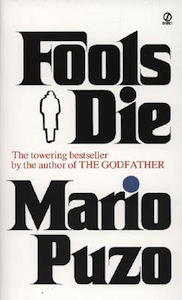
From there Puzo then became involved with screenplay writing for other films as well, including co-scripting the first two Superman films. In fact, it would be nearly a decade before Puzo would publish his next novel, Fools Die, which is in fact partly set in Las Vegas.

I ended up writing a lot of additional material about both Inside Las Vegas and Fools Die for the Pop Poker piece, although in the end we decided just to stick with a discussion of The Godfather over there. Meanwhile, for those who are curious, I thought I’d share some thoughts about the latter two books here today.

Going Inside Las Vegas

As I say above, Inside Las Vegas is really a “coffee table” book filled with hundreds of color and black-and-white photographs taken in and around the casinos of Las Vegas from during the mid-1970s. Interspersed along the way are chapter-length essays by Puzo which detail the history of gambling, offer some behind-the-scenes stuff about Vegas casinos and how they run, and also occasionally explore humans’ seemingly innate need to take risks.

The book also contains some highly personal anecdotes about Puzo himself, revealing him to have followed the footsteps of one of his favorite writers, Fyodor Dostoevsky, to become a problem gambler. He even admits in the introduction that he was likely chosen to write the book “because I have the reputation as a degenerate gambler.”

The stories he tells about himself confirm this reputation, showing that he lost so much gambling he basically had reached a point at which he was forced to swear off it altogether. Having become immensely rich from The Godfather book and films, he realizes that ironically he could no longer afford to gamble now that he possesses real wealth.

“Now for the first time in my life, making more money than I have ever made in my life... now I have too much to lose,” he admits.

Like The Godfather, Inside Las Vegas defends gambling as a “natural” vice, “one of the primary drives of mankind.” But Puzo also recognizes its destructiveness, and characterizes the casino games of Las Vegas as eminently unbeatable. “Sure, you may win on some trips,” writes Puzo. “But eventually you will get wiped out.”

Poker was not nearly as popular in the 1970s as it has since become, so it is not surprising to read of Puzo playing nearly every other game in the casino except poker. Thus does he repeatedly succumb to the house’s percentage edge, coming away with the conclusion that while Vegas is great fun, one can only (ultimately) lose while there.

The book provides a subjective, loosely organized study of Las Vegas of the era, with Puzo’s anecdotes populated by a large collection of character sketches of casino managers, pit bosses, floorwalkers, boxmen, stickmen, croupiers, dealers, shills, hosts, junket masters, collectors, and call girls.

I’d recommend it without qualification for the photos alone, but the essays by Puzo add further insight and are quite diverting for those of us with an interest in gambling, casinos, Las Vegas, and/or the 1970s.

People gamble... and Fools Die

At last in 1978, Puzo’s next novel Fools Die would appear, which like The Godfather is a sprawling story with a large cast of characters whose stories intertwine over the course of a couple of decades and five hundred-plus pages.

There’s more sex and less violence in Fools Die than in Puzo’s previous novel, although the overall tone is similarly dark. And this time Puzo more directly explores the culture of gambling, beginning and ending his novel amid the adult-themed excesses of the Las Vegas that captivated him so.

Some of the anecdotes and characters from Inside Las Vegas find their way into Fools Die, with the story focusing initially on a group of gamblers thrown together in Las Vegas, then separating as the story narrows to concentrate upon one of them -- Merlyn -- whose life most obviously parallels Puzo’s own.

Like Puzo, Merlyn is a novelist who eventually writes a best-seller before getting involved in movie-making. He’s also a losing gambler, although avoids the debilitating losses Puzo experienced. Again, poker isn’t really given much prominence in the book, although the baccarat games are sometimes described in terms that resemble the dynamics of a poker table.

While not as carefully plotted as The Godfather and even somewhat experimental in places -- including frequent shifts between first- and third-person narration -- the book offers much of interest to gamblers and poker players. There are numerous quotable lines about gambling throughout, too, including one frequently delivered by the casino owner Gronevelt who wields Don Corleone-like power over his casino, Xanadu, and beyond.

“You have to get rich in the dark,” Gronevelt says, the point being that like was the case with the Corleones in The Godfather, he’s determined it best to operate outside of externally-imposed “systems” if one hopes to get ahead.

I was fairly energized by the first third or so of Fools Die, but to be honest found myself less and less enthused by the latter chapters. Those indulgences and digressions I mentioned popping up in The Godfather happen again in this novel, and while I did find some of them interesting after a while they caused me to become less engaged and not terribly motivated to discover the ultimate fates of Merlyn and the other characters.

There’s a ton of stuff about Hollywood culture and its artist-killing influence, and in fact at times the novel seems to read like a roman à clef-type exposé of particular figures as well as the general corruption of the studio system. And while the introduction of a Norman Mailer-like character, Osano, sparks interest about halfway through, he -- like Mailer -- gets tedious after while.

All of which is to say while I certainly recommend Inside Las Vegas -- especially to readers of this blog -- I’m a little less quick to do so with Fools Die. I’ve yet to explore too much else from Puzo, although I know he’d return again to the topic of Las Vegas in The Last Don, the last of his novels to be published prior to his death in 1999, the story of which explicitly examines mob ties to the origins and growth of Vegas casinos.

For those who have read this far, thanks for permitting me to be like Puzo and indulge in these digressions from that Pop Poker piece. And if you’ve read any of these books (or other titles by Puzo), I’d be curious to hear your thoughts about him, too.

Labels: , , , , , ,

Tuesday, March 05, 2013

Murder in the Cards on CSI

For a while I’ve been planning to create a special “Poker and Pop Culture” page here on Hard-Boiled Poker that will link to the various columns I’ve written under that heading both here and elsewhere, getting them all in one place for easy access.

As I start to get that page together I now have a new entry to include, a write-up of last week’s poker-themed episode of CSI: Crime Scene Investigation that appeared on CBS. I wrote about the show for my “Pop Poker” column on PokerListings, and the article appeared yesterday as “CSI Features Poker Serial Killer (and Tom Schneider).”

I’d known that CSI had an episode involving poker coming up for a few weeks now, having spotted a couple of reports highlighting David Cassidy’s upcoming guest spot on the show as an aging poker champ. As it turned out, Cassidy’s turn was mighty brief as his character gets offed in somewhat gruesome fashion even before the opening credits roll.

I had no idea my buddy (and 2007 WSOP Player of the Year) Tom Schneider was to appear on the episode as well until just a couple of days before it aired. Schneider happened to know the show’s producer who called him up a couple of months back asking about getting a consultant to help them with poker-related details. One thing led to another, and Tom ended up getting recruited to play a poker dealer -- a non-speaking role, but his character in fact is significantly involved in the episode’s twisted plot.

Read the article to learn more about how Schneider got involved in the show and a little more about the premise and story. I purposely avoided getting too detailed with explaining the episode’s plot or revealing any spoilers, since I know folks reading the article might not have seen it and might be curious to do so. I didn’t even get into talking about the two hands of poker that get highlighted in the episode, including the one from the final table of the 1997 Palermo Poker Classic (meant to resemble the WSOP Main Event) that ultimately sets what turns out to be a long-delayed revenge plot into motion.

In that hand a player flops a set of aces, then Cassidy’s character makes runner-runner quads with his pocket kings to win the hand. Here and elsewhere, the script writer, Gavin Harris, throws in a few details that poker players might find distracting as either improbable or not really accurate as far as an individual hand or the playing of a tournament goes. But he does ultimately figure out a whacked-out way to build a whole serial-killer plot out of the playing of a single hand of hold’em, with individual cards providing inspiration for various murderous methods (and in one case, the weapon itself!).

Reading around today, I am seeing how a tennis-themed episode from January featured a tennis racket as a weapon, with Chris Evert, Lindsay Davenport, and Justin Gimelstob among that show’s guest stars. Looks like that show also features some knowing references to the world of professional tennis, not unlike some of what happens with regard to poker and the WSOP in this latest episode, the title of which in fact comes straight from tournament poker, “Last Woman Standing.”

At the end of the PokerListings piece I make a couple of disclaimers about the episode, one of which is to acknowledge that you’ll need to be able to suspend your disbelief a bit to enjoy it. The other is to warn the squeamish about the gore, which frankly amazed me. (I’m thinking of one scene in particular -- anyone who sees the show will know which one.)

I hadn’t really watched CSI much since it first began airing over a decade ago. So while I was aware of general complaints about the show (and prime time graphic violence, broadly speaking) I had no idea how far the standard had moved for what is allowed these days over network teevee.

Some of my academic writing has been about film, including a new article in the latest issue of Paracinema which I mentioned here back in January. Some time ago I found myself focusing on horror films for a while and among the pieces I published were a couple about Halloween III and The Stepfather -- two ’80s horror entries that get grouped with other “slashers” of the day. (If you’re curious about those old articles of mine, click the film titles to read posts over on FilmChaw where I talk a little more about each.) But even with that background, I was still surprised a little by last week’s CSI.

Anyhow, with those warnings having been made, I’ll echo what I say at the end of the PL piece and say that poker players might well find the episode interesting -- and perhaps somewhat different from the usual ways poker tends to pop up in mainstream popular culture.

Labels: , , , ,

Friday, October 05, 2012

“We’re not talking now about a poker game” (Kennedy & Nixon)

Was pulling together a new “Pop Poker” column for PokerListings this week regarding presidential debates and how they so readily get compared to heads-up poker matches. The piece went up yesterday, if you’re curious.

I’m old enough to be awestruck by how quickly and simply we can access information these days. That is to say, I remember how much effort and energy it would have taken to research and write even a casual piece about the history of presidential debates without the ease afforded by today’s internet.

With just a few keystrokes we can search full transcripts of every debate there ever was (since 1960, anyway, when they began to be televised). Heck, we can watch most of them, too.

Anyhow, as I say, I was digging through various items this week and found myself distracted for a while reading some speeches and other material related to the 1960 presidential campaign, the one that ultimately pitted John F. Kennedy versus Richard Nixon.

Nixon we all know was a serious poker player prior to embarking on his political career. The story of him winning significant sums while serving in the Navy and in fact funding his first Congressional campaign with his winnings has been told many times over. And while Nixon often tried to downplay his poker-playing experience and ability once he assumed public office, he nonetheless made references to poker constantly in speeches and communications before, during, and after his presidency.

Anyhow, when looking at some of the speeches Kennedy and Nixon were delivering during the final weeks leading up to the 1960 election, I noticed curious bit of back-and-forthing in which both candidates brought up poker, albeit metaphorically.

The first reference came from Kennedy in a relatively short speech delivered at the Sheraton Hotel in Washington, DC about a week before that first debate in late September. In that speech Kennedy mostly addressed foreign policy and the Communist threat, with just a few quick words about the economy coming in near the end.

Regarding the former, Kennedy argued that “the next President must promptly send to the Congress a special message requesting the funds and the authority necessary to give us a nuclear capacity second to none, making us invulnerable to any attack.... Only then can we get Mr. Khrushchev and the Chinese Communists to talk about disarmament, because having the second best defensive hand in the 1960s will be like having the second best poker hand.”

Six days later Kennedy and Nixon had that first debate in Chicago, the one in which Nixon’s “five o’clock shadow” is said by many to have doomed him. No poker metaphors were employed that night.

About a week after that (and before the second debate), Nixon gave a speech in early October in Elizabeth, New Jersey in which he touched on several points, including what he viewed as differences between himself and his opponent.

After bringing up Kennedy and another speech he’d recently made, Nixon stepped back and kind of self-reflexively tried to characterize the whole process of candidates going out and trying to convince voters in this fashion.

“You know, it’s the custom when presidential candidates travel through a country, a custom which is often cartooned about and editorialized about and written about a great deal, to see who can outpromise the other,” said Nixon.

“One fellow comes in and says, ‘I promise you this,’ and the next one comes in and says ‘I raise you,’ and the third one comes in and says ‘I call you.’ But whatever the case may be, we’re not talking now about a poker game. We’re talking about what’s best for the country.”

Nixon isn’t specifically referring to Kennedy’s use of a poker analogy to characterize the Cold War arms race, although given the close proximity of the speeches it feels like Nixon is perhaps trying to suggest that there’s something unsavory about comparing nuclear conflict to a card game.

I’m reading between the lines, of course. And as I say, Nixon himself so often references poker himself when making various points it becomes all the more curious to see him sound as though he might be trying to criticize doing so.

Anyhow, that was just one of several items I found myself lingering over this week. I’m starting to think it could be fun to pull together a short monograph about Nixon and poker, telling the story of his poker playing and compiling all of his references to the game.

Such a fascinating, complicated, and wildly-flawed figure was Nixon -- and so comprehensively chronicled, too. (I wonder, for instance, how many times poker came up during those 3,700 hours’ worth of tapes?)

Labels: , , , ,

Tuesday, August 07, 2012

We Are Sorry, www.epicpoker.com Cannot Be Found

We Are Sorry, www.epicpoker.com Cannot Be FoundTo future searchers of information about the Epic Poker League, I welcome you to my blog. Read on.

The Epic Poker League was a failed attempt at a professional poker league that managed to host three tournaments before Federated Sports & Gaming, Inc. (its parent company) filed bankruptcy at the end of February 2012. Shortly after declaring bankruptcy, it was reported that the company had liabilities totaling more than $7.8 million. As some may recall, I was one of the writers recruited to contribute to the EPL blog which launched in early August 2011, which perhaps explains my interest in writing about it today, several months after its demise.

The EPL and the accompanying blog were introduced with much fanfare and excitement. “Global Poker Community Has a New Resource: EpicPoker.com” went the press release from FS&G almost exactly one year ago today. The website would combine live tourney reports and other content, including lots of video, profiles of EPL players, poker news, reports on the new Global Poker Index rating system, and regular columns appearing in a blog.

Michael Craig (The Professor, The Banker, and the Suicide King) had recently left his long-running gig writing for the Full Tilt Poker blog, and he was tapped to serve as Editor-in-Chief for the EPL site. He was the one who eventually called on me, Jessica Welman, Jennifer Newell, Mark Gahagan, Fred Bevill, John Vorhaus, AlCantHang, and others to contribute. I wrote a post here including the new assignment with some other “New Adventures” in which I found myself involved at the time.

Michael and I talked and emailed a few times trying to decide how I might contribute to the EPL blog, eventually settling on my doing a new version of the old “Poker & Pop Culture” column I did for PokerNews from 2008-2009. Here’s a post from a while back in which I compiled links to those PN columns, which included fun topics like Mark Twain, the “Dogs Playing Poker” paintings, Amarillo Slim’s appearances on The Tonight Show with Johnny Carson, W.C. Fields, Kenny Rogers’ “The Gambler,” poker on Star Trek: The Next Generation, and so on.

Besides being fun to write, those kinds of pieces tended to provide something a little off the beaten path when it came to poker-related writing. It actually took Michael and me a bit of discussion to get there, but in the end it was an obvious niche for me to fill for the EPL blog. I also kind of liked the column title I came up with for the column -- “Community Cards” -- which highlighted how I’d be discussing poker in the larger “community” or culture.

The Epic Poker League blogFor six months I produced my column about once a week. I also contributed a couple of other items to the EPL blog along the way (i.e., a couple of columns discussing ESPN’s coverage of the 2011 November Nine). Looking back I see I ultimately penned 26 different “Community Cards” pieces. Some are better than others, but there are a few in there of which I’m fairly proud.

Here’s a list of column titles and dates of publication, just to give an idea of the kinds of topics I chose:

Poker and Late Night Television (7/17/11)
Celebs in the Spotlight at the WSOP Main Event (8/18/11)
Your Friendly Neighborhood Spider-Man Plays Poker (8/23/11)
Poker in A Streetcar Named Desire (8/30/11)
Poker in the World of Degrassi (9/13/11)
Politicians Talking Poker (9/20/11)
The Congressman Who Wrote a Poker Book (9/27/11)
An Expose: Strip Poker in the U.S. (10/4/11)
How They Do It In Hollywood (10/11/11)
An Anthropologist at the Table (10/18/11)
Poker in The Killing of a Chinese Bookie (10/25/11)
Poker and the Boy Scouts (11/1/11)
The Not-So-Small Poker World (11/8/11)
Poker and “The Gambler” (11/15/11)
Poker and Paul Newman (11/22/11)
Poker as a Sport (11/29/11)
The Poker Brat Delivers a Hellmuth-to-Helmet Talk (12/7/11)
TV Shows and Poker (12/23/11)
A 100-Year-Old Poker Movie: A Cure for Pokeritis (1/3/12)
Al Alvarez on “The American Game” (1/10/12)
Bret Harte’s “The Outcasts of Poker Flat” (1/17/12)
Poker Meets Politics in Havana (2/1/12)
Poker-Like Plotting at Super Bowl XLVI (2/7/12)
Casanova, Lover and Gambler (2/14/12)
The Pull of Poker in HBO’s Luck (2/21/12)
Jeremy Lin, Poker, and the Desire to Be Surprised (2/28/12)

I mentioned back in March how I saw a kind of grim humor in that last column, insofar that those of us churning out content for the EPL blog were all somewhat surprised when the plug was suddenly pulled just one day after that piece appeared.

I was paid each month for my efforts. The rate was decent, and payments always came in a timely fashion. As it happened FS&G’s declaration of bankruptcy came just as I sent my last invoice (for the February pieces). That meant I got included among the long, long list of the company’s creditors, since like many others I am owed money, too.

Over the past five-plus months I’ve received mailings regarding the ongoing case approximately 1-2 times a week. I usually skim them, vaguely noting whatever new motion is being filed, then add them to the stack of papers over in the corner of a bookcase that is now a couple of hundred pages deep.

One motion from early July caught my eye, causing me to linger a little longer than usual. That’s because it included an attached “Exhibit A” listing “The Rejected Agreements” -- a long list in which my own name appeared.

The multi-part motion was FS&G asking permission to reject all of the executory contracts listed. There’s a sentence in the motion explaining that “The Debtors, in their business judgment, have determined that the Rejected Agreements are burdensome and of no further value to the estate as the costs associated with the contracts exceed the benefits” (see left, highlight added).

Some of you might remember my friend and writing colleague Jen Newell (also one of the creditors) referring to that statement over Twitter about a month ago. She noted how crummy that sounded -- i.e., to be referred to as “burdensome and of no further value” -- even though the statement is about the contracts, not the people.

If this motion is granted, all of the contracts will be rejected which means neither party will have any obligation or liability under the contract going forward. That doesn’t mean (yet) that I won’t get paid what I’m still owed, but that appears to be the most likely scenario as my claim is part of the unsecured claims of the bankruptcy estate.

It would have been nice to get that last check. It’s not a lot (although it is more than my current Full Tilt Poker balance). But it isn’t like losing out on a few hundy at the end ultimately matters that greatly to me going forward.

The experience of working with Michael and being part of a team of talented poker writers was a good one. And as I say above I was proud of having produced some decent analyses of certain films and exploring other topics in which poker and pop culture collided. By the way, I’ve since taken that “Pop Poker” idea over to PokerListings. Last week the latest entry went up, a new discussion of the 1966 film Kaleidoscope.

That said, I was taken aback a little a week or so ago when I noticed the entire EPL site is now offline. That’s right... all of those columns, videos, live reports, everything. Gone. So is the FS&G site. I believe the EPL Facebook and Twitter accounts have been deleted, too.

I still have copies of all of my columns, of course. When that motion to reject my agreement with FS&G is ultimately granted, I’ll probably repost a few of the better ones here on Hard-Boiled Poker. I wait because until then FS&G (or, I guess, Pinnacle Entertainment, who acquired FS&G via auction in June) does technically still own those columns, even if they are no longer being posted anywhere.

Wicked Chops PokerThose who’ve followed the whole debacle closely might recall the guys at Wicked Chops Poker talking about this provision regarding intellectual property being a kind of deal-breaker for them when it came to their potentially getting involved with EPL. In my contract it says (in a fairly unremarkable way) that when a column I send in gets approved for publication, it then belongs solely to FS&G -- “all ownership, intellectual property and proprietary rights to an Approved Submission shall be transferred fro Author to FSG upon Approval, and FSG shall thereafter be the sole owner of all rights to the Approved Submission, including, but not limited to, all copyrights.”

For me, this was meaningful but not too huge of a deal -- as a freelance writer, I have to be willing sometimes to allow those who publish my work to claim ownership of it, or I’m going to have a hard time finding gigs. However, for Wicked Chops the stakes were considerably higher in this regard (I think), potentially covering branding and other “intellectual property” they’d spent years accumulating. As it turned out, FS&G’s behind-the-scenes purchase of all of those “wicked” URLs certainly indicated some sort of early plan to usurp the brand in a big way.

Again, my personal involvement with EPL was pretty tangential, and ultimately I’m not greatly affected one way or the other by its comprehensive failure. But many did get burned badly, and the image of poker as a whole took yet another significant hit thanks to the blundering management and poor choices made by those running the show at FS&G.

Still, I share in everyone’s disappointment. And for me, the website and blog getting scrubbed away is probably the biggest bummer. I suppose those who ran the EPL would like it if the whole experiment could be deleted away so easily, but there are many who’ll remember it.

Interested in reading more about the Epic Poker League? Try Wikipedia, Wicked Chops Poker, PokerNews, CardPlayer, PokerListings, Bluff Magazine, and “An Epic Short Story” by Matt Glantz.

Labels: , , ,

Wednesday, April 04, 2012

Pop Poker

Shamus Goes PopI’ve mentioned from time to time various columns and other poker-related writings I’ve done elsewhere. Some time ago I had the chance to write a “Poker & Pop Culture” column at PokerNews, although that ended a while back. Got to explore in depth all sorts of fun topics like Mark Twain, W.C. Fields, the “Dogs Playing Poker” paintings, Star Trek: The Next Generation, and so on.

I thought briefly of trying to revive the idea at Betfair Poker, writing a single post over there about the Thanatopsis Pleasure and Inside Straight Club, a group of poker players who were part of that Algonquin Round Table during the 1920s.

However, I only ended up doing the one “Poker & Pop Culture” post over at Betfair. Here on Hard-Boiled Poker I published a post in the fall of 2010 listing and linking to all of the different pop culture pieces I had written up to then.

Then last summer I had the opportunity to revive the idea once again with that “Community Cards” column I did for the Epic Poker blog. Had about a six-month run there before the EPL ran into its difficulties a little over a month ago. Was able to explore a lot of other examples of poker popping up in unusual places, like television shows, movies, sports, and other “mainstream” areas of the culture.

M*A*S*H (1972-1983)I’m glad to share that like a free agent roaming from team to team, the idea has found a new home over at PokerListings where I’ve begun a “Pop Poker” column. Yesterday PL posted a piece exploring poker on the television show M*A*S*H which was a lot of fun to pull together. Those who remember the often-clever comedy set against the backdrop of the Korean War might get a kick out of it.

Incidentally, when going back and looking at those old episodes in which Hawkeye, Radar, Fr. Mulcahy, and others all played poker, some of those I watched online did not feature the laugh track, something that was of course highly typical for sitcoms of the time when the show aired (1972-1983).

I read around a little and discovered that apparently the show’s creators didn’t want to have a laugh track, but CBS made them include it in all but the operating room scenes. However, when the show got aired outside the U.S. it sometimes appeared without the laugh track, and I think on some of the DVDs there’s an option to turn it on or off.

That explained why I stumbled onto some episodes without the laugh track. Was kind of weird to watch the show that way, I thought, with all of the one-liners and rapidly-fired zingers just hanging in the air, since oftentimes the responses by other characters were of the deadpan variety. Kind of gave the show a darker feel, overall, even though all of the episodes I focused on (the ones containing poker) were fairly light-hearted in tone.

Anyhow, if you’re curious, check out the column. And if you have any ideas for other TV shows, movies, or other topics you would like to see examined in such a column, let me know.

Labels: , , ,


Older Posts

Copyright © 2006-2021 Hard-Boiled Poker.
All Rights Reserved.