Sunday, November 19, 2017

A Different “Chris Ferguson Challenge”

When I started this blog in 2006, blogs were much more of a “thing.” Heck, so was poker, especially online poker.

The Unlawful Internet Gambling Enforcement Act was still a few months away from slithering into our lives in the dead of night as a surreptitious supplement to another, unrelated bill. And it would still be nearly five years before Black Friday came along to raze the online game down to the felt (here in the United States, that is).

I’d been playing online for some time before I started the blog. I was also eagerly consuming other blogs, books, magazines, podcasts, forums, and everything else related to the game. Like some (or most) of you, I’d guess.

For a number of years I probably played at least some poker practically every single day. I also spent nearly every spare moment reading about poker -- studying strategy, learning about the game’s long and colorful history, and reading news about players and tournaments.

I was as fascinated as anyone by all of those “poker celebrities” of that “boom” era, too, and early on got a kick out of the idea I was playing the same game they were. Full Tilt Poker’s long-running “Learn, Chat and Play with the Pros” campaign was a good one, encouraging many to get involved and even believe they, too, could improve their games and move up to bigger and better things -- not unlike the pros with whom they learned, chatted, and played.

One of the many, many promotions Full Tilt Poker ran way back around 2009 or so was called “The Chris Ferguson Challenge.” If you played the micros back then you surely recall it. It involved Ferguson, one of the site’s founders (and one of the core “red pros” representing FTP), embarking on a nifty “challenge” in which he tried to build a bankroll of $10,000 from nothing at all.

He started out with freerolls and won entries into small buy-in events, then by following strict bankroll management guidelines (and continuing to win, of course) he did after busting a time or two manage to built that $10K roll which he then donated to charity.

In 2011, the whole idea of “The Chris Ferguson Challenge” took on a different connotation following Black Friday, and especially after the later amendment to the civil complaint that added Ferguson (among others) to the list of those accused of wrongdoing.

Allegations against Ferguson were ultimately dismissed several months after PokerStars bought out the site, paid the DOJ an enormous settlement, and also managed to get funds back to FTP players after years of uncertainty regarding whether or not the money in those accounts might be lost forever.

The dismissal swept away the issue of legal culpability for Ferguson and others, but the ironic juxtaposition remained. “The Chris Ferguson Challenge” provided a lesson in how to turn a little (nothing, in fact) into a lot. Full Tilt Poker meanwhile provided a lesson in how to turn a lot into a little (into a lot less than nothing, in fact).

After the last of the FTP-related settlements were finally completed in 2016, both Ferguson and Lederer turned back up at the World Series of Poker after a six-year absence. Most with any memory of the Full Tilt debacle were less than delighted.

The pair then came back again this summer, even boldly playing a tag-team event together. While Lederer has yet to cash once since returning to the tables, Ferguson has thrived, cashing 10 times at the 2016 WSOP, then a record 17 times at the 2017 WSOP. (John Racener also cashed 17 times in Las Vegas at this year’s WSOP.)

That success inspired Ferguson to continue a quest for WSOP Player of the Year in the recently completed WSOP Europe series in Rozvadov. There he managed to collect six more cashes including a bracelet win to clinch the award.

Back in 2016, Ferguson responded to questions about his return with a curt non-response: “I’m just here to play poker.” After winning his bracelet last week and clinching Player of the Year, he noted how the prospect of winning POY presented a kind of challenge he wished to attempt: “I was just trying to sneak in... just advance a little bit; trying to get a couple more [POY] points. And it’s just kind of happened. It’s the best way,” he said.

Ferguson’s new challenge -- and his meeting it with success -- managed to be the central story of the WSOPE, stealing attention and headlines away from others like Niall Farrell and Dominik Nitsche (who each won high rollers) and Main Event champion Marti Roca.

Again, many were less than enthused by such a turn of events. Indeed, while the original “Chris Ferguson Challenge” was genuinely inspiring, this new one kind of has the opposite effect.

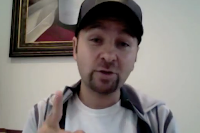
Photo (adapted): PokerNews

Labels: , , , , , , , ,

Tuesday, June 28, 2016

That Time I Learned That Jesus Didn’t Love Me

I think any of us who work long enough “in poker” -- as players, staff or tournament organizers, agents, promoters, reporters and “media,” or in other capacities -- end up collecting quite a few stories that we can’t really share, for a variety of reasons.

Some of the stories can’t be told because they involve “sensitive” information never intended to be publicized. Others have to remain hidden because they might endanger a person’s current employment. Still more are kept quiet because they reflect badly on either the one telling the story or others who for whatever reason are judged not to deserve such treatment.

I know over the ten-plus years of this blog I’ve “self-censored” a number of times, although to be honest I wouldn’t suggest any the stories I’ve suppressed were all that scandalous. One of the stories I consciously chose not to tell before I’m gonna share today, as it seems both a little timely and at this far remove fairly innocuous.

My first time covering the World Series of Poker was for PokerNews back in 2008, and as I’ve written about here many times before during those first couple of summers everything seemed especially interesting and exciting thanks largely to the novelty of it all. The interest remained even by the fifth or sixth summer I was there, even if the excitement had waned a bit by then.

Chris Ferguson -- a.k.a. “Jesus” (a nickname I tend not to employ anymore) -- was of course one of the more recognizable “poker celebs” back then. One of the early events I helped cover in 2009 was a $2,500 buy-in pot-limit hold’em/pot-limit Omaha event, and Ferguson played. While at the table he had out his phone and was playing Chinese poker, and I remember writing a live update in which I mentioned this fact.

It was kind of a novel thing back then to see someone on a device playing a different poker game while at the table -- not nearly as ubiquitous as it would soon become -- making for a bit of color worth mentioning amid an otherwise not-so-exciting Day 1. Kind of thing wouldn’t deserve being pointed out even a year later, I’d say, but at that time it was curious enough to include. I seem to recall making a joke in the update about two games not being enough, since the tourney featured PLH and PLO and Ferguson was playing a third game on his phone.

Anyhow, in my next “travel report” post here on the blog, I retold that story and a few others from the day. When referencing Ferguson, I said something about peeking over his shoulder to see him playing Chinese poker, taking a bit of poetic license in the way I described the scene (as though I had captured a little “inside dope”). Truthfully, there was no reason to look all that closely to see what he was playing. In fact, he was talking about the game with Andy Bloch who asked him about it.

In that post I also mentioned an “Approved Electronic Device Rule” the WSOP had in place that year which was not being enforced at all. I explicitly said I didn’t care one way or the other about players being on phones or other devices while playing, but I did note it seemed inconsistent to have a rule that no one heeded and that no one seemed interested in requiring anyone to heed.

There was a short sequel to the story -- this is the part I haven’t told before.

The next day I was back at the Rio where I first heard from a fellow reporter, then from the head of the team something about Ferguson not being happy with my posting about his Chinese poker playing. It was never 100% clear to me whether the objection concerned the live update or my HBP post (it seems like it was the latter, actually), but apparently “Jesus” was concerned enough to have spoken to then-WSOP Commissioner Jeffrey Pollack about it.

This is all very vague in my memory, I’m afraid, but I have a fleeting recollection of Ferguson having said something about how the WSOP shouldn’t allow the reporters to nose around in private business, with there even being some suggestion about credentials being revoked. However severe his objection really was, Ferguson was eventually told whatever he needed to be told, and the matter went no further. Meanwhile I was assured I’d done nothing wrong -- either in the live updates or on my blog -- and not to worry about it.

I also remember being told how Ferguson and I would probably get along quite well -- that we have similar personalities and interests, and seemed like we’d hit it off. Needless to say, I never sought out meeting him to find out if that were true.

I didn’t tell the story at the time partly because I was a little embarrassed by it, even if I shouldn’t have been. As a reporter, I didn’t like being noticed at all, never mind in a negative way. And if given the choice, I would have much rather reported that Ferguson liked me than that he had been made upset by anything I’d done.

I thought about the story again after Ferguson made his inglorious return to the WSOP earlier this month. When asked by PokerNews if he had anything to say regarding his absence since 2010 and/or his feelings regarding what had happened with Full Tilt Poker, he repeatedly responded “I’m just here to play poker.” It was a little like back in ’09, when he didn’t like anyone reporting on his doing anything other than playing in an event.

Ferguson has cashed seven times already this summer, including finishing fourth in an event over the weekend. His appearance at that final table created a bit of a stir, as PokerListings described in detail. He was asked again about whether or not he planned to apologize to the poker community, he responded “What are you talking about? No comment” before walking away.

Howard Lederer has also returned to the WSOP, the prospect of which I wrote about here back in May following his apology (which seemed at the time an unsubtle prelude to his returning). I mentioned in that post how his playing in any events would be a bit like men playing in the ladies event, necessarily producing a lot of unpleasantness and ill will, especially should he be successful. The same obviously goes for Ferguson, and it sounds a lot like that final table scene over the weekend confirmed that prediction.

Of course, while Lederer’s apology caused us to wonder about his sincerity, Ferguson seems unequivocally sincere in his non-avowal of responsibility for what happened at Full Tilt Poker.

No, people aren’t really loving Ferguson very much these days, and his success in WSOP events only seems to be adding still more negativity to a poker community he and others damaged so greatly already. Can’t say I’m that bothered, though, given how I found out long ago “Jesus” didn’t love me.

Image: “Jesus eyes the next table,” Matt Waldron. CC BY 2.0.

Labels: , , , , , , , , ,

Monday, May 23, 2016

WSOP-Related Reads on PokerNews

A few good reads over on PokerNews today, IMHO (as they say). All have something to do with the 2016 World Series of Poker, which starts in just about a week.

For one there’s the first part of PN’s annual predictions for the upcoming World Series of Poker, where I’m chiming in along with several others. We give thoughts about 10 different questions in this part, with more to come.

We guess who will win WSOP POY, who will win various marquee events, opine about how various pros will do, and weigh in as well on this question of whether or not Howard Lederer and/or Chris Ferguson will turn up at the Rio this summer.

I’m more or less okay with my predictions in this part, though I’m less confident about some of the ones I ventured in the second part. In any case, check out “2016 World Series of Poker Predictions, Part 1: Will Ferguson or Lederer Return?” and compare your own ideas about what’s going to happen this summer.

Two good strategy articles additionally went up today, also both relevant to the upcoming WSOP.

One is by Darrel Plant, who took a close look at the structures for the low buy-in events at this year’s WSOP and saw the early levels go much faster this time versus last year. The $565 buy-in Colossus gets most of the focus, and what Darrel has to say should be pretty interesting (and useful) to those playing in that one.

See “Playing the Colossus? Structure Changes to Early Levels Make Fast Start Crucial.”

Also, our friend Robert Woolley, a.k.a. the “Poker Grump,” wrote what I think has to be the first strategy article I’ve seen that specifically focuses on seniors events such as the $1K one the WSOP has for players aged 50 and up.

Check it out: “Thinking of a Seniors Event? Tips to Make it Fun and Profitable.”

Photo: courtesy PokerNews.

Labels: , , , , , , ,

Thursday, May 19, 2016

Lederer’s Mea Culpa

So Howard Lederer today -- today (!) -- issued an “apology” for the whole Full Tilt Poker 1.0 fiasco shared via Daniel Negreanu’s blog over on Full Contact Poker.

As it happens, earlier this week the player pool at Full Tilt Poker 2.0 was at last combined with that of PokerStars, both sites being currently owned by Amaya Gaming. That’s actually coincidental, though, as Lederer has no connection to the new Full Tilt other than having been among those who named the site long ago.

No, the timing of the apology rather has to do with the World Series of Poker beginning in just a week-and-a-half, or at least that seems the most likely explanation for it. Lederer is now admitting both to having made mistakes pre-Black Friday and not owning up to his culpability afterwards in what appears to be an attempt to pave the way for his return to the WSOP, something Negreanu alludes to as well in his contextual commentary on the statement.

You can read the statement yourself and decide how genuine the apology seems. You might also note how it mostly avoids any sort of particulars with regard to the mismanagement of player funds, Lederer’s own prominant role with FTP right up until and after Black Friday, and the way he still weirdly seems to portray himself as a victim of sorts while nominally accepting blame.

As far as Lederer’s playing at the Rio this summer goes, the WSOP reserves the right to refuse anyone the ability to participate in their events, and so it is technically up to them. I don’t necessarily see any legitimate argument for not allowing Lederer to play, but perhaps others might.

That said, I can’t imagine most are going to be all that enthusiastic about Lederer playing. He himself notes in his statement, “Players were not able to get their money back for a minimum of a year and a half, and, for many, it has been much longer. I’ve been a poker player my entire adult life. I know the importance of having access to one’s bankroll.”

In other words, thanks to Lederer’s own mismanagement and lack of oversight, he (and others) significantly damaged the careers of thousands of poker players -- indeed, in many cases, ended those careers altogether. Who could possibly be eager now to compete with such a person at the poker table -- i.e., to have such a person (again) do what he can to try to keep others from winning money at poker?

That’s what I think about here -- not just Lederer playing in WSOP events, but winning in them by cashing. Who could possibly be enthused by that prospect? (I even wonder how much Lederer himself would enjoy it.) Reminds me a little of what happens when men who choose to play in ladies events make the money, and the unpleasant feeling that results. What has been won, exactly?

If Lederer is not angling for a WSOP return, then, well, the gesture perhaps has some, small meaning. If he is, though, that only makes the much-delayed apology seem more empty and without significance than it already is -- another mostly self-serving act, following a long, long sequence of them.

Photo: “Sorry,” Timothy Brown. CC BY 2.0.

Labels: , , , , , ,

Friday, January 18, 2013

When Momentum Takes Over (Armstrong and FTP)

Like many, I clicked over last night to watch a little of Lance Armstrong’s tell-all with Oprah Winfrey, the first part of which aired on her network, OWN. (And like many, I had to do a little bit of searching up and down the menu of channels to see if I received OWN.)

At some point early in the evening I saw Matthew Parvis of PokerNews had sent out a funny tweet alluding to his interview last September with Howard Lederer, the circumstances and dynamic of which did kind of resemble the Armstrong-Winfrey convo:

“Lance, were you doping during the Tour de France? ‘I remember one time at a party...’ #TheArmstrongFiles.”

I lol’d. And as the interview continued, I found myself involuntarily thinking further about how one might compare the motives of the two interviewees, with the idea of performing some kind of reputation repair perhaps foremost for both.

That said, I don’t really want to perform such close analysis of either of these two characters beyond simply noting that both were frauds, both were living a lie (so to speak), and both acted in ways that proved highly destructive and hurtful to others. Both also had others abetting their causes significantly, helping them to perpetrate their respective “schemes” further and further, and thus dig their respective holes deeper and deeper.

There was one moment in the Armstrong interview, however, that I did want to point to as having resonated especially strongly with the whole Full Tilt Poker fiasco, a fiasco which (I should point out) was obviously not just one man’s fault but the result of a kind of communal dysfunction (among the FTP BOD, owners, and marketers/PR people) and as well as a consequence made possible by an industry (online poker in the U.S.) that had evolved in such a way as to encourage exploitation by those willing to take advantage.

“Listen, all the fault and all the blame here falls on me,” Armstrong tells Winfrey. “But behind that picture and behind that story is momentum. Whether it’s fans or whether it’s the media or whether it’s... it just gets going. And I lost myself in all of that. I'm sure there would be other people that couldn’t handle it, but I certainly couldn’t handle it....”

When Armstrong talks about “momentum” taking over, it’s hard to avoid thinking about a riding a bicycle. Anyone who has done so has experienced that moment when the bike kind of feels as though it has “taken over,” giving the impression of moving on its own. Whether by the force of your pedaling or having found yourself on a downward incline (or both), enough impetus has been given to the bike for it to continue moving forward without any further action required of you. And as a rider, your task then shifts over to steering (and, if necessary, braking) rather than making the sucker go.

Perhaps because of Parvis’s tweet, when hearing this talk of “momentum” I couldn’t help but think of Lederer and FTP. Specifically I thought about Lederer speaking of having lost control of the “company culture” and how “something weird happened” and “clearly things got out of hand.” Sort of like the FTP bike could no longer be stopped and was recklessly hurtling down a steep incline toward an unavoidable crash. And that crash would be taking down others, too.

Like I say, I’m not too inspired to scrutinize this comparison too deeply. It does seem, though, that when Armstrong evokes that idea of momentum he isn’t primarily trying to deflect blame as much as to explain his own thinking and what might have been additionally influencing him to continue to cheat and lie (although that motive could be intermingled in there, too). However when Lederer evokes the same idea of momentum taking over, it’s pretty clear he’s mostly hoping to direct our attention to others’ culpability for the FTP situation getting “out of hand.”

Labels: , , , , ,

Monday, November 19, 2012

A Petition to Prevent the “Professor” from Playing Poker

Some brouhaha of late regarding a petition drafted by the poker player Nick DiVella seeking to have Howard Lederer barred from playing poker at the Aria. The petition went up a couple of days ago and has almost a couple of hundred signatures so far.

Remember Lederer’s brief, calculated media blitz from a couple of months ago (discussed in part here and here)? It wasn’t long afterwards we began hearing reports of Lederer turning up at the Aria to play in the $400/$800 mixed games. (That photo of Lederer in action in Bobby’s Room was snapped and tweeted by “Crazy” Mike Thorpe.)

Seemed like an incredibly tactless move on Lederer’s part, destined to provoke a negative reaction from a community of poker players many of whom continue to wait upon the return of their FTP funds.

Then last month the “Professor” played in the $10,000 buy-in WPT Festa al Lago event at the Bellagio, burning through a couple of buy-ins on his way to busting. That, too, earned Lederer a lot of vitriol from players upset that he’d blithely ignore how others might feel about his gambling away thousands at a time when he continues to stand accused by the U.S. Department of Justice of funneling hundreds of millions of players’ funds into “FTP Insider” accounts.

All of which is to say, it’s not like DiVella’s petition comes out of nowhere. People are upset, and so DiVella has made a decision to see if he can influence the Aria somehow to stop allowing Lederer to continue to play in their poker room. Claiming that the Aria has “a moral and ethical obligation to bar Howard Lederer from playing in the poker room,” those signing the petition are collectively threatening the Aria with a boycott should it fail to follow through on such an obligation.

I don’t know a lot about DiVella. I do know he is one of the regulars at the Aria cash games and that he made a deep run in the WSOP Main Event this year where he finished 72nd. In fact, I happened to have reported on his unfortunate bustout hand for PokerNews, one which saw Steven Gee accidentally call DiVella’s all-in with K-7 then beat DiVella’s A-K when the community cards brought a seven.

I remember DiVella handling his misfortune in that hand very well. I also recall listening to DiVella on a podcast later on with Kristy Arnett where he talked about his Main Event run, and found him interesting and thoughtful. So while I don’t really know DiVella, I have an impression of him as a fairly rational dude who isn’t necessarily looking to round up a lynch mob but rather simply wants to find some way to address an unpleasant situation.

That said, I can’t really agree with the suggestion that the Aria has any “moral and ethical obligation” to bar Lederer from playing in its poker room. The Aria can do what it wants, of course, but it would have to be regarded as a troubling move if they decided to bar a player simply because others did not want to play with him.

I’d be a lot quicker to say Lederer is the one who is choosing to ignore what might be called an ethical obligation to refrain from playing, at least until all players are finally refunded their balances.

I’d be curious to know what Andrew Brokos, the “poker ethicist,” has to say about the “ethical obligations” of the Aria and/or Lederer here. Speaking of, Brokos and Nate Meyvis have a new episode of their “Thinking Poker Podcast” up in which they talk to PokerNews’ Matt Parvis about (among other things) the “Lederer Files.”

Labels: , , , ,

Wednesday, October 17, 2012

Fact-Checking; or, The Professor’s Plight

Am still occasionally giving time here and there to ongoing fallout from Howard Lederer’s interviews for PokerNews (“The Lederer Files”) and for the Two Plus Two Pokercast (Episode 239). Have viewed QuadJacks’ “Oral History” compilation of responses, am reading Diamond Flush’s still-in-progress summary-response, have watched Daniel Negreanu’s latest rant, and have looked in on the forum discussions and op-eds continuing to pop up.

These responses kind of remind me of all the so-called “fact-checking” that happens following each of the debates between the major parties’ presidential and vice-presidential candidates. Some of that effort is legitimately aimed at seeking corroboration (or the lack thereof) to support or challenge statements made during the debates. But a some of it -- perhaps a lot of it -- is really just spin, that is, a rhetorically-savvy way to persuade others to read a particular, desired message or intent into what was said.

Speaking of fact-checking, there was a moment in the Two Plus Two interview with Lederer in which he instantly inspired pretty much everyone listening to engage in such. I’m talking about that moment when the “Professor” professes a kind of ignorance that Full Tilt Poker continued to deliver the “your funds are safe and secure” message to customers well after the point when it was obvious that was not the case. (I’ve written about this a little before, but forgive me a quick look back at it in the present context.)

To review, Lederer was asked during the 2+2 interview about Full Tilt Poker’s continuing to tell customers that their funds were safe even after Black Friday. Lederer responded by saying he did not believe the words “safe and secure” were still being used in any of FTP’s communications “after April 20 [2011].” And if they were, “it happened without me knowing about it.”

To me that was one of the more blatant bits of culpability dodging Lederer exhibited in either interview.

For one, as just about everyone listening to the podcast knew immediately, the statement was obviously inaccurate. We all remembered how assurances to players about the return of their funds continued to appear well after April 20, 2011 via emails and forum posts by FTPDoug (Shyam Markus). Some of us also recalled the amended civil complaint, filed on September 20, 2011, which catalogued several post-April instances of the “funds are safe and secure” message being repeated.

I included a reference to this point in a post earlier this month. There I noted how the FTP website continued to display the message until after the amended civil complaint appeared that “funds are safe and secure.” I also referred to a post I wrote on 9/22/11 called “Talk About Red Pros (More on the DOJ vs. Full Tilt Poker)” in which I included a screen shot of the front page of the FTP site, taken that day, showing the statement still appeared.

But you don’t have to believe that. Or rather, if you want to check my facts, just take a look at the amended complaint where the DOJ makes the same assertion. “As of September 19, 2011,” they write, “Full Tilt Poker’s website stated that players’ funds were ‘safe and secure.’”

Which means not only is the statement inaccurate, it also sounds highly insincere.

That’s because when Lederer says he doesn’t believe FTP was saying anything about funds being “safe and secure” after April 20, he’s suggesting both that he had no idea what was posted on the fulltiltpoker.com site between April-September 2011 and that he wasn’t aware of the long list of examples of the assurance being repeated that appears in the amended civil complaint.

The latter suggestion is especially odd to consider, given how Lederer himself is being directly charged with funneling player funds into his own accounts in that very complaint. Indeed, it is at the end of the long section titled “FULL TILT POKER’S AND THE FTP INSIDER DEFENDANTS’ THEFT OF PLAYER FUNDS” that we find the quote about FTP’s website continuing to maintain on 9/19/11 that player funds were “safe and secure.” In other words, it is beyond disingenuous for Lederer to have us believe he never read the civil complaint in which he himself is named.

So he’s factually incorrect. And he’s not credible, either, when he explains why his facts might be wrong.

I call this one of the more blatant instances from the interviews of Lederer ducking under a hood of supposed ignorance in order to evade blame, but it isn’t the most significant example of him doing so. And really, in the larger scheme, while Full Tilt Poker’s misrepresentation of the situation to customers during 2011 is certainly blameworthy, worse crimes were committed in order to create that situation.

Again, I think of the debates and the so-called “fact-checking” that follows them. In some cases, those engaged in the effort to confirm or dispute candidates’ statements are being moved by a genuinely estimable intention -- i.e., to seek truth, and to hold those seeking our votes accountable for the words they say. Others are motivated by the less noble purpose of political spin, their goal being to recast objective evidence (the words that were spoken) as supporting this or that self-serving narrative.

While I suppose some of those engaged at present in fact-checking Lederer are just piling on or following the mob, I think most are doing so with good, constructive intentions.

Even so, at the risk of sounding overly cynical, in the end I’m afraid what we’re all mostly engaging in is a big, distracting game of trivial pursuit. The same goes for the debate fact-checkers. Most of the details of their findings will be forgotten come Election Day, and all of them will essentially buried thereafter, only to be dug up later by academics and other obscurists.

It’s a curious text, no doubt, the two-act absurdist play in which Lederer starred in those interviews with PokerNews and Two Plus Two. Call it The Professor’s Plight, another drama helping comprise that fascinating and varied genre of theatrical works that have been produced over the last decade by online poker. About which someone will someday be writing a dissertation, I am sure.

Labels: , , , , , , ,

Wednesday, October 10, 2012

Full Tilt Poker Relaunch Soon (No Shinola)

Full Tilt Poker 2.0 is happening. In less than a month, the site will be relaunched under the auspices of PokerStars. Soon players around the world will be back at the FTP tables, reanimating their geckos and pandas and gnomes and other avatars (I assume) in real money games.

It wasn’t that long ago that the prospect of Full Tilt Poker actually reopening seemed as far-fetched as oh, I don’t know, a team winning a football game by throwing a game-ending interception.

Then again, following his recent media-blitz-cum-absurdist-theater performance of a couple of weeks ago, Howard Lederer is now back at the tables in Vegas playing $400/$800 mixed games.

How did we get here? Well, to borrow a line delivered by the “Professor” character in “The Lederer Files” (Act I, Scene 1), “something weird happened.”

When the Department of Justice first amended the civil complaint in September 2011 and U.S. Attorney Preet Bharara described the site as “not a legitimate poker company, but a global Ponzi scheme,” it was hard to imagine any sequence of events that could result in an FTP comeback.

That sense remained evident pretty much all through that whole uncertain pas de deux between the site and Groupe Bernard Tapie that followed the DOJ’s amendment, when the idea of the site actually being purchased, relicensed, and revived somehow continued to appear a distant prospect at best.

And even after rumors regarding PokerStars entering the picture began swirling in April of this year, for most it wasn’t until the official confirmation of such and estimates regarding the date of an FTP relaunch were starting to be made at the end of July that FTP’s return seemed a real possibility.

And it’s happening, all right. Last month some players in non-U.S. countries began receiving emails from FTP regarding their accounts. PokerStars then began rolling out procedures for those non-U.S. folks to follow in order to access their funds.

Last week came news that Team Full Tilt member Gus Hansen was being tapped as the “first brand ambassador” for the relaunched site. A couple of days ago we learned that after having its licenses suspended and then revoked by the Alderney Gaming Control Commission last year, FTP has been granted a new online gaming license by the Isle of Man Gambling Supervision Commission (the same group that has licensed PokerStars since 2005). Heck, they’ve even announced dates for FTOPS XXI -- picking back up Full Tilt’s popular online tourney series -- scheduled for the first half of December.

All systems are go, then, regarding the targeted relaunch date of Tuesday, November 6. Alas, along with players in a few other countries (Belgium, Denmark, Estonia, France, Italy, and Spain), Americans won’t be able to reopen their accounts and play real money games on Full Tilt Poker that day.

We will, however, be able to vote for candidates running for president, House and Senate seats, and local offices as it just so happens November 6 is also Election Day here in the U.S. A few will grimly note some vague irony tucked away inside that juxtaposition.

Even though Full Tilt will operate as a distinct site and not as a “skin” of PokerStars or part of the same network, its position in the online poker market will nonetheless be as a kind of Stars subsidiary, a highly visible and important complement to the primary site which according to PokerScout currently enjoys “around 50% market share.” In other words, as far as the business side of things is concerned, the online poker “game” should be affected considerably by FTP’s return.

Should prove an interesting game tto watch. Which is what we mostly do here in the U.S. at present when it comes to online poker. Watch.

Labels: , , , ,

Tuesday, October 02, 2012

On the Author Function in Poker and Poker Writing

I was in graduate school a long time. Long enough to be infected -- briefly, though significantly -- by the literary theory bug to which most of those who go for advanced degrees in English are necessarily exposed.

I choose a disease-related analogy because in the end most of us who put aside the novels and plays and poems and even the criticism written directly about various works of literature to pick up these works labeled “theory” found ourselves momentarily disoriented as though affected by a fever.

Part of the reason for such a response had to do with the head-spinning novelty (I think) of leaving the “primary” texts for a while -- the novels, the plays, the poems -- to read the utterly different, often confounding prose of writers with names like Derrida, Lyotard, Lacan, Bakhtin, Althusser, Spivak, Fanon, and Foucault (the philosopher, not the poker player). Then came the extreme mental gymnastics required when trying somehow to apply these writers’ ideas to the literature we were supposed to be studying.

For a lot of us, the drawing of such connections was mostly beyond our capabilities. But we made the attempt, anyway, because it seemed like everyone else was doing it and, well, we didn’t want to be left behind. Not surprisingly, we wrote a lot of poor, confused essays as a result. And while a few found literary theory enticing enough to become a focus of their studies thereafter, most of us made our way back to the novels and poems and plays once the fever finally broke.

That said, those courses and readings in literary theory did provide me with a few ideas that have stuck with me and proven useful from time to time. In most cases those ideas were in the form of invitations to question certain aspects of a text I might have otherwise taken for granted. You know, things like the cultural conditions under which a given work of literature is produced. Or the relationship between form and content the work exhibits. Or the way the work addresses (or doesn’t address) issues of race, class, and sex. And so on.

One of those useful ideas -- something I probably would’ve never thought much about had I not endured and survived my theory fever -- was the significance of the author to a given piece of writing and how our ideas of the author necessarily affect the way we interpret what we are reading.

It might seem like a simple idea, but whenever we pick up a book we typically make note of the author’s name and thus allow whatever connotations we associate with that name to shape our interpretation of what we read. Right? Even if we don’t know the first thing about the author, as we read we start to form ideas and opinions about who that person might be, and thus our response to what has been written still gets shaped by the notion that someone -- a person we think of as “the author” -- has attempted to communicate something to us via these words we are reading.

It was an essay (actually a lecture) from the late 1960s called “What Is an Author?” by Michel Foucault that probably first introduced this idea to me in a way I could understand. That is to say, the idea that there is what Foucault calls an “author function” we tend to associate with certain kinds of writing or “discourses,” for example, so-called “literary” writing (novels, plays, poems). These would be varieties of discourse in which certain standards occur to us that make the idea of the author important or needful -- in other words, there are certain kinds of writing for which the idea of the author is more important to us than others.

What was really eye-opening for me was the idea that Foucault proposes that the “author function” is something the reader (or the culture, which influences the reader) brings to the text and is not necessarily inherently part of the text itself.

Foucault gives the example of scientific writing and how during the Middle Ages its validity and thus influence (as determined by readers) was often affected greatly by who authored it. But later on, who wrote an article advancing a new scientific discovery was thought to be less important than the discovery itself -- that is to say, the way the text was read and interpreted was less affected by the “author function” than was earlier the case.

One other idea Foucault points out (and he’s not the only literary theorist to come up with this one) is how when we do start thinking about the author of a given text -- or give significance to the “author function” when we read -- that person we’re thinking about is not identical to the person who wrote the sucker. Rather, it’s a limited, skewed version of that person, necessarily shaped in the reader’s mind by the text itself as well as by other cultural factors influencing the reader.

So “Freud is not just the author of The Interpretation of Dreams or the Jokes and Their Relation to the Unconscious; Marx is not just the author of The Communist Manifesto or Das Kapital” writes Foucault. Rather when we read, say, The Interpretation of Dreams, we think about this “Freud” fellow as we do and let our idea of that person affect how we interpret the book. But that person we’re thinking of isn’t Freud. Not really (or utterly).

I’m not going to go any deeper into Foucault’s essay than I already have -- I’ve barely scratched the surface, if you can believe that -- but hopefully you see how just asking the question “What is an Author?” can open us up to all sorts of other questions when it comes to interpreting a piece of writing.

I was reminded of all of this “author function” business recently after reading Diamond Flush’s announcement that Howard Lederer had backed out of his planned-for interview with her following his two long interviews with PokerNews (“The Lederer Files”) and for the Two Plus Two Pokercast (Episode 239).

Actually, Lederer himself already had me occasionally thinking a little bit about the “author function” from things he said in those earlier interviews. For instance, when he attempts to dodge responsibility for various poor decisions by alluding to the “Operating Agreement” or the “owners” or the “board” as if they were the true “authors” of FTP’s demise who were somehow to be understood as distinct from himself.

Or when in the 2+2 interview he responds to a question about FTP continuing to repeat that message to customers that “funds are safe and secure” well after Black Friday -- in fact, all of the way until late September 2011! -- by saying he did not believe “that those words would have been used after April 20 [2011]” and that if they were “it happened without me knowing about it.”

In that latter case, Lederer is suggesting two wildly improbable ideas: (1) he did not read the amended civil complaint in which he himself is named which spells out several instances of Full Tilt Poker telling customers their “funds are safe and secure” and were continuing to do so on September 20, 2011 (the date of the amendment); and (2) he never once visited the Full Tilt Poker website after April 20 where the “funds are safe and secure” message remained prominently displayed until late September 2011 (i.e., until after that first amendment to the civil complaint).

Relatedly, the whole issue of the “author function” comes up again when we think about good old “FTPDoug” (a.k.a. Shyam Markus), i.e., the apparent “author” of many of those “safe and secure” messages. His transformation into “FTPMarkus” in preparation for the launch of FTP 2.0 in November has encouraged all of us to think differently about the significance of a signature and how it isn’t necessarily to be understood as representing “authorship.”

But it was while reading a thread on 2+2 about Lederer’s backing out of the Diamond Flush interview that I found myself thinking most specifically about the “author function,” namely thanks to a post by Pokercast co-host Mike Johnson regarding Diamond Flush herself.

“I’m not knocking the massively important role she has played in all of this, she has been beyond invaluable,” writes Johnson. “I just personally believe that once you start interviewing the biggest names involved in the story on the record you have officially made the transition from info-leaking blogger to media member. I actually can’t think of any other media person who interviews major news personalities for public consumption anonymously.”

Johnson’s post inspired some interesting discussion about journalistic standards, the so-called “poker media” (and whether it adheres to such standards), as well as blogs and pseudonyms. There were several direct responses to Johnson’s observation, some quite thoughtful. My friend Change100, a.k.a. Kristin (of “Pot Committed”), came up at one point in the discussion. Diamond Flush herself then jumped in with an explanation of her reasons for using a pseudonym and a defense for doing so. “It’s not the name that’s important,” she argued. “It’s the content.”

Someone later humorously responded that “Diamond Flush is the Isildur of poker insiders.” Another made a Watergate reference by referring to her as “the Deep Throat of poker journalism.” One poster pointed out how DF has appeared on the Pokercast as a guest in the past and Johnson never insisted she identify herself there. And 2+2 Grand Poo-Bah Mason Malmuth hopped in as well to say he believes DF needs to identify herself publicly.

Thinking again about the “author function” and how it affects our understanding and interpretation of the written word, I think this whole debate makes clear that there are certain contexts in which it continues to have great importance, for better or worse.

I think it is interesting that Johnson’s objection to Diamond Flush’s use of a pseudonym was clearly inspired by the content of her posts which to him has reached a certain level of significance (“interviewing the biggest names involved in the story on the record”) that to him changed the nature of the discourse and thus introduced a different standard according to which the identity of the author is somehow more significant. As Johnson says of DF, “you have officially made the transition from info-leaking blogger to media member.”

I certainly see where Johnson is coming from. And, of course, I understand Diamond Flush’s position as well. After all, I started this blog using a pseudonym -- for some of the same reasons DF says she uses one, actually -- and only when I began writing for other poker sites did I begin using my real name for a by-line.

But really, even if a person signs his or her real name to something he or she has written, the “author” of the piece is still going to be distinct from the person who wrote it. The credibility of the piece might be affected by the “author function,” but other contextual factors have as much or more to do with credibility, too, including other texts produced by the same hand, others’ responses to those texts, as well as additional culturally-determined factors regarding journalistic standards.

I’ve written before about how the poker world is filled with characters with multiple identities, with lots of examples of pseudonyms and attempts to participate with anonymity, and with other factors complicating what we might regard as the “author function.” And of course all of that becomes even more evident when it comes to online poker.

There’s a lot more to say about it all, really. But I’ll sign off now. As “Short-Stacked Shamus,” that version of me who regularly -- sometimes feverishly -- writes here.

Labels: , , , , ,

Thursday, September 27, 2012

Poker Podcast Review: Full Tilt Poker's Tips from the Pros, Episode 5 -- Your Online Poker Bankroll feat. Howard Lederer

I see the Two Plus Two Pokercast guys have conducted their interview with poker’s most interviewed subject of late, Howard Lederer. They posted the show just a few moments ago, actually. Four hours long, this one.

As I was saying a few days back, I’ll certainly be listening in, even though I have a feeling that while there may be some new nuggets, there will be a lot that will be similar to what we heard last week in the PokerNews interview -- i.e., deflecting blame, rationalizing inexcusable decisions, selectively forgetting unflattering details, and the like.

Before I listen, though, I wanted to share one little find I had while sorting through some old files, something that kind of relates both to the Two Plus Two Pokercast and to Lederer.

When I started the blog way back in 2006, I was inspired to do so by a few different factors, one of which was the poker podcasts I had begun listening to just a few months before. In particular it was the Card Club on Lord Admiral Radio podcast on which the subject of poker blogs occasionally arose that got me thinking of trying something similar.

Among those early podcasts was Rounders, the Poker Show, the one hosted by Mike Johnson and Adam Schwartz who later on would move over to host the consistently excellent 2+2 show. Those early Rounders shows were good, too, many of which focused on one lengthy interview with a poker personality. Indeed, given their track record and experience with interviewing, I do look forward to hearing how Johnson and Schwartz handled the interview with Lederer (and am inclined to guess they likely did well).

Anyhow, just yesterday I happened to be searching for some old music files among a stack of CDs and DVDs and noticed I had a few on which there were folders labeled “Poker Podcasts.” During those early days of listening to podcasts I’d save them onto the computer before listening, and for some reason I was compelled to back those files up along with everything else.

Looking through those folders I am seeing a bunch of old episodes of Rounders, the Poker Show as well as Card Club, Poker Diagram, The Circuit (from back when it first appeared on the CardPlayer site), Ante Up!, The Poker Edge (with Phil Gordon), and some other obscure ones like California Poker Radio, NetBettor, and so on.

Also tucked in there are some old files labeled “Full Tilt Poker” which upon closer inspection turn out to be episodes of a kind of half-hearted attempt at podcasting by the FTP crew. The shows were all just a few minutes long and featured members of Team Full Tilt being interviewed by a host (who doesn’t identify himself) to talk about various strategy tips -- e.g., how to play ace-king, slow-playing, heads-up play, and so on. I think most were recorded either late 2005 or early 2006.

One of those I found featured Lederer, of course. The topic? Bankroll management. I had to listen.

“The number one consideration when it comes to bankroll management is working on your game and making sure you have the best of it,” Lederer begins. “If you don’t have the best of it, no bankroll management system is going to help you win.”

It’s an obvious point, of course, that if you aren’t a winning player then you can’t possibly come up with a scheme to prevent your bankroll from dwindling rather than growing. Lederer follows that with a few other guidelines regarding how much you need to have in your account in order to play different games comfortably (e.g., SNGs, limit games, no-limit).

Lederer then gets into other standard stuff about how, say, if you are a limit hold’em player you want to have a certain number of big bets in order to avoid going broke (Lederer says 500 big bets per table). He goes on to recommend “limits per session” (i.e., “stop-loss” limits) and the need to walk away once you’ve lost a certain amount.

“Poker’s going to be there, you know, Full Tilt Poker’s going to be open,” he says with a laugh. “There’s always going to be a game.”

The discussion then moves on to address the importance of tracking one’s play and keeping good records. “Being a good poker player takes a lot of self-honesty,” says Lederer. “Keep accurate records of how you do... those records won’t lie,” he adds. And for players who are losing overall, a check of the ledger can be especially helpful. Says Lederer, “you need to be objective, you need to be self-critical, you need to figure out what you’re doing wrong, and you need to fix it.”

I know, I know... it’s an easy target. Still, pretty funny hearing all of this advice about how to avoid risk of ruin coming from one of those involved with losing track of hundreds of millions of dollars. By the way, there’s another episode featuring Chris Ferguson also on the topic of bankroll management advice (talking about the “The Chris Ferguson Challenge.”)

(I’d point you to the shows on the web, but am having trouble finding them anywhere anymore.)

Will be thinking of all of these tips, then -- about the need to keep accurate records, about the value of setting limits for oneself, about the importance of self-honesty and figuring out what’s one is doing wrong -- when listening to Lederer’s 2+2 interview.

Labels: , , , , , ,

Monday, September 24, 2012

The Mis-Lederer Files

So last Friday we finally reached the end of “The Lederer Files,” the lengthy interview with Howard Lederer posted in seven half-hour segments throughout the week by PokerNews.

To me the interview grew increasingly compelling as it went. Indeed, the process of watching successive “episodes” kind of reminded me of how a lot of us view new television programs, consuming entire seasons’ worth of shows in a single sitting or over the course of just a few days. I joked at one point over Twitter the sucker should have been put on Netflix streaming.

The forums and Twitter were of course all fired up over Lederer’s explanations, evasions, declarations, and obfuscations. A few detailed responses appeared as well on various sites and blogs, with Bill Rini’s breakdown of the interview (including some comments about Diamond Flush’s recent interview with Andy Bloch) being the most insightful by far.

In “A Review of The Lederer Files (Parts I-IV) and Andy Bloch Interview,” Rini assesses what Lederer and Bloch reveal about the ultimately inadequate management structure at FTP, including discussing at length about that incredible blind spot regarding the need to segregate accounts used for operating expenses and player funds that many of us were commenting on last week.

Then in “The Lederer Files Parts 5, 6, and 7” Rini looks a little more closely at the internal strife between the FTP owners and the issue of culpability. He rightly points out how Lederer utterly missed the point of Matt Glantz’ “The Silence of Full Tilt” blog post from February 2012. (Glantz wasn’t asking for a daily report on the status of deals and/or return of funds; he was noting the utter lack of any acknowledgement of the hugely effed-up situation.) Rini also ultimately finds Lederer’s interview-concluding apology to ring hollow, ultimately viewing the entire three-and-a-half-hour interview as much, much more self-serving than altruistic.

At the end of that second post, Rini offers some additional comments about Matthew Parvis and the quality of the interview as a whole. Parvis provided his own post-mortem on Saturday, also worth a look: “The Lederer Files: Process and Opinions.”

Sure, there were a few moments when follow-ups were warranted -- e.g., after that bizarre suggestion early on that segregating accounts wasn’t important to FTP or the industry as a whole; in the face of the non-explanation for why distributions continued at an obscenely high clip even after the company began to experience financial difficulty; during the self-righteous talk about the need to be fully “committed” as a member of FTP Board of Directors when Lederer himself was pretty obviously far from committed to his responsibilities as a BOD member prior to April 2011.

But like Rini I nonetheless have to acknowledge Parvis and PokerNews as having mostly done well with what was certainly a “tough gig” (as Rini says). And as I say above, I found the interview more compelling as it went, mostly because of the weird detours and occasional howlers Lederer dropped along the way.

His grouchy griping about Phil Ivey, John Juanda, Phil Gordon, Perry Friedman, and others was certainly intriguing, although in truth the more Lederer tried to deflect blame the worse he came off.

For example, the business with the “double-credited” loan to Erick Lindgren certainly appears primarily intended as a criticism of Lindgren for making off with not just a $2 million loan but another $2 million accidentally wired to him. But really, the whole idea of FTP casually shipping seven-figure loans to its Red Pros like this -- and amazingly being able to make multi-million-dollar mistakes in accounting when doing so (!) -- reflects incredibly badly on FTP and those who so recklessly ran the sucker.

If this were a television show, the dominant theme or motif of the “story arc” presented in these seven “episodes” would have to be the idea of being misled. On the surface, Lederer tries to argue over and again how he himself had been misled in various ways and in various contexts. But the audience cannot help but see the irony of his position as someone who contributed significantly (both by action and inaction) to the misleading of us all.

It sounds like Lederer may possibly return with still more interviews, and while more Lederer “episodes” -- or a second “season” -- might well provide some more gossipy nuggets to distract us, I’m not too hopeful anything more of substance will be forthcoming from the man who just a year-and-a-half ago was crowned the most powerful person in poker.

I was writing on Friday about quantity versus quality (referring to my chosen posting schedule). More is not necessarily better. While I’ll certainly be curious should further interviews take place, I’m kind of done with Lederer’s lecturing, as I think the “Professor” hasn’t really that much more to teach us.

That said, what an object lesson, eh?

Labels: , , , ,

Thursday, September 20, 2012

On the Lederer Files: The “Professor” and the “Culture” of Online Poker

In my “Poker in American Film and Culture” class we frequently talk about “the culture of poker.” In fact, I have one unit called just that -- “The Culture of Poker” -- in which we take look at how the game was played in certain times and places and consider some of the various characteristics associated with poker as it was played in those contexts.

For example, we go back to the 19th century and read some authors writing then who explain how much cheating was prevalent or part of the “culture” of the game. We then look at later authors showing how in the 20th century the game became relatively less plagued by cardsharps and blacklegs.

We look at places like Las Vegas and California and talk about how poker rooms operated there. We talk about the “masculine culture” of poker and how through much of its history poker has been primarily thought of as a “man’s game.” And so on. We even occasionally talk about the online version of the game and its “culture,” if the schedule permits.

Like a lot of you, I’ve watched the first four half-hour long parts of the PokerNews interview with Howard Lederer in which he has thus far offered a kind of sketchy narrative of how Full Tilt Poker was started, its early days and rapid rise, the move of FTP headquarters to Dublin, the UIGEA and eventual troubles with transactions that led to the massive “backlog,” and Black Friday.

In that narrative, Lederer presents us with what might be called the “culture” of Full Tilt Poker as it evolved from 2004 to 2011. He even uses the word “culture” near the end of Part 1 when he talks about having had “a good influence over company culture” back when FTP was still being run from California, and how he felt as though he lost such influence at some point after the move to Ireland in 2006.

Lederer also makes a few references along the way to the larger “culture” of online poker, particularly in that first part when talking about the early days of FTP.

For example, there’s a moment about halfway through that first video (around the 13-minute mark) when Lederer suggests the idea of keeping segregated accounts -- i.e., keeping operating expenses separate from player balances -- wasn’t really part of the culture of online poker, generally speaking.

This comes up when PokerNews’ Matthew Parvis asks Lederer about the early days of FTP and whether or not there were “multiple bank accounts at this point for operating versus player funds.” To that question, Lederer has a couple of responses.

The first is “I don’t know.” As he repeats frequently throughout the interview, despite being a major owner, a member of the Board of Directors, and (theoretically) a primary decision-maker at FTP, the “Professor” professes ignorance when it comes to financial matters. Indeed, according to his version of the story, it wasn’t until about a week before Black Friday -- when the nine-figure “backlog” was finally spelled out to him -- that he seemed ever to concern himself at all with the financial side of things. (And even then “it didn’t seem like an emergency” to him [!])

Lederer then adds what I find a curious claim. Regarding the idea of segregated accounts, he suggests that not only did FTP not really consider that important, he thinks perhaps the industry as a whole -- i.e., the “culture” of online poker -- was such that keeping operating expenses separate from player funds wasn’t really an issue.

Here’s that second response to the question...

“It just wasn’t... you know, the company was strong, the reports looked good. I just... it just wasn’t, uh, this idea of segregated trust accounts [shakes head “no”]. That... I don’t think it was anywhere even in the industry. I don’t think people were even thinking about it. I just... it just wasn’t anything that was of a real concern, you know?”

More than a little strange, really, that Lederer would characterize the culture of online poker this way. Because it was a concern -- perhaps not a widespread one, but not completely off the radar (as Lederer suggests).

I realize it is easy with hindsight to point out how fundamentally important the idea of keeping player funds separate from operating expenses truly is. And I understand how it may have taken the “culture” of online poker some time to appreciate this importance. But I don’t think it was as alien an idea as Lederer suggests, not by a long shot. And particularly for those online poker sites who were moving to the forefront in terms of popularity and ambition.

In fact, less than a minute before Lederer says this he alludes to PartyPoker -- or, really, PartyGaming (the parent company) -- having gone public (in June 2005). Other poker sites were edging in that direction, too. As Lederer says, they were “hearing rumblings that it’s happening, that companies are starting toward that.”

Obviously Party had to ensure it had its financial situation well under control before making such a move. At that time PokerStars was also apparently looking into the possibility of going public (and thus was also ensuring its accounts were in order). Lederer implies FTP might’ve been considering going public, too, although obviously those ideas weren’t pursued very far if they never inspired the company to begin thinking about the importance of segregating accounts.

There’s a lot more to the story of the rise and fall of Full Tilt Poker, of course. And of Howard Lederer’s role in both. But it’s this weird blind spot about segregating funds (and about paying attention to the books, generally speaking) that seems central to all of it, kind of the fatal flaw that pretty much ensured from the start the story would end badly.

Perhaps the culture of Full Tilt Poker didn’t see it as important back in the early days, but it certainly was not the case it wasn’t a “real concern” to others in the industry. And it wouldn’t be long -- March 2008 -- before FTP was addressing the matter directly. That’s when CEO Ray Bitar drafted a response to customer inquiries stating that “Players’ funds at Full Tilt Poker are kept in several deposit accounts throughout the world, all of which are separate and distinct from our operating accounts.”

That response appears in the superseding indictment against Bitar and Nelson Burtnick, which also explains how such a declaration (repeated ad infinitum by “FTPDoug” and others over the next three-plus years) was in fact never true: “at no time in its history did Full Tilt Poker protect player funds in separate accounts.”

Going back to the “culture of poker,” we might remind ourselves how Full Tilt Poker was an online site conceived and operated by poker players. I wrote a post here almost a year ago called “The Perils of Learning as You Go” that addressed what we already knew well before “The Lederer Files” -- the guys making the decisions at FTP were in way over their heads.

In that post I talked a little about how professional poker players necessarily learn the game by playing it, contrasting that with most other professions which require some sort of study or classroom work or training that isn’t necessarily “on-the-job.” I suggested that perhaps Chris Ferguson, Howard Lederer, and the other poker players who helped launch FTP approached that venture similarly -- they’d learn as they went, make “reads” and react accordingly, etc.

Some of the FTP owners also appear to have been influenced by other elements of the “culture of poker” in their management of the company, too. Things like self-interest, a willingness to take risks, and greed.

Obviously, it didn’t work out. As Lederer variously puts it in the interview, “something weird happened” and “clearly things got out of hand.”

It appears the “Professor” should’ve studied the culture in which he found himself a little more carefully.

Labels: , , ,

Tuesday, September 18, 2012

Full Tilters Talking

Andy Bloch and Howard LedererLate last week Diamond Flush published a very lengthy interview with Andy Bloch, one of those Team Full Tilters who had been closer than most to the many failures that led to Full Tilt Poker’s fall.

Bloch had been a significant shareholder in FTP’s parent company, Tiltware. He was also present and involved in discussions regarding a potential change in the management of the company post-Black Friday. Thus is Bloch one of several individuals definitely worth interviewing with regard to the FTP fiasco, someone who theoretically should know more than most about how the site came to mismanage funds so egregiously so as to be unable to allow players to cash out their balances once the site ceased U.S. operations (in April 2011) and eventually lost its licenses to operate elsewhere (in late June 2011).

Even though the interview is more than 7,000 words long, it has a fairly narrow scope, drilling deeper and deeper into what are really just a couple of issues -- (1) the logistics of decision-making and management at Full Tilt during the months before and after Black Friday; and (2) Bloch’s personal knowledge and/or understanding of what was happening.

Regarding the former, Bloch doesn’t offer too much that is new regarding how things were run prior to Black Friday, his comments essentially confirming what we’ve read elsewhere suggesting that CEO Ray Bitar was largely responsible for major decisions. We learn a bit more, however, about what happened from the summer of 2011 onward, when an attempt was made to unseat Bitar and/or bring in a new Board of Directors (on which Bloch would potentially serve). Neither change happened.

Bloch also tells of his own discovery in April 2011 of just how cash-poor FTP really was. It sounds like he had been vaguely aware of those governmental seizures of funds although hadn’t really focused on the situation until after the shinola had already hit the fan. Indeed, in the interview Diamond Flush seems a little surprised that Bloch is expressing a lack of awareness regarding certain seizures and amounts that had been reported by mainstream outlets.

That section of the interview almost led me to affix some cheeky title to this post, something about “Bloch-ing It Out” or the like, although I resisted. Bloch’s lack of awareness about what was going on didn’t seem as though it deserved highlighting in that way. (Of course, Bloch wasn’t the only one in a position of potential influence at FTP who apparently chose not to look more closely at what was happening.)

There’s some interesting almost-dirt being tossed around in there, with Bloch expressing suspicion and/or uncertainty about fellow Team Full Tilt members’ motives during those contentious what-the-hell-are-we-gonna-do-now meetings in Dublin last summer. Bloch looks askance at both of “the Phils” -- Gordon and Ivey -- sounding as though he believes both were more interested in preserving themselves than the company, especially Ivey with his lawsuit that Bloch judged “ma[de] no sense” and “had no valid legal basis.”

Andy BlochBitar predictably receives criticism from Bloch. The CFO (Gil Coronado, whom Bloch doesn’t name) is also censured here by Bloch, although only in passing. However, when it comes to the other three “FTP Insiders” named in the DOJ civil complaint -- Howard Lederer, Chris “Jesus” Ferguson, and Rafe Furst -- Bloch says relatively little.

He doesn’t mention Furst at all. Ferguson comes up but once, during a discussion of a possible post-Black Friday “cash call” which would involve the inner circle putting up their own cabbage to try to save the company.

“A lot of people had their money tied up in real estate for example and had lost a lot in real estate as well,” explains Bloch. (We learned something of this kind of spending-slash-investing in the second amendment to the civil complaint that appeared last week just after Bloch’s interview.) “Unfortunately, not everyone is like Chris Ferguson who doesn’t spend a lot of money.”

In other words, unlike most (says Bloch), “Jesus” saves. Ultimately, though, the idea of the “FTP Insiders” supplying the needed money to cover cashouts wasn’t feasible. So the only reference to Ferguson here is positive. So, too, are the few references by Bloch to Howard Lederer.

Bloch notes how Lederer contacted him shortly after Black Friday, instructing Bloch to remain available for votes (as a shareholder). There’s reference to Lederer actually going ahead and pledging money amid that “cash call” discussion, the only person Bloch is aware of having done so. Finally, there’s one last reference to Lederer by Bloch when he’s asked about whether or not he would have done things differently.

“I would have been more involved,” Bloch begins, “and made sure there is somebody that was making sure that Ray was doing his job and not making ridiculous risky decisions that put everything in jeopardy. I think Howard would probably say the same thing.”

Speaking of Lederer, he, too, has finally spoken -- and again, at great length -- having agreed to an interview with PokerNews’ Matthew Parvis that apparently lasted seven hours or thereabouts. In a teaser, Parvis reported yesterday that the interview will be posted on the PN site in multiple installments starting today under the austere heading “The Lederer Files.” Sounds like there will be a follow-up of some kind as well over on Two Plus Two where Lederer will be answering further questions.

Like Bloch, Lederer will no doubt characterize his own involvement similarly, noting how the situation at FTP largely unraveled between 2008 (when he stepped away from the day-to-day operations) and early 2011. Will be curious to see, though, if the interview goes beyond Lederer just attempting to absolve himself over and again.

Diamond Flush introduced the Bloch interview as the first of several with FTPers, so it sounds like now that the PokerStars-DOJ-FTP agreement has been finalized, that trickle of anonymous postings by FTP employees that began almost a year ago is about to become a tidal wave of talk.

Meanwhile the rest of us will have to get out our detectors and start mining. Here’s hoping something of use washes ashore.

Labels: , , , ,

Thursday, September 13, 2012

Bad Cell

Battery testThis week I found myself experiencing some inconvenience thanks to a faulty car battery. All’s well today, but it did cause a headache or two.

Actually the problems with my car extend well beyond the battery. Nearly 15 years old and with almost 200,000 miles on it, just about every non-essential part of the car is broken or malfunctions in some fashion. I won’t bore you with details of the vehicle’s many issues, other than to share that the very old battery finally became unresponsive to jump starts this week and had to be replaced.

In truth, the battery hadn’t completely crapped out, but rather had developed one bad cell, meaning it couldn’t produce enough voltage to get the sucker started. There are six cells in a 12-volt battery, and when one goes that means the others have to work harder. My radio and lights worked, but with the bad cell there wasn’t enough juice to start the engine, and so a change had to be made.

The metaphor of a “bad cell” seems apt for describing the United States’ current status relative to the world of online poker.

When Black Friday happened and suddenly Americans were all but shut out of the online poker game, it was a little like one cell had gone bad, and for a while the others had to work a bit harder in order to keep the game going. Of course, online poker has survived these last 16-plus months without the U.S., and you might say the whole system has by now been replaced with a new one.

Meanwhile comes this week’s news that a second amendment has been made to the original Black Friday civil complaint adding new charges against the so-called “Full Tilt Insiders” named in the first amendment from September 2011. The idea behind the new amendment is to bolster the case for getting the FTPers to forfeit assets by adding in the Travel Act as another law the accused have violated.

The new amendment provides details regarding what Howard Lederer and Ray Bitar were doing with the millions they’d funnelled from FTP to their own personal accounts from 2006 to 2011. Sounds like both were doing a lot of home-buying and/or renovating. Lederer also apparently bought himself several nice cars, including a sweet 1965 Shelby Cobra.

Apparently some of the cars were in need of repairs, too, as the new amendment spells out. Not seeing any references in the complaint noting whether any of the cars needed batteries replaced.

2012 Audi A8 L QuattroSome of the expenditures apparently took place after Black Friday, if you can believe that. For example, Lederer is said to have completed his purchase of a 2012 Audi A8 L Quattro for $156,549 on June 30, 2011. (There’s a picture of one to the left.) Of course, the Professor did knock a good chunk off the list price by trading in his 2008 Audi and selling his Maserati to the dealer (both vehicles also purchased with funds traced back to FTP).

Again, none of it looks good at all for Lederer and Bitar in particular, nor the other FTP “Insiders” more generally speaking.

You could call the whole FTP saga yet another kind of “bad cell” that essentially helped ensure that online poker in the U.S. would end up getting pushed to the curb. (Others contributed to that development, too, of course.) We’ll see what happens in November when the new FTP launches and once again becomes part of the worldwide online poker machine.

Meanwhile, we Americans will sit parked a little while longer, hoping roadside assistance arrives soon.

Labels: , , ,

Friday, February 17, 2012

Kid Poker Not Kidding Around

Daniel Negreanu, from his video blog of 2/15/12Many noticed the always forthright Daniel Negreanu made a short video blog this week in which he comments on various items, including the continued silence from those three Full Tilt Poker principals, Howard Lederer, Chris Ferguson, and Ray Bitar.

I said something on Monday about how I thought we’d probably hear other pros comment on FTP in the wake of Matt Glantz’ thoughtful post concerning “The Silence of Full Tilt,” so it wasn’t too surprising to see Negreanu’s video come when it did.

I still think as I did a few days ago that such petitions aren’t that likely to encourage anyone from Full Tilt to step forward and suddenly start communicating anything of significance to the rest of us. But as I said on Monday, I support those who insist on making sure we all don’t just forget about the hundreds of millions of dollars of players’ funds that remain inaccessible more than 10 months after Black Friday.

The level of vitriol in Negreanu’s statements captured some notice, something I think PokerLawyer did a nice job addressing in her post from yesterday, titled “Targets.” I think most are familiar enough with the context to understand what inspired Negreanu’s comments -- and frustration -- but it’s also worth pointing out the relationship between words and actions as PokerLawyer does.

I do believe that Negreanu is dead on, though, when he points out how those responsible at FTP “have no respect for our community.” The damage they’ve done to poker’s place in the culture, generally speaking, goes well beyond the theft of players’ funds.

It’ll be curious to see how everything develops with regard to the Full Tilt Poker saga as we get closer to the one-year anniversary of Black Friday, assuming that nothing happens with regard to the still-pending Groupe Bernard Tapie deal and players are still without their funds.

Even if something does happen and the deal somehow gets done before then, the logistics of players getting paid -- particularly for American players for whom the DOJ would be involved in facilitating such payments -- will mean a lot of time will necessarily have to pass before anyone actually gets their money back.

But even that slight ray of hope is pretty dim at present. And so the many who played on Full Tilt Poker -- and even those who didn’t but who have strong feelings about the game and the way it is perceived (and often proscribed) by the larger culture -- will continue to be frustrated. And justifiably so.

Labels: , , , , , ,


Older Posts

Copyright © 2006-2021 Hard-Boiled Poker.
All Rights Reserved.