Friday, October 07, 2016

The Matthau Line About Poker and America

There’s a much shared quote about poker attributed to the comic actor Walter Matthau that you’ve probably come across somewhere before.

Matthau’s career spanned nearly the entire second half of the 20th century. He appeared in 80 or so films along with dozens of stage and television credits. Among all those roles are relatively serious turns in a couple of my faves, Dr. Strangelove and The Taking of Pelham One Two Three. He also starred in one of my top ten films of all time, The Bad News Bears.

Probably his most famous role was as the slovenly sportswriter Oscar Madison in Neil Simon’s The Odd Couple, both the play and the 1968 film (though not the subsequent TV series). That whole story is anchored by a weekly poker game, which is from where that image of him holding a hand up above comes.

Here’s the quote, which like I say you’ve probably heard:

“Poker exemplifies the worst aspects of capitalism that have made our country so great.”

I was thinking about that line a little today, one that often gets brought up without too much commentary as a quick reference to the idea that poker uncannily reflects American culture and society -- both the good and the bad. In particular the observation highlights how both poker and our economic system necessarily make us rely on each other while also (paradoxically) forcing us to compete with one another.

Matthau’s line gets quoted everywhere. For example, James McManus appropriately includes it in his history of poker, Cowboys Full, as meaningful support to his point “that poker and the United States grew up together” and that “the game is often said to epitomize American values” like independence, liberty, equality, freedom, work, entrepreneurial love of risk, and, of course, the central importance of money.

In his collection of essays Risky Business: People, Pastimes, Poker and Books, Al Alvarez offers to explain what Matthau means.

“Poker, he meant, is social Darwinism in its purest, most brutal form,” writes Alvarez regarding the line. “The weak go under and the fittest survive through calculation, insight, self-control, deception, plus an unwavering determination never to give a sucker an even break,” he concludes, evoking the 1941 comedy by W.C. Fields (another actor often captured on the silver screen holding a poker hand).

Anthony Holden likewise quotes it in his sequel Bigger Deal as a kind of punctuation mark to a lament about the post-“boom” commercialization of poker.

There Holden summarizes the scene at the Rio All-Suite Hotel and Casino back in 2005, where, suddenly, a whopping 5,619 were playing in the Main Event when just 839 did two years before. Referring to the Gaming Lifestyle Expo with all of its poker-related products, Holden decides “the whole jamboree strikes me as acutely depressing: visual confirmation that the maverick, bohemian, once backroom game I have loved for so long has now turned into just another branch, logos and all, of corporate American capitalism.”

Then comes Matthau’s line, in this case positioned as a kind of judgment on poker having become something other than the game Holden had written about much more enthusiastically in his earlier Big Deal.

These are mostly serious reflections on the quote, though in each case the author is obviously aware of the humor it injects into the discussion. It’s very W.C. Fields-like, in fact, the way the quote kind of sneaks up on you -- beginning like some sort of sober truism and ending with an absurdist rim-shot (e.g., “The world is getting to be such a dangerous place, a man is lucky to get out of it alive.”).

The line acknowledges there’s something bad about the way both poker and capitalism pit us against one another. But it also celebrates such a flawed system (or set of rules) as having somehow, maybe even despite itself, produced something “great.”

The line also evokes both the love-hate relationship I think some (perhaps most?) players have with poker and the similarly mixed feelings a decent percentage of Americans often have about their country.

After all, whether we’re talking about poker or America, we find ourselves often having to acknowledge both the good and the bad. If we’re offering praise, we acknowledge shortfalls (even if we don’t articulate them). Similarly, if we’re being critical, we know there are positives, too (whether or not we include them in our commentary).

Image: The Odd Couple (1968), Amazon.

Labels: , , , , , ,

Wednesday, December 19, 2012

Holden On...

As I was mentioning over the last few days, the accommodations at the Sands Casino Resort in Bethlehem, Pennsylvania were quite nice and overall the trip was a fun one. I didn’t really get to see the city so much while I was there -- indeed, I remained indoors the entire visit. But the driver of the cab I hired to take me back to the Allentown airport was generous enough to take me around the city for a quick tour of the old steel factories and the bustling downtown area on the way out, and I could see returning to the area for a vacation one day.

Even so, as nice as things were at the Sands, it was even better to wake up in my own bed this morning. And to think that I’ll be mostly sticking close to home here over the next few weeks with a few short trips to see family over the holidays mixed in along the way.

Been so busy over the last couple of weeks I didn’t get a chance to pass along that I recently had the pleasure of interviewing Anthony Holden, the great poker writer (and scholar of literature, opera, and other subjects) and current president of the International Federation of Poker.

The interview went up over on PokerListings just a few days ago, and in it Holden talks about the IFP and its mission, as well as about his favorite poker writers and poker in film.

I’ve been a Holden fan for quite some time, and like many include his 1990 title Big Deal on the short list of “must read” poker narratives. I have assigned excerpts from the book in my “Poker in American Film and Culture” class, including his discussion of the final hand in The Cincinnati Kid which I have students read after they watch the film.

In the interview I invited Holden to talk about his favorite poker movies and poker writers/books, as well as to discuss the IFP and what it is all about. For more you can check out the IFP website that includes all sorts of info regarding the organization’s mission, publications, events, and more. Started in 2009, the organization not only serves as a kind of central hub that connects 44 different member nations on four continents, but it also provides an important voice in the effort to highlight poker’s skill component.

Anyhow, go check out the PokerListings interview for more from Holden. And if somehow you’re a fan of high-level poker writing and haven’t checked out Big Deal before, go get yourself an early Christmas present, why dontcha? That title chronicles Holden’s year-long adventure taking a shot at playing poker professionally, offering a fascinating glimpse of the poker world circa late-1980s plus a comprehensive discussion of both the psychology of the game and its rich history.

Holden’s other poker-related titles are worth checking out as well. His post-boom follow-up Bigger Deal (2007) I wrote about here when it first appeared, and I reviewed his strategy book Holden On Hold’em for PokerNews when it came out a year later.

Labels: , , , ,

Tuesday, April 10, 2012

Black Friday Stories; or, Where Were You?

Someone asks 'What is literature?'Whenever I teach a class, I always take time early on to talk about things like the objectives of the course and what exactly it is I’m hoping the students learn by taking it. Part of that effort involves asking the students to think about why they are taking the class, that is, beyond the need to pick up credits or satisfy a requirement.

For example, when teaching literature classes I’ll ask students to think about the reasons for studying stories, plays, and poems. Of what use is it, really? Kind of a dangerous thing for the teacher to be doing, if you think about it, especially in those core classes where the great majority of those sitting in the seats didn’t sign up because they liked the subject, but rather because they had to take it to graduate.

But I remember my best teachers and how they all forced me to think about such questions -- not just with regard to their classes, but about everything. So I ask my students to do the same kind of work, to think not just about what we’re studying but why we’re studying it.

In a literature class, this means talking about how poets and fiction writers respond to the world and being humans differently than do historians or scientists or philosophers or others. Their stories and plays and poems are imaginative responses to their experiences in the time and place in which they live, perhaps meant to comment on the world as a historian or scientist or philosopher would but doing so in a much different way. And, of course, literature has other purposes, too, such as to entertain or provide pleasure, or force us to feel certain emotions in addition to think certain thoughts.

Sometimes I’ll ask students to think about what “literature” or “literary” writing is. Not a simple matter, really, even for those who’ve spent their lives studying the subject.

Among the distinctions I’ll draw in such discussions will be to point out how literary writing is more likely to involve less literal modes of expression (e.g., figurative language, symbols, metaphors, irony, allusion, and so on).

Poetic licenseThe writer of literature also isn’t as bound to realism as is the historian or scientist or philosopher. All of which means when reading a poem or story or play we always have to be ready for the possibility that something we read might not be meant to be taken “straight,” but rather is intended to evoke an idea in a less literal, more indirect way.

Sometimes it’s obvious the writer is being “literary.” When you get to chapter 19 of William Faulker’s As I Lay Dying and Vardaman Bundren startles us with the line “My mother is a fish,” well, we can be pretty sure the boy isn’t literally saying his recently deceased Mom is a fish. There’s something else going on there, clearly.

Other times, though, it isn’t so clear that a non-literal meaning is being intended within a poem, story, or play. Such is one of the many challenges literature provides -- that is, to figure out just what the author might be saying when he or she isn’t necessarily being “straight” with us.

This brings up one of the reasons why I think reading and studying literature is useful even to those who don’t go on to become teachers or scholars with jobs focusing primarily on parsing the meanings of sonnets or novels. The fact is, people use “literary” language all of the time, not just poets, fiction writers, etc. Understanding literary techniques helps us understand the world at large -- to recognize allusions, irony, symbolism, metaphors, and so forth when people communicate their ideas to one another.

I had been thinking about this use of “literary” language in non-literary contexts last week when reading some reviews of the new documentary All In: The Poker Movie.

The film begins and ends with Black Friday, and in both spots we see players and other commentators talking about the day itself, a somber soundtrack kind of emphasizing a tone of sadness and dismay. It’s pretty clear the film makers included the question “Where were you when you heard about Black Friday?” in a lot of their interviews, then used the replies to help create the bookends for the narrative they ended up creating.

In a couple of spots, people answering the question bring up the assassination of president John F. Kennedy on November 22, 1963, appearing to suggest some sort of juxtaposition as they do.
Where Were You?“This is like the Kennedy assassination,” says author Peter Alson (Take Me To the River, One of a Kind) barely a minute into the film. “Every poker player knows where he was.” Alson’s tone suggests he’s questioning the interviewer, actually, guessing (correctly, in fact) the film makers’ intentions to suggest that exact “Where Were You When...?” kind of feel with regard to Black Friday.

Then near the end, Anthony Holden (Big Deal, Bigger Deal) is shown saying “It’s kind of like 'where were you when JFK was shot?'” That clip is presented without much context, so it’s hard to tell how serious Holden is being when making the comparison. But I’m going to guess that Holden -- who, like Alson, has authored some very “literary” reads about poker -- was similarly clued in to what the film makers were up to by asking the question.

In other words, in my estimation both Alson and Holden are making a historical allusion that is meant to evoke an analogy between two examples of large groups of people reacting collectively to an event. Obviously neither is suggesting the two events are somehow equal in their gravity, but rather the point is in both cases something happened that caught a lot of people by surprise and that the circumstances surrounding their learning of the news got kind of burned into their memories in similar fashion.

However, not everyone has been so generous in their response to such an analogy. In his review for Variety, John Anderson derisively notes how All In starts “with a number of the film’s recurring interviewees... making reference to some cataclysmic event in ways that suggest a combination of Pearl Harbor, 9/11 and the Kennedy assassination,” going on to explain how the event being remembered is “the so-called ‘Black Friday’ of April 15, 2011.”

Anderson is clearly mystified at why people in the movie are taking the whole Black Friday thing so seriously, and as the rest of his review shows he’s coming at it from the perspective of someone who doesn’t share the film makers’ view of the importance of poker to American history and culture. That’s fine, although I think Anderson has misrepresented the JFK references in the film, and in fact adds a couple of his own allusions (to Pearl Harbor and 9/11) that the film doesn’t make in order to exaggerate his response even further. (That is, he’s using another literary device -- hyperbole -- to make a point.)

Straight from the horse's mouthAs the anniversary of Black Friday approaches, we’ll no doubt be hearing more of these kinds of stories as people remember where they were on April 15, 2011 when they first heard the news. I understand the Wicked Chops guys are gathering such accounts for piece they’ll be pulling together to mark the anniversary. You know, an “oral history”-type article in which all of the stories will come straight from the horse’s mouth. And no I don’t mean literally reaching in between the horse’s teeth and... oh, you knew what I meant.

We might well see more references to the Kennedy assassination among those stories. Or, perhaps even 9/11, which more experienced and thus remember.

I saw how yesterday Dusty Schmidt in his blog was apologizing for making a 9/11-Black Friday comparison in an earlier post. It appeared to be kind of a carelessly made reference, and in today’s post Schmidt expresses sincere regret for suggesting the analogy. Indeed, in his case it wasn’t as though he was referring to groups collectively reacting to an event, but was kind of suggesting something similar in the events themselves, which is obviously not a smart comparison to make.

I do recall others having made 9/11-Black Friday comparisons before, however, including our buddy Dan Michalski of Pokerati. Dan pursued that analogy a bit on QuadJacks radio the night of April 15, 2011 right after the DOJ unsealed the indictment and civil complaint -- with Dan even going so far as to describe PokerStars and Full Tilt Poker as “Twin Towers” of online poker going down.

Apologies to Dan for bringing up what was likely a first-response, off-the-cuff attempt at trying to characterize what was happening that day. I personally wouldn’t have gone in that direction with the analogy-making, although I’m going to suggest Dan was being somewhat “literary”-minded when trying to draw such an allegory.

Suffice it to say, Black Friday was an important moment for poker and for all of those affected by what transpired that day. I have written more than once here about where I was on April 15, 2011 -- in Lima, Peru, covering a poker tournament. The most “literary” of those posts was one written a couple of weeks after, titled “Plotting in Peru.”

We might well brace ourselves for more Black Friday stories over the next week or so. Some will probably include examples of hyperbole when trying to convey the magnitude of the day. And some of these stories may well adopt a more “literary” approach than others -- worth keeping in mind as we evaluate them and respond.

Labels: , , , , , , ,

Wednesday, February 15, 2012

The Challenge to Look at Ourselves

Warning... Challenges AheadOne reason why poker is such a fascinating game is the way it challenges us to look at ourselves. Relentlessly.

When we play poker we are forced to acknowledge that others’ perceptions of us actually have significance. Voluntarily or otherwise, we make impressions. We communicate ideas about who we are to others by our play, our demeanor, our talk, and in countless other ways. These ideas may provide genuine indicators of who we are. Or they might not, as we purposely or even unintentionally give off false signals to our opponents.

In any event, we know others are looking at us and trying to figure us out. And whether or not we try to deceive them, we are made to think about (1) who we really are, (2) who we are perceived to be, and (3) the relationship between the reality and the image.

In other words, it is a most self-conscious thing to play poker. And to play poker seriously is to be willing to accept the game’s challenge to look at ourselves. Relentlessly. As Anthony Holden smartly noted in Big Deal (1990), “Whether he likes it or not, a man’s character is stripped bare at the poker table; if the other players read him better than he does, he has only himself to blame. Unless he is both able and prepared to see himself as others do, flaws and all, he will be a loser in cards, as in life.”

Yesterday the poker pro Jason Somerville published a post to his blog titled “Real Talk” which begins with a simple, direct statement: “I’m a poker player.” Somerville then proceeds to share with his readers in a more detailed way another truth about himself, namely, that he is also a gay man.

Those of us who’ve watched Somerville play poker over the past few years and witnessed him amass over $1.7 million in tourney winnings, including picking up his first WSOP bracelet last summer in a $1,000 NLHE event, all knew about the first statement. That is, we all knew he was a poker player. And an above-average one at that.

I’ve covered Somerville in a few WSOP events, the most memorable probably being Event No. 35 from 2010, the $10,000 Heads-Up No-Limit Hold’em Championship in which he made it to the semifinals before finally losing to the eventual champ, Ayaz Mahmood, in a well-contested match. That event stands out for me as including what might have been the longest day-slash-night-slash-day of blogging I’ve ever experienced, with my partner Tim Duckworth and I going for 18 hours or something while covering the event’s last three rounds (and still not finishing!).

Few if any of us, however, were aware of the other revelation Somerville makes in the post about his sexual orientation. As he points out, other than Vanessa Selbst, he himself has never met a single openly gay professional player. He also mentions how, at present, “no man who is a well-known pro in poker is open about it.” And so there’s something noteworthy in his having decided to share this information about himself.

Jason Somerville after winning Event No. 20 at the 2011 WSOP, a $1,000 No-Limit Hold'em eventFinding the situation somewhat “archaic” while also professing a desire to be open about who he is and perhaps close the gap between reality and image a bit about himself, Somerville tells his story in a thoughtful, well-considered, and even inspiring post. It’s a personal statement written with goals and intentions that are in part wholly specific to Somerville. But it’s also obviously a public statement, too, written with a constructive purpose to help others as well as to affect the culture of poker in a positive way.

A few thoughts came to my mind when I read Somerville’s post, including some that are in fact on the personal side. I’ve had friends who’ve gone through similar trials to the ones Somerville describes in his post, and even once found myself involved in helping a friend discover a way to make his story known to a wider community. I’ll keep those thoughts to myself, though, and instead just share some other, more general ideas Somerville’s post inspired.

One was how poker resembles other sports, where the subject of sexual orientation continues to be avoided and/or treated in an “archaic” fashion (to use Somerville’s term). The number of men who play professional sports who have come out as gay is very small, and as far as I’m aware the few who have (at least here in the U.S.) all waited until after their careers were over to do so. Just take a look at this ESPN story from not that long ago about former NBA player Don Amaechi’s post-career coming out to get an idea of how mightily the professional sports world struggles with the issue.

As is the case with football or basketball or other sports, the culture of poker has long been especially male-dominated -- or, one might say, chauvinistic or sexist or outright intolerant of those failing to recognize it as a “man’s game” in which all of the traditional ideas of masculinity mustn’t be challenged. So all the forces to keep talk of male homosexuality out of other sports are in place in poker, too, perhaps even more so.

But poker is different from other sports, too, as Somerville notes early on in his post when he characterizes the game as especially inviting to all types and the poker community as being inclusive to just about all comers. “It doesn’t matter if you’re white, black, Christian, Jewish, a woman, physically disabled, a foreigner, a felon, or smell terrible, we’ll make room for you at the not-necessarily-proverbial table and let you play,” writes Somerville. Thus is Somerville hopeful that poker will be able to handle and accommodate another type of diversity, too.

And there’s that other thing about poker, what I was mentioning at the beginning about the way the game forces us to look at ourselves and become aware of how others look at us, too. That relentless challenge the game offers. Which can be difficult, but which I think most of us who play the game realize is worth the effort. And from which often comes rewards that go beyond the money we might win.

Instinctively most of us know it is good to look at ourselves and think about who we are. That’s something poker forces us to do. As has Somerville’s post.

Labels: , ,

Wednesday, November 16, 2011

Strip Poker, Art, and Cultural Commentary

Warning for 'I'll Raise You One...' performanceThis week I’ve seen a number of articles about this performance art happening up in New York City involving a strip poker game. You’ve probably seen stories about it by now, too, if you spend any time on the poker news sites. Or even several non-poker news sites where the story has proven attention-grabbing enough to rate a mention.

Zefrey Throwell is the artist behind the performance, titled “I’ll Raise You One...” All week at the Art in General studio on Walker Street in Tribeca, a group of 48 people are playing an ongoing game of strip poker. The game is taking place from 10:30 a.m. to 6:00 p.m. each day through Saturday in the studio’s front window, meaning passersby can look in and watch the game as it proceeds.

According to a report in the Village Voice, the performance is meant to offer a commentary of sorts on American culture, a commentary which seems to either have some affinity with or to have been inspired by the “Occupy” protests in New York and elsewhere.

“Throwell sees strip poker as a metaphor for the economy, with clothing symbolizing money,” the article states, quoting from the studio’s explanation of the piece. “While skill can help, the people who show up with the least clothing are in the worst shape, and no one can control the luck of the draw.”

from 'I'll Raise You One...'Like I say, there’s plenty online already about the strip poker game. Here’s a short video put together by The New York Post presenting it, and here is the page on the Art in General website explaining it further.

Throwell was in the news back in early August after another of his performance pieces, also involving public nudity, was swiftly shut down within minutes. That one also had an awkward title -- “Ocularpation: Wall Street” -- and involved 50 people suddenly stripping on Wall Street. Was sort of a visual pun, I guess, on the “flash mob” idea.

A few were detained for disorderly conduct, the others quickly put their clothes on, and that was that. Other than the news articles, that is, which helped spell out the artist’s intended message “to lend more transparency to Wall Street, a street which is so damn mysterious.”

I was intrigued to hear about this performance piece thanks in part to the fact that last month I’d written a short piece about strip poker in American history and culture for the Epic Poker blog. But the more I read about “I’ll Raise You Once...” the less enthused I am about the piece.

Like that “Ocularpation: Wall Street” performance, this one, too, seems to be delivering a not-so-interesting political message, in this case regarding the unequal distribution of wealth and material goods. And again, public nudity gets the piece extra attention, thereby extending the reach of that message.

But I dunno... can’t say I’m all that inspired by it.

Maybe it’s because as a poker player I am already too well acquainted with the message. We players well know that having more chips gives a player more options and thus an advantage over his or her shorter-stacked opponent. And sure, we’re also well aware that we’re all subject to luck, and that while having more chips makes it easier to absorb potential misfortunes, there are no guarantees.

Poker is unfair. Life is unfair. Being good doesn’t guarantee reward. Got it.

from 'I'll Raise You One...'“Using the language of small stakes capitalism mixed with America’s favorite gambling pass-time [sic], and the flirtatious teenage party game of strip poker, Throwell draws a fluxus parallel between what we consider winning and losing in the world today.” So explains the studio.

“Fluxus” refers to that category of experimental art across a variety of media usually designed to deliver various kinds of cultural commentary -- including commentary on art itself -- often with an emphasis on humor. Sorta big in the ’60s, it was. Think John Cage or Yoko Ono.

The strip poker piece reminds me of a similar but more interesting work, a short film titled “Naked” in which poker pro and chess champ Jennifer Shahade plays chess against a nude male amateur, Jason Bretz. That piece plays off of a famous photo of Marcel Duchamp (a big influence on the Fluxus crowd), reversing the roles of the man and woman to make a comment on the relationship of the sexes.

In Big Deal, Anthony Holden famously observed that “whether he likes it or not, a man’s character is stripped bare at the poker table.” Holden’s point was to emphasize the inescapability of “exposing” oneself (figuratively) at the table. And the need to appreciate that fact if one hopes to endure as a player. “Unless he is both able and prepared to see himself as others do, flaws and all,” says Holden, “he will be a loser in cards as in life."

I suppose strip poker kind of weirdly literalizes this process of being “stripped bare,” although losing your clothes needn’t signify much in particular about your character. (Other than perhaps a willingness to party, that is!) Nor does it say too much about your abilities as a player, either. Not in the short sample size marked by a few garments and a pair of shoes, anyhow.

Does it say something about the U.S. economy? Or the unequal distribution of wealth in this country? Or “a world where money has taken supreme importance and all functions of life are commoditized”?

Eye of the beholder, I guess. Or of the voyeur.

Labels: , , , ,

Monday, April 13, 2009

The Ever-Present Existential Struggle With Change

The Ever-Present Existential Struggle With ChangeMany have noted before how poker is a game that tends to reveal certain aspects of a person’s character. Players play according to so many different styles because, well, people are different. They view the world differently. They view themselves differently. And poker helps to make all those differences much more conspicuous.

A person comes to the table with certain ideas. Meets a group of others, all of whom have their own way of understanding this mortal coil about which we individually wind. They’re all exposed to that chance element -- the cards -- and how they differently respond provides the foundation for the ensuing conflict of ideas. Eventually, each starts to understand how the others look at things, with some picking up on such more quickly than others.

Anthony Holden described the phenomenon in Big Deal (1990) as follows: “Whether he likes it or not, a man’s character is stripped bare at the poker table; if the other players read him better than he does, he has only himself to blame. Unless he is both able and prepared to see himself as others do, flaws and all, he will be a loser in cards, as in life.”

Holden’s line gets quoted a lot, and while the leap from “loser in cards” to loser “in life” probably skips over a few necessary steps, it does nevertheless make a valid point. A big part of one’s success in poker has to do with seeing oneself as clearly and accurately as others do. You can’t win if others understand what you are doing better than you do. Which happens -- to all of us when we first start to play poker, and to most of us even after we’ve been playing for a long while. We get lazy, we stop paying attention to ourselves, we stop paying attention to how others are seeing our “character stripped bare.” And when that happens, we lose. Usually.

Sorry to be so abstract here, but I’m getting to a sort of mini-epiphany I had over the last few days that concerns both my poker playing style and my character, generally speaking.

I am probably best classified as one of those “creatures of habit” types who generally has a hard time changing my routine once I find something that I like or at least is comfortable enough to endure without too much hardship. That’s not to say I am not able to adapt to changes that go on around me, but rather that I myself am less inclined to introduce such changes if not forced to do so.

This character trait gets illustrated in various ways, some relatively trivial, some not. For example, a less important manifestation of my resistance to change might be found in how I choose to negotiate my 25-mile commute to work. I take the same path every day, avoiding the interstate and its high-speed intensities and instead opting for the relatively tranquil state roads where I tool along at 45 per. After several years of construction, a new loop was added to the interstate several months ago that I have heard would cut a few minutes off of my commute, should I take it. But I haven’t even tried it. I’m just not interested.

The Road of LifeA more meaningful example of my resistance to change would be that other path -- the career one -- that I chose a long time ago and have similarly stuck to for a good while now.

The poker writing has now become a not insignificant detour from that one for me, taking me to Las Vegas last summer to cover the WSOP, and allowing me to leave that same old, tedious main road for longer and longer stretches. I may well be going back to the WSOP this summer, and am starting to think more and more about whether or not I even want to return to the main road. Not quite ready to make that decision, but Vera and I have been talking more and more about the possibility of my doing so.

My resistance to change manifests itself in my poker playing, too -- to my detriment, I’m afraid. For one, I tend to pick one game and stick to it in an almost obsessive (or superstitious) way, even though I know switching up would likely keep my poker instincts sharper in all games. I also tend to have a hard time moving around stakes-wise, especially if I’m extracting a modest win rate wherever I happen to be. Kind of limits my ever seeing what exactly I’m capable of doing, poker-wise.

The most harmful effect of resisting change at the poker table, though, is that others can “see” you much more quickly and clearly than they can otherwise. And, making matters worse, you tend not to pay attention to yourself, either. It’s easy in any game to turn predictable and make your patterns of raises, continuation bets, checks, and folds become blatantly apparent to others. Gotta be ready and willing to change it up, and often, since doing so increases your own understanding of yourself, and tends to decrease others’ understanding. And when that happens, you win. Usually.

Anyhow, one thing ain’t gonna change, and that is I’ll keep you updated here on all of the changes.

Labels: , ,

Tuesday, October 10, 2006

Considering the Unlawful Internet Gambling Enforcement Act, Part I: "A Game Subject to Chance"

Previous iterations of the UIGEA contained a section designed to update the 1961 Wire Act. The 35-year-old law specifically prohibits anyone from taking sports bets over the telephone (or “wire communication facility”). That law refers to “bets and wagers” both in a generic way and with regard to a “sporting event or contest.” My understanding is the law is also primarily aimed at folks who try this sort of thing across state lines. In other words, once the Wire Act came down, the poor sap in Idaho who routinely called in his football bets to Vegas was no longer able to do so.

There are two ways the old Wire Act doesn’t quite address online poker. One, it isn’t clear whether the internet is to be understood as a “wire communication facility.” Two, it has yet to be determined in a court whether “bets and wagers” includes something like poker. According to Allyn Jaffrey Shulman of CardPlayer, a case was brought before a District Court judge back in 2001, and that judge determined the Wire Act in fact did not apply to online gambling (including poker).

Nonetheless, the Attorney General’s office of these here United States continues to maintain in a blunt, non-specific way that the 1961 Wire Act indeed makes online gambling illegal. And when they say gambling they mean poker, too. Incidentally, the Attorney General -- Alberto Gonzales -- is the government’s legal advisor. He is part of the executive branch of government. That’s the branch that enforces the laws (not like the legislative branch that writes the laws, or the judicial branch that interprets the laws). Even though the Attorney General often has a lot of influence over how laws are interpreted, he doesn’t get to interpret them.

Back in 2003, then-Attorney General John Ashcroft sent his deputy assistant, John Malcolm, over to the Senate to tell them that online gambling was a problem, particularly because it made it easier to launder money. According to Malcolm, the growth of online gambling sites (including poker sites) represented a “great concern to the United States Department of Justice, particularly because many of these operations are currently accepting bets from United States citizens, when we believe that it is illegal to do so” (emphasis added). The Attorney General's office can "believe" whatever it wants to about how to interpret a law, but in reality the courts get to decide such things.

When the UIGEA was revised late last week and rammed through Congress, the section attempting to update the Wire Act (to include transactions via the internet and to revise “bets and wagers” to include other kinds of gambling than betting on sports) was removed. What was left behind does include vestiges of that section of the Act, including a passage early on that defines a “bet or wager” as “the staking or risking by any person of something of value upon the outcome of a contest of others, a sporting event, or a game subject to chance.”

So the version of the Act that passed through Congress doesn’t exactly take care of the whole “can we regard the internet transactions the same way we regard transactions made over the telephone” question. (Although its references to “interactive computer services” does address this issue -- more about that in the next post.) However, this version does contain this somewhat tangential reference to other kinds of online gambling -- which, depending on your point of view, may or may not include online poker.

Some groups -- such as the Poker Players’ Alliance -- continue to argue poker should not be regarded as “a game subject to chance.” On their website, the PPA insists poker is “a skill game.” Indeed, over on the 2+2 Forums there was an inspired post and discussion hoping for a “poker carve-out” in a lame duck session of Congress that would make an exception for poker.

Nice idea. Ain’t gonna happen, though. The fact is, the authors of the Act and (many of) those who voted for it are thinking primarily here about online poker. They unflinchingly see it as “a game based on chance.”

This is the only part of the Act with which I agree.

I’m not saying I like it. Nor am I saying that the Act does an unambiguous job of amending the definition of “bet or wager” to include poker. But I have to agree that poker, while a “skill game,” is also most certainly “a game based on chance.” How about a quick for instance . . . ?

Last Friday, late afternoon. I’m sitting in the BB with ThJc. (Again, 6-max limit HE, $0.50/$1.00.) First two players fold, the cutoff limps, and the button raises. The SB folds. I call the raise, as does the limper, so we’ve got three to the flop ($3.25 in pot).

The flop comes QhJs Tc and the action is on me. Big Slick may be lurking. (I’ve written before about players making “the Big Slick assumption” about preflop raisers.) Or a set of queens. Actually, though, I’m thinking I’m probably good here . . . for now, anyway. The button has shown he’ll raise from late position with less than premium stuff, and the limper has been gunning for almost every pot. I check it, the limper bets, and the button just calls. The button could be slowplaying something big. Or not. I check-raise, figuring (1) I’m probably still good, and (2) if I’m not, I might be able to determine that right here. The limper calls, then the button reraises. Uh oh. Hello Big Slick. I call, as does the limper, so now the pot is $7.75.

The turn is the 9h, a card I did not want to see. Even before the limper bets and the button raises, I was certain I was no longer in front. Now I’m caught in the chip sandwich -- if I call, I’m probably looking at more raises and ultimately putting in four bucks to see that river card.

Now I am capable of folding a hand like this, but this time I decided to chance it. That’s right. I made a conscious decision to continue with a hand where I knew I was an underdog and did not have pot odds on my side. I’m hoping for a jack or ten on the river -- four measly outs (and, in fact, I can’t be certain any of them actually give me the nuts). As I suspected would happen, the betting was capped on the turn, so I ended up contributing $4.00 into what had now ballooned to an $19.75 pot. Playing like a donk here, odds-wise, since I’m taking an 11.5-to-1 longshot while getting not even 4-to-1 on my money.

The last card came . . . Jd. Sweet sassy molassey. Your humble donkey bet out, was called by both players, and scooped $22.25 (giving fifty cents to the rake). Knowing full well I’d rivered them both, I didn’t even bother to look up what they had until today. Limper had 8hKd for the second-best straight. Button indeed had AcKs. Showing he’s a good sport about such things, the button typed “nh” to me. I responded shame-facedly: “not really, but thx.”
(Feel free to file this one in that growing folder of "Rat, River, Shamus Is A" we've been building here over the last few weeks.)

Poker is gambling, let there be no doubt. Or perhaps it is more accurate to say poker involves gambling -- to a greater or lesser degree, depending on how one approaches the game. Good players tend not to take the “worst of it” like this very often. But even those who never stay with hands unless the odds dictate they should are still playing “a game based on chance.” Big Slick capped the betting on the turn knowing there might be at least a few river cards that would take his money away. The CardPlayer Hold ’em calculator says he was over 90% to win or tie going to the river. But that still means he could lose. He, too, was playing "a game based on chance."

In Anthony Holden’s 1990 book, Big Deal: Confessions of a Professional Poker Player, Holden offers early on to explain why poker might be considered more of a “skill game” than other forms of gambling. “The difference between a gambler and a poker player is a crucially simple one,” writes Holden. “A gambler, be he one who bets on horses or sports events, on casino games or raindrops running down windowpanes, is someone who wagers on unfavorable odds. A poker player, if he knows what he is doing, is someone who wagers favorable odds. The one is a romantic, the other a realist.”

Nicely put. Note, though, that both are wagering. Both face odds -- i.e., there’s a chance both might lose.

I’m a poker player. I’m also a realist. That’s why I believe our new definition of “bet or wager” -- lovingly bequeathed to us in this here UIGEA -- is always going to refer to poker as another "game based on chance."

In the next post I’ll talk a bit about what the Act says about “interactive computer services” (or ISPs) and how I think that part of the Act is gonna affect us American punters. Perhaps more than any other.

Photo: “Honest Abe” (adapted), jeff_golden. CC BY-SA 2.0.

Labels: , , , , , ,

Sunday, June 11, 2006

Dostoevsky is Not Considered Summer Reading (Pt. I)

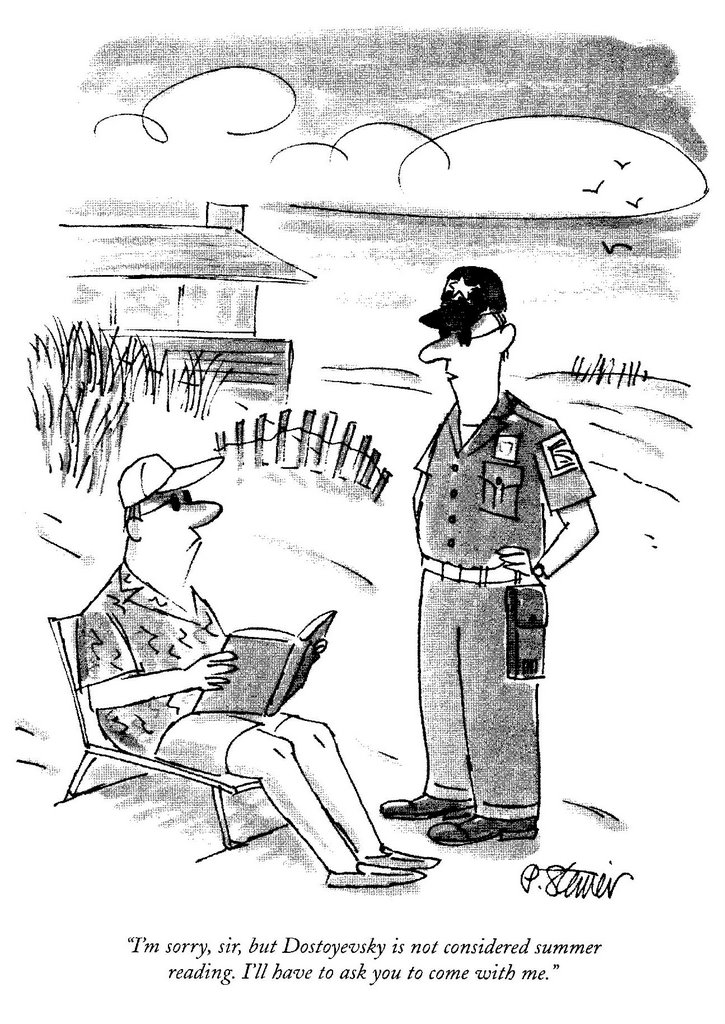
Fyodor DostoevskyThere’s a New Yorker cartoon in which a guy reading a book on the beach is approached by a policeman. “I’m sorry, sir,” the cop says to him, “but Dostoevsky is not considered summer reading. I’ll have to ask you to come with me.”

I thought of that cartoon last week as I read Fyodor Dostoevsky’s The Gambler -- one of the 19th-century Russian novelist’s lesser known novels, although certainly his most popular in the poker world. References to The Gambler pop up in many poker books, particularly “literary” ones like Anthony Holden’s Big Deal, the late David Spanier’s The Hand I Played, and James McManus’s Positively Fifth Street.

The novel is set in the fictional German city of Roulettenburg -- kind of a 19th-century European version of Vegas -- where the main character, a tutor named Alexey Ivanovitch, unsuccessfully battles his obsession with the game after which the city is named. There is one card game that comes up occasionally in the novel, a game called trente et quarante (a.k.a. rouge et noir) that is essentially a kind of roulette using six decks of playing cards rather than a wheel and a ball. (You can still get a game of trente et quarante in Monte Carlo, apparently.) However, roulette is the game that Alexey plays the most, and that’s the game about which Dostoevsky (himself a roulette addict) has the most interesting things to say.

Anyone at all serious about poker will be quick to point out that poker ain’t roulette. Some go so far as to distinguish poker from gambling altogether, insisting that it’s a skill game wherein the better-equipped players always win out over time. I like how Miller/Sklansky/Malmuth treat this subject in the opening sections of Small Stakes Hold ’em. They assert that, in fact, “poker is gambling,” and the schmo who says it ain’t “does not understand poker as well as he should.” Poker is gambling because it always involves some measure of uncertainty, particularly with regard to the cards. Sure, at times we might be uncertain about our opponents’ play or holdings, but better players eventually can get a line on those things.

Yet even the very best poker player cannot get a line on precisely what card is gonna come on the turn or river. (Raise yer paw if you’ve also lost a 20+ BB pot to a river one-outer . . . . There we go.) So while in poker you can (as Miller/Sklansky/Malmuth explain) play in such a way so “that your expectation can be positive,” when you play poker you’re still gambling. That's why The Gambler ultimately touches on so many concepts of interest to poker players.

As a way of responding to the book, I thought I’d focus on a few ideas related to gambling that come up in The Gambler that might be of particular interest to poker players. I’ve pulled out three ideas or concepts, all of which could be made to relate to the “psychology of poker” -- that is, all three concern how our minds work (and, at times, fail to work) when we play.

The first has to do with how a particular sequence of hands will affect our thinking regarding what comes next. The second involves the way the game tends to consume us, causing us to forget about everything else besides the “here and now.” The third has to do with issues of control and personal responsibility, and how poker (or any form of gambling) strangely satisfies certain, contradictory desires most of us seem to possess.

I’ll discuss these ideas in separate posts over the next few days. Afterwards you can decide if you want to check out The Gambler yourself. Of course, you’ll want to keep one eye out for the summer reading cops if you do.

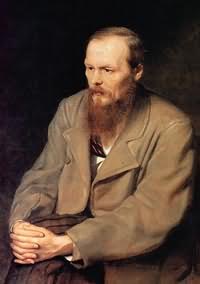
Image: Vasily Perov, portrait of Fyodor Dostoevsky (1871), public domain.

Labels: , , , , , , , , , ,


Older Posts

Copyright © 2006-2021 Hard-Boiled Poker.
All Rights Reserved.