Monday, July 25, 2016

The Asynchronous Audience

Over the last few days I’ve gradually been listening to the final PokerNews Podcast of the 2016 World Series of Poker (episode #406) -- of the summer portion of the WSOP, anyway. Kind of just the way things worked out in terms of my listening opportunities, although there wasn’t such an urgency to listen right away as there was with earlier episodes since this one recapped the action as it concluded on that final day when the Main Event played down from 27 to nine.

That’s where the Main Event will remain, of course, for approximately 100 more days until the “November Nine” (which starts at the end of October) finally gets going.

There are a lot of good interviews in this episode -- the ones with Gordon Vayo, Cliff Josephy, and Griffin Benger stand out as especially interesting. Again, I’ve said it before (and recently), but Remko Rinkema is terrific with these.

Along the way Remko and Donnie Peters talk through that last day, recounting highlights and big hands. Which is how most of us will be experiencing that day (and the couple preceding it) once ESPN begins airing its coverage -- not until Sunday, September 11, actually.

In other words, the WSOP shows won’t begin on ESPN until after the NFL has already begun, as the network is obviously once more using poker as a kind of “counterprogramming” to football. Doesn’t matter too much, though, as I imagine many will go the DVR route, watch “on demand” via the WatchESPN app, or view the episodes online in some other fashion when and where they wish. Kind of like the way I’m listening to the PNPod.

If you think about it, those of us who like to follow the WSOP Main Event now experience this particular tournament very much like other “series” people watch on demand -- i.e., dramas, comedies, etc. That delivery method also creates conditions for the same sort of “asynchronous” dialogue about the tournament we often have online via various social media outlets and discussion forums.

All of which means our talk about the tournament so far has been necessarily scattered and strung out. Even when the episodes start airing seven weeks from now, they’ll only serve as vague points of reference for the discussion as it goes forward -- apart, perhaps, from a big hand or two (such as Benger’s aces-over-kings ouster of the talkative William Kassouf in 17th) which might get us all on the same page for a brief moment.

Not saying this is good or bad, just different from most major poker tournaments and sporting events that are covered live (or essentially live), and perhaps more like other facets of entertainment culture that are not collectively experienced at once. At least the final table will give us a chance to witness and respond to the WSOP Main Event as a group.

Meanwhile, if you want to talk about the WSOP Main Event, well, go right ahead. We’ll catch up eventually.

Image: “Scattered Time,” dommylive. CC BY 2.0.

Labels: , , , , , ,

Monday, July 11, 2016

Tuning into the Main Event

The World Series of Poker Main Event is now well underway, and in fact the last of the three Day 1 flights is already edging over into its latter levels.

Back at the start of the WSOP I had predicted 6,613 for a total number of entrants this year, and for a while this afternoon and early evening it was looking like that might have been an uncannily close guess. They pushed past that mark, though, hitting 6,737 overall after a monstrous Day 1c field of 4,240 -- the largest single flight ever.

As has been the case the last three summers, I’m realizing as the WSOP Main Event gets underway that without any sort of live streams or anything beyond the hand updates and chip counts, it feels as though there’s a hole in the coverage. Too bad they cannot have an EPT Live-style stream running these first several days of the event -- say, up until Day 4 or whenever edited ESPN shows are going to pick up the story once they start airing later in the summer.

This is a point that keeps coming up every single summer. Matt Glantz tweeted about it a year ago (earning himself a block from the WSOP account for doing so). “Players would tell you that an absence of live streaming, in an event so big to the game, is a huge mistake that needs to be turned around for the upcoming year,” wrote Glantz. Alas, such a move didn’t happen, likely due to preexisting agreements with ESPN. Instead it’s almost as though with the Main Event the WSOP is already kind of over for the summer for those following from offsite. I’ll still eagerly check in on how things go from here, of course, particularly once the field shrinks to less than 100 and the pre-final table excitement starts to build. But it’s almost like mentally I’m recording everything to watch later, not fully focusing on it right now.

I’ve had fun again this summer listening to the PokerNews Podcast with Remko Rinkema and Donnie Peters, catching it nearly every day while doing barn chores or other outdoor activities. Has been a fun way to follow results, while also including a lot of interesting discussions about various topics having to do with the current state of tournament poker. (Remko’s also terrific with interviews -- I marvel at how good he is.)

The “PNPod” made me think some sort of live audio from the Main Event each night could be an entertaining and different way for audiences to experience the tournament. The final day in particular -- when they play from 27 to nine -- could be covered from start-to-finish as a radio show, interspersing interviews. I know I’d listen.

Then again, I might be a bigger fan of radio and “theater of the mind” than the average content consumer. Still, it’s starting to feel like in this age of the live streaming and all of our nonstop “feeds” that live updates might finally be slipping over into anachronistic status.

Labels: , , , , , ,

Friday, July 01, 2016

What Mitchell Towner Did On His Summer Vacation

I’m kind of chuckling at this result from one of the World Series of Poker bracelet events this week, the so-called “Monster Stack” event that cost $1,500 to play and which attracted a huge field of 6,927.

A fellow named Mitchell Towner won the sucker, collecting a $1,120,196 first prize that will end up being one of the biggest cashes anyone makes all summer at the Rio All-Suites Hotel and Casino.

Towner is an Assistant Professor of Finance at the University of Arizona, which means he hasn’t gotten tenure yet and might have had to dodge teaching during summer session in order to take a Vegas vacation. Towner is a self-admitted amateur; in fact, he said afterwards (as reported by PokerNews), “I really don’t play poker.”

The WSOP’s official report elaborates a bit more on Towner’s story, including his sharing how he only devotes about an hour a week to poker, and had only twice before played events with buy-ins of more than $100.

Gotta love Towner’s Hendon Mob page, listing exactly one cash worth $1,120,196.

I was listening to Remko Rinkema and Donnie Peters chatting about Towner’s win on the PokerNews Podcast, and Remko pointed out how players can safely assume the $1.12 milly Towner won was now gone for good from the poker “economy,” not likely to be put back in play by the 29-year-old teacher.

Indeed, with a Ph.D. in finance, he probably has a good idea how smart it would be to put nearly all of those winnings away, perhaps only to play other small buy-in events here and there during the breaks between semesters.

Am doubly glad to hear of fellow teacher and fellow amateur being the one to tame the “Monster Stack.”

Photo: WSOP.com.

Labels: , , , , , ,

Thursday, November 19, 2015

Sidestepping the Spoilers

Was listening to last week’s PokerNews podcast today -- not the most recent one, but the “November Nine Recap” one in which Donnie Peters and Rich Ryan broke down the World Series of Poker Main Event final table (Episode #343).

Besides discussing all the key moments from Joe McKeehen’s dominating win, the pair got into some other related topics as well including considering suggestions for improving the WSOP Main Event going forward and whether or not the November Nine experiment has run its course after eight years’ worth of delayed final tables.

Near the very end they played a voice mail from a listener referring back to Donnie’s live tweeting during the final table, and from there came a short discussion of the whole “spoilers” topic. Donnie was one of a few folks tweeting live from the Rio that night, which meant those watching the coverage on the ESPN networks (on a half-hour delay) needed to mute or unfollow those Tweeters if they didn’t want to know ahead of time what they were about to see.

I tried to mute everyone who like Donnie warned they’d be tweeting “spoilers” during the WSOP Main Event final table. It almost worked except for once when someone retweeted a knockout before it had shown up on the teevee (argh!).

I thought of that conversation again just now while watching the World Poker Tour’s live stream of the final table of the WPT Montreal event from the Playground Poker Club. There, too, one can enjoy “cards up” coverage on a half-hour delay. (Side note: The WPT stream shows all players’ hole cards, not just players voluntarily putting chips in the middle like they’ve been doing with the WSOP ME final table. The WSOP should be showing everyone’s cards, too, I think, for the sake of fairness.)

Anyhow, you run into a similar “spoiler” issue following live updates from the event on the WPT site alongside the live stream, as the hand reports are a half-hour ahead of what is being shown. They’re also tweeting live updates about the final table from @WPTLive, which means you can’t follow that and watch the stream without being told about things ahead of time as well. (E.g., that bold five-bet shove by Brian Altman with pocket fours pictured above was partially signaled a half-hour ahead of time via the Twitter feed.)

Just now on the WPT feed play was delayed for a couple of moments while Mike Sexton, Vince Van Patten, and Lynn Gilmartin could be heard adding some commentary for the edited version of the final table that will be shown later -- a phenomenon I wrote about here once before following a WPT final table I helped cover. Kind of wild to think of the many different ways the WPT is covering their event all at once -- live, on a half-hour delay, then yet again in a different, edited way on longer delay.

Over on the European Poker Tour, the issue is handled pretty effectively via an embargo (of sorts) on reporting ahead of the delayed live stream. That can’t prevent non-media folks from tweeting out what’s happening, but the system works pretty well. It also kind of “unifies” the coverage with the live updates, the features on the PokerStars blog, the EPT Live stream, and all of the coverage appearing on other online outlets all operating in tandem rather than one “spoiling” things for any of the others.

I really enjoy watching live streams, and I also like being on social media to share the experience (such as when the WSOP Main Event final table is playing out). Indeed, as I observed last week when discussing the slowness of the WSOP ME FT, the pace of the game with its frequent pauses makes it well-suited to be combined with something like Twitter where spectators can share impressions as they watch. But “cards up” coverage can’t be provided without a delay, which necessarily introduces the possibility for “spoiler” situations.

I like the EPT’s attempt to solve the conundrum. Is there any other way to do so?

Labels: , , , , , , ,

Monday, June 08, 2015

The Strangest Race

Was listening earlier to the PokerNews Podcast where Jason Somerville, Donnie Peters, and Remko Rinkema are getting together in the Rio hallway every Monday, Wednesday, and Friday to talk about what’s happening at this year’s World Series of Poker. Have started to realize listening to these guys chatting for a couple of hours three times a week has become my primary way of following the WSOP.

I’ll read the recaps on PokerNews, follow the back-and-forthings on Twitter some, and occasionally visit Two Plus Two to see what the latest gripe is. I’m also tuning into the final table live streams over on WSOP.com which have been quite good, with better production values and graphics than what has generally been the case over there in the past.

I’m not sweating every event as I tended to do last year, but am still enjoying following some of the finishes. As far as getting deeper into what’s interesting about a given event or how the latest scandal is (or is not) being handled, though, I feel like just sitting in on the PNPod guys’ discussions has kept me as in tune as I want to be with the day-to-day out there this time around.

Today on the show one of the topics discussed was the WSOP Player of the Year race, which I mentioned here a couple of weeks ago is this year being newly “powered” (i.e., sponsored) by the Global Poker Index. It’s also thoroughly out of whack, predictably so as Jess Welman and others noted it would be even before things got started.

Among the strange examples Donnie cited today was the case of Cord Garcia (a.k.a. Lance Garcia), winner of that crazy Colossus (Event No. 5) that drew 22,374 entrants. Garcia also picked up a small cash in the Millionaire Maker (Event No. 16).

Garcia is one of only 15 bracelet winners thus far; however, those achievements are only enough to put Garcia in 230th place (!) in the WSOP POY race at the moment. No shinola. He earned nearly as many points, actually, for finishing 652nd in the Milly Maker (101.71 pts.) as he did for winning the Colossus (128.92 pts.). (Click the pic above to details of his current ranking.)

In fact, the current leader Paul Volpe (who has two runner-ups and a 12th-place finish already) has about five times as many POY points as Garcia. Garcia could have won the Millionaire Maker, too, and then gone on to win the Monster Stack (Event No. 28) and the Little One for One Drop (Event No. 61) and still would finish with less points than Volpe already has through the first two weeks.

That’s because (as Jess pointed out in her pre-WSOP post) all of these events feature buy-ins of $1,500 or less, and according to the GPI formula are diminished in value, POY points-wise, relative to the bigger buy-in tournaments. By a lot.

I’m of the group that tends to view the whole POY thing as a diverting bit of trivia, hardly of central significance to the WSOP. But the formula being used is so strange and non-intuitive, it’s hard to assign much importance to it at all.

The imbalance in favor of bigger buy-in events also makes it a race many players are essentially not even able to participate in, which as the PNPod guys noted is too bad for Garcia and others who might’ve earned a little more notice had their wins gotten them into those POY conversations.

Then again, I guess Garcia was in a POY conversation -- for being out of the running, that is, and not a contender.

Labels: , , , , , , , , , , ,

Monday, June 01, 2015

Riding the Colossus

Over the weekend I gave some time along with many other poker people tracking how that “Colossus” (Event No. 5) was playing out at the World Series of Poker, marveling as others did at the numbers it was producing.

The name sounds like what you might call a roller coaster, and in fact there was a well known ride at Six Flags Magic Mountain in California called the Colossus. That was the one you see in National Lampoon’s Vacation (the “Screemy Meemy”), and I’m reading it also turns up in the classic KISS Meets the Phantom of the Park, although the ride is now closed due to a fire last year.

Was a fast, wild, bumpy ride for the poker Colossus, too, the last couple of days.

I appreciated some of the things regarding the $565 buy-in event Jason Somerville, Remko Rinkema, and Donnie Peters discussed on the Friday episode of the PokerNews Podcast, in particular what they had to say regarding the Colossus functioning as many players’ “Main Event” (more or less) as far as the WSOP was concerned. It was also interesting to see the reports of poker rooms all around Las Vegas booming with business, too, as a side effect of the event bringing so many poker players to Sin City.

The final total came to 22,734 entries (about 5K over my guess), a number that includes the many, many re-entries as players could fire up to four times. I’d expected to hear something around that number (or a little less) as the total prior to players getting their refunds for unused entries, but it sounds like that total comes after subtracting those, as there were 25,571 “raw, paid entries” altogether.

As the guys on the “PN Pod” discussed -- and as many others who played the event were tweeting about, too -- there were a lot of first-time WSOP players in the Colossus. Would be interesting to know exactly how many were playing their first ever WSOP event, or even just a rough percentage. Perhaps half? More?

[EDIT (added 6/3/15): The WSOP did release further Colossus stats, noting there were 14,284 unique players and that 5,664 of them -- just a tad under 40% -- were playing in their first ever WSOP event.]

The crew’s sentiments about it shaping up to be an especially positive experience not just for the newcomers, but for the experienced players, too, were all convincing.

As you’ve surely heard by now, 22,734 entries translated to a prize pool of $11,187,000 to be divided by the top 2,241 finishers (a little over 10% of the field). They already made it to the money last night, in fact, with no less than nine all-ins during the final hand of hand-for-hand play.

Of course, if you were following things last night you know that the excitement of the bubble bursting was basically set to the side thanks to the animated response to the announcement of the prize pool, in particular to the $636,880 up top for the winner. That figure surprised many who thought first place in a tournament with that many entries and a $11,187,000 prize pool would at least pay a milly to the one managing to survive the record-crushing field.

Not having any particular skin in the game made it easier for me to be entertained watching the Twitter feed last night as people took up either side of arguments regarding “flat” payouts, the “Golden Ratio,” the relationship of rake to payouts (or lack thereof), and so on. Defensive (and in some cases even seemingly dismissive) responses from the WSOP’s Twitter feed served to add further drama.

Marty Derbyshire does a great job summarizing last night’s immediate reaction over on PokerNews, if you missed that. Jeremiah Smith also has a good morning-after piece today over at All In where he focuses on the WSOP’s not having made clear beforehand the possibility of this particular payout schedule should the event draw the 20K-plus entries they were saying they expected it would.

Sort of felt a little like watching a movie in which the “Colossus” was this awesomely big, frightening-looking creature who turned out to be cuddly and lovable, someone everyone in the story liked. Then suddenly he starts breaking things and wreaking havoc, which might well have been expected given his size, but since everyone had been lulled into thinking they’d always like everything about him they all reacted with surprise.

I’m still on the side of those thinking the event ultimately seems as though it is (or will be) mostly positive, all things considered. And perhaps after this first wild ride it will serve to teach some lessons to players and tournament organizers alike -- also a positive.

Labels: , , , , , , , ,

Tuesday, January 22, 2013

A Heads-Up on the NBC Heads-Up

Most readers of this blog probably have been hearing about the rebooting of the NBC National Heads-Up Poker Championship happening this week. After running from 2005-2011, Black Friday came along to turn the lights out on poker for a while, and the NHUPC went dark during 2012. But poker’s prospects are brightening here in 2013, and the event is returning.

As before, 64 players will compete in a “March Madness”-style series of heads-up matches. The names of the competing players were announced last Friday (save the one WSOP.com qualifier), and a draw party will be happening tomorrow at Caesars Palace in Las Vegas to determine the brackets.

The event will play out this Thursday through Saturday, Jan. 24-26. A $25,000 entry fee is being put up for each participant (either by the player or his or her sponsor). In the past, the entry fee was $20,000, with the prize pool then topped off further to total $1.5 million. Those who won two matches to make the final 16 were guaranteed $25,000, those losing in the quarters got $75,000, the semifinalist losers each earned $125,000, the runner-up took $250,000, and the winner made $500,000.*

Here is a list of who’ll be competing:


As was the case in previous years, the announcement of the list of invitees inspired a lot of conversation about who was chosen and who was left out. Donnie Peters posted a comprehensive breakdown on PokerNews over the weekend addressing all of the “snubs” and further commenting on the selections.

Like happens with the NCAA men’s basketball tournament every spring, such debates regarding the NHUPC are inevitable. And of course with poker there’s always that additional layer of discussion focusing on marketing the game and players being more or less “good for television.” As if ranking players isn’t hard enough, that additional issue regarding entertaining audiences and representing poker in the mainstream gets evoked as well to complicate further the conversation.

It’s all fairly diverting, though, and I think most agree that getting poker back on a major network represents a positive development for all. (The matches will begin airing in March.)

When I heard about the selections, I thought back to the criteria that had been previously employed for choosing players. If you recall, it was a pretty involved list that changed from year to year but usually included the previous five champions, the previous two runners-up, anyone who had cashed four consecutive years in the NHUPC, the previous three WSOP Main Event champions, and so on. The WPT Player of the Year, the EPT Grand Final winner, the BLUFF magazine POY, and others who’d achieved recent, significant poker successes were usually invited, too.

It appears that with the one-year hiatus these criteria for selecting players were probably jettisoned or at least modified considerably. For example, of the last five NHUPC champions -- Paul Wasicka (2007), Chris Ferguson (2008), Huck Seed (2009), Annie Duke (2010), and Erik Seidel (2011) -- only Seed and Seidel will be among the 64 this time.

We don’t necessarily know if Ferguson and Duke were invited or not, but I would think given both players’ current status in the poker community, it’s quite likely they were not. In fact, other than noticing a few of the more conspicuous omissions Donnie discusses in his article, the non-appearance of these two names in the list probably stood out the most for me as I first perused it.

While I know some would like the NHUPC to aspire to be more like the NCAA tourney and feature poker’s elite players and ultimately a worthy “champion,” the event obviously cannot ever realize such a goal. Even with ultra-rigorous vetting and/or selection criteria in place, the process will necessarily be imperfect. And to be honest I think it is better that there be no pretense to following some sort of quasi-objective criteria for selecting players.

(*EDIT [added 1/25/13]: Payouts for this year’s NHUPC are following a different schedule, with a total prize pool of $1.65 million: 1st, $750,000; 2nd, $300,000; 3rd-4th, $100,000; 5th-8th, $50,000; 9th-16th, $25,000. In other words, winning three matches only wins one his or her money back, and just $50,000 has been added to the entry fees.)

Labels: , , , , ,

Thursday, October 18, 2012

The Fun Factor

My friend Donnie Peters at PokerNews offered some food for thought yesterday with an op-ed titled “What Happened To Poker?

In his column, Donnie mostly refers to poker as it is played on the professional circuit, although in some cases his comments apply more broadly. He shares his impression that many players appear not to enjoy themselves very much at the tables anymore. And as the players seem to be having less fun, those covering and watching the tournaments tend to have less fun, too.

Donnie’s covered tourneys on pretty much every tour there is for the last several years, and thus has gathered a lot of experience watching the general mood and atmosphere at these events decline into the state he is describing.

He goes on to talk about the need for personalities and even some of the outrageous table behavior frequently highlighted on ESPN’s WSOP coverage during the “boom” years (liked by some, not so much by others). He also finds space to decry the robotic, emotionless poker played by many of the younger generation as well as the unpleasantness that sometimes arises from new players being criticized for their play and thus discouraged from continuing.

Donnie’s primary intention with the article was to get some conversation going about the topic, and I think he’s presented his argument in a way that definitely encourages response. As I read, I found myself thinking both about the game in general -- including what I’ve also witnessed when covering tournaments over the years -- as well as my own personal experience with the game.

I think many readers of this blog have probably gone through something similar with regard to poker whereby the initial “romance” of the game has either disappeared or waned into something less exciting and novel. I’ve told that story myself here several times and in several different ways, how the thrill and pleasure of the game was most intense early on and after a period of time necessarily became less so. And I’ve read others tell a similar tale, too, remarking how odd it seemed that the more they played and learned about poker, the less interesting and fun it was to play.

Thus when Donnie writes that “the poker industry as a whole has been at a standstill” and that poker has become “extremely stale,” I think at least some of us -- perhaps most of us -- might think about what he’s saying in personal terms. Do anything for years and years and it is going to lose its freshness.

Of course, Donnie’s talking primarily about the “industry” and thus is aiming his commentary more at major poker tours, television, and the way poker gets marketed to the masses. All that, too, has become “stale,” and he sees that trend as a primary reason for why “there aren’t hoards of new players flocking to the game” -- namely, because poker is “not seen as ‘fun’ to them anymore.”

There are other issues Donnie doesn’t bring up which might be cited as reasons why poker has become less attractive for new players.

One is brought up by a reader commenting on my post from yesterday in which I discussed Howard Lederer and the ignominious fall of Full Tilt Poker. As Robert Johnson points out, scandals such as the ones at Absolute Poker, UltimateBet, and FTP have had a significant effect, and I think Robert’s correct to present them as causes for “why poker is losing favor with many people in the real world.”

Another related reason is the (essential) loss of online poker here in the United States, which for many of us (myself included) pretty much signaled the end of our being able to play and enjoy the game on a regular basis -- that is to say, to enjoy playing poker without having to worry too much about the status of the game itself.

I’m reminded of a post I wrote here way back on Friday, October 13, 2006. That was the day President George W. Bush signed into law the SAFE Port Act to which the Unlawful Internet Gambling Enforcement Act was surreptitiously attached. I remember in that post referring to the Crazy Ralph character from the original Friday the 13th running around Camp Crystal Lake with warnings about how “you’re all doomed” as I drew a comparison to how online poker would subsequently be played.

“Be nice to play a few hands without all the drama,” I said, likening Crazy Ralph’s worrisome ramblings about a “death curse” to the situation of playing poker with an apprehension that at any minute the game could be forcibly taken away. Which, of course, eventually happened, although it took about four-and-a-half years.

Perhaps we online poker players were “doomed” even if the UIGEA had never been passed. In any case, I think the legal machinations constantly surrounding (and sometimes threatening) poker -- both online and live -- must have a wearying effect, and in some cases have to make playing the game less fun or attractive.

A third point to add here has to be the fact that as the game grew over the last decade, the money became more significant -- there’s more to be won, but more to spend, too. The primary motivation for most players participating in tournaments on the circuit is to profit, with the fun of tournament poker not really registering as a meaningful factor. The stakes are high, and a lot of times the risks are, too. And even in the best of all possible environments, around nine out of ten of those who play in a poker tournament are going to leave losers, and losing pretty much makes anything less fun.

In other words, I think there are probably certain other relevant factors -- the scandals, the legal threats, the relative accessibility of the game (for some), the increased expense/risk, and even the inherent nature of poker being a game that creates more losers than winners -- that are worth thinking about when examining “what happened” to make poker less fun over recent years.

It’s definitely worthwhile, though, for those of us who care about poker and who want to keep playing to consider how we might keep the game fun.

Labels: , , , ,

Tuesday, June 26, 2012

2012 WSOP, Day 30: Attempts at Time Travel at the WSOP

Attempts at Time Travel at the WSOPI’m not a huge science fiction fan, although I have a few favorite authors and novels. In grad school once I had the opportunity to help teach a history of SF class, and so became acquainted with some of the periods and subgenres like the early adventure/pulp stuff and the “space westerns,” “hard” and “soft” SF, alternate history SF, the variety focusing on satire/social commentary, cyberpunk, and so on.

Time travel stories represent another category of SF that always intrigued me, especially those stories that used the conceit of traveling through time to explore ideas about what might be natural to us as humans and what is learned behavior or thinking. You know, stories that use time travel to show how particular cultures shape us into being and acting a certain way, with the move to the past or future forcing characters to question assumptions about themselves or each other. (See Mark Twain’s A Connecticut Yankee in King Arthur’s Court.)

You could say any attempt to write factually about something that has happened in the past is a little like traveling through time. Even writing up a hand report at a poker tournament involves imagining for a moment what you experienced a few minutes before.

In that case there are usually certain tangible facts that overwhelm the story and its significance, namely, the cards that were dealt, the bets that were made, and the ultimate impact of the hand on the tournament as a whole. Other elements might be worth including, too, as part of the effort to give a reader a sense of what it was like to have been there, standing nearby, watching what happened. But at the heart of it is an attempt to go back, to relive.

Last night I was helping cover Event No. 44, a $1,000 no-limit hold’em event in one corner of the Amazon. Meanwhile, across the spacious ballroom on the other side of the science-fiction-y “mothership,” there arose a complicated situation in Event No. 45, the $50,000 Poker Players Championship, surrounding a controversial pot-limit Omaha hand primarily involving Nikolai Yakovenko, Shaun Deeb, and Abe Mosseri. You’ve probably already heard something about this one, which came up last night right at the end of Day 2 of that five-day event.

Donnie Peters wrote up a detailed report of what happened (in two parts) for the PokerNews blog. In the first part, Donnie explains the complicated preflop betting that saw four players limp in, the small blind complete, then the big blind raise and the first three limpers call. Deeb then reraised with the rest of his chips from the button -- he had less than the amount needed to make a pot-sized raise, so he was all in. It folded to Yakovenko in the big blind who reraised over the top of Deeb’s raise, and only Mosseri called (after an especially long time in the tank).

The hands were tabled and the community cards dealt with Deeb winning the main pot and Mosseri the side pot. Then arose the real controversy over Yakovenko’s reraise over Deeb’s raise. According to Donnie, he’d said he was “all in” although he could only reraise the size of the pot. Which suggests he wasn’t really all in. And which also suggests Mosseri’s call wasn’t for all of his chips either (Yakovenko had Mosseri covered by a little), but for just whatever amounted to a pot-sized reraise. This despite the fact the players had played the hand as if it were an all-in shove and call.

At issue, then, was the side pot and how much Yakovenko really owed Mosseri after the hand. But the floor came over and apparently initially ruled that since Mosseri had only technically called a pot-sized reraise preflop, there should have been a betting round after the flop (there hadn’t been -- the five community cards were dealt out without any chances for post-flop betting), and thus “the turn and river would have to be rerun as the flop action hadn't been complete,” as Donnie reports.
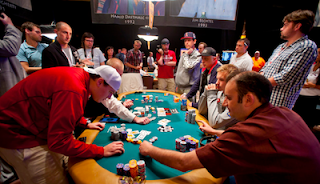
Time-Travel HandIn other words, it appeared as though they were going to try to go back in time (so to speak) to deal the turn and river anew, this time giving Yakovenko and Mosseri an opportunity to bet, raise, or fold. Such a ruling also meant Deeb was no longer safe. He’d survived the hand by flopping a set of jacks, then rivering a flush to beat Mosseri’s A-A-x-x and Yakovenko’s K-K-x-x. (I like how PN photographer Joe Giron used the fish-eye on that pic, adding a bit further to the weirdness of it all.)

See Donnie’s post for all of the specifics. He uses that initial ruling -- and Deeb’s understandably incredulous response -- as a cliffhanger moment, then comes back with the second part of the story in which the ruling gets overturned. There would be no redealing of the turn and river, after all. Also, Yakovenko was made to pay off Mosseri as though it had been an all-in situation even though Yakovenko couldn’t have raised all in, because that was essentially how the players had played the hand. (Sounds like a correct ruling.)

By the way, B.J. Nemeth additionally reported the hand for PokerListings. And both Donnie and B.J. did especially well, I thought, relating what happened clearly and thoroughly.

The controversy then continued when Yakovenko (crippled in the big hand) busted shortly thereafter and Phil Ivey was moved to the table to fill the empty seat. Because Mosseri had tanked for so long (possibly as much as 15 minutes, according to Donnie) and the subsequent efforts to get a ruling on the hand took a lot more time, players were unhappy they’d missed most of the last level of the night while other tables played on.

They’d already reached the point where it had been announced the clock would be stopped and only four more hands would be played. That’s when the table apparently proposed playing the last four hands of the night with Ivey, then have Ivey leave the table and allow them to play 15-20 more minutes to make up for hands lost before.

Ali Eslami explained it all to Donnie, using what I consider the line of the night to explain the players’ thinking. It would be like "going back in time to fill the space," Eslami told Donnie. The floor wasn’t going for that, though, and after four hands with Ivey the day was done.

Love that line. Probably a very good thing they weren’t allowed to go back in time to fill the space. All of us in the Amazon Room might have gotten swept up into a black hole or something, jettisoned out into a different dimension entirely.

Man, it would’ve taken forever to get a decent ruling if something like that had happened.

In the end, then, there were a couple of moments in the story where people had seriously entertained the idea of “going back in time” to redo things. In the first, the floor actually ruled they’d be redealing a turn and river in the big hand, then changed their minds. In the second, it was the players coming up with the idea of going back and reliving a section of Level 10, but that plan didn’t materialize either.

Not that you really can go back in time. Not really. Still, the desire to do so more or less possesses us so frequently. Happens constantly in poker tournaments. And in poker tournament reporting, too.

Probably says something about human nature, this desire we have always to go back and “get it right” or at least do things differently.

But no, the present is where we must remain, spending much of our time thinking about what has happened. And what might have been.

Labels: , , , , ,

Tuesday, June 15, 2010

2010 WSOP, Day 18: Beating 2-4

Beating Two-FourRelatively speaking, yesterday was one of the less hectic days at the WSOP in terms of number of events being played. Whereas on Saturday (say), there were six different events going on throughout the day, with two final tables, yesterday there were just four and one final table.

Of course, I ain’t gonna say anything remotely resembling that it was not a busy day at the WSOP too loudly around my buds F-Train and Donnie Peters. That is because those two were assigned to cover the one final table yesterday for Event No. 25, the $10,000 Omaha Hi-Low Split-8 or Better Championship. Which only ended like a half-hour ago. Looks like even the otherwise indefatigable Dr. Pauly had to give up and go to bed before the sucker finally concluded.

F-Train and Donnie knew the deal when things first got started for them mid-afternoon on Sunday. As F-Train’s Day 3 intro post notes, they had 23 players coming back yesterday, and so knew it was going to be a long, long day from the beginning. I haven’t checked the schedule, but I’m hoping for both those guys’ sakes they have today off, or at least aren’t to come in until later in the afternoon.

Meanwhile, I ran well yesterday -- in a couple of ways.

For one, I had the day off, and so for the first time since the WSOP started -- save that week-long Peru excursion for LAPT Lima -- I did not set foot in the Rio. Took care of some day-to-day stuff, including getting ready for Vera’s visit later in the week by renting a car (something I’ve held off doing until now).

Also got to visit with my friend the Poker Grump, having a delicious early dinner at Bachi Burger, an “Asian Inspired BBQ Burger restaurant.” I had the Banh-Mi burger, garlic salt & pepper french fries, and a strawberry Boba drink. Just awesome. Vera and I may be going back there when she comes. (Here’s a page full of photos of dishes and the menu, if you are curious.)

Then Bob and I went for a short session of low limit hold’em afterwards at the MGM, where I ran well again. Couple of full houses, a few other one-pair hands holding up, and even a hand in which I somehow -- incredibly -- beat Bob’s 2c4c.

Readers of the Grump are well aware of his long-time championing of the “Mighty Deuce-Four.” I explained to the Grump after that hand that as strong as the deuce-four is normally, in $2-$4 it gets cracked all the time.

Anyhow, things get busy again today, both for me personally and the WSOP in general. At least five or six events will be going on every day this week.

For the next three days, I’ll be helping report on Event No. 28, the $2,500 Pot-Limit Omaha event. I might have anticipated Sammy Farha -- the Omaha king -- perhaps to show up for this one, but he was up late last night, too, winning that Event No. 25 (his third Omaha bracelet). Also, Farha doesn’t tend to play the lower buy-in events, anyway.

We’ll see, though. Check in over at PokerNews’ live reporting for news from all five events happening today.

Labels: , , , , , ,


Older Posts

Copyright © 2006-2021 Hard-Boiled Poker.
All Rights Reserved.