Thursday, October 08, 2015

WSOP Europe Begins in Berlin

The World Series of Poker Europe quietly began today at the Spielbank Berlin Casino in Germany. I say “quietly” because I can’t remember there ever having been less buzz about the WSOPE before.

This marks the eighth installment of the WSOPE which dates back to 2007. It’s also the first one to come after a two-year gap after there having been seven straight years’ worth of WSOPEs from 2007 to 2013.

From 2007-2010 the WSOPE took place in London, growing from three to five bracelet events over that stretch. Then from 2011-2013 the festival traveled to France, taking place in Cannes twice then moving to Enghien-les-Bains (north of Paris) in 2013. There were seven bracelet events for each of those two years in Cannes, then eight bracelet events in Enghien-les-Bains.

This year there are 10 bracelet events, with buy-ins ranging from as little as a couple of €550 buy-in events (one no-limit hold’em, one pot-limit Omaha) up to the €10,450 NLHE Main Event and a €25,600 High Roller. Looks like a small field of 197 showed up for today’s Event No. 1, a €2,200 NLHE 6-Max. event.

Most of what I saw over Twitter the last couple of weeks with regard to WSOPE were occasional notes from players wondering how to wire funds to Berlin and appearing to run into hurdles preventing them from doing so. Now that things have started, there are some updates (in English) on WSOP.com and also live reporting (in German) on the PokerFirma site (where the WSOP updates are also being funneled through).

Things pick up, coverage-wise, this weekend with live streaming of several events on Twitch starting tomorrow. I think, though, that neither the Main Event nor the High Roller is going to be featured there, as those are being shot for ESPN. (Not 100% sure about that.) Here’s the presser spelling out what WSOP is doing to cover the series.

For various reasons it feels almost more like a WSOP Circuit stop than a major stop (looking at it from afar, that is), with the upcoming European Poker Tour festivals in Malta (later this month) and Prague (in December) seeming more significant by comparison.

We’ll see how (or if) the bracelet buzz builds by the time the Main rolls around. Not hearing too much as yet, though.

Labels: , , , ,

Friday, October 25, 2013

If You Never Go All In, You Cannot Lose

“Tournaments are like plus-EV lottery tickets... or in some cases, minus-EV lottery tickets.”

That was an idea tossed out by Phil Laak this week while helping with the commentary on the WSOP Europe live stream. Kind of an interesting observation, I thought, about tournament poker that highlighted how much luck is involved in winning a tourney while also noting that some players can via their skills and tourney know-how lessen that chance element -- or, with a lack of such know-how, increase it.

During some of the breaks this week on the WSOPE stream they’ve been showing clips from last year’s WSOPE Main Event final table won by Phil Hellmuth. Saw the finale again a little earlier today, including Hellmuth’s coming over to the rail after winning and saying something about having been all in and at risk only a single time throughout the entire tourney.

We take him at his word, I suppose, but in truth I think that is one statistic Hellmuth can be counted on to keep track of as he plays -- namely, the number of times he’s been all in and at risk in a tournament. He’s famously pronounced in the past with pride his ability to avoid such spots in tourneys. Of course it is an inarguable truism that if you never go all in versus a player with more chips, you cannot possibly be eliminated. (Easier said than done.)

Was kind of setting those two ideas beside each other today while watching what has turned out to be a long heads-up battle between Fabrice Soulier and Adrian Mateos, thinking about how that strategy of avoiding all-ins -- when employed in conjunction with a lot of other poker skills, of course -- can work to improve ones chances in the tourney “lottery.”

Especially in a relatively small field tourney like the WSOPE Main Event usually is -- Hellmuth topped a field of 420 last year; there were 375 entered this time -- the chances of making one’s way all of the way through it without being at risk more than once is better than is the case, say, in the WSOP Main Event where I have to imagine all nine of those who made this year’s final table were at risk somewhere along the way, perhaps more than once. Would be interesting to sort that out regarding this year’s November Nine (if possible).

In any event, it’s interesting to think how playing a tournament is on one level a willing acceptance of risk (especially from the perspective of a cash game player), a primary strategy of the tournament itself is to avoid risk.

Have a good weekend all. And whatever you do, manage your risk appropriately.

Labels: , , , , , ,

Thursday, October 24, 2013

From the Front Row

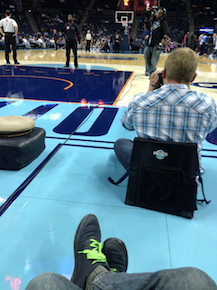
Kind of a crazy day filled with various tasks and obligations that carried me past the dinner bell without even having stopped to eat anything. Looking up and realizing night had fallen, I remembered having agreed to go see a Charlotte Bobcats’ preseason game with my friend, James, a season-ticket holder who had asked me earlier in the week about going.

I raced down the highway to arrive shortly after tip-off, then was pleasantly surprised to discover James had in fact scored us a ticket upgrade that put us courtside, right on the first row just a few feet from the baseline. Even better, the ticket got us into a buffet -- free through the first quarter! -- and before we got comfortable in our seats I’d had the chance to fill my empty belly with some good eats.

Like I say, the day had been filled taking care of a number of different tasks, all done while I had the WSOP Europe €25,600 High Roller final table streaming, eventually won by Daniel Negreanu who also clinched the WSOP Player of the Year for his finish. That’s two WSOP POYs for Negreanu after having one before in 2004, and caps a fairly remarkable year’s worth of tourney finishes dating back to his WSOP APAC Main Event win.

Was kind of interesting to hear it reported early on during that final table that those remaining had made a “gentleman’s agreement” not to collect any information from live stream which came with a half-hour delay and with hole cards shown after the hands had completed. (For more about the delay and players utilizing such info, see last week’s post “The Blessing and the Curse.”)

I think my favorite comment regarding that agreement came via Twitter from Mike “Tîmex” McDonald who tweeted “Just a headsup if I’m ever part of a gentleman’s agreement to not utilize hole card info from a live stream. My word is worth under €725,000.”

Actually I stayed away from Twitter for much of the day, especially once the final table got going in earnest, as I didn’t care to have results reported ahead of time. That delay starts to work on you after awhile, I think, so much so that once I finally tore myself away from work to go to the game it was a little disorienting suddenly to be back in “real time” so to speak.

Sitting so close to the action was a little jarring, too. I would say I felt like Haralabos Voulgaris, who whenever he sees an NBA game live he invariably sits courtside. But it was preseason, and the Bobcats and the Cavs, and, well, that ain’t exactly “high rolling.” But it was fun to pretend. The Bobcats won tonight, though it will probably be another long season.

Was also in very close proximity to lots of sideline reporting going on, and glancing over shoulders I saw people blogging and tweeting not unlike what I do when live reporting from poker tournaments. Indeed, it took me a few years to figure this out, but that sort of work resembles sports reporting more than anything else, and thus when people ask me what I do these days I find myself often quickly bringing up reporting on sports as the easiest way to explain writing about poker all the time.

Speaking of NBA ball, I’m contributing to a roundtable over on Ocelot Sports that will appear soon in which some of us are picking over/unders on all 30 teams, so check over there for that.

Now I’m back home and settling into some more sports-watching in real time, flipping back-and-forth between Game 2 of the World Series and my Panthers playing Tampa Bay. Will slide back into the delay again tomorrow, though, I imagine, to see that WSOPE final table play out, again taking a front row seat... on my couch.

Labels: , , , , , , , , ,

Tuesday, October 22, 2013

Hellmuth Wants To Draw a Line in the Sand

Been continuing to follow the coverage of the 2013 World Series of Poker Europe on various sites, in particular of the Main Event which today played down to 24 players. A little drama at the end of today as Daniel Negreanu was finally ousted in 25th place for a cash worth €21,750. His knockout today means Matthew Ashton stays in front in the 2013 WSOP Player of the Year race as Negreanu needed to finish seventh or better in the ME to pass him.

Negreanu immediately hopped into Event No. 8, the High Roller event for which the buy-in of €25,600 was just a bit higher than his take-away from the ME. He could still pass Ashton in the POY race with a high finish in that one, I believe, as long as Ashton doesn’t do better. And while Ashton has the edge there are some other scenarios still in play, too, as Tim Fiorvanti broke down over on BLUFF today.

Negreanu, of course, got a head start in the 2013 WSOP POY race by winning the WSOP Asia Pacific Main Event back in April where he also final tabled another preliminary event. All of the open-bracelet events in the WSOP APAC, the WSOP in Las Vegas, and WSOP Europe count toward the WSOP Player of the Year race.

Speaking of whether or not certain events “count” when it comes to the WSOP, Phil Hellmuth offered some thoughts a few days ago to Thomas Keeling (a.k.a. “SrslySirius”) about whether or not bracelets won at WSOP APAC should “count” or not. Hellmuth, of course, has an obvious interest in that particular tally given that he leads all with 13 total bracelets, including one in the 2012 WSOP Europe Main Event.

In a video made at WSOP Europe, Keeling put the question to Hellmuth directly about the relative value of the WSOP APAC or WSOP Europe bracelets, and the Poker Brat responds initially by saying “There’s two bracelets that no one can argue with, you know... Daniel’s -- he won the Main Event in Australia -- and mine -- I won the Main Event [in Europe in 2012]. So those should count for sure as bracelets.”

Hellmuth is implying, of course, that it might be debatable whether to count bracelets won in preliminary events in Europe or Australia, so Keeling asks him if he thinks Phil Ivey’s ninth bracelet -- won in Event No. 2 at the 2013 WSOP APAC, a $2,200 buy-in (AUD) mixed event in which 81 players took part and Ivey won only a little over $50K -- doesn’t “count.”

In his response Hellmuth kind of talks himself into saying Ivey’s bracelet counts, although it’s pretty obvious he wants to say otherwise. “I mean it was in a field of 80 players, mixed game, small limit,” he begins, then realizing it "probably sounds like sour grapes because he chasing me for the bracelets," admits with some reluctance that Ivey’s bracelet does count.

But Hellmuth has some other thoughts, too.

“I don’t know if the ones in Australia next year should count or not,” he continues. From there he brings up the idea of a “players council” that would decide whether or not the WSOP APAC bracelets counted or not before 2014 rolls around.

“We have to draw a line in the sand somewhere... where bracelets count and don’t count,” insists Hellmuth, his finger extended as though he’s ready to be the one to do the drawing.

I like Keeling’s BLUFF videos, both these “straight” ones and the funny, “Srsly”-styled ones. In fact, I can’t help but view these more straighforward-seeming interview clips through the not-always-serious SrslySirius “lens” now and then, such as in this one when Keeling enthusiastically says “that’s a good idea” to Hellmuth as he gets him to elaborate about his idea for some sort of WSOP Bracelet-Line-Drawing Players Council.

Because, well, it’s a terrible idea, and for obvious reasons. Negreanu says as much in another Keeling video from today. And as for “drawing a line in the sand” about which tournaments award WSOP bracelets and which don’t, well, the WSOP already does that.

Sure, there might be some issues with how many bracelets are being awarded as well as when and where the WSOP is staging its events in which bracelets are the prize. But having the guy with the most be involved with deciding which ones “count” or not would be like letting the chip leader change the rules of the game.

Labels: , , , , , ,

Thursday, October 17, 2013

The Blessing and the Curse

Woke this morning to watch some of the WSOP Europe live stream on PokerListings, catching most of the final heads-up match of Event No. 3, the €5,300 no-limit hold’em Mixed-Max event in which Darko Stojanovic of France came back to beat Dan O’Brien of the U.S. to win the bracelet.

These live streams are so commonplace now, many of which come on a delay of some sort and feature hole cards. The ability to go back through the program and instantly click back to earlier moments also adds a lot to the experience when following along.

I believe the 2011 PokerStars Caribbean Adventure might have been the first, most prominent experiment with the format, which means we’re going on almost three years’ worth of having it around. One of the first questions that came with the delayed-with-hole-cards format was how it would affect the actual play of tournaments -- that is, when players found out later what their opponents had in hands in which they hadn’t shown, how might they use that additional knowledge going forward?

This Event No. 3 finale this morning presented an interesting moment during O’Brien and Stojanovic’s heads-up battle that brought that issue to the foreground again, a match-changing hand that saw a big bluff succeed.

The “mixed max” format has players carrying stacks forward through the tourney, which meant in this case O’Brien had a healthy 3-to-1 advantage to start the heads-up match with 1,594,000 to Stojanovic’s 507,000.

Stojanovic quickly evened the score, however, after the Parisian turned two pair on just the second hand between them. But a few hands after that O’Brien took back a big chunk to push back out in front, setting up Hand #12 which began with O’Brien at 1,337,000 and Stojanovic with 764,000.

The hand began with a 2x button raise to 20,000 by O’Brien who held Ah5h, then Stojanovic three-bet big to 70,000 with QsJh and O’Brien called.

The flop then came Kd9cAs, giving O’Brien top pair and Stojanovic a gutshot to Broadway. With 142,000 in the middle, Stojanovic led with a huge overbet of 160,000. O’Brien paused at that for a short while, then called, and the pair watch the turn bring a cliché of a “blank card,” the 2c.

This time Stojanovic shoved all in with his last 533,000, and O’Brien took about four minutes before folding.

The live stream commentary was provided by David Tuchman, Max Steinberg, and Jesse Sylvia, and during that lengthy tank Steinberg spoke about how strange Stojanovic’s line was ("That makes no sense") while also developing a convincing argument for why it was very difficult for O’Brien to call, even predicting (correctly) that he would fold.

O’Brien still had the lead after the hand with about 1.1 million while Stojanovic had climbed back to just under 1 million. A few hands more and they were even, then as Stojanovic nudged out into the lead the trio began speculating about what would happen when O’Brien eventually found out about Stojanovic’s bluff.

Steinberg referred to “the blessing and the curse of the 30-minute delay,” something he himself had some experience with after making a couple of final tables during the WSOP this summer. “It’s almost like you don’t want to find out” explained Steinberg with reference to such a hand and the possibility of learning definitively what your opponent had.

About 15 minutes after the hand took place, they explained on the live stream how O’Brien -- in real time -- had spoken to his rail and likely had learned that Stojanovic held Q-J in the most memorable hand of their duel thus far. “He looks sort of down on himself,” speculated Steinberg, and the discussion moved on to consider how (or whether) O’Brien might be affected going forward with the knowledge that had he called the bluff early in the match he very likely would have won the tournament.

The pair would ultimately play 53 hands before Stojanovic won, and so it was probably only for the last dozen or so that O’Brien would have known about the bluff. In truth, it wasn’t obvious on the live stream that he was especially affected by any extra knowledge of the earlier hand, no more so than he might have been by the doubts about it that probably were lingering in his mind anyway. Meanwhile, they were still breaking down the hand right up until the last few hands, with the consensus favoring O’Brien's fold. “It was a good fold with the information he had,” said Steinberg.

I tend to think O’Brien probably felt the same even after getting the additional information. Now I see O’Brien is tweeting that he’s about to jump on the live stream to do some commentary on the Event No. 4 final table and to talk about his match, so I’ll think I’ll jump off here to tune in.

Labels: , , , , , ,

Monday, October 14, 2013

The Bracelets and the Bucks

The 2013 World Series of Poker Europe is underway, kind of appearing suddenly and without too much fanfare amid all of the other tours already up and running all over the globe, not to mention the coming of the November Nine which is now just three weeks away.

I remember in 2008 when the WSOP first announced the whole delayed final table concept less than a month before the start of the Series that summer. One of the instant subplots created by the announcement was the fact that the WSOPE (which only began in 2007) would be playing out before the Main Event concluded, which meant a lot of curiosity about whether or not the WSOP ME final tablists would be turning up in London (where the WSOPE was then held) prior to their final table playing out in November.

After six years’ worth of delayed ME final tables, there doesn’t seem to be that much fuss about the current November Niners and the WSOPE. Nor is there quite as much of the “Are WSOPE Bracelets ‘Real’?” debate happening like there once was, although the conclusion of the first event over the weekend did stir up a few related discussions.

You’ve no doubt heard by now that Jackie Glazier, fresh off of finishing 31st in the WSOP Main Event in July (where she was the last woman eliminated), won the first of eight gold bracelets to be awarded in Paris this week when she took down the €1,100 Ladies Event. Glazier won €21,850 for topping a field of 65 players.

Obviously some want to debate whether non-open tourneys should be regarded as “real” bracelet events. The undersized field of 65 and/or the relatively small first prize can be cause for some also to build similarly-themed arguments.

That first prize of €21,850 is well under what the winner of every other bracelet event during the 2013 WSOP took away. In fact it’s almost five times less what the smallest first prize was this summer (David Chiu’s $145,520 for winning the $2,500 stud event), and that’s not counting the Casino Employees Event. Even there, Chad Holloway won a prize nearly three times as large ($84,915).

A couple of the bracelets won at the 2013 Asia Pacific back in April also featured five-figure first prizes, with Jim Collopy winning AU$69,992 ($1,650 PLO) and Phil Ivey AU$51,840 ($2,200 Mixed Event).

Such comparisons are diverting, but do they add up to a coherent argument about the worth of a WSOP bracelet? Ever since a bracelet came with a $18,346,673 first prize attached, any ideas of a “range” in which first place prizes ought to fall somehow seem less persuasive.

The same might be said for field sizes (which in the case of the “Big One for One Drop” in 2012 was smaller than Event No. 1 at the 2013 WSOPE), the relatively quality of fields, or other of the several distinctions that tend to make every tournament unique.

I’m of the mind that each WSOP bracelet event is different, anyway, and while it’s hard not to equate them on some level to do so always requires momentarily setting aside each event’s uniqueness in favor of indulging in a different kind of scorekeeping.

Labels: , , , ,


Older Posts

Copyright © 2006-2021 Hard-Boiled Poker.
All Rights Reserved.