Tuesday, August 05, 2008

Weapons of Choice

Arnold Snyder's 'Poker Tournament Formula'I’ve been perusing Arnold Snyder’s first book about hold’em tournaments, titled The Poker Tournament Formula (2006). The book concentrates largely on “fast” tournaments, i.e., tourneys with rapidly rising blind/ante structures that require players to master strategies that Snyder collectively refers to as “speed play.” A sequel, The Poker Tournament Formula 2, came out this summer, and it focuses more on “slow” tournaments with large starting stacks and longer levels with more gradual increases of blinds/antes.

Incidentally, “Arnold Snyder” is actually a pseudonym for a successful tourney player who has also written some well-regarded books on blackjack. He writes quite clearly and has many interesting ideas that build upon and, in some cases, refute well-known concepts appearing in other books such as Dan Harrington’s Harrington on Hold’em series. For example, in the second book Snyder offers a particular criticism and clarification of Harrington’s much-lauded “M” concept that I would think most hold’em tourney players would find persuasive (or at least intriguing).

In this first book Snyder starts out with an explanation of how to analyze the structure of a given tournament and thus determine whether or not it is “fast,” “medium,” or “slow.” Snyder provides some formulas to help figure out the “patience factor” of a given tournament based on its starting chips and schedule of play, as well as the relative “skill level” one might therefore associate with the tournament.

I’m not going to get into the specifics of Snyder’s formulas (which do seem quite helpful), but wanted instead just to share one observation he makes early on in the first book regarding the relative importance of cards, chips, and position.

Snyder believes that in tournaments with fast structures, “your cards are the least important of your three weapons.” Also, echoing Doyle Brunson’s point from Super/System, Snyder believes that “position is the most important weapon you have in... a fast no-limit hold’em tournament.” That said, “it’s usually best not to tangle with a big chip stack when you’re really just making a position play.”

Rock-Paper-ScissorsThus when assessing the relative value of cards, chips, and position in these fast tourneys, Snyder suggests thinking of of the three factors as a version of the “rock-paper-scissors” game. He even offers a helpful mnemonic device for remembering what beats what: “Cards are made of paper. Chips are something you could throw, like a rock. If you can remember those two, there’s nothing left for position except scissors.”

Thus, cards beat chips (paper beats rock). Chips beat position (rock beats scissors). And position beats cards (scissors beats paper).

An interesting analogy. Of course, as Snyder goes on to explain, there are a few reasons why it is incorrect to think of hold’em tourneys as simply an elaboration on the game of Rochambeau. For one, in rock-paper-scissors, all three weapons are always of equal value, no matter what. In hold’em tourneys, the relative strength of your three weapons is constantly changing -- as is the case for your opponents, too -- and so it is important to recognize where you stand with regard to each when determining how best to proceed.

I’m hardly doing Snyder’s idea justice here -- you’ll have to go check out his book yourself for more explanation. Interesting stuff, though.

Tao of Poker 5th Birthday CelebrationEven so, I haven’t left my usual pot-limit Omaha and H.O.R.S.E. ring games and started jumping into any hold’em tourneys just yet. Although I am thinking of playing in a certain one tonight.

Most reading this blog probably know all about it already, but Dr. Pauly is hosting a $5.00+$0.50 no-limit hold’em tourney on PokerStars tonight at 9:00 p.m. Eastern time as a way of celebrating the fifth anniversary of Tao of Poker. And in addition to the usual prize pool, the winner will receive an entry into a $5,000 buy-in no-limit hold’em tournament during the Borgata Poker Open (September 12th) as well as two nights’ stay there Borgata Hotel & Spa in Atlantic City.

Pretty swell deal, there. Like I say, I’m probably going to be playing, although I might be distracted for the first hour as tonight ESPN is showing the final table of Event No. 4, the $5,000 Mixed Hold’em event which I covered for PokerNews. That airs from 8-10 p.m. Eastern time.

Whether I make it or not, let me encourage everyone reading to join in the fun. And don’t forget yr weapons.

Labels: , , , , , , ,

Tuesday, March 25, 2008

“M”

Harrington's 'M' Will Likely Not Be RivalledGot the opportunity to catch up on a few of the podcasts I missed last week. Most interesting among them was Dan Harrington’s appearance over on the Two Plus Two Pokercast.

“Action Dan” is an intriguing figure. Particularly notable is his overall lack of gamble -- i.e., his aversion to taking unnecessary risks -- perhaps the only trait he possesses that I can reasonably claim to share. Definitely distinguishes him from yr average poker pro. Also enjoyed the discussion of pot limit Omaha at the end of the show with Ian “iggymcfly” Gordon, frequent contributor to the 2+2 Omaha forum.

Of course, everyone’s currently a-buzz over the new Harrington books on NLHE cash games. Can’t say I’m as excited as most (since I’m not really playing NLHE these days), but I may still have to have a look. Harrington himself admitted on the show that while he believes the new books are even better written than the famed Harrington on Hold ’em series, they aren’t likely to be regarded as ground-breaking as the tourney books were.

Probably the single most-cited concept from the Harrington on Hold ’em series is the idea of “M” or “M-ratio” -- that figure intended to represent the number of rounds a player can survive in a tournament without voluntarily putting any chips into the middle. One’s “M” equals the size of one’s stack divided by the blinds and antes required per round. Harrington explains at length in the second HOH volume how changes in one’s “M” should affect one’s starting hand requirements and other decisions.

Listening to the other podcasts reminded me that even though Harrington is often lauded with having been a pioneer of sorts for having presenting the idea of “M,” he didn’t really originate it. In fact, in the book Harrington himself credits the concept to fellow backgammon whiz Paul Magriel (to whom the “M” refers). Couple of other references in the other shows from last week also indicated the idea had made the rounds a bit before finding its way into HOH.

On Ante Up! last week, Kill Everyone co-author Steven Heston talked about the circumstances under which the new book and its predecessor, Kill Phil were composed. Heston claims that he and his co-contributors had been speaking of a couple of different ideas -- referred to in the books as “CPR” (“cost per round”) and “CSI” (“chip status index”) -- even before Harrington’s books had come out. Indeed, if I understand the term correctly, “CSI” is essentially the same thing as Harrington’s “M.”

Also heard Kirk Morrison make reference last week to “CPR” on Phil Gordon’s podcast, The Poker Edge. Morrison, of course, was a successful tourney player in the 1990s, then took a hiatus until a couple of years ago when he made a triumphant return to the circuit. Although he didn’t specify it on the podcast, his use of “CPR” seems as though it might’ve dated from his earlier time on the tour. Steve Zolotow, in his CardPlayer articles about “CPR” from the summer of 2006 (Part I & Part II), says he’d “used the abbreviation CPR for years, and was surprised to learn that Blair ‘Kill Phil’ Rodman had independently started using it.” Harrington actually mentions Zolotow on the Two Plus Two show as a fellow member of the old Mayfair Poker Group (along with Howard Lederer, Erik Seidel, and Jay Heimowitz).

Of course, even if the groundwork for Harrington’s “M” was laid well before he spelled out the theory in the second volume of HOH, he deserves a lot of credit for helping elevate the concept to such an significant status in discussions of tourney poker strategy and theory. Indeed, one cannot reasonably enter such discussions without at least acknowledging the concept, regardless of what significance one does or does not ascribe to it.

Harrington on Cash Games, Vols. 1 & 2Will be interesting to see if the Harrington on Cash Games books provide any ideas that even come close to rivalling the popularity of “M.” (Would bet against it.)

Labels: , , , , , , , ,

Monday, September 11, 2006

WSOP Final Table Hand No. 218: Honest Abe

Was over on Full Tilt Poker this afternoon and realized there were more playing that $200/$400 Omaha Hi-Lo game (twelve players, including Allen Cunningham) than $0.50/$1.00 limit hold’em (eight players, including your humble servant). Starting to think FTP is a great site for watching, but not so hot for playing . . . at least if yr a short-stack like me. (Ranted about this circumstance once before, actually.)

Speaking of watching poker . . . I have two more hands from the WSOP Main Event Final Table to talk about. I see that ESPN’s edited version of the Main Event has made it through day four so far (six episodes down, six to go). Not sure when exactly they’ll be getting to the final table, but I’ll probably take a peek to see some hole cards on a few of these hands.

By the time we get to this particular hand, they were down to Jamie Gold (nearly 62 million), Paul Wasicka (about 16 million), and Michael Binger (around 12.5 million). The mood around the table has lightened considerably since Cunningham went out. It’s about 3 a.m., so they’ve been at it for eleven hours or so, minus the breaks. Chris “Jesus” Ferguson is now in the booth with Ali Nejad and Phil Gordon answering questions about three-handed play. Ends up delivering a mini-sermon here on the subject. And it was good.

What would Jesus do? Well he’d never limp from the button. Rather, when on the button, he says to raise half the time and fold the other half. He says definitely play any king or ace. When in the small blind, he says to call a third of the time, fold a third of the time, and raise a third of the time.

On Hand No. 217, Gold had raised to 1 million from the button. (The blinds are still 200,000/400,000 with a 50,000 chip ante.) Wasicka folded in the small blind, then Binger moved all-in from the big blind. Instead of deciding on his own what to do next, Gold asked Binger what he wanted him to do.

“It’s fifty-fifty,” Gold explains. “You wanna go all-in fifty-fifty? You tell me . . . call or fold.” Binger smiles nervously. “I don’t know what you have,” he says. “I’m telling you, I don’t have much,” Gold replies. “If I had a big hand, I’d call you in five seconds.” Gold is grinning from ear to ear. Binger asks him “You have a pair or an ace?” Gold slowly blinks, saying “I don’t have a pair.” Finally, after some more hem-and-hawing, Binger says he can’t tell Gold what to do. Gold nods and tosses his cards into the muck.

As the cards are dealt for Hand No. 218, Nejad confidently suggests “Michael Binger is showing that he is unafraid of Jamie Gold.” Nejad is dead wrong, of course. Anyone paying even a little bit of attention can see Binger just now demonstrating that he’s very afraid of Jamie Gold. The man has him outchipped five-to-one, and Binger has little desire to tangle with the chip leader when the difference between second and third place is two million clams.

Binger also seems to be having difficulty figuring out what Gold has from how he’s playing. Case in point: Hand No. 218.

The action moves fairly quickly here until we get to the river. Wasicka folds on the button, Binger raises to 1 million from the SB, and Gold calls from the BB. The flop is 9sQc4h. Binger checks, Gold casually throws out a minimum bet of 400,000, and Binger calls. The pot is 2,950,000. The turn is the Ad and both players quickly check. The river is the 8s. Binger checks and Gold casually stacks twelve green chips and pushes them in the middle -- a bet of 1,200,000.

“Ten and jack?” quickly asks Binger. Gold appears amused at the question. He smiles and exhales. There is absolutely zero chance he has a straight here. “I’ll show ya,” says Gold. Binger looks up at the dealer and asks “Can he show me before I make my decision?” The table shares a chuckle.

Then Gold actually flips one card over quickly, briefly exposing it before turning it back down. Binger leans forward in an exaggerated gesture, asking “What was that?’ “I dunno,” Gold shrugs. “Was that the jack of diamonds?” says Binger.

“He can’t do that,” says Gordon. “If the tournament director sees him do that, that is a ten-minute penalty.” The commentators will continue to discuss the violation for the next couple of hands, and while Gold is never assessed any penalty, it ultimately matters very little. Sitting out ten minutes at this juncture would’ve caused Gold to miss at most four or five hands, perhaps six if Binger and Wasicka agreed to fold each hand immediately after it was dealt. That’s two orbits or so -- at most a 1.5 million chip hit to Gold’s massive stack, probably evenly divided between the two short stacks. Not a factor.

The subsequent exchange between Gold and Binger is one of the better examples of table talk in the whole broadcast.

Gold: “You wanna donate, donate.”
Binger: “I’m thinking about it.”
Gold: “I’m probably bluffing, man.”
Binger: “I know.”
Gold: “1.2 million, man . . . . Put it in . . . .”

In the booth, Ferguson says “The bet actually does smell a lot like a bluff.” Gordon agrees. “He’s been Honest Abe so far when he’s talking at the table,” Nejad chimes in.

Binger: “Aye-yi-yi.” (He slaps his hand to his forehead.)
Gold: “I bet small enough so you can call. Then you’ll see my hand.”

Binger takes a moment to calculate pot odds and then compute what percentage of the time Gold would have to be bluffing to justify a call here. You know what I’m talking about. That piece of mental calisthenics you read about in Harrington on Hold ’em but have yet really to implement in your game. The pot is nearly 3 million. Gold bet 1.2 million, so Binger is looking at about 3.5-to-1 odds to call. As Harrington explains, that means Binger needs to be right only once every 4.5 times he calls here to break even. As Binger himself finally concludes, “if you’re bluffing like 20-30% of the time, I gotta call.” “So you’re priced in,” says Gold. “Here you go. Let’s call. Get it over with. You’ll see my hand . . . and . . . rock ‘n roll! I’ll show you either way.”

Binger continues to deliberate. “You got me,” Gold finally confesses. “C’mon!”

Binger folds and Gold immediately shows his Jh3h. Jack-high. In other words, jack squat.

“Aaaaaugghhh,” cries Binger, doing a nice imitation of Charlie Brown just after Lucy pulls the football away. Again.

[EDIT (added 9/28/06): The hole card cameras on ESPN's edited version of the final table show us Binger indeed folded the best hand -- Td9d.]

Binger shakes his head, takes a swig from his water bottle, slaps the padded table edge, and tells Gold good hand. “I told you you got me,” says Gold. “I’m having fun. Easy for me to say, with a stack like this . . . .”

Gold’s having fun, all right. So is the viewer. (Good thing, too, since the outcome has been all but decided.) A great example, really, of where the live broadcast beats the edited version.

Okay, one more hand (Hand No. 229) and we can get on with our lives. Meanwhile, I’ll be railing that crazy Omaha Hi-Lo game on FTP . . . .

Photo: “The first 1953 $5 Silver Certificate printed (Smithsonian)” (inset), National Museum of American History. Public Domain.

Labels: , , , , , , ,

Tuesday, August 08, 2006

Gold Looking Golden, For Now

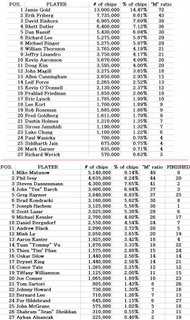
Comparing chip counts with 27 left, 2005 and 2006 (click to see Word documentThey are down to just three tables at the WSOP Main Event. Jamie Gold has a commanding lead -- not unlike where Raymer sat in 2004 when they were approaching the final table. Allen Cunningham (at 13th) is easily the most recognizable name left of the remaining 27. Very different from a year ago, when there were quite a few familiar names still left at this stage (including Mike Matusow [1st in chips w/27 to go], Phil Ivey [2nd], Greg Raymer [5th], Minh Ly [12th], Tim Phan [15th], and Sean Sheikhan [26th]). Of course, all of the better-known players other than Mike the Mouth would be done by the time they reached the final table.

I thought it would be interesting to compare the chip counts from last year to what we have entering today. Click on the picture to see a Word document that compares the final 27 from both years. Besides chip counts, I’ve also noted the percentage of chips in play each player held/holds, as well as each player's “M” ratio (as detailed in Harrington on Hold ’em, Vol. 2). The “M” ratio is the amount of chips divided by the blinds plus the antes for each round. Harrington suggests that if your “M” falls below 10, you no longer are able to maneuver very much and thus must make a move quickly. It looks like close to half of the remaining players are either in this situation or close to it, so there ought to be a lot of action fairly early today.

Notice how last year the nine who made the final table were all among the top 13 with 27 left. Only a couple of the short stacks managed to move up significantly before bowing out (Sean Sheikhan from 26th to 11th and Ayhan Alsancak from 27th to 10th), while only a couple of the big stacks busted out quickly (Ivey and Raymer). This would suggest that we certainly should expect folks like Jamie Gold, Erik Freberg, David Einhorn, and Rhett Butler to be at the final table Thursday. You never know, of course. Just ’cause it’s glittering today doesn’t mean it’ll be gold tomorrow . . . .

Labels: , , , , , ,

Thursday, July 27, 2006

Raising Hellmuth

'Play Poker Like the Pros' by Phil HellmuthWell, the Poker Brat did it. Phil Hellmuth, Jr. won the $1,000 NL Hold ‘em with rebuys event (Event No. 34), besting a field of 754 to grab his tenth WSOP bracelet. It didn’t appear too likely once Daryn Firicano busted out in third and Hellmuth was left to battle Juha Helppi. (You might remember Helppi was the fellow who as an amateur beat out Phil Gordon in that amateurs-vs.-pros WPT event from the first season.) When heads-up play began, Hellmuth was outchipped 2-to-1. Six hands later Helppi had a 3-to-1 advantage. Then came that wild, miraculous hand that turned the tide.

Helppi was sitting pretty with about $1,850,000 in chips while Hellmuth was down to $650,000. The blinds were $15,000/$30,000 with a $5,000 ante. Helppi raised to $90,000 from the button and Hellmuth moved all in from the big blind. Helppi called and it was his Ah6d versus Hellmuth’s 5h5s. The flop was a crowd-electrifying KdJd5d, giving Hellmuth a set but also giving Helppi nine outs to a possible tourney-winning flush. The Qd came on the turn, completing the Finnish player’s flush and leaving Hellmuth ten outs to fill up or make quads. Fortunately for Hellmuth, the Qh came on the river and he survived, pulling about even in chips. Over the next thirty hands or so, Hellmuth slowly increased his lead before finally taking the last of the chips when his AsJh outlasted Helppi's Ad9h.

Not that huge of a surprise, really, considering how the Brat has been going at this year’s series. He had already seen a couple of final tables, including a second place finish (out of 622) in the $5,000 NL Hold ’em event (Event No. 9). Of course, Hellmuth would've been the center of attention anyway. Everyone seems to have an opinion about him. His books and DVDs routinely receive a fair amount of criticism on message boards, newsgroups, and blogs. Despite his many accomplishments, it has almost become a cliché for poker players to dismiss outright his best-selling Play Poker Like the Pros.

I’d mentioned in an earlier post that I’d read Hellmuth’s book and intended at some point to say something about it, so I thought this might be as good of an occasion as any to do so. Play Poker Like the Pros is hardly the best or most helpful poker book I’ve read, but I’ll grant that it does possess some merit, especially for someone brand new to poker.

Nearly half of Play Poker Like the Pros concerns limit hold ‘em cash games. Hellmuth outlines a “beginner” strategy whereby one is encouraged only to play “top ten” premium hands, and almost always to play them aggressively (to “ram and jam” the pot). This advice gets targeted a lot by critics, particularly since Hellmuth includes 77 in his “top ten,” a hand that rarely survives the “ram and jam” approach unless one is up against a set of meek opponents (or if you’ve so well established your tight image no one will play back at you). He goes on to add other possible hands to the mix for “intermediate” and “advanced” play, and offers a lot of specific advice about post-flop play and dealing with various, commonly-faced scenarios.

Another issue Hellmuth discusses early on in Play Poker Like the Pros is how to interpret other players’ styles and act accordingly. His infamous “animal types”-approach to classifying players has been mocked by many -- Hellmuth calls the conservative rock a “mouse,” the loose-aggressive maniac a “jackal,” the immovable calling station an “elephant,” and so forth. Even if the idea is reductive (or even silly), the approach isn’t that bad of a way of introducing the importance of paying attention to what others are doing at the table.

The first poker book I ever read was David Sklansky’s Hold ’em Poker, a decent primer for learning about starting hand groupings, pot odds, and other strategies. While Sklansky does explain at times how to interpret another player’s action during a hand, he really is focusing throughout on a single kind of opponent, the kind that played the somewhat-tight $10-$20 limit game at the Mirage back in the 70s and 80s when he wrote and revised the book. Sklansky’s advice is theoretically sound, but it doesn’t always apply very well to the looser games one encounters online (esp. at lower limits). Just being aware of different styles (as Hellmuth encourages the limit hold ’em player to be) is a benefit, especially to the beginning player. (Of course, Miller/Sklansky/Malmuth go way beyond Hellmuth in this regard with their Small Stakes Hold ’em, a much much better resource for dealing with loose low limit games, though not necessarily the best book for beginners.)

Play Poker Like the Pros also includes a much briefer discussion of pot-limit and no-limit hold ’em cash games, as well as a tiny chapter (only a dozen pages or so) about limit hold ’em tourneys. I’ve never gotten much at all out of these chapters, and indeed, it is somewhat baffling to consider how little Hellmuth has to offer here to the person wanting to learn how to play hold ’em tourneys. (All ten of his WSOP bracelets have been in hold ‘em events.)

Finally, Hellmuth includes chapters on Pot Limit Omaha, Omaha 8-or-better, Seven-Card Stud, Stud 8-or-better, and Razz, as well as a cursory discussion of playing online. These chapters on other games are not bad to have around as a reference, I suppose. As I mentioned earlier, the chapter on Razz is apparently one of the few strategy discussions of that game available. Still, none of this material really distinguishes the book that greatly.

People continue to buy Play Poker Like the Pros, though certainly not at the clip they were a couple of years ago. Looking over at Amazon’s up-to-the-minute listing of top-selling poker books, there are 25 other poker books outselling Play Poker Like the Pros at the moment I'm publishing this post. Looks like the Brat’s win didn’t really cause that much of a jump in sales. Meanwhile, Dan Harrington is riding high, with both Volume I and Volume III of his Harrington on Hold ’em coming close to cracking the top 100 selling books overall. That’s among all the books Amazon sells! (Harrington did say on The Circuit the other night one of the main reasons he wrote his Hold ’em volumes was for the money . . . . Action Dan knows what he’s doing, all right.)

The loudest censure of Play Poker Like the Pros usually concerns the large amount of anecdotal material Hellmuth includes, most of which reads as more of that ego-massage-type behavior we've come to expect from Hellmuth. I’m not going to disagree with that criticism here -- especially in the chapters about non-hold ’em games, one gets the sense at times that Hellmuth's purpose is more to prove his worth in these games than to teach strategy.

As far as instruction goes, there are much better books about limit hold ’em than Hellmuth’s, no doubt. And for the NL hold ’em tourney player, the book has practically no value at all. That being said, while I don’t necessarily recommend the book outright, I’ll admit to have benefitted somewhat from the experience of having read it as a novice player. That’s why I usually don’t rush to join the chorus of Hellmuth-haters whenever the subject of Play Poker Like the Pros comes up.

I usually don't rush to defend him either, though. Hellmuth takes care of that just fine on his own.

Image: Phil Hellmuth, Play Poker Like the Pros (2003), Amazon.

Labels: , , , , , , ,

Tuesday, July 18, 2006

Everybody's Talkin'

Was at the Razz tables again today for a bit (on Full Tilt Poker, the only major site that currently spreads Razz). There are easier things in the world than trying to find a Razz game, frankly. I found only four tables going -- 21 players total (out of about 5000 who were on the site at the time). And three of those tables were out of my league, stakes-wise. But there was that one $0.25/$0.50 table that mostly held together for the hour or so I was there. Actually ended up ahead this time (about $7.00). Was able to resist playing those 9-high hands or chasing other dubious draws, unlike before.

I’m starting to see that while Razz might appear to be overwhelmingly a “math” or “numbers” game, it actually involves a lot more “feel” than I realized before trying it out. I haven’t played enough, obviously, to be able to explain what that means, really. But it has been interesting to see how the third-street raising tends to go (usually only two or three players see fourth), how you really can bluff folks out of pots (and/or be bluffed out of pots), how one can go from being the favorite to a dog and back several times before a hand is complete, among other aspects of the game.

When I finished I tripped over to the 2+2 Forums to see if anyone ever talks about Razz over there. Didn’t find much. There is no “Razz” forum -- only an “Other Poker Games” section where Razz very occasionally comes up. (A couple of Razz-related threads actually popped up over in the “Stud” section as well.) As usually happens whenever I skim through the forums (at 2+2, RGP, the Card Clubs Network Forums, CardPlayer, THF), I ended up clicking around and getting distracted by other threads that looked interesting. I enjoy reading these and occasionally will contribute. Given that I live hundreds of miles from the nearest casino and am currently without a regular home game, it’s good to be able from time to time to have a kind of “community” of poker players with whom to discuss the game.

The poker forum is an interesting animal, really. Some of the threads on 2+2 get fairly competitive, almost as though those who are posting see themselves as participating in a hand of poker. One will “open bet” (let’s say) with a comment challenging some sort of accepted wisdom, for example, “Harrington’s Law of Bluffing” which states “the probability that your opponent is bluffing when he shoves a big bet in the pot is always at least 10 percent” (from Volume 1 of Harrington on Hold ‘em). Nonsense, says the thread-starter -- there are some players who simply never ever bluff. The first few respondents write comments that essentially agree with the original post (they “call” him). Then someone decides to put in a small “raise” by modifying the original argument, applying the principle to limit hold ’em (not NL tourneys). Then another “reraises” by challenging that assumption. And so forth.

That particular thread has thus far remained fairly amicable, although sometimes you’ll see posters aggressively battling each other as if vying for a huge pot. Another similarity with playing online is the fact that irony/sarcasm generally doesn’t go over terribly well -- oftentimes you’ll see threads taken completely off-track by someone having mistaken a tongue-in-cheek comment for sincerity, follow-up “I-was-half-joking-when-I-said-that”-type posts, or the like.

These phenomena aren’t specific to poker forums, of course, but the fact that poker players are usually trying not to “communicate” with complete transparency when at the table -- instead deliberately deceiving others with false cues -- makes it doubly interesting to witness these genuine attempts to communicate in the forums.

Or via blogs, for that matter.

Labels: , , , , , , ,

Wednesday, June 14, 2006

Dostoevsky is Not Considered Summer Reading (Pt. III)

The Gambler by Fyodor DostoevskyA second phenomena explored by Fyodor Dostoevsky’s The Gambler concerns the way the game -- be it roulette, poker, or any other contest that involves gambling -- has the potential to consume us, causing us to forget about everything else. What I’m suggesting is that when we play poker, the past and future tend to mean less to us. The present is all.

In The Gambler, whenever Alexey Ivanovitch goes to the casino to gamble he tends to experience a kind of “transcendence” while playing -- a sort of euphoria, actually, that causes him not simply to lose track of time, but to lose his sense of self. Toward the novel’s conclusion, Alexey has trouble recounting the details of one frenzied session of play: “I don’t remember my winnings after, nor what I staked on. I only remember as though in a dream that I won . . . but I scarcely felt anything as I did so; I simply waited [for the next turn of the wheel] in a mechanical, senseless way . . . .” When Alexey plays, it is as though nothing else exists for him. Everything -- the past, the future, all of his relationships with others -- falls away as he waits “mechanically” to see where the ball will land.

In fact, during this particular session he has entirely forgotten his reason for having come to the casino in the first place -- to win enough to pay off the debts of a woman, Polina, with whom he is obsessed. While leaving the casino with his winnings he realizes “I hardly remembered what she [Polina] had said to me earlier, and why I had gone.” Later on another character, an Englishman named Mr. Astley, has to tell Alexey that Polina was in love with him all along, yet his having become consumed with gambling caused him not to recognize this fact. Mr. Astley accuses Alexey of having relinquished everything to the perpetual present of roulette: “You have not only given up life, all your interests, private and public, the duties of a man and a citizen, your friends (and you really had friends) -- you have not only given up your objects, such as they were, all but gambling -- you have even given up your memories.” Alexey’s reply is rich with irony: “Enough . . . please don’t remind me.” He doesn’t want to be reminded about his past -- even that he has a past. Rather, the game is all.

Of course, not everyone who plays poker is as troubled as Alexey. Most of us don’t allow the game to consume our lives as thoroughly as he does. I would suggest, however, that all of us experience this sort of “transcendence” at times when playing, those moments when we find ourselves simply waiting in a “mechanical, senseless way” for the next card to come. These moments come most frequently during the latter stages of particuarly lengthy sessions, I’d venture, although they can come at other times, too (such as during a wild “rush” of cards or a sequence of large pots in which one is frequently involved). As happens with Alexey, our minds momentarily trick us into forgetting all else and giving ourselves over to the here and now.

The fact is, when it comes to poker, thinking primarily of the present moment is not entirely a bad thing. As was pointed out in the previous post, each hand exists as an independent event and thus must be regarded as such. Also, within each hand come moments that exist independent of each other, decision points when we have to evaluate our situation right here and right now. Dan Harrington makes this argument repeatedly in Harrington on Hold ‘em when taking us through the sample hands. Just because we made a mistake preflop, we cannot allow that blunder to affect our next decision. “Once you’re in a hand,” says Harrington, “every subsequent decision has to be determined by your hand, the pot odds, and the total table situation. Every betting decision is a new problem. Don’t forget that.”

That may well be one of the greatest appeals of poker, the way it continually provides us new problems to try to solve. (If one views these poker problems as eclipsing in importance other “problems” in our lives -- as happens with Alexey -- then one has a much greater problem, of course.) In any event, this momentary “forgetting” of ourselves relates to a couple of other issues that come up in The Gambler that I’ll discuss in my last post on the novel, namely, how poker strangely satisfies contradictory desires to control one’s life while at the same time relinquish responsibility over it.

Image: Fyodor Dostoevsky, The Gambler (1866), Amazon.

Labels: , , , ,

Friday, June 09, 2006

Hammer Time

I reached down and grabbed him under the arm and yanked him to his feet. His eyes bugged. Maybe he thought he was dealing with somebody soft. “Listen, pimple face. Just for the fun of it I ought to slap your fuzzy chin all around this room, but I got things to do. Don’t go playing man when you’re only a boy. You’re pretty big, but I’m three sizes bigger and a hell of a lot tougher and I’ll beat the living daylights out of you if you try anything funny again.”

So Mike Hammer tells that young punk Hal Kines early on in Mickey Spillane’s I, the Jury. Such a tactic is familiar to anyone who remembers the playground, where a standard ploy for dealing with bullies is to show them aggression. Having seen so many back down from them before, they often become unsettled by such demonstrations of strength and will back down themselves. Such is the advice we also frequently hear for dealing with overly-aggressive poker players -- wait for the right moment, then come back “over the top” and watch him scurry away as you gather his chips.

Dan Harrington actually calls this play “the Hammer” in the first volume of his Harrington on Hold ’em. “When you see a super-aggressive player move into a pot, and you have some kind of reasonable hand,” writes Harrington, “don’t just call; come over the top with a big raise.” Doing so “takes courage,” says Harrington, but is generally successful because, “paradoxically, super-aggressive players aren’t looking for expensive confrontations.”

Of course, most of us aren’t badasses like Mike Hammer. That means whenever we do grit our teeth and try to bully the bully, we are essentially playing against our true natures. In this situation, if you are normally a conservative player (like Harrington), you find yourself temporarily having to play an unfamiliar role in the hopes of creating a favorable outcome for a particular hand (and perhaps affecting future play by demonstrating to the table that when playing with you they aren’t “dealing with somebody soft”). This kind of performance is much easier said than done for most of us, I’d venture. In a NL tournament (the primary context for Harrington’s advice), opportunities to “drop the Hammer” can come infrequently, making it all the more crucial to be successful when the time comes to do so.

Let’s say you are in a tourney and for the last 4 or 5 orbits a super-aggressive player has been raising preflop anywhere from 2x-4x the BB approximately half of the hands. You’ve seen a couple of showdowns where he’s had to reveal holdings like QT-offsuit or 65-suited, so you know his range of raising hands is damn wide. You’d know that even without having laid eyes on the samples, of course -- no one ever picks up premium hands half the time, even for a single orbit. Now you’re sitting there with a below average stack and you’ve become gripped with the notion that dropping the Hammer on this guy is for you both a desire and a necessity. Like Mike Hammer, who can’t proceed with his investigation until he deals with the Kines kid, you know you probably won’t get much further in the tourney until you deal with your adversary.

Without any obvious tells to guide you, you cannot possibly know when this louse preraises whether he’s hiding J8 or the Hilton sisters. It appears, then, at least three criteria need to be satisfied before making your move:

1. You have a “reasonable” hand. You can’t move in here without packing some kind of weapon with which to fight. You needn’t necessarily have a loaded .45, but a nice-sized cudgel will do. What constitutes a “reasonable” hand is entirely up to you, but it has to be a hand with which you won’t fear a call. Any hand (except kings or aces) fears a reraise, but you should have a decent range of hands that you can play with confidence here if called. If the hand isn’t strong enough for you to withstand a call from the bully, don’t try the move here.

2. You have position. Unless you’re planning an all-in move (thereby negating the significance of position), you have to be later than the bully here in case he does call your reraise. You simply cannot be acting first after the flop, particularly if you have a hand that is at the bottom of your range of “reasonable” hands with which to make this move.

3. No one else is going to enter the hand. This is probably the most crucial factor to consider, as you cannot reasonably expect to drop the Hammer successfully when a third player decides that pot odds make a cold call of your reraise the right play. If a player between you and the bully decides to rereraise, then you make like a tree and get the heck outta there (unless you hold kings or aces, of course). But you cannot allow a third player to call you here. This means knowing something about the tendencies of the players sitting in between you and the bully and betting the right amount to keep them out.

Even knowing these criteria, I generally find dropping the Hammer a difficult move, especially in tourneys. I’ll do it in my low limit ring games where the stakes aren’t as high (and where I’m generally more aggressive myself). However, in tourneys I find it hard to grab the dude under the arm, yank him to his feet, and tell him what I’ll do if he tries anything funny again.

Image: A standard household claw hammer, public domain.

Labels: , , , , ,

Monday, May 22, 2006

How To Survive If Your Parachute Fails to Open

The Worst-Case Scenario Survival HandbookI’m in an online ring game of $.50/$1.00 limit hold ’em. A loose cat limps in early position. Rest of the table folds to me sitting right of the cutoff and I see a pair of ladies looking back. I put in the raise. The cutoff and button both fold. The small blind waits a beat and reraises. Big blind folds. Limper calls. I think about it for a moment then decide just to call and see the flop. Capping ain’t chasin’ anyone and I have position, so I say let’s just buckle up and see what’s what. The pot is an even $5.00.

The out-of-sync rhythm of the small blind’s reraise (combined with earlier info gleaned from playing a few dozen hands with him) adds up to big slick or maybe a pair of hooks. He could have the bullets or cowboys, sure, but something tells me he ain’t got it quite that good. The limper? Could have anything at all.

Flop comes a sweet QT7 rainbow. Both of my opponents check. I bet, the small blind calls, and the limper decides he’ll put his spoon in the dish as well. The pot is now $6.50. As I silently mouth the words “no jack” the turn comes a J. Again, both opponents check. Now what?

How often does this happen? You make a read with confidence, a sequence of events unfolds from which you may potentially benefit from that read, and yet you act otherwise? There I was in the cutoff with my no-longer-pretty set of queens and a feeling of utter certainty that I was up against an opponent slow-playing his straight.

What did I do?

I bet, of course. (“Jingle-brained” ain’t exactly a compliment, if you were wondering.) I cringe as the small blind (inevitably, it seemed) check-raises. Then the madman limper on the other side of the table surprisingly three-bets. What? Has he plugged a gutshot as well (holding K9)? Or maybe he has 98? Criminy.

Do I give up my set? I do potentially have 10 outs here that help me beat a straight (the case queen, three jacks, three tens, and three sevens) -- about 3.5-to-1 against. I’m now looking at a pot of $12.50. It’s $2.00 to call, although I’m a victim of the “sandwich effect” (as Harrington puts it) and so likely it’s gonna cost me another buck to stay in after the small blind caps. That means I’m looking at putting in a total of $3.00 for a shot at $15.50, so the actual pot odds are going to be a little better than 5-to-1.

So math is telling me to stick around. To be honest, I ain’t listening too much to math here. I flopped top set, dammit, and now I’m gonna bust that lucky palooka with the horseshoe up his ass. (After I get lucky and fill up on the river, that is . . . .) So I call (and call) and we have a pot of $18.50 when the river brings a lousy 4.

Poof. Where the hell did I put my Worst-Case Scenario Survival Handbook?

The small blind bets. The limper raises. The pot has grown to a ridiculous $21.50. Practically a small field of cabbage for these stakes. If I fold, I’ve lost a total of $6.00 on this hand. If I make two (or even three) more crying calls as the final round of betting gets capped, I’ll have put in $10.00 altogether. I could calculate pot odds once more and perhaps rationalize that somehow I’m still good here -- or even that I’ve got a 10% shot of being good and so should keep calling -- but that would be strictly non compos mentis. I sigh and let it go. My two friends cap it and it turns out they’re a regular chopper squad with both of ’em holding big slick.

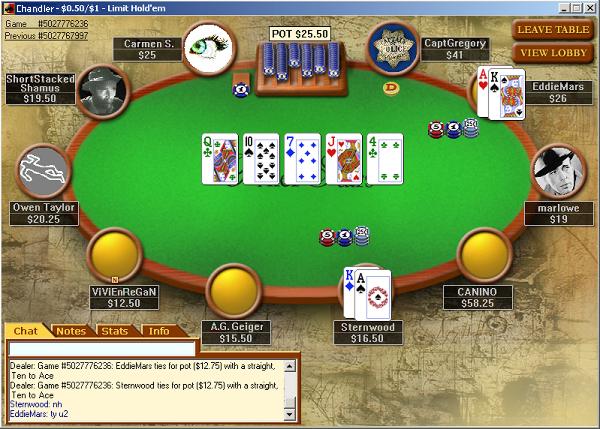
Short-Stacked's parachute fails to open. (Click to enlarge)

Now there might have been ways I could have lost less on this hand, though I’m not bright enough to see them. Seems more like a cold deck to me, but if anyone has any ideas, I’m all ears. If I were a look-on-the-bright-side type, I might say I “made” $4.00 by folding on the river. (As Miller/Sklansky/Malmuth would put it, folding made my "expectation for the entire hand less negative than the alternatives.") I don’t order my eggs sunny-side up, though. Strictly hard-boiled around here . . . .

Images: The Worst-Case Scenario Survival Handbook (1999), Joshua Piven, David Borgenicht (top); PokerStars screenshot (adapted) (bottom).

Labels: , , , , , , , , ,


Older Posts

Copyright © 2006-2021 Hard-Boiled Poker.
All Rights Reserved.