Tuesday, November 10, 2015

2015 WSOP November Nine, Day 2: McKeehen’s Still On Top

Watched every hand again last night as the 2015 World Series of Poker Main Event final table played down from six players to three, with Joe McKeehen remaining in a dominant position going into three-handed play for tonight’s finish.

It’s reminding me once again of that WSOP Circuit final table from a couple of years ago that I’ve mentioned before, the one at Caesars Atlantic City I helped cover where McKeehen entered the final day with a big lead and never seemed to be challenged much at all on his way to the win.

Kind of remarkable, really, to think how easily things have gone for McKeehen at the final table thus far. Not only has he avoided making any bad decisions, he’s barely even taken that many risks at all even with decent hands in good spots. Both his opponents’ styles and the cards have dictated that result somewhat, but the overall impression has been that it’s hard to imagine how things could have gone much differently for McKeehen up to this point.

Easily the most interesting hand last night was the one that came relatively late when they were four-handed and Josh Beckley managed to three-bet and then fold pocket jacks to a reraise from the chip leader. We knew when watching that McKeehen had four-bet with pocket queens, which helped raise the eyebrows a little further when we saw Beckley avoid getting hooked by his two hooks.

The hand reminded me of one from the 2006 WSOP Main Event final table, something I brought up in another “what would you do?”-type PokerNews article today. I’m referring to a hand in which Richard Lee reraised all in with pocket jacks versus Jamie Gold’s queens and was knocked out in sixth.

Even though the two hands were similar, it’s funny to go back and think about how crazily different the play was at the ’06 final table -- where, it should be said, most of those there were amateurs, with Allen Cunningham being the exception. In fact in the hand Gold limped in with his queens, something that is hard to imagine happening today. So, too, have the 3x-and-above opening raises at that final table become a thing of the distant past.

Will be there ’til the end again tonight. While it’s hard to envision McKeehen in trouble, it sure would be interesting to watch should either Beckley or Neil Blumenfield manage to get in a position where they can present him some difficulty to complicate the conclusion.

Labels: , , , , , , , , ,

Thursday, September 07, 2006

WSOP Final Table Hand No. 187: Having the Heart to Go Big-Time

Who has the heart?Later on in Jim Thompson’s The Getaway, a mix-up in a train station allows a small-timer crook to make off with Doc McCoy's bag full of loot from the bank heist. As McCoy pursues him through the train station, the thief notices the man chasing him isn’t shouting after him as one might expect a robbery victim to do. The small-timer correctly surmises that there must be something in the bag that is preventing him from calling out. “The thief was very cocksure, it should be said; in this particular branch of crime, he had to be. Also -- and it is hardly necessary to point this out -- he had known no criminals of Doc McCoy’s caliber.” Things don’t end well for the small-timer. (Also hardly necessary to point out.)

There were a number of interesting hands prior to Hand No. 187.

There was Hand No. 141 involving Gold and Cunningham. From UTG, Cunningham bet 1 million on a flop of Ah8c2s and Gold called from the button. Both checked the turn card, the 6d. Then when the river came 2h, Cunningham bet 2 million and Gold quickly raised all-in. As Cunningham contemplated what to do, Gold stood up and said “Gotcha!” and made like he was ready to turn over his cards. Cunningham had no choice but to fold.

There was Hand No. 155 where Wasicka, as he had done in Hand No. 134, made what appeared to be another sketchy decision. After raising to 1 million UTG, Binger reraised all-in from the button. Wasicka thought for quite a while (nearly three minutes), then called with KQ-off only to see Binger turn over a pair of cowboys. The board didn’t save Wasicka this time, and Binger doubled up.

There was Hand No. 170 in which Gold and Cunningham both called Rhett Butler’s short-stacked all-in, then Gold bet into the dry side pot on a board of Jd6h5d2c. Cunningham folded, Gold showed KcJh, and his jacks outlasted Butler’s pocket fours. Butler finished fifth.

So they were four-handed as Hand No. 187 began. Blinds were 150,000/300,000 with a 50,000 ante. Gold had just about exactly 50 million chips, Binger around 14 million, Wasicka 12 million, and Cunningham just over 10 million. Cunningham raised to 800,000 from UTG, Binger folded on the button, Gold called from the small blind, and after a bit of thought Wasicka chose also to call from the big blind. A rare instance of three-way action (at this stage). The pot is 2.6 million.

The flop comes an eyebrow-raising JhAh9h. All three players check fairly quickly. Ali Nejad asks Robert Williamson (the current guest in the booth) why Cunningham didn’t bet that flop. “Suited and coordinated,” explains Williamson. The turn is the Ac. “Somebody might take a stab at this now, with that ace on the turn,” Williamson suggests. Indeed, Wasicka, acting first, bets 1 million. At not even 40% of the pot, Wasicka’s bet is either a simple probe bet to see how the others feel about their hands or a potential trap. Cunningham thinks a moment, pushes out 1 million to call and says he’s going to raise. Even before Cunningham announces the amount of his raise, Gold tosses his cards in the muck.

After some deliberation, Cunningham eventually pushes in 2,975,000 more chips. It isn’t clear why he didn’t put in exactly 3 million for the raise -- it appears from the dealer's tone he might have simply missed grabbing that last 25,000 chip before pushing in. (“I do that on purpose sometimes,” says Williamson.) Gordon and Williamson agree that Cunningham probably has an ace with a high heart kicker.

The pot is now 7,575,000 million and the action is on Wasicka. Gold’s early fold had enabled Wasicka to contemplate his next move for a bit even before Cunningham put in his raise. He waits about twenty seconds then announces he’s all-in. “Wow,” says Williamson. “Oh, my goodness,” says Gordon. It appears neither saw that coming. “Paul must have a heart flush or an ace,” says Williamson. Since Wasicka has him covered, a call would force Cunningham to put in his entire stack. He takes only a moment and then folds.

As the crowd cheers, Wasicka shows his hand -- KdQd. No ace. No flush draw. Nothing, really. “That was a big boy bluff right there,” says Gordon. Cunningham smiles sheepishly in appreciation of the play. “Two tens with the ten of hearts,” he says to someone else at the table, revealing what he had held. “Trying to get him to fold a jack.” [EDIT (added 9/28/06): ESPN's edited version of the final table confirms Cunningham indeed held ThTc. Gold, incidentally, had Kc7c.]

Cunningham was a little bit like the thief who stole McCoy’s bag here. For a moment it looked like he might get away with the loot. But he ran into a higher-caliber criminal (on this hand, anyway). Wasicka’s “big boy bluff” looks sick, all right, although if you think about it, Cunningham just about has to have what Gordon and Williamson speculated he did have (an ace with a high heart kicker), or perhaps JJ, to continue with the hand. After the tournament ended, Gold spoke of Wasicka as the one player at the final table he could never figure out. This was probably one of the hands that helped make Wasicka appear more of a "big-time" opponent in Gold's eyes.

This was also probably the hand that determined how both Wasicka and Cunningham would be finishing, securing Cunningham’s eventual exit in fourth place and allowing Wasicka to stick around a bit longer. Winning that pot pushed Wasicka up to 19 million; meanwhile Cunningham had been knocked down to 7 million. Within three hands Cunningham would begin moving all-in repeatedly in a last-ditch attempt to recuperate. On the hand in which Cunningham is finally eliminated -- Hand No. 208 -- he again holds pocket tens, this time losing out to Gold’s KdJd after a king flops. (And, as it turned out, Wasicka also loses with pocket tens on the tourney's final hand.)

I have one of my own hands I’d like to solicit advice about in my next post. After that I’ve picked out two more hands from the latter stages of the WSOP final table that seem worth talking about. One of those features a lot of interesting table talk (the best thing about this here pay-per-view, I’ve decided). The other is the hand in which Binger gets eliminated in third. Being a small-timer myself, I’ll be leaving that final hand for commentators of a higher caliber to discuss.

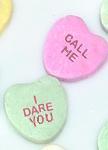
Image: Brach’s Conversation Hearts (adapted), Amazon.

Labels: , , , ,

Monday, August 28, 2006

WSOP Final Table Hand No. 22: Just In Case

Shamus watches the WSOP final tableThe blinds are still 80,000/160,000 with a 20,000 ante. For the three main players in this hand, Gold has around 27.5 million in chips, Cunningham has 16.7 million, and Erik Friberg 7.5 million. Gold limps in from UTG, Friberg calls from middle position, and Cunningham also calls from the button. “Oh boy, here we go,” says Gordon when Cunningham calls. Cunningham has only voluntarily put money in the pot once during the night’s first 21 hands (a brief battle of the blinds with Michael Binger in hand no. 13), so the mere fact that he’s entered a hand warrants our attention. Douglas Kim checks his option from the big blind, and the four see a flop of 8h9h9d.

Kim checks and then Friberg -- his view of the chip leader perhaps being obscured by Gold’s enormous stack of chips -- accidentally checks out of turn. “I didn’t check,” says Gold, and Friberg apologizes. “It’s all right . . . you didn’t see,” Gold replies. He then bets 1 million. With minimal deliberation, Friberg calls. “This the man who checked out of turn?” asks Cloutier (still in the booth with Gordon and Nejad). When Gordon confirms, Cloutier claims “I haven’t seen that play before.”

If the check out of turn were intentional, Friberg’s call doesn’t seem that odd. With that flop, he could well have a nine or a strong draw and now believes he’s induced a bluff from Gold. However, watching the action, it really doesn’t appear Friberg meant to check out of turn. I’m guessing he has some kind of draw and is willing here to commit the 15% or so of his stack in order to see the turn (barring, of course, a reraise from Cunningham). [EDIT (added 9/28/06): As ESPN's edited version of the final table reveals, Friberg indeed had reason to pay to see that turn card -- he held QhJh, thus giving him an open-ended straight flush draw.]

Cunningham also calls. When he does, Cloutier says to “watch out,” because he’s likely strong. “When he’s not doing the leading,” says Cloutier, Cunningham “is very very dangerous.”

The turn brings the 5s and Gold quickly says “check check” while looking at Cunningham. I’m not certain, but I think Gold might be implying that he’s confident Friberg is going to check behind him. In any event, it is pretty clear that Gold is primarily concerned with Cunningham here. Friberg indeed checks, and Cunningham fires out 2.5 million (into the 3.8 million pot). Gold calls quickly and Friberg folds.

The river is the As. Gold checks. The announcers are now convinced Cunningham has a nine. (They don’t offer to guess what Gold has.) “Will he bet for value?” asks Gordon. Cunningham bets 2 million -- less than 25% of the pot. Definitely appears to be a value bet. Gold swiftly puts down his water bottle and with a “what-can-I-do?”-type gesture says “I gotta nine . . . I gotta call you.” Gold shows the T9 (we don’t see the cards), Cunningham slowly mucks, and Gold slaps his hands together, yelling “Yes!” The pot he’s won is something like 12 million, thus far the biggest pot of the night (and maybe the entire tournament).

“They’ve asked to see Allen’s cards,” says Gordon, and we learn he held 97. (It isn’t clear who asked to see Cunningham’s cards, though I imagine it was probably Gold.) Gold then is shown telling Kim (on his right) that if Cunningham had gone all-in on the river he would probably have folded, fearing a boat. Cunningham looks dismayed -- I think he's genuinely surprised Gold had the case nine. But Cloutier quickly points out “You know, he [Cunningham] is supposed to have lost more money in that pot.” Cunningham is now in third with 12 million, and Gold is up to 34.5 million. It takes Gold a couple of hands to finish stacking all of his chips.

I’m sure Cunningham thought he was good after the river and indeed was betting for value. Even if going all-in might have bought him the pot, doing so with just a set doesn't seem like a realistic option for Cunningham at this point. I can’t tell if Friberg’s out-of-turn check after the flop had any real effect on how the hand played out. It seems to me that Gold would’ve probably put in his bet of 1 million (about a third more than the size of the pot at the time) no matter what, and Cunningham would’ve probably still just smooth called.

Cunningham was indeed fortunate not to lose more on the hand. But was it skillful play that kept him from being crippled here? If he had Gold on a busted draw or an eight or an ace -- which is what I think Cunningham was probably thinking -- I imagine he would’ve played the hand identically. I could be wrong, but it seems to me that having position -- more than anything else -- is what enabled Cunningham to escape the hand without greater damage. In other words, I don’t really think Cunningham was betting 2 million on the river “just in case” Gold had him beat.

And what about Gold’s play? His caution following that initial flop bet appears to make sense here, but could he have gotten more out of Cunningham on this hand (as Cloutier seems to be implying by his comment)?

During the subsequent break Gordon talks about how some viewers had been emailing in their thoughts about this hand. Gordon is now saying that he questions Cunningham’s 2 million river bet, claiming that he could only be called by a hand that beats him. Perhaps. (Or could Gold call there with aces up?)

The next hand I want to talk about is probably going to be Hand No. 122, the one involving Gold and Richard Lee and what I think turned out to be the biggest pot of the entire tourney. Still have four hours and eighty hands to watch first, though, so there may be another interesting one before I get there . . . .

Photo: Tom Neal from the 1945 film Detour (adapted), public domain.

Labels: , , , ,

Friday, August 11, 2006

Assessing the Gold Standard

It took 236 hands and nearly 14 hours before Jamie Gold finally claimed all 88 million chips in play to become this year’s WSOP Main Event winner. In terms of time and number of hands, this year’s final table was similar to 2005, when Joe Hachem also needed nearly 14 hours (and 232 hands) to take the bracelet. Unlike last year, however, when the chip lead changed several times and the eventual winner was short-stacked for most of the night, Gold dominated throughout. His performance will undoubtedly inspire much analysis and talk of “playing the big stack” -- something Gold obviously did successfully as the chip leader for the last five days of the tournament.

Gold came to the final table with 26,650,000 chips -- about 30% of the total chips in play and about 9 million more than his nearest competitor, Allen Cunningham. He demonstrated aggression from the start, taking five of the first 11 hands (four without having to go to showdown). After three hours Gold had built his stack to 33 million, knocking out the first two players in the process. An hour later Gold went over 50 million after eliminating Richard Lee in what appears to have been a pivotal hand. Lee was second in chips with approximately 16 million when he decided to put them all in the middle with JhJs. Unfortunately for him, the one man at the table with more chips held QdQs. The board came KdKs3d6hTs, and Lee was on the rail.

Around 2 a.m., Gold knocked out Cunningham in fourth place. Around 3 a.m., Gold dispatched Michael Binger in third. And after seven hands of heads-up, Gold took out Paul Wasicka around quarter ’til four. In the end, Gold eliminated seven of the eight players at the final table. I didn’t pony up the 25 clams for the pay-per-view broadcast, but I am curious to find out how many did -- and how much those who did enjoyed what they saw. Given Gold’s dominance throughout the night, it may well have been less than exciting to watch. Still, it had to be marginally more fun than purchasing a heavyweight fight that ends with a first-round knockout. Lasted longer, anyway . . . .

Prior to the final table there appeared an interesting article over on Bodog Nation which quoted Gold saying he wasn’t interested in all of the fame and publicity that would come should he win the Main Event. In the article, Gold talks about how being thrust into the limelight “tears apart” some people. He even mentions the possibility of avoiding such scrutiny by cutting a deal at the final table -- the kind of talk regarded by many in the poker world as utter heresy. “I don’t want to be the next poker ambassador,” Gold says in the article. “I love my life just like it is. I make a good living and I’m happy. Why would I want that to change?”

Given Gold’s huge chip lead throughout the night, the idea of cutting a deal could never have been genuinely considered. When heads-up play began, Gold had nearly an 8-to-1 chip advantage over Wasicka -- not the sort of scenario that would lead any sane chip leader to commit to a deal.

As far as Jamie Gold’s reluctance to be the “ambassador” of poker goes, I think it should be understood that winning the bracelet need not require one to fill any particular, Miss-America-type diplomatic role. (The hosts of CardPlayer’s The Circuit smartly addressed this topic during last night’s episode.) Whether Gold stays in the spotlight or hides away in relative obscurity ultimately will make little difference to the industry as a whole. He needn’t feel it necessary to live up to the “standard” established by Moneymaker, Raymer, and Hachem, nor should his actions over the next year be regarded as any “standard” for future winners to follow.

No, the true “Gold standard” -- that which should prove genuinely influential at the tables in the months to come -- is the man’s play last night and throughout the Main Event. For that he’ll be both celebrated and looked to as a guide by the many who hope to follow his successful path.

Image: Trademark Poker 24k Gold Playing Cards, Amazon.

Labels: , , , , , ,

Wednesday, August 09, 2006

Final Tables: Not for the Faint of Heart

World Series of PokerI’m sorry CardPlayer doesn’t appear to be planning a live audio play-by-play of the final table of the WSOP Main Event (as they did last year). I assume the ESPN pay-per-view telecast means there will be no such webcast this time around. I suppose Bluff Magazine is doing something along these lines on Sirius radio, but I’m not a Sirius subscriber so I don’t know much about that.

I was listening back to some of last year’s coverage again this week and remembered how entertaining -- even riveting -- it was to hear the first time around. Click here to listen to an .mp3 clip of Phil Hellmuth and Daniel Negreanu describing the second hand of the final table, that insane one in which Mike Matusow’s KcKh ran into Scott Lazar’s AhAd. (The third voice you hear chiming in is that of Greg Raymer.) The file is about 3.5 MB. This is still a blast, even a year later.

I mentioned in my previous post how those at the final table at last year’s WSOP Main Event all came from the upper half of the final 27 -- all nine who made it were among the top 13 with three tables remaining. All but one of those who survived to make this year’s final table were also among the top 13 with 27 to go. Here are the chip counts for the final table (scheduled to begin at 2 p.m. Pacific time tomorrow):

2006 WSOP Main Event Chip Counts, Start of Final Table


Among these only Paul Wasicka was significantly short-stacked with 27 to go. Wasicka had a terrific day on Tuesday, starting with a mere 700,000 chips (in 24th place) and ending with nearly 8 million (5th out of 9). About a half hour into the day’s play on Tuesday, Wasicka caught a pair of queens and doubled up. He then laid low for the next three hours or so and was down to about 860,000 when he again found himself all in, this time with kings. They held up, and Wasicka was up to 1.7 million. An hour later he was dealt kings again and after watching four other players limp he put his nearly 2 million in the pot and was only called by the one who had jacks. The cowboys held up again, and Wasicka was back to playing poker with a nice stack of 4 million chips.

The most dramatic fall on Tuesday was experienced by David Einhorn who started the day in 3rd place but busted out before the dinner break in 18th. Einhorn’s story ends well, however. Before play began on Tuesday, the hedge fund manager from California had announced he would be donating all of his winnings to charity -- the Michael J. Fox Foundation which is dedicated to discovering a cure for Parkinson’s disease. Einhorn, whose grandfather had Parkinson’s, won just over $659,000 for finishing 18th, a significantly-sized contribution to the foundation’s efforts. Pretty cool stuff.

I believe the blinds will still be 80,000/160,000 with a 20,000 ante when they start back up tomorrow. This means there will be a bit of room for some play when they begin, and that even the short stacks won’t necessarily have to push right away. It will be interesting to see whether Gold and/or Cunningham allow anyone stay comfortable, however. You gotta believe Gold in particular will be applying serious pressure from the get-go.

The payout structure should have some kind of an effect, as well. From 9th to 3rd, moving up a spot means another $400,000-$500,000 with each step. For most of these guys, that's a hell of a lot of scratch, particularly when you consider Cunningham is the only one at the table whose lifetime earnings exceeds a quarter million. (Cunningham has earned over $4 million; Wasicka, about $237,000; Gold and Binger about $100K each; the others, next-to-nothing or nothing.) The difference between 3rd and 2nd is almost $2 million, though, and the difference between 1st and 2nd is nearly $6 million. So it could be some players will think “top 2 or bust” and thus get wild right away, while others may well put their heads inside their shells and hope to wait out a spot or two or three before getting blinded off.

Whatever happens, it’ll surely be relived, replayed, and reviewed endlessly until next year’s WSOP. There’s a kind of permanence about final table play that may also have its effect tomorrow. The fact that the “world” (or some of it) will literally be watching this time certainly won’t lessen the pressure. As Negreanu says at the end of the clip, “if you have heart problems, the World Series of Poker is not for you.”

Image: WSOP logo.

Labels: , , , , , , , , , ,

Tuesday, August 08, 2006

Gold Looking Golden, For Now

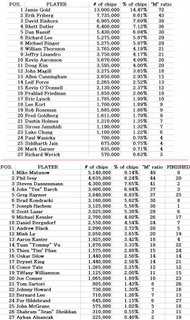
Comparing chip counts with 27 left, 2005 and 2006 (click to see Word documentThey are down to just three tables at the WSOP Main Event. Jamie Gold has a commanding lead -- not unlike where Raymer sat in 2004 when they were approaching the final table. Allen Cunningham (at 13th) is easily the most recognizable name left of the remaining 27. Very different from a year ago, when there were quite a few familiar names still left at this stage (including Mike Matusow [1st in chips w/27 to go], Phil Ivey [2nd], Greg Raymer [5th], Minh Ly [12th], Tim Phan [15th], and Sean Sheikhan [26th]). Of course, all of the better-known players other than Mike the Mouth would be done by the time they reached the final table.

I thought it would be interesting to compare the chip counts from last year to what we have entering today. Click on the picture to see a Word document that compares the final 27 from both years. Besides chip counts, I’ve also noted the percentage of chips in play each player held/holds, as well as each player's “M” ratio (as detailed in Harrington on Hold ’em, Vol. 2). The “M” ratio is the amount of chips divided by the blinds plus the antes for each round. Harrington suggests that if your “M” falls below 10, you no longer are able to maneuver very much and thus must make a move quickly. It looks like close to half of the remaining players are either in this situation or close to it, so there ought to be a lot of action fairly early today.

Notice how last year the nine who made the final table were all among the top 13 with 27 left. Only a couple of the short stacks managed to move up significantly before bowing out (Sean Sheikhan from 26th to 11th and Ayhan Alsancak from 27th to 10th), while only a couple of the big stacks busted out quickly (Ivey and Raymer). This would suggest that we certainly should expect folks like Jamie Gold, Erik Freberg, David Einhorn, and Rhett Butler to be at the final table Thursday. You never know, of course. Just ’cause it’s glittering today doesn’t mean it’ll be gold tomorrow . . . .

Labels: , , , , , ,


Older Posts

Copyright © 2006-2021 Hard-Boiled Poker.
All Rights Reserved.