Friday, March 07, 2014

Talking Ice, Power, and Limit Hold’em

Had a decent-sized ice storm hit us starting before dawn today with the cold temps and freezing precipitation lasting into the early afternoon.

We woke up to no power and as I write here just after dinner time we’re still without, although after successfully cranking up our generator (a must for farm living) we’re enjoying a window of a few hours of power before bedtime. That pic is of two of our barn cats, Lily and Moe, who like Vera and myself figured out how to make do.

With little time to write I just wanted to point folks to Nolan Dalla’s latest piece on his personal blog, one that focuses on limit hold’em and how it was once all the rage in poker rooms prior to the “boom” and now finds itself a threatened game not unlike five-card draw and other rarely spread variants.

Dalla titles his post provocatively -- indeed, pretty much everything he posts on his blog is provocative -- calling it “Mason Malmuth Was Right (Limit vs. No-Limit Hold’em).” The title is referring back to Malmuth’s prediction way back in the early 1990s that no-limit hold’em had little chance of catching on, something he had written in a volume of his Poker Essays.

I actually wrote a little something last summer about this very same passage in Malmuth’s book, coming in a chapter titled “The Future of Poker.” It’s one of those predictions that reads much, much differently from our perspective, of course, and Dalla offers some reasonable justification both for Malmuth’s position back then and for his underlying arguments about no-limit hold’em actually still being valid despite the fact that NLHE has not only lasted but has grown into the single most popular variant of poker played for the last several years.

I can’t delve into the entire discussion just now, but you can read what Dalla has to say and decide for yourself what you think about the points he makes. I will say that as a LHE player myself, I’ve always felt similarly to Dalla that the game is more fun than NLHE, and in fact to me provides a lot more action in the form of constant decisions and the higher percentage of hands played.

I even wrote a kind of defense of LHE for Learn.PokerNews some time back called “Limit Hold’em Isn’t Always Like Watching Paint Dry” in which I made a couple of the same points Dalla does about why LHE is fun, perhaps especially so for beginners and/or recreational players.

Anyhow, follow those links for more Friday evening reading. Meanwhile, I’m going to go try to enjoy a couple more hours’ worth of power here before we shut it down for the night. Might go check on the cats one more time, too, although I’m sure they’re doing fine.

Labels: , , , , ,

Tuesday, June 11, 2013

Racing Presidents, the Future of No-Limit Hold’em, and the Significance of Context

Over the weekend I was able to take a quick trip with Vera up to Washington, DC to enjoy a couple of days’ worth of leisure.

We’d been a few times before in the past, and thus had already done much of the usual sightseeing stuff. This time we mostly just enjoyed some good eats in various restaurants, checked in on a museum, saw the Washington Monument being repaired, and did a lot of walking around. We made it to a Washington Nationals game, too, and had a laugh watching the Racing Presidents run around the field between innings.

The huge-headed mascots include George Washington, Thomas Jefferson, Abraham Lincoln, Howard Taft, and Theodore Roosevelt. Of those I know Lincoln played a little poker. Taft isn’t known so much for his poker-playing, I don’t think, although he was a member of the Queen City Club in Cincinnati that had some card rooms. TR, though, was the big poker player of the bunch, and as it happened Roosevelt won the race on Saturday afternoon.

I was searching around online a little this morning and found a piece about the Racing Presidents visiting Mount Rushmore a few months back. While there, it looks like Teddy took a trip over to the famous Old Style Saloon No. 10 in Deadwood, the site of the famous poker game in which Wild Bill Hickok met his demise. In fact, old “Square Deal” Teddy took the opportunity to sit in on a poker game while there (pic above via the Black Hills Travel Blog).

Got a chance to visit a number of cool bookstores while in DC as well. At one of them I picked up several poker-related titles on the cheap, some of which I’ll be sending out as prizes in the Hard-Boiled Poker Home Games. One of the books I picked up was Mason Malmuth’s Poker Essays.

First appearing in 2000 and including a lot of previously published items (among them several revised Card Player columns), it is the first of three volumes’ worth of similar essays published by Malmuth. Like a lot of titles published back then, the book is probably more interesting in the way it provides evidence of an earlier, pre-boom era of poker than for specific strategy advice. Also included are several pieces offering opinions about the staging of tournaments and talk about structures, as well as some thoughts on how card rooms were being run at the time, thus providing more interesting reading as reflections on the Las Vegas and California poker scenes circa 1990s.

This is the book that also contains a couple of Malmuth’s most quoted lines about the future of no-limit hold’em and tournaments. You might have run into these statements before somewhere, which in retrospect obviously read a little differently than they might have back when they were made.

In a chapter called “The Future of Poker,” Malmuth discusses 11 different variants then being spread in card rooms, offering his thoughts about the current and future popularity of each. He’s high on fixed-limit hold’em and seven-card stud (at the time the most popular variants in most rooms), and down on both pot-limit Omaha and fixed-limit Omaha (the latter having been spread during the late ’80s and ’90s, but hardly at all since). He thinks razz and Omaha/8 will survive, while draw poker probably won’t.

Of course, it’s his assessment of no-limit hold’em -- the first game on his list -- that grabs the attention the most while reading today. “The problem with no-limit hold’em,” writes Malmuth, “is that the expert player has too great an edge over weak players and will virtually never lose to these people.” He adds that “since bad players almost never win, they either go broke, find another game, or quit playing poker altogether.”

Those thoughts then inform what seems an inevitable conclusion for Malmuth.

“Unfortunately, there is not much future in no-limit hold’em.”

There’s another essay titled “Are Poker Tournaments Dying?” that offers a similarly bleak forecast. “I suspect that as years go by, there will be fewer major tournaments in Nevada casinos,” speculates Malmuth, although he does think things might play out differently in California. He also recognizes that there are “a few events, like ‘The World Series of Poker,’ [that] are spectacular successes and probably will continue to be so.”

“But as far as Nevada is concerned,” he says, “the great poker tournament boom is, in my opinion, past its peak.”

It isn’t fair, of course, to go back and isolate Malmuth’s proclamations about no-limit hold’em and tournaments almost a decade-and-a-half later like this, especially when considering that both were made well before online poker had surfaced much at all, never mind the subsequent and sudden “boom” fueled by televised that began around 2003 and which very few saw coming -- a development that directly spurred tremendous interest in both NLHE and tournaments.

Found a 2+2 thread from 2008 in which someone brought up the NLHE prediction and Malmuth responded, pointing out that “It did die as a side game. There were virtually no no-limit poker games for many years. It came back due to the interest in the TV shows and the fact that a cap was put on almost all games, something which was not done before.”

In other words, context matters. Thus when you alter the context -- say by reading predictions made long ago, or having former U.S. presidents absurdly dash around a baseball field to the delight of cheering fans -- a few grins (including unintended ones) are sometimes gonna result.

Labels: , , , , , , , ,

Friday, April 27, 2012

Someone Figured Out Two Plus Two

Two Plus Two has been down over 24 hours?!?Like most of you, I’ve noticed the popular Two Plus Two forums went offline yesterday afternoon, having fallen victim to a hacker who “has displayed the ability to access e-mail addresses and encrypted passwords” as well as “the ability to decrypt passwords” (to quote from 2+2’s statement on the matter).

The site was taken offline as a precaution, with 2+2 advising users that if they happened to use their password for the forums for other accounts, they should change them as the hacker potentially has that info. NoahSD published a helpful post on his blog yesterday afternoon discussing the situation and providing advice.

The forums have been down for over 24 hours now, which means just about everybody who frequents them has become aware. The situation reminds me of that little brouhaha that erupted just about a year ago -- in late March, just before Black Friday -- which inspired a lot of talk about 2+2’s true significance to the poker community.

2+2At issue was the revelation of still more questionable information regarding the insider cheating scandal (and subsequent cover-up) at UltimateBet. You might recall how during the first weeks of 2011, Joe Sebok -- at the time still a sponsored pro as well as UB Media and Operations Consultant -- was stirring things up a bit with interviews as well as some wars over Twitter. Coupled with some other new revelations about UB, the clamoring for answers was starting to become louder, with some wanting in particular to hear what UB’s COO Paul Leggett had to say about it all.

That’s when 2+2 “Grand Poobah” Mason Malmuth suggested in a thread that if Leggett were to come forward to address any questions, “He should answer them here,” since “2+2 is where the poker community is.”

That suggestion of 2+2’s centrality to the poker community -- or, perhaps even that 2+2 was “the poker community” -- got a lot of response, including many pointing out that the poker community includes a lot of people who have little or nothing to do with the forums, among other rejoinders.

I wrote a post here at the time in which I noted that in poker we really have multiple, overlapping communities (plural). I also got a little abstract and talked about how the whole idea of “community” in sometimes hard to imagine in poker given how the game necessarily pits us all against one other.

Phil Hellmuth riding a giant hot dog on waterI suppose the longer 2+2 stays offline, the more its significance within the poker community will be clarified to us. It isn’t hard to imagine us all congregating somewhere else to share news, spread rumors, discuss strategy, insult and troll, earn warnings and bans, and imagine different scenarios in which Phil Hellmuth would ride a giant hot dog on water.

Then again, since Black Friday a lot of us have been wandering around somewhat detached from “the” poker community for many months now. Could make it that harder to get back together....

I expect 2+2 will be back soon enough, though. Which is good, ’cause I don’t have time to keep making my own photoshops.

Labels: , , , , ,

Thursday, December 22, 2011

A Break-In, a Brouhaha, and a Beginning

News Round-UpHugely busy these days, trying to get everything together before all the gift-giving, family-visiting, and food-stuffing gets going in earnest this weekend. As a result I haven’t had a lot of time to devote to poker -- either playing it or giving a lot of attention to the various news items surfacing in the poker world.

I did get a chance to skim through a few stories standing out from the most recent cycle, though.

Truly hated to hear about 2010 World Series of Poker Main Event champion Jonathan Duhamel being the victim of what sounds like a harrowing home invasion this week. Two men broke into his Montreal home, tied him up and physically assaulted him, threatened to kill him, then left with money and other items including his 2010 WSOP Main Event bracelet.

2010 WSOP ME braceletOf course, that bracelet is a pretty damned conspicuous item -- hard to imagine the thieves being able to pawn such a thing with ease. It sounds like they also made off with a lot of 500 Euro notes that are also rare enough to raise eyebrows, should they try to use them. Here is a report about the incident from a Canadian news outlet.

I also found myself a little distracted the last couple of days by this multi-way spat that has arisen involving I. Nelson Rose, the Poker Players Alliance, Mason Malmuth, and Rep. Joe Barton.

Barton, as we know, has proposed a federal bill designed to provide a means to license and regulate online poker in the U.S. He’s also appeared a couple of times before the House committee that’s been discussing the topic of online gambling, speaking in particular about poker and his desire to see his bill or something similar move forward.

I. Nelson Rose vs. Joe BartonEarlier this month, the gambling lawyer I. Nelson Rose attacked Barton in a piece for Poker Player Newspaper, primarily aiming at Barton’s previous record regarding votes to prohibit online gambling (including his votes on the UIGEA).

The Poker Players Alliance took issue with Rose’s article, sending out a rebuttal of sorts on Tuesday. And Mason Malmuth stirred the pot some more by starting a thread on Two Plus Two in which he shared the PPA’s statement, then jumped in to criticize Rose himself. Then following Rose’s appearance on QuadJacks Radio yesterday, Malmuth appeared on QJ Radio as well to further discuss Rose, Barton, and everything else.

The result is a fairly noisy, overlapping discussion touching on a number of different issues, including the prospects of Barton’s bill, Rose’s political leanings, the PPA’s effectiveness as a representative of poker players’ interests, the possible editorial stance of Poker Player Newspaper, Malmuth’s status as a firebrand, among others.

Finally -- and not unrelatedly -- today we’re learning of Nevada moving forward as expected to adopt intrastate internet gaming regulations. A vote today confirmed that Nevada has agreed to rules for allowing entities to apply for licenses to operate online poker sites.

NevadaIt sounds like this vote means that should any sort of federal legislation come to pass, Nevada will be a place to go for those seeking licenses to operate sites. It also sounds like Nevada may be ready to go forward with in-state-only sites, too, but work will have to be done to ensure they'll be able to pull that off (i.e., successfully limiting play within the state's borders).

I still need to read up more on this latter item in order to grasp the particulars. Here’s a Wall Street Journal piece from yesterday describing what was voted on today, which as mentioned did pass. (EDIT [added 12/23/11]: Here is a report from PokerFuse about the Nevada vote and its possible implications.)

Definitely appears as though movement on the state level is going to be happening a lot more swiftly than on the federal level, as far as the licensing and regulating of online poker in the U.S. is concerned. And while it is hard to say just yet what the significance of today’s move in Nevada will ultimately be, it does appear to be the beginning of something.

Speaking of beginning something, these gifts aren’t gonna wrap themselves. Better go get started.

Labels: , , , , , , , , ,

Thursday, March 24, 2011

On Poker Communities

On Poker CommunitiesAn interesting discussion arose yesterday among various poker types (players, media, etc.) whom I follow on Twitter. Primarily had to do with the Two Plus Two website -- specifically the forums -- and its significance within “the poker community.”

Using scare quotes there, natch. Have to, right? The whole idea of a single “community” containing all things poker obviously doesn’t exist, although the concept of such a thing is often brought up in a theoretical way in various contexts (e.g., “How will the poker community respond to this-or-that?”).

The discussion arose thanks to a comment Two Plus Two “Grand Poobah” Mason Malmuth made yesterday in a thread regarding recent developments and revelations related to the UB insider cheating scandal, including some of the tangentially-related drama surrounding UB Media and Operations Consultant Joe Sebok.

In the thread it was suggested that there remain a large number of questions about the scandal and that UB COO Paul Leggett might be a person to whom those questions could be posed. Talk of an appropriate venue for such a Q&A ensued, at which point Malmuth jumped in to say he believed Two Plus Two itself (either the forum or the weekly podcast) would be the best choice.

Referring to Leggett and questions that could be asked of him, Malmuth said “He should answer them here,” since “2+2 is where the poker community is.”

Probably worth noting that he didn’t say 2+2 is “the poker community,” but rather was referring to how the site tends to be a “place” (so to speak) where members of the community tend to congregate. A central location where people assemble to exchange ideas, you might say, like the Agora in ancient Greece (plus funny photoshops). Which in many respects it is. Nonetheless, subsequent posts in the thread and some of the Tweets from last night appeared to interpret Malmuth as having claimed his site is the “poker community” -- as though he were claiming the whole “world” of poker was included within the metaphorical borders of 2+2’s little empire.

Malmuth didn’t say that, of course, although I can see how some might have considered him to have implied as much. Then again, maybe that was what he meant. (A later post by Malmuth in the thread, one more specifically identifying 2+2 as “the discussion center of everything poker,” perhaps edges even closer to making such a pronouncement.) No matter... objections are necessarily going to be raised whenever anyone refers to “the poker community” as if it were a single entity.

I think most would agree there are many communities (plural) that could be said to have formed themselves around poker, including some those of us who spend most of our time in one particular community may not be aware even exist. Such was the observation B.J. Nemeth made regarding the significance of Zynga PokerCon which I was commenting on earlier this week. As that example illustrates, there are lots of people who have formed lots of communities -- some small and inclusive, others large and influential -- that have been brought together by the game of poker.

It’s an interesting paradox, really, how poker is a game that provides both an occasion for social interaction (to commune with others) and an opportunity to pursue unapologetically our own interests (to compete with others). Such a paradox might help explain why even within various poker communities there almost always tends to exist tension and/or conflict, never mind the disagreements that often arise between disparate ones.

When we play, we’re necessarily in it for ourselves. I can’t win unless somebody else loses. Makes it hard, sometimes, to think of others.

Still, we have to think of others to some extent, right? Otherwise, there’s no game.

Labels: , , ,

Wednesday, August 12, 2009

Rarities

Pocket aces, again!Was scanning through the Two Plus Two forums yesterday when I noticed a thread that had begun during the spring that got “bumped” to the front page thanks to a new post or three. Not really that interesting of a thread, and in fact it looks like the mods swiftly closed it as there didn’t seem to be that much left to say about the original topic.

The thread appeared in the “Two Plus Two Magazine” forum and was titled “How is being delt [sic] aces twice in a row not over 40,000-to-1?” The original poster’s question was in response to something Mason Malmuth had written in his “Publisher’s Note” to the April 2009 issue of the online magazine.

At the end of his note, Malmuth mentioned how he’d been playing limit hold’em at the Bellagio and a woman had been dealt pocket aces on two consecutive hands. “She couldn’t believe her good fortune and wanted to know what the odds of that happening were,” tells Malmuth. “Another player spoke up and told her that it was over 40,000-to-1. Of course this is wrong.”

The subsequent debate revealed that, in fact, “over 40,000-to-1” does correctly describe the odds of getting dealt A-A on two consecutive hands -- i.e., (1/221)(1/221) = 1/48,841. Of course, the odds of getting dealt pocket aces on the hand after the one in which you just got pocket aces is still just 220-to-1, as it always is for every hold’em hand. Indeed, Malmuth himself chimes in on the first page of the thread to say as much.

As I say, not that interesting of a thread, and it seems like the only real debate is over accuracy in one’s phrasing. As we all know, the odds of being dealt any two cards are entirely unrelated to whatever cards one was dealt before. As Malmuth, Ed Miller, and David Sklansky say in one of my favorite passages in Small Stakes Hold’em (2004), “each hand is an independent event. Cards are pieces of plastic. They have no knowledge, no memory, no cosmic plan. They are scrambled and shuffled thoroughly prior to every hand. Pieces of plastic cannot possibly conspire against you....”

'Poker Nation' by Andy Bellin (2002)In Andy Bellin’s Poker Nation (2002), he relates the story of a small-time pro named Dicky Horvath. He quotes Horvath describing how boring the lifestyle of the small-time grinder can be. “‘The monotony is what kills you,’” says Horvath. “‘Not the gambling. You got to remember that poker is a finite game. There are only so many variations. I’ve been dealt pocket aces five hands in a row. That’s like a billion to one odds. I figured it out once.”

Some may want to quibble with the precision of Horvath’s calculation. But really, who cares? Getting aces twice in a row is quite rare. Five times is extraordinarily rare. The odds of either are not really worth knowing, other than to satisfy our curiosity for mathematical trivia.

For some reason, thinking about this whole issue of getting dealt pocket aces twice put me in mind of baseball and its many statistics and records. As a kid, I was a fanatic, and like many young American boys memorized all of the important numbers associated with baseball records -- numbers like 4,191, 56, 755, .367, 61, and 511. Some of the records represented by those numbers have since been broken. Some haven’t yet.

They say all records are made to be broken, but there’s one baseball record that I think it is safe to say will probably never be broken. And it sort of resembles getting dealt pocket aces twice in a row.

Johnny Vander MeerI’m referring to Johnny Vander Meer’s having thrown no-hitters on two consecutive starts (June 11, 1938 and June 15, 1938). Someone one day might also get two, but no one is going to get three, I don’t think.

That’s like a billion to one odds. I figured it out once.

Labels: , , , ,

Wednesday, February 11, 2009

What We Talk About When We Talk About Poker

What We Talk About When We Talk About PokerAbout ten days ago, a poster over on Two Plus Two decided to begin a new thread in the “Books and Publications” forums by quoting Mason Malmuth’s review of Tommy Angelo’s Elements of Poker. The review appears in the February 2009 issue of the online Two Plus Two Magazine.

I also recently reviewed Angelo’s book here on Hard-Boiled Poker, despite the book being published over a year ago. I only just got to it last December, and found it highly enjoyable and instructive. Call me a bandwagon guy, but I think it’s one of the best poker books I’ve read in a long while. Here’s my review, if you are interested.

Malmuth’s review of Elements of Poker is much less favorable than mine. He does credit Angelo for being “witty” (and, backhandedly, “cute”), and even calls “worthwhile” some of the strategy advice. Ultimately, though, Malmuth doesn’t see the book as having much value for beginning or intermediate players, and in the end concludes “this text is certainly not recommended, even as supplemental reading.”

The post sharing Malmuth’s review engendered a provocative discussion (I thought), with posters taking sides over the relative value of Elements of Poker, as well as (somewhat tentatively) debating the criteria by which Malmuth based his review. There also emerges what might be called a theoretical divide among the posters that roughly corresponds to the wildly differing positions represented by Malmuth and Angelo -- specifically with regard to each author’s approach to writing/publishing poker books.

Some posters were “disappointed” with Angelo’s book, finding it “overhyped and overrated,” ultimately echoing Malmuth in expressing their belief that reading the book yielded no practical benefits for most poker players. Others defended the book as being of immense help to poker players, especially those with some experience with the game and the many emotional/psychological ups & downs it produces.

One such poster, explaining why he liked Elements of Poker, says that in his view the book is not “a beginner’s guide to playing better poker,” as some appeared to have wanted to read. Rather, said the poster, he believes the book to be “a better player’s guide to being a better person, which will make you a better player as well.” Another poster less specifically praised Angelo’s book as being “much more real than anything published before” -- ostensibly pointing out how the author’s voice manages to connect with the reader more effectively than generally happens with most poker writing.

Still another poster made what I thought was an especially interesting distinction by saying “Tommy Angelo writes poker LITERATURE. Mason writes stiff, clumsily worded cookie-cutter advice.” I’m actually one of those who doesn’t necessarily think Malmuth’s style is “clumsily worded” -- in fact, while it isn’t always flawless, it is for the most part quite clear and precise.

But I think I get what the poster is saying. There is most certainly a more obvious “literary” sensibility present in Elements of Poker than one finds in most poker books (including those Malmuth has written or co-written). And some of us happen to think literary writing and/or modes of expression have something to offer us, too.

Eventually, both Angelo and Malmuth join in the discussion, with the author of Elements of Poker demonstrating humility and graciousness in response to the praises and criticisms directed toward his book, and the owner of Two Plus Two continuing to press his case to devalue the book. (There’s also a brief detour in there where Malmuth appears to be explaining how comedy works -- and, not surprisingly, implying that Angelo fails to be humorous, too.)

The conversation turned toward the subject of editing, and couple of days ago Angelo supplied a bit of background info regarding the editing process for Elements of Poker, prompting Malmuth to fire a tangential (and personal) shot at one of the book’s editors. What had been a provocative, enlightening discussion that pointed up a number of key theoretical issues regarding poker writing and its purposes rapidly derailed.

Malmuth shuts off another debateFinally a poster of the Malmuth camp summed up the thread to that point by saying “Mason did not like the EOP. Most of the posters liked the book. I am not sure that there is more to discuss.” Malmuth agreed, and locked the thread.

Actually, the thread itself, both in the course it took & the way it prematurely ended, well exemplifies what for me is the fundamental distinction between Malmuth and Angelo’s outlooks -- on poker, books, life, what have you.

The former seeks concrete, tangible, readily quantifiable answers to all of life’s problems, and, importantly, believes such answers can be found to all questions worth asking. As a result, the idea of “dialogue” or any sort of inquiry without a specific goal -- the achievement of which unmistakably signals its conclusion -- is to be roundly dismissed as an utter waste of time.

The latter also seeks answers, but additionally values that which is abstract, intangible, and not-so-readily quantifiable. The latter outlook also understands that there are, in fact, some questions worth asking for which there are no single, unambiguous answers. Thus, a premium is placed on the idea of “dialogue” or keeping the conversation going, since value is to be had in the exchange of ideas (even if such value is hard to compute). In fact, rather than wasting one’s time (or other resources), such inquiry is the best possible use of it.

As the poster “jlocdog” (one of those who likes Elements of Poker) put it, Angelo “has a knack for not putting closure on any concepts or ideas he talks about so as to keep you thinking about them and trying to expound on them within your own game/life.” Meanwhile, Malmuth most decidedly has a knack for closing off discussions whenever possible. This had been an interesting thread with a number of intelligent, serious posters contributing (not always so easy to find on 2+2). But as soon as an apparent impasse had been identified, Malmuth decided there was nothing more to discuss.

I guess another, more cynical way of describing the difference between the two thinkers would be to say that while Angelo teaches, Malmuth preaches. The teacher expects you to ask questions, to challenge assumptions, to think. The preacher expects you to sit quietly in the pew. And believe.

Not saying the preacher doesn’t have something to offer us. But you better understand that with this one you’re not expected to raise your hand and ask questions or talk back.

When he’s finished, however, you may shake his hand. On the way out.

Labels: , , , ,

Wednesday, December 03, 2008

Silver Lining?

Yesterday I passed along some of the smarter responses to Sunday night’s 60 Minutes story on the Absolute Poker and UltimateBet insider cheating scandals. Heard one other response yesterday. Not really recommending this one, as such, but it was so strange I thought I’d share it with those who might’ve missed it.

The response came on this week’s Two Plus Two Pokercast (the 12/1/08 episode), the first half-hour of which was devoted to discussing the 60 Minutes story. As show hosts Mike Johnson and Adam Schwartz point out, Two Plus Two was given a bit of exposure there in the segment. The site is never specifically mentioned by name in the report, but there are references to “internet poker forums” and their participants having been largely responsible for uncovering the scandals. (I think there was a fleeting shot of the site up on a computer monitor at one point as well.)

Since Two Plus Two was part of the story (says Johnson), they decided to have Two Plus Two owner Mason Malmuth on at the start of this week’s show to offer his thoughts on the 60 Minutes piece.

“I want to talk about this from a little different point of view,” Malmuth characteristically begins. I say “characteristically” because as we all know, just about everything from Malmuth comes from “a little different point of view.”

After noting that “obviously” the report “was not good for internet poker or our industry,” Malmuth says that “sometimes events happen which on the surface don’t seem like they are very good but they create opportunities to get things accomplished which can be long term good.”

That little preface is kind of a false tell, actually. Most of us probably are thinking Malmuth is about to point out how the negative report might lead to legislative action that would clarify the murky legal status of online poker, and perhaps also ensure certain regulatory standards that would further prevent other, similar cheating scandals from occurring.

But no. Malmuth isn’t going there.

He then explains that when it comes to “our industry,” there are “certain groups who are important” who oppose online poker and who routinely associate internet poker with all forms of of “gambling, pornography, racism, [and] anti-religious themes.” Put ’em “all in the same basket” and “call it vice,” says Malmuth. It is therefore important for those of us who are invested in online poker to be wary of this prejudice.

A little out there, but okay. I’m not so sure that many people or “groups who are important” are arguing that playing online poker is somehow equivalent (or even comparable to) being racist, but I understand the point that there are those who see it as a “vice” and who have a very hard time thinking of it any other way.

Malmuth then focuses on the 60 Minutes piece, saying how it “began with a person and ended with a person” -- he won’t even say Todd Witteles’ name -- whom Malmuth clearly doesn’t like seeing on CBS speaking for “our industry.” (Malmuth isn’t alone in having this opinion, of course.) What most grieves Malmuth, though, is that Witteles’ “name is now out there, and what’s going to happen is people are going to Google his name, and they are going to come to the website that he’s associated with.”

That is, NeverWin Poker. Malmuth refuses to say the name of the site, too.

Says Malmuth, NeverWin Poker is a “cancer in our industry” which as far as he is concerned is “all these things wrapped up together” -- that is, the list of “vices” he’d previously presented.

Then Malmuth calls on Poker Players Alliance Chairman Alphonse D’Amato to issue “standards” according to which poker websites be recommended to follow in order to help disassociate poker from other “vice” or deplorable intercourse or behavior. “Those websites or members of our industry who don’t follow these standards should be treated as outcasts,” Malmuth concludes.

So that’s the silver lining or “long term good” Malmuth sees in the 60 Minutes piece? Not that it might affect in a positive way the legal status of online poker in the United States, but it might lead to the poker community making “outcasts” of NeverWin Poker, once and for all?

I’m not looking to defend some of what one finds on the uncensored NeverWin Poker forum and website. But what kind of a response to the 60 Minutes story is this? Is Malmuth right? Will some of those members of “certain groups who are important” now look up Witteles, find NeverWin Poker, and decide poker is a breeding ground for all other “vice” and/or socially unacceptable activities?

Host Mike Johnson compliments Malmuth for “taking the high road” here by not mentioning Witteles or NWP by name. But really, this sort of griping doesn’t seem much like the “high road” at all. Maybe there’s a point in there somewhere, but it all just sounds way too petty and personal to me.

Labels: , , , , , , ,

Thursday, August 14, 2008

A Sticky Issue

Mason Malmuth's post to moderators regarding 'stickies'Yesterday I read Bill Rini’s post in which he passed along some inside dope from Two Plus Two regarding strategy posts and “Grand Poobah” Mason Malmuth’s worry that the forums are negatively affecting the company’s book sales. If you didn’t happen to catch Bill’s post, here’s the skinny:

Back in May, 2+2 author Ed Miller put up a post on his popular “Noted Poker Authority” site announcing that “for the last nine months” he had been “receiving pressure and threats aimed at forcing me either to shut down Noted Poker Authority or to make the vast majority of its content available for pay only.” The upshot was that articles older than 30 days would no longer be accessible for free. Am not quite sure how the new system works or what the cost to view the older articles happens to be, but I do see that now one has to login in to see the older articles (such as that nice “shout out” Ed gave me back in January).

In any event, earlier this week Malmuth posted a message -- titled “Some Stickies Need to Be Modified” -- for the 2+2 moderators that begins with an allusion to Miller’s site. This message was apparently not intended to be seen by anyone other than the moderators, but a leak somewhere caused the message to be made public.

“Many of you are not going to like this,” Malmuth begins, “but we have had a terrible time with one of our authors creating a website with so much information on it that it was clearly going to destroy book sales.” 2+2 “is first and foremost a publishing company,” Malmuth points out, and apparently he has concluded that “many of our stickies are similar” in the way they deter readers from buying the company’s books.

The 2+2 forums work like most in that the most recent and most popular threads appear at the top of each individual forum. Forum moderators will create a “sticky” post whenever a particularly important topic comes up that needs to continue to appear at the top of the forum and not be pushed downward when newer threads are begun. For instance, in “News, Views, and Gossip” one finds a “UB scandal sticky” atop the page where many links to relevant posts/threads have been organized for readers’ convenience.

Some of the strategy-based forums had also begun collecting links to some of the best-received strategy posts into “stickies” for the same purpose -- i.e., to make life easier for the reader hoping to find these posts amid the hundreds of thousands that have been created since the site began back in 1997. (Actually, I’m not sure the site’s archival system currently allows one read posts from that far back, but you get the idea.)

In Malmuth’s note, he recognizes that while the site “contains a lot of quality information,” such information is a bit difficult to track down since it isn’t “readily accessible and well organized.” And what he’s noticed is “the stickies are doing just that,” that is, organizing the information in ways that make it easier for readers to access it. “Having links to lots of top quality posts may be serving as a substitute for book purchases,” worries Malmuth, so he is asking the moderators “to look at the stickies in your areas and consider deleting some of the links that can substitute for book purchases.”

My initial reaction to hearing this story was to chuckle at how a website’s owner can arrive at the conclusion that making his site less user-friendly is somehow in the site’s best interest. Malmuth and 2+2 have always been stubbornly iconoclastic (to their detriment, frankly) when it comes to all phases of book publishing -- from writing and editing to promotion and distribution -- so it isn’t at all surprising to see such a strange, backwards-seeming understanding of the relationship between different types of media (print and electronic) emerge from the same source.

I then recalled that little brouhaha that came up last December regarding an allegedly plagiarized passage appearing in Seven Card Stud for Advanced Players, a book co-authored by Malmuth and David Sklansky. I wrote a lengthy post about the dust-up then; you can read more about it there, if yr curious.

That little dust-up concerned a sample hand appearing in the pair’s book that was essentially identical to one that comes up in Chip Reese’s stud section of Super/System (published over a decade before). The similarity caused some to suggest the pair had stolen the material from Reese. As I said then, it appeared to me a fairly innocent slip on the part of the authors, though the pair’s mule-headed responses to the matter (in the 2+2 forums) revealed what I then described as a overly “functional view of style” wherein Malmuth and Sklansky both insist on quantifying things that simply cannot be quantified. Let me explain.

Defending himself against the charge of plagiarism, Sklansky posted the following dismissive comment on what happened: “But duh. Cmon. How easy would it have been for me to come up with a completely different example to perfectly describe the exact same concept? To ascribe this to anything other than an oversight is completely ridiculous. Chip’s chapter was very good but it was 50 pages. Our book has 300.”

That reference to the amount of pages at the end -- our book was six times longer than Reese’s section, chirps Sklansky, suggesting somehow it is six times more valuable -- is indicative of that tendency to overvalue quantity. But it is the idea that he could’ve picked a different example to illustrate the same concept -- and that making that sort of change would’ve somehow made the passage acceptable (and not plagiarism) -- that reveals an utter misunderstanding of the importance of form and its relation to content. And I think Malmuth’s directive to his moderators comes from the same sort of misapprehension about form and content Sklansky evinces in his defense against the plagiarism charge.

Malmuth believes that a significant number of visitors to the 2+2 forums who would have bought a 2+2 book decide not to because they can get all of the good, “quality information” on the site that they need. This view suggests that the form in which this information is presented is of no consequence -- that we don’t care whether it comes in a book written by a “noted poker authority” or via a post from some dude who goes by Butterfingers123. Just tell me what to do when my continuation bet on a raggedy flop gets check-raised by that LAG from UTG and I’m happy, right?

Wrong. While the centrality of print media in our culture has certainly been threatened in our electronic age, the formal differences between books and websites are so vast -- and significant -- one cannot reasonably argue that the 2+2 forums are going to “destroy book sales” for the company. Those of us who read books and want to read more books will continue to do so, no matter what “stickies” get created. And those of us who don’t read books still won’t read them, no matter what “stickies” get created.

Malmuth isn’t entirely indifferent to form, of course. After all, his primary worry here has to do with the formal characteristics of his website. He’d prefer the content of the site be presented in a less-organized, harder-to-navigate form, and is thus asking his moderators to help him achieve this goal by removing the helpful stickies. He seems thus to have some idea that form affects content -- that the content of his site (its usefulness, its value) will be affected by these changes to the site’s form.

But the attention to form here is utterly misplaced. If anything, the changes to the site’s form are intended to lessen the value of its content.

And to end on a less theoretical note, let’s think of the practical consequences of that change. If the site becomes less user-friendly, fewer will spend time on it. And thus fewer will become aware of the books. And fewer will buy them.

(EDIT [added 8/14/08, 5:30 p.m.]: It appears the message from Malmuth to the 2+2 mods was sent some time ago -- likely near the end of May, judging from the post count listed under Malmuth’s name in the message -- although it was not until earlier this week that it became known to anyone beyond the original recipients. Also, it looks as though after subsequent discussion the directive from Malmuth contained in the message was ultimately rescinded -- good news to those who appreciate the usefulness of the “stickies.” If you are curious, start here and read further to learn a bit more about the original message and its having been leaked this week.)

Labels: , , , , ,

Saturday, March 08, 2008

Cheating “Scheme” Confirmed at UltimateBet

Cheating 'Scheme' Confirmed at Ultimate BetRather than notify users or post anything on its website, Ultimate Bet -- following the same, questionable path of its partner, Absolute Poker -- has decided to publicize news regarding allegations of cheating on its site by sending messages to various poker people who then pass the stuff along to the poker community at large.

Around 9:00 p.m. (EST) on Friday, Mason Malmuth posted the following over on Two Plus Two:

Hi Everyone:

We just received this from Ultimate Bet and they asked us to post it. So here it is.

Best wishes,
Mason

ULTIMATEBET INTERIM STATEMENT

Contact: Press@ultimatebet.com

Montreal, Canada (March 6, 2008) – UltimateBet (UB), one of the ten largest online poker cardrooms, today issued the following interim statement with respect to allegations of unfair play on its site.

“On January 12, 2008, UltimateBet was alerted to allegations that a player with the online handle “NioNio” exhibited abnormally high winning statistics and was accused of having an unfair advantage during play. These allegations were made both directly to UltimateBet by concerned players and the KGC, and indirectly through several web forums. The allegations also included reports of suspicious activity concerning the deletion of the NioNio account and other accounts that may have been related to this scheme.

“We immediately launched an extensive inquiry involving an independent third-party expert to review hundreds of thousands of hand histories, all of which were promptly locked down and made available to this expert. The initial findings of our third-party expert confirm that the NioNio account’s winning statistics were indeed abnormal, and we have expanded the investigation to look into whether an unfair advantage existed, how such a scheme might have been perpetrated, and whether additional accounts beyond those of NioNio were involved.

“UltimateBet is in regular communications and contact with its regulatory authority, The Kahnawake Gaming Commission (KGC), and will continue to cooperate fully with that body.

“UltimateBet is determined to complete a full and thorough investigation. We pride ourselves on providing a safe, secure playing environment for our customers. The investigation has proven to be extremely complex and, therefore, has been more extensive and taken much longer than initially expected. We continue to aggressively pursue the matter and will communicate the findings of our full investigation to our regulatory authority and to our customer base as soon as practicable.”

Of course, when Ultimate Bet says they plan to communicate the findings to its customer base, I think we all know better. Only those among their customer base who happen to peruse forums like Two Plus Two, poker blogs, and/or a few of the poker news sites are ever going to hear the first word about cheating occurring on the site on which they play.

If you do happen to be one of those few who both play at Ultimate Bet and read the forums and/or Hard-Boiled Poker, tell me this: Does this vague report of a cheating “scheme” make you feel any safer about UB?

Labels: , , , , ,

Wednesday, September 20, 2006

Poker and Nothingness

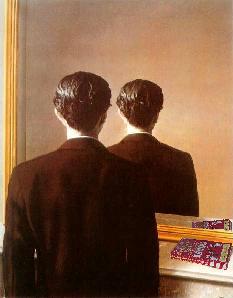
René Magritte's 'La Reproduction Interdit' (slightly altered)Been intending for a while to try to explain that reference to existentialism in the descriptive subtitle to “Hard-Boiled Poker.” Partly alludes to the great hard-boiled novels of writers like Hammett, Chandler, Cain, Thompson, Willeford, and others, all of which could -- in one way or another -- arguably be categorized as notable examples of “existentialist art.”

I also have in mind a more direct connection to existentialism as defined and explained by Jean-Paul Sartre and others -- an implied argument, if you will, for a connection between poker and existentialist thought. A lot of ideas produced by the existentialists seem to me to be readily applicable to poker. They may even be useful. But that (as the existentialists would insist) is up to each individual to decide.

First there’s Sartre’s famous observation that existence precedes essence (as far as humans are concerned). We start with existence, then formulate ideas about who we are, what our “essence” or “nature” might be. Thus might we say that the experience of the poker player is what defines him. He plays a number of hands, then becomes a certain kind of player (to himself and to others). He plays more hands, and his so-called “essence” changes still again.

The way we exist -- what we say, what we do, whether we call preflop raises from late position with suited one-gappers -- defines who we are. (You might want to argue the reverse -- e.g., that my conservative “nature” is what makes me fold ace-rag preflop -- but the existentialist knows better. He knows that folding ace-rag is what makes me a conservative player.)

It doesn’t help, of course, that the world in which we exist is indifferent to our plight. At times it may appear to follow some “order” (and thus imply some sort of creator having fashioned it thusly), but in actuality such order is only the result of our own idiosyncratic perceptions -- our relentless attempts at “meaning-making.”

In a previous post, I mentioned Miller/Sklansky/Malmuth’s observation in Small Stakes Hold ’em that “cards are pieces of plastic . . . [that] have no knowledge, no memory, no cosmic plan.” In other words, despite the frequency and/or conviction of our invocations, there are no poker gods. And not only do the cards have no “memory” or “plan” -- they have no meaning, either. Not on their own, anyway. (Just like everything else, actually.)

Facing such a circumstance, we could go the route of the nihilist and say that having accepted (1) existence precedes essence & (2) that the world is indifferent to us, there is no point in going forward. It’s a common mistake, actually, to say the existentialist believes life has no meaning. Not so. It’s the nihilist who believes life is without meaning, purpose, truth, what have you. (Sartre titled his book Being and Nothingness -- not simply “nothingness” -- deliberately choosing a phrase that implies a kind of ongoing conflict.)

Unlike the nihilist, the existentialist understands and accepts that we are the ones creating meaning -- that we are free, in fact, to make whatever we want of the world. To change the world, or what it means to us . . . for the better, even (if that’s your cup of tea).

We’re on our own, though. No “god” is going to help us. (Thus does such freedom produce a great deal of anxiety in us.) The poker player cannot control the cards. Nor can he perfectly control others’ actions at the table (although he can influence those actions). But he can certainly affect what those cards mean (to him). He can affect what his opponents’ actions mean (to him). And he can affect what his own actions mean (to himself). In fact, he not only can affect the meanings of those things -- he necessarily does affect what they mean. Every single hand.

In that earlier post (about Dostoevsky’s The Gambler -- another example of “existentialist” art, one might argue), I proposed that poker might be defined as “an activity in which each participant is trying to exert the most control in situations where everyone is a little out of control.”

In a way, that’s what I’m trying to say here about “meaning-making” at the poker table (and beyond). Poker is meaningful . . . because we give it meaning. And when we play, we not only confront other players, we confront that villainous “nothingness” who always seems to be following us around, showing up in the bathroom mirror, sitting across from us on the bus, waiting in line behind us at the store . . . .

And while we sometimes lose to the other players, we beat him . . . every time.

Image: Portrait of Edward James (a.k.a. Not to Be Reproduced) (1937) (adapted -- notice the book on the table), Rene Magritte, fair use.

Labels: , , , , , , , ,

Saturday, September 09, 2006

Testing, Testing . . .

You’re in a limit game and are dealt 9sQc in the big blind. It folds around to the cutoff who calls. The button folds, the small blind completes, and you check your option. So there are three of you in when the flop comes 9d4dQd. The small blind checks. What do you do?

This is a situation that comes up frequently enough to warrant some consideration. You find yourself barely committed to a hand, then a flop comes that changes everything. Like you’d been laying low, trying to figure out where the buffet line begins, when all of sudden you’ve been asked to deliver a toast to the happy couple. Now you’re the center of attention. You are expected to speak. But what are you going to say?

Do you bet? For as long as I can remember this was an automatic bet for me. I know that flopping a flush is a statistical rarity. For the guy holding two suited cards, he’s flopping a flush something like 1 out of 118 times. In fact, if three diamonds come out like this, it is more likely than not neither of my two opponents holds a single diamond. Of course, if one does have a diamond, he’s probably going to be sticking around for the turn (especially if that diamond isn’t especially low).

So it’s very likely -- almost a certainty, really -- that I’m ahead. And there are big draws out there, flush and straight. So I gotta protect, right?

Like I said, in the past, I would always bet. If the fourth diamond came on the turn, I’d often weakly remain in the hand (by check-calling) in the hopes of filling up on the river (even if pot odds weren’t quite enough to warrant sticking around). In other words, I hated letting go of my flopped two pair, and so often ended up paying off my drawing opponent when they didn’t hold up.

The other day, though, I was in this very situation and decided to do something different. I checked. And when the cutoff bet and the small blind folded, I just called. I figured if anyone was on a draw, he wasn’t folding to my open bet on the flop, nor would a check-raise likely scare him away. Pessimistic, I know . . . but I’d made up my mind that I didn’t want to lose a lot on this hand. I thought I’d try to keep the pot small and see what the turn brought.

The turn was the 3s. No straight. No flush. My top two pair was still the best hand, I was sure. I checked and as I’d hoped the cutoff bet. I check-raised, and he called me. The river was the 8s. I bet, he folded, and I took the pot of $6.20 (giving up thirty cents to the rake).

I don’t know what my opponent had, but clearly he didn’t have a queen. He likely had a diamond. And he may even have let go of bottom or middle pair. Of course, if he had flopped the flush (or made a set), I was doomed. But he didn’t, and I wasn’t. As it happened, I’d probably extracted the most I possibly could have from this particular hand.

I looked back in Miller/Sklansky/Malmuth’s Small Stakes Hold ’em to see if there were any sort of justification for how I’d played the hand. It had felt right to me, and (of course) the result made me think I’d done well here.

Speaking of “Slowplaying,” the trio point out that it is never a good idea to risk large pots by slowplaying. (I hadn’t done that.) But they don’t recommend giving free cards with draws on the board, either. (I had done that.)

However, in the section about “Protecting Your Hand,” they describe situations where a post-flop raise will not protect your hand. One example involves being in the big blind and flopping two pair with straight and flush draws on the board (e.g., you have T8 and the flop comes QT8 with two hearts). “If you raise now,” they explain, your opponents “will often call anyway,” particularly when there are multiple players still involved. “The best plan is to call now, hoping for a safe card. If fourth street is a blank, plan to check-raise then.” This was precisely the plan I had followed in the hand (although I wasn’t necessarily conscious of any theoretical basis for playing it this way).

Does the math support the play? Doesn’t seem to, really. When I check-raised the turn, my opponent faced 4.5-to-1 pot odds to call; thus, he was certainly justified to call if indeed he was hoping to complete his flush (around 4-to-1 to hit). However, a bet on the flop wouldn’t have been much better, odds-wise. If I had bet, the cutoff would’ve had 4-to-1 to call (and surely would’ve, if he’s chasing that flush). If I had check-raised the flop, the cutoff would’ve had 6-to-1 to call . . . even better.

So it seems like waiting until the turn indeed maximized my profit, although it also maximized my potential loss had my opponent made his draw. Still, I’m over 80% to win after that turn card -- a good place to be with one card to come, no matter how you look at it.

Did I stumble my way into a viable strategy for this kind of situation? What do you say? Here . . . take this microphone . . . I’m gonna go see if there are any of those little shrimp thingys left . . . .

Labels: , , , , ,

Monday, July 31, 2006

Fingering Those Four-Flushers (Redux)

Shamus hits the booksThat problem I discussed in my previous post continues to linger in my mind. Ran into the same situation more than once over the last couple of days of play. For example, had a hand where I was dealt AsQc in the cutoff and raised. Only one caller (the big blind). Flop comes Qh2d6h. He checks, I bet, he calls. Turn is the 7c. He checks, I bet, he calls. River is the 8h. He checks, I check, and he shows 4h4d. Don’t know if he’d have called a bet on the end, but given how he’d played the hand he probably would have as there would have been $6.25 in the pot. I won the hand but (likely) lost an extra big bet. I decided it was time to consult the experts about the problem.

David Sklansky has a chapter titled “Heads-Up On The End” in his The Theory of Poker where he addresses this very circumstance. The chapter is divided into “first position play” and “last position play.” Since the difficulty I face comes up most frequently when I am in last position, I reviewed what Sklansky had to say there.

He talks about those times when the last card comes and your opponent bets out and those times when your opponent checks to you. Now when I’m only holding top pair and that third heart appears, if my opponent bets out I’m definitely only going to call. That’s essentially what Sklansky recommends here -- he says to raise if I think I have a better hand or if I think my opponent is bluffing, but otherwise just to call. (Pot odds generally mean folding isn’t an option.) Since I usually don’t know if my opponent is bluffing in this situation, and since I also usually am not certain I have a better hand here, I call.

Now those times when my opponent checks to me on the end, Sklansky says “Bet your hand for value if you are a favorite,” but “don’t bet in close situations to avoid a check-raise.” As I’ve already established, I consider this a close situation, especially if multiple players saw the flop and only one or two of them decided to chase it to the river against me. So it appears Sklansky is here telling me that checking behind (as I have usually been doing) is probably a sound play.

It's important to note that Sklansky is offering only general guidelines in The Theory of Poker. For more particular advice about my game -- low limit hold ’em -- I go to Miller/Sklansky/Malmuth’s Small Stakes Hold ’em. In the back of the book they list a series of “Hand Quizzes,” and, in fact, the very last one closely resembles the “four-flusher” situation I’m investigating. In their example, you are dealt big slick on the button and two limpers call your raise. You flop a king (with two diamonds on the board), and so bet your top-pair, top-kicker. Both limpers check-call. The turn is a non-diamond blank, and both limpers again check-call. Then the river puts a third diamond on the board and your two opponents both check it to you.

This is precisely where I’ve almost always been checking down the hand, but Miller/Sklansky/Malmuth say this is a time to bet. Their reasoning is that “it is more likely that you are still ahead after your opponents check [on the river] than it is before they check.” It is also true that your opponent isn’t always going to check-raise you, even if he has hit his hand. They then add a “game theory”-type explanation that I’m not going to try to paraphrase here (see pp. 308-09 of SSHE, if'n yr innersted) that essentially says not betting here causes you to lose more bets in the long term than betting does.

I see how it is more likely that if my opponent(s) check to me in late position here -- as the fellow with the pocket fours did -- that I’m still ahead. Most who make their flush will indeed bet out on the end so as not to miss getting one more big bet on the river. Now that I think about it, I don’t recall that many instances where I check that hand down and then see my opponent has made his flush.

Every situation is different, of course, but I think I’ll probably be betting out here more often than I have been in the past. As Miller/Sklansky/Malmuth say, "Do not let every river card scare you. Bet!"

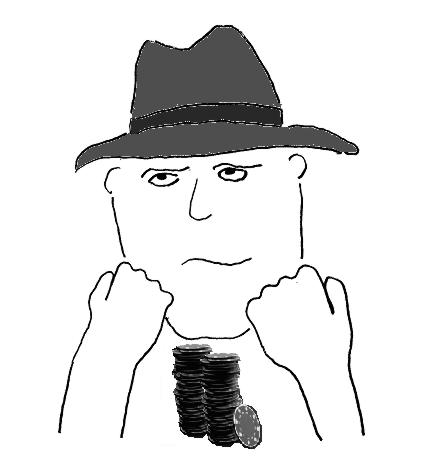
Photo: Tom Neal from the 1945 film Detour (adapted), public domain.

Labels: , , , , , ,

Tuesday, July 04, 2006

Is Patience a Virtue?

Shamus waits to play his first hand.Played some Stud 8/b yesterday and had a decent, brief session. Had a hand where I managed to catch a wheel on sixth street, capturing a nice pot. With the antes and bring-ins, Stud has a different character than blinds-driven games like Hold ’em. One of several ways Hold ’em plays like a circle, Stud like a straight line.

I ended up back at the limit Hold ’em tables afterwards. I joined one table (full limit, $1.00/$2.00) and got a seat just after the big blind had passed. So I clicked “Wait for the BB” (as I usually do) and watched six or seven hands. I almost always choose to wait for the BB, particularly if I am looking at calling the blind from middle position or earlier. Finally we came to the point where the next hand would bring the BB back to me. That’s when the player to my right decided to leave, thereby causing the button to pass me by yet again. So once again I sat there watching the wheel go 'round (only a few minutes, although online a few minutes can seem an eternity) until I finally got to play.

I had considered going ahead and putting my BB out there the second time I was given the opportunity to do so -- from the cutoff -- but by force of habit did not. There’s certainly a benefit to sitting and watching other players for a few hands before jumping in. A few months ago, Roy Cooke wrote an article in CardPlayer titled “Increasing Edge by Observing a Hand” in which he discussed this very topic. One can often learn quite a bit from paying attention to what the players around you are doing while you await the big blind.

Of course, by choosing to wait you are also signalling something about yourself as a player -- cultivating an image of sorts even before you play your first hand. At the low limits, folks aren’t always paying a lot of mind to this sort of thing. Still, by not playing right away, I may well be announcing (quite accurately, in fact) to attentive players that I am a somewhat conservative player, selective with his starting hands and careful not to take too many unreasonable risks.

I’m reminded of one of my favorite sentences in Miller/Sklansky/ Malmuth’s Small Stakes Hold ’em -- not so much for what it says but for the trio’s curious choice of vocabulary. “When you enter a game,” they explain, “you usually have the option either to post an amount equal to the big blind and take a hand immediately or wait for the big blind to come to you. Mathematically, the choice you make does not much matter. (Nevertheless, people seem to like to debate this picayune topic.)”

Picayune? What a word. I can just imagine the look on Sklansky’s face when he pronounces it. (Try it -- pick-uh-YOON -- you can’t help but sneer.) A fancy way of saying “trivial” or “petty.” Etymologically, the word actually refers to money, coming as it does from the French word picaillon (meaning "small coin"). Le chump change.

As the trio go on to explain, while there is little mathematical significance to whether or not you decide to wait, there can be -- as I’ve already suggested -- a significant psychological significance. “If you sit out seven hands before you play,” they explain, “you will appear too serious” to your opponents, causing them to play more carefully against you. This phenomenon is certainly more meaningful in the live game situation than online, I’d venture. Still, it makes me think that perhaps I should go ahead and jump into the fray once in a while and perhaps mislead the table into thinking I’m a looser cannon than I actually am.

I’m curious to hear what others think about this issue. Do you routinely wait for the blinds, or jump right in? This topic is probably more meaningful for limit games, although I’m interested to hear what the difference might be for NL players as well.

Or is it all just too picayune to matter?

Labels: , , , , , , , ,

Monday, June 26, 2006

Assuming the Worst

Assuming the WorstThis week’s installment of Card Club on Lord Admiral Radio (an entertaining, informative podcast primarily aimed at the lower limit player) featured the conclusion of Episode 19 of Columbo’s “One Minute Mystery,” titled “The Case of the Clichéd Players.” If you haven’t heard ’em, Columbo’s OMMs generally come in two parts, and usually the Card Club guys make us wait a week to find out how each OMM turned out for Columbo. (See my earlier review of Card Club for more about both the show and the OMMs.)

“The Case of the Clichéd Players” generated a thoughtful discussion on the Card Clubs forum that was continued on the show once the hosts played the second part of the OMM. An issue that arose -- really the main issue of significance, I’d say -- concerned the quality of play in online, low buy-in, multitable tourneys. In the hand, Columbo faced what appeared to be some very loose, very questionable betting and calling before and after the flop. Having to make a tricky post-flop decision, Columbo decided he was up against a couple of inexperienced and/or inexpert players and so acted accordingly. It turned out well for him, with his correct assumption that his two opponents were playing the hand poorly allowing him to triple up.

The OMM and the discussion surrounding it got me thinking a bit about how easy it is to underestimate one’s opponents at the table. I essentially agreed with Columbo’s cogitatin' in this here situation -- the minimum raises and calls of big bets by his foes did seem to indicate the likelihood that he was up against some untutored adversaries. It is easy, though, to fall into the trap of “assuming the worst” about the level of one’s opponents’ abilities, especially in these low buy-in tourneys or in low limit cash games. I know I’m guilty of making such assumptions -- sometimes on scant evidence -- and usually end up paying the price when an apparent donk turns out to be more crafty that I had realized.

In some of my recent posts I may have given the impression that I’m the only sane one at a table of lunatics -- that all of the other players at these low limits are operating at less than full capacity, thereby giving me the right to sit back and judge their awful play. Such is hardly the case. Looking back at the three hands I shared in “Life in the Land of the Blue Chips,” I can certainly question the level of my own thinking in a couple of instances (particularly “Hand 1” where I recklessly ride big slick to the bottom of the river). While those hands all certainly demonstrate some unorthodox play, none of them can be taken as irrefutable evidence that those involved (even me) are bad players. Indeed, the fellow in “Hand 1” (Underpants) who preraised with 82-suited could well have been pursuing a simple blind steal, was caught (with his pants down, so to speak) by my BB reraise and had to call, then fortunately flopped two pair and turned the boat. If I proceed from that point assuming he’s preraisin’ with any ol’ suited crap, I’m likely gonna be donating even more to his stack.

In Small Stakes Hold ’em, Miller/Sklansky/Malmuth make two sets of recommendations regarding starting hand selections, one for a “loose” table (where 6-8 players are seeing the flop) and one for a “tight” table (where only 3-5 players see the flop). When first arriving at a low limit hold ’em table where you don’t know any of the players, they recommend presuming you are at a loose table and continuing to think that way until proven otherwise. This advice goes against conventional wisdom, actually, which says to begin cautiously and try to learn about your opponents’ tendencies before mixing it up. However (argue Miller/Sklanskly/Malmuth), “at the small stakes there are so many confused and poorly-skilled players that failing to play extra hands should prove more costly those times when you should play them than they will save you those times you should throw them away.”

Notice that the authors are not saying to assume you are up against bad players -- rather, they say to assume you are up against loose players (implying, perhaps, that one or two or more might in fact be “poorly-skilled” enough to pay you off if you time things well). When I first arrive at a low limit table I try to follow the trio’s advice and assume it’s a loose table, but also try to avoid assuming the players are clueless. In fact, I attempt to give them all credit for knowing what they’re doing -- again, until they make a play that cannot possibly be interpreted as an intelligent one. In truth, I usually find it better policy to assume the worst about my own hand -- not about my opponents’ abilities -- and let folks showdown a few bottom pairs or busted draws to me before concocting any overly-elaborate theories about them.

If you haven’t done so, do check out Card Club and the OMMs. I always liked the Columbo TV series, where “who done it” was usually less of an issue than how it was done (and how Columbo is going to figure it all out). We all know the murderer will be caught in the end, so the result matters less to us than the process by which the result was achieved. The OMMs tend to operate similarly. It (usually) doesn’t matter so much how the hands turn out; what matters is process, that is, the thinking that leads to -- hopefully -- correct decision-making. And a big part of such correct decision-making is not assuming your opponents all think they’re playing blackjack.

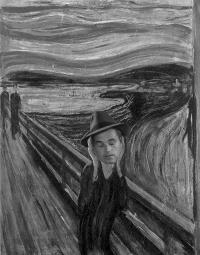
Image: Edvard Munch, The Scream (1892) and Tom Neal from the 1945 film Detour (adapted), public domain (both).

Labels: , , , , , ,

Tuesday, June 13, 2006

Dostoevsky is Not Considered Summer Reading (Pt. II)

As I mentioned before, I want to discuss three ideas of interest to poker players that come up in Fyodor Dostoevsky’s The Gambler. The first concerns the human tendency to see patterns where they don't exist.

Alexey Ivanovitch is not the only character in The Gambler who becomes obsessed with roulette. Other characters are shown succumbing to the lure of the wheel, the most colorful being Granny. Granny is the grandmother of the family for whom Alexey works as a tutor, and for the first half of the novel most members of the family appear impatient to see Granny die and leave them her estate. Without warning, Granny suddenly appears in Roulettenburg -- in good health, at that. She’s a bit eccentric and certainly enjoys the discomfort she has produced by appearing so unexpectedly.

“I want to see everything here,” Granny tells everyone, and soon has made Alexey take her to the casino. Within minutes she’s at the roulette table. After a rapid tutorial from Alexey about how the game works, she’s ready to play. Before placing any money down, they watch as the wheel lands on zéro. Alexey explains to Granny that if one bets on zéro and it hits one wins 35 times the bet. “Why don’t they stake on it, the fools?” she asks. “There are thirty-six chances against it, Granny,” Alexey explains. “What nonsense,” she replies, and fishing out a friedrich d’or from her purse orders her servant to “Stake it on the zéro at once.”

Her bet concerns Alexey, who with the appearance of rationality explains “Granny, zéro has only just turned up . . . so now it won’t turn up for a long time. You will lose a great deal; wait a little, anyway.” “Oh nonsense, nonsense” says Granny. “If you are afraid of the wolf you shouldn’t go in the forest.”

After losing three times running, Granny decides to stake two friedrichs d’or and the zéro hits. Much to Alexey’s dismay, she bets as much as is allowed on zéro again and loses. Undeterred, she bets on zéro yet again. “Zéro!” cries the croupier, and once more she’s won a bundle. Alexey describes how he felt upon realizing the zéro had hit three times within a dozen turns: “I felt that at the moment my arms and legs were trembling, there was a throbbing in my head.” Granny puts the bulk of her winnings on rouge, wins again, then announces “That’s enough! Home! Wheel my chair out.” All told Granny had staked five friedrichs d’or and was now leaving the casino with about 220 times that, an amount nearly equal to that of her entire estate.

There are a few different ideas present in this episode familiar to poker players (e.g., running well, playing one’s rush, boldly taking risks, hitting longshots, etc.), but the one I find most interesting concerns Alexey’s claim that since the zéro had recently hit it was less likely to hit again in the near future. Earlier in the novel Alexey describes players who “sit with papers before them scrawled over in pencil, note the strokes, reckon, deduce the chances, calculate, finally stake and -- lose exactly as we simple mortals who play without calculations.” Alexey instinctively knows these players are self-deluded. He knows that one turn of the wheel has no bearing whatsoever on the next. Nevertheless, he still advises Granny against betting on zéro since it had so recently hit.

In Small Stakes Hold 'Em, Miller/Sklansky/Malmuth discuss the tendency for poker players to believe how the cards are dealt in one hand actually affects how they will be dealt in the next hand. “The human brain is terrific at identifying patterns,” they point out, though sometimes -- especially when playing poker -- “people see false patterns that they believe are real.” “Most gamblers,” they claim, “tend to ascribe meaning to purely random, independent events.” Have you ever (like Alexey) allowed the appearance of such false patterns affect your thought process during a given hand? If you are human, you probably have.

Just today I had newly arrived at a $1/$2 limit table where I was dealt Jh 3c in the BB. A late position player raised, the SB called, and after a moment I decided to let it go. Sure, I’d be getting 5-to-1 by calling, but I knew zilch about the other two players. Besides, I didn’t want to get in trouble here on my first hand and thereby create an unwanted table image from the get-go. I folded and watched as the flop came 9h 3s Jd. The SB called bets on both the flop and turn, then after an Ace came on the river fireworks erupted and the pair capped. Both had big slick and so chopped a huge pot -- $25 or so -- although they ended up only coming out even on the hand after the $1 rake (precisely what I had put into the pot).

Before I had time to grieve my missed oppportunity, I chuckled to see I’d been dealt J3-offsuit once again in the small blind. “When most people play poker,” write Miller/Sklansky/Malmuth, “they tend to expect that which has recently occurred to recur.” Hmmm . . . . As I waited for the action to come back to me I couldn’t help thinking how attractive J3 looked. Would I dare? Luckily for me, a raise and reraise kept me from pursuing my relationship with this garbage hand any further. (And yes, the flop did not bring a J or 3 this time.)

Barring six limpers (and thus even greater odds than the previous hand offered), I probably would’ve let the hand go again, but not for the correct reasons. Rather, I felt like Alexey did after seeing the zéro hit the first time -- it somehow seemed less likely to flop two pair (or something else favorable, like trips) because it had “only just turned up . . . so now it won’t turn up for a long time.”

Nonsense! (As Granny would say.) Miller/Sklansky/Malmuth say the same thing in a different way: “The cards dealt on any poker hand are, for practical purposes, completely random and independent of the cards dealt on any previous hand.” The odds of my flopping two pair hadn't changed an iota. They remained about 1 in 49 -- the same as every other hand where one holds two unmatched cards.

Granny herself eventually shows that she, too, can’t resist believing in false patterns when she returns to the casino and loses all she won and then some, mostly by betting on zéro. She would have done well to heed the advice of Miller/Sklansky/Malmuth: “Stop your pattern-recognizer before it goes haywire by telling yourself, ‘There is no pattern! There is no pattern!’”

In my next post I'll say something about how The Gambler illustrates another “mind game” poker players often experience, namely the way the game can cause us to shut out past and future and live only in the moment.

Photo: “Roulette ball,” Ralf Foletschek. CC BY-SA 3.0

Labels: , , , , , , ,


Older Posts

Copyright © 2006-2021 Hard-Boiled Poker.
All Rights Reserved.