Tuesday, November 17, 2015

Files Found! Poker Audio from 2004-2006

We still have this desktop PC in use that is probably more than a decade old now. We use it for a few household-related tasks, among them printing documents with the even older printer attached to it (although that is rarely needed in this mostly paperless world). It’s not even online, which in truth has probably helped add to its longevity, being isolated as it is from the scary virus-filled outside world.

As you might imagine, there are some old, old files on there, including some old audio files of poker podcasts from back when podcasts first became a thing. I’ve written about those before here, including recently. In fact it was just in December of last year I shared a screenshot of all the folders on the drive containing those old shows.

I guess I’ve got a little bit of hoarder in me, having continued to keep all those files. The only reason I downloaded them in the first place was because that was typically the method of listening to them then. We weren’t listening to podcasts on our phones quite yet, and so a lot of the time I’d download the show and listen on my computer while playing online.

Anyhow, for a long time I’ve been going back to those directories and to other places on that old PC to look for something else -- something I knew I had downloaded once upon a time, but could never quite put my finger on where it could be.

In 2005, CardPlayer sponsored live audio commentary for that year’s World Series of Poker Main Event final table. I remember listening all night and into the morning, with the sun having risen here on the east coast by the time Joe Hachem finally ousted Steve Dannenmann in a short heads-up battle to win. Shortly after that CardPlayer posted the .mp3s on their site -- one per week, I think -- eventually posting eight files which totaled something like 13.5 hours’ worth of audio. It wasn’t long after that the files were no longer available.

I was positive I had downloaded those files, and I thought I must have them somewhere but just couldn’t figure out where. Finally -- kind of randomly -- I looked in an old external drive last week and there they were, along with some other old poker-related goodies.

Among the other files there were what I believe might even be the entire run of Card Club on Lord Admiral Radio shows (from 2004-2006), a number of Ante Up! episodes from their first couple of years (2005-2006), some episodes of CardPlayer’s The Circuit from early 2006, Phil Gordon’s 2005 WSOP podcasts plus some Poker Edge shows, the old Poker Diagram podcast (anyone remember that one?), and several episodes of Rounders the Poker Show (forerunner to the 2+2 Pokercast) from the summer of 2006.

I think the latter collection of Rounders shows might include the Jamie Gold interview he gave just a couple of days after winning the 2006 WSOP -- the one I believe was later admitted into court as part of Crispin Leyser’s lawsuit against him that was eventually settled out of court in 2007. (I hope so, anyway.)

I grabbed the 2005 WSOP shows, got ‘em loaded on the iPod, and listened to the first 20 minutes today. Phil Hellmuth and Jeff Shulman are hosting, and already within that short introductory section had on Gary Thompson and Howard Greenbaum of Harrah’s, Mike Matusow (who was at that final table and destined to go out in ninth), Howard Stutz of the Las Vegas Review-Journal (then, and still), and Oklahoma Johnny Hale.

I remember lots of other guests coming and going throughout the marathon, including Puggy Pearson who would pass away the following spring. I found myself wanting to jot down some notes as I listened, thinking perhaps I’ll share some highlights here once I get through it all.

What a time that was, and it’s hard to believe it’s now over a decade ago. A time when I couldn’t get enough poker -- I’d listen, watch, or read anything. You too, probably.

Labels: , , , , , , , , , , ,

Wednesday, August 06, 2014

A 2006 WSOP Time Capsule

Didn’t watch the “One Drop” last night (DVR’d it). Instead what time I did spend looking at poker actually involved viewing some of the 2006 World Series of Poker Main Event -- not the ESPN episodes, but the live pay-per-view that was shown that August night (the eighth anniversary of which comes this weekend) when Jamie Gold won the biggest first prize in WSOP Main Event history.

The program brings back some personal memories. That final table occurred just a few months after I started this blog, and about six weeks prior to the passage of the Unlawful Internet Gambling Enforcement Act of 2006. Thus it exists within a rosy context, a time when my absorption in all things poker was at an all-time high. As was the case for a lot of people.

The playing styles at the final table are of course conspicuously different from what we see today, with everyone opening for at least three times the big blind before the flop (sometimes more), lots of overbetting of pots after the flop, and many all-ins that today would automatically be read as “ICM suicide.”

The commentary by Phil Gordon doesn’t have the benefit of eight years’ worth of hindsight, and so while he does point out what seem like misplays or less-than-recommended bet-sizing here and there, most of his observations -- like the plays themselves -- are essentially time-bound, perfectly fine then while highlighting in retrospect changes in tournament strategy that have happened since.

Other comments by the many guest hosts rotating through during the broadcast are similarly time-bound, and since it was such an interesting time those comments are all the more intriguing.

At one point Doyle Brunson stops by. It happens to be his 73rd birthday. He’s just finished playing a 14-hour day the night before, finishing 21st in one of those post-Main Event bracelet tournaments they ran that year.

“What are your impressions... eighty-seven hundred players this year?” begins Gordon, and Brunson answers that he was one who expected there would be an increase in players from 2005. There were 8,773 players in the WSOP Main Event that year -- still a record. That was more than 3,000 more than had played in 2005, and more than 10 times as many as had played in 2003.

“I think that it’s just going to get bigger and bigger,” Brunson continues. “I don’t see any stopping it. In fact if there were some way to bet, I would like to bet there would be something like 40-50 thousand players in 10 years.”

“Oh boy,” says Gordon, who begins to disagree. “I think so,” affirms Brunson. “The only thing that would stop it, you know, if the internet....”

At that point Brunson gets interrupted by another “Oh boy” from Gordon as a hand has developed that will result in Sweden’s Erik Friberg getting knocked out in eighth place by Gold.

“Hold onto that thought,” says Nejad as the hand starts to play out. But the bustout distracts them and they never do get back to the topic.

Not unlike the way the idea itself would be interrupted just a few weeks later. That vision of 50,000 WSOP Main Event players -- perhaps spread all over Las Vegas and/or the internet -- would be left behind, time-bound.

Labels: , , , , , , ,

Wednesday, October 27, 2010

TWIP Notes

Mel AllenAn especially interesting episode of “This Week in Poker” yesterday, I thought.

The Entities from Wicked Chops managed to cram four guests into the less-than-hour-and-a-half long program. I'd say three of those four guests shared thoughts and/or opinions which might’ve caused some viewers to utter the catch-phrase of Mel Allen, longtime Yankees broadcaster and host of “This Week in Baseball.”

Don’t tell me you don’t remember...! What did Allen always say at the end of the weekly “TWIB notes” segment?

“How about that!”

Dan Fleyshman, CEO of Victory Poker and seventh-place finisher at last month’s WSOPE Main Event, was in the studio. Fleyshman shared a lot of interesting views about the state of online poker at present, particularly in the United States where we remained mired in ambiguity, legally speaking. He expressed cautious optimism about the eventual regulation of online poker in the U.S., though noted that we’re still at least a couple of years away from such occurring.

He also had some things to say about the upcoming WSOP November Nine and sponsorships. If I heard him correctly, Fleyshman mentioned that last year’s chip leader (Darvin Moon) had been offered $300,000 by both PokerStars and Full Tilt Poker to wear their patches, but had turned down the offers.

Last fall some of the rumors suggested Moon had been offered as much as $1 million to get himself patched up, although most had guessed something less than that. Last year Paul Leggett, COO of Tokwiro Enterprises (then owner of UltimateBet), was interviewed about the topic over on Poker News Daily, and while he didn’t confirm exact figures, an editor’s note suggested $350,000 to have been the offered sum. (Tip of the fedora to Kevmath for help recalling that item.)

Another guest on the show, November Niner John Racener, was also asked about the wearing of logos at the final table, specifically who among the November Niners being sponsored by Full Tilt Poker will be the ones to sport FTP patches.

Over on Full Tilt’s site, they are currently listing seven of the nine as part of their stable -- Filippo Candio, Joseph Cheong, John Dolan, Matthew Jarvis, Michael Mizrachi, Soi Nguyen, and Racener. (The other two -- Jonathan Duhamel and Jason Senti -- have PokerStars’ backing.)

This Week in PokerRacener was asked the question because of the restriction listed in the WSOP rules that limits the number of players who can wear a single site’s logos at a televised table. According to the rule (Rule 50, section B), “During all events taped for television coverage, and at the start of each television taping day, no more than three (3) players at the Final Table -- and all other tables featured for television coverage -- will be allowed to wear apparel with logos, patches or promotional language from the same entity.”

Racener initially seemed under the impression that all seven of the FTP players would be wearing garb representing the site. However, further discussion seemed to reveal that he was assuming as much because he hadn’t been told otherwise.

Kind of interesting to see how FTP has kept even their players in the dark regarding this decision, a strategy which Fleyshman -- who remains interested in possibly having a November Niner don a Victory patch -- commended as strategically sound insofar as all seven necessarily remain identified with FTP throughout this long build-up to the final table.

Another “how about that” moment from Racener’s interview came up when he was asked whether or not he and his friend Michael Mizrachi had pieces of one another or had swung any sort of deal leading into the final table. Racener said no, adding that the WSOP explicitly forbid the players from making deals at the final table, an admonition expressed to them in a meeting with the final nine before they left Vegas in July.

Speaking of Full Tilt, one of their “red pros” Phil Gordon also appeared on the show. And speaking again of the battles between online sites, one of the more interesting items Gordon brought up was his frustration over the fact that the FTP pros and members of Team PokerStars couldn’t compete against one another on televised shows like “The PokerStars.net Big Game” or the “Full Tilt Doubles Poker Championship.”

In fact, when Gordon was asked which player he’d like most to team up with in a doubles tourney among those not already on the Full Tilt show, Gordon somewhat surprisingly answered Joe Cada, the 2009 WSOP ME champ and PokerStars pro. The issue was discussed further, and Gordon acknowledged that the marketplace was so competitive that his desire to see the sites no longer segregate themselves this way was perhaps not something that was likely to happen.

Can’t honestly report the fourth guest on yesterday’s show -- Victory Poker model Victoria Moore -- offered anything as intriguing as did the other guests. Besides being easy on the eyes, that is. Or the news of her being named this year’s “Official Wicked Chops Poker Girl.”

Like I say, another interesting and engaging episode of “This Week in Poker.” An archived version should appear over on the “This Week In” site soon. I’ll add a link here when it does.

(Here you go.)

Labels: , , , , ,

Thursday, December 10, 2009

Out of This World: The Isildur1 Saga Continues

That's a lot of cabbageSo Brian Hastings, a senior at Cornell University, is trying to study for finals right now. I understand he’s having a hard time concentrating. Why? Word is he had a decent session at the online tables night before last.

How decent? Try about $4.2 million up. Sometimes taking a study break can be most beneficial.

That gargantuan session by Hastings thus provides us with the latest jaw-dropping chapter of the continuing adventures of Isildur1. Hastings won that big countryside-sized field of cabbage -- $4,206,964.19 to be exact (according to highstakesdb.com) -- in 2,867 hands of $500/$1,000 heads-up pot-limit Omaha versus the ever-ready Isildur1. Meanwhile Isildur1, having won earlier in the day versus jungleman12 (~$471,000) and Brian Townsend (~$722,000), ended December 8 down a total of $3,013,361.19 (in a little under 10,000 hands played).

That rivals Isildur1’s day back on Saturday, November 21 when he dropped around $3.3 million to Patrik Antonius and Phil Ivey, also at $500/$1,000 PLO. That was the day of the still-record $1,356,946.50 pot Isildur1 lost to Antonius. Still not as bad as his worst day when he dropped over $5 million, though.

Speculation about Isildur1’s identity has continued over the past couple of weeks, with no final revelation having been made as yet. On November 26, Tony G posted on his blog that Isildur1 was in fact the young Swedish player Viktor Blom. Ilari “Ziigmund” Sahamies also addressed Isildur1 as “Viktor” in chat during one of their sessions, which most took as further confirmation the player was Blom.

However, soon (on December 1) we heard news in a Bluff Europe piece that Blom was denying he was Isildur1. The next day another story popped up saying that the fellow issuing the denial was in fact a different person, a fellow named Victor Blom (with a “c”) who happens to live in the same Swedish town as the poker pro.

Hard to know, then, which of the stories to believe. Some have speculated that it would be in Blom’s interest to deny being pegged as Isildur1 because of a severe tax situation in Sweden. Gotta think the longer this plays out, the greater the chance we’ll finally learn once and for all.

Hastings wrote a lengthy post on his CardRunners blog that talks a bit about the session, though mostly just tries to place the day in the larger context of his life and career. Others who have played Isildur1 are talking, too, including Patrik Antonius, who recently was interviewed by Phil Gordon over on the Full Tilt Poker Academy site.

Phil Gordon interviews Patrik Antonius about Isildur1“He’s a very interesting opponent,” says Antonius near the start of the 18-minute interview, adding that he’s “very dangerous” because of his penchant for aggression, his desire always to play deep, and the way he constantly “wants to make big decisions all the time,” thereby always keeping the game at an intense level. Like Tony G does in his post, Antonius judges Isildur1 to be a talented player, and the Finnish stud especially marvels at the way Isildur1 seems always to make decisions especially fast, even when playing 6-8 tables at a time versus multiple opponents.

Gordon asks Antonius about bankroll management with regard to this $500/$1,000 PLO game, and Antonius explains that in truth “there are different rules for bankroll management when it comes to very good players.” There are also different rules, it seems, when dealing with stakes this high. The fact is, no one has the $300-$500 million Antonius suggests would be needed to play in such a game where one can lose a milly in a half-hour, or $3 million (or more) in a single day. So, in essence, for everyone playing the game it is “all like taking shots” -- something good players can handle much more readily than lesser skilled players.

At the end of the interview Gordon asks Antonius again about Isildur1’s remaining anonymous, and whether that gives him any advantage. Not anymore, says Antonius. Even though Isildur1 can apparently mix up his game quite effectively, by now he’s played so many hands he’s become more of a known quantity than he was when he first appeared a few weeks back.

According to highstakesdb.com, Isildur1 is now more than $1.5 million down overall. That’s after having peaked at more than $5 million ahead right around mid-November. The report on the Hastings-Isildur1 session notes how Hastings ran especially well during the session, hitting cards at a much higher clip than would be expected. (He ended more than $3 million over his EV.) Writes Baard, “it was clear from the comments [Isildur1] made in the chat that he thought he was caught in a parallel universe or something.”

To most of us, the whole Isildur1 story seems like it is playing out in a parallel universe. Actually not even “parallel,” as it is hard to see it having much relation to this one.

Definitely out of this world, though.

Labels: , , , ,

Friday, November 06, 2009

2009 November Nine Just Hours Away... Time for Special Tactics!

ESPN's The Poker EdgeToday was listening back to some of these interviews with November Nine-alists on The Poker Edge from the past few weeks. Great stuff, and Andrew Feldman and the crew is continuing to produce shows right up until tomorrow’s final table. Don’t forget Feldman’s also got a blog goin’ over there on the ESPN Poker Club with polls and other whatnot, so check that out as well.

One of the eps I was listening to today was that one with chip leader Darvin Moon (the 9/25/09 episode). Just as we read earlier this week in Matt Waldron’s interview with Moon (from a while back), Moon insists on The Poker Edge that in that huge hand with Billy Kopp that his impression was the board had not paired on the turn. No shinola!

You’ll recall that when the flop came Kd9d2d both he and Kopp had flopped diamond flushes, with Moon holding QdJd, and Kopp 5d3d. The turn brought the 2h, Moon checked, Kopp bet 2 million, Moon check-raised to 6 million, Kopp shoved, and Moon called. Kopp was drawing dead.

“The flop come Kd9d6d,” says Moon to Feldman and co-host Phil Gordon, getting that third card wrong. “I checked and he checked.” Actually, Moon checked, Kopp bet 750,000 (a little under half the pot), and Moon called.

Darvin Moon, courtesy the great Flipchip“Turn card come 2h,” Moon continues. (Photo courtesy the great Flipchip.) “I checked, he bet 2 million, so I went all in, and when he said ‘all in’ my heart ’bout jumped on the table.”

I don’t believe Moon was misremembering the final sequence of bets -- he didn’t go all in first. Rather, he was just stumbling a little in the retelling, as made clear by his subsequent words. “When that happened, I mean I just leaned back in my chair, leaned back forward, and I said ‘I call.’”

Moon goes on to say how Kopp turned over 5d2d. “Didn’t the board pair on the turn?” asks Feldman. “No,” says Moon. Gordon reiterates that the board paired on the turn, but Moon insists “No, the board didn’t pair. It might’ve paired on the river. But it didn’t pair on the turn. The turn come the 2h. I’m very confident of that.”

“Interesting,” says Gordon.

After the interview was over Gordon and Feldman revisit the issue, and both seem ready to believe Moon, though as we all saw back in July -- and as was confirmed by the ESPN telecast earlier this week -- the original reports of the hand were correct.

In other words, Kopp, for whom the board pairing on the turn absolutely dictated his play on that street (see his explanation here), was playing against a guy who hadn’t noticed the board had paired! Doomed, he was.

Gotta love Moon, though. “Are you paying much attention to the telecasts?” Gordon asks him. There’s a pause.

“On the teevee?” Moon responds.

Moon has absolutely no desire to change his lifestyle one iota, regardless of how this sucker turns out. “I’ve got everything I want,” he says. “I don’t need anything. I mean, I’m 45 years old. I’ve live my first 45 years like this. Why change?”

That attitude similarly applies to his decision not to seek any sort of coaching for the final table.

“See, I’m not hiring no coach. I don’t understand all that. I’ve been called and asked if I would like to have coaching, and... naw. I mean, I’m going in there the same way I went in the last time. Just with a game plan of my own and if it works, it works, and if it don’t, it don’t.”

Speaking of coaches, the interview with Phil Hellmuth -- who is coaching Jeff Shulman -- from yesterday (the 11/5/09 episode) is pretty fascinating as well. Do note the Poker Brat has supplied Shulman with a “special tactic” that will “shock the world” when used. Awesome!

(Of course, one wonders how well them special tactics will work if the opponent ain’t clear on the community cards!)

Can’t wait.

Labels: , , , , , ,

Monday, August 18, 2008

Worryin’ About Hurryin’: The 2008 WSOP Main Event Final Table

Was catching up on some podcasts over the weekend and heard Gary Wise’s interview with David Rheem on Wise Hand Poker (the 8/13/08 episode). Rheem is one of the so-called “November Nine” who made the delayed final table of this year’s World Series of Poker Main Event. You might remember Rheem from his appearance at the Event No. 4 final table (the $5,000 Mixed Hold’em event) shown on ESPN a couple of weeks ago. He entered that final table the chip leader, but ended up going out in fifth.

You might also recall back in July an article appeared in the South Florida Sun Sentinel reporting Rheem had an outstanding warrant in Hollywood, Florida for apparently having failed to appear in court in 2003 on a misdemeanor trespassing charge. Less widely circulated was a subsequent report that the 2003 warrant is apparently no longer valid.

I had heard Rheem interviewed once before on the Two Plus Two Pokercast (Episode 32, 7/14/08), but on Wise’s show Rheem mentioned something new. When asked his thoughts regarding the 117-day delay before the WSOP ME final table, Rheem admitted that when he began the tournament, he had no idea such a delay was scheduled.

According to Rheem, following Day 2 he had a decent-sized chip stack and was discussing the tournament with some friends. “They were, like, ‘you know, once you make the final table, you make a three-month break,’ and then, you know, I almost lost money on it because I didn’t believe them. I was like ‘I’ll bet you money that you don’t!’ And then when their arm was out ready to shake my hand, I knew they were serious.” Rheem said he then went to the Tournament Director to confirm, and that’s when he first found out about the delay.

There was no hurry, I guess. Not like it really mattered on Day 2.

Rheem seems pretty likable. So do his fellow final tablists Dennis Phillips, whom I heard interviewed on Phil Gordon’s The Poker Edge (7/24/08), and Craig Marquis, who appeared on The Poker Edge as well (8/7/08). Listening to their interviews got me wondering about where things stood heading into that final table, still nearly three months away.

Play stopped in the early morning hours of July 15th with exactly 21 minutes and 50 seconds left in Level 33. That means these guys played over 65 hours of poker to get to this point in the tourney. The blinds are currently 120,000/240,000 with 30,000 antes. Here’s what each player will have in front of him when the first hand gets dealt on November 9th:

2008 WSOP Main Event final tableOn the World Series of Poker website, there’s an article dated July 15th that purports to give final table seat assignments, but that information is incorrect. As Dennis Phillips mentioned on The Poker Edge, they will be drawing for seats five minutes before play begins on Nov. 9th.

I listed the number of big blinds each player currently has as well as the “M” or ratio of one’s stack to the current total of blinds and antes -- i.e., the “cost per round” figure popularized by Dan Harrington and Bill Robertie in their Harrington on Hold’em series.

On the most recent episode of The Poker Edge, Phil Gordon suggested that “the pace of play at that final table is going to be ridiculously slow.” He was referring to the fact that when it came to players like Marquis -- whom he said was “not exactly short-stacked, not exactly desperate yet” -- “you’ve got 40 big blinds, there’s no hurry.”

Indeed, if one looks at the “M” ratio of the nine players, a lot of them are still in that “Green Zone” (an “M” of 20 or higher) in which Harrington and Robertie say “all moves are available.” However, Arnold Snyder, in his discussion of “chip utility” in The Poker Tournament Formula 2, would certainly disagree with the notion that “there’s no hurry” when one is down to 40 big blinds.

For Snyder “full utility” is only possible when one has 100 big blinds or more, a situation only Phillips and Demidov currently enjoy. That, says Snyder, “is the minimum stack size required for unhampered post-flop play, including information bets and more advanced moves on later streets or against more aggressive deep-stacked opponents.” Snyder describes a stack size of 60 big blinds as still “competitive,” though not “fully functional.” Stacks of 30-60 big blinds have “moderate utility,” and below 30 makes one’s utility “low.”

Of concern here for players other than Phillips and Demidov is the fact that 20 minutes after they start play on November 9th -- i.e., probably less than one orbit -- the blinds and antes will be moving up to 150,000/300,000 plus 40,000. That means unless a player like Marquis picks up a pot within those first few hands, he’s down to 30 big blinds and “low utility” (according to Snyder’s rubric).

Gordon’s comment reminded me that he had said something similar last year at the start of the 2007 final table. Indeed, that final table also began with 120,000/240,000 blinds and antes of 30,000, with roughly the same total number of chips in play. After the first hand of that final table -- in which Jerry Yang raised to 1.4 million from under the gun, was called by a late position player, then took the pot with a big bet on the flop -- Ali Nejad spoke of the 630,000 that was in the pot before each hand began and how that was a decent-sized prize to go after.

“Yeah, but the blinds are very small in relation to the stack sizes here,” answered Gordon. “There’s not a single player at the table who’s ready to just push under the gun or raise all in…. It would surprise me greatly -- unless there are just some huge hands, like aces versus kings or something like that -- to see any elimination here in the first three or four hours of this tournament.”

Anybody remember where we were after four hours last year? No less than four players -- Philip Hilm, Lee Watkinson, Lee Childs, and Hevad Khan -- had already busted.

We’ve a long time to wait, still. But I tend to believe we’re probably gonna see some serious hurryin’ once we get there.

Labels: , , , , , , ,

Friday, June 13, 2008

2008 WSOP, Day 14: Postscript

PostscriptAt one point last night after the tourney had gone three-handed, I was standing next to the table, right along the ropes where fans had gathered. I was just a few feet back, on Jamie Pickering’s left and Vanessa Selbst’s right. This was when Selbst had around three-fourths of the chips in play in front of her -- close to 1.5 million -- while both Pickering and Stanley Statkiewicz were nursing stacks of about 300,000 each.

We were between hands, and the dealer was pushing the cards around on the felt before him, jumbling them up and reassembling them in preparation for the subsequent hand. Suddenly I hear a voice addressing me from well above my left shoulder.

“What’s this?”

I answer before looking up. “PLO final table.” Then I look. Why, it’s Phil Gordon. Man, he is tall.

He sticks around for a couple of hands. One came up in which Selbst made an almost pot-sized bet after the flop and the action was on Pickering. He hemmed and hawed for at least a couple of minutes. It was one of many instances where to continue with the hand would’ve meant committing oneself utterly, as a call would represent probably a third of Pickering’s stack.

“Is he like this every hand?” Gordon asked me in a low voice.

“Nah,” I whispered. “The shorties are trying to outlast each other,” I added by way of clarification. Gordon nodded.

Pickering eventually folded, and Gordon left soon after that.

I mention the encounter for a couple of reasons. One, it illustrates something that has happened to me every single day I’ve been at the Rio: casual, fleeting interactions with individuals I’d only known previously from their frequent appearances on my television screen (and/or my iPod). I haven’t even mentioned most of them as they don’t really amount to a heck of lot in terms of what the day ultimately signified (to me, anyway). Those encounters do, nevertheless, provide a curious rhythm to one’s day.

The other reason why I mention it is to illustrate (again) the intensity of that final table. Pickering might well be remembered as a wild party guy who lucked his way into almost winning the bracelet. The fact that he is a wild party guy -- I believe he runs a strip club in his home Australia -- will contribute to that impression, too.

But the fact is, he played some solid poker throughout the tourney, and especially at that final table. He, Selbst, and Statkiewicz (the final three) were tough, competitive, skillful combatants. The time Pickering took on that hand Gordon witnessed was a bit unusual (at that point in the night, anyway), but indicative of how carefully he and the others were playing.

Both Pickering and Statkiewicz would eventually manage to double through Selbst, making the three stacks relatively even. And boy did it become even more intense, then. What had been a relatively light-hearted scene in which Selbst’s victory seemed assured and everyone else was playing for second had suddenly shifted into something much more serious.

Back with more a little later.

Labels: , ,

Wednesday, May 21, 2008

How Many Will Enter the 2008 WSOP Main Event?

How Many Will Enter the 2008 WSOP Main Event?Unlike last year at this time, I haven’t really noticed all that much speculating on the forums, blogs, podcasts, and elsewhere about the possible number of entrants for this year’s WSOP Main Event.

There was one thread over on 2+2 (begun back in early March) that didn’t get too much response when it began, flared up again briefly in April, then got some more responses after the announcement that the Main Event final table had been rescheduled to November. (Most estimate that move won’t have a significant impact on the overall number of players entering the ME.)

The thread hasn’t even reached 90 posts, though. I remember last year someone posted a contest to pick the correct number (perhaps someone will do that again eventually). Over 700 responded on that one, including me. I guessed 5,763, about 600 shy of the final total.

Guesses in this year’s thread mostly range between 5,000 and 8,000. (Oliver Tse predicted between 8,000 and 9,000.) One popular response was to say less than 2006 (8,773) but more than 2007 (6,358). Several also suggested that for a variety of reasons (including the weak dollar) we’re going to see fewer Americans percentage-wise in this year’s field than ever before.

Last year at this time, we were all still trying to keep our heads above water amid the considerable wake caused by the Unlawful Internet Gambling and Enforcement Act, signed into law in October 2006. It was only late February 2007 when Harrah’s made it known that “third-party registrations for players are not permitted unless submitted by Official WSOP sponsors.” That policy continues to be in place for this year’s WSOP -- it appears as Rule No. 5 on this year’s tournament rules -- although by now the online sites and players have had plenty of time to grow accustomed to the new arrangement.

On Monday, Lenny over at the PokerBlog posted some lines regarding the WSOP ME, including some odds on the number of total entrants. The odds came from an online casino called “Paddy Power.” Here are the odds they’re laying on how many will enter the Main Event:


Lenny says he’s going with one of the favorites here and predicting “right around 6,700” entrants. Phil Gordon made the same prediction last week on his podcast, The Poker Edge, also guessing exactly 6,700, although he also stated he thought attendance was going to be down this year at the WSOP. He must’ve been referring to overall numbers and not the Main Event, as 6,700 entrants would represent an increase from last year’s total of 6,358.

Says Gordon, “I’ve noticed the attendance in the poker rooms has been significantly lower over the course of the past, say, six-to-nine months than [it had been] in the past. The economy, as we know, is suffering a little bit. I think that although the rest of the world seems to be exploding with poker growth, I think the U.S. might be a little burned out on it.”

The discussion came amid Gordon’s interview with WSOP Commissioner Jeffrey Pollack. Gordon had asked Pollack to offer his own prediction, which the Commissioner refused to do (as he always has done). However, when Gordon offered that estimate of 6,700 -- saying he “wouldn’t put too big a bet on it” -- Pollack did respond by saying “We will see, and maybe off-air we will wager a nice steak dinner,” a response which Gordon interpreted as implying Pollack was “taking the over” on his prediction.

I don’t have much feel for what we’ll see at this year’s Main Event, although I do think the final total will probably exceed that of 2007. Of course, whatever the tally ends up being, it will surely be given more symbolic worth than it deserves as an “indicator” of the overall health of poker.

Labels: , , , , ,

Tuesday, March 25, 2008

“M”

Harrington's 'M' Will Likely Not Be RivalledGot the opportunity to catch up on a few of the podcasts I missed last week. Most interesting among them was Dan Harrington’s appearance over on the Two Plus Two Pokercast.

“Action Dan” is an intriguing figure. Particularly notable is his overall lack of gamble -- i.e., his aversion to taking unnecessary risks -- perhaps the only trait he possesses that I can reasonably claim to share. Definitely distinguishes him from yr average poker pro. Also enjoyed the discussion of pot limit Omaha at the end of the show with Ian “iggymcfly” Gordon, frequent contributor to the 2+2 Omaha forum.

Of course, everyone’s currently a-buzz over the new Harrington books on NLHE cash games. Can’t say I’m as excited as most (since I’m not really playing NLHE these days), but I may still have to have a look. Harrington himself admitted on the show that while he believes the new books are even better written than the famed Harrington on Hold ’em series, they aren’t likely to be regarded as ground-breaking as the tourney books were.

Probably the single most-cited concept from the Harrington on Hold ’em series is the idea of “M” or “M-ratio” -- that figure intended to represent the number of rounds a player can survive in a tournament without voluntarily putting any chips into the middle. One’s “M” equals the size of one’s stack divided by the blinds and antes required per round. Harrington explains at length in the second HOH volume how changes in one’s “M” should affect one’s starting hand requirements and other decisions.

Listening to the other podcasts reminded me that even though Harrington is often lauded with having been a pioneer of sorts for having presenting the idea of “M,” he didn’t really originate it. In fact, in the book Harrington himself credits the concept to fellow backgammon whiz Paul Magriel (to whom the “M” refers). Couple of other references in the other shows from last week also indicated the idea had made the rounds a bit before finding its way into HOH.

On Ante Up! last week, Kill Everyone co-author Steven Heston talked about the circumstances under which the new book and its predecessor, Kill Phil were composed. Heston claims that he and his co-contributors had been speaking of a couple of different ideas -- referred to in the books as “CPR” (“cost per round”) and “CSI” (“chip status index”) -- even before Harrington’s books had come out. Indeed, if I understand the term correctly, “CSI” is essentially the same thing as Harrington’s “M.”

Also heard Kirk Morrison make reference last week to “CPR” on Phil Gordon’s podcast, The Poker Edge. Morrison, of course, was a successful tourney player in the 1990s, then took a hiatus until a couple of years ago when he made a triumphant return to the circuit. Although he didn’t specify it on the podcast, his use of “CPR” seems as though it might’ve dated from his earlier time on the tour. Steve Zolotow, in his CardPlayer articles about “CPR” from the summer of 2006 (Part I & Part II), says he’d “used the abbreviation CPR for years, and was surprised to learn that Blair ‘Kill Phil’ Rodman had independently started using it.” Harrington actually mentions Zolotow on the Two Plus Two show as a fellow member of the old Mayfair Poker Group (along with Howard Lederer, Erik Seidel, and Jay Heimowitz).

Of course, even if the groundwork for Harrington’s “M” was laid well before he spelled out the theory in the second volume of HOH, he deserves a lot of credit for helping elevate the concept to such an significant status in discussions of tourney poker strategy and theory. Indeed, one cannot reasonably enter such discussions without at least acknowledging the concept, regardless of what significance one does or does not ascribe to it.

Harrington on Cash Games, Vols. 1 & 2Will be interesting to see if the Harrington on Cash Games books provide any ideas that even come close to rivalling the popularity of “M.” (Would bet against it.)

Labels: , , , , , , , ,

Tuesday, February 26, 2008

Antes & Options

Have mentioned a few times of late how I ain’t playing a lot of tourneys these days. I guess we can’t all be Hoyazo. (Congrats on taking down the Fifty-Fifty, man!)

Had to miss Saturday’s with Pauly last week -- way to go, Pauly (1st) and Amy (4th). Am hoping to be back there this weekend. Also had a conflict causing me to miss last week’s AIPS III in 3-D event, though to be honest I’m not too broken up over having to pass up a Stud hi tourney.

And I have yet to try that Bodog Poker Blogger Tournament Series. Happens again tonight at 9:05 p.m. EST. Follow the link at the end of this sentence for more on the Bodog Poker Tournament.

No, am still primarily sitting down at the cash tables, splitting time between PLO and H.O.R.S.E. Have preferred H.O.R.S.E. on Stars as the antes in the stud games are half what they are on Full Tilt (e.g., a nickel for the $0.50/$1.00 games on Stars, as opposed to a dime on FTP). For a relative novice like myself, it is preferable to be allowed a bit more time to sit and wait for playable hands.

Speaking of . . . was listening to the most recent episode of The Poker Edge (the Feb. 22 show) on which Phil Gordon answers listener questions. Someone sent in a question about H.O.R.S.E. tourneys, in particular asking about how best to endure those games in which one is less strong. Gordon has confessed before on the show his lack of knowledge concerning mixed games (stud games, in particular). He even had a recent series of shows devoted to H.O.R.S.E., though had guests on to offer their knowledge rather than try to do it himself.

In his answer, Gordon says to “play extraordinarily tight during those rounds” where one is least comfortable, and “don’t get involved with marginal hands.” Then his co-host, Andrew Feldman, asked him what to do when you get short-stacked and suddenly it is time to play your worst game? After joking around a little, Gordon added the following:

“The great thing about a H.O.R.S.E. tournament is that there are no antes. You know, it’s always the small blind or the big blind in the Hold ’em and Omaha rounds. And I think that’s a really powerful weapon you can use if you’re willing to play tight. You really have a lot of time to wait to get involved.”

Huh? No antes?

I think Gordon must’ve been thinking of pot limit games. Obviously, there have to be antes in H.O.R.S.E. tourneys, otherwise a player really could just avoid “R,” “S,” and “E” without much penalty at all (other than having to pay the bring-in now and then). E.g., here's the structure for the 2007 $50K H.O.R.S.E. event. (Pic courtesy the Fail Blog.)

Will cut Gordon some slack for the slip-up. Like I said, at least he has admitted he ain’t a big H.O.R.S.E. guy.

Meanwhile, as I’ve been promising, I’ll provide some H.O.R.S.E. stats here once we reach March. Have a feeling I’m going to be reporting big success in one of the five games, and a lot of mediocrity in the other four. (Betcha can’t guess which game has been my big winner.)

Labels: , , ,

Friday, September 01, 2006

WSOP Final Table Hand No. 122: You Going All the Way?

In Hand No. 122, Richard Lee cruised past the point of no return . . . Have now made my way through five-and-a-half hours or so of ESPN’s pay-per-view broadcast of the WSOP Main Event final table. The commentary by Phil Gordon and Ali Nejad has been hit-or-miss, though I’d say they’re doing about as well as could be expected. The interview with Erik Friberg (out in 8th place) was more than a little cringe-worthy, peppered as it was with lots of awkward questions about Swedes. They also spoke with Douglas Kim (out in 7th); he seemed like a smart young man who had a decent idea of what he’d just been through. Two-time WSOP bracelet-winner David Grey came in and made some intelligent observations about the pressure the players were experiencing. And Phil Hellmuth stopped by to remind everyone how great he is.

(I’m not even going to comment on the Rochambeau nonsense Gordon and Nejad keep perpetrating on their unwitting guests.)

As far as the play goes, Jamie Gold had spent several orbits mostly keeping out of the way while others attempted to outlast the short stacks (Michael Binger and Rhett Butler). Then came Hand No. 104. Gold put in a preflop raise, got two callers (Paul Wasicka and Richard Lee), and with a board of QQJJ put in a smallish bet that made his opponents fold. Gold then showed his hand -- 3s2h. Gordon and Hellmuth both suggested showing the bluff to have been a poor decision on Gold’s part. A few hands later, Allen Cunningham made a spectacular call of another Gold bluff, calling a bet of 2 million on the river with ace-high. Thanks in part to that hand, Cunningham had built himself back up to 14.5 million or so (third place), while Gold still sat comfortably in the lead with 37.5 million.

Then comes Hand No. 122, involving Gold and the man in second place, Richard Lee. Lee had bled some chips during the previous orbit -- in reckless fashion (or so it appeared). During the last six hands Lee had lost around 3.8 million in chips, knocking him back down to 16.5 million. Hand no. 119 saw Lee raise to 800,000 from middle position and get called by Gold from the big blind. As he had done back in Hand No. 5, Gold checked in the dark. When the flop came 2h7h5d, Lee bet 1.1 million, Gold check-raised to 3 million, and Lee got out.

So there are a couple of trends worth considering as this pivotal hand begins. Gold’s early momentum had appeared to wane, particularly following Cunningham’s successful call. However, he had just won the last three pots (all without showdowns) and looked ready to reassume the role of table captain. Meanwhile, Lee’s chair might have become slightly less comfortable after the last round of play. I wouldn’t say he was steaming, but it’s clear he’d become anxious to make something happen.

The cards are dealt and the table folds around to Gold in the cutoff. He looks down, takes a quick glance across the table at Wasicka (in the big blind), then calls (for 240,000). Rhett Butler folds on the button. Lee, in the small blind, looks at his cards and announces he’s going to raise. He deliberates, then bets 1.2 million. Wasicka folds and the action is back on Gold.

Gold looks at his cards again, peers over at Lee for ten seconds or so, then says “I raise.” As we’ve seen before, Gold announces his intentions with a kind of dismissive air, as though he’s utterly unconvinced whomever he’s up against is too weak (lacking the cards and/or the courage) to face up to him. He raises to 4 million. Gordon claims Gold’s hands are shaking a bit as he stacks his chips and pushes them into the pot, but I’m not seeing it. Gold has to stand up, actually, to reach the chips at the front of his stack, and he remains standing, hands in pockets, looking down on Lee considering what to do next.

Lee spends a few moments moving his chips around and Gold abruptly asks “You going all the way?” Lee quickly replies “All in.” Gold eagerly shows QdQs. Lee turns over JhJs. Gold is ecstatic. We hear him telling his friends “I can only make the right play . . . I can’t do anything about what comes out.” Lee appears amiable, sipping his coffee and smiling as he asks the dealer for a jack. It’s obvious, though, that he’s less than thrilled.

The flop comes 3dKdKs. Lee is shown with his eyes closed, as if in momentary meditation. The turn is the 6h. Gold points at the dealer and says “no paint . . . nice and low.” The river is the Tc. Lee is done, and Gold now has over 51 of the 88 million chips in play.
What’s to say here? While the play perhaps does not descend to the level of Scott Lazar’s meltdown at the 2005 Main Event final table (where he blew through his entire stack in two hands calling all-in bets with K9-suited & QT-off), Lee clearly blundered when calling Gold's reraise. Lee was in much better shape than Lazar had been chipwise, and definitely should have finished higher than Lazar did last year. But he didn’t. Both landed in sixth place.

Following the hand, the five remaining players headed for the dinner break. I may well take a break, too, and save further posts about the final table for later. A person can only take so much rock-paper-scissors . . . .

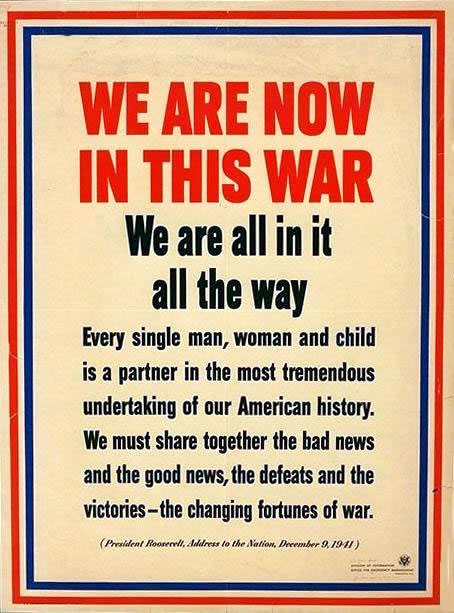
Image: A U.S. World War II poster calls for all members of American society to contribute to war effort, public domain.

Labels: , , , , , , ,

Sunday, July 02, 2006

A Lack of H.O.R.S.E. Sense

Poor England. Done in by penalty kicks (more accurately, a “penalty shootout”). Hell of an effort to hang in a man down for most of the second half and the two OTs. Still, had a bad feeling for England as soon as the PKs began. I suppose I understand why the penalty shootout was brought in as a way of deciding knockout stage World Cup matches, and I won’t deny they’re exciting to watch. Can’t help but feel there’s something anticlimactic, though, to have two teams battle for 120 minutes only to have the match decided in this fashion. Something like having a basketball game go several overtimes only to be settled in the end by a free throw shooting contest . . . .

Well, there’s always poker. The World Series of Poker is now well underway and like everyone else I’ve got one eye on my table and the other scanning for updated results and stories from the various tourneys on sites like CardPlayer, Poker Wire, Tao of Poker, the WSOP official site, and others. Indeed, as I write this post I’m following the final table of the $2,500 NLH 6-handed event where Joe Hachem, Dutch Boyd, and Jeff Knight are (at this moment) the last three standing.

Probably the most anticipated event at this year’s WSOP -- other than the Main Event, of course -- is Event 20, the $50,000 buy-in H.O.R.S.E. event that begins Wednesday, July 12. As most of you probably know, H.O.R.S.E. is a mixed game that combines Hold ’em, Omaha 8-or-better (also called Hi-Lo), Razz, Stud, and Stud 8-or-better (or Hi-Lo). The game changes each time the blinds go up, and all five of the games -- including Hold ’em -- are played as limit games. Usually, anyway.

Thanks in part to the H.O.R.S.E. event and the other non-Hold ’em events in the WSOP, I’ve found myself drifting over to the other games online over the last couple of days. I’ve even sat on the rail at the Razz tables on Full Tilt Poker a bit, contemplating whether or not to dip my toe in the shallow end. I have a plan of sorts for July to get back into Omaha and Stud (games which I used to play more regularly, but haven’t really played seriously for the last six months or so). Maybe by summer’s end I’ll even give one of those $5.00+$1.00 H.O.R.S.E. tourneys they run on Full Tilt a shot.

Regarding the H.O.R.S.E. event at this year’s WSOP, there have been two main bones of contention. One concerns the high buy-in, which delights some of the pros (like Daniel Negreanu, last spring’s most vocal proponent for adding the event) insofar as it virtually guarantees a field comprised primarily of serious, high-bankrolled professional players. I’ve no idea what the over-under currently is regarding the number of potential entrants. On his new weekly ESPN podcast The Poker Edge, Phil Gordon (citing Erik Seidel as an authority) suggested 85, which sounds about right. I wouldn’t be surprised at all if less than 100 lay down the 50,000 clams for this one. I think the high buy-in is a good idea, not so much because it weeds out the “riff-raff” (as some pros -- e.g., Mike Matusow -- routinely describe non-circuit players), but because it helps distinguish the event even further from the other forty-four. The high buy-in is definitely going to cause more people to pay attention, thereby creating more interest in games like Omaha, Razz, and Stud. And that’s a good thing for poker, I think.

The other controversy concerns the decision by WSOP officials to make the final table of the event No Limit Hold ’em only -- that is, essentially to end the “H.O.R.S.E.” part of the game and revert back to the familiar NLH we’ve seen endless versions of on ESPN, the Travel Channel, and elsewhere already. (Click here to see the WSOP’s official structure sheet that describes how the entire event will go down.) Concerning this issue, I’m strongly opposed to switching the format once they’ve whittled the field down to the last table. Doing so defeats the entire purpose of H.O.R.S.E., a game that allegedly tests players’ abilities to compete successfully in several limit games, none of which allow players to negate post-flop strategic advantages by going all-in. Never mind how switching to NLH for the final table -- the only part of the event that will be televised, of course -- completely counters the event’s ability to foster interest in non-Hold ’em games.

To me, giving up the H.O.R.S.E. format in favor of using NL Hold ’em to decide the winner is a lot like resorting to a penalty shootout to decide who advances in the World Cup. In both cases, you’re essentially taking the “play” out of the contest, adding a much higher degree of chance that ultimately negates (or at least compromises heavily) the test of skill the original game is supposed to represent.

It looks like its Hachem and Boyd heads-up. Ought to make for a story either way.

Hope to see some of you over at the Razz tables soon!

Labels: , , , , , , , ,

Wednesday, June 07, 2006

Poker Podcast Line-Up (Part II, 1-5)

Okay, single file . . . everyone line up against the far wall there. What follows are my top five poker podcasts (6-10 appeared in my previous post). I should note that there are other podcasts out there, of course, that I've yet to hear. Also, my preferences are dictated (predictably) by my own interest in small stakes games, so someone with other interests may have different favorites. In any event, here goes:

Card Club on Lord Admiral Radio1. Card Club on Lord Admiral Radio
The longest-running poker podcast is also the best, in my opinion. Card Club began in November 2004 as a weekly podcast devoted to chronicling the adventures of a private poker club in Toronto. Soon the show expanded to include reports from Vegas, book reviews, listener contributions, and more, growing from a 25-30 minute show to what now generally approaches a hour’s worth of quality listening. The hosts, “Cincinnati” Sean and Brent Stacks, are smart, witty students of poker who (too) modestly describe themselves as low-limit hacks. They occasionally invite other members of Lord Admiral for “roundtable” discussions about hands or other poker-related topics. Last summer a listener, Ray or “Columbo” (of pokerwannabe.blogspot.com), began contributing his own “Columbo’s One-Minute Mysteries.” Each mystery features Columbo puzzling over a particular crisis point in a poker hand, at which time he invites the listener to consider “What would you do?” The Lord Admirals ponder their responses, then we get to hear a second, concluding part (either during the same show or the following week). The OMM’s are smartly constructed and made more humorous by the clever insertion of Peter Falk soundbites into each mystery. (They begin around episode 40 -- check ’em out.) That a listener has now become part of the regular program this way highlights one of the show’s greatest strengths -- its inclusiveness. “Cincy” Sean often repeats his desire for the show to participate in and help foster a larger “community” of poker players, a kind of common ground where small stakes players can meet and share ideas and experiences. The show entirely succeeds in realizing this purpose. I recall a “roundtable” from an early episode when the club discussed a Hold ’em hand that had been emailed in by a listener. As the discussion began, Sean mentioned that the hand came from a $0.50/$1.00 limit game, but quickly added that the stakes weren’t as important as the listener’s question about his play. Short-stacked players like myself appreciate such disclaimers. Many of us will never rise much further than the lower limits. For us poker will probably always be a much-valued recreational activity (and not a full-time profession). If you fall into this category of player, a show like Card Club will add significantly to your enjoyment of the game. Perhaps begin with the later shows, but do work your way back as the earlier ones -- even the first dozen -- remain good listening. Rating: a pair of aces; always play

Ante Up!2. Ante Up!
This Florida-based weekly podcast started approximately one year ago with hosts Christopher Cosenza (an editor at Tampa Bay Times) and Scott Long (an editor at the St. Petersburg Times also who writes a column called "Bet On It" for the TBT) having conversations about poker of modest length (15-20 minutes) and unexceptional depth. The early episodes are all fine, but none are terribly impressive. However, after 20 weeks or so the pair really began to hit their stride and shows became lengthier and much more engaging. The occasional appearance of avuncular Mike Fasso (a columnist for the St. Petersburg Times) also adds a lot to the proceedings. Cosenza and Long play all games at lower limits (online and live) and thus much of what they have to say is relevant and enjoyable to small stakes grinders such as myself. Episodes are organized around a particular topic or theme (e.g., “Pot Odds,” “First time in a casino,” “Check raising,” “Poker Books We’re Reading”). They’ve also devoted shows to games other than Hold ’em (Omaha, 7-Card Stud, Razz). Pick it up around the 20th episode or so and enjoy. Rating: ace-king suited; play often, particularly from late position

CardPlayer's The Circuit3. CardPlayer’s The Circuit
Last December CardPlayer magazine began producing these podcasts at the Five Diamond World Poker Classic, essentially daily reports from the event though augmented considerably by interviews and strategy discussions. Since then, CardPlayer has continued to produce four or five lengthy (usually around an hour-long) episodes from each major circuit event. The show was originally co-hosted by Scott Huff (an amateur player) and Mike “the Mouth” Matusow, and the earliest episodes (from the Five Diamond, the Caribbean Poker Adventure, and the Gold Strike World Poker Open) feature several moments where Huff successfully tames Matusow into an entertaining and informative contributor. Things deterioriate a bit after that, with Matusow frequently coming on and complaining endlessly about his misfortune at whatever tournament they happen to be covering, his self-loathing and/or whining often obscuring interviews with guests. (Even Huff’s attempts to toss the Mouth into “Radio Jail” -- i.e., turning off his mic -- seem not to have worked.) Matusow has now apparently moved on, with pros Joe Sebok and Gavin Smith having assumed co-hosting duties with Huff. This trio interacts very effectively -- all three are smart and articulate about poker and at times can be funny as hell. Huff’s perspective probably matches that of most of the show’s listeners (a low-limit grinder with more online than brick-and-mortar experience), and thus provides a nice way of interacting with Sebok, Smith, and the pros who come on the show. Huff frequently asks questions you or I would want asked (about strategy, moving up limits, bankroll considerations, etc.). The show can also be very entertaining. For some humor highlights, check out the episode featuring Steve Dannenman and the “New Cut Crew” from the WPT Winter Open, the one featuring Phil “I can dodge bullets baby” Hellmuth from the Five-Star World Poker Classic, or the one with Haralabos Voulgaris at the Mirage (which I’ve mentioned before). Great stuff. Rating: ace-king offsuit; plenty of reasons to play

Rounders, the Poker Show4. Rounders, the Poker Show
Rounders is a Canadian podcast that’s associated with an AM station out of Vancouver. The hosts Mike Johnson and Adam Schwartz are both smart and engaging, although their sometimes-overly-rapid delivery (esp. Johnson’s) is a clear tell that you’re listening to sports radio. The weekly, 45-minute show focuses primarily on the pros, with nearly all the top names having been interviewed at some point during the thirteen months or so it has been produced. There’s also a good deal of discussion about what’s happening in Vegas. So while you may now and then hear some strategy talk, the podcast is generally geared in other directions. The hosts are players as well, with Schwartz playing in some of the bigger money games and Johnson playing lower limits and online tourneys. So they will occasionally relate their own experiences, and since they are both good talkers the discussions are generally fairly compelling. The show is well-produced and always sounds great, and a lot of the older interviews are not so time-bound as to be less interesting today. If you’re interested in particular personalities, go through the archives and find their interviews among the 50+ episodes produced thus far. (Unlike some of the interviewers at the bottom of the list, these two do a fine job letting the guests speak their minds.) Rating: ace-queen offsuit; mostly play but can be let go now and then

Phil Gordon's 2005 WSOP Podcasts5. Phil Gordon’s 2005 WSOP podcasts
Last summer professional player and former co-host of Celebrity Poker Showdown Phil Gordon produced one of the more popular poker podcasts of the year during the World Series of Poker. From June 3rd to July 17th, he posted podcasts on an almost daily basis detailing his experiences playing multiple events at the WSOP. During breaks Gordon would record brief rundowns of how he had fared during the previous level, often narrating interesting hands or other notable events that had occurred. He’d also usually interview at least one other pro per episode (they run from 5-10 minutes up to a half hour or more). In the end, every episode includes something of interest, including genuinely helpful tournament strategy tips (from himself and from others). Gordon is a pretty likable guy who’s clearly knowledgable about poker. He also can be pretty damn funny at times, too. I found these sometime late last summer and had listened to all 29 of them within a couple of weeks. I’m sure I’m not alone in hoping he does something similar again this year. Rating: pocket jacks; a favorite over most of the field

Okay, move it on out. You've seen 'em all . . . now, check 'em out yer selves and tell me what you think.

Images: Card Club on Lord Admiral Radio, Ante Up!, CardPlayer’s The Circuit, Rounders, the Poker Show, Expert Insight (Phil Gordon).

Labels: , , , , , , ,


Older Posts

Copyright © 2006-2021 Hard-Boiled Poker.
All Rights Reserved.