Tuesday, May 20, 2008

Sartre’s Gambler (1 of 3)

Jean-Paul SartreThere’s a famous (though brief) passage early on in Jean-Paul Sartre’s Being and Nothingness (originally published in 1943) in which the French philosopher uses the example of a problem gambler to help illustrate what he means by “nothingness” and how it differs from “being.”

I suppose Sartre could’ve used a different example to make his point, but I can see a couple of reasons why he chose the gambler. For one, doing so enabled him to acknowledge in a subtle way the influence of Fyodor Dostoevsky. I’ve written here before about Dostoevsky’s 19th-century novel The Gambler and his status as a thinker whose ideas helped provide some of the groundwork for modern existentialism. Dostoevsky was also himself an inveterate gambler -- indeed, Sartre is referring to the Russian writer’s life (and not his fiction) when he brings him up here.

The example of a gambler who is trying to quit gambling also demonstrates in a particularly useful manner Sartre’s argument about existence. In particular, speaking of a problem gambler helps Sartre clearly distinguish the difference between who we are and our ideas about who we are.

I’m probably asking for all sorts of trouble, but I thought it’d be worth trying to take a shot at presenting Sartre’s gambler. My main motive here is just to try to sort out what Sartre is saying in order to understand it better myself. But I also thought others might be interested, too, as some of what Sartre says about his gambler seems to prefigure certain ideas I’ve seen explored from time to time in discussions of poker (both strategic and theoretical). That is to say, whether or not you buy Sartre’s explanations of existence, I think poker players might at least be somewhat intrigued by some of the various implications of what comes up in this here passage.

Gonna try to pull this off in three posts. In this first one, I’ll see if I can present in at least a semi-coherent way Sartre’s general argument about “being” and “nothingness” in order to give us a context for reading the passage. In the next post, I’ll do my best to summarize what Sartre is saying in that passage about the gambler. Then, in a third post, I’ll try to connect Sartre’s gambler to certain ideas I’ve seen specifically expressed by a few poker players.

Being and Nothingness

Jean-Paul Sartre's 'Being and Nothingness' (1943)Being and Nothingness is a big, thick, imposing book. And making matters worse, it begins with a very hard-to-read introduction in which Sartre explains what he thinks “being” is. A lot of readers never get beyond the first few pages of this introduction. It’s understandable -- the prose is very rough-going, and the arguments not really as conclusive as what one finds elsewhere in the book.

Sartre starts out by rejecting “the dualism of appearance and essence” that he says has long “embarrassed” philosophy. According to Sartre, there is no such thing as “essence” (or “soul” or a “noumenon” or whatever you want to call that stuff that isn’t really there but which many philosophers insist is somehow accessible to us). No, says Sartre, “the being of an existent is exactly what it appears.” There is no “interior” or “secret reverse side” or whatever.

Of course, when it comes to us poor humans, we have this thing called “consciousness” that tends to complicate our experience of the world. Consciousness is what makes me different from, say, a poker chip or a playing card or all of the other stuff that exists but lacks consciousness.

Everything that exists -- me, the chip, the card -- has what Sartre calls “being-in-itself.” Of each of these “existents” we can say “it is what it is.” But unlike the chip and the card, I also have consciousness, which means I am also aware of all sorts of stuff that is not -- i.e., that is not there, that is not me, etc.

This leads to a distinction that Sartre is willing to make, and which is fairly important to everything else he has to say in Being and Nothingness. There’s “being-in-itself,” which I have, but which the chip and the card have, too. That’s a kind of being that is “unconscious” or “unaware.” We can only say that “it is” and nothing more.

Then there’s “being-for-itself,” which I have but which the card and chip do not -- namely, a kind of being that is “conscious,” but we’re not talking merely self-consciousness. Rather, says Sartre, “being-for-itself” is “consciousness conceived as a lack of Being.” To put it broadly, it is being conscious of what I am not. And that is “nothingness” -- the idea, I mean, not the “being-for-itself.” Nothingness not a type of being; rather, nothingness is brought into the world by those of us who are conscious of our being.

So unlike a lot of earlier philosophers, Sartre is not a “substance dualist.” There’s just the one substance for Sartre, and that is “being-in-itself.”

After that difficult introduction, Sartre gets into part one of the book where he addresses “The Problem of Nothingness” and this part is much more accessible. He presents some examples to illustrate nothingness. (This is the part of the book where his discussion of the problem gambler comes in.)

One such example involves a person looking in his wallet and expecting to find 1,500 francs, yet only seeing 1,300. As he “experiences the absence” of 200 francs, Sartre would say, he “brings nothingness” into the world. He gives another example of going to the café to meet his friend Pierre at four o’clock and discovering he isn’t there. Again, he experiences the absence of Pierre, or, to put it differently, he brings “nothingness” into the world.

Notice how both of those examples involved expectations being foiled. In other words, unlike “being-in-itself” (that mode of being that exists without needing anyone to be aware of it), “nothingness” is wholly dependent on our awareness.

Sartre goes on to talk about some other aspects of nothingness, but I’m going to leave it there. You can probably already see how this way of explaining our experience of the world -- talking about “being” (all the stuff in the world, including ourselves) and “nothingness” (all the stuff we imagine about the world, including what we imagine about ourselves) -- potentially relates to poker.

As I said, in the next post I’ll see if I can summarize Sartre’s portrait of the gambler, then add one more where I’ll try to make a connection or two to poker.

Labels: , , , , ,

Wednesday, September 20, 2006

Poker and Nothingness

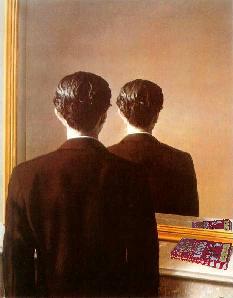
René Magritte's 'La Reproduction Interdit' (slightly altered)Been intending for a while to try to explain that reference to existentialism in the descriptive subtitle to “Hard-Boiled Poker.” Partly alludes to the great hard-boiled novels of writers like Hammett, Chandler, Cain, Thompson, Willeford, and others, all of which could -- in one way or another -- arguably be categorized as notable examples of “existentialist art.”

I also have in mind a more direct connection to existentialism as defined and explained by Jean-Paul Sartre and others -- an implied argument, if you will, for a connection between poker and existentialist thought. A lot of ideas produced by the existentialists seem to me to be readily applicable to poker. They may even be useful. But that (as the existentialists would insist) is up to each individual to decide.

First there’s Sartre’s famous observation that existence precedes essence (as far as humans are concerned). We start with existence, then formulate ideas about who we are, what our “essence” or “nature” might be. Thus might we say that the experience of the poker player is what defines him. He plays a number of hands, then becomes a certain kind of player (to himself and to others). He plays more hands, and his so-called “essence” changes still again.

The way we exist -- what we say, what we do, whether we call preflop raises from late position with suited one-gappers -- defines who we are. (You might want to argue the reverse -- e.g., that my conservative “nature” is what makes me fold ace-rag preflop -- but the existentialist knows better. He knows that folding ace-rag is what makes me a conservative player.)

It doesn’t help, of course, that the world in which we exist is indifferent to our plight. At times it may appear to follow some “order” (and thus imply some sort of creator having fashioned it thusly), but in actuality such order is only the result of our own idiosyncratic perceptions -- our relentless attempts at “meaning-making.”

In a previous post, I mentioned Miller/Sklansky/Malmuth’s observation in Small Stakes Hold ’em that “cards are pieces of plastic . . . [that] have no knowledge, no memory, no cosmic plan.” In other words, despite the frequency and/or conviction of our invocations, there are no poker gods. And not only do the cards have no “memory” or “plan” -- they have no meaning, either. Not on their own, anyway. (Just like everything else, actually.)

Facing such a circumstance, we could go the route of the nihilist and say that having accepted (1) existence precedes essence & (2) that the world is indifferent to us, there is no point in going forward. It’s a common mistake, actually, to say the existentialist believes life has no meaning. Not so. It’s the nihilist who believes life is without meaning, purpose, truth, what have you. (Sartre titled his book Being and Nothingness -- not simply “nothingness” -- deliberately choosing a phrase that implies a kind of ongoing conflict.)

Unlike the nihilist, the existentialist understands and accepts that we are the ones creating meaning -- that we are free, in fact, to make whatever we want of the world. To change the world, or what it means to us . . . for the better, even (if that’s your cup of tea).

We’re on our own, though. No “god” is going to help us. (Thus does such freedom produce a great deal of anxiety in us.) The poker player cannot control the cards. Nor can he perfectly control others’ actions at the table (although he can influence those actions). But he can certainly affect what those cards mean (to him). He can affect what his opponents’ actions mean (to him). And he can affect what his own actions mean (to himself). In fact, he not only can affect the meanings of those things -- he necessarily does affect what they mean. Every single hand.

In that earlier post (about Dostoevsky’s The Gambler -- another example of “existentialist” art, one might argue), I proposed that poker might be defined as “an activity in which each participant is trying to exert the most control in situations where everyone is a little out of control.”

In a way, that’s what I’m trying to say here about “meaning-making” at the poker table (and beyond). Poker is meaningful . . . because we give it meaning. And when we play, we not only confront other players, we confront that villainous “nothingness” who always seems to be following us around, showing up in the bathroom mirror, sitting across from us on the bus, waiting in line behind us at the store . . . .

And while we sometimes lose to the other players, we beat him . . . every time.

Image: Portrait of Edward James (a.k.a. Not to Be Reproduced) (1937) (adapted -- notice the book on the table), Rene Magritte, fair use.

Labels: , , , , , , , ,

Thursday, June 15, 2006

Dostoevsky is Not Considered Summer Reading (Pt. IV)

One last thought about Fyodor Dostoevsky’s The Gambler and how it relates to the poker player’s experience. Not to worry. Tomorrow I’ll be saying sayanora to the book club for awhile and get back to the friggin’ tables.

I previously discussed a couple of other ideas from the novel that might be interesting to poker players. The first involved how the novel successfully dramatizes a common fallacy in poker whereby we believe that the way the cards are dealt in one hand has something to do with the way they will be dealt in the following hand. Miller/Sklansky/Malmuth humorously remind us that “Cards are pieces of plastic. They have no knowledge, no memory, no cosmic plan.” The Gambler also conveys this truth about the roulette wheel, although we see in the novel how even those characters who understand this still sometimes act as though they do not.

The second idea concerned the way playing poker tends to consume our thinking to the point that we forget about past and future and live as though only the present moment is of any consequence. Again, characters in the novel vividly portray this phenomenon. In that post I concluded that such living only in the “here and now” doesn’t necessarily have to be a bad thing, particularly if understanding this helps you concentrate on your decision-making at the table (and doesn’t wreck your life as happens to Alexey Ivanovitch).

I want to talk about another interesting aspect of gambling and its psychological effects that comes up in The Gambler. Alexey’s experience in the novel shows how gambling in fact satisfies two contradictory desires that most humans possess. (I say most humans because certainly there are those who don’t have these desires, but since those that don’t probably also don’t like to gamble very much they aren’t of much concern to us here.) The two desires are
(1) to be in control (over our lives, over others, etc.)
(2) to relinquish personal responsibility (over our lives,
over others, etc.)
Now, at first glance it might appear impossible to believe that we can have both of these desires at the same time. After all, how can one be “in control” while at the same time not be responsible for one’s actions or the actions of others? Let me try to explain how this seeming contradiction works in the novel while also relating how it plays out at the poker tables.

Alexey Ivanovitch is both the main character and narrator of The Gambler (the novel is presented to us as his “diary”). Early in the novel he talks about how he felt when he first came to Roulettenburg: “I knew for certain, and had made up my mind long before, that I should not leave Roulettenburg unchanged, that some radical and fundamental change would take place in my destiny; so it must be and so it would be.” Alexey speaks with such assurance here because he knows in Roulettenburg he will gamble. Such knowledge grounds him, actually, since otherwise he is relatively clueless about everything going on around him. That Alexey often complains about how others miserably exist in “bondage and submission” proves that he prefers having more command over his life than most others are able to have. Being able to gamble allows Alexey a kind of control over his “destiny” that as a lowly tutor he otherwise wouldn’t possess. He even goes so far as to tell others “I am absolutely convinced that when I begin playing . . . I shall win.”

Alexey is clearly self-deluded about how much “control” he actually can have when playing roulette. He can control whether or not he plays, of course, but he cannot control whether or not he’ll win. Nevertheless, I think Alexey here exemplifies the poker player’s experience to a degree when he comes to the table knowing “for certain . . . that [he] should not leave . . . unchanged.” Even if a poker player plays two hundred hands and leaves with exactly the same amount of money with which he began, he will not be unchanged. Thus does playing poker strangely allow us to exert a kind of control over ourselves (and, at times, over others) that we normally don’t possess. In fact, one might define poker as an activity in which each participant is trying to exert the most control in situations where everyone is a little out of control. We succeed sometimes. The best of us succeed more often than the worst of us. But even terrible players get to taste such control every now and then, thus satisfying a desire that all of us sitting around the table likely have at least to some degree.

For all his talk about defying fate, however, Alexey appears equally desirous to give up himself to the spin of the roulette wheel. Having personal responsibility over oneself is such an enormous burden we sometimes want (like Alexey) to let it go and yield ourselves entirely to some other authority (perhaps greater, perhaps not). Gambling -- like religious faith, actually -- provides for many an opportunity to relinquish such responsibility. Frequently in the novel Alexey shows how much he wishes not to be responsible for himself, for instance when he willingly assumes the role of “slave” to Polina. Since he isn’t accountable, things like “good” and “evil” no longer matter to him. “I don’t even worry my head about moral qualities of any sort,” he says early on to Polina. “I see nothing but you everywhere, and all the rest is naught to me.” Gambling produces a similar effect upon Alexey. At the end of the novel he admits “I even dream of playing.” Again, “all the rest is naught.” He’s beyond good and evil. He’s able to exist without a will of his own.

I’d suggest that playing poker satisfies a similar urge for most of us as well. There is something thrilling about not being entirely responsible for what happens at the tables. We all want to win, of course, but when it happens that we’ve flopped a set and someone unreasonably stays in the hand to make a one-card flush on the river, we know we aren’t to blame. What sweet relief not to be held accountable, even when things go wrong!

As I’ve said before, most of us aren’t as extreme in our relationship to gambling/poker as Alexey is in The Gambler. For most of us these desires -- to exert control and to relinquish personal responsibility -- are satisfied at the poker table but only in a temporary way. Most of us readily go back to our “real” lives where our control is limited and our personal responsibility considerable.

There are other items of interest in the novel, and I do recommend it to any poker player. It’s summer time, though . . . I need to put down this book and relax a bit. Find me a game. Where’d I put my beer?

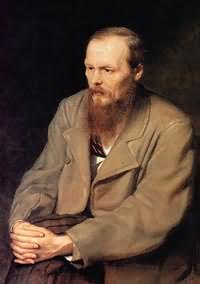
Image: Dostoyevsky in Paris, 1863, public domain.

Labels: , ,

Wednesday, June 14, 2006

Dostoevsky is Not Considered Summer Reading (Pt. III)

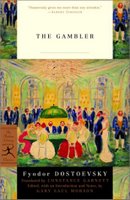
The Gambler by Fyodor DostoevskyA second phenomena explored by Fyodor Dostoevsky’s The Gambler concerns the way the game -- be it roulette, poker, or any other contest that involves gambling -- has the potential to consume us, causing us to forget about everything else. What I’m suggesting is that when we play poker, the past and future tend to mean less to us. The present is all.

In The Gambler, whenever Alexey Ivanovitch goes to the casino to gamble he tends to experience a kind of “transcendence” while playing -- a sort of euphoria, actually, that causes him not simply to lose track of time, but to lose his sense of self. Toward the novel’s conclusion, Alexey has trouble recounting the details of one frenzied session of play: “I don’t remember my winnings after, nor what I staked on. I only remember as though in a dream that I won . . . but I scarcely felt anything as I did so; I simply waited [for the next turn of the wheel] in a mechanical, senseless way . . . .” When Alexey plays, it is as though nothing else exists for him. Everything -- the past, the future, all of his relationships with others -- falls away as he waits “mechanically” to see where the ball will land.

In fact, during this particular session he has entirely forgotten his reason for having come to the casino in the first place -- to win enough to pay off the debts of a woman, Polina, with whom he is obsessed. While leaving the casino with his winnings he realizes “I hardly remembered what she [Polina] had said to me earlier, and why I had gone.” Later on another character, an Englishman named Mr. Astley, has to tell Alexey that Polina was in love with him all along, yet his having become consumed with gambling caused him not to recognize this fact. Mr. Astley accuses Alexey of having relinquished everything to the perpetual present of roulette: “You have not only given up life, all your interests, private and public, the duties of a man and a citizen, your friends (and you really had friends) -- you have not only given up your objects, such as they were, all but gambling -- you have even given up your memories.” Alexey’s reply is rich with irony: “Enough . . . please don’t remind me.” He doesn’t want to be reminded about his past -- even that he has a past. Rather, the game is all.

Of course, not everyone who plays poker is as troubled as Alexey. Most of us don’t allow the game to consume our lives as thoroughly as he does. I would suggest, however, that all of us experience this sort of “transcendence” at times when playing, those moments when we find ourselves simply waiting in a “mechanical, senseless way” for the next card to come. These moments come most frequently during the latter stages of particuarly lengthy sessions, I’d venture, although they can come at other times, too (such as during a wild “rush” of cards or a sequence of large pots in which one is frequently involved). As happens with Alexey, our minds momentarily trick us into forgetting all else and giving ourselves over to the here and now.

The fact is, when it comes to poker, thinking primarily of the present moment is not entirely a bad thing. As was pointed out in the previous post, each hand exists as an independent event and thus must be regarded as such. Also, within each hand come moments that exist independent of each other, decision points when we have to evaluate our situation right here and right now. Dan Harrington makes this argument repeatedly in Harrington on Hold ‘em when taking us through the sample hands. Just because we made a mistake preflop, we cannot allow that blunder to affect our next decision. “Once you’re in a hand,” says Harrington, “every subsequent decision has to be determined by your hand, the pot odds, and the total table situation. Every betting decision is a new problem. Don’t forget that.”

That may well be one of the greatest appeals of poker, the way it continually provides us new problems to try to solve. (If one views these poker problems as eclipsing in importance other “problems” in our lives -- as happens with Alexey -- then one has a much greater problem, of course.) In any event, this momentary “forgetting” of ourselves relates to a couple of other issues that come up in The Gambler that I’ll discuss in my last post on the novel, namely, how poker strangely satisfies contradictory desires to control one’s life while at the same time relinquish responsibility over it.

Image: Fyodor Dostoevsky, The Gambler (1866), Amazon.

Labels: , , , ,

Tuesday, June 13, 2006

Dostoevsky is Not Considered Summer Reading (Pt. II)

As I mentioned before, I want to discuss three ideas of interest to poker players that come up in Fyodor Dostoevsky’s The Gambler. The first concerns the human tendency to see patterns where they don't exist.

Alexey Ivanovitch is not the only character in The Gambler who becomes obsessed with roulette. Other characters are shown succumbing to the lure of the wheel, the most colorful being Granny. Granny is the grandmother of the family for whom Alexey works as a tutor, and for the first half of the novel most members of the family appear impatient to see Granny die and leave them her estate. Without warning, Granny suddenly appears in Roulettenburg -- in good health, at that. She’s a bit eccentric and certainly enjoys the discomfort she has produced by appearing so unexpectedly.

“I want to see everything here,” Granny tells everyone, and soon has made Alexey take her to the casino. Within minutes she’s at the roulette table. After a rapid tutorial from Alexey about how the game works, she’s ready to play. Before placing any money down, they watch as the wheel lands on zéro. Alexey explains to Granny that if one bets on zéro and it hits one wins 35 times the bet. “Why don’t they stake on it, the fools?” she asks. “There are thirty-six chances against it, Granny,” Alexey explains. “What nonsense,” she replies, and fishing out a friedrich d’or from her purse orders her servant to “Stake it on the zéro at once.”

Her bet concerns Alexey, who with the appearance of rationality explains “Granny, zéro has only just turned up . . . so now it won’t turn up for a long time. You will lose a great deal; wait a little, anyway.” “Oh nonsense, nonsense” says Granny. “If you are afraid of the wolf you shouldn’t go in the forest.”

After losing three times running, Granny decides to stake two friedrichs d’or and the zéro hits. Much to Alexey’s dismay, she bets as much as is allowed on zéro again and loses. Undeterred, she bets on zéro yet again. “Zéro!” cries the croupier, and once more she’s won a bundle. Alexey describes how he felt upon realizing the zéro had hit three times within a dozen turns: “I felt that at the moment my arms and legs were trembling, there was a throbbing in my head.” Granny puts the bulk of her winnings on rouge, wins again, then announces “That’s enough! Home! Wheel my chair out.” All told Granny had staked five friedrichs d’or and was now leaving the casino with about 220 times that, an amount nearly equal to that of her entire estate.

There are a few different ideas present in this episode familiar to poker players (e.g., running well, playing one’s rush, boldly taking risks, hitting longshots, etc.), but the one I find most interesting concerns Alexey’s claim that since the zéro had recently hit it was less likely to hit again in the near future. Earlier in the novel Alexey describes players who “sit with papers before them scrawled over in pencil, note the strokes, reckon, deduce the chances, calculate, finally stake and -- lose exactly as we simple mortals who play without calculations.” Alexey instinctively knows these players are self-deluded. He knows that one turn of the wheel has no bearing whatsoever on the next. Nevertheless, he still advises Granny against betting on zéro since it had so recently hit.

In Small Stakes Hold 'Em, Miller/Sklansky/Malmuth discuss the tendency for poker players to believe how the cards are dealt in one hand actually affects how they will be dealt in the next hand. “The human brain is terrific at identifying patterns,” they point out, though sometimes -- especially when playing poker -- “people see false patterns that they believe are real.” “Most gamblers,” they claim, “tend to ascribe meaning to purely random, independent events.” Have you ever (like Alexey) allowed the appearance of such false patterns affect your thought process during a given hand? If you are human, you probably have.

Just today I had newly arrived at a $1/$2 limit table where I was dealt Jh 3c in the BB. A late position player raised, the SB called, and after a moment I decided to let it go. Sure, I’d be getting 5-to-1 by calling, but I knew zilch about the other two players. Besides, I didn’t want to get in trouble here on my first hand and thereby create an unwanted table image from the get-go. I folded and watched as the flop came 9h 3s Jd. The SB called bets on both the flop and turn, then after an Ace came on the river fireworks erupted and the pair capped. Both had big slick and so chopped a huge pot -- $25 or so -- although they ended up only coming out even on the hand after the $1 rake (precisely what I had put into the pot).

Before I had time to grieve my missed oppportunity, I chuckled to see I’d been dealt J3-offsuit once again in the small blind. “When most people play poker,” write Miller/Sklansky/Malmuth, “they tend to expect that which has recently occurred to recur.” Hmmm . . . . As I waited for the action to come back to me I couldn’t help thinking how attractive J3 looked. Would I dare? Luckily for me, a raise and reraise kept me from pursuing my relationship with this garbage hand any further. (And yes, the flop did not bring a J or 3 this time.)

Barring six limpers (and thus even greater odds than the previous hand offered), I probably would’ve let the hand go again, but not for the correct reasons. Rather, I felt like Alexey did after seeing the zéro hit the first time -- it somehow seemed less likely to flop two pair (or something else favorable, like trips) because it had “only just turned up . . . so now it won’t turn up for a long time.”

Nonsense! (As Granny would say.) Miller/Sklansky/Malmuth say the same thing in a different way: “The cards dealt on any poker hand are, for practical purposes, completely random and independent of the cards dealt on any previous hand.” The odds of my flopping two pair hadn't changed an iota. They remained about 1 in 49 -- the same as every other hand where one holds two unmatched cards.

Granny herself eventually shows that she, too, can’t resist believing in false patterns when she returns to the casino and loses all she won and then some, mostly by betting on zéro. She would have done well to heed the advice of Miller/Sklansky/Malmuth: “Stop your pattern-recognizer before it goes haywire by telling yourself, ‘There is no pattern! There is no pattern!’”

In my next post I'll say something about how The Gambler illustrates another “mind game” poker players often experience, namely the way the game can cause us to shut out past and future and live only in the moment.

Photo: “Roulette ball,” Ralf Foletschek. CC BY-SA 3.0

Labels: , , , , , , ,

Sunday, June 11, 2006

Dostoevsky is Not Considered Summer Reading (Pt. I)

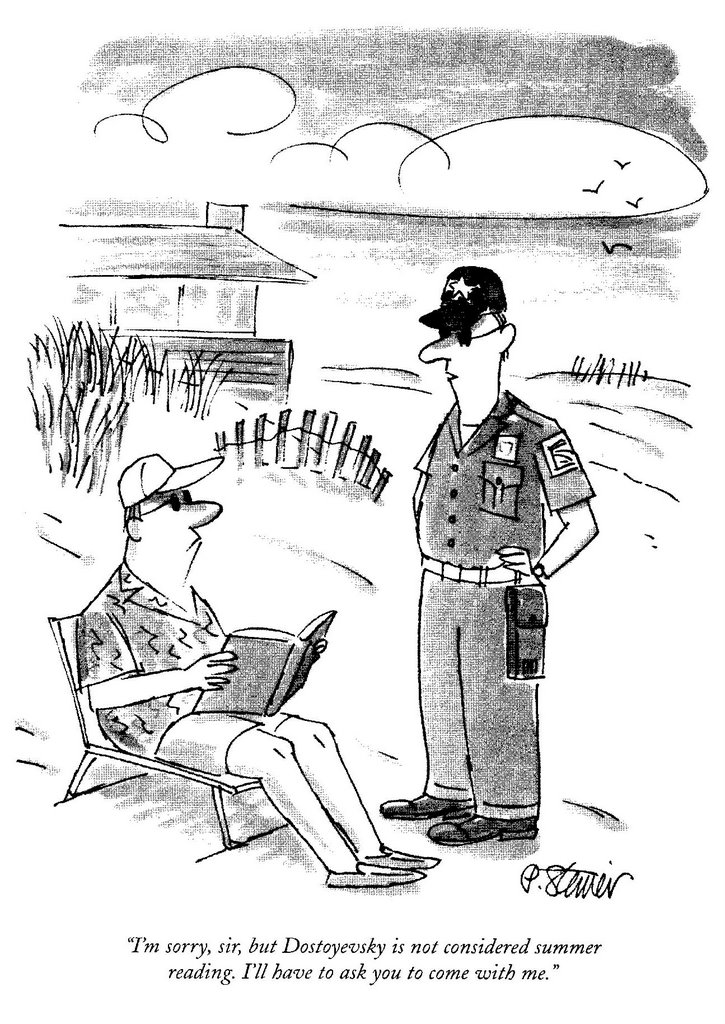
Fyodor DostoevskyThere’s a New Yorker cartoon in which a guy reading a book on the beach is approached by a policeman. “I’m sorry, sir,” the cop says to him, “but Dostoevsky is not considered summer reading. I’ll have to ask you to come with me.”

I thought of that cartoon last week as I read Fyodor Dostoevsky’s The Gambler -- one of the 19th-century Russian novelist’s lesser known novels, although certainly his most popular in the poker world. References to The Gambler pop up in many poker books, particularly “literary” ones like Anthony Holden’s Big Deal, the late David Spanier’s The Hand I Played, and James McManus’s Positively Fifth Street.

The novel is set in the fictional German city of Roulettenburg -- kind of a 19th-century European version of Vegas -- where the main character, a tutor named Alexey Ivanovitch, unsuccessfully battles his obsession with the game after which the city is named. There is one card game that comes up occasionally in the novel, a game called trente et quarante (a.k.a. rouge et noir) that is essentially a kind of roulette using six decks of playing cards rather than a wheel and a ball. (You can still get a game of trente et quarante in Monte Carlo, apparently.) However, roulette is the game that Alexey plays the most, and that’s the game about which Dostoevsky (himself a roulette addict) has the most interesting things to say.

Anyone at all serious about poker will be quick to point out that poker ain’t roulette. Some go so far as to distinguish poker from gambling altogether, insisting that it’s a skill game wherein the better-equipped players always win out over time. I like how Miller/Sklansky/Malmuth treat this subject in the opening sections of Small Stakes Hold ’em. They assert that, in fact, “poker is gambling,” and the schmo who says it ain’t “does not understand poker as well as he should.” Poker is gambling because it always involves some measure of uncertainty, particularly with regard to the cards. Sure, at times we might be uncertain about our opponents’ play or holdings, but better players eventually can get a line on those things.

Yet even the very best poker player cannot get a line on precisely what card is gonna come on the turn or river. (Raise yer paw if you’ve also lost a 20+ BB pot to a river one-outer . . . . There we go.) So while in poker you can (as Miller/Sklansky/Malmuth explain) play in such a way so “that your expectation can be positive,” when you play poker you’re still gambling. That's why The Gambler ultimately touches on so many concepts of interest to poker players.

As a way of responding to the book, I thought I’d focus on a few ideas related to gambling that come up in The Gambler that might be of particular interest to poker players. I’ve pulled out three ideas or concepts, all of which could be made to relate to the “psychology of poker” -- that is, all three concern how our minds work (and, at times, fail to work) when we play.

The first has to do with how a particular sequence of hands will affect our thinking regarding what comes next. The second involves the way the game tends to consume us, causing us to forget about everything else besides the “here and now.” The third has to do with issues of control and personal responsibility, and how poker (or any form of gambling) strangely satisfies certain, contradictory desires most of us seem to possess.

I’ll discuss these ideas in separate posts over the next few days. Afterwards you can decide if you want to check out The Gambler yourself. Of course, you’ll want to keep one eye out for the summer reading cops if you do.

Image: Vasily Perov, portrait of Fyodor Dostoevsky (1871), public domain.

Labels: , , , , , , , , , ,


Older Posts

Copyright © 2006-2021 Hard-Boiled Poker.
All Rights Reserved.