Monday, April 07, 2008

WSOP to Create “Sequel” for Main Event Final Table?

Nobody likes sequels. Not really. Unless we’re talking The Godfather or Dawn of the Dead, sequels just about always disappoint.

Besides failing to live up to whatever made us like the originals, sequels also tend to change the nature of the relationship between creator and audience. I say that because usually sequels make much more explicit the commercial side of the exchange. That’s not to say, for instance, in the case of movies, making money wasn’t part of what was going on before. However, when we buy the ticket to a sequel, we enter the theater with a more conscious acknowledgement of our “consumer” status.

You’ve no doubt heard by now about the apparent plan to delay the final table of this year’s World Series of Poker Main Event until October in order to air it live (or sort of live) on ESPN. If we fans of poker weren’t sure we were mostly regarded as consumers before, we are being reminded of that pretty loudly today.

Tried not to rush to judgment on this one. But I keep thinking what is happening here is a commercially-motivated manufacturing of a weird sort of “sequel” to this year’s WSOP. And while I appreciate the earnestness of those arguing in favor of the idea, I just can’t bring myself to buy it.

I’d seen that brief bit on Michael Craig’s blog last October about such an idea, but frankly dismissed it at the time as one of those sorta-interesting-but-hopelessly-flawed schemes that might sound nice in theory but would never work in practice. Craig had been at the WSOPE talking to officials like Ty Stewart, and on October 16th Craig went ahead and shared Stewart’s having told him about the idea “to play down to the final table and then adjourn the Series” for a couple of months in order to make arrangements to air the FT live.

Craig came back the next day to relate (somewhat sheepishly) that Stewart hadn’t been too crazy about his having publicized the plan. Craig neverthless added a few more details in his second post, including some info from an email Stewart sent to him expressing a belief that he did “not believe that ESPN will dedicate more than a three hour window to the stunt” or “that a mainstream audience will have interest watching for a period longer than that anyway.”

Stewart needn’t have worried too much about Craig letting the cat out of the bag, as the whole issue essentially disappeared from public consciousness until late last week when the story again popped up in a few different places. Then Dan “Scoop” Michalski (of Pokerati) gave us all some further specifics about what might happen. In a post Saturday morning, Dan made it sound as though it were pretty much a done deal, saying that “on the big pro-con list, the left side of the board has it all but locked up.”

Says Dan, the idea will be to play down to the final nine as planned (the current schedule has that happening by July 14th), then shut ’er down for 90 days while ESPN gears up for a two-day, “plausibly live” presentation of the finale. They’ll play from nine down to two the first day, then handle heads-up the next. Officials won’t let ESPN monkey around with blind/ante structures (they say), although according to Dan, “Timing will be carefully coordinated so most people will be watching to see who will win, not how one wins (the Olympics broadcast model).”

A smart, lengthy discussion going on in the comments to that Pokerati post. They’re also buzzing about it on Two Plus Two, Pocket Fives, Card Clubs, and elsewhere. Noticed one poster on Card Clubs liken the idea to NASCAR’s season-ending, ten-race “chase” instituted a few years back. “Big sell out but huge for ratings,” he said.

You can check out them links for various arguments for and against this sucker (ain’t gonna rehearse ’em all here just now). I continue to hold out hope that despite Dan’s report, this idea ain’t gonna actually happen. As for my objections to the idea, they mostly resemble those same complaints whenever producers decide to pump out a sequel to the movie you thought was pretty damn good as it was . . .

It mucks with yr memory and/or enjoyment of the original.

It’s anticlimactic.

And it’s all about the money.

Labels: , , , , , ,

Saturday, August 05, 2006

In the Money

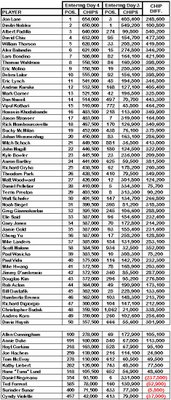
Chip Counts entering Day 4 -- Top 50 plus other notablesThey've reached the money at the 2006 WSOP Main Event. Of the 8773 who entered, 481 remain. The top 873 places paid. I happened to have been watching online last night as the bubble burst. With about three to go before they were down to 873, a player found himself in the big blind with less than 30,000 in chips. The table folded to the small blind, who put in a raise that would force the big blind player all in. The big blind called, and as he showed the table his pocket aces he announced that was the only hand with which he would have even considered calling. The small blind showed a pair of sixes. The flop came A65, giving both players sets. The turn brought the only card in the deck that could eliminate the big blind -- the case six. What agony.

If you click on the picture you'll get an Excel file that lists the top 50 chip stacks heading into Day 4. I've added columns that show where these players stood entering Day 3. I've also added other notables at the bottom of the list. Incidentally, these chip counts were culled from a couple of different sources, neither of which was CardPlayer (who currently lists a different player atop the leaderboard). CardPlayer, the "official content provider" of the WSOP, has been pretty erratic, frankly, when it comes to providing clear chip counts (a topic of discussion over on the Card Clubs Network Forums as of late).

It is interesting to see how much movement occurs from day to day. Of these top 50, only 16 were in the top 50 heading into Day 3. Most of this group features players who were able to make tremendous moves, the most dramatic probably being Christopher Budak who started yesterday with a meager 21,000 chips (sitting 1,062nd out of 1,159). Today he has 359,500 chips and finds himself in 48th place. Albert Padilla's Day 3 was more than a little impressive as well -- he built 99,800 chips up to 640,000, moving from 274th to 3rd.

None of the name pros are among the top fifty, but Allen Cunningham (100th, 278,000), Annie Duke (191st, 180,000), Hoyt Corkins (218th, 163,000), Joe Hachem (259th, 139,000), Tom McEvoy (278th, 130,000), and Kathy Liebert (282nd, 126,000) all certainly have enough chips to make something happen. The blinds will start today at 2,000/4,000 (with a 500 ante), so none of these players have an "M" ratio below 10 just yet. However, they will all certainly be looking to make moves. Meanwhile pros like Hans "Tuna" Lund (318th, 105,500), Daniel Negreanu (354th, 93,500), Ted Forrest (385th, 78,000), Surindar Sunar (400th, 71,500), and Cyndy Violette (457th, 42,000) have all slipped down into Harrington's orange or red zones and thus will be pushing right away when play resumes today at noon PDT. I imagine about half of the field will be gone after today, but there will still be another five days of play before they reach the end.

I wonder how they plan to fit $12 million cash on a single poker table . . . .

Labels: , , , , , , , ,

Tuesday, July 25, 2006

Doing the "What If?" Shuffle (the sequel)

The investigation continues . . . In my last post I decided to track down the answer to a question about how the shuffling software works over at PokerStars, a site where I play frequently. After one of those very common “what if?” situations (I had folded a hand preflop that would have flopped a straight), I wondered about a comment I had heard on the PokerDiagram podcast regarding online sites and how they “reshuffle” the deck all throughout the hand. I wrote an email to PokerStars and they told me that, in fact, they only run their randomizing program once prior to the hand and thus “set the deck.” This meant that when you decide to fold that four-flusher on the turn and the fifth of your suit comes on the river, you can correctly torment yourself with the woulda-shoulda-couldas. If that’s your cup of tea.

Anyhow, since the fellows on PokerDiagram play on PokerRoom (a site on which I do not play), I decided to send PokerRoom an email asking how their shuffling software works. In his comment on that post, derbywhite said not to “hold your breath waiting for a reply” from PokerRoom -- good advice, as they have yet to respond (over 48 hours later). But I was already wearing my detective hat, so I decided to keep snooping. I thought I’d ask around at other sites to find out what the “norm” was. Doing so would serve a few purposes: (1) I’d find out whether other sites, like PokerStars, only shuffle the deck once prior to the hand or not; (2) I’d learn a bit about how shuffling software works, generally speaking, and how sites defend the integrity of their games; and (3) I’d perform an informal survey of the level of customer support at each site.

I looked on Poker Listings -- a helpful site that gives tons of information about fifty or so poker sites -- and picked out the ten sites that currently have the highest player volume. Those sites (from highest volume on down) are PokerStars, PartyPoker, PokerRoom, Hollywood Poker, Ultimate Bet, Paradise Poker, Doyle’s Room, Poker Share, Full Tilt Poker, and Pacific Poker. (PartyPoker has the highest cash game volume, but PokerStars makes the top of their list because of its frequent high-entry tourneys.) I had already contacted PokerStars and PokerRoom, so I sent a similar message to the other eight sites asking them about whether the cards were reshuffled during the hand or not.

The first to respond was Paradise Poker. Within 15 minutes I was directed to a page on their website with a fairly detailed description of their shuffling software that appears written for programmers. I battled through it, however, and toward the end found my answer. Each time they run the program, they create what they call a “seed” (referring to the shuffled deck). They then update the seed very frequently (again, like PokerStars, incorporating lots of input such as players’ mouse and keyboard movements), including during the hand. As they explain, “The updated seed is used for dealing cards during each card dealing round, and since a hand always lasts longer than it takes to inject 2000 bits of new random data, all subsequent cards will be dealt using a seed which is completely random and which is completely unrelated to the seed used to deal the previous hands of cards.” So Paradise reshuffles throughout the hand. Asking “what if?” is even less meaningful over there, as the cards would not necessarily have come out the same way.

Pacific Poker sent a response shortly afterwards (within 30 minutes), and while they also sent me a somewhat technical explanation of the process, the support person helpfully prefaced that with this handy sentence: “I am enclosing an explanation but in answer to your specific question it is done on every card.” Then came Hollywood Poker's response (within 45 minutes) which begins in uncertainty (“I cannot say for sure how does the random number generator works [sic] in shuffling and dealing . . . ”) but concludes by saying that at “each phase in a single hand, the cards are generated at the moment it is shown on the hand or table and not pregenerated in the deck.” Soon afterwards, Poker Share sent a terse but clear response that “the deck is shuffled after every card, rather than after every round.”

Like poker players, detectives are always looking for patterns. And I was seeing one. Of the first four sites to respond, all four reshuffled the deck throughout the hand. I wondered if I might be approaching an "industry standard" here -- one that PokerStars didn't necessarily follow . . . ?

Full Tilt Poker got back to me within 90 minutes or so with a detailed message defending its software’s integrity (but not really addressing the question). However, FTP did direct me to “a newsgroup link to a simplified explanation by Perry Friedman (one of our pros) of how our random number generator works.” I followed the link which didn’t seem to feature Perry Friedman at all but did include a transcript of a chat session involving Howard Lederer. There Lederer explains that over at FTP “the remaining cards are shuffled during the action.”

In his comment to my earlier post, mattastic had said he thought FTP reshuffles throughout the hand and he was right. Incidentally, Full Tilt has incorporated a new feature in its games that seems doubly useless, given this information. After you have folded, for the rest of the hand you can hold your mouse over your avatar to see what cards you folded, in case you forgot. (There is a thread in which some were discussing this new feature -- and related issues -- over on the Card Clubs Network Forums over the past couple of weeks.) But since they reshuffle the deck during the hand, the only thing that is significant about the cards you folded is that no one else will be receiving them. In other words, the only person who gets this information is the one person for whom it is utterly meaningless!

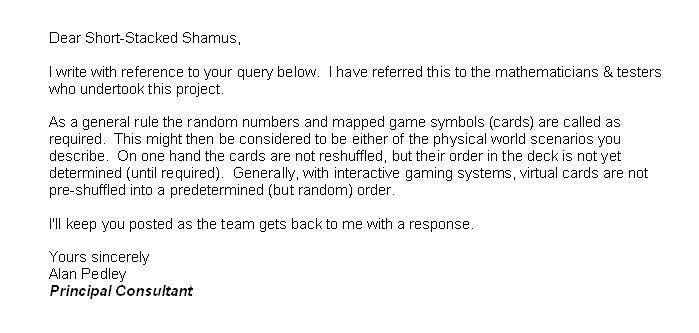
The only other site that responded to my message was Doyle’s Room. (I never heard from PokerRoom, PartyPoker, or Ultimate Bet.) Within an hour or so Doyle’s Room got back to me with a valiant but ambiguous reply that didn’t really answer the question. They did, however, tell me if had any further questions to contact Gaming Associates, an independent agency that consults with many online gambling sites. I sent them the question, and looking at their response it appears I’ve got the whole team buzzing over there:

Gaming Associates tries to clarify

Of the seven sites that responded, then, six of them reshuffle throughout the hand. And Mr. Pedley here (who probably knows a bit more that you or I do about the subject) says that “generally” speaking that is the way it is done -- online sites don’t usually “set the deck” the way PokerStars does.

Based on this information, I’m guessing that PokerRoom -- as Henry and Zog were saying on the PokerDiagram podcast -- probably does as most of the industry does and reshuffles throughout the hand. There’s probably an advantage, security-wise, in doing so, I would imagine, although I’m not too concerned about the integrity of PokerStars’ games. Nor am I that concerned, really -- despite the length of these last two posts -- about whether I should have played that 58-offsuit when the flop came 746. Hard enough to live in the world as it is without worrying over what it might have been . . . .

Photo: Tom Neal from the 1945 film Detour (adapted), public domain.

Labels: , , , , , , , , , , ,

Tuesday, July 18, 2006

Everybody's Talkin'

Was at the Razz tables again today for a bit (on Full Tilt Poker, the only major site that currently spreads Razz). There are easier things in the world than trying to find a Razz game, frankly. I found only four tables going -- 21 players total (out of about 5000 who were on the site at the time). And three of those tables were out of my league, stakes-wise. But there was that one $0.25/$0.50 table that mostly held together for the hour or so I was there. Actually ended up ahead this time (about $7.00). Was able to resist playing those 9-high hands or chasing other dubious draws, unlike before.

I’m starting to see that while Razz might appear to be overwhelmingly a “math” or “numbers” game, it actually involves a lot more “feel” than I realized before trying it out. I haven’t played enough, obviously, to be able to explain what that means, really. But it has been interesting to see how the third-street raising tends to go (usually only two or three players see fourth), how you really can bluff folks out of pots (and/or be bluffed out of pots), how one can go from being the favorite to a dog and back several times before a hand is complete, among other aspects of the game.

When I finished I tripped over to the 2+2 Forums to see if anyone ever talks about Razz over there. Didn’t find much. There is no “Razz” forum -- only an “Other Poker Games” section where Razz very occasionally comes up. (A couple of Razz-related threads actually popped up over in the “Stud” section as well.) As usually happens whenever I skim through the forums (at 2+2, RGP, the Card Clubs Network Forums, CardPlayer, THF), I ended up clicking around and getting distracted by other threads that looked interesting. I enjoy reading these and occasionally will contribute. Given that I live hundreds of miles from the nearest casino and am currently without a regular home game, it’s good to be able from time to time to have a kind of “community” of poker players with whom to discuss the game.

The poker forum is an interesting animal, really. Some of the threads on 2+2 get fairly competitive, almost as though those who are posting see themselves as participating in a hand of poker. One will “open bet” (let’s say) with a comment challenging some sort of accepted wisdom, for example, “Harrington’s Law of Bluffing” which states “the probability that your opponent is bluffing when he shoves a big bet in the pot is always at least 10 percent” (from Volume 1 of Harrington on Hold ‘em). Nonsense, says the thread-starter -- there are some players who simply never ever bluff. The first few respondents write comments that essentially agree with the original post (they “call” him). Then someone decides to put in a small “raise” by modifying the original argument, applying the principle to limit hold ’em (not NL tourneys). Then another “reraises” by challenging that assumption. And so forth.

That particular thread has thus far remained fairly amicable, although sometimes you’ll see posters aggressively battling each other as if vying for a huge pot. Another similarity with playing online is the fact that irony/sarcasm generally doesn’t go over terribly well -- oftentimes you’ll see threads taken completely off-track by someone having mistaken a tongue-in-cheek comment for sincerity, follow-up “I-was-half-joking-when-I-said-that”-type posts, or the like.

These phenomena aren’t specific to poker forums, of course, but the fact that poker players are usually trying not to “communicate” with complete transparency when at the table -- instead deliberately deceiving others with false cues -- makes it doubly interesting to witness these genuine attempts to communicate in the forums.

Or via blogs, for that matter.

Labels: , , , , , , ,


Older Posts

Copyright © 2006-2021 Hard-Boiled Poker.
All Rights Reserved.