Wednesday, March 02, 2016

Cards, Money, and Bluffing

Gonna get a little abstract both in this post and the one tomorrow. I had written something up for another purpose a while back and never used it, and so rather than leave it hidden in an old file on my computer I have decided to share it here.

The first part has to do with defining the game of poker according to its essential elements. It’s something I want to say was first inspired by a conversation with Tommy Angelo from many years back, although it could be I’m associating the author of Elements of Poker with this argument about the elements necessary to the game.

Wherever this started, the question with which we begin couldn’t be more broad in its scope: “What is poker?” And the answer is a list: “Cards, money, and bluffing.”

First, cards. Dating back as far back as the ninth century to imperial China, playing cards were employed in a wide variety of games over the next millennium while spreading throughout Asia and Europe, reflecting a host of cultural symbols and values in their changing designs along the way.

By the early 1800s, most features of the modern deck had been established, including the size and thickness of the cards as well as the four suits, with various games including bouillotte, mus, pochen, and poque having been introduced throughout Europe and carried to North America. Features borrowed from each of these games, including the building of five-card hands as well as discarding and drawing, would be incorporated into poker, a game initially played with 20 cards, then later with the full 52-card deck.

In the United States the game would grow and develop alongside the country itself, expanding to include a multitude of variants linked by the use of similar hand rankings and rules of play. Poker wouldn’t be poker without cards, but then the game has always been about much more than a flush beating a straight.

All of these precursor games offered opportunities for wagering, though it would be the amalgam of poker that would promote money to the status of being a required element of the game, as essential as the cards.

In an essay written about a half-century ago titled “Poker and American Character” (discussed here and here), historian John Lukacs maintains that “Money is the basis of poker: whereas bridge can be played for fun without money, poker becomes utterly senseless without it,” a position which many commentators on the game readily share.

Each hand of poker is like a complicated negotiation, with players forced both to invest in their own hands while weighing prices set by opponents on theirs. Entering into such transactions requires purchasing power -- one must bring money to the table to participate at all -- and just like in negotiations away from the poker table, each player’s personal idea of what money signifies directly affects the amounts set when selling, or the costs agreed to when buying.

“The money staked in poker represents not only our idea of the value of our cards, but our idea of what the other players’ idea of the value of our cards might be,” explains Lukacs, suggesting that money’s importance to the game is even greater than the cards. “Cards count in poker,” the historian acknowledges, “but they count less than in any other game.”

Of course, as anyone who has played even a single hand of poker well knows, such negotiations need not be entered into in good faith, thus making bluffing a third defining feature of the game.

Like the cards and the use of money, bluffing was likewise inherited by poker from most of its immediate precursors. For example, the British game of three-card brag -- one of the few antecedents of poker still played today -- bluffing is literally the name of the game, with players dealt a hand, then “bragging” their cards’ value with bets until just two remain.

“Bluff is the essence of poker,” argues David Spanier in Total Poker, articulating another sentiment with which many poker players would agree. “It is lurking in every single hand of the game,” he continues, alluding to the possibility of a bet or raise misrepresenting a hand’s value: “Has he or hasn’t he got what he says he’s got?” Every instance of a player backing cards with money presents the question to the next player to act, adding layers of complexity to the game that distinguish poker markedly from other card games and forms of gambling.

Poker needs cards, then, and money and bluffing. This argument might be used to exclude some card games that are often referred to as poker, such as liar’s poker (no cards) or HoldemX (no money) or Chinese poker (no bluffing), but to be honest I’m not that interested in drawing hard, angry lines around poker here. Rather I’d like merely to suggest cards and money and bluffing to be core elements of the game, perhaps forcing us to recognize that any variants that lack one of the three is better considered part-poker and part-something-else.

It’s not too complicated of an argument, saying poker is cards and money and bluffing. Of course, when these elements are combined, it is clear poker becomes much more than the sum of such parts, and, importantly, more complicated to describe. Doyle Brunson notes early start of Super/System that “poker is a game of people.” And because poker is a game of people -- and since people are inconsistent, flawed, and self-contradictory -- it perhaps isn’t surprising to find the game itself replete with several seeming incongruities.

These paradoxes of poker I’ll discuss tomorrow when I share the rest of this discussion.

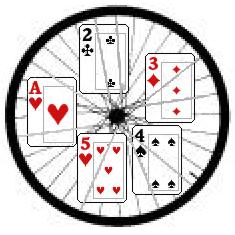
Photo: “Cash Money,” Aaron Jacobs. CC BY-SA 2.0.

Labels: , , , , , , , ,

Tuesday, August 05, 2008

Weapons of Choice

Arnold Snyder's 'Poker Tournament Formula'I’ve been perusing Arnold Snyder’s first book about hold’em tournaments, titled The Poker Tournament Formula (2006). The book concentrates largely on “fast” tournaments, i.e., tourneys with rapidly rising blind/ante structures that require players to master strategies that Snyder collectively refers to as “speed play.” A sequel, The Poker Tournament Formula 2, came out this summer, and it focuses more on “slow” tournaments with large starting stacks and longer levels with more gradual increases of blinds/antes.

Incidentally, “Arnold Snyder” is actually a pseudonym for a successful tourney player who has also written some well-regarded books on blackjack. He writes quite clearly and has many interesting ideas that build upon and, in some cases, refute well-known concepts appearing in other books such as Dan Harrington’s Harrington on Hold’em series. For example, in the second book Snyder offers a particular criticism and clarification of Harrington’s much-lauded “M” concept that I would think most hold’em tourney players would find persuasive (or at least intriguing).

In this first book Snyder starts out with an explanation of how to analyze the structure of a given tournament and thus determine whether or not it is “fast,” “medium,” or “slow.” Snyder provides some formulas to help figure out the “patience factor” of a given tournament based on its starting chips and schedule of play, as well as the relative “skill level” one might therefore associate with the tournament.

I’m not going to get into the specifics of Snyder’s formulas (which do seem quite helpful), but wanted instead just to share one observation he makes early on in the first book regarding the relative importance of cards, chips, and position.

Snyder believes that in tournaments with fast structures, “your cards are the least important of your three weapons.” Also, echoing Doyle Brunson’s point from Super/System, Snyder believes that “position is the most important weapon you have in... a fast no-limit hold’em tournament.” That said, “it’s usually best not to tangle with a big chip stack when you’re really just making a position play.”

Rock-Paper-ScissorsThus when assessing the relative value of cards, chips, and position in these fast tourneys, Snyder suggests thinking of of the three factors as a version of the “rock-paper-scissors” game. He even offers a helpful mnemonic device for remembering what beats what: “Cards are made of paper. Chips are something you could throw, like a rock. If you can remember those two, there’s nothing left for position except scissors.”

Thus, cards beat chips (paper beats rock). Chips beat position (rock beats scissors). And position beats cards (scissors beats paper).

An interesting analogy. Of course, as Snyder goes on to explain, there are a few reasons why it is incorrect to think of hold’em tourneys as simply an elaboration on the game of Rochambeau. For one, in rock-paper-scissors, all three weapons are always of equal value, no matter what. In hold’em tourneys, the relative strength of your three weapons is constantly changing -- as is the case for your opponents, too -- and so it is important to recognize where you stand with regard to each when determining how best to proceed.

I’m hardly doing Snyder’s idea justice here -- you’ll have to go check out his book yourself for more explanation. Interesting stuff, though.

Tao of Poker 5th Birthday CelebrationEven so, I haven’t left my usual pot-limit Omaha and H.O.R.S.E. ring games and started jumping into any hold’em tourneys just yet. Although I am thinking of playing in a certain one tonight.

Most reading this blog probably know all about it already, but Dr. Pauly is hosting a $5.00+$0.50 no-limit hold’em tourney on PokerStars tonight at 9:00 p.m. Eastern time as a way of celebrating the fifth anniversary of Tao of Poker. And in addition to the usual prize pool, the winner will receive an entry into a $5,000 buy-in no-limit hold’em tournament during the Borgata Poker Open (September 12th) as well as two nights’ stay there Borgata Hotel & Spa in Atlantic City.

Pretty swell deal, there. Like I say, I’m probably going to be playing, although I might be distracted for the first hour as tonight ESPN is showing the final table of Event No. 4, the $5,000 Mixed Hold’em event which I covered for PokerNews. That airs from 8-10 p.m. Eastern time.

Whether I make it or not, let me encourage everyone reading to join in the fun. And don’t forget yr weapons.

Labels: , , , , , , ,

Wednesday, July 12, 2006

All That Razz

The Best Possible Hand in RazzAll eyes on the WSOP today as the much-ballyhooed H.O.R.S.E. event finally began. I discussed the event in an earlier post, where I also mentioned how it had renewed my interest in games other than hold ’em. Coincidentally or not, today was the day I finally took the plunge on the Razz tables over on Full Tilt Poker. Intended only to play a few dozen hands, but ended up sticking around for close to two hours. I ended up on the losing side, but had a lot of fun and will likely be back soon.

Before playing my first hand, I had compiled some advice from a few different sources. No exhaustive study, mind you. But I did at least make sure I knew the rules of the game going in. The original cue to give Razz a try had come from an episode of the excellent Ante Up! podcast from a few months back. Hosts Christopher Cosenza and Scott Long discussed how the game is played and offered a few strategy tips, then Cosenza followed up with a post on the Ante Up! blog in which he shared some more advice. I read through Cosenza’s comments there, then (as he recommends) I also read over the brief section on Razz in Doyle Brunson's Super/System: A Course in Power Poker as well as Phil Hellmuth’s chapter on Razz in Play Poker Like the Pros.

(I am aware how Hellmuth’s book tends to provoke extreme responses -- mostly negative -- and one day will post something here about Play Poker Like the Pros. I won’t be blindly defending the book or Hellmuth, mind you, but neither will I reject it wholesale as most seem to do.)

When I clicked the Razz tab at Full Tilt I saw that there were only a few tables going. There were a couple of active tables at higher stakes (one $2.00/$4.00 and one $8.00/$16.00). I knew I didn’t want to venture there. I scrolled down to find a couple of $0.25/$0.50 tables going and so took a spot at one of those. I adopted Cosenza’s “tight is right” strategy and restricted myself only to playing hands where I had been dealt three cards eight or lower (non-paired, of course) -- i.e., a "three-card eight." Was actually dealt AhAdAs once and cringed as I folded. I was doing a lot of folding, actually, and after a while decided to fill the time calculating exactly the chances of being dealt a three-card eight. (If my math is correct, it is a little over 16% . . . just about 1 out of 6 hands.)

I finally got involved in a few pots, winning a few and losing a few. I won about half of my showdowns -- I don’t know if that’s a decent percentage or not, really. I realized fairly quickly how you can often know precisely whether or not you are holding a winner. Occasionally you have your opponent “board-locked” (as Hellmuth says), meaning you can know with 100% certainty that your hand beats what he is showing. This circumstance comes up more frequently (per hands played) than does having the “absolute nuts” in hold ’em, to be sure.

By far the most memorable hand came when I was dealt 3h As 2s. Everyone put in the $0.05 ante. A player two seats to my right with Qc had to put in the bring-in of $0.10. The player to his left, Petty, called with 3d. I completed to $0.25, and GenialGeorge called with the 4s. Petty called as well. Fourth street brought me the 4h, giving me four-fifths of a wheel, so I bet out the quarter. GenialGeorge had picked up the 5h and called. Petty folded. Fifth street was a sweet 6c for yours truly, giving me a “smooth 6-low” -- a very strong hand, especially by fifth street. GenialGeorge, meanwhile, had picked up the Ah and so he was first to act. He bet the $0.50, and I immediately raised him to $1.00. He called. He drew the 9c on sixth street, and so I bet out again only to be raised by GenialGeorge. I reraised to $1.50 and he called.

Looking at the hands -- I had 3hAs2s4h6c8h and George had Hole card No. 1Hole card No. 24s5hAh9c -- I felt pretty confident I had to be ahead. He had to have precisely a deuce and a trey in the hole to be ahead of me, and I had one of each. (Also, Petty had folded a trey as well.) Seventh street cards were dealt face down, and I again bet. GenialGeorge again raised me. Could it be? I called and yes, indeed, he had the wheel: 3c2c4s5hAh9cAd. We had been dealt the two best possible hands in Razz, and we both had hit those hands on fifth street!

I couldn’t complain, though. I did make a couple of wheels myself before I finished, and while I ended up down about $12 for the session I went back over to the limit hold ’em tables and quickly made that back. Looking back, I realize I did end up chasing a few times when I shouldn’t have and even allowed myself to play a couple of 9-high hands when I knew better. Most folks at the table seemed to know what they were doing, although there was that one guy who showed down a full house on one hand and quads on another. (That caused some chat.)

Fun to learn and play a new game. I certainly recommend it. Meanwhile, what is this I hear about marked cards at the H.O.R.S.E. event?! I can see how marking the cards would make Razz easier. Somewhat, anyway . . . .

Labels: , , , , , , ,


Older Posts

Copyright © 2006-2021 Hard-Boiled Poker.
All Rights Reserved.