More on the Travails of Live Tournament Poker
 Was directed via Twitter this morning to an interesting blog post by PokerStars Team Online member Mickey “Mement_Mori” Petersen, one titled “My WSOP and why live tournaments are not THAT great.” I think it was Kevmath’s retweeting about it that led me to read the post.
There were a few reasons why I clicked through when invited. Petersen only recently started his blog, but I had read a couple of his earlier posts and so know he’s a good writer and thinker. I’ve also covered Petersen in many tournaments, both online and live, and so thought from the title he might be offering something interesting about how live tourneys differ from online.
I had another thought in mind, though, as began reading. I was remembering this summer’s WSOP and covering one event in which Petersen had played. Like many players, Petersen had an iPad with him and was occasionally checking it between hands.
Kind of amazing, actually, to walk through a tournament these days and notice just how many players have iPads at the tables. It is not a new phenomenon by any means. In fact, that picture below is one taken by B.J. Nemeth from the 2010 WSOP, a shot of Andy Bloch checking his iPad... and reading an article about how he uses an iPad at the poker table (!).
Now, though, there are times when it seems like more players have iPads (and smart phones) than don’t.
 At this year’s WSOP, many of those with iPads seemed to be mostly checking Twitter or Facebook, or playing games such as Words With Friends. Others had the PokerNews site up, which was always kind of intriguing (and a little uncanny) to see whenever I had just posted a hand about them. And a few were watching television programs or movies they had downloaded.
 In fact, I remember back in May at LAPT Uruguay seeing a player actually playing on PokerStars on his iPad (something I never saw at the WSOP, natch). To someone who doesn’t constantly grind these suckers full time, it can seem a little odd to witness players not really paying attention to the tournaments in which they are participating.
All of which is to say seeing Petersen check his iPad at the table wasn’t all that unusual. But I also recall passing by his table once to see him having put the iPad away and having gotten out a book to read -- an actual hardback book. I remember being kind of struck by the sight of what seemed an artifact of an earlier age. I was also curious to know what he might be reading, although never did find out.
Anyhow, coupled with Petersen’s identity as an “online pro,” that memory made me think perhaps Petersen’s blog post might focus on the tedium of live play. But in fact that isn’t his topic at all. Rather Petersen is concentrating more on the overall profitability of live tourney play, kind of dovetailing on that “ROI at the WSOP” discussion I posted about at the end of last week.
I’ll let you read Petersen’s post for full details, but to summarize, he points out how despite a couple of deep runs in events and results that might suggest a successful summer, his buy-ins did ultimately exceed his cashes.
Petersen also includes an interesting chart in his post tracking his live tourney net profits over the three years he’s been playing in them (143 tourneys total). While he’s been an overall winner (thanks largely to a big cash from his EPT Copenhagen win earlier this year), the chart helps underscore his observation about live tourneys “that relying on them as your sole source of income has an extremely high chance of failing.”
 The discussion reminds me a lot of Dan Harrington’s interview in CardPlayer from December 2007 in which he likewise stated in blunt terms that “I don’t think you can consider playing tournaments for a living” and that “the reality in [tournament] poker is that only one or two in every 100 players will make any real money at it.” (Here’s that interview, now hidden behind a paywall at CP.)
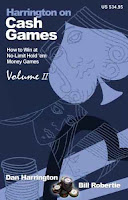
 I remember Harrington’s interview raising some eyebrows, appearing as it did at a time when his three Harrington on Hold’em tourney strategy books (released from 2004 to 2006) were at the peak of their popularity. Much like Harrington did before, Petersen smartly cuts through the “HUGE misconception about how profitable [tourneys] are,” correctly pointing out “how the media romanti[ci]zes them” by focusing on winnings and ignoring expenses.
I think a lot of players tend to ignore these realities, too, getting caught up in the romance of chasing that one big score that will finally (permanently?) put them into the black. Kind of analogous to being at the tables with the iPads or smart phones or other distractions, which in some cases might cause players not to be fully mindful of what is actually going on.
Like I say, check out Petersen’s thoughtful post for an updated consideration of the realities of live tournament poker.
Labels: *the rumble, 2012 WSOP, Dan Harrington, Mickey Petersen, tournaments
posted by Short-Stacked Shamus at 7/25/2012 11:08:00 AM
1 comments


 under the gun and raised to 450 (blinds were 75/150). The player to my left then pushed all in for 1,350, and the player to his left thought a while then called. It folded back to me and I shoved, and the third player, who had me covered, thought a bit more and called.
 two seats over. Flop comes 6-7-8. Turn a nine. River a ten. Pocket jacks wins the main pot, and I get about 700 or so back splitting the side pot with ten-nine.
 , the same player who’d reraised before with A-4 did it again, then a third player pushed all in as well. They had pocket eights and pocket aces, respectively. An eight flopped, and an ace came on the turn. And I was toast.




 . Binger checks, Gold casually throws out a minimum bet of 400,000, and Binger calls. The pot is 2,950,000. The turn is the
  and both players quickly check. The river is the
  . Binger checks and Gold casually stacks twelve green chips and pushes them in the middle -- a bet of 1,200,000.
 . Jack-high. In other words, jack squat.


 versus Hellmuth’s
 . The flop was a crowd-electrifying

 , giving Hellmuth a set but also giving Helppi nine outs to a possible tourney-winning flush. The
  came on the turn, completing the Finnish player’s flush and leaving Hellmuth ten outs to fill up or make quads. Fortunately for Hellmuth, the
  came on the river and he survived, pulling about even in chips. Over the next thirty hands or so, Hellmuth slowly increased his lead before finally taking the last of the chips when his
 .
.