Well, the Poker Brat did it. Phil Hellmuth, Jr. won the $1,000 NL Hold ‘em with rebuys event (Event No. 34), besting a field of 754 to grab his tenth WSOP bracelet. It didn’t appear too likely once Daryn Firicano busted out in third and Hellmuth was left to battle Juha Helppi. (You might remember Helppi was the fellow who as an amateur beat out Phil Gordon in that amateurs-vs.-pros WPT event from the first season.) When heads-up play began, Hellmuth was outchipped 2-to-1. Six hands later Helppi had a 3-to-1 advantage. Then came that wild, miraculous hand that turned the tide.
Helppi was sitting pretty with about $1,850,000 in chips while Hellmuth was down to $650,000. The blinds were $15,000/$30,000 with a $5,000 ante. Helppi raised to $90,000 from the button and Hellmuth moved all in from the big blind. Helppi called and it was his


versus Hellmuth’s


. The flop was a crowd-electrifying


, giving Hellmuth a set but also giving Helppi nine outs to a possible tourney-winning flush. The

came on the turn, completing the Finnish player’s flush and leaving Hellmuth ten outs to fill up or make quads. Fortunately for Hellmuth, the

came on the river and he survived, pulling about even in chips. Over the next thirty hands or so, Hellmuth slowly increased his lead before finally taking the last of the chips when his


outlasted Helppi's


.
Not that huge of a surprise, really, considering how the Brat has been going at this year’s series. He had already seen a couple of final tables, including a second place finish (out of 622) in the $5,000 NL Hold ’em event (Event No. 9). Of course, Hellmuth would've been the center of attention anyway. Everyone seems to have an opinion about him. His books and DVDs routinely receive a fair amount of criticism on message boards, newsgroups, and blogs. Despite his many accomplishments, it has almost become a cliché for poker players to dismiss outright his best-selling
Play Poker Like the Pros.
I’d mentioned
in an earlier post that I’d read Hellmuth’s book and intended at some point to say something about it, so I thought this might be as good of an occasion as any to do so.
Play Poker Like the Pros is hardly the best or most helpful poker book I’ve read, but I’ll grant that it does possess some merit, especially for someone brand new to poker.
Nearly half of
Play Poker Like the Pros concerns limit hold ‘em cash games. Hellmuth outlines a “beginner” strategy whereby one is encouraged only to play “top ten” premium hands, and almost always to play them aggressively (to “ram and jam” the pot). This advice gets targeted a lot by critics, particularly since Hellmuth includes
77 in his “top ten,” a hand that rarely survives the “ram and jam” approach unless one is up against a set of meek opponents (or if you’ve so well established your tight image no one will play back at you). He goes on to add other possible hands to the mix for “intermediate” and “advanced” play, and offers a lot of specific advice about post-flop play and dealing with various, commonly-faced scenarios.
Another issue Hellmuth discusses early on in
Play Poker Like the Pros is how to interpret other players’ styles and act accordingly. His infamous “animal types”-approach to classifying players has been mocked by many -- Hellmuth calls the conservative rock a “mouse,” the loose-aggressive maniac a “jackal,” the immovable calling station an “elephant,” and so forth. Even if the idea is reductive (or even silly), the approach isn’t that bad of a way of introducing the importance of paying attention to what others are doing at the table.
The first poker book I ever read was David Sklansky’s
Hold ’em Poker, a decent primer for learning about starting hand groupings, pot odds, and other strategies. While Sklansky does explain at times how to interpret another player’s action during a hand, he really is focusing throughout on a single kind of opponent, the kind that played the somewhat-tight $10-$20 limit game at the Mirage back in the 70s and 80s when he wrote and revised the book. Sklansky’s advice is theoretically sound, but it doesn’t always apply very well to the looser games one encounters online (esp. at lower limits). Just being aware of different styles (as Hellmuth encourages the limit hold ’em player to be) is a benefit, especially to the beginning player. (Of course, Miller/Sklansky/Malmuth go way beyond Hellmuth in this regard with their
Small Stakes Hold ’em, a much much better resource for dealing with loose low limit games, though not necessarily the best book for beginners.)
Play Poker Like the Pros also includes a much briefer discussion of pot-limit and no-limit hold ’em cash games, as well as a tiny chapter (only a dozen pages or so) about limit hold ’em tourneys. I’ve never gotten much at all out of these chapters, and indeed, it is somewhat baffling to consider how little Hellmuth has to offer here to the person wanting to learn how to play hold ’em tourneys. (All ten of his WSOP bracelets have been in hold ‘em events.)
Finally, Hellmuth includes chapters on Pot Limit Omaha, Omaha 8-or-better, Seven-Card Stud, Stud 8-or-better, and Razz, as well as a cursory discussion of playing online. These chapters on other games are not bad to have around as a reference, I suppose. As
I mentioned earlier, the chapter on Razz is apparently one of the few strategy discussions of that game available. Still, none of this material really distinguishes the book that greatly.
People continue to buy
Play Poker Like the Pros, though certainly not at the clip they were a couple of years ago. Looking over at
Amazon’s up-to-the-minute listing of top-selling poker books, there are 25 other poker books outselling
Play Poker Like the Pros at the moment I'm publishing this post. Looks like the Brat’s win didn’t really cause that much of a jump in sales. Meanwhile, Dan Harrington is riding high, with both
Volume I and
Volume III of his
Harrington on Hold ’em coming close to cracking the top 100 selling books
overall. That’s among all the books Amazon sells! (Harrington did say on
The Circuit the other night one of the main reasons he wrote his
Hold ’em volumes was for the money . . . . Action Dan knows what he’s doing, all right.)
The loudest censure of
Play Poker Like the Pros usually concerns the large amount of anecdotal material Hellmuth includes, most of which reads as more of that ego-massage-type behavior we've come to expect from Hellmuth. I’m not going to disagree with that criticism here -- especially in the chapters about non-hold ’em games, one gets the sense at times that Hellmuth's purpose is more to prove his worth in these games than to teach strategy.
As far as instruction goes, there are much better books about limit hold ’em than Hellmuth’s, no doubt. And for the NL hold ’em tourney player, the book has practically no value at all. That being said, while I don’t necessarily recommend the book outright, I’ll admit to have benefitted somewhat from the experience of having read it as a novice player. That’s why I usually don’t rush to join the chorus of Hellmuth-haters whenever the subject of
Play Poker Like the Pros comes up.
I usually don't rush to defend him either, though. Hellmuth takes care of that just fine on his own.
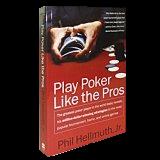
Image: Phil Hellmuth, Play Poker Like the Pros (2003), Amazon.
Labels: *by the book, Dan Harrington, David Sklansky, Harrington on Hold 'em, Hold'em Poker, Phil Hellmuth, Play Poker Like the Pros, The Circuit


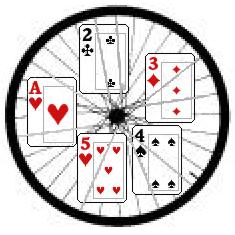

 . Everyone put in the $0.05 ante. A player two seats to my right with
  had to put in the bring-in of $0.10. The player to his left, Petty, called with
  . I completed to $0.25, and GenialGeorge called with the
  . Petty called as well. Fourth street brought me the
  , giving me four-fifths of a wheel, so I bet out the quarter. GenialGeorge had picked up the
  for yours truly, giving me a “smooth 6-low” -- a very strong hand, especially by fifth street. GenialGeorge, meanwhile, had picked up the
  on sixth street, and so I bet out again only to be raised by GenialGeorge. I reraised to $1.50 and he called.
 and George had


 . We had been dealt the two best possible hands in Razz, and we both had hit those hands on fifth street!