Friday, October 14, 2016

Poker Hall of Fame: Carlos Mortensen and Todd Brunson Make 52

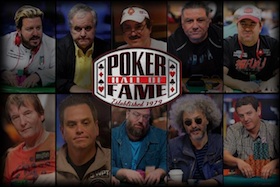
Saw yesterday how Carlos Mortensen and Todd Brunson had been elected as the 51st and 52nd members of the Poker Hall of Fame. Now’s the time for the World Series of Poker to create a commemorative deck of cards featuring pictures of all 52 members.

If I’d had a vote I certainly would’ve given support to Mortensen’s candidacy, though there were other nominees I’d have probably chosen this year ahead of the younger Brunson (though he’s certainly deserving).

Mortensen is a WSOP Main Event champion (2001), and I tend to have a bit of a prejudice in favor of that select group when it comes to the PHOF. With three WPT titles, nearly $12 million in career tourney earnings, and a near-miss to make a second WSOP Main Event final table in 2013 (when he finished 10th), he was a shoo-in. That’s not even counting the highly advanced chip stacking skills that further distinguish the Spaniard (originally from Ecuador).

Todd Brunson has won a lot in tournaments as well (nearly $4.3 million, including a WSOP bracelet in 2005), although he’s much better known as a high-stakes cash game player. His notable heads-up battles with Andy Beal -- including a $13.5 million win over two days (as chronicled in Michael Craig’s The Professor, the Banker, and the Suicide King), then another belated reprise versus Beal in early 2015 which Brunson is said to have won another $5 million -- are legend-making and probably enough to earn him serious PHOF consideration.

I’m going to guess he got a lot of support from the living Poker Hall of Famers, and perhaps not quite as much from the media who voted. Speaking of living PHOFers, he joins his dad, Doyle Brunson, as a PHOF member, which has to be fairly unusual as far as hall of fames go, generally speaking.

The only other father-son combo I can think of in any sports hall of fame would be Bobby and Brett Hull, even if Ken Griffey, Sr. and Jr. spring to mind (Jr. got in this year, Sr. isn’t a HOFer).

In any case, congrats to both. And if the WSOP is reading, feel free to steal that special WSOP PHOF deck idea!

Image: WSOP.com.

Labels: , , , , , ,

Monday, September 19, 2016

Panels and Processes

Was reading this curious article earlier today by someone who had been part of the group of “poker media” who voted for the Poker Hall of Fame in which he says he’s giving up his spot on the panel.

The author is from the United Kingdom, and after talking about how he generally doesn’t vote (e.g., he passed on Brexit), he’s giving up voting for the PHOF, too, because he doesn’t feel informed enough about the nominees to be able to vote in a way that wouldn’t be overly biased toward his personal, limited experience.

In his case, he says, he’d cast all 10 of his available points for Dave “Devilfish” Ulliott, mainly because of having met him early in his poker writing career and having a personal liking for him.

While he says “a Hall of Fame means jack diddly squat to me,” he also notes how he’d felt honored to be part of the PHOF voting process. But he’s giving that up, mainly because of that feeling he’s not quite qualified to assess the nominees adequately, while also adding some doubts about the process by which the nominees are selected (which might have discouraged him further).

I suppose it’s a good move for the fellow to step away and let someone else who cares more about it all to get involved. Kind of weird how it comes off as vaguely suggesting some kind of criticism of the process, but I don’t think that’s the intention.

I’ve mentioned here before how I used to be part of that group of “poker media” who voted for the PHOF. The votes come both from the writers and from living Poker Hall of Famers, and from 2010 through 2013 I spent a lot of hours each fall going through the nominees and deciding how to fill out my ballots.

Before the 2014 vote I had switched email accounts and missed a note regarding that year’s PHOF, and as a result ended up not being part of the voting process anymore. In other words, I think my losing my spot was mostly inadvertent, although I did talk with the WSOP then and learned how they were interested in getting more Europeans involved in the voting, which made sense to me.

I also feel like it is good for the panel to have at least some turnover as a general principle -- after all, “poker media” has a lot of people coming and going constantly, and thus isn’t necessarily represented so well if the exact same people are involved every single year.

I wouldn’t have given up my spot as a PHOF voter willingly. I have too much interest in the game and history of poker, and I always felt like my vote was well informed and a positive contribution to the process.

But as I say I didn’t mind letting others get in there and have a crack at it, too -- if they wanted to, that is.

Image: “Personal preference,” Kevin Dooley. CC BY 2.0.

Labels: , ,

Friday, September 09, 2016

Poker Hall of Fame Talk (Again)

Today the World Series of Poker announced its 10 “finalists” for this year’s Poker Hall of Fame, and the chorus of criticism has already begun over Twitter and elsewhere.

Following a procedure first adopted in 2009, the WSOP invites the public to nominate players, but then has a Poker Hall of Fame Governing Council go through those nominations and select 10 names to include on the final ballot.

That second step was introduced into the process in 2010 after the public managed to stuff the ballot box that first year with nominations of Tom Dwan. It was a bit hilarious for Dwan to be among the 10 PHOF nominees, given he was only 23 years old at the time. (This was before the “Chip Reese Rule” was instituted in 2011 requiring nominees to be at least 40.)

In fact, the powers that be took Dwan off the list, thus forwarding along only nine names to the voters, a group consisting of living Poker Hall of Famers and a “blue ribbon panel” of poker media members. The voting process was a little different in 2009, requiring a nominee to get 75% “yes” votes from voters to get in. That resulted in only one inductee that year (Mike Sexton), and so going forward they tweaked things again, essentially assuring that two of the 10 would get in each year. (If you’re curious, you can read this post from a year ago for a little more about how the voting is done.)

Obviously there were problems with having the public choose nominees. That said, with that PHOF Governing Council stepping in to select the 10 finalists, that creates other issues, opening the door to some of the complaints people fire off each year regarding who gets picked and who gets left out.

The 10 finalists this year are Chris Bjorin, Humberto Brenes, Todd Brunson, Eli Elezra, Bruno Fitoussi, Chris Moneymaker, Carlos Mortensen, Max Pescatori, Matt Savage, and Dave “Devilfish” Ulliott. Seven of the 10 have appeared on ballots before, the new names being Brunson, Elezra, and Moneymaker.

No surprise, really, to see Moneymaker -- who turned 40 last November -- on the list. In fact it wouldn’t be a surprise to see him voted in, even if some might argue others should be getting in before him. Meanwhile Elezra is not a great surprise either as a nominee, although Brunson seems like it could be a stretch. Can’t see either of those two being voted in, though.

Some are wondering where Phil Ivey is on the list of nominees, but in fact he doesn’t turn 40 until early next year.

If I had to predict, I’d say Mortensen and Ulliott get the votes this time (if Moneymaker doesn’t). Who would you vote in, and who should be nominated who isn’t on this year’s list?

Photo: WSOP.com

Labels: , ,

Monday, October 26, 2015

The Hall Picks Up Another Pair

Results from this year’s Poker Hall of Fame voting were announced today, with John Juanda and Jennifer Harman the newest two members named.

I’ve written here before about how I had the privilege of being involved with the PHOF voting for a few years. I was one of the “poker media” picked to vote alongside the living Hall of Famers (always tend to want scare quotes around those two words, for a variety of reasons). We were all given 10 names (finalists) from which we could pick up to three to whom we doled out our allotment of 10 total points, then the top two points-getters would make it through.

I’ll point out again that having a PHOF vote only meant being able to pick from the 10 names the panel was given. I never could suggest nominees myself, although I believe the living PHOF members were able to do just that (which is how Brian “Sailor” Roberts got on the ballot, I believe).

That said, during the years I voted (2010-2013), I was essentially okay with the individuals who made it through to be named PHOFers. While I sometimes gave points to players who didn’t ultimately get inducted, I didn’t disagree too greatly with what the final results were.

Back in early September when this year’s finalists were announced, I guessed Dave “Devilfish” Ulliott would get picked with either Carlos Mortensen or Juanda getting the other spot. Was mainly just trying to predict what the current voters would do, and not suggesting who I thought should get in out of the 10 nominees.

I don’t disagree with either Juanda or Harman getting in, although Mortensen is certainly one that seems like he should get the nod sooner than later. In fact if I were to predict again I’d say next year it will probably be Mortensen and Phil Ivey, as Ivey turns 40 in February and so cannot be denied one of the two spots, unless they manage to change the process around somehow between now and then.

Which I suppose could happen, given some of the clamor that appears to have resulted from this year’s vote. It’s necessarily always going to be a flawed process, ultimately unsatisfactory to some if not the majority of those who care a lick about it.

For more on the topic, including some discussion of the lack of non-Americans in the PHOF, see Chris Tessaro's piece over at All In titled “Did the Poker Hall of Fame Pick the Right Inductees?

(EDIT [added 10/29/15]: Yesterday European Poker Tour founder John Duthie added another op-ed regarding problems with the current nomination/voting process and the glaring lack of non-Americans in the Hall over at PokerNews -- check it out.)

Labels: , , , , ,

Tuesday, September 08, 2015

2015 Poker Hall of Fame Nominees Announced

The 10 finalists for this year’s Poker Hall of Fame have been announced, prompting a few in the poker world to spend a little effort once again thinking about what the PHOF represents and perhaps to debate once more about the challenge of trying to measure the worthiness of an individual to be recognized as a PHOFer.

There are currently 48 inductees, with Daniel Negreanu and Jack McClelland being the most recent to be awarded the honor last year. I believe something like 23 or so of those in the PHOF are still living. That group gets to vote on the 10 nominees along with an appointed group of poker media, with two nominees at most able to get the nod.

For several years I had the opportunity to vote for the Poker Hall of Fame and so have a bit of familiarity with the process. The 10 names are given to the voters, chosen by a group of folks at the WSOP from those submitted online. They aren’t the 10 most-nominated by the public, but rather the ones whom those doing the selecting think deserve to be finalists.

From there the “Blue Ribbon” committee of PHOFers and media have 10 points they are allowed to distributed among one, two, or three nominees. The points are then tallied, and the two getting the most are elected.

As I say, I had the privilege of voting for a few years there, and in fact if I hadn’t missed an email sent to an old, dormant account, I might still be part of the group voting. I didn’t mind losing my spot, however, for a couple of reasons. For one, I think any committee is benefited by changing members occasionally, if only to assure bringing in different views and perspectives. Secondly, people come and go a lot when it comes to the so-called “poker media,” which would also be a reason to revisit who is being included in that half of the group of voters.

I was also told at the time the WSOP was interested in getting more European media represented as voters, which I also thought was a good thing. In any case, it’s clear from the 10 names presented to voters this year that the WSOP is pushing to try to get some non-Americans voted in to the PHOF.

This year’s nominees are Chris Bjorin, David Chiu, Bruno Fitoussi, Jennifer Harman, John Juanda, Carlos Mortensen, Max Pescatori, Terry Rogers, Matt Savage, and Dave “Devilfish” Ulliott.

Bjorin’s a Swede, Fitoussi is French, Pescatori is Italian, and Mortensen was born in Ecuador and grew up in Spain. The two deceased nominees Rogers (Ireland) and Ulliott (England) are also non-U.S. Chiu was born in China and Juanda in Indonesia, though both are American. Meanwhile Harman and first-time nominee Matt Savage are both U.S. natives.

The idea of inviting the public to nominate 10 individuals for the PHOF and then have a committee vote to select inductees from that list began in 2009. Just for fun, here’s a rundown of who the finalists were for the six years prior to this one. The asterisks denote those inducted, and clicking the year gets you to a post written here about the PHOF class/winners from each:

  • 2009: Tom Dwan, Barry Greenstein, Dan Harrington, Phil Ivey, Tom McEvoy, Daniel Negreanu, Men Nguyen, Scotty Nguyen, Erik Seidel, Mike Sexton*

  • 2010: Chris Ferguson, Barry Greenstein, Jennifer Harman, Dan Harrington*, Phil Ivey, Linda Johnson, Tom McEvoy, Daniel Negreanu, Scotty Nguyen, Erik Seidel*

  • 2011: Annie Duke, Barry Greenstein*, Jennifer Harman, Linda Johnson*, John Juanda, Marcel Luske, Jack McClelland, Tom McEvoy, Scotty Nguyen, Huckleberry Seed

  • 2012: Chris Bjorin, David Chiu, Eric Drache*, Thor Hansen, George Hardie, Jennifer Harman, John Juanda, Tom McEvoy, Scotty Nguyen, Brian “Sailor” Roberts*

  • 2013: Chris Bjorin, Humberto Brenes, David Chiu, Thor Hansen, Jennifer Harman, Mike Matusow, Tom McEvoy*, Carlos Mortensen, Scotty Nguyen*, Huckleberry Seed

  • 2014: Chris Bjorin, Humberto Brenes, Bruno Fitoussi, Ted Forrest, Jennifer Harman, Bob Hooks, Mike Matusow, Jack McClelland*, Daniel Negreanu*, Huckleberry Seed
  • In 2009, Sexton was the only inductee. The voting process was different then, but a stipulation requiring a nominee to get at least 75% “yes” votes (like the MLB Hall of Fame) made it hard for more than one to get in that year (and in fact almost made it so no one could get in).

    Also noteworthy from 2009 was how Tom Dwan -- then just 23 years old -- got picked by the public, and then was removed from the ballot by the WSOP.

    In 2011 the so-called “Chip Reese Rule” was added, meaning no one under 40 years old could be nominated. That’s why Ivey and Negreanu were on the ballots before that date, and Negreanu only showed up again last year after turning 40. Ivey turns 40 next February, will be on the ballot next year, and will be inducted, no doubt.

    Also, in 2012 Brian “Sailor” Roberts was not picked by the public to go on the ballot, but was a “write-in” nominee submitted by a PHOFer (I believe).

    Gonna guess Ulliott, who passed away in April, gets in this year, with either Mortensen or Juanda nabbing the other spot. Who would you vote for, and who do you think gets in?

    Labels: , , , , , , , , , , , ,

    Tuesday, June 16, 2015

    All-Star Voting Royally Skewed

    Major League Baseball’s All-Star game is scheduled for Tuesday, July 14 this year. That’s also the last day of the summer portion of the World Series of Poker -- that is, the day they’ll play down to a final nine in the Main Event.

    It’s been a while since I’ve paid much attention to the MLB All-Star Game. Back in the day as a kid I remember looking forward to it every year -- even mailing in ballots -- and then always rooting for the National League which enjoyed a lengthy streak of victories, as I recall.

    I continued to follow the MLB into adulthood, albeit less intensely, though by the late 1990s my interest had begun to fade. As far as the All-Star game goes, I remember staying up to watch 11 innings of the 2002 game only to watch it end in a tie after both teams ran out of players, which for me (and I imagine for many others) made that the last All-Star game I bothered to watch all of the way through.

    I could be bothered to watch the game this year, though, at least the first couple of innings. That’s because one team’s fans -- the Kansas City Royals -- has done a great job of stuffing the ballot box thus far. In fact right now Royals players are leading for eight of the nine positions for which fans get to vote.

    Below is a shot of the latest update of the AL voting totals:

    Only Mike Trout of the Angels has one of the outfield spots at the moment -- the rest are all KC.

    Something similar happened in 1957 when Cincinnati fans voted seven different Reds into the NL starting line-up. The MLB took voting away from the fans the next year, not giving it back until 1970.

    You can now vote online -- up to 35 times per email address, in fact -- and as this Washington Post article spells out that’s a big reason why Kansas City fans have been successful thus far.

    The Royals are leading their division currently, although all of their starters are hardly having seasons worthy of earning the All-Star nod. In fact one of them, Omar Infante, who is leading among second basemen, is batting .204 and is currently ranked dead last in the league in “OPS” (on-base % plus slugging %).

    Still, I’m kind of pulling for the Royals all to get voted in, just for the sake of anarchy. Kind of reminds me of the time online voters chose Tom Dwan as a Poker Hall of Fame nominee (back in 2009). Like MLB Commissioner Ford Frick did back in 1957, though, when he took a couple of Reds off the NL team in order to give Willie Mays and Hank Aaron spots, the WSOP took Dwan’s name off the ballot.

    Labels: , , , , , ,

    Thursday, October 23, 2014

    Two More for the PHOF

    I mentioned a few weeks ago when the nominees for this year’s Poker Hall of Fame were announced how this year I was not part of the panel of media who voted along with the living PHOF members. I had that privilege to cast a ballot for the previous four years, actually. Was honored to have had the chance to take part and happy to step aside to allow others the chance to do so.

    Today the WSOP announced Daniel Negreanu and Jack McClelland had been voted in, with Negreanu a “first-ballot” Hall of Famer as he just turned 40, the minimum age for induction.

    As I didn’t participate this time, I’m not 100% sure on what the instructions were for those who did. In the past, we’d receive the ballot with the 10 nominees listed and vote according to a “10-point must system” meaning we had 10 points we had to assign to one, two, or three candidates. So we could give all 10 points to one nominee, split the points among two or three, or even vote for no one (I think).

    Then the points were all tallied and the two candidates who received the most total points were elected. I believe at some point early on there was talk about a candidate needing enough points to exceed a minimum overall percentage to make it (as in the Baseball Hall of Fame), but if I’m not mistaken they just take the top two point-getters, however many points they happened to get.

    Like I say, I don’t know if they used the same system this year, but if they did I have to imagine everyone had to have given Negreanu some of their points, perhaps even most of them. And I’d guess many of the living PHOFers likely cast votes for McClelland, as well as some of the media.

    Negreanu’s poker résumé is so extensive it goes without saying he was a shoo-in and much deserving. McClelland recently retired at the end of last year after four decades in poker, a time that included serving as a tournament director since the 1980s in various poker rooms (including at the WSOP).

    I was at McClelland’s last tourney, actually, the WPT Five Diamond at the Bellagio last December, where there were some nice moments of recognition for him at the final table. His contributions to poker are harder for those who came into the game more recently to appreciate, but he’s clearly had a significant influence that many have regarded as especially positive.

    There will be a ceremony at the November Nine to recognize Negreanu and McClelland. Perhaps next summer the WSOP will consider my Poker Hall of Fame idea to construct some sort of temporary “Hall” in the halls of the Rio.

    Labels: , , ,

    Wednesday, September 24, 2014

    Talking Weight, Not Gravitas, With Hall of Fame Nominees

    After having had the honor of being part of the panel of “poker media” invited to vote in the Poker Hall of Fame the last few years, I’m not part of the process this time around. The WSOP wanted to rotate some new folks into the mix, something I think is a great idea and thus don’t mind a bit stepping aside.

    Since I’m not voting, I haven’t given that much thought regarding the list of 10 nominees (which I talked about briefly here a short while ago). I did notice, though, that two of them -- Ted Forrest and Mike Matusow -- have gotten back onto the gossip pages lately thanks to that weight loss bet from about four years ago won by Forrest.

    Matusow had won a different weight loss prop bet between the pair previously, picking up $100,000 from Forrest after managing to go from 250 to 181 lbs. in less than a year. Then the pair made a second bet that would require Forrest, then 188 lbs., to get under 140 lbs. I’m not sure of the exact terms, but if Forrest could manage it by a specific deadline -- less than a year away, I believe (perhaps just a few months) -- Matusow would owe him $2 million.

    Forrest achieved the feat, and then afterwards they agreed that Matusow -- who didn’t have the funds with which to pay his debt -- would pay Forrest $5,000 a month thereafter with the debt adjusted down to $1.8 million. That would still take over 30 years to pay off.

    Cut to four years later, and Matusow has apparently only paid Forrest $70,500 thus far. Forrest took to Twitter earlier this month, and Matusow now seems to be referencing the collapse of Full Tilt Poker (version 1.0), the fact that the pair had been drinking when the bet was made, and other factors as lessening his obligation.

    There are other details, but to be honest it took some extra effort for me just to get up the energy to look into it that far.

    In terms of tourney results, both players have built up impressive, lengthy lists of wins and deep finishes, which is how both made it onto the PHOF ballot. Even with these accomplishments, I wouldn’t have been too enthused to vote for either, however.

    I don’t say that because of these prop bet shenanigans, but just because when it comes to rating a super-select few above the rest, it’s hard (for me) to think of either as belonging to the toppermost tier of poker people.

    That said, it’s hard to imagine “hall of fame nominees” of any other sport sniping at each other on Twitter in such a fashion. Seems to lack a certain gravitas, doesn’t it? I’m sure similar things have happened, but it still feels like an “only in poker” kind of story.

    Labels: , , , ,

    Thursday, September 11, 2014

    A Poker Hall of Fame Idea

    The 10 finalists for this year’s Poker Hall of Fame have been announced. No more than two will be voted in as the 2014 class from this group: Chris Bjorin, Humberto Brenes, Bruno Fitoussi, Ted Forrest, Jennifer Harman, Bob Hooks, Mike Matusow, Jack McClelland, Huck Seed, and Daniel Negreanu.

    Negreanu just turned 40 and is thus in his first year of eligibility, and seems an utter shoo-in to get voted in. Being at least 40 (the so-called “Chip Reese” rule) is one of the criteria for selection, along with playing against top competition, playing for high stakes, gaining peers’ respect, standing the test of time, and (for non-players) contributing to the game’s overall growth.

    With the others it is hard to say who among them might earn the needed votes this year. Bjorin, Brenes, Harman, Matusow, Seed, and McClelland have been nominated before, while Negreanu, Fitoussi, Forrest, and Hooks are on the ballot for the first-time. Now a panel comprised of current PHOFers and poker media (totaling around 40 folks) will be casting votes to determine who makes it in.

    The public nominates individuals for the PHOF via the WSOP.com website, then a group comprising the Poker Hall of Governing Council goes through the list to choose the 10 finalists. Current PHOFers also can write in candidates to be included among those 10, although I’m not exactly sure how the Council goes about both choosing from the public’s nominees and working in the written-in nominees.

    In any event, as happens every year there are the usual calls to revise the criteria, the nomination process, and the system for voting. And as usually also happens, those calls are accompanied by references to those omitted from the ballot who some believe should be nominated. This year Carlos Mortensen, David Chiu, John Juanda, and Gus Hansen are among the several players folks are mentioning in this regard.

    Negreanu was one mentioning Hansen as a candidate in a blog post this week, with the Dane also in the news for having crossed the $20 million-mark in online losses at Full Tilt Poker. Talk about contributing to the game’s overall growth!

    Among the comments I saw scrolling by on Twitter as folks debated was mention (again) of creating some sort of physical “hall” or location for the PHOF. There is none, of course, nor would I imagine there really be much of a demand for something like that. Even so, seeing that mentioned again gave me an idea about the Poker Hall of Fame.

    The WSOP could create some kind of temporary PHOF display each summer to show during the nearly two months that the World Series plays out in Las Vegas. They could set it up in the hallway at the Rio, making a literal “hall of fame” where players and the many visitors who come to rail the WSOP could get a look at photos of the inductees with attached bios. They could roll out the display again in November when the Main Event final tablists and others return and the ceremony for the new inductees takes place.

    It would at least make the Poker Hall of Fame better known among those who play and attend the WSOP. And probably spark still more debates, too, in the Rio hallway.

    Labels: , , ,

    Friday, September 27, 2013

    Who Would You Select Among the 2013 Poker Hall of Fame Nominees?

    In a rush today and so just thought I’d post a quick one noting the announcement of the 10 finalists for this year’s Poker Hall of Fame. I’ve had the honor in the past of being one of those called upon to vote in this process, and as I look at the finalists for this year I’m again thinking about how difficult a task it will be when it comes to deciding between them.

    As you’ve probably read elsewhere, the following players all made this year's list of finalists: Chris Björin, Humberto Brenes, David Chiu, Thor Hansen, Jennifer Harman, Mike Matusow, Tom McEvoy, Carlos Mortensen, Scotty Nguyen, and Huck Seed.

    Of those, McEvoy and Nguyen have both been nominees for each of the past five years -- indeed for every year since they instituted this new process by which fans were able to nominate candidates over at WSOP.com and then the panel of living Hall of Famers and poker media then vote on finalists culled from those who were nominated. Harman has also been nominated each of the last four years.

    Meanwhile four of this year’s nominees are back for a second go-round, with Björin, Chiu, and Hansen on the ballot for a second consecutive year while Seed is on for a second time after being a finalist once before in 2011. The other three candidates this year are all first-time nominees -- Brenes, Matusow, and Mortensen.

    Matusow won his fourth WSOP bracelet this past summer and has the unique distinction of also having made a couple of WSOP Main Event final tables (in 2001 and 2005). Mortensen of course won the WSOP ME back in 2001 and very nearly made another final table this year before being ousted in 10th.

    Brenes, meanwhile, might surprise some as a nominee, but I knew his nomination was a distinct possibility after learning about a groundswell of support for him when at LAPT Peru a couple of months ago, something I noted in one of my reports from Lima for the PokerStars blog. Brenes’s standing in that part of the world as an important ambassador of the game is not unlike that of Hansen in Norway where Hansen is viewed as the “Norwegian Godfather of Poker.”

    Interestingly, six of the 10 nominees were born outside of the U.S. (Björin, Brenes, Chiu, Hansen, Mortensen, and Nguyen). Four won WSOP Main Event titles (McEvoy, Seed, Nguyen, Mortensen). And all 10 have won at least two WSOP bracelets.

    Gotta think McEvoy, Nguyen, and Harman will have an edge when it comes to the voting, given their having been on ballots for several years running by this point, but like I say those voting will have a tough decision to make. Only two at most will be voted in to join the other 44 already inducted in the Poker Hall of Fame.

    Say you could only pick two of these candidates... how would you cast your vote?

    Labels: , , , , , , , , , , ,

    Wednesday, January 09, 2013

    Empty Hall

    Moving kind of slowly this morning-slash-afternoon following a late night of writing. Have been a little distracted today by some of the lead-up to the announcement of this year’s Baseball Hall of Fame vote, with a lot of the discussion concerning the candidacies of Barry Bonds, Roger Clemens, and Sammy Sosa.

    The story reached its climax just a few moments ago with the announcement that in fact no player had earned the needed 75% total of votes to be elected this year. For the first time since 1996, the Baseball Writers Association of America didn’t see fit to elect anyone to the HOF.

    Bonds, Clemens, and Sosa all made their last appearances in the majors in 2007, which means after five years of non-activity this was the first year they were eligible for the Baseball Hall of Fame. Bonds won seven MVPs during his career on his way to establishing a new all-time home run record. Clemens won 354 games as a pitcher and seven Cy Young Awards. And Sosa was a seven-time All-Star on his way to becoming one of only eight MLB players ever to hit more than 600 home runs.

    Of course, thanks to allegations regarding all three players’ use of performance-enhancing drugs (PEDs) during their careers, all three were likely considered essentially ineligible by a large number of voters. In the end Clemens only earned votes from 37.6% of the 569 BBWAA voters, Bonds only got 36.2%, and Sosa 12.5%.

    There were a few other players whose named appeared on this year’s ballot who’ve also had their reputations tarnished by allegations of PED-use, including Jeff Bagwell, Mike Piazza, Rafael Palmeiro, and Mark McGwire. While the allegations have more or less substance in each instance, all four of those players have what most observers regard as “HOF numbers.” But none of them were voted in this year either.

    “This is the best pitcher and the best hitter that any of us have ever seen, and they’re only getting one-third of the vote” said a somewhat baffled-sounding Tim Kurkjian on ESPN just now. The MLB analyst was referring to Clemens and Bonds, of course. “At some point the relevancy of the Hall of Fame is going to come into question... when the best players of a generation are not voted in,” Kurkjian added.

    Baseball Hall of Fame voting follows a complicated process that many regard as flawed even without the impossible-to-quantify variable caused by the “steroid era” that plagued the game from the early 1990s to the mid-2000s.

    For the last three years I’ve had the great privilege of being invited to participate as a voter for the considerably less controversial Poker Hall of Fame. The process we follow is also not perfect, although I think has ultimately produced some worthy inductees of late.

    There are certainly players and other individuals who are not presently in the Poker Hall of Fame who deserve such recognition. And there are probably a couple in there who shouldn’t be. But I think the institution (as such) does nonetheless retain a modest level of veneration, with those who have earned their way into the PHOF justly regarded as having achieved something significant.

    I wonder about the Baseball Hall of Fame, though. While I certainly belong to the large group of fans who lament the influence of PEDs on the game, I tend to share Kurkjian’s consternation that baseball’s HOF may be rapidly descending into a state of irrelevancy (if it isn’t already there). Yet another, only recently realized casualty of the steroid era, you might say.

    Labels: , , ,

    Friday, October 19, 2012

    Apples, Oranges, and the Poker Hall of Fame

    As you’ve probably heard by now, Brian “Sailor” Roberts and Eric Drache are the latest inductees into the Poker Hall of Fame. The Poker Hall of Fame Governing Council made the announcement yesterday, and the Class of 2012 will be recognized in a ceremony at the “Octo-Nine” at the Rio All-Suite Hotel and Casino later this month.

    I had the honor of participating in the process once again this year, being one of the poker media who voted on the 10 finalists. Living Poker Hall of Famers also voted, and while I believe both Roberts and Drache got support from the media, my sense was that the other PHOFers were especially behind those two and likely ensured their getting in. (For more on Roberts and Drache, here’s a Betfair Poker piece about their induction.)

    As in the past, I’m not going to reveal specifically how I voted. However, I will say I’m glad about the two inductees and believe both are deserving of being included among the now 44 members of the Poker Hall of Fame.

    Roberts, of course, is being elected posthumously, having passed away in 1995. While Drache is still part of the current poker scene (serving as a consultant on poker TV shows, playing in events on occasion), both he and Roberts really belong to earlier eras of poker, with their contributions mostly coming before or during the birth of tournament poker as we know it.

    As one of the “Texas Rounders” with Doyle Brunson and Amarillo Slim Preston, the most significant years of Roberts’ poker career mostly predated tournament poker, although he did enjoy success during the early years of the WSOP, including winning the Main Event in 1975. Meanwhile, Drache is being recognized largely thanks to his having served as the WSOP’s tourney director from 1973-1988, during which time he introduced the significant innovation of staging satellite tourneys to feed players into the larger buy-in events, including the Main Event. In other words, Drache is one of several who helped create and build the wildly popular variant that is tournament poker.

    Today the WSOP, the WPT, and other tournaments tend to overwhelm all other aspects of professional poker, at least in terms of media coverage and the marginal place poker occupies in popular culture. Tournaments also largely influence opinions about players’ skill and thus their qualifications for recognition in something like the Poker Hall of Fame.

    These days winning tournaments, especially WSOP events, rapidly promotes a player into a position of prominence when it comes to debates about his or her greatness as a player. But poker has been played for about two centuries, with tournament poker (and all of its associated statistics and records) having only truly come into prominence during the last three decades or so.

    When we think of different sports and their respective histories, it’s easy to see how games change over time. The baseball being played today is obviously much different from that of even 10 or 15 years ago, let alone during the 1950s or 1920s or 1890s. That said, it’s still essentially a very similar game, and in fact produces a lot of the same statistical measurements that can be useful when drawing comparisons between players and ranking them against one another.

    So while it might be hard to draw parallels between, say, a couple of pitchers like Christy Mathewson (who won 373 games from 1900-1916) and Greg Maddux (who won 355 games from 1986-2008), you can still tentatively pursue a comparison. And you can definitely talk about how each pitcher rates against others of his respective era, thereby drawing some meaningful conclusions about the greatness of each.

    But with poker, there are no such stats to draw on outside of tournaments. There is no “record book” prior to 1970 -- only fading memories, stories (often embellished), and other scant evidence. And even if there were records of every high-stakes cash game ever played, it would be a mostly quixotic pursuit to try to compare one to another.

    Indeed, even tourney results are only somewhat useful when talking about players’ skill and rating them against one another. There are so many variables that make even identical-looking events wildly different from one another, not to mention the variance that affects outcomes in significant ways. And, of course, the fact that lists of results generally omit all reference to non-cashes also makes the “record book” as it currently exists less than comprehensive.

    In other words, everywhere you look in poker, just about every comparison you might be tempted to make requires extensive qualification. Every game, every tourney, every hand is different.

    All of which is to say the debates that always surround the naming of players into various sports’ halls of fame -- debates that usually revolve around numbers and what might be considered objective evidence -- aren’t as applicable when it comes to poker and its hall of fame. Just like comparing any two poker players brings up an “apples and oranges” situation, so, too, does trying to match up the Poker Hall of Fame against other halls of fame highlight too many differences to make the comparison apt.

    In the case of poker, even the numbers we do have are of limited value, which if you think about it perhaps lends an even greater importance to poker’s storytellers. I’m mostly referring to stories told by the players themselves, but also to others (the witnesses, the historians) who take up the challenge of trying to chronicle the game and tell its tales.

    Perhaps it is best to think of the Poker Hall of Fame not as a collection of poker’s greatest players or contributors, but of poker’s most valuable characters -- the ones whose stories have proven the most compelling and influential and meaningful to the game and its continuing evolution.

    Yeah, I know... how do we measure that?

    Labels: , , , ,

    Friday, September 14, 2012

    2012 Poker Hall of Fame Nominees Announced

    Poker Hall of FameHave spent some time this morning contemplating those 10 nominees for the 2012 Poker Hall of Fame. Once again I’ve been tapped to participate in the process as a voter along with other poker media and the 18 living Poker Hall of Famers, and so I’m currently doing some homework to try to sort out who among the 10 will be getting my votes.

    This year’s nominees are Chris Björin, David Chiu, Eric Drache, Thor Hansen, George Hardie, Jennifer Harman-Traniello, John Juanda, Tom McEvoy, Scotty Nguyen, and Brian "Sailor" Roberts.

    The ballots have yet to be sent out -- that will happen next week -- but I’m assuming things will go similarly to previous years. I’ll have 10 points which I’ll be allowed to distributed among one, two, or three nominees. (Voting for none at all is an option, too, although I can promise I won’t be doing that.) Once the votes are collected, the points will be tallied and the top two point-getters will be inducted.

    For a rundown of the nominees and a little info about each, check my post over on Betfair poker this morning titled “New Names Among 2012 Poker Hall of Fame Nominees.”

    I had a few initial impressions when the list was announced earlier this week. One was the fact that McEvoy and Nguyen have both been named as finalists for the last four years (i.e., ever since the voting process was first introduced). Unlike other finalists who’ve appeared, were not voted in, and then dropped, these two have had support in the past and may well be favorites to get in this time around.

    Among the other things that stood out as I intially perused the list was the fact that six of the nominees this year hadn’t been named before. That five of the 10 were born outside the U.S. (Björin, Chiu, Hansen, Juanda, Nguyen). And that Annie Duke, Marcel Luske, Jack McClelland, and Huck Seed failed to get back on the ballot this time after being finalists and not getting voted in last year.

    I wasn’t surprised to see Eric Drache’s name included, as I’ve heard several voice support of his candidacy before thanks to his contributions as a tourney director at the WSOP and introduction of the satellite system.

    Can’t say I expected to see George Hardie’s name on the ballot, although it wasn’t out-of-nowhere. He started and ran the Bicycle Club in the 1980s and was part of the California poker scene’s huge growth during that era, although subsequently ran into all sorts of legal problems in the 1990s and eventually left the Bicycle after the U.S. government took the place over. (Here’s something from Poker Player Newspaper about Hardie from a short while ago arguing the case for his importance to poker’s history.)

    The late “Sailor” Roberts appears on the ballot thanks to having been suggested by a living Poker Hall of Famer -- that is, he’s a “write-in” candidate rather than one nominated by the public via the WSOP website. As one of the famed “Texas Rounders” along with Doyle Brunson and “Amarillo Slim” Preston -- not to mention having won the WSOP Main Event in 1975 -- Roberts is certainly deserving of the nomination, although I wonder if those voting will consider him worthy enough to take points away from other candidates.

    I don’t take this responsibility lightly, and so as before I will be committing a lot of study and thought before deciding how to vote. Thankfully I will have until the end of September to make my decision.

    How would you distribute your 10 points among one, two, or three of these candidates?

    Labels: , ,

    Tuesday, November 08, 2011

    Greenstein, Johnson Today Inducted into Poker Hall of Fame

    Today, just a little bit before the 2011 World Series of Poker Main Event final table gets back underway, they’ll have an induction ceremony to honor Barry Greenstein and Linda Johnson as this year’s newest members of the Poker Hall of Fame. (Pics below are from the live stream of the ceremony.)

    I’m coming back here tonight to do some more “almost live” blogging once play resumes, but I thought I’d post a short observation about the Poker Hall of Fame here first.

    I mentioned here a few weeks back how I’d been given the privilege once more to participate in the voting process for the Poker Hall of Fame.

    After an online poll (plus some post-vote vetting by the Poker Hall of Fame Governing Council), a list of ten finalists was sent to a group comprised of the living Poker Hall of Famers and poker media. We then voted by allocating as many as 10 points to those we thought worthy of inclusion, with three being the maximum number of nominees for whom we could vote. The top two points-getters then got the nod. (I believe there’s a further provision that they both needed to get a minimum number of points to be inducted, although to be honest I’m not 100% clear on that.)

    Barry Greenstein being inducted into the Poker Hall of FameIn any case, Greenstein and Johnson came out on top and will thus join the 40 other members of the Poker Hall of Fame, first established in 1979. While I’m not sharing specifics about how I voted, I will say I agree that both are worthy of being so honored. (I wrote a bit more about both Greenstein and Johnson in a Betfair poker post a couple of weeks ago.)

    I was listening to the latest Wicked Chops podcast yesterday in which two other voters -- Steve “Chops” Preiss and Dave “F-Train” Behr -- talked a bit about the vote and how the credentials of the two inductees compared to those of the other nominees (among other items).

    Chops says he’s writing a column about the topic for that new “Wicked Chops Poker Insider” site that one must pay for to read. As he made clear repeatedly during the podcast (much as he did last year on Wicked Chops and in BLUFF) he believes Scotty Nguyen deserves the nod. And as far as this year is concerned -- as I assume he’ll be arguing in that article -- Chops thinks Nguyen was a better candidate than either Greenstein or Johnson.

    Clearly Johnson is one whose accomplishments as a player are quite modest, comparatively speaking, and thus it is safe to say that her candidacy was largely considered according to the lone criterion for non-players, namely, how well they “contributed to the overall growth and success of the game of poker, with indelible positive and lasting results.”

    On the podcast, both Chops and F-Train agreed that Johnson did not get voted in for a playing career which includes one WSOP bracelet (the $1,500 razz event in 1997), about $320,000 in lifetime tourney winnings, and not much evidence of having “played for high stakes” (among the criteria for players).

    Regarding those credentials, F-Train noted that “if she were a man, she wouldn’t even be considered.” True, although really even as a woman her achievements aren’t all that eye-popping, even if winning that razz bracelet puts her into a relatively select group of women who have won bracelets in non-ladies events at the WSOP.

    Linda Johnson being inducted into the 2011 Poker Hall of FameThe pair then discussed Johnson’s “non-player” résumé, with both concluding that while it is impressive, it isn’t enough for them to want to promote her to Hall of Fame status. F-Train wrapped up his judgment by again noting how Johnson being a woman might have helped her cause among the voters. “My thought about it was that ‘if this person were a man, would they get in the Hall of Fame?’ And I thought the answer was ‘no’.”

    An interesting discussion. But it got me thinking about whether or not it is really right (or possible) to try to judge candidates without taking into consideration their sex, most particularly when it comes to the “non-player” criterion of helping grow the game.

    I can see how when it comes to accomplishments at the tables, we shouldn’t get too carried away with a candidate being a man or a woman. Even if it is notable or relatively unique for a woman to win significantly, that shouldn’t unduly sway us into promoting her to membership into the Poker Hall of Fame over men with similar or better careers.

    But one of Johnson’s primary “non-player” achievements was being a pioneer of sorts who helped bring more women into the game by providing an example to follow. In other words, the fact of her being a woman seems to matter here in a way that cannot be set aside. Can it?

    Just a thought inspired by Chops and F-Train’s interesting discussion. They also talk Groupe Bernard Tapie-FTP stuff, the Party-bwin-MGM-Boyd agreement, the November Nine, and more items of interest, so check it out.

    Meanwhile, I’ll come back later once the show begins on ESPN (at 9:00 ET, 6:00 Vegas time).

    Labels: , , , ,

    Friday, October 07, 2011

    2011 Poker Hall of Fame: How Would You Vote?

    2011 Poker Hall of FameNot much time for scribblin’ today. I did, however, want to mention that announcement this week of the nominees or “finalists” for this year’s Poker Hall of Fame. And also to pass along that I’ve been given the honor of participating in the voting once more.

    The finalists are Annie Duke, Barry Greenstein, Jennifer Harman-Traniello, Linda Johnson, John Juanda, Marcel Luske, Jack McClelland, Tom McEvoy, Scotty Nguyen, and Huck Seed.

    Not a simple task, this.

    The way the voting works, we are allowed to vote for as many as three of the 10 who have been nominated. We can also vote for two, one, or none. Each voter gets 10 points to distribute among the individuals for whom we wish to vote. Then all of the votes are tallied, and the top two get in (as long as each gets a certain minimum of points, I think).

    I’ve written a piece over on Betfair poker that goes over the criteria and voting procedure more thoroughly. I also talk about all 10 of the nominees a bit over there.

    We’ll be voting next week. I assume the winners will be announced shortly thereafter. Then later they will be honored at the Rio as part of the whole November Nine shindig.

    So, let me ask here the same question I asked over at Betfair. How would you vote?

    Labels: , ,

    Tuesday, October 19, 2010

    From the Mayfair Club to Poker’s Most Exclusive Club: Harrington, Seidel Newest Poker Hall of Famers

    Poker Hall of FameThe votes have been tallied and today comes the announcement that Dan Harrington and Erik Seidel have become the 39th and 40th members of the Poker Hall of Fame. As I mentioned yesterday, the newest inductees will be recognized in a special ceremony at the Rio All-Suite Hotel & Casino as part of the November Nine festivities.

    Not a huge surprise to see these two emerge from the list of ten nominees. As was the case for Mike Sexton last year, various factors had combined to make Harrington a favorite this time around. And Seidel, too, had been getting a lot of attention as one of those several “gonna-get-in-eventually” future Hall of Famers whose time appeared to have come.

    I think most observers will agree that both players are highly deserving.

    Dan HarringtonHarrington’s four WSOP Main Event final tables -- including one victory -- is one of those jawdropping feats that has to be recognized as an accomplishment worthy of praise. The fact that he made those final tables in three different decades (’80s, ’90s, ’00s) and in events with fields of 152 (1987), 273 (1995, the year he won), 839 (2003), and 2,576 (2004) only makes it more impressive.

    “Action Dan” has a second WSOP bracelet (also won in 1995) plus a World Poker Tour title (won in 2007), and has racked up about $6.5 million in tourney winnings while essentially being a part-time player. Also, his books -- especially the Harrington on Hold’em series -- have helped further establish his legacy as an important contributor to the game.

    Seidel has also enjoyed a long, lucrative career with over $10 million in career tourney earnings and a whopping eight WSOP bracelets. Seidel’s WSOP wins have come in a variety of games, too, including limit hold’em, Omaha/8, pot-limit Omaha, Deuce-to-Seven, and no-limit hold’em.

    Erik SeidelThe other part of Seidel’s resume that especially impresses is the fact that not only has he cashed 60 times at the WSOP, but he tends to make the most of his cashes, having made 33 final tables, too. That gets him into the all-time top five of both lists (most cashes, most final tables).

    In a response to the news of his induction, Seidel made reference to his having gotten his start playing at the old Mayfair Club in New York with Harrington long ago. “Both of us refined our games at the Mayfair Club in New York,” he noted, saying “it’s an extra bonus for me to be going in with Dan Harrington” with whom he has “been great friends for my entire poker career.”

    The fact that Harrington and Seidel are going in together will bring renewed attention to the Mayfair Club, a place where many others also played before becoming stars at the WSOP. Other regulars at the underground club (shut down finally in 2000) included Jay Heimowitz, Mickey Appelman, and Howard Lederer. Stu Ungar apparently would stop in there, too, as would Steve Zolotow, Paul Magriel, and others.

    Mayfair Club on 'Poker After Dark'The club was featured one week on “Poker After Dark,” with club goers Heimowitz, Lederer, Appelman, Harrington, Zolotow, and Mike Shictman all playing. The club was apparently a model of sorts for the Chesterfield Club in Rounders (1998), the movie in which Seidel’s second-place finish in the 1988 WSOP Main Event (to Johnny Chan) was forever immortalized.

    Both Harrington and Seidel were among the nominees on last year’s ballot, and I think when they did not get in last year just about everyone believed they would both be inducted soon. And as I say, I think the timing turned out right for both this time, partly because of the fact that both compared well to the other eight nominees.

    I wrote a piece last week for Betfair Poker in which I discussed “Age and the Poker Hall of Fame.” There I pointed out how the great majority of the 38 individuals who had been inducted into the Poker Hall of Fame -- all but three, in fact -- were aged 50 and above (or were deceased) when they got in. Harrington is 64, meaning only Tom McEvoy at 65 was older among this year’s nominees. And Seidel will be turning 51 a couple of days before the ceremony in November.

    Among the other nominees, only McEvoy, Linda Johnson (aged 57), and Barry Greenstein (aged 55) were also more than 50. Even though there is no specific rule regarding a minimum age for induction into the Poker Hall of Fame, I think it still remains a factor for most voters, which means when it comes down to it, those candidates who are older will be competing against one another as long as the WSOP continues to limit the number who can be inducted each year (which I have no doubt they will continue to do).

    All of which probably means McEvoy, Johnson, and Greenstein each have a good chance of making it in next year, since it is doubtful there are other players aged 50 or above who will emerge between now and 2011 to challenge them.

    I’ve mentioned here before how I had the chance to participate in the voting for this year’s Poker Hall of Fame as one of the members of the media panel. I’m very grateful to have been given the opportunity to participate in the process, and while I’m not going to share specifics of my vote, I will place myself in that group who believe Harrington and Seidel are both highly deserving of the honor. Congrats to both!

    Labels: , , , ,

    Monday, September 13, 2010

    2010 Poker Hall of Fame Ballot Has Arrived

    2010 Poker Hall of Fame BallotLate Friday those of us who will be voting this year to determine who will be inducted into the Poker Hall of Fame received our ballots. Time to put on the thinkin’ cap.

    The ten names that appear on the ballot are the same ten who were earlier reported as being the most-nominated during the two months that polls were open this summer over on the WSOP site. In other words, no one was added or removed from the list, as happened last year when Tom Dwan’s name was removed.

    The voting procedure isn’t exactly what I’d anticipated, but seems fair enough. We are only allowed to vote for three of the 10 nominees, and our votes are to be weighted according to how strongly we favor each candidate. The weighting is done via a “10-point must system,” sort of like what they use in boxing, I think.

    Basically the system dictates that the voter must assign 10 points total when scoring. In this case, we can vote for zero, one, two, or three of the nominees. If we choose to vote for three, we then distribute 10 points among the three, giving more points to those we favor more. Get it?

    In the end the “two individuals receiving the majority of votes” will be inducted. A little ambiguous, perhaps, but I think that what is intended there is that the two who receive the most points will get in, provided both get votes from at least half the 33 voters (16 living Poker Hall of Famers & 17 media).

    Here, again, are the criteria by which nominees are to be judged: (1) a player must have played poker against acknowledged top competition; (2) played for high stakes; (3) played consistently well, gaining the respect of peers; (4) stood the test of time; or (5) for non-players, contributed to the overall growth and success of the game of poker, with indelible positive and lasting results.

    I have an idea already which candidates I plan to vote for, though I haven’t decided yet how I want to distribute my 10 points. The deadline to submit ballots is October 1. How would you cast your vote?

    To help you think about it, here’s a list of the 10 with a few details about each:

    Chris FergusonAfter earning a Ph.D. in Computer Science at UCLA, Chris “Jesus” Ferguson won the WSOP Main Event in 2000, the first of five bracelets he earned at the Series from 2000-2003. He’s also won three WSOP Circuit events, and has somewhere around $8 million in lifetime career tourney winnings (dating back to 1993).

    A fixture at the WSOP, where he enters dozens of events each summer, the 47-year-old Ferguson has a whopping 63 total WSOP cashes, which puts him third on the all-time list behind Phil Hellmuth and Men Nguyen. That includes an impressive 30 WSOP final tables.

    Ferguson also has a NBC Heads-Up Poker Championship (2008) plus two runner-ups in that event (2005, 2006), as well as a WPT final table.

    Thanks in large part to the fact that his WSOP successes came just before and as the poker “boom” was hitting, Ferguson has become one of a few iconic figures in poker over recent years thanks to frequent appearances on television, thus finding a place on many poker fans’ short list of favorite players.

    Barry GreensteinLike Ferguson, Barry Greenstein studied computer science in college and graduate school, but stopped short of the Ph.D. Until his mid-30s he worked for the computer software company, Symantec, at which point he left that position to play poker full-time.

    Greenstein has accumulated more than $7 million in tourney winnings since 1992. In addition to his three WSOP bracelets (2004, 2005, 2008) and two WPT titles (2004, 2006), the 55-year-old Greenstein has long been regarded a top high stakes cash game player, including being a prominent figure in the “Big Game” at Bobby’s Room in the Bellagio. Indeed, Greenstein has said he only got into tournament poker at the behest of his children who wanted to see him television.

    For a time Greenstein donated his tourney winnings to charity, earning him the nickname “the Robin Hood of poker,” although he found the expense of the tournament circuit too great to continue doing so. That was one of the topics I asked Greenstein about when I had the chance to interview him -- in Bobby’s Room, actually -- in the spring of 2009 (Part 1 & Part 2).

    Greenstein has also written a well-regarded “advanced poker guide,” titled Ace on the River (2005), in which he addresses a lot of issues and concerns faced by the professional poker player, including those beyond the table.

    Jennifer Harman-TranielloJennifer Harman-Traniello also is known for being a long time participant in the “Big Game,” as well as being a proven player (like Greenstein) in many different games. At the WSOP she has 26 cashes (dating back to 1996) and two bracelets, both in open events.

    The story goes that prior to winning her first bracelet in the $5,000 buy-in Deuce-to-Seven Lowball event in 2000, Harman-Traniello had never even played the game, having received a quick five-minute tutorial before the tourney began from Howard Lederer. Her other bracelet came in 2002 in a $5,000 limit hold’em event.

    Harman-Traniello (aged 45) has a couple of WPT final tables to her credit as well, helping add to her more than $2.5 million lifetime tourney earnings. She also contributed the chapter on limit hold’em to Doyle Brunson’s Super System 2 (2004).

    All serious conversations about the “best female poker player” include Harman-Traniello, with many arguing -- including fellow nominee Daniel Negreanu -- that Harman-Traniello deserves the honor.

    Dan HarringtonOn a recent episode of ESPN’s coverage of the 2010 WSOP Main Event, Dan Harrington was at the feature table, and it was mentioned that “Action Dan” has made an incredible four final tables at the Main Event.

    Harrington’s first ME final table was in 1987, when he finished sixth. He then won the ME in 1995, and got back to the final table in 2003 (finishing third) and 2004 (finishing fourth). A remarkable feat, really, considering the time span and the field sizes for those latter two (873 in 2003, and 2,576 in 2004).

    A champion backgammon player and chess master, in poker Harrington (aged 64) has amassed over $6.5 million in career tourney earnings over the last 25 years. He has two WSOP bracelets (the other came in a $2,500 no-limit hold’em event the same year he won the ME, in 1995), and a WPT title (2007).

    Harrington has also exerted enormous influence on tournament poker strategy thanks to the well-regarded Harrington on Hold’em series of books (published 2004-2006) he co-authored with Bill Robertie.

    Phil IveyPhil Ivey is 34 years old. Most know the story of his having snuck into Atlantic City poker rooms when underage (with his “Jerome” fake I.D.). Thus might his “career” be described as having lasted about 15 years to this point, with his first tournament cashes coming about a decade ago.

    Relatively speaking, then, it has been a brief career for Ivey, at least when compared to the careers preceding the induction of many of the other 38 players currently in the Poker Hall of Fame. But when it comes to just about any other measure of comparison with other players, Ivey’s superiority is hard to deny.

    During that brief time, Ivey has earned more than $13.5 million in tournaments alone, a figure that puts him at the top of the Hendon Mob all-time money list. He has 40 WSOP cashes, including 22 final tables and eight bracelets (the first in 2000, the most recent in 2010). He’s also won a WPT title (2008), and has made nine WPT final tables.

    In addition to his tourney successes, Ivey is universally acknowledged as one of the best cash game players -- of all variations of poker -- and like Greenstein and Harman has been a fixture in the “Big Game.” His online success is well-documented, too, with a recent report noting that he’d won over $19 million on Full Tilt Poker since 2007.
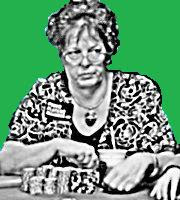
    Linda JohnsonKnown for some time now as “The First Lady of Poker,” Linda Johnson has been a player three decades, although her accomplishments are easily the most modest of the 2010 nominees.

    Johnson has earned around $320,000 in tourneys since her first cash in 1989. Johnson won one WSOP bracelet in 1997 in the $1,500 razz event. She has 10 cashes in the WSOP overall, including three in 2010.

    Johnson (aged 57) has nonetheless contributed significantly to the growth and well being of poker in other ways, most conspicuously as the publisher of CardPlayer magazine for eight years during the 1990s. She’s also a guiding force behind the Tournament Directors Association, and last year founded PokerGives.org, a site that helps poker players more easily donate to charities.

    Johnson holds a kind of “ambassador” position for poker not unlike that of 2009 inductee Mike Sexton, with many in the poker world especially appreciative of her many important contributions to the game’s welfare.

    Tom McEvoyTom McEvoy is best known for having won the 1983 WSOP Main Event after having won his entry into the $10,000 tournament via a satellite, the first such player to do so. Incidentally, the idea for satellites is often credited to Eric Drache, another player/contributor to poker whom some believe belongs in the Poker Hall of Fame.

    McEvoy (aged 65) won four WSOP bracelets altogether (the last in 1992), and by my count made 19 WSOP final tables (the last in 2002). He’s earned more than $2.9 million since his first cash back in 1982. He also won that “WSOP Champions Invitational” in 2009, besting a field of 20 former WSOP ME champs.

    McEvoy is additionally known for his successful efforts to eliminate smoking in poker rooms as well as for having authored or co-authored a number of poker strategy books (including several with Poker Hall of Famer T.J. Cloutier).

    Daniel NegreanuLike Ivey, 36-year-old Daniel Negreanu strikes most as being on the young side when it comes to discussions about the Poker Hall of Fame. Yet his accomplishments during what is also essentially a 15-year career are similarly impressive, and compare well to those who have played much longer.

    Negreanu has won four WSOP bracelets (1998, 2003, 2004, and 2008) and two WPT titles (both in 2004). He’s racked up more than $12.5 million in career tourney earnings since his first recorded cash in 1997, and was sitting atop the all-time leaderboard until Ivey recently passed him.

    Like Greenstein, Harrington, and McEvoy, Negreanu is a poker author, having published numerous columns and three books of strategy (two of which are compilations of his columns).

    Negreanu is also a ubiquitous figure on television, having appeared on all of the most popular poker shows and even having had a show (“PokerStars Million Dollar Challenge”) built around him. Additional cameo spots in the occasional film (X-Men Origins: Wolverine), music video (Katy Perry’s “Waking Up in Vegas”), or commercial (Pepsi) have helped increase the profile of “Kid Poker” for non-poker audiences as well.

    Scotty NguyenScotty Nguyen, a.k.a. the “Prince of Poker,” has earned over $11.5 million in tournament winnings over the last 20 years (fifth on the all-time list), highlighted by a victory in the 1998 WSOP Main Event.

    His line during the final hand of that tournament -- “You call, it’s gonna be all over baby!” -- delivered to his opponent Kevin McBride just before McBride did call (and it was all over), helped provide one of the most memorable moments in WSOP history.

    The 47-year-old has five WSOP bracelets altogether, plus a WPT title and eight WPT final tables. Nguyen’s most recent WSOP bracelet was won in 2008 in the $50,000 H.O.R.S.E. event or “Player’s Championship.” His boorish, drunken behavior at that final table, presented in detail on ESPN’s coverage, has been the subject of much discussion, with some believing it might have hurt his chances for making the Poker Hall of Fame.

    Nguyen nevertheless remains a huge fan favorite, something I witnessed again first-hand last summer when covering him in the latter stages of the 2010 WSOP Main Event (where he finished 209th).

    Erik SeidelErik Seidel began his poker career back at the famed Mayfair Club in New York in the 1980s, where Harrington also played. A much-respected player with a long career of consistent success, the 50-year-old has collected over $10 million in tourney winnings over the last 22 years.

    Seidel’s first tournament cash was perhaps his most famous. In what was reportedly the first major event he ever played, Seidel took runner-up in the 1988 WSOP Main Event to Poker Hall of Famer Johnny Chan, the final hand of which was immortalized in Rounders (1998).

    Seidel has since won eight WSOP bracelets (from 1992 to 2007), cashing 60 times at the Series. Among those 60 WSOP cashes are 33 final tables -- including a couple this past summer -- putting him in the top five for both lists (most cashes, most FTs). He also has a WPT title and this year took second in the NBC National Heads-Up Poker Championship.

    There they are. Okay, so you have 10 points you can give to three (at most) of these nominees. How you gonna distribute ’em?

    Labels: ,

    Thursday, September 02, 2010

    Top Nominees for 2010 Poker Hall of Fame Announced

    Who will be among the class of 2010 for the Poker Hall of Fame?The top ten nominations for the Poker Hall of Fame’s 2010 class have been announced. Still one more step before the final vote occurs, though.

    The Poker Hall of Fame Governing Council -- which I assume is comprised of various Harrah’s/WSOP folks -- will now determine which candidates are eligible to be voted upon for the Hall. That’s when the final vote will happen, probably within the next couple of weeks.

    The top ten most nominated are as follows (in alphabetical order):
    Chris Ferguson
    Barry Greenstein
    Jennifer Harman-Traniello
    Dan Harrington
    Phil Ivey
    Linda Johnson
    Tom McEvoy
    Daniel Negreanu
    Scotty Nguyen
    Erik Seidel
    Not too surprising to see the top ten closely resemble last year’s top ten. Seven of the 10 names are the same. There’s no Mike Sexton (of course), Men Nguyen, or Tom Dwan this time among the top 10. The three new names are Chris Ferguson, Linda Johnson, and Jennifer Harman-Traniello.

    I noted last week how there were apparently a lot more nominations this year than there were in 2009. When the top 10 most nominated were announced last year, we heard that a total of 41 had been nominated (among them Ferguson and Harman-Traniello, but not Johnson).

    In mid-August it was widely reported that 181 individuals had already been nominated for the class of 2010 with a couple of weeks still remaining for nominations to be cast. It turns out that number was a bit higher than the actual figure -- apparently in the end there were only 102 “valid unique names” submitted as nominees, with 44 of those receiving multiple nominations.

    Last year the Poker Hall of Fame Governing Council removed Tom Dwan’s name from the final ballot, citing the fact that he was still a few weeks away from his 23rd birthday as enough argument that he’d yet to have “stood the test of time” (one of the listed criteria for admission into the Hall of Fame). The final ballot contained nine names, then, from which Mike Sexton was the only one chosen to be inducted.

    Not really seeing any obvious reasons for the Poker Hall of Fame Governing Council to remove any of the top 10 from the ballot this time around. In fact, they may end up adding a name or two -- we’ll see. In any event, the 33 voters will have some difficult choices to make, I think, when trying to distinguish between the candidacies of these 10.

    There are 16 living members of the Poker Hall of Fame who get to vote, plus 17 more members of the poker media who will also cast ballots (including your very humble gumshoe). My understanding is we’ll be able to vote for as many folks as we wish this time, and in the end the top two vote-getters will get in, provided they are named on at least 50% of the ballots.

    I have some ideas about these 10, but will wait until the final ballot comes out before I consider this task in earnest. Meanwhile, what do you think of these 10? Any of them especially stand out as likely to be voted in this time around? (Or likely not to?)

    Labels: , ,

    Monday, August 23, 2010

    Thinking About the Poker Hall of Fame, Class of 2010

    Poker Hall of FameLast week we began hearing some news about this year’s Poker Hall of Fame. The nominating process is coming to a close, and voting for the 2010 class is coming up soon.

    I have to admit I am extra interested in how the vote goes this time around. Why? Because I was asked to participate as one of the panel of poker media who vote on the finalists. It was a great honor to be asked, and I plan to give the matter careful consideration when it comes time to cast my vote.

    For those who aren’t familiar with the process, I thought I’d post a little something about how it all goes.

    As was the case last year, anyone who wants to can submit nominations for the Poker Hall of Fame over at the WSOP website. The story getting passed around last week was that a total of 181 have been nominated thus far for consideration this year.

    My first reaction to hearing that figure was to think that’s a heckuva lot of nominees. Then I looked back to see what happened last year to compare.

    In 2009 -- the first year the WSOP opened up the nominating process in this way -- the polls were opened on May 26 (at the start of the Series) and closed on July 2 (at the start of the Main Event). During that period -- a little over five weeks -- the reports I read said there were ultimately 41 nominees.

    Those included the 10 who received the most nominations: Tom Dwan, Barry Greenstein, Dan Harrington, Phil Ivey, Tom McEvoy, Men Nguyen, Scotty Nguyen, Daniel Negreanu, Erik Seidel, and Mike Sexton. You’ll recall Sexton was the only one of those appearing on the ballot who was voted in. You might also recall that Dwan -- still a few weeks shy of his 23rd birthday at the time -- was removed from the ballot as he obviously had yet to have “stood the test of time,” one of the criteria for entry into the Poker Hall of Fame.

    Others nominated last year included Annie Duke, Chris Moneymaker, Patrik Antonius, and noted poker authors Mike Caro and David Sklansky. Norman Chad -- color commentator on the ESPN broadcasts of the WSOP -- apparently was nominated. So were people like Phil Hellmuth, Stu Ungar, and others already in the Poker Hall of Fame.

    This year the polls were opened on July 1 and run through the end of August. The extra time for nominating this year might be one reason we’re seeing a few more names. I suppose the fact that this is the second year of the process -- and the fact that we just had that voting for the Tournament of Champions, too -- might also help explain the increase in nominations.

    No idea how many of those 181 nominated so far this year are legitimate (or even eligible). Although really, when one thinks of the criteria and the fact that only 38 have been inducted since the Poker Hall of Fame was established back in 1979, it really doesn’t seem like there could be even two dozen “legitimate” nominees, let alone 181.

    Thinking About the Poker Hall of Fame, Class of 2010Those criteria again, by the way, are as follows: (1) a player must have played poker against acknowledged top competition; (2) played for high stakes; (3) played consistently well, gaining the respect of peers; (4) stood the test of time; or (5) for non-players, contributed to the overall growth and success of the game of poker, with indelible positive and lasting results.

    So there is still over a week to submit nominations, if one wishes to do so. On September 1 we’ll learn the names of the top 10 vote-getters, as well as who ultimately makes it onto the ballot. I believe last year the living Hall of Famers were also invited to submit names (“write-in candidates”) to be added to the consideration list for this year, so we could see an additional name or two on the ballot, I think, that wasn’t among the top vote-getters.

    At that point the currently living members of the Poker Hall of Fame (16 total now, I believe) and that panel of poker media will vote on the final list of nominees. It appears at that stage there will be a slight difference from last year in how the votes are tabulated.
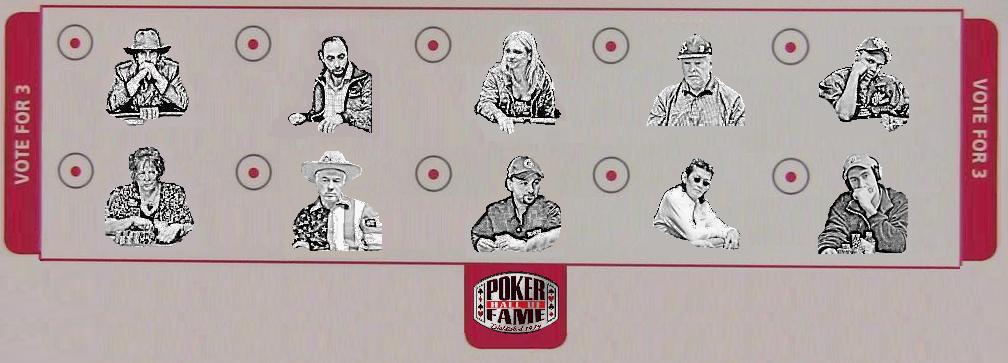
    Last year, the voters were limited to voting for three of the nine individuals on the ballot, and for a nominee to get in, he had to receive votes from at least 75% of those voting. I wrote a post last year about how that system appeared to guarantee that no more than one of the nine would get it, and perhaps could result in none of them getting the needed 75%.

    This year, it looks like those voting on the finalists aren’t necessarily being limited to voting for just three candidates -- we can vote for as many or as few as we wish -- and in the end the top two vote-getters will be inducted, provided both receive at least 50% of the vote. Probably a good change, I think, that all but ensures there will not be a situation in which no one gets in, while also making certain there won’t be too many inducted at once. (EDIT [added 9/10/10]: Now that I have received my ballot, I have learned that in fact we are only allowed to vote for three of the 10 nominees.)

    I assume we’ll see guys like Ivey, Negreanu, Seidel, and Harrington up for the vote again. The others from last year’s finalists’ ballot (Greenstein, McEvoy, Men Nguyen, and Scotty Nguyen) probably stand a good chance of getting back there, too.

    Once we see the final ballot, I’ll probably write a post next month asking who people are favoring among the finalists. But at this stage -- with the nominations still open -- let me go ahead and ask:

    Which players (or non-players) would you say are among those deserving to join that most exclusive group of Poker Hall of Famers?

    Labels: , ,


    Older Posts

    Copyright © 2006-2021 Hard-Boiled Poker.
    All Rights Reserved.