Monday, January 07, 2013

On Lindgren and “Rehab”

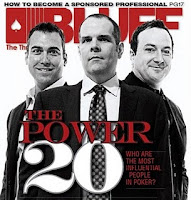
Over the weekend BLUFF magazine posted an interview with Erick Lindgren focusing primarily on the poker player’s significant sports-betting woes. Titled “Broken: The Erick Lindgren Story,” the article by BLUFF Editor in Chief Lance Bradley relates how Lindgren recently spent two weeks in a California rehab facility “trying to work through his addiction to gambling.”

The piece describes how Lindgren, once something of a favorite among poker-TV celebs thanks both to his amiable personality and talents at the table, has seen his reputation plummet of late following reports of his multi-million dollar gambling losses and comprehensive failure to cover debts.

Reference is made to last spring’s revelations regarding the extent of Lindgren’s losses/debts, which at the time were much greater than most realized. I wrote a post then titled “Hero Call” that discusses what was being said about Lindgren while also reflecting on how his story had become yet another example of a one-time popular figure in poker proving disappointing to some.

Clearly an action junkie who cannot help himself when it comes to sports betting, Lindgren speaks in the BLUFF article of having “the degenerate gene” and thus having had a goal of “removing” it via his stay at the rehab facility. The article explains how as a member of Team Full Tilt, Lindgren received payments “upward of $250,000 per month,” all of which (it seems) was squandered via betting on sports and participation in high-stakes fantasy leagues. And then some.

When the dividends stopped coming following Black Friday, Lindgren’s ability to make payments and/or hold off creditors lessened considerably. According to Lindgren, his gambling debts total about $3 million at present, although at one time he had been more than $10 million in the hole. He is also currently in the process of filing for bankruptcy.

The mention of “rehab” and the acknowledgment of having “degenerate” tendencies perhaps suggest that Lindgren is looking for a way to stop gambling entirely, much like an alcoholic might try once and for all to give up drinking. But that is not the case, as Lindgren describes himself at the end of the piece having “been staked in poker and some sports (betting) to try and raise some money.” As Bradley puts it earlier, “Lindgren wasn’t in rehab to cure him of gambling -- that’s his day job and he knows he needs to continue to play poker and work in Las Vegas if he has any hope of paying all his debts and beginning the process of repairing his name.”

It all sounds very odd and not at all encouraging. A cynical response would be to say that the primary goal of the two-week stay -- not to mention submitting to the interview -- was to rehabilitate Lindgren’s reputation, not really to try to help him directly address his gambling addiction (and thus, by improving his reputation, improve his shot at finding backers). But even a more generous reading of Lindgren’s words and situation has to be filled with trepidation thanks to the obvious disconnect between addressing one’s gambling problem by formulating plans to figure out how to continue gambling.

Thanks to Bradley’s balanced approach, the reader is allowed to form his or her own opinions regarding Lindgren and his plight. As Lindgren’s example well proves, the poker world tends to enable such “degen” behavior, allowing those who are self-destructive to continue down the same path as long as doing so doesn’t negatively affect others too greatly. And in some cases those who write and report on poker might be said to contribute even further to the process of enabling by romanticizing wild, reckless gambling without acknowledging the damage often done. But Bradley avoids that tendency in the article, mostly letting Lindgren speak for himself and thereby allowing readers to make their own judgments regarding the poker player’s future prospects.

While I’m as hopeful as anyone that Lindgren makes good, it seems to me that most who read “Broken” and respond rationally will probably come to a similar conclusion regarding Lindgren’s proposed method of recovery.

Not to bet on it.

Labels: , , ,

Friday, March 02, 2012

Power Trip

Checking the Twitter feedOn a retreat of sorts this weekend, having trucked to Florida with Vera Valmore for a short vacation. Kind of unplugging for a spell, too, if I can manage it. Hoping to recharge the mental battery a bit.

We’ve visited Florida a few times before, usually around this time of year, and have enjoyed ourselves in the past. There’s a dressage competition happening that Vera likes, and during our previous trips I’ve also been able to play some poker in what has become a booming poker state. Now my recently-retired Pop lives down here as well and so we’re staying with him this time.

All of which means I’m mostly off the grid for the next few days, although I did see that new “Power 20” list come trickling over the Twitter transom yesterday via the BLUFF magazine feed.

Last year BLUFF polled more than 100 folks to compile the list which was topped by Full Tilter Howard Lederer (#1) and PokerStars founder Isai Scheinberg (#2). Soon after came the Black Friday indictment and civil complaint, with Lederer having been added to the latter by the U.S. Department of Justice in September. As a result, Lederer has tumbled from this year’s list entirely, while Scheinberg has in fact grabbed the top spot -- just like he’s in the top spot on the DOJ indictment.

This year BLUFF “canvassed 51 poker industry insiders ranging from online operators, casino executives, media, players, agents and other influencers” to vote, asking them to “consider individuals whose influence on the industry and the game is mostly positive.”

That last caveat is kind of curious to consider, actually, with regard to a few of the names who made this year’s list. Indeed, in presenting the list the BLUFF staff can’t resist commenting on U.S. Attorney General Preet Bharara having surprisingly been voted into the fifth spot.

I’ve never been asked to vote for the BLUFF Power 20, although to be honest while I obviously follow the industry and have familiarity with a lot of what’s happening, I don’t feel all that qualified when it comes to judging where “power” in poker truly lies. Indeed, I don’t envy those among my colleagues who have been charged with what is really a difficult task.

It makes sense for such a list to include a preponderance of business execs and “movers and shakers.” And the presence of a few legislators -- and the one law enforcer, mentioned above -- is probably appropriate, too. Interesting, though, to consider there are only three poker players on the list: Daniel Negreanu (#9), Tony G (#11), and Annie Duke (#18).

BLUFF has been compiling Power 20s every year since 2005, and most years around a third of the spots have been occupied by poker pros. Looks like only three players were on the 2009 list, although that year BLUFF included a lot of “entities” like poker sites or “Professional Poker Players” (as a group) on the list. Are players (on the whole) less powerful today than in the past when it comes to having a “mostly positive” influence on the game?

Have a few more thoughts about some of the particular names included of this year’s list -- as well as those left off -- but like I say I’m gonna try to power down myself here, at least for the weekend.

Let’s see now... where’s the off button on this here iPhone?

Labels: ,

Friday, February 24, 2012

To Sum Up

Among the writing assignments I have today is one involving the novel I’m working on, the first draft of which I have completed.

There’s still a way to go on this sucker, with much revising to do as well as a few additional scenes to include. But I’ve written the first version of the last chapter, which is satisfying in its own right.

My assignment today is to write a 50-word synopsis of the book, a “pitch” such as I might include in a query letter soliciting an agent or in other contexts. Not an easy thing to do, although I think I have a good idea of how I’m going to say it. My first novel, Same Difference, was just over 100,000 words long. This one will be shorter, but getting it all down to two or three sentences remains a challenge.

I’m unsure at the moment how I plan to go about publishing this one. I may not even get to the stage of trying to get an agent -- I didn’t use one for the first novel -- and even if I do, I may or may not be trying to get one via the query letter route. But I think it’s still a good exercise to try to boil it all down to a quick, understandable synopsis. In fact, I can tell already it will be a useful exercise when it comes to the revising, having focused my thoughts a bit more sharply regarding what the novel is really about.

When it comes to writing well, summarizing is often an underrated skill. Just about every kind of writing requires a least some form of summary, and a lot of times it takes more creative muscle to grasp the “gist” of something that has already been written than to write something wholly new or original.

A lot of people reading this site probably frequent other poker-related sites where summaries of the day’s news are regularly posted. You know, like PokerNews’ “Nightly Turbo,” the “Daily Rewind” at PokerStrategy, BLUFF Magazine’s “The Week That Was” and the like. Michael Gentile’s “This Week in Poker Podcasts” for PokerFuse can be listed, too, as an another example of the form.

Barry Carter recently wrote about these “news in brief”-type articles amid that series of posts about poker media I was recommending a while back. Such articles may appear relatively simple to pull together, but often require a lot of effort to be done effectively, with some of the hardest decisions being of the editorial variety where one has to be judicious when selecting what to include and what to leave out.

Of course, summarizing your own stuff presents a different challenge, too, since even great writers often have occasional blind spots when it comes to reading and evaluating their own work. But like I say, it can be a useful -- even enlightening -- exercise for a writer.

Here... for practice I’ll try boiling down this 500-word post to 10:

While summarizing his novel, Shamus procrastinates by writing about summarizing.

Labels: , , , , ,

Friday, August 19, 2011

On the Global Poker Index (and Other Ways of Keeping Score)

On the Global Poker Index (and Other Ways of Keeping Score)In Big Deal: A Year as a Professional Poker Player (1990), Anthony Holden memorably noted how “poker may be a branch of psychological warfare, an art form or indeed a way of life -- but it is also merely a game, in which money is simply the means of keeping score.” Kind of a curious statement, really, at once assigning a high level of seriousness to poker while pointing out that it is also just an amusing diversion, a way to pass the time, a game.

Of course, it’s the latter part of the quote -- about the money -- that helps bridge the gap. Sure, poker is just a game. But it’s a game played for money. And the introduction of money explains how something that is “merely” play can also be “a way of life.”

Most would agree that money is indeed a “means of keeping score” in poker. During a given session, only those with more money than what they started with are called “winners,” and those with less are the “losers.” Simple, really.

However, when it comes to tracking winners and losers over periods lasting longer than a single session, it becomes difficult to use money as “the” means of keeping score. Since everyone’s results are only imperfectly known (at best) to others, there’s no way, really, to know who is winning the most or losing the most or to produce any other objective measurement by which to compare players.

Even if we’re restricting ourselves, say, to tournament poker and a comprehensive database like Hendon Mob, that, too, is obviously an imperfect way to keep score. Only winnings are listed there, not buy-ins, so there’s no way to know how much a given player laid out in order to accumulate whatever winnings he or she has listed as part of her entry. Thus do lists like the “All-Time Money List” on Hendon Mob more often start debates rather than settle them (as discussed here back in January).

Global Poker IndexAll of which brings up other means of keeping score, such as the interesting new “Global Poker Index” one finds over on the Epic Poker site. Based on a complicated formula (explained in full here), the GPI purports to rank the top 300 live tourney players in the world over the most recent 36-month period.

Using the Hendon Mob’s results as a resource, the GPI sorts through all players’ results over the last three years, picking out the top three finishes (in qualifying events) from each of the six distinct six-month periods (i.e., at most only 18 results are considered). Each of those results is weighed according to various factors, including buy-in, number of entrants, place finished, and recency or the “aging factor” (i.e., more recent results are given more weight than ones from the first part of the 36-month period). I’m summarizing here -- again, check the full explanation if you’re curious -- but basically what results is a fairly detailed bit of number-crunching of live tourney results to produce a necessarily provocative list of players.

Incidentally, while the GPI is provided by Federated Sports+Gaming and is highlighted on the Epic Poker site, qualification for the Epic Poker League is not connected to the GPI rankings. That is to say, a high GPI ranking is not part of the qualifying criteria for the EPL, although I believe the rankings will be used for seeding purposes for that heads-up tournament the EPL has planned for its third Season One event (in December).

This week's top 10 tourney players according to the GPI are as follows:

1. Jason Mercier
2. Erik Seidel
3. Bertrand Grospellier
4. Eugene Katchalov
5. Fabrice Soulier
6. Samuel Stein
7. Sorel Mizzi
8. Thomas Marchese
9. David "Bakes" Baker
10. John Juanda

While following different criteria -- and only looking at 2011 -- the BLUFF Magazine power rankings also currently have Jason Mercier sitting in the top spot. And in ESPN Poker’s latest installment of “The Nuts,” that monthly poll of 10 poker scribes who vote on poker’s best, Mercier was likewise named the #1 player as of late July. Meanwhile, Card Player’s latest list rates Mercier as fifth in its POY system, with Sam Stein currently out in front.

As someone who enjoys such number-crunching perhaps a little more than your average geek, I find all of these lists intriguing, particularly the new Global Poker Index and the way its formula might be applied to earlier eras. (For instance, see this recent column by Michael Craig discussing how Phil Hellmuth’s GPI ranking has gone up and down and back up again from 1989 to today.) Kind of makes me think of Bill James’ Baseball Abstract and “sabermetrics” and all of the fun stuff he’s done with baseball’s numerous numbers. (Talked some about James some time ago in a post titled -- fittingly -- “Keeping Score.”)

Hard not to be a tad skeptical about any means of keeping score in poker that isn’t unambiguously tied to players’ bottom lines. But as already noted, players’ bottom lines aren’t generally available for the public to peruse. And so such lists do provide us with an amusing diversion, a way to pass the time, a (different sort of) game.

Labels: , , , ,

Friday, February 25, 2011

Man Power: The BLUFF Power 20

BLUFF Magazine, March 2010Been looking over this year’s “BLUFF Power 20” that was released a few days ago. Always interesting to see who is being considered the 20 “most influential people in poker.”

Howard Lederer sits atop the list this year, his association with Full Tilt Poker the primary reason for his being handed the crown of “most influential.” The founder of PokerStars, Isai Scheinberg, is runner-up. And Ty Stewart, WSOP Executive Director and Caesars VP, is third. Click here for the full list as it appears over on the BLUFF site.

For more on the list, Dr. Pauly has offered some entertaining and insightful commentary on all 20 names. And F-Train posted recently about the list, too, noting suggestively how his ballot differed from the final one collectively created by the 101 voters. I say “suggestively” because F-Train, being the wise and judicious sort he is, doesn’t give up precise details of where he differed from the final vote.

I offered a few observations as well about the latest Power 20 over on Betfair today. This is the sixth year that BLUFF has published its Power 20 list, so I thought it would be interesting to take a look at how this year’s list compared the ones from 2006-2010.

By looking back at those earlier lists, I was able to confirm a hunch of F-Train’s, shared in a footnote to his post. “I’m not sure a woman has ever made the list,” F-Train suspects. Indeed, he’s correct -- if you look back at all of the Power 20s, not a single woman has ever been named among the top 20 most influential people in poker.

Was a little surprised not to see Annie Duke’s name pop up at least once on any of those previous lists. (F-Train says he had two women among his Power 20 for this year, and I think it is safe to assume Duke was one of them.) I suppose we’ll have to wait and see how this here “Federated Poker League” experiment goes in 2011, but if it proves even a marginal success in its first year, I imagine Duke would probably have to crack the Power 20 the next time it comes around, wouldn’t you think?

Do any other women spring to mind as possibly having deserved a spot among the Power 20 over the past six years? I can think of a couple, but like F-Train I think I’ll keep ’em to myself and instead give you a chance to ponder how you might answer the question.

1300Just noticed this is post #1,300. Perhaps another reason to cut it short. As I usually say whenever these milestones come up, that’s a damn lot of scribblin’!

Labels: , , , ,

Tuesday, February 01, 2011

The Test of Time

It’s a new month. Already. Another chance to think about what has been accomplished, and what goals remain as we move forward.

Such a busy month was January. Tourneys being played all over the world, every day it seemed. Plus lots of other poker-related distractions to occupy us all.

One item from last month I missed mentioning here was that votes for this year’s Bluff Magazine Reader’s Choice Awards were finally tallied and the winners announced. In the “Favorite Poker Blog” category, our buds over at Wicked Chops claimed their second straight award. Big congrats to the Entities!

I managed to land some votes in the sucker as well, and wanted here to thank everyone who voted for me. Also, thanks a ton to those who’ve sent along nice comments to me regarding getting nominated.

Hard, really, to compare blogs. All are so different. Even just the four that were included in the category are mostly unlike one another in method and approach, really.

As much as I like Pokerati and Wicked Chops, I tend to think of Tao of Poker as providing kind of the “template” for what I imagine a poker blog to be -- a mix of personal anecdote and more general reportage, delivered in a particular style that well communicates the blogger’s personality.

But there are many, many other ways of going about it, obviously, and so “ranking” blogs is about as difficult a task as comparing the relative abilities of poker players (a topic that has been getting a lot of attention here lately). And maybe as futile, too, although I suppose such an exercise affords a certain amount of fun and even usefulness insofar as it gets us thinking about what qualities make a blog (or player) especially good.

Have been pondering a bit lately about the relative value of some of the writing -- both poker-related and otherwise -- I’ve been doing (e.g., blog posts, articles, tourney reporting, and the new novel I keep adding to when I get a chance). Some of it I certainly value and am reasonably proud of. Other stuff tends to vanish more quickly, not necessarily leaving much of an impression on yr humble scribbler.

Some of the latter was written more for money than for other reasons, although financial gain usually does not dictate exactly how I’m personally going to value something I’ve written. As is the case with playing poker (for many), there are a lot of reasons to write -- and benefits to be had from writing -- that don’t have anything to do with making money.

'Fast Company' (1975) by Jon BradshawHad an exchange not long ago with someone who had read my post about Jon Bradshaw’s excellent 1975 collection of essays, Fast Company, and then went and picked up the book for himself. He thanked me for drawing his attention to Bradshaw’s book, which contains some of the best poker writing you’re going to find.

I told him I was glad he enjoyed the book, adding that I hoped one day I’d be able to write something as meaningful and lasting about poker.

Or about anything, really (now that I think about it). A goal worth pursuing, I believe.

Labels: , , , , , ,

Thursday, December 02, 2010

Nominated! Bluff Reader’s Choice Awards (Favorite Poker Blog)

Bluff MagazineTraveling can be great fun, no doubt. Of course, one of the greatest things about traveling is coming home.

Got a good night’s sleep, although I did wake up a few times with fleeting thoughts of posting hands, searching for wi-fi connectivity, and racing to make flight connections. One time when I woke, I actually thought I was slumped in an airplane seat, and when I realized where I was -- in my own bed -- I was overjoyed to realize I’d been mistaken.

Will be spending the day finishing unpacking and getting further reoriented. A lot of catching up to do, and so haven’t too much time today to write.

I did, however, want to share some nifty news -- Hard-Boiled Poker has been nominated as a “favorite poker blog” as part of Bluff Magazine’s recently announced, sixth annual “Reader’s Choice Awards.” No shinola! (Unless, of course, this is yet another dream, which is possible.)

Am reasonably certain that anyone reading this blog probably also keeps up with and digs (like me) the other nominees -- Wicked Chops Poker, Pokerati, and Tao of Poker. Am pretty sure those guys have all been nominated before, and I know WCP won the sucker last year. (Can’t recall if Pauly or Dan’s blogs have won before.)

Here’s the article from today listing the nominees. It looks like voting opens on December 6th, at which time I’ll probably put a link up somewhere on here.

Big thanks to Bluff for the nod. And I promise, regular posting to resume tomorrow.

I mean, I gotta kick-start the campaign, right?

Labels: , , , ,

Thursday, February 11, 2010

Who Has the Power?

Who Has the Power?Saw that “Power 20” list put out by Bluff Magazine recently, a list of “the most influential and powerful people in the poker industry” here at the start of 2010.

The magazine has compiled similar lists in the past, polling media types and other industry insiders to create it, and has usually included not just individuals but companies or organizations, too. The idea for such a list likely comes from other, similar catalogues of important, influential types from various industries. That annual “Forbes 500” springs to mind -- a list of the 500 top U.S. companies that identified the “largest” companies by looking at various factors, including sales, profits, assets, market value, and number of employees. They turned that into the “Fortune Global 2000” a few years ago, following a similar rubric to compare companies around the world.

The Bluff list of powerful poker people doesn’t come accompanied with a particular set of criteria other than to say these are the “movers and shakers” of the poker world, which I take to mean folks whose actions necessarily get noticed and have some substantial effect on everyone else involved in poker, such as players or others whose livelihood is shaped by poker in some fashion (e.g., casino employees, media, etc.).

Of the 20 spots, nine are occupied by professional players, most of whom have numerous ties within the industry that help extend their influence: Howard Lederer (#4), Doyle Brunson (#6), Joe Cada (#7), Tony G (#9), Daniel Negreanu (#10), Phil Ivey (#11), Mike Sexton (#13), Joe Sebok (#17), and Barry Shulman (#18).

The rest of the list is comprised of two folks who represent important poker industry entities, Mitch Garber (Harrah’s) at #3 and Ty Stewart (the WSOP) at #5, two agents (Brian Balsbaugh [#15] and Per Hagen [#20]), the Executive Director of the Poker Players Alliance (John Pappas [#12]), a tournament director (Matt Savage [#19]), a television producer (Mori Eskandani [#14]), a lawmaker (Barney Frank [#8]), and Bluff’s editor, (Lance Bradley [#16]).

I didn’t really want to get into the merits of the list itself, which certainly names a lot of important people but -- as always happens with such things -- seems to omit some obvious ones, too (e.g., no Annie Duke?). For more discussion of who got picked and who got left out, see Wicked Chops’ post on the list as well as the one over on Pokerati. (The latter includes a number of interesting and insightful comments as well.) They also talked about the list some on last week’s episode of The Poker Beat.

I did, however, want to say a word about the top of the list, where one finds not individuals but two online poker sites, Full Tilt Poker (#2) and PokerStars (#1). Their listing is preceded by a disclaimer that “Given the murky legality involved in owning an online poker site, the top two names... both asked to have their names removed from the list” and Bluff did so.

While not entirely surprising, I nevertheless find this to be the most intriguing aspect of the entire list -- the fact that the most important two individuals in poker as voted upon by more than 100 industry folks and members of the poker media are uncertain about being identified at all, never mind being highlighted as especially powerful within poker. Says a couple of important things about the industry as a whole, I think.

For one, the list seems a pretty strong argument for the centrality of the online game and the influence of online poker over just about all other aspects of the industry. Many, many jobs within poker are tied directly to the health of online poker, and in particular to the continued growth and success of a couple of two “U.S.-facing” sites. We knew that already, but the list certainly clarifies that to be the case.

Secondly, the fact that those who own those two sites shun this sort of publicity says something about the highly uncertain status of the online game at this moment in time, most particularly in the U.S.

ForbesRegarding that subject -- and speaking of Forbes -- an article appeared on the business magazine’s website today with a headline asking “Are the Feds Cracking Down on Online Poker?

The article notes how PokerStars and Full Tilt Poker together “account for maybe 70% of the $1.4 billion in revenue the U.S. [online poker] industry brought in last year.” Speaking to the issue of the legality of operating an online poker site that serves U.S. customers, the article reports that “PokerStars, situated on the Isle of Man, claims it has legal opinions from five U.S. law firms saying it is not violating any laws.” Forbes tried also to talk to Full Tilt, though their representatives “did not respond to requests for comment,” likely because Full Tilt “has deep roots in the U.S. and close connections to famous American poker players who can be found in Las Vegas regularly.”

The article goes on to summarize recent history, including the passage of the Unlawful Internet Gambling Enforcement Act of 2006 and its aftermath, PartyGaming founder Anurag Dikshit’s guilty plea to violating the Wire Act back in 2008, and the seizing of $34 million by federal prosecutors in 2009 from companies processing payments for Stars and Full Tilt. It also mentions Barney Frank’s current efforts to get online gambling licensed and regulated in the U.S., as well as that June 1, 2010 deadline for banks to start implementing the UIGEA.

Thus are we in a world where “Online poker operates in the law's shadows.” And since the entire poker industry is so enormously affected by the status of the online game in the U.S., anyone appearing in poker’s “Power 20” today may well be more vulnerable than their listing might suggest.

In other words, they have the “power” right now, but everyone continues to worry and wonder -- could others come in and pull the plug?

Labels: , , , , ,

Friday, December 11, 2009

The Written Word Remains

World Poker Blogger TourNot much time to write today, I am afraid. Of course, that makes me like most of the poker bloggers, actually.

Many of them have a better excuse, though, being in Las Vegas this weekend as they are for for the winter gathering of the World Poker Blogger Tour. Also known as the WPBT. Or the #wpbt.

Unlike my buds, I’m sadly mired under a heap of “real life” applesauce and will be for the next week at least, meaning I couldn’t make it out west to join in the revelry.

Speaking of poker blogs, the nominations for the 2009 Bluff Magazine Readers Choice Awards were announced earlier this week, and three of our faves -- Tao of Poker, Pokerati, and Wicked Chops -- were included on the “Top Poker Blog of 2009” list. The other nominee -- Poker News Daily -- is a site I frequent often as well, although I’m not sure it is correct to describe it as a blog.

There are 13 categories in all, some (best poker TV show, best poker podcast, best LV poker room) more interesting than others (favorite poker villain, favorite poker personality). You can find the full list of nominees and how to vote over at the Bluff site by clicking here.

Betfair blogDespite being a bit overwhelmed with work stuff, I did manage to find time to write a Betfair piece which went up this morning.

This one concerns an article by the journalist and best-selling author Malcolm Gladwell called “Open Secrets” that appears in his new collection of essays titled What the Dog Saw and Other Adventures. In the article Gladwell explains a distinction between “puzzles” and “mysteries” that I thought applied quite readily to poker. Kind of a “shots in the dark”-type post, I’d call it. Check it out.

Okay, time to get to work. Safe travels and good times, all you WPBTers! And be sure to write all about it. ’Cause, you know, cards get returned to the dealer, chips get cashed in, and limes get tossed away, but littera scripta manet.

Labels: , , ,

Friday, May 22, 2009

On ESPN’s Coverage of the WSOP, Continued

ESPN360.comFollowing up on yesterday’s post regarding ESPN’s coverage of the World Series of Poker comes the good news. Yesterday came the announcement that 24 of the preliminary events will be streamed live on either ESPN360 or Bluff.

Of the 24 events on the schedule, 19 are hold’em (one limit, three pot-limit, 14 no-limit, and one mixed limit/no-limit). Three more are pot-limit Omaha events, and one is the $2,500 buy-in PLO/PLH mixed event. I recall there was a similar principle of selection followed last year for the televised final tables, with stud and draw games being excluded entirely.

It’s understandable, for instance, why they wouldn’t want to show a draw event where no cards are seen until the showdown (if then), although I remember saying on the blog last summer how cool it would be to have, say, a Daniel Negreanu or Mike Caro or Billy Baxter or some other old schooler do some commentary for such an event.

Actually, now that I look back I’m recalling a small furor that arose after the final table of the $5,000 Deuce-to-Seven Single Draw w/rebuys event went down without being streamed live. The reason why people were griping was because the final table for that one included Jeff Lisandro, Mike Matusow, Tom Schneider, Erick Lindgren, Barry Greenstein, Tony G, and David Benyamine.

The WSOP put out a press release shortly after that, explaining how “draw poker of any kind is a difficult sell for both viewers and spectators.” So none of that is going to go out on the intertubes, nor will there be any stud events. There will, however, be coverage of the $50,000 H.O.R.S.E., the lone televised event to feature games without flops. So there will be some pictures to go along with PokerNews’ live blog.

ESPN360.com provides free access to their live streaming coverage of sporting events if you happen to be accessing the web via one of ESPN360’s affiliated internet service providers. Here on my home computer, I apparently do not. As I recall, the word was last summer a lot of other folks didn’t have access to ESPN360, either. Which is a damn shame.

Twelve of the 24 events that will be streamed live are scheduled for ESPN360 (including the $50K H.O.R.S.E.). The other dozen will be shown over on the Bluff site. I’m not certain, but I think this means the rest of the world may get to see these final tables no matter what affiliations yr ISP’s do or do not have. (Kevmath, do you know?)

By the way, these live streams don’t use hole card cameras, of course, but do show every hand, just as those of us sitting tableside will be seeing.

Meanwhile, tomorrow is the second of the two events scheduled for PokerListings’ Run Good Challenge 3: WSOP Edition. The event kicks off over at PokerStars at 2 p.m. Eastern. There were 25 runners out for last Saturday’s event, so I’m assuming there will something in that neighborhood again this time. The top two finishers win spots in $1,500 WSOP preliminary events.

Unfortunately, there will be no live streaming of the final RGC 3 event anywhere. However, I do have an exclusive preview of the event. Click below to watch. Speaking of running good, it is my plan to run exactly like Bugs Bunny does in the latter part of this, one of the best poker/gambling films ever made:

Labels: , , , ,

Friday, February 13, 2009

The (Unexpected) Return of the Prodigal Son

'The Return of the Prodigal Son' (1668) by Rembrandt Harmenszoon van RijnSo I’m listening to yesterday’s episode of The Poker Beat (2/12/09), that new podcast over on PokerRoad hosted by Scott Huff in which he has on various poker media types to discuss news of the day. After a discussion of that Russ Hamilton video and its possible significance, Bluff Magazine Editor-in-Chief Matthew Parvis came on to talk about this new “Bluff Magazine Online Poker Challenge” announced earlier this month.

The Challenge sounds interesting enough. It looks like a great chance for the sponsoring site, Lock Poker, to get some publicity, although in the interview Parvis says it was his “brainchild.” As one can read about over on Bluff, the “competition will bring together some of the best online poker players and each will be given an opportunity to build a bankroll playing multi-table tournaments and sit-n-gos exclusively on Lock Poker.”

As Parvis explained on the show, “we are basically depositing $200 into a Lock Poker account” for each player invited to play in the Challenge. The accounts are apparently “locked” (pun intended?) so no other deposits or transfers can be made with them, and as the Challenge proceeds they will be audited each night “because we don’t want any scandal to be associated with the Challenge itself” (explained Parvis). The players will have 30 days to try to build their rolls, and the one who manages to earn the most will make the cover of an upcoming issue of Bluff. I believe all of this will happen in March.

“We were lucky enough to get some really quality guys,” noted Parvis on the show. He mentioned several, including the magazine’s 2008 online poker player of the year David “The Maven” Chicotsky, Adam Junglen, Matt Vingren, Eric “Rizen” Lynch, Søren Kongsgaard, “Bodog” Ari Engel, and Jeff “Yellowsub” Williams. “A really, really good line-up of quality guys,” said Parvis, adding that he was only listing some of the 20 players who had been invited.

The article over on Bluff mentions some of the others who have been invited, including Garrett “GBecks” Beckman, Phil “USCphildo” Collins, Brett “Bhanks11” Hanks, and Maria Ho. Sorel Mizzi is also listed, he of the “account selling” incident from December 2007 that caused him to be banned from Full Tilt Poker.

Parvis talked a bit about Mizzi on the show. He also talked more than a bit about one other controversial name appearing over there on the list of invitees: Josh “JJprodigy” Field. No shinola.

You remember Field, don’t you? First banned from PartyPoker back in February 2006 (when he was just 16) after he won their $500,000 Sunday Tournament in which he was playing under two screen names (JJProdigy and Ablackcar). He was then caught cheating at other sites, as well, from which he was also banned. PokerStars even banned him from playing in their PokerStars Caribbean Adventure once he turned 18.

It was right around the time he turned 18 that Field issued some “apologies” (of a sort) on forums and in interviews. I transcribed a bit of the PokerRoad interview (the 1/14/08 episode) in a post titled “Uncorrected Personality Traits That Seem Whimsical in a Child May Prove to Be Ugly in a Fully Grown Adult.”* Among other questions, Field was asked in the PokerRoad interview whether or not he was then “playing on the sites you’re banned from and you have no plans to play on [those] sites.”

“At this moment in time, yeah,” answered Field. “I can’t tell you in a month I’ll be thinking the same, because it’ll be really hard not playing all those sites. But right now, yeah.”

On The Poker Beat, Parvis said he’d spoken with Field at the recent Aussie Millions and afterwards felt he was worth inviting to participate in the Challenge, even though Parvis admitted Field had made some “serious, serious mistakes in his life in terms of the poker world and cheating, and multi-accounting, and ghosting, and selling accounts... whatever the scandals may be.” “That’s a hell of a laundry list,” joked Huff in response.

Well, now it appears Field will not be able to play in the Challenge after all. Parvis told Huff he received an email on Wednesday which reported “there was some situation” over on Cake Poker (for which Lock Poker is a skin, I believe) with an “account hand-off” involving Field. “Whatever the case is, it appears that JJ has been involved in another sticky situation here,” said Parvis, and so will not be allowed to play in the Challenge.

To Parvis’ credit, he expressed humility to Huff about having been fooled into thinking Field had indeed changed his cheating ways. Still, one has to wonder about the initial decision to invite the notorious JJProdigy to participate in such a Challenge. They don’t want “any scandal to be associated with the Challenge itself,” but then Bluff invites the most notorious, scandal-ridden player in online poker to participate?

As I was listening, I was amazed Field could even resurface in this way as part of any story -- much less one involving selecting top online pros to participate in a freeroll like this. As Seth Meyers would say over on Saturday Night Live Weekend Update, “Really?!?”

Yet another head-scratching moment from the ethically-ambiguous world of online poker.

'I Often Dream of Trains' by Robyn Hitchcock*By the way, that earlier post title came from Robyn Hitchcock’s twisted a cappella number “Uncorrected Personality Traits” that appears on one of my all-time favorite discs, Hitchcock’s 1984 masterpiece I Often Dream of Trains. And speaking of masterpieces, that’s “The Return of the Prodigal Son” by the Dutch master, Rembrandt Harmenszoon van Rijn, pictured above.

Labels: , , , , , , ,

Wednesday, January 07, 2009

On Player of the Year Awards

On Player of the Year AwardsSome of you may have heard or read about how John “the Razor” Phan was named Card Player’s “Player of the Year” for 2008. Phan also finished atop the 2008 POY list over at Bluff Magazine, thanks to his having earned over $2 million in prize money this year.

In addition to making several final tables, Phan won a couple of bracelets at the WSOP in 2008. I had the chance to cover the final table for one of them, Event No. 40, the $2,500 Deuce-to-Seven Triple Draw event. I wrote a couple of posts here about that final table.

One was back in late June, just after it took place. In that one, “2008 WSOP, Day 27: Cheers,” I wrote a bit about Phan’s ordering 10 cups of Corona once they had gotten down to three-handed. The other post, “Thriving vs. Surviving: John Phan & David Sklansky at the 2008 WSOP, Event No. 40 Final Table,” was written back in August after I’d returned, and there I contrast Phan’s aggressive style at that final table to the decidedly more conservative one employed by Sklansky (who’d finish sixth). Check ’em out, especially if you happen to be a Phan fan.

A few weeks ago I listened to Scott Huff talk about player of the year awards on Big Poker Sundays (the 12/18/08 episode). There Huff talked some about Phan and how his manner at the tables -- lots of deliberation, lots of confrontational table talk -- rubs some players the wrong way. Huff was more interested, though, in discussing POY awards and their value, generally speaking.

Huff suggested Card Player was the “gold standard” when it comes to player of the year awards, since “they have the most . . . scientific system for figuring this out,” although he admits “it is still flawed.” I’m not sure how “scientific” it is, but Card Player does certainly employ a fairly complicated rubric to assign points for its player of the year. And it is probably safe to say CP’s POY award is probably the one of which the majority of poker players and fans are most aware.

For last year’s award, Card Player only counted single events with at least $250,000 in the prize pool, or events that were played as part of series in which the overall prize pool for the entire series was $750,000. At least 60 entrants had to be playing in a given event for it to be counted, and the buy-in had to be at least $300.

That meant all of the big ones were in there -- the WSOP, the WSOPE, the EPT, the APPT, the Aussie Millions, and so forth. There were also many smaller events included, too, although when it comes to assigning points CP gives more for higher buy-in events and for events with more players. There was also even a provision in there to include online events in which the prize pool exceeded $5 million. Off the top of my head, I know the Main Event of PokerStars’ World Championship of Online Poker (played in September) had a prize pool of over $10 million, so it must have been included. There may have been one or two other online tourneys with big enough prize pools in there somewhere as well.

If you’re curious, you can sort through the entire Card Player 2008 Scoring Criteria by clicking here.

The system over at Bluff is similar insofar as players get points according to three main criteria: their finish, the amount of the buy-in, and the number of entrants. However, unlike Card Player, Bluff limits the number of tournaments it considers to just the big series: WSOP, WSOPE, WSOP Circuit events, WPT, Wynn Classic Tournaments, EPT, APPT, Aussie Millions, and the Monte Carlo Millions. Here’s the Bluff system, if yr interested.

I should add that both magazines include non-hold’em events in their rankings, too. That meant Phan’s Deuce-to-Seven Triple Draw bracelet win did help him, although the majority of his cashes and deep runs came in NLHE tourneys.

Big Poker SundaysGetting back to Huff’s commentary, the Big Poker Sundays host went on to make a couple of other, broader observations about POY awards. I thought both points were fairly provocative, and since I am curious to know what others think about them, I thought I would share Huff’s points here.

The first observation has to do with the “flawed” system currently used to determine POY. In response, Huff suggests an alternative method. “I would like to see it polled much like college football (minus the BCS),” says Huff. “I would like to see a poll of the people that are working in poker as journalists who follow and cover the tournament circuit. You know, people like B.J. Nemeth. People like Gary Wise . . . . Even people like Dr. Pauly. People who are around this all of the time, voting on who they think is deserving of the player of the year. And then also have the players vote on their peers.”

Huff goes on to say he doesn’t know how such a system would be weighted, but he thinks this polling method for determining the best player of the year would be preferable to the “scientific” method of assigning points currently used.

Such a poll would be quite interesting, I think. However, as much as I respect folks like Nemeth, Wise, and the good doctor, I think even they would tell you their own votes for player of the year would be of limited value. I know for a fact that Nemeth has spent a lot of time thinking about different ways of determining POY -- in fact, last summer he shared some of his thoughts on this very subject with me. While I won’t go into any of the details of Nemeth’s ideas here (which are terrific, by the way), I will say none of them give any weight at all to his own opinion or “vote” on who the player of the year should be.

Dunno about Wise or Dr. Pauly, but I would guess they, too, would be suitably humble about their own abilities to say who is the best player they’ve covered this year.

Huff’s other observation was to point out the relative value of POY awards. He thinks they are important, and thus improving the system for determining player of the year “would give even more legitimacy to an award that I think is necessary when we’re trying to still promote poker as a sport, and trying to get people to watch it.”

Huff is on to something here, I think. He maintains “the more statistics that we have, the more accessible those statistics are, the more sense that they make, and also being able to tell people out there in the general public who are watching poker as entertainment, to be able to tell them this person is definitively the ‘best player in the world for this year’ as far as tournaments are concerned, is an important thing.” Huff acknowledges that some would disagree with his view, but believes that “as a fan of poker” such awards do, in his opinion, serve an important purpose.

He’s probably right that POY awards do have the ability to excite the interest of casual poker fans -- i.e., those who watch poker on television much as they would any other sport, and are therefore interested in following certain players and learning how they rate against one another.

Even so, I don’t think a poll of journalists and/or players is going to be the way to make such an award more “legitimate” or give it a more prominent status than the relatively modest one it currently enjoys, even among the most ardent poker fans.

Labels: , , , , ,

Tuesday, September 16, 2008

What is Your Conceptual Continuity? (The Crux of the Biscuit is the Apostrophe)

Ended another six-day run of WCOOP live blogging yesterday. Day off today, then back to the grind tomorrow. Combined with my other “life” (which includes continuing to show up dutifully for my “real” job), Shamus is sapped.

'Infinite Jest' by David Foster Wallace (1996)Otherwise, I’d have lots on which to opine. I’d probably try (not necessarily successfully) to write something meaningful about the suicide last Friday of David Foster Wallace, author of The Broom of the System (1987), Infinite Jest (1996), and many other narrative delights.

Instead I’ll just send you over to Spaceman and the Poker Grump for their thoughts about Wallace’s untimely passing here in (what I think adds up to be) the Year of the Depend Adult Undergarment.

And if the mental tank wasn’t so close to empty I’d also perhaps say something about what is happening this afternoon over in the House of Representatives, specifically the meeting of the House Financial Services Committee in which among other items on the agenda the committee will be “marking up” yet another newly-proposed bill from their chair, Rep. Barney Frank (D-MA) designed to counter the damage wrought by the Unlawful Internet Gambling Enforcement Act of 2006.

Barney FrankThis bill, titled the “Payment System Protection Act” (H.R. 6870), appears another attempt to pull off what Frank and Rep. Ron Paul (R-TX) had previously undertaken back in April with H.R. 5767. That bill was a very straightforward, very brief bill designed to prohibit the feds from finalizing any UIGEA regulations. It died in committee, though, toward the end of June.

The new bill is also quite brief and to the point, and is also designed to stop the feds from moving forward with the UIGEA. This time the tactic is slightly different, though, insofar as the bill doesn’t expressly prohibit the UIGEA regs from being finalized and implemented, but is asking the feds “To ensure that implementation of proposed regulations... does not cause harm to the payments system.”

Not quite sure how one exactly makes a law out of a directive like that, really, but like I said, I’m tired. Perhaps after the markup session (in which amendments to the bill may or may not be proposed and voted on) I’ll have the energy to talk more about this one.

Bluff MagazineFinally -- again, if I weren’t so bushed -- I might say something about the 2008 Bluff Magazine Reader’s Choice Awards (sic) currently ongoing, specifically regarding some of the selections they’ve listed (and not listed) for certain categories. Again, though, maybe I’ll just save that for later and for now just wonder why they would place the apostrophe there. What, they got only one reader? (To be fair, they get it correct elsewhere on the site.)

Talk about a lack of conceptual continuity. From suicide to punctuation. Plus yr odd Frank Zappa allusion, destined to baffle most, I’d guess. Ah, Wallace wouldn’t have minded, I don’t think...

Alas, poor Yorick! I knew him, Horatio: a fellow of infinite jest, of most excellent fancy...

Labels: , , , , ,

Wednesday, August 09, 2006

Final Tables: Not for the Faint of Heart

World Series of PokerI’m sorry CardPlayer doesn’t appear to be planning a live audio play-by-play of the final table of the WSOP Main Event (as they did last year). I assume the ESPN pay-per-view telecast means there will be no such webcast this time around. I suppose Bluff Magazine is doing something along these lines on Sirius radio, but I’m not a Sirius subscriber so I don’t know much about that.

I was listening back to some of last year’s coverage again this week and remembered how entertaining -- even riveting -- it was to hear the first time around. Click here to listen to an .mp3 clip of Phil Hellmuth and Daniel Negreanu describing the second hand of the final table, that insane one in which Mike Matusow’s KcKh ran into Scott Lazar’s AhAd. (The third voice you hear chiming in is that of Greg Raymer.) The file is about 3.5 MB. This is still a blast, even a year later.

I mentioned in my previous post how those at the final table at last year’s WSOP Main Event all came from the upper half of the final 27 -- all nine who made it were among the top 13 with three tables remaining. All but one of those who survived to make this year’s final table were also among the top 13 with 27 to go. Here are the chip counts for the final table (scheduled to begin at 2 p.m. Pacific time tomorrow):

2006 WSOP Main Event Chip Counts, Start of Final Table


Among these only Paul Wasicka was significantly short-stacked with 27 to go. Wasicka had a terrific day on Tuesday, starting with a mere 700,000 chips (in 24th place) and ending with nearly 8 million (5th out of 9). About a half hour into the day’s play on Tuesday, Wasicka caught a pair of queens and doubled up. He then laid low for the next three hours or so and was down to about 860,000 when he again found himself all in, this time with kings. They held up, and Wasicka was up to 1.7 million. An hour later he was dealt kings again and after watching four other players limp he put his nearly 2 million in the pot and was only called by the one who had jacks. The cowboys held up again, and Wasicka was back to playing poker with a nice stack of 4 million chips.

The most dramatic fall on Tuesday was experienced by David Einhorn who started the day in 3rd place but busted out before the dinner break in 18th. Einhorn’s story ends well, however. Before play began on Tuesday, the hedge fund manager from California had announced he would be donating all of his winnings to charity -- the Michael J. Fox Foundation which is dedicated to discovering a cure for Parkinson’s disease. Einhorn, whose grandfather had Parkinson’s, won just over $659,000 for finishing 18th, a significantly-sized contribution to the foundation’s efforts. Pretty cool stuff.

I believe the blinds will still be 80,000/160,000 with a 20,000 ante when they start back up tomorrow. This means there will be a bit of room for some play when they begin, and that even the short stacks won’t necessarily have to push right away. It will be interesting to see whether Gold and/or Cunningham allow anyone stay comfortable, however. You gotta believe Gold in particular will be applying serious pressure from the get-go.

The payout structure should have some kind of an effect, as well. From 9th to 3rd, moving up a spot means another $400,000-$500,000 with each step. For most of these guys, that's a hell of a lot of scratch, particularly when you consider Cunningham is the only one at the table whose lifetime earnings exceeds a quarter million. (Cunningham has earned over $4 million; Wasicka, about $237,000; Gold and Binger about $100K each; the others, next-to-nothing or nothing.) The difference between 3rd and 2nd is almost $2 million, though, and the difference between 1st and 2nd is nearly $6 million. So it could be some players will think “top 2 or bust” and thus get wild right away, while others may well put their heads inside their shells and hope to wait out a spot or two or three before getting blinded off.

Whatever happens, it’ll surely be relived, replayed, and reviewed endlessly until next year’s WSOP. There’s a kind of permanence about final table play that may also have its effect tomorrow. The fact that the “world” (or some of it) will literally be watching this time certainly won’t lessen the pressure. As Negreanu says at the end of the clip, “if you have heart problems, the World Series of Poker is not for you.”

Image: WSOP logo.

Labels: , , , , , , , , , ,


Older Posts

Copyright © 2006-2021 Hard-Boiled Poker.
All Rights Reserved.