Friday, July 31, 2015

Ten Thousand Tweets

Was noticing over the last several weeks that the total for the number of tweets I’ve sent from @hardboiledpoker was approaching 10,000. Today I got there, with the tweet I sent to announce this post being the one.

It actually has taken me a while finally to reach that milestone after first noticing I was getting close. It took me a little over a month to get from 9,900 to 10,000 tweets. I first opened my Twitter account on April 9, 2009. That was 2,304 days ago which means I’ve been averaging sending out a little over four tweets per day over the last six years-plus.

Went back today to find my first tweet, pictured above. You can see before I even get to the end of that one how I’m distracted by the medium itself, self-reflexively counting down the characters at the end.

Seeing my reference to an article about Twitter by Otis (Brad Willis), I was curious to track it down once more. I headed over to Rapid Eye Reality, the blog Brad started way, way back in 2001 (about five years before I began Hard-Boiled Poker), and found his post dated April 9, 2009 titled “Much Atwitter About Nothing.”

He begins engagingly -- as he always does -- suggesting “Twitter is the Keanu Reeves of the internet.” Then he proceeds to list by category those who were then complaining about Twitter:

  • Advertising and branding people who can’t figure out if it’s important
  • Hipsters who have to hate anything a lot of people like
  • Companies that feel like they have to use it but don’t know why
  • People who don’t know what a Twitter is and are afraid to put one in their pants
  • “My favorite criticisms,” Brad continues, “are those who use Twitter to talk bad about Twitter,” following that with a list of examples I won’t cut-and-paste here, because you’ve been reading the same kinds of statements about Twitter on your feed for the last six-plus years, too.

    “As far as I’m concerned,” Brad says, “you’re better off wringing your hands about Keanu Reeves.” That is to say, in his estimation, Twitter was hardly something to get too worked up over. Sure, like Reeves (then), it was a conspicuous part of our cultural landscape, something hard to avoid if you wanted to. That said, it was (at least then) something more or less innocuous -- an occasionally entertaining diversion.

    “I use Twitter the same as I use the blog,” he concludes. “It’s a way to communicate. If you’re in the business of communication, you should know Twitter. If you don’t, you’re behind.”

    I feel like over the years I’ve mostly thought of Twitter in a similar way, simply viewing it (and using it) as another way to communicate, although I’ve always been more inclined to express opinions here on the blog than over there. Even though I agree Twitter is real, actual communication, it still feels ephemeral to me, despite the fact that I can search back through all 10,000 of my tweets if I wish, as well as the tweets of others. And while I generally like Twitter, I do sometimes experience a kind of Twitter weariness such as I was describing a few months ago in “Time for a Twitter Break?

    If you’ve read any of those 10,000 tweets of mine and looked at the photos and other silliness I’ve broadcast there, you’ve perhaps gotten to know me a bit, much as have those who’ve read what I’ve been posting on this blog over the years. And if that’s the case, thanks for following and responding and communicating with me along the way.

    See you on Twitter, then. And definitely not on Facebook. Speaking of, the occasion of tweet #10,000 is reminding me of tweet #5,000 (pictured at left).

    Labels: , , , , , , ,

    Thursday, May 23, 2013

    Moneymaker

    Today’s a special anniversary in the poker world, one that many have been noting had been coming for the last couple of weeks. I’m referring, of course, to it being the 10th anniversary of Chris Moneymaker’s stunning victory in the 2003 World Series of Poker Main Event, an event which many point to as a catalyst of sorts for the subsequent poker “boom” thanks to the way it brought together numerous influential factors -- online poker, newly-revamped televised poker (with hole cards), and the underdog story of an amateur being the pros that further inspired so many to get involved in the game thereafter.

    I’ve written many times about Moneymaker and his win here before, including writing posts marking this very date and its significance, and so am not too interested in scribbling yet another, similar one today. Am also kind of running low on mental fuel, to be honest, thanks to having sat up the entire night following and reporting on an online tournament -- one in which Moneymaker himself actually made a fairly deep run, finishing ahead of about 1,500 other players or almost twice as many as he bested in the 2003 ME.

    I’ve enjoyed reading some of the other pieces that have been posted this week regarding Moneymaker’s win, most particularly that cool, lengthy oral history of the 2003 WSOP Main Event compiled by Eric Raskin for Grantland, titled “When We Held Kings.”

    Nolan Dalla has also been writing a series of entertaining posts over the last several days sharing his memories of that Main Event. As I talked about once with Dalla in an interview for Betfair Poker, it wasn’t that long before Moneymaker’s win that he’d become the WSOP’s Media Director, and he worked for Binion’s then, too, which necessarily put him right in the middle of things when lightning struck 10 years ago today. Check his blog for the series, to which he’s still adding.

    Finally, I very much liked Brad Willis’s piece on the PokerStars blog today in which he shares a more personal account of how Moneymaker’s victory affected him both personally and professionally. In “Ten years later: How Chris Moneymaker changed my life,” Brad tells a story that is familiar to a lot of us, and in fact when I look at his next-to-last paragraph, I could almost quote it verbatim as representative of what also happened me (changing out only the original career):

    “Ten years ago today, I thought I was going to spend the rest of my life working in local TV news. It wouldn't have been a bad career, and I think I could’ve done it with pride. But because of that day in 2003, I’ve seen a big part of the world, been able to report some amazing stories, and met friends I will cherish forever. And, for what it’s worth, I’ve been able to hang out with a poker hero named Moneymaker from time to time.”

    All of those statements apply to me, too. Even the bit about getting to know the champ a little, as I’ve had the opportunity to talk to Moneymaker on several occasions, including about what happened on May 23, 2003. Such a friendly guy and truly a remarkable ambassador for the game -- and, if you think about it, a person who has helped define what we mean by that idea of being an “ambassador” for poker.

    Of course, when I think back to 2003 I don’t remember anything at all about what happened on this date as far as poker was concerned. Like many, many others, it wasn’t until ESPN began showing its coverage of the Main Event in late August -- and I got hooked like everyone else on the weekly one-hour segments -- that I ever paid any attention to Moneymaker and his story.

    If I’m adding up the dates correctly, it would have been Tuesday, October 7, 2003 when the seventh and final installment of ESPN’s coverage was shown for the first time. That was the night it all went “boom,” I’d say, and everyone finally found out about Moneymaker and the WSOP and online poker and everything else.

    Still today’s a day worth noting, and enjoying the memories being shared by others regarding a life-changing event for one 27-year-old accountant and for countless others, too.

    Labels: , , , , , , , ,

    Thursday, July 12, 2012

    2012 WSOP, Day 46: Blogging Blom

    Viktor Blom playing Day 2c in the 2012 WSOP Main EventYesterday I’d guessed the 2,300 players taking seats for Day 2c of the 2012 World Series of Poker Main Event would probably play down to about 900 during the five two-hour levels. As it happened, that’s just about how it went, with 911 still having chips by day’s end.

    That group will join those who survived Tuesday’s Day 2a/2b for today’s Day 3. I believe the total number of players left is 1,765 (out of the 6,598 who started).

    One player who didn’t survive Day 2c was Viktor “Isildur1” Blom. He began the day with a healthy stack of 110,225, well above the average and one of only about 100 or so players who had more than 100,000 to start yesterday. The swingy Swede saw his stack go up and down all day, peaking at around 200,000 before he finally busted during the last half-hour of the night.

    This year marked Blom’s first World Series of Poker, as he only turned 21 last September. I’m not sure how many events Blom played overall this summer. I know he cashed in a couple including finishing 14th in Event No. 45, the $50,000 Poker Players Championship. But I hadn’t really had the chance to cover him yet since I arrived a little over three weeks ago.

    As it happened, Blom was seated in my section yesterday and thus I was able to watch him frequently and report on a number of hands he played. I decided early on I’d try to get over to his table at least once or twice per level, primarily because he’s a player a lot of visitors to the live blog would want to follow, although I was also kind of personally intrigued to watch him live after so many years of watching him play online.

    The situation reminded me of a couple of years ago when I first had a chance to watch Annette Obrestad play at the WSOP, then wrote a post here titled “Observing Obrestad.” (I haven’t seen Obrestad this summer, although I know she played events early on and cashed in a couple.)

    When Blom finally busted it came near the end of the night amid the frenzy of finding big stacks, and we didn’t see the actual bustout hand. I was also writing the final recap post at the time, and so even though I knew he was short on chips and in danger of busting, I couldn’t camp out near his table as the night wound down.

    I had kind of felt all day there was a possibility pretty much at any moment that he might get eliminated, given how active he was and how willing he often seemed to put his chips at risk. In other words, I knew there was a good chance he would get knocked out during a time when we were not standing nearby. But I was able to get the story of his bustout hand from another player once play concluded for the night, and so reported it.

    It was funny to hear the player refer complainingly to Blom opening the hand with a raise. “He was always raising,” said the player with a note of exasperation, and I nodded knowingly. Every time I passed Blom’s table he was involved in hands, it seemed. While I can only really guess, I’d bet his “VP$IP” was somewhere around a third of the hands played, perhaps more. In any case, it was definitely higher than that of his opponents.

    I’d end up writing more than a half-dozen posts on Blom. Probably the two most interesting were “Blombarded” and “What To Believe With Blom.” In the first, Blom raised with 9-8-suited, flopped trip eights, and managed to get value from a couple of opponents. In the second, a river bet by Blom won him a hand without a showdown, and his subsequent behavior and table talk suggested a bluff to have been highly likely.

    Blom wore a light white hoody with the usual PokerStars patches, only occasionally putting the hood up over his head during the latter part of the day. He had on shorts and with his messed up hair looked even younger than 21. There was a moment late when the lights in the Amazon room were finally turned up after being dimmed for most of the day, and when I saw Blom squinting uncomfortably I couldn’t help but think of the stereotypical young online poker player who spends hours and hours inside in darkened rooms.

    While he’d sometimes listen to music or check messages on his phone, he mostly seemed very intensely focused on the game, watching others carefully even on those rare occasions when he was not involved in a hand. When in a hand he’d often steal looks at his opponent(s), and I sensed a kind of nervous energy at times -- kind of an odd mix between being intimidating and vulnerable, which I know doesn’t exactly make sense.

    What I mean is I think he was daunting largely because of his constant betting and raising and the fact that he really could show up with any hand at showdown, but he also showed a kind of anxiousness at certain moments that weirdly made him seem less invincible.

    For example, in that hand in which he may or may not of bluffed the river, he covered his mouth with his shirt while his opponent thought about what to do, a kind of petrified look in his eyes, then after the fold was exhaling in a way that definitely looked like he was glad not to have been called (although I realized what seemed natural behavior could have been “overacting”).

    Blom also engaged in table talk frequently, although usually only after a hand was done. And I only heard him talking about hands, not anything else.

    If I had more time, I might be able to come up with a better summary of what it was like watching and writing about Blom all night. I know some of my colleagues like to do these “An Orbit With...” posts in which they watch a particularly compelling player play an entire orbit’s worth of hands and report on each. It occurred to me to try something like that last night -- Blom was playing so many hands, it was virtually certain something interesting would come amid a selection of nine consecutive ones. But I didn’t, both because there were many other tables to follow and because I tend not to want to hover too long in the same place when on the floor.

    My buddy Brad “Otis” Willis is here in Vegas now, reporting on the WSOP for the PokerStars blog. He, too, is fascinated with Isildur1, and for a more studied example of blogging Blom, see his piece from yesterday “Viktor Blom Versus the World.”

    It goes without saying that Blom is a “player to watch” going forward, not just because he’s a talented player who is likely to win, but because he’s a fascinating representative of a type -- the seemingly fearless online player who now finds himself in a live setting.

    Where he can be watched.

    Labels: , , , ,

    Saturday, November 05, 2011

    Post No. 1,500: When Will It End? Or, the Story of ElkY’s Uncle

    A glimpsePost No. 1,500 today. Bertrand “ElkY” Grospellier’s favorite Twitter hashtag “#whenwillitend” comes to mind.

    The 2011 World Series of Poker Main Event final table cranks up just a little over 24 hours from now. I may have to come back here tomorrow and post a bit while watching it all “almost live” on ESPN2. Then again, I can see being too distracted to do so. Besides, after this many posts I should probably think about taking a day off.

    Meanwhile, I thought I’d use this milestone post to point back to what I wrote here on Hard-Boiled Poker while helping cover the Main Event for PokerNews back in July. Here are those posts:
    Day 1a: Mirror, Mirror on the Wall
    The Main Event begins, and a player dressed as Snow White plays, as does the Poker Grump (not a dwarf).

    Day 1b: KK vs. AA
    Having a day off, I play a “deepstack” event at the Rio and run kings into aces relatively early, thereby allowing me to get away from poker for much of the day and evening.

    Day 1c: The Utility Player
    Back to work at the Main Event, I spend Day 1c running around to various sections of the Amazon, filling in wherever needed.

    Day 1d: The Lottery
    Reporting from the super busy Day 1d of the Main Event, my favorite story involves a player who won his seat via the North Carolina lottery, and played like it.

    Day 2a: 6,865 & Other Numbers
    Crunching a few of the numbers regarding Main Event entrants, the total way over most folks’ expectations.

    Day 2b: A Glimpse
    I’m back at the Main Event, helping cover Day 2b, and am moved to remark on how fast it is all going, and how hard -- or impossible -- it is to keep up with it all.

    Off-day: Unwind
    The WSOP takes a day off, I play in the media tournament, then join up with others to play some pub trivia.

    Day 3: Places, Everyone!
    Day 3 of the Main Event, and the ESPN cameras are all around us, shooting everything. Starting to feel a bit like we are all -- staff, media, players -- actors on a set, with the directors guiding our every move.

    Day 4: A Short-Stacked Story
    We’re already up to Day 4 of the Main Event and the money bubble bursts. Moments before, I find myself becoming most interested in the shortest stack in the room, wondering whether he’s gonna make it or not.

    Day 5: Thinking Poker
    Moving on to Day 5, highlighted by dinner with Andrew “Foucault” Brokos and Nate Meyvis, both of whom would crack the top 100 of the ME.

    Day 6: Access
    By the time we reach Day 6, the number of people covering the Main Event well exceeds the number playing it, and space becomes limited.

    Day 7: In the Thick of It
    Getting down to just three tables on Day 7 of the Main Event, and my friggin’ laptop won’t seem to fire up.

    Day 8: Smile
    The November Nine is set. And they are all smiles. And so is everyone else, it seems.
    Speaking of Grospellier, there was one story from the WSOP Main Event I don’t believe I shared here during the summer.

    It was near the end of the Main Event, somewhere around Day 6 or so, I believe. Most of the tables had been moved out, and the WSOP staff had reoriented the ropes to surround the remaining three or four outer tables there in the center of the Amazon room. I was stationed some distance away, but would frequently come over and duck inside the ropes to check on the action.

    Sometimes, though, when I walked over I’d remain outside the ropes if we had plenty of reporters already by the tables. There were a number of spectators gathered about the outer tables -- not a huge number, but enough to make the scene a touch more festive. Most of those watching had wandered over from elsewhere in the Rio, many having carried various adult beverages with them from wherever they had come.

    I had just walked over and was standing by the ropes when a dude with a beer in hand looked up at me and with a laugh asked me the following, wholly unexpected question:

    “Are you ElkY’s uncle?”

    I am not making this up. Otis (whom I mentioned yesterday) was nearby, and can confirm the story as true. The question inspired laughter from both the asker and his buddy, and an uncertain “Um... no?” from your humble scribbler.

    Bertrand 'ElkY' Grospellier busting out from the 2011 WSOP Main Event (from the PokerStars blog)Soon the inquisitive reveler wandered off and out of our lives, thus sparing me from having to make additional denials that I was related to the PokerStars pro. Who, by the way, wasn’t anywhere in sight at the time of this here applesauce, having busted on Day 1d. (That photo from the PokerStars blog, taken about 10 days prior to this little story takes place, shows Grospellier exiting the 2011 WSOP ME.)

    Not that being ElkY’s uncle would be a bad thing. I’m sure he’s a great nephew to have, probably full of interesting stories at Christmas. And the gifts he gives are probably so seeek!

    Do I look like Grospellier? Nah. Not that uncles necessarily resemble their nephews. I am an uncle, and I suppose look like I could be one to people who don’t know me. But all in all, just an absurd anecdote....

    Did get me a cool nickname, tho’.

    Thanks as always to everyone for reading all of my stories, including the absurd ones.

    Labels: , , ,

    Friday, November 04, 2011

    A Glance Back While Driving Ahead

    A Glance Back While Driving AheadBeen spending today thinking some about the near future -- specifically that November Nine which finally kicks off on Sunday afternoon -- as well as the recent past.

    By the recent past I’m referring to the last four years or so, the period comprising my having surprisingly transitioned into this life of poker writing and tourney reporting. I guess there are a few reasons why my anticipation of watching the WSOP Main Event finale this weekend is being mixed a bit with the retrospective stuff.

    The event itself is bringing on some of the looking back. Seems like I was just there, helping PokerNews report on the eighth and final day of action at the ME back in July. I won’t be there for this weekend’s restart, but will certainly be following the reporting coming from my several buds who will be.

    Speaking of buds, posts by a couple of them have also got me thinking back even further than the last few months.

    Change100My friend Change100 yesterday penned a piece called “The Last November Nine?” in which she shared her thoughts about the possibility that this ME final-table-delay experiment may well have “run its course.” (Talked about that a little at the start of yesterday’s post.)

    The possibility that the November Nine might be on the way out was the occasion for Change’s post, but along the way she shares a lot of insight both about the way this whole “poker media” thing has evolved and about where it might be headed. She also connects the current, wildly uncertain state of online poker in the U.S. to larger cultural contexts in ways that are worth considering.

    One observation in particular that stands out for me from Change’s post is her point about how televised poker’s greatest “hook” has always been the viewer getting to enjoy the idea -- even if it were largely fantastic -- that he or she could be among those playing for the bracelets or bundles of cash one day. That connection between viewers and participants is incredibly meaningful, I think, even if it is mostly imaginary. And without online poker or even a faint hope of winning our way into the events being shown on our teevee screens, it’s hard for many to care much about watching them.

    I’m not going to rehearse all of Change’s other points here about where poker has come from, where it might be going, and the ever-evolving status of those who write about poker within the overall scheme of things. Go read for yourself.

    OtisMeanwhile, another friend, Brad “Otis” Willis, has today posted a brief history of the PokerStars blog that similarly reflects on the whole idea of “poker media” as a relatively recent phenomenon. His post is titled “PokerStars 10th Anniversary: How the PokerStars Blog Got Its Start.”

    Brad had told me before how the PS blog first came about in 2005 and how things grew from there, but his write-up adds further depth and color to the story that makes it especially fun to relive. It also illustrates -- like Change’s post -- the inherent value of thoughtful, reflective prose, something both Brad and Change have brought to poker writing in ways that have influenced others of us who’ve tried our hands at such.

    Anyhow, check it out. It really is a cool story, bro’.

    Oh, crap. Am noticing the next post is No. 1,500 for me here. Will be another temptation to wax nostalgic, although I think I’m sufficiently distracted what’s coming up to get too carried away with too much more looking back just now.

    Labels: , , , ,

    Tuesday, September 13, 2011

    On “Roboreporting”

    On RoboreportingThis morning my friend and fellow poker scribe Brad, a.k.a. “Otis,” drew the attention of his Twitter followers to a post by Derrick Goold titled “The Robot that wants to be a Sportswriter.”

    Goold’s piece is itself drawing his readers to another article, one by business writer Steve Lohr that appeared in the New York Times over the weekend. Lohr’s article, titled “In Case You Wondered, a Real Human Wrote This Article,” is about a tech company called Narrative Science that focuses on creating computer-generated content, with their latest advances including writing programs that can actually produce full-length articles.

    In his tweet, Brad specifically addressed “poker writers and publishers” to take note. And if you follow the links above, I think you’ll readily see why he did.

    Goold points out how in Lohr’s piece the article given as an example of computer-generated copy happens to be a sports story. Not coincidental, thinks Goold.

    “Sportswriting is the natural place for the roboreporters to start their revolution,” says Goold. “Games are easy to distill into numbers, right down to the integers that are the very definition of sport -- the final score.”

    Goold goes on to share how even though the articles produced by “roboreporters” are “formulaic,” “stilted,” and “rely on cliché,” there is already evidence to support that such articles are drawing more Web traffic thanks to their successful negotiation of all-powerful SEO (Search Engine Optimization).

    You can see how all of this might be of relevance to those who write about poker. Or to those who pay those who write about poker.

    The book-writing machine at the Academy of LagadoThese new article-writing programs remind me of that bit from Part 3 of Jonathan Swift’s Gulliver’s Travels when Gulliver visits the Academy of Lagado and is shown what is in essence a book-writing machine.

    It’s a huge contraption, “twenty feet square” and made of wires, blocks of wood with paper pasted on their sides, and iron handles. The professor responsible for the machine shows Gulliver how his students turn the forty handles protruding from the machine’s sides, thereby altering the arrangement of words written on the pieces of paper.

    Gulliver is told how whenever phrases of more than a few words were created, scribes took them down, and eventually the results were published in book form. As the professor explains, those volumes “he intended to piece together, and out of those rich materials, to give the world a complete body of all arts and sciences.”

    Swift is of course spoofing the idea of such short cuts to knowledge and/or the production of literature, kind of exaggerating the position and/or approach taken by some of the “moderns” of his day -- a group that included both writers and publishers. It’s a position opposed by Swift and other “ancients” in the “battle of the books,” the conflict’s name supplied in the title of another of Swift’s satires.

    To get back to poker reporting, it obviously wouldn’t be hard to construct a program with which one could enter names, numbers, and other data and thus -- by pressing a button (rather than cranking forty handles) -- produce reports of results and even key hands such as knockouts, hands resulting in significant exchanges of chips, hands resulting in new chip leaders, and so forth.

    In fact, I think there’s probably a not insignificant percentage of people -- among readers and even some writers -- who’d prefer such “roboreporting” from poker tourneys.

    For me, though, it has always been the stories and characters that not only make poker fun to play and/or watch, but which give it value that goes beyond simple calculations of ROI. In other words, the human stuff that the hands and pots and bustouts and triumphs help demonstrate.

    But getting to that stuff that takes time. And effort. And, well, money. And there’s not a lot of any of that, not here in the modern world.

    Labels: , , ,

    Monday, January 10, 2011

    Viktor Blom is Isildur1 and Other Revelations

    Viktor Blom is Isildur1, and Other RevelationsEveryone knew already.

    That is to say -- among those who follow such things, anyway -- no one was surprised by the announcement on Saturday down at the Atlantis Resort and Casino that Viktor Blom was indeed Isildur1. On the heels of the announcement, our man Otis swiftly published a cool feature in which he spoke with Blom, an introduction of sorts to the 20-year-old Swede about whom so much has been written since late 2009.

    Jokes about this “worst kept secret” in poker have been part of the fun, of course. So has the sometimes-serious, sometimes-not speculation about Isildur1’s identity. I’m thinking of Dr. Pauly’s faux “interview” with Blom from last spring. Or Jen Newell and I contemplating in our “He Said/She Said” columns at Woman Poker Player the significance of how most assumed (correctly, as it happened) from the get-go that Isildur1 had to be a man.

    Some have suggested PokerStars might’ve derived additional benefit from prolonging the mystery even further. However, it appears that doing so wouldn’t really have been feasible, especially if Blom were to continue to play in live events. According to the PokerStars piece, the offer to become a Team Pro “came with a price” -- namely, that Blom would have to end the charade once and for all.

    “It felt like the right time,” Blom told Otis. And in truth, despite all the fun and intrigue, for the guessing game to have lasted more than a year was probably long enough.

    A couple of thoughts came to mind for me following the “revelation” on Saturday. One was that no matter who Isildur1 turned out to be, we knew him pretty well already -- a seemingly fearless, ultra-aggressive, unpredictable player who in a few short months had managed to gain the respect and/or awe of many of the world’s top pros.

    In the Stars piece he tells how he turned $2,000 into $2 million in just three weeks. We know how he took a lot of that roll to Full Tilt Poker and built it even higher before crashing hard against Brian Hastings (et al.) in December 2009. According to Poker Table Ratings, Blom has been involved in all 10 of the biggest pots in online poker history (and 18 of the top 20), including that monstrous $1,356,946.50 PLO pot Patrik Antonius won off of him.

    That “Isildur1” turns out to be a private, perhaps even a bit shy young man in need of a haircut (or at least a comb) certainly adds to the portrait, but those details hardly distinguish him. It’s the force-of-nature-like online persona with which those details contrast that makes them at all interesting, really.

    The other thought I had while reading about Blom’s introduction in the Bahamas was how it kind of dramatized something that happens to all of us when we play poker, albeit in a much more extravagant, even grandiose way. That is the way poker forces us to “reveal” our true selves, so to speak.

    That second thought probably occurred to me because I’m about to start teaching that course I mentioned last week, the “Poker in American Film and Culture” class in which we’ll be reading all sorts of discussions of poker and its significance. In particular, I’m thinking about one of our first scheduled readings, the playwright David Mamet’s short essay from 1986 called “The Things Poker Teaches Us.”

    Among the several points Mamet makes, he mentions how “poker reveals to the frank observer something... of import -- it will teach him about his own nature.” It’s inevitable, really. The more we play, the more we necessarily reveal about our characters or our true “natures” -- both to our opponents and to ourselves.

    Such a process had been happening with Isildur1 for quite a while now. We (and his opponents) had been getting to know him more and more with each passing hand. The revelation of his “real” name and other biographical details perhaps adds further to the character sketch, though the process had been ongoing for quite some now.

    Mamet gets into various psychological traits such as “a need to be abused” or “a need to be loved” and so forth in his catalogue of such disclosures, though I’m sure you can imagine other elements of the self that poker potentially exposes. As Anthony Holden says in Big Deal (another text we’ll be looking at this semester), “a man’s character is stripped bare at the poker table.”

    That second thought might have been a little abstract, but you get the idea. We know Isildur1/Blom a little better today. And so do his opponents. And I imagine many of us will keep watching, seeing what else gets revealed

    Labels: , , ,

    Saturday, February 20, 2010

    Travel Report, NAPT Venetian: Arrival

    Travel Report, NAPT Venetian: ArrivalToday’s the day. The second big North American Poker Tour event (NAPT) -- and first in the U.S. -- begins at noon at the Venetian. Lot of buzz surrounding this one, for various reasons, with many interested to see just what the turnout will be, who comes to play, and how it all plays out.

    Flight out was routine, the nearly one-hour delay before departure the only notable diversion from the ordinary. I peripherally followed the progress of my two seatmates as they became fast friends, traded whisky shots, turned predictably rambunctious, then predictably sleepy. Meanwhile, I read two-thirds of Dashiell Hammett’s most insane novel, The Dain Curse. Had been awhile, and I'd forgotten just how nuts that one is.

    Finally put the book down shortly after poor Eric Collinson went over the cliff, and ended up spending the last part of the trip listening to Here Come the Sonics. “Have love... whoa baby, will travel...”

    Landed at McCarran around nine-ish, and the Poker Grump was there to meet me. He and I created a funny scene there outside of the secured area, both on our phones trying to describe to each other our locations, then realizing we were practically standing right in front of one another.

    We rode to Venetian, and soon got me checked in. I hadn't eaten dinner, so we hit the Grand Lux Cafe where I enjoyed a plate of pasta and clams while the Poker Grump impressively demolished an oversized chocolate cake dessert. Was fun visiting and definitely nice to begin the trip hangin’ some with a bud.

    I expect I’ll be seeing a lot of other familiar faces soon. I arrived too late last night for the partyin’ at Tao. Was too tired anyway, really, although I'd end up only sleeping a few hours before waking this morning. Body will catch up, clock-wise, about time I leave I expect.

    I’ll get an idea in just a little bit what the next few days will be like. The Main Event, a $4,750+$250 tourney, gets underway at noon today, and it looks like according to the schedule the plan is to play down to 24 players by the end of Day 3 (Monday), then eight (Tuesday), then the final table plays out Wednesday. Meanwhile, there’s also a “High Roller Bounty Shootout” event with a $25,000+$600 buy-in taking place on Tues. and Thurs. I believe I’m gonna be helping with the first day of that, too, although as I say I’ll find out for sure in a little while.

    You can get all the info about the NAPT Venetian schedule over at the tour’s website. Meanwhile, coverage has already begun over on the PokerStars blog, where Otis wrote up details of yesterday’s celebrity charity tourney and the party (see here).

    Be sure to check in on the PS blog to follow the coverage of today’s action. Meanwhile, I need to spend some more time getting acclimated to my new computer.

    Labels: , , ,

    Thursday, August 06, 2009

    Time Is Money, So Can I Afford to Pause to Reflect?

    Time Is MoneyOn Sunday, Otis sent us all a tweet linking to an interesting Washington Post article called “The Death of Journalism.”

    As you probably know, Otis ably steers the ship over at the PokerStars blog as well as writes his own smart, funny, insightful personal blog Rapid Eye Reality. In a previous life, Otis had experience in news reporting -- “real” journalism -- which kind of distinguishes him a bit in the world of poker media. That previous experience also means Otis tends to raise an eyebrow at articles with titles like “The Death of Journalism.”

    The article is by Ian Shapira, and tells the story of his having researched and written a feature for the WaPo, then subsequently discover his article had reappeared in a different form over on the popular news and gossip website Gawker.

    Shapira’s initial response was to experience a kind of narcissistic pleasure at seeing his work disseminated further via Gawker. Then his editor at the WaPo suggested he shouldn’t be so excited. “They stole your story,” said his editor to Shapira. “Where’s your outrage, man?”

    Shapira’s article provides further details of the writing of the feature -- a highly laborious exercise that took hours and hours of legwork, interviewing, and research -- and the process by which the story got cut-and-pasted (essentially) over on Gawker. Shapira even ended up phoning up the fellow who “authored” the Gawker piece, a guy named Hamilton Nolan, who revealed it had taken him “a half-hour to an hour” to pull the piece together.

    The rest of Shapira’s piece talks further about some of the implications of sites like Gawker -- among which he lists The Huffington Post and The Daily Beast -- these “free-rider” type sites the content of which is primarily “sourced” from other places on the web and then presented in ways that maximize hits and other revenue-creating actions from readers, sometimes crediting original sources though often doing so only ambiguously or non-conspicuously.

    Hot off the pressesThe title of Shapira’s article -- “The Death of Journalism” -- refers to at least a couple of different phenomena, actually. One is that severe financial struggle being faced by traditional print newspapers like The Washington Post. They are “dying” insofar as circulations are dwindling, staffs are being cut, and some papers are printing fewer pages, publishing fewer times per week, or ceasing to exist altogether.

    The other is a general shift away from traditional ideas of reporting -- those that value accuracy, thoroughness, and originality -- toward the new set of values one sees being followed on these “free-rider” sites which instead emphasize speed, pithiness, and what might be called “the art of borrowing.” The “wild and riffy world of the Internet,” writes Shapira, “is killing real reporting -- the kind of work practiced not just by newspapers but by nonprofits, some blogs and other news outlets.”

    With regard to the former -- the business failure of print papers -- there isn’t too much to say. An inevitable consequence of the introduction of new media, one might argue. Books are in trouble, too. For some new college students, the act of sitting down with a book and reading an assignment -- with no computer screen glowing nearby -- has already become a strange, new experience. We can mope about that (or some of us can), but it doesn’t seem too constructive to do so. Such is life.

    I do have a thought about the latter, though -- that is, the way the internet and its various financially-driven models tend to punish those who care about so-called “traditional” journalistic values like accuracy, thoroughness, and originality and instead reward the aggregators, the cut-and-pasters, the “riffers.”

    Nolan -- the Gawker “author” -- described what he does to Shapira as “trying to put in a highlight reel of the stories. It’s like doing movie previews.” I understand the value in having someone else digest the news for me and provide “highlights” like this. But I also instinctively know better than to value that above the actual reporting on which such sites rely.

    But not everyone sees a difference. Many genuinely prefer brevity, shun depth -- both readers and those who run the websites. Hell, poker players are probably more focused on that equation than most of the population, measuring their hours by big bets won as they do.

    Indeed, having already cruised past 700 words here -- never mind 140 characters -- I’ve probably lost four-fifths of my readers. To those who remain, I appreciate the time you’ve invested, and invite you to take a minute or two more to think about what constitutes “accuracy” or “thoroughness” or “originality” when you pause between sessions to make your daily rounds of poker sites and blogs.

    And whether or not those things matter to you.

    Labels: , , ,

    Monday, July 20, 2009

    The Big Rush (Afterthoughts on the WSOP’s Wild Windup)

    STOP rushingWas catching up some on poker podcasts over the weekend. (By the way, am hoping to revive the Hard-Boiled Poker Radio Show here with a new episode in the next few days.) Particularly enjoyed last week’s Two Plus Two Pokercast (the 7/14/09 episode), recorded near the end of the evening last Monday as the Main Event was playing down to 64 players.

    A lot of cool stuff in there in that show, including an entertaining interview with Brad “Otis” Willis (Rapid Eye Reality, the PokerStars blog, Up for Poker). There is also a discussion of a hand that happened right on the bubble during the Main Event in which a short-stacked player faced a dilemma having been dealt pocket aces but showing some reluctance to play them with just a couple of eliminations to go before the money. Found the latter extra interesting because the hand in question happened to have been one I reported.

    At the start of the show the hosts, Mike Johnson and Adam Schwartz, spent the first five minutes or so puzzling over how quickly the Main Event seemed to be playing. What prompted them was a quote from Joe Hachem criticizing the “overaggressive style” many players seemed to be exhibiting in the tournament. What Hachem and others were seeing were many examples of players going ahead and committing their very deep stacks rather than demonstrating some patience and perhaps taking advantage of what Arnold Snyder refers to as their “chip utility.”

    It was the same phenomenon Joe Sebok was recognizing last week when he sent that tweet with 265 players left saying “People are dropping like flies...they're focused on the average and not their stack in relation to the blinds.” I wrote about that a little bit in a post then, and gave an example of players “Flipping for Four Million.” The fact was, this sort of thing was not an isolated phenomenon -- we were seeing this happen over and over again all across the Amazon Room.

    Johnson and Schwartz continued to talk about these hands wherein you’d see a raise, a reraise, a four-bet, a five-bet all in, and a call, then neither player would turn over pocket aces or pocket kings. Indeed, I recall reports of many hands like this. And this willingness of players to gamble it up with stacks of 50 or more big blinds was certainly a big reason why the tournament played so quickly.

    Heading into that final day of play, when the 27 returning players had average stacks of over 7.2 million or 72 big blinds to start the day, absolutely everyone was predicting a marathon day. “It’s gonna take eight or nine levels,” is what Phil Ivey had said the day before. Over/under lines were being set at 4 a.m., 5 a.m., even 7 a.m. I even brought my bags to the Rio, anticipating the possibility of leaving straight from there for the airport to catch my 8:15 a.m. flight home on Thursday morning.

    But it was all over before 11 p.m. They played not quite five levels on Day 8. Before the last hand of the night was dealt, the ten remaining players had average stacks of about 19.5 million, which at the time was over 80 big blinds. Of course, “average” doesn’t mean so much to the short stacks, but even the shortest stack -- James Akenhead -- had/has over 28 big blinds. So even as that last hand was being dealt, we still weren’t convinced it wasn’t going to be at least another full level or longer before the day was done.

    But then Jordan Smith got dealt pocket aces -- the second time within an orbit -- and Darvin Moon decided to call both a raise and a reraise with his pocket eights. And Moon flopped his set, and got Smith to push his last 13 million or so, and -- boom -- that was that.

    Of course, the hand that I keep thinking about from Wednesday night -- the one that sort of emblematizes the entire frenzied last day and indeed last few days of the Main Event -- was that one in which Billy Kopp went from second in chips with 12 remaining to the rail.

    Kopp had something close to 22 million when that hand began, and I think Moon was the only player in the tournament who had him covered with about 24 million. (He certainly was the only one at that six-handed table who did.) In other words, the players each had more than 80 big blinds -- in fact, probably 90-100 -- when the hand began. The Kd9d2d flop was destined to elicit some action for sure, as Moon held QdJd and Kopp 5d3d.

    But I remain dumbfounded at how far it went. And how quickly.

    If my arithmetic is correct, preflop action meant the pot was 1.62 million when that flop came out. Moon checked, Kopp bet 750,000, and Moon called. New pot size 3.12 million.

    The turn was the 2h, pairing the board. Neither player had the nuts to start with, and with the paired board their flushes -- even though it was six-handed -- had become all the more tenuous.

    As it happened, both players played it like they had at least big full houses, if not the nuts. Moon checked. Kopp bet 2 million. Moon check-raised to 6 million. Kopp pushed all in. And Moon called.

    Boom. I keep remembering Kopp’s pained reaction when he saw Moon’s cards -- he was drawing dead, and, really, it was his own doing that had gotten him there. Such a desperate feeling, there being one card to come, but it was already all over. I think Kopp might’ve waited long enough for that last card to be dealt, but he was out of there like a shot afterwards. Leaving us all behind. Wondering.

    Kopp was sporting an UltimateBet patch and cap, and I recall also there were three people on the rail supporting him, including a couple of very attractive women. I knew they were supporting him both because they were occasionally shouting out cheers for “Billy” and “BK” and also because they, too, had UltimateBet patches on. (UB wasn’t the only online site that slapped logos on railbirds this year.) In fact, I distinctly remember one of them shouting out “UltimateBet” after a hand -- no shinola. The trio vanished as quickly as Kopp did following that last fatal hand.

    I definitely feel empathy for Kopp -- can’t help it. Last week I described his expression afterwards as being one of “mute horror as though he was just then realizing he’d accidentally downed the glass with the poison in it and not the one without.” We’ve all made mistakes -- perhaps not multi-million dollar ones -- and experienced such oh-my-gosh-what-have-I-done moments in our lives, for sure.

    By the same token, I can’t quite grasp what it is that spurred so many players go for those huge gambles time and time again. We ought to be used to it by now, though, as it happens every year at the WSOP Main Event, including at the final table.

    On the Two Plus Two show, Johnson and Schwartz spoke a bit about how gambling it up is a way for amateur players to negate the skill advantage, but that really doesn’t explain a lot of these wild hands we saw go down. There’s something else going on in the Amazon Room when it gets down to 200, then 100, then 50, then 15 players. Something to do with the cameras, the lights, the crowd, the sponsorships, the prize money....

    Something most all of us have never experienced (and never will). Meaning our empathy can only go so far, I guess.

    Labels: , , , , , ,

    Friday, April 10, 2009

    Follow You, Follow Me

    Follow me on Twitter @hardboiledpokerMentioned a couple of weeks ago how that Twitter thing had stealthily crept onto my radar. Was sitting there in the back of my mind last night as I read Otis opining about it. Otis is smart.

    Then I decided, sure, why not. So I got me an account: @hardboiledpoker. “Shamus” was taken, and “Short-Stacked Shamus” too many characters, apparently.

    I’m starting to think I myself am too many characters.

    Has been an especially busy time over the last few weeks balancing the pokery stuff -- a little bit of playing, a lot of writing, and a lot more writing -- with everything else. By which I mean the “real” life which continues apace, that non-pokery stuff which includes a full-time job. The noggin’ is getting crowded.

    One other thing squeezing its way into my ever-addled cranium is the fact that Vera Valmore and I will be making a quick trip to Vegas next week, during which time I’m hoping to connect with a number of folks. The World Poker Tour Championship -- the Five Star World Poker Classic -- is cranking up at the end of next week at the Bellagio, too, and so I imagine I’ll probably head over there some to see what I can see.

    While there I am hoping to attend a meeting of one of those Wednesday Poker Discussion Groups over at Binion’s Horseshoe and Casino next week. If you’ve read any of Dr. Al Schoonmaker’s books (or listened to his old podcast), you remember he talks about the WPDG from time to time. I think it would be neat to sit in on one of the meetings and see what folks are discussing.

    This Vegas trip, which will only last for a few days, of course brings to mind the last one, which lasted a couple of months. Still unsure about whether or not I’ll be back out in Vegas this summer to cover the WSOP, although it could happen. Everyone is still in the planning stages as far as media goes, I think, and so there are a lot of people who still don’t know for sure what exactly they’ll be doing come the end of May.

    I’ve written before here about how positive the experience was for me last summer helping cover the WSOP for PokerNews. During those last days in mid-July, my sense was it was definitely something I could stand to do again. So we’ll see. I’ll definitely let you know here what I end up doing. Heck, I might even send out a tweet about it.

    Between now and then are more SCOOP recaps for the PokerStars blog. That continues through next Monday (April 13), when we’ll be live blogging Day 2 of the big no-limit hold’em Main Event. I’ll be helping with the “high” stakes version of that one, the $10,000+$300 event.

    Wonder how many will come out for that, actually. The WCOOP Main Event last September was a $5,000+$200 buy-in, and attracted 2,185 entrants. So perhaps 1,200 for this one? Maybe a few more?

    Some of these SCOOP recaps have meant late nights for yr humble gumshoe, although I think overall I’ve gotten a lucky draw compared to some of my colleagues. Haven’t had to stay up past 2 or 3 a.m., which has been good considering I generally have to get up early.

    Am also hoping to post another episode of the Hard-Boiled Poker Radio Show very soon, perhaps this weekend. I think I might should just call it a monthly show so as not to tease folks into thinking I can manage it more frequently. April 1 was actually the one-year anniversary of the show, during which time 14 episodes were produced. So, yeah, it’s a monthly.

    Okay, am ready to post. Do I send a “tweet” saying I have posted something? Do people do that? I think I won’t. If you wanna read, you’ll read. (And as always, thanks for doing so!)

    Many months ago, Michele Lewis had invited me to follow her on Twitter, but since I didn’t have an account I didn’t. I added her soon after creating my account. And yes, today’s post title was written with Michele in mind. (Explanation here.)

    Have a good weekend, all.

    Labels: , , , , , ,

    Monday, May 05, 2008

    The WSOP Main Event: Birth, Build Up, Boom . . . Bastardized?

    The World Series of PokerStill brooding a bit about the decision to delay the 2008 World Series of Poker Main Event final table to November. Have been reading through several thoughtful responses to the decision on various blogs, including those of Michael Craig (Part I & Part II), Luckbox and Otis (taking the pro & con), Haley, Andrew “Foucault” Brokos (here, here, and here), Mean Gene, Craig Cunningham, among others. Have also continued to follow the debates on the forums, where it appears as though posters are mostly (say, 3-to-1?) against.

    Not that it matters, of course. As a colleague of mine likes to say, the toothpaste is already out of the tube.

    My sense is there’s an unreconcilable tension here between a lot of folks’ ideas of what tournament poker should be and what the WSOP Main Event has become. Sometimes it is hard to remember what the Series was like before the Moneymaker “boom” changed everything, but when one looks back, one sees pretty clearly that what we’ve been watching for the last few years only barely resembles what went before it.

    The WSOP Main Event: Birth

    Benny BinionBack in 1970, Benny Binion invited a group of high-stakes, poker-playing buddies to the Horseshoe to play five different cash games. Thirty-eight players competed, then seven of them (Crandell Addington, Doyle Brunson, Carl Cannon, Johnny Moss, Puggy Pearson, “Amarillo Slim” Preston, and Brian “Sailor” Roberts) voted Moss that year’s winner. They gave him a silver cup.

    The next year was the first in which a freeze-out tournament was used to determine the champion. In 1969, something called the “Texas Gamblers Convention” had been held at a Holiday Inn in Reno. (In fact, this gathering directly inspired Binion to create the WSOP the following year.) A tourney was held at the Reno convention, and some believe this to have been the first high-stakes poker tournament of any magnitude.

    Back at Binion’s, in 1971 there were four preliminary events (Seven Card Stud, Five Card Stud, Razz, and Ace-to-Five Draw), followed by the Main Event, a $5,000 buy-in, winner-take-all No Limit Hold ’em tournament. Only six entered, and the story goes that Moss had to stage a huge comeback to take the $30,000 prize.

    As Benny Binion’s son Jack told Gary Wise on the 4/16 episode of Wise Hand Poker, soon afterwards two reporters came out to Vegas from the Cleveland Plain Dealer to do a story on the WSOP. Seeing the chance to create some publicity -- both for the WSOP and his casino -- Binion got Jimmy “the Greek” Snyder to help further increase buzz for the event.

    Indeed, just about every major change that has been made to the WSOP has been motivated by a desire to make the event more popular (both for players and fans). In other words, the media has been heavily involved pretty much from the beginning of the WSOP’s history, helping to shape (either indirectly or directly) what the series of tournaments would become.

    The WSOP Main Event: Build Up
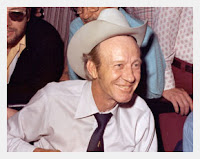
    'Amarillo Slim' PrestonIn 1972, Benny Binion added $5,000 of his own money for each entrant into the Main Event, thus doubling the prize pool. Eight entered that year, and “Amarillo Slim” Preston took the trophy. That’s right. There would be no bracelets per se until 1976 -- another change introduced to increase the WSOP’s prestige.

    Preston, of course, helped make the WSOP a nationally-known entity following his victory, appearing on Johnny Carson’s The Tonight Show 11 times, being featured in a 60 Minutes segment, Tom Snyder’s The Tomorrow Show, Good Morning America, and doing a cameo in Robert Altman’s 1974 film California Split (reviewed here). He even addressed the U.S. Senate on one occasion. (I have no idea why, or what he might have told them.)

    Besides increasing Preston’s own profile, the publicity tour got people interested in Binion’s Horseshoe and the WSOP. Of his appearance on The Tomorrow Show -- in which Preston appeared along with Benny Binion and Joe Bernstein (a Vegas gambler) -- Preston said it was like “an hour’s commercial for the Horseshoe.”

    According to Jonathan Grotenstein and Storms Reback in All In: the (Almost) Entirely True Story of the World Series of Poker, “The Press flocked to the 1973 World Series -- beginning what would become for many of them an annual pilgrimage. They note that a couple of books -- including David Spanier’s Total Poker (1977) (discussed here) -- devoted entire chapters the event, “as did seven thousand newspaper and magazine articles.” One other major change in the way the event was covered happened in 1973 as well: “Television cameras also appeared for the first time as a crew from CBS News filmed a documentary narrated by Jimmy the Greek.”

    That year there were six preliminary events and 13 entrants in the Main Event, each of whom paid the full $10,000 to enter. In 1974, there were 16 entrants. And so forth. In 1980, the year Stu Ungar won his first Main Event, there were 11 preliminary events and 73 who ponied up the $10K for the Main Event. In 1990, the year Mansour Matloubi become the first European to win the big one, there were 14 preliminary events and 194 Main Event entrants. In 2000, the year Chris “Jesus” Ferguson caught that nine on the river to beat T.J. Cloutier, there were 23 preliminary events and 512 players in the Main Event.
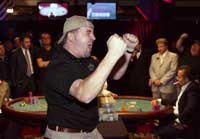
    Chris MoneymakerCBS produced a few more one-hour documentaries about the WSOP during the late 1970s and early 1980s. Then ESPN took it over in the late 1980s, producing a show most years through 2002. (There were no shows in 1996, 1999, 2000, or 2001.) Steve Lipscomb helped make a documentary of the 1999 WSOP for the Discovery Channel, a program that would provide the spark for the World Poker Tour. Then came the hole card cameras, a variation on the under-the-table cameras first introduced on the U.K.’s Late Night Poker in 1999. Lipscomb’s WPT made its first season debut on March 30, 2003. Then, later that summer, ESPN showed those seven episodes chronicling Chris Moneymaker outlasting 838 competitors to win the 2003 WSOP Main Event.

    And the World Series of Poker was never the same.

    The WSOP Main Event: Boom

    The number of players entering the Main Event suddenly vaulted into the thousands: 2,576 in 2004; 5,619 in 2005; 8,773 in 2006; 6,358 in 2007. The number of preliminary events has also increased over that period from thirty-some to the current 54. Several of those early events have also begun attracting thousands of entrants; for example, last year’s initial $1,500 No Limit Hold ’em event (Event No. 3) had 2,998 runners.
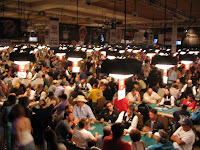
    A scene from the 2007 World Series of PokerA lot of us -- myself included -- have an idea about what tournament poker should be. While any given tournament will necessarily involve a higher degree of variance than will a long sequence of cash games, a lot of us like to believe that these tourneys -- including the Main Event -- do somehow reward players with above-average skill thanks to time-tested structures and well-planned payouts.

    When the WSOP Main Event began attracting more than two thousand entrants in 2004, we “purists” could no longer pretend to think the tournament resembled what Addington, Brunson, Cannon, Pearson, Preston, and Roberts got together to do back on May 10, 1971. Or even what Moneymaker, et al. did in May 2003.

    In 2004, because of space limitations, “Day One” had to be split into two days to fit everyone into Binion’s Horseshoe. (Aside from the 2005 ME final table, this would be the last year for the WSOP at Binion’s.) That year the tournament was played in a week, with no days off (other than if you happened to have played in the first Day One).

    In 2005, the tourney was completed in eight days, again with no scheduled days off. In 2006, with four “Day Ones,” two “Day Twos,” and an off-day before the final table, the tournament took 14 days to complete. Last year, following a similar schedule (with a couple thousand fewer entrants), the tourney took 12 days.

    Like I say, the tourney barely resembles what it looked like even five years ago, but I think there has always been an effort to make it at least appear to be a unified event genuinely testing each individual poker player’s skill at the tables. That’s out the window, now. This year the Main Event will begin on July 3rd and conclude on November 11th -- a 132-day span.

    The WSOP Main Event: Bastardized?

    Now I don’t oppose change per se, but this one is different, representing an utter break from what went before. Some, like Shane “Shaniac” Schleger, believe the change has “bastardized and twisted around” the format of traditional tournament poker as it has developed and become established over the last forty years. Others, like Michael Craig, think the change will give poker (generally speaking) a much need “shot in the arm” and help with the business of “building the brand” of the WSOP.

    At the end of his thoughtful post on the matter, Up for Poker’s Otis (who opposes the change) eloquently states “As we move forward, we should always be asking ourselves what is more important . . . the integrity or growth of the game? Moreover, is there ever a time we should put the latter before the former?” Otis doesn’t think there is.

    Of course, looking back at the history of the WSOP Main Event -- in particular the last five years -- I think it is clear that for all its symbolic value, the Main Event has evolved into something very different than an indicator of poker’s integrity.

    Indeed, the decision to move its conclusion months and months away from the rest of the Series is itself appropriately symbolic, signifying the utter separation of the Main Event from what a lot of us believe “real” poker to be.

    Labels: , , , , , , , , , , , , ,


    Older Posts

    Copyright © 2006-2021 Hard-Boiled Poker.
    All Rights Reserved.