Still brooding a bit about the decision to delay the 2008 World Series of Poker Main Event final table to November. Have been reading through several thoughtful responses to the decision on various blogs, including those of Michael Craig (
Part I &
Part II),
Luckbox and
Otis (taking the pro & con),
Haley, Andrew “Foucault” Brokos (
here,
here, and
here),
Mean Gene,
Craig Cunningham, among others. Have also continued to follow the debates on the forums, where it appears as though posters are mostly (say, 3-to-1?) against.
Not that it matters, of course. As a colleague of mine likes to say, the toothpaste is already out of the tube.
My sense is there’s an unreconcilable tension here between a lot of folks’ ideas of what tournament poker
should be and what the WSOP Main Event
has become. Sometimes it is hard to remember what the Series was like before the Moneymaker “boom” changed everything, but when one looks back, one sees pretty clearly that what we’ve been watching for the last few years only barely resembles what went before it.
The WSOP Main Event: Birth
Back in 1970, Benny Binion invited a group of high-stakes, poker-playing buddies to the Horseshoe to play five different cash games. Thirty-eight players competed, then seven of them (Crandell Addington, Doyle Brunson, Carl Cannon, Johnny Moss, Puggy Pearson, “Amarillo Slim” Preston, and Brian “Sailor” Roberts) voted Moss that year’s winner. They gave him a silver cup.
The next year was the first in which a freeze-out tournament was used to determine the champion. In 1969, something called the “Texas Gamblers Convention” had been held at a Holiday Inn in Reno. (In fact, this gathering directly inspired Binion to create the WSOP the following year.) A tourney was held at the Reno convention, and some believe this to have been the first high-stakes poker tournament of any magnitude.
Back at Binion’s, in 1971 there were four preliminary events (Seven Card Stud, Five Card Stud, Razz, and Ace-to-Five Draw), followed by the Main Event, a $5,000 buy-in, winner-take-all No Limit Hold ’em tournament. Only six entered, and the story goes that Moss had to stage a huge comeback to take the $30,000 prize.
As Benny Binion’s son Jack told Gary Wise on the 4/16 episode of
Wise Hand Poker, soon afterwards two reporters came out to Vegas from the
Cleveland Plain Dealer to do a story on the WSOP. Seeing the chance to create some publicity -- both for the WSOP and his casino -- Binion got Jimmy “the Greek” Snyder to help further increase buzz for the event.
Indeed, just about every major change that has been made to the WSOP has been motivated by a desire to make the event more popular (both for players and fans). In other words, the media has been heavily involved pretty much from the beginning of the WSOP’s history, helping to shape (either indirectly or directly) what the series of tournaments would become.
The WSOP Main Event: Build Up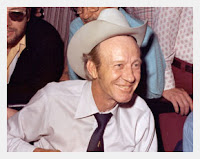
In 1972, Benny Binion added $5,000 of his own money for each entrant into the Main Event, thus doubling the prize pool. Eight entered that year, and “Amarillo Slim” Preston took the trophy. That’s right. There would be no bracelets
per se until 1976 -- another change introduced to increase the WSOP’s prestige.
Preston, of course, helped make the WSOP a nationally-known entity following his victory, appearing on Johnny Carson’s
The Tonight Show 11 times, being featured in a
60 Minutes segment, Tom Snyder’s
The Tomorrow Show,
Good Morning America, and doing a cameo in Robert Altman’s 1974 film
California Split (
reviewed here). He even addressed the U.S. Senate on one occasion. (I have no idea why, or what he might have told them.)
Besides increasing Preston’s own profile, the publicity tour got people interested in Binion’s Horseshoe and the WSOP. Of his appearance on
The Tomorrow Show -- in which Preston appeared along with Benny Binion and Joe Bernstein (a Vegas gambler) -- Preston said it was like “an hour’s commercial for the Horseshoe.”
According to Jonathan Grotenstein and Storms Reback in
All In: the (Almost) Entirely True Story of the World Series of Poker, “The Press flocked to the 1973 World Series -- beginning what would become for many of them an annual pilgrimage. They note that a couple of books -- including David Spanier’s
Total Poker (1977) (
discussed here) -- devoted entire chapters the event, “as did seven thousand newspaper and magazine articles.” One other major change in the way the event was covered happened in 1973 as well: “Television cameras also appeared for the first time as a crew from CBS News filmed a documentary narrated by Jimmy the Greek.”
That year there were six preliminary events and 13 entrants in the Main Event, each of whom paid the full $10,000 to enter. In 1974, there were 16 entrants. And so forth. In 1980, the year Stu Ungar won his first Main Event, there were 11 preliminary events and 73 who ponied up the $10K for the Main Event. In 1990, the year Mansour Matloubi become the first European to win the big one, there were 14 preliminary events and 194 Main Event entrants. In 2000, the year Chris “Jesus” Ferguson caught that nine on the river to beat T.J. Cloutier, there were 23 preliminary events and 512 players in the Main Event.
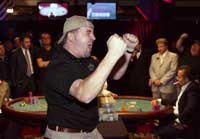
CBS produced a few more one-hour documentaries about the WSOP during the late 1970s and early 1980s. Then ESPN took it over in the late 1980s, producing a show most years through 2002. (There were no shows in 1996, 1999, 2000, or 2001.) Steve Lipscomb helped make a documentary of the 1999 WSOP for the Discovery Channel, a program that would provide the spark for the World Poker Tour. Then came the hole card cameras, a variation on the under-the-table cameras first introduced on the U.K.’s
Late Night Poker in 1999. Lipscomb’s WPT made its first season debut on March 30, 2003. Then, later that summer, ESPN showed those seven episodes chronicling Chris Moneymaker outlasting 838 competitors to win the 2003 WSOP Main Event.
And the World Series of Poker was never the same.
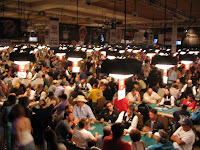
The WSOP Main Event: BoomThe number of players entering the Main Event suddenly vaulted into the thousands: 2,576 in 2004; 5,619 in 2005; 8,773 in 2006; 6,358 in 2007. The number of preliminary events has also increased over that period from thirty-some to the current 54. Several of those early events have also begun attracting thousands of entrants; for example, last year’s initial $1,500 No Limit Hold ’em event (Event No. 3) had 2,998 runners.
A lot of us -- myself included -- have an idea about what tournament poker
should be. While any given tournament will necessarily involve a higher degree of variance than will a long sequence of cash games, a lot of us like to believe that these tourneys -- including the Main Event -- do somehow reward players with above-average skill thanks to time-tested structures and well-planned payouts.
When the WSOP Main Event began attracting more than two thousand entrants in 2004, we “purists” could no longer pretend to think the tournament resembled what Addington, Brunson, Cannon, Pearson, Preston, and Roberts got together to do back on May 10, 1971. Or even what Moneymaker, et al. did in May 2003.
In 2004, because of space limitations, “Day One” had to be split into two days to fit everyone into Binion’s Horseshoe. (Aside from the 2005 ME final table, this would be the last year for the WSOP at Binion’s.) That year the tournament was played in a week, with no days off (other than if you happened to have played in the first Day One).
In 2005, the tourney was completed in eight days, again with no scheduled days off. In 2006, with four “Day Ones,” two “Day Twos,” and an off-day before the final table, the tournament took 14 days to complete. Last year, following a similar schedule (with a couple thousand fewer entrants), the tourney took 12 days.
Like I say, the tourney barely resembles what it looked like even five years ago, but I think there has always been an effort to make it at least appear to be a unified event genuinely testing each individual poker player’s skill at the tables. That’s out the window, now. This year the Main Event will begin on July 3rd and conclude on November 11th -- a 132-day span.
The WSOP Main Event: Bastardized?Now I don’t oppose change
per se, but this one is different, representing an utter break from what went before. Some, like Shane “Shaniac” Schleger, believe the change has “bastardized and twisted around” the format of traditional tournament poker as it has developed and become established over the last forty years. Others, like Michael Craig, think the change will give poker (generally speaking) a much need “shot in the arm” and help with the business of “building the brand” of the WSOP.
At the end of his thoughtful post on the matter, Up for Poker’s Otis (who opposes the change) eloquently states “As we move forward, we should always be asking ourselves what is more important . . . the integrity or growth of the game? Moreover, is there ever a time we should put the latter before the former?” Otis doesn’t think there is.
Of course, looking back at the history of the WSOP Main Event -- in particular the last five years -- I think it is clear that for all its symbolic value, the Main Event has evolved into something
very different than an indicator of poker’s integrity.
Indeed, the decision to move its conclusion months and months away from the rest of the Series is itself appropriately symbolic, signifying the utter separation of the Main Event from what a lot of us believe “real” poker to be.
Labels: *high society, Amarillo Slim Preston, Andrew Brokos, Benny Binion, Craig Cunningham, Haley Hintze, Jonathan Grotenstein, Luckbox, Mean Gene, Michael Craig, Otis, Storms Reback, Up for Poker, WSOP
 Looks as though 70 players survived through Day 1 of Event No. 1, the World Championship Pot-Limit Hold’em event ($10,000 buy-in). A total of 352 ended up entering the event, it appears, with several recognizable figures still alive. Among those still with chips are Chris “Jesus” Ferguson, Andy Bloch, Humberto Brenes, Lyle Berman, Rolf Stotboom, Phil Laak, David Benyamine, Patrik Antonius, Jennifer Harman, Bill Chen, Mike Sexton, Kathy Liebert, and Eli Elezra who currently leads the event with 302,000. Thirty-six spots will pay.
 According to PN live blogger Don Peters, “A spectator on the rail was timing the event levels with his stopwatch and found that the tournament clock was running fast. Word spread to the players and the players began complaining to the tournament directors about losing playing time.” Apparently a “computer glitch” was causing the clocks to run too quickly. I liked Mean Gene’s Einstein-referencing follow-up post on the matter, titled “The Theory of Special Relativity at Work?” Not sure if they managed to fix that problem or not, but I imagine I’ll find out today.