Friday, October 14, 2016

Poker Hall of Fame: Carlos Mortensen and Todd Brunson Make 52

Saw yesterday how Carlos Mortensen and Todd Brunson had been elected as the 51st and 52nd members of the Poker Hall of Fame. Now’s the time for the World Series of Poker to create a commemorative deck of cards featuring pictures of all 52 members.

If I’d had a vote I certainly would’ve given support to Mortensen’s candidacy, though there were other nominees I’d have probably chosen this year ahead of the younger Brunson (though he’s certainly deserving).

Mortensen is a WSOP Main Event champion (2001), and I tend to have a bit of a prejudice in favor of that select group when it comes to the PHOF. With three WPT titles, nearly $12 million in career tourney earnings, and a near-miss to make a second WSOP Main Event final table in 2013 (when he finished 10th), he was a shoo-in. That’s not even counting the highly advanced chip stacking skills that further distinguish the Spaniard (originally from Ecuador).

Todd Brunson has won a lot in tournaments as well (nearly $4.3 million, including a WSOP bracelet in 2005), although he’s much better known as a high-stakes cash game player. His notable heads-up battles with Andy Beal -- including a $13.5 million win over two days (as chronicled in Michael Craig’s The Professor, the Banker, and the Suicide King), then another belated reprise versus Beal in early 2015 which Brunson is said to have won another $5 million -- are legend-making and probably enough to earn him serious PHOF consideration.

I’m going to guess he got a lot of support from the living Poker Hall of Famers, and perhaps not quite as much from the media who voted. Speaking of living PHOFers, he joins his dad, Doyle Brunson, as a PHOF member, which has to be fairly unusual as far as hall of fames go, generally speaking.

The only other father-son combo I can think of in any sports hall of fame would be Bobby and Brett Hull, even if Ken Griffey, Sr. and Jr. spring to mind (Jr. got in this year, Sr. isn’t a HOFer).

In any case, congrats to both. And if the WSOP is reading, feel free to steal that special WSOP PHOF deck idea!

Image: WSOP.com.

Labels: , , , , , ,

Thursday, January 29, 2015

Big Big Bets Between Beal and Brunson in Bobby’s Room

Had a non-poker playing (or following) friend ask me yesterday “What’s going on in poker these days?”

He asks me the same question every six weeks or so, and more often than not I’m answering by telling him wherever it is I might have recently gone for a tournament. He then almost always follows up with a question about who won the most or what was the biggest game-slash-tourney I’ve seen or heard about.

More than once I’ve concluded my response to the latter question with some version of the statement that “it’s the same guys trading it back and forth” -- usually referring to those “super high roller” events which do often feature the same small population of players.

However yesterday I had a different response, referring instead to that Andy Beal-Todd Brunson heads-up session of fixed limit hold’em in Bobby’s Room at the Bellagio that happened last weekend, the one in which each player brought $5 million to the game and Brunson ultimately won it all.

Tweets by poker pro Kyle Loman about the match (who snapped the photo above of Beal and Brunson, with Tex Dolly also there to the right) started Friday night and lasted into Saturday morning, covering about five-and-a-half hours altogether. Loman noted how they were using pink $25,000 chips and the limits were $50K/$100K, making a loss of $5 million equal just 50 big bets. Or should I say BIG bets

Loman did a great job with his updates, providing about 25 tweets altogether noting the changing stack sizes as Brunson gradually whittled away at Beal’s stack before taking the last of his chips.

The game, of course, represents a belated reprise of the famous games between the banker and investor and the team of pros dubbed the “Corporation” that first took place over a decade back. The 2001-2004 games were chronicled in Michael Craig’s The Professor, The Banker, and the Suicide King (2005), then there was another round in 2006, the last before Beal’s surprise return to the tables a few days ago.

My friend was impressed to hear that amount, although truth be told it wasn’t all that different to him (or me) than to hear of a player winning $200K in a tourney. Meanwhile, to look at a $5 million loss from Beal’s point of view -- he’s worth something like $11 billion, apparently, which would make a $5 million loss the equivalent something like $25 for the average wage-earner in the U.S. today.

I don’t know the details, but surely Brunson wasn’t just playing with his own money. In any event, the story made it impossible with my friend to end with the usual sign-off about the same guys trading money back and forth.

Labels: , , , , , ,

Friday, March 01, 2013

Epic Anniversary

It was one year ago that Federated Sports + Gaming, parent company of the Epic Poker League, suddenly announced its intention to file for bankruptcy. The announcement came on Leap Day -- February 29 -- which should have inspired more puns about Epic and “leaps of faith” than it did. So technically the anniversary will only be coming around every four years.

Kind of wonder, actually, if all matters involving the FS+G and its debts will be resolved by the next Leap Day.

As I’ve mentioned here a few times, I became tangentially involved in the sad story of the Epic Poker League as I was one of a few writers recruited to contribute columns to the EPL blog. It was a good experience, particularly working with the blog’s editor-in-chief, Michael Craig, as I produced weekly columns for about six months. I wrote about a variety of topics, all under the heading of “poker and pop culture,” and my column was titled “Community Cards.”

The timing of the bankruptcy filing meant I ended up on the long, long list of FS+G’s creditors (I was owed one last invoice), and a year later I continue to be among the large crowd of folks still owed money. And who still receive the mailings regarding the latest happenings in the Maryland court where it all continues to play out.

A couple of weeks after the filing in mid-March, FS+G issued an angry statement responding to a Card Player article that outlined how “Epic Poker Bankruptcy Leaves Mountain of Debt.” That article referenced the more than $5 million owed to creditors and the $15,000 the company then had on hand. (I believe the amount of debt was ultimately found to be considerably greater than that.)

FS+G’s response to Card Player strongly suggested that the EPL wasn’t “shutting its doors” but that the bankruptcy was part of the effort to reorganize and somehow keep the sucker going. That the EPL “website and social media game are up and running” was cited in that statement as evidence that the league wasn’t planning to fold.

But even then few were being fooled by such optimism, and indeed by mid-June the company’s meager assets were being sold off to Pinnacle Entertainment, thus enabling FS+G to pay back a small fraction of the $2.1 million they owed Pinnacle. Those assets were highlighted by the Heartland Poker Tour, but also covered what was left of Epic, including the website with all of its live reports from the three tournament series, the blog, and other content produced over the league’s brief run.

It wasn’t long after that I noticed the EPL site had been taken down altogether, an occurrence I noted here with dismay in a post last August. Eventually I put it together that when Pinnacle sold the Global Poker Index to Zokay Entertainment, the contents of the website had gone over as well and soon all but the GPI stuff was scrubbed away.

I talked to Zokay CEO Alex Dreyfus since then, and he confirmed for me that this was how things went as far as the EPL site is concerned. Dreyfus, of course, is helping to promote the Global Poker Index ranking system into something the poker world has become increasingly intrigued by over the last few months. I believe the GPI will become a bigger part of the scene this coming year thanks to a new partnership with the World Poker Tour and plans for the upcoming WSOP in Las Vegas.

In any case, to mark this one-year anniversary I thought I’d today start reposting some of those “Community Cards” columns here on Hard-Boiled Poker. I won’t be publishing them all here, but there were a handful in I have wished were still around on the web.

I’ll tentatively plan to use the next few Fridays to share these columns, starting with one titled “Men, Women, and Poker in A Streetcar Named Desire,” which I’m posting separately today.

Labels: , , , , ,

Tuesday, August 02, 2011

New Adventures

LAPT Punta del EsteEmbarking on a couple of new adventures this week.

One is another tourney trip, this time down to Punta del Este, Uruguay to help report on the Latin American Poker Tour event that begins there on Thursday. I’ll be at the airport later this afternoon for the first of three flights that will eventually get me there. Will basically be either in the air or waiting to get on the next plane for about 24 hours or so.

I think distance-wise this’ll about equal my longest-ever voyage (as the crow flies) to go cover a poker tournament. The number of miles -- like 5,100-plus -- is close to the same for that trip to Kyiv, Ukraine back in 2009.

This’ll be my first time to LAPT Punta del Este, after having twice reported from LAPT Lima. So there will be some familiar folks about including the LAPT staff, Brad “Otis” Willis (with whom I’ll be working for the PokerStars blog), the PokerNews folks, and probably a number of players, too.

But there will be much that is new, too, I expect. Hoping to provide a few updates here along the way, so stay tuned.

The other new adventure I’d like to pass along is a new column/blog I have begun over at the Epic Poker site, called “Community Cards: Poker in Popular Culture.” Kind of reviving that old “Poker & Pop Culture” column I’d written before (see here). Am planning to write both about poker in contemporary culture as well as occasionally delving back in history for interesting poker-related stories and anecdotes. My first entry is up now, having to do with poker frequently popping up as a topic of conversation on late night talk shows.

Epic PokerHas been a lot of buzz of late over the fast-approaching first event for the Epic Poker league (of Federated Sports+Gaming) which kicks off in just a few days. The just-announced television deal with CBS and Velocity got a lot of talk last week. And I think many are going to be curious to see how many of the 252 players who are qualified to participate wind up playing that $20,000 buy-in, six-handed NLHE main event (with $400,000 added to the prize pool) that starts Aug. 9.

Connected with the league is a newly-launched site featuring all sorts of information about the league, the players, the events, as well as a bunch of other poker-related content. Author Michael Craig is serving as the editor-in-chief over there, and he’s assembled a number of different folks to contribute columns on a regular basis.

Have to say I’m fairly psyched to be there writing alongside this group. Shane “Shaniac” Schleger will be sharing highlights from the Two Plus Two forums. Jen Newell will write about legal news. AlCantHang will report on poker in social media. Mark Gahagan will be analyzing poker news items to identify “winners” and “losers.” Jess Welman will contribute features about Epic Poker league players. John Vorhaus (author of the poker-themed novel Under the Gun and those “Killer Poker” strategy books) will write an advice column for new players. Fred Bevill will report from the Heartland Poker Tour. And Craig will also be frequently contributing variously, including filing updates on that new Global Poker Index.

Craig has written an introductory “mission statement” post with some further info about the site and the columnists, if you’re curious. There are also some player blogs, videos, photos, and other news already up on the site. And I imagine once the events start happening there will be a lot of reporting from the tourneys, too.

Meanwhile, in a few weeks I’ll be teaching my “Poker in American Film and Culture” class again. Will be changing a few items on the syllabus over the next couple of weeks, for sure. And I have a couple of other poker-related items brewing which may well evolve into still more adventures.

Better sign off now, though. I mean, if I’m gonna run off on another one of these epic-length odysseys, I probably oughta pack a bag.

Labels: , , ,

Monday, May 05, 2008

The WSOP Main Event: Birth, Build Up, Boom . . . Bastardized?

The World Series of PokerStill brooding a bit about the decision to delay the 2008 World Series of Poker Main Event final table to November. Have been reading through several thoughtful responses to the decision on various blogs, including those of Michael Craig (Part I & Part II), Luckbox and Otis (taking the pro & con), Haley, Andrew “Foucault” Brokos (here, here, and here), Mean Gene, Craig Cunningham, among others. Have also continued to follow the debates on the forums, where it appears as though posters are mostly (say, 3-to-1?) against.

Not that it matters, of course. As a colleague of mine likes to say, the toothpaste is already out of the tube.

My sense is there’s an unreconcilable tension here between a lot of folks’ ideas of what tournament poker should be and what the WSOP Main Event has become. Sometimes it is hard to remember what the Series was like before the Moneymaker “boom” changed everything, but when one looks back, one sees pretty clearly that what we’ve been watching for the last few years only barely resembles what went before it.

The WSOP Main Event: Birth

Benny BinionBack in 1970, Benny Binion invited a group of high-stakes, poker-playing buddies to the Horseshoe to play five different cash games. Thirty-eight players competed, then seven of them (Crandell Addington, Doyle Brunson, Carl Cannon, Johnny Moss, Puggy Pearson, “Amarillo Slim” Preston, and Brian “Sailor” Roberts) voted Moss that year’s winner. They gave him a silver cup.

The next year was the first in which a freeze-out tournament was used to determine the champion. In 1969, something called the “Texas Gamblers Convention” had been held at a Holiday Inn in Reno. (In fact, this gathering directly inspired Binion to create the WSOP the following year.) A tourney was held at the Reno convention, and some believe this to have been the first high-stakes poker tournament of any magnitude.

Back at Binion’s, in 1971 there were four preliminary events (Seven Card Stud, Five Card Stud, Razz, and Ace-to-Five Draw), followed by the Main Event, a $5,000 buy-in, winner-take-all No Limit Hold ’em tournament. Only six entered, and the story goes that Moss had to stage a huge comeback to take the $30,000 prize.

As Benny Binion’s son Jack told Gary Wise on the 4/16 episode of Wise Hand Poker, soon afterwards two reporters came out to Vegas from the Cleveland Plain Dealer to do a story on the WSOP. Seeing the chance to create some publicity -- both for the WSOP and his casino -- Binion got Jimmy “the Greek” Snyder to help further increase buzz for the event.

Indeed, just about every major change that has been made to the WSOP has been motivated by a desire to make the event more popular (both for players and fans). In other words, the media has been heavily involved pretty much from the beginning of the WSOP’s history, helping to shape (either indirectly or directly) what the series of tournaments would become.

The WSOP Main Event: Build Up
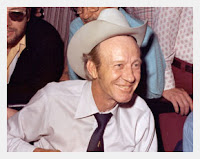
'Amarillo Slim' PrestonIn 1972, Benny Binion added $5,000 of his own money for each entrant into the Main Event, thus doubling the prize pool. Eight entered that year, and “Amarillo Slim” Preston took the trophy. That’s right. There would be no bracelets per se until 1976 -- another change introduced to increase the WSOP’s prestige.

Preston, of course, helped make the WSOP a nationally-known entity following his victory, appearing on Johnny Carson’s The Tonight Show 11 times, being featured in a 60 Minutes segment, Tom Snyder’s The Tomorrow Show, Good Morning America, and doing a cameo in Robert Altman’s 1974 film California Split (reviewed here). He even addressed the U.S. Senate on one occasion. (I have no idea why, or what he might have told them.)

Besides increasing Preston’s own profile, the publicity tour got people interested in Binion’s Horseshoe and the WSOP. Of his appearance on The Tomorrow Show -- in which Preston appeared along with Benny Binion and Joe Bernstein (a Vegas gambler) -- Preston said it was like “an hour’s commercial for the Horseshoe.”

According to Jonathan Grotenstein and Storms Reback in All In: the (Almost) Entirely True Story of the World Series of Poker, “The Press flocked to the 1973 World Series -- beginning what would become for many of them an annual pilgrimage. They note that a couple of books -- including David Spanier’s Total Poker (1977) (discussed here) -- devoted entire chapters the event, “as did seven thousand newspaper and magazine articles.” One other major change in the way the event was covered happened in 1973 as well: “Television cameras also appeared for the first time as a crew from CBS News filmed a documentary narrated by Jimmy the Greek.”

That year there were six preliminary events and 13 entrants in the Main Event, each of whom paid the full $10,000 to enter. In 1974, there were 16 entrants. And so forth. In 1980, the year Stu Ungar won his first Main Event, there were 11 preliminary events and 73 who ponied up the $10K for the Main Event. In 1990, the year Mansour Matloubi become the first European to win the big one, there were 14 preliminary events and 194 Main Event entrants. In 2000, the year Chris “Jesus” Ferguson caught that nine on the river to beat T.J. Cloutier, there were 23 preliminary events and 512 players in the Main Event.
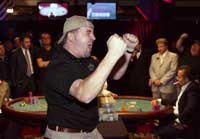
Chris MoneymakerCBS produced a few more one-hour documentaries about the WSOP during the late 1970s and early 1980s. Then ESPN took it over in the late 1980s, producing a show most years through 2002. (There were no shows in 1996, 1999, 2000, or 2001.) Steve Lipscomb helped make a documentary of the 1999 WSOP for the Discovery Channel, a program that would provide the spark for the World Poker Tour. Then came the hole card cameras, a variation on the under-the-table cameras first introduced on the U.K.’s Late Night Poker in 1999. Lipscomb’s WPT made its first season debut on March 30, 2003. Then, later that summer, ESPN showed those seven episodes chronicling Chris Moneymaker outlasting 838 competitors to win the 2003 WSOP Main Event.

And the World Series of Poker was never the same.

The WSOP Main Event: Boom

The number of players entering the Main Event suddenly vaulted into the thousands: 2,576 in 2004; 5,619 in 2005; 8,773 in 2006; 6,358 in 2007. The number of preliminary events has also increased over that period from thirty-some to the current 54. Several of those early events have also begun attracting thousands of entrants; for example, last year’s initial $1,500 No Limit Hold ’em event (Event No. 3) had 2,998 runners.
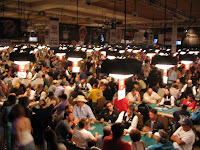
A scene from the 2007 World Series of PokerA lot of us -- myself included -- have an idea about what tournament poker should be. While any given tournament will necessarily involve a higher degree of variance than will a long sequence of cash games, a lot of us like to believe that these tourneys -- including the Main Event -- do somehow reward players with above-average skill thanks to time-tested structures and well-planned payouts.

When the WSOP Main Event began attracting more than two thousand entrants in 2004, we “purists” could no longer pretend to think the tournament resembled what Addington, Brunson, Cannon, Pearson, Preston, and Roberts got together to do back on May 10, 1971. Or even what Moneymaker, et al. did in May 2003.

In 2004, because of space limitations, “Day One” had to be split into two days to fit everyone into Binion’s Horseshoe. (Aside from the 2005 ME final table, this would be the last year for the WSOP at Binion’s.) That year the tournament was played in a week, with no days off (other than if you happened to have played in the first Day One).

In 2005, the tourney was completed in eight days, again with no scheduled days off. In 2006, with four “Day Ones,” two “Day Twos,” and an off-day before the final table, the tournament took 14 days to complete. Last year, following a similar schedule (with a couple thousand fewer entrants), the tourney took 12 days.

Like I say, the tourney barely resembles what it looked like even five years ago, but I think there has always been an effort to make it at least appear to be a unified event genuinely testing each individual poker player’s skill at the tables. That’s out the window, now. This year the Main Event will begin on July 3rd and conclude on November 11th -- a 132-day span.

The WSOP Main Event: Bastardized?

Now I don’t oppose change per se, but this one is different, representing an utter break from what went before. Some, like Shane “Shaniac” Schleger, believe the change has “bastardized and twisted around” the format of traditional tournament poker as it has developed and become established over the last forty years. Others, like Michael Craig, think the change will give poker (generally speaking) a much need “shot in the arm” and help with the business of “building the brand” of the WSOP.

At the end of his thoughtful post on the matter, Up for Poker’s Otis (who opposes the change) eloquently states “As we move forward, we should always be asking ourselves what is more important . . . the integrity or growth of the game? Moreover, is there ever a time we should put the latter before the former?” Otis doesn’t think there is.

Of course, looking back at the history of the WSOP Main Event -- in particular the last five years -- I think it is clear that for all its symbolic value, the Main Event has evolved into something very different than an indicator of poker’s integrity.

Indeed, the decision to move its conclusion months and months away from the rest of the Series is itself appropriately symbolic, signifying the utter separation of the Main Event from what a lot of us believe “real” poker to be.

Labels: , , , , , , , , , , , , ,


Older Posts

Copyright © 2006-2021 Hard-Boiled Poker.
All Rights Reserved.