Friday, February 10, 2012

Onilne Gaming in the U.S.: Reservations from the Reservations

2/9/12 hearing of the U.S. Senate Committee on Indian AffairsI watched that hearing yesterday of the U.S. Senate Committee on Indian Affairs, titled “What’s at Stake for the Tribes.” You might recall this is the second such hearing for that committee, following an earlier one back in November.

If you’re curious you can read the testimony from yesterday and view the hearing yourself over on the committee’s web page, although if you happen to dial up the video skip to about the 44-minute mark because for some reason the actual hearing doesn’t start until there.

With that opinion from the Department of Justice first made public in late December indicating an altered position regarding the Federal Wire Act, the tribes and those representing their interests are now viewing the prospect of online gambling in the U.S. as not just a possibility but likely. And, as I cracked after the first hearing, there appear to be a lot of reservations coming from the reservations when it comes to the possibility of legally-sanctioned online gaming coming to the U.S.

In fact, now there appears to be more explicit fretting over negative consequences for the tribes should individual states start moving forward with offering online gaming. Such appeared to be the sentiment being expressed by some of the witnesses yesterday, anyway.

I. Nelson Rose, the gambling law professor, was there as a witness and his testimony -- outlining his speculative view of what will be happening as we move forward with states lining up to pass legislation, establish regulations, issue licenses, and start offering online gaming (either intrastate or with other states as a “consortium”) -- seemed to me as though it probably mostly confirmed the tribes’ fears that their significant gaming revenues were going to be in danger.

Meanwhile, Patrick Fleming, an attorney who is serving as the Litigation Support Director for the Poker Players Alliance, appeared to be trying assuage such fears, suggesting instead how online gaming need not necessarily eat into the profitability of the tribes’ brick-and-mortar casinos. Fleming also made an effort to distinguish poker from other casino games, but I’m not sure how significant that argument really was in this context.

In the end, the hearing again seemed to demonstrate how discussions about online gaming on Capitol Hill have tended to veer away from being marked by moral objections to gambling, generally speaking, and are becoming more focused on practical questions regarding (1) how it is all going to work, and (2) who is going to benefit financially.

Lou KriegerAs I mentioned yesterday, I was a guest last night on the poker podcast “Keep Flopping Aces” with Lou Krieger and Shari Geller, and we did spend some of the hour talking about the prospects for online poker in the U.S. both on the state and federal levels.

When asked by Lou to predict whether or not we’d see any online poker in the U.S. in 2012, I had to say I didn’t think so. While things are moving on the state level -- having progressed the most in Nevada -- it still feels to me like logistical concerns may require significant time to pass before anyone is actually playing online poker in the U.S.

And as far as the idea of an interstate “consortium” goes, I can’t help but think the feds won’t stand idly by and allow that to happen without some sort of meddling that’ll at least delay such a development if not prevent it altogether. (I could be way off-base in thinking that way, but I guess I’m still mired in a believe-it-when-I-see-it mode for a lot of this.)

Meanwhile, I suppose there always exists the possibility of some surprise addendum to a federal bill to allow for online poker. In fact, there was some of that talk coming out of the rumor mill yet again this week -- i.e., that Harry Reid was again primed to try to do just that by adding an online poker bill to an upcoming payroll tax bill. I might have accounted for that possibility when answering Lou’s request to make a prediction, but I feel like there are so many variables affecting the prospects of a federal bill succeeding that it is hard for any of us amateur prognosticators to foresee that turn of events.

I was reflecting on Lou’s question again today, and thinking how in fact there still are a lot of months to go here in 2012. Still, with all of the various political forces in play -- Indian gaming being just one of them -- it continues to seem like the odds are mighty slim that online poker could be legally offered anywhere in the U.S. before the year is out.

Labels: , , , ,

Monday, January 23, 2012

Bracing for a Boom of Dragon Babies

Chinese calendarWas in the car today when I happened to hear I. Nelson Rose talking the Wire Act and the future of online gambling in America on “Here & Now,” an NPR show.

Nothing we haven’t heard or read before, particularly if we have been keeping up with the various state-level developments that happening in the wake of that December memo from the Department of Justice noting that the Federal Wire Act of 1961 applies strictly to sports betting (and not other forms of gambling). Or if we happen to follow some of what Rose has been writing about over on his Gambling and the Law blog of late.

Still, it was interesting to hear both the questions and Rose’s answers, and perhaps notable to consider that NPR saw fit to give it a quarter-hour’s worth of time to discuss. You can listen to the segment online here.

When Rose was done, the show then segued to a segment on the Chinese New Year which begins today.

“Here & Now” did a good job keeping me from changing the channel, initially by introducing the segment with Warren Buffett performing “I’ve Been Working the Railroad” on the ukulele. Apparently Buffett’s company owns the railroad operator Burlington Northern-Santa Fe in China, and more than a billion Chinese travel during the Lunar New Year holiday period, including many by train. The song was part of an advertisement.

I didn’t change the channel after Buffett was done, though, because I was intrigued by the host Robin Young explaining how Asia was “bracing for a boom in dragon babies.” The funny-sounding phrase brought to mind fantastic, B-movie scenarios, but in fact Young was referring to how the Year of the Dragon (which starts today) is widely considered by the Asian countries that follow the Chinese calendar to be the luckiest of the twelve in the cycle.

Thus have many families been carefully planning to have children during the current year, or “dragon babies.” The segment went on to share quotes from a Hong Kong couple talking about children born during the Year of the Dragon being both smarter and luckier.

Hong Kong’s medical system is in fact being put under extra strain to accommodate the extra births (about a 10% increase). The educational system also feels the effect of there being more “dragon babies” than children born in other years, although those effects aren’t felt until a few years later when those children start going to school. “Dragon babies may not receive the same quality of education as children born in other years,” commented a Hong Kong University professor.

In other words, one might argue that it is in fact less advantageous, practically speaking, to be a “dragon baby” than not, since you could face issues initially with regard to your birth and care, then later in terms of the education you might receive.

The segment (which you can listen to here) got me thinking a little bit about how superstitions in poker -- such as coveting lucky hands or seats or the like -- can sometimes have real, practical consequences on game play. Or, to look at it from the other direction, how others’ apparently irrational predilections can affect the fortunes of the logical-minded trying to coexist and/or prosper in their world (or at their table).

The Year of the Dragon begins todayMeanwhile, if there isn’t already a band named the Dragon Babies, I’m grabbing that one right now. Fire-breathing power pop is what we’ll play.

Brace yourselves.

Labels: , , ,

Thursday, December 22, 2011

A Break-In, a Brouhaha, and a Beginning

News Round-UpHugely busy these days, trying to get everything together before all the gift-giving, family-visiting, and food-stuffing gets going in earnest this weekend. As a result I haven’t had a lot of time to devote to poker -- either playing it or giving a lot of attention to the various news items surfacing in the poker world.

I did get a chance to skim through a few stories standing out from the most recent cycle, though.

Truly hated to hear about 2010 World Series of Poker Main Event champion Jonathan Duhamel being the victim of what sounds like a harrowing home invasion this week. Two men broke into his Montreal home, tied him up and physically assaulted him, threatened to kill him, then left with money and other items including his 2010 WSOP Main Event bracelet.

2010 WSOP ME braceletOf course, that bracelet is a pretty damned conspicuous item -- hard to imagine the thieves being able to pawn such a thing with ease. It sounds like they also made off with a lot of 500 Euro notes that are also rare enough to raise eyebrows, should they try to use them. Here is a report about the incident from a Canadian news outlet.

I also found myself a little distracted the last couple of days by this multi-way spat that has arisen involving I. Nelson Rose, the Poker Players Alliance, Mason Malmuth, and Rep. Joe Barton.

Barton, as we know, has proposed a federal bill designed to provide a means to license and regulate online poker in the U.S. He’s also appeared a couple of times before the House committee that’s been discussing the topic of online gambling, speaking in particular about poker and his desire to see his bill or something similar move forward.

I. Nelson Rose vs. Joe BartonEarlier this month, the gambling lawyer I. Nelson Rose attacked Barton in a piece for Poker Player Newspaper, primarily aiming at Barton’s previous record regarding votes to prohibit online gambling (including his votes on the UIGEA).

The Poker Players Alliance took issue with Rose’s article, sending out a rebuttal of sorts on Tuesday. And Mason Malmuth stirred the pot some more by starting a thread on Two Plus Two in which he shared the PPA’s statement, then jumped in to criticize Rose himself. Then following Rose’s appearance on QuadJacks Radio yesterday, Malmuth appeared on QJ Radio as well to further discuss Rose, Barton, and everything else.

The result is a fairly noisy, overlapping discussion touching on a number of different issues, including the prospects of Barton’s bill, Rose’s political leanings, the PPA’s effectiveness as a representative of poker players’ interests, the possible editorial stance of Poker Player Newspaper, Malmuth’s status as a firebrand, among others.

Finally -- and not unrelatedly -- today we’re learning of Nevada moving forward as expected to adopt intrastate internet gaming regulations. A vote today confirmed that Nevada has agreed to rules for allowing entities to apply for licenses to operate online poker sites.

NevadaIt sounds like this vote means that should any sort of federal legislation come to pass, Nevada will be a place to go for those seeking licenses to operate sites. It also sounds like Nevada may be ready to go forward with in-state-only sites, too, but work will have to be done to ensure they'll be able to pull that off (i.e., successfully limiting play within the state's borders).

I still need to read up more on this latter item in order to grasp the particulars. Here’s a Wall Street Journal piece from yesterday describing what was voted on today, which as mentioned did pass. (EDIT [added 12/23/11]: Here is a report from PokerFuse about the Nevada vote and its possible implications.)

Definitely appears as though movement on the state level is going to be happening a lot more swiftly than on the federal level, as far as the licensing and regulating of online poker in the U.S. is concerned. And while it is hard to say just yet what the significance of today’s move in Nevada will ultimately be, it does appear to be the beginning of something.

Speaking of beginning something, these gifts aren’t gonna wrap themselves. Better go get started.

Labels: , , , , , , , , ,

Friday, April 22, 2011

The Hustler, the DOJ, and Online Poker in the U.S.

DOJ breaks PS and FTP's thumbsA couple of months ago I wrote a short post about The Hustler, the great 1961 film starring Paul Newman in which the game is pool, but many of the lessons apply directly to poker. Such was David Spanier’s evaluation in his chapter on poker movies in Total Poker. The PokerGrump spelled out some of the ways the film applies to poker, too, in a post from a while back.

I was reading through various posts and articles over the last couple of days concerning “Black Friday,” including the several written by Bill Rini, one of a few especially lucid commentators on the situation. One of Bill’s posts caused me to think again of a particular sequence in The Hustler.

The scene comes a little over halfway through the movie. Eddie enters Arthur’s Pool Hall, a place where no one knows of his skills as a player. He plays a few friendly games for low stakes. Soon the other players all drop out, leaving just Eddie and the player who is presumably the best Arthur’s Pool Hall has to offer. Eddie is asked if he’d like to raise the stakes, he responds with a jokey comment (“I think maybe you’re a hustler”), and they continue playing at slightly bigger stakes.

Eddie’s opponent wins a match -- Eddie is clearly letting him do so -- and afterwards decides to needle our hero a little. “You sure you don’t want to quit, friend?” he asks. Eddie turns serious. “Let’s cut out the small stuff, huh?” he says, then proposes they play 10 matches for $100 -- a significant jump in stakes. His opponent delivers another dig just before they begin, and Eddie responds angrily.

“I don’t rattle, kid!” he fires back with a menacing look. “Just for that I’m going to beat you flat!”

Eddie proceeds to win the next 10 matches in rapid fashion, not letting his opponent have a single shot. He then tells the “two-bit punk” to pay up. His opponent leaves the money, but also leaves Eddie alone with the other locals, none too pleased at Eddie’s display.

Not so fast, Eddie“We got no use for pool sharks around here,” one says. Then they proceed to take the money back and rough him up, including breaking both of his thumbs.

The lesson -- as PokerGrump points out -- is to show some reserve when beating an inferior player. When you win, keep quiet, or practice a kind of faux humility about it. Don’t trash talk. Don’t “tap the glass” and scare the fish away. You’re only increasing the likelihood that your opponent won’t want to play anymore, and then there’s no game.

Eddie won a lot, couldn’t resist becoming very showy and arrogant about it, and suddenly found himself out of the game entirely.

The post from Bill that caused me to think about this scene from The Hustler was one titled “Why Bodog Wasn’t Kicked Out of the U.S.” I was intrigued to read what he had to say, not least because I still have an account on Bodog. That account is presently empty, however, and so I have found myself thinking off and on about perhaps trying to put some dollars back in and play once more.

“Will the DOJ come after Bodog or any of the other sites still offering U.S. gaming?” asks Bill. “Probably if they get too big,” is his answer. “Right now they’re small fish. If any significant U.S. traffic starts over there then they’ll come up on the crosshairs.”

Thus, Bill goes onto explain, the processing of transactions will become more and more difficult for Bodog should their traffic increase significantly. Then they’ll find themselves in a similar position PokerStars, Full Tilt Poker, and UB/AP did before they apparently resorted to non-legal machinations to get money to and from players.

Should I try to play on Bodog then? The fact is, I had stopped playing there over a year ago because the traffic had grown too slow. And it sounds like if the traffic were to increase, the likelihood that the site would become the next DOJ target would increase, too. Not encouraging.

Eddie’s showy play and subsequent punishment might be compared to how PokerStars and Full Tilt Poker had become so huge and successful, and prominent, too, via constant advertisements on the web and our TV screens, that their status as “sharks” could no longer be ignored. And recent developments on the legislative front regarding online poker and those alliances with casinos (discussed in that “Some Rambling About the Rumble” post from 4/8/11) only served to increase the the sites’ stature further.

As I. Nelson Rose has pointed out, when we consider the Department of Justice’s decision to pounce, “the timing is suspicious.” He sees the decision to act now as having been directly motivated by the increasingly loud “rumble” that had been created by the online site-casino alliances (e.g., Wynn and PokerStars) and the momentum being gathered behind the various legislative pushes to license and regulate online poker in the U.S.

As Rose points out, the DOJ has been “waging a war of intimidation against Internet gambling for years, successfully scaring players, operators, payment processors and affiliates into abandoning the American market.” To keep an upper hand in this war, they couldn’t wait any longer, allowing legislation to pass or the sites to grow even stronger via various business alliances in the U.S.

In other words, like the locals at Arthur’s Pool Hall, the DOJ had seen the sites run the table -- and perhaps be a bit showy about it as they did -- and decided they couldn’t just sit back and watch.

You could say that part of what has happened here is the DOJ viewed the sites as having thumbed their noses at them for too long.

So they broke some thumbs.

Labels: , , , ,

Tuesday, August 11, 2009

On the Menendez Bill (S. 1597); or, Be Careful What You Ask For

Internet Poker and Games of Skill Regulation, Consumer Protection, and Enforcement Act of 2009 (S. 1597)Last week Senator Robert Menendez (D-NJ) introduced yet another online gambling-related bill, something called the Internet Poker and Games of Skill Regulation, Consumer Protection, and Enforcement Act of 2009 (S. 1597) (full text here).

Once again, the news of another “anti-UIGEA” bill has evoked a kind of vague enthusiasm in the poker community. And once again, I find myself wondering “Do We Really Want Online Poker Regulated?

You might recall that Menendez introduced a somewhat similar bill on the Senate floor last September (S. 3616). That one also focused on “games of skill” as it brought together various ideas for regulation of online gambling that had been proposed in the several other bills introduced over on the House side during the previous (110th) Congress.

Mendendez’ previous bill went nowhere -- in more ways than one. Once S. 3616 was introduced, it was referred to the Committee on Banking, Housing, and Urban Affairs, and that’s the last action taken. But like all bills introduced in the Senate, it remained “in play” (as it were) even as a new president took office and a new Congress took up residence over in the House. That’s because unlike House bills, which fade into history if not made laws during the Congress in which they are proposed, Senate bills that have not been acted upon perpetually remain in consideration since the Senate is technically a “continuing body.” (EDIT [added 8/12/09]: Might not be accurate here with regard to the fate of Senate bills, I am afraid -- see comments.)

In other words, when Menendez decided to introduce a second online gambling-related bill last week, his decision meant he’d had a rethink and wanted to propose something different from before, since his earlier bill was still on the table. That’s a little different from Barney Frank (D-MA) reintroducing his legislation last May -- he had to, if he still wanted the legislation considered, since all of those bills he’d proposed during the previous Congress (including the Internet Gambling Regulation and Enforcement Act, or IGREA) had died away.

So there’s a procedural difference to note here. And, indeed, the new bill from Menendez does represent a kind of rethink, insofar as it presents a much more detailed outline of how licensing and regulation of online poker (and other “games of skill”) would go.

Capitol HillThere’s also a fairly huge difference between the bill Frank proposed back in the spring -- his Internet Gambling Regulation, Consumer Protection and Enforcement Act (H.R. 2267) (full text here) which now has 54 co-sponsors -- and the Menendez bill. I’ve already heard some commentators strangely describe Menendez’ bill as just “a Senate version” of Frank’s House bill, but that’s not even close to being the case. While it does recite several of the same mechanisms for licensing and regulating online sites that Frank’s bill recommends, it also makes that distinction between “games of skill” (e.g., poker, chess, bridge, mah-jong, backgammon) and other forms of online gambling, and thus only proposes to regulate sites that offer such skill games.

Like Frank’s H.R. 2267, Menendez’ bill sets up a federal licensing and regulatory system, to be run by the U.S. Treasury, but also allows for individual states (and tribes) to ask to be allowed to take over the business of issuing licenses and do the regulating. This continues to be the part of such proposed legislation that frets me the most, as I happen to live in a state where it seems quite possible my government would decide against letting the feds license and regulate online gambling here.

In his analysis of Menendez’ bill, I. Nelson Rose, a gambling law professor at Whittier Law School in California, explains that this state “opt out” provision is quite sketchily explained and even self-contradictory, and so is hard to respond to as it is presently worded. If you are interested, you can read Rose’s analysis here, which once again gives us a lot of reason not to be so excited about this or any other bill proposing the licensing and regulating of online poker.

The Poker Players Alliance has come out in favor of the new bill, noting how it speaks to the need “to protect consumers by exercising appropriate control and oversight over Internet poker and other games of skill.” PPA Chairman Alfonse D’Amato calls S. 1597 “another powerful step towards protecting Internet freedom, protecting consumers and protecting online poker.”

What do I think? I have a couple of responses.

For one, I have to think the prospects for Menendez’ bill are quite dim, especially compared to Frank’s. I say that mainly because of the present makeup of the two legislative bodies, as well as the relative power Frank and Menendez currently enjoy in each. And like that previous House bill introduced by Rep. Robert Wexler (D-FL) regarding “skill games,” I think S. 1597 is likely going to remain in the background of any discussions about licensing and regulating online gambling for the near (and possibly far) future.

Secondly, I’m becoming less and less enthused by these bills as time goes by as it becomes increasingly clear that each doesn’t really represent “another powerful step toward protecting Internet freedom” (as D’Amato says), but instead introduces ways to restrict such freedoms.

I fully recognize that we need to be able to play online poker without worrying about sites cheating us -- and we need to have some legal recourse whenever they do. But what’s the point of fighting for that protection if by doing so we help create a situation in which some of us -- maybe a lot of us -- cannot play at all?

The sole reason to be at all energized by any of these bills is the way they invite criticism of the hopelessly-flawed and unfair Unlawful Internet Gambling Enforcement Act of 2006 -- the bill that has become law.

Here comes the UIGEAAnd, really, the only bill I’m supporting at present is the one Frank introduced back in May just before his latest attempt at licensing and regulating online gambling, namely, his Reasonable Prudence in Regulation Act (H.R. 2266) (full text here), a simple two-pager that does nothing more than ask for a one-year delay before financial institutions’ compliance with the UIGEA becomes mandatory. That happens on December 1, 2009, and I do think we online poker players are going to face some frustrations here and there -- particularly with regard to depositing -- if that date arrives without any legislative action happening in the interim.

H.R. 2266 currently has 35 co-sponsors -- more than I thought it would have at this juncture. It has been referred to the House Financial Services Committee (which Frank chairs), and so shouldn’t completely fall off the radar, although I’m not too hopeful about it moving through the House, Senate, and onto the president’s desk before December 1.

Even so, I think that’s probably where our energy should be directed -- toward the rapid passage of H.R. 2266 -- and not so much expended as vague, misinformed praise for bills we may not actually want to see become law.

Labels: , , , ,

Thursday, October 12, 2006

Considering the Unlawful Internet Gambling Enforcement Act, Part II: Eliminating the Middle Man

To sum up the previous post, then . . . (1) Congress identifies several activities as examples of gambling (or a “bet or wager”) in the Unlawful Internet Gambling Enforcement Act, including “a game based on chance”; (2) No matter how much skill is involved, poker is always going to be regarded by the powers that be as “a game based on chance” and, therefore, a form of gambling; (3) I agree that poker is gambling, though I don’t agree that it should be made illegal (online or elsewhere).

Reading the analyses, surfing through the forums, and listening to the podcasts, one starts to realize a lot of people are simply echoing each other. A common refrain is that laws about online gambling have not changed here; rather, the Act simply outlines ways to enforce existing laws. I think that is mostly true, but not entirely. The fact is, while this reference to “a game based on chance” might seem innocuous at first glance, it does bring poker into the discussion. I. Nelson Rose claims that “The Act does not expand the reach of the Wire Act.” Allyn Jaffrey Shulman says “The new bill does not make online gaming illegal where it was not illegal before.” I believe both are underestimating the significance of this new, expanded definition of “bet or wager.” Those who are going to enforce this law -- and perhaps even those who interpret the law in court -- are going to include poker as an example of an activity prohibited by the Act.

As bad as that seems, what the Act says about actually enforcing laws prohibiting online gambling is even more worrisome. The UIGEA outlines measures to make it very difficult for American players to transfer money to and from online poker sites located outside the United States.

The Act outlines the responsibilities of “designated payment systems” (meaning banks, credit card companies, or any other money transfer system). These systems are here given 270 days from the date the bill is signed to implement measures to stop money from going to online gambling sites. Just how banks and credit card companies can monitor every single transaction in this way is unclear -- many observers have noted how impractical it would be to do so. (In truth, few Americans were sending money directly from their banks or credit cards to online poker sites anyway -- I certainly haven't been -- so this provision shouldn’t have much effect.)

The Act also speaks of “financial transaction providers” and places a similar onus on them not to help facilitate the transfer of money from Americans’ bank accounts to online gambling sites. Here the Act is referring specifically to third-party vendors like Neteller and Firepay. Rose wonders why such vendors -- all located outside of the U.S. -- would feel any obligation to comply with U.S. regulations. Shulman makes the obvious point that the U.S. government cannot arrest anyone in another country who breaks a U.S. law. Nevertheless, Firepay -- run by Canadian-owned FireOne -- has already announced that ten days after Bush signs the Act into law, they will no longer allow U.S. consumers to transfer money to or from online gambling merchants.

So . . . we have some poker sites still in operation. Full Tilt Poker made a statement they would remain in the game even after the Act becomes law. Poker Stars finally made a similar announcement last night. And Neteller has also said that since "it is currently unclear . . . how a European company, with no assets, presence or employees in the U.S., would be affected by this bill," that for them it shall be "business as normal."

So we’re okay, right? Business as normal, right? Shuffle up and deal . . . !

Hold on. There’s one other nasty little passage in this here Act that may prove to be the fly in the ointment. That mean little subsection about “interactive computer services,” a.k.a. Internet Service Providers (ISPs).

In part (c) of section 5365 (“Civil remedies”), we learn that federal agents can force ISPs to block access to online gambling sites, and even access to sites that link to online gambling sites. There it says the responsibilities of ISPs will be limited to “the removal of, or disabling access to, an online site violating section 5363 [i.e., an online gambling site], or a hypertext link to an online site violating such section.” It also says that the Act does “not impose any obligation on an interactive computer service to monitor its service or to affirmatively seek facts indicating activity violating this subchapter.” In other words, unlike banks, credit card companies, other “designated payment systems,” and even some “financial transaction providers,” the Act does not say that ISPs are going to have to police themselves. Nor does it say the ISPs are liable at all if their patrons are accessing such law-breaking sites.

Now on the face of it, this might seem harmless. ISPs don’t have to block sites unless the feds tell them to. So why should we worry? I can think of two reasons.

For one, the feds may well start telling them to. Again, a federal agency may have an easier time herding cats than tracking down each and every ISP hosting a site linking to an online gambling site. But given the letter of the law, I would not be at all surprised if we start to hear of some instances of this enforcement occurring. And woe to those of us affected.

Secondly, should the feds exert enough pressure on ISPs, we could possibly see some police themselves even though they haven’t been ordered to do so. This would be a most unfortunate turn of events. This might seem unlikely, but it wouldn’t be that different from what we have already seen with several poker sites (e.g., Party Poker, InterPoker & other Cryptologic sites, 888, Sun Poker, Titan, etc.) and now even a popular third-party vendor (Firepay).

I envision very little (really, no) recourse for the online player who suddenly discovers he cannot access his favorite online poker site. I also see the potential for problems for those who operate as affiliates to poker sites, and even sites like this one that provide links to online poker sites. If the ISP hosting this blog was told by federal agents to pull the plug on Hard-Boiled Poker -- or if the ISP decided to do so on its own -- there’s not much I could do about it. (Except perhaps go all "hard-boiled" and no "poker" . . . .)

Taking the law at its word, I will be able to link to sites like Interpoker and Party Poker that refuse U.S. customers, but if I were to link to any of those section 5363-violating sites like Full Tilt and Stars, my hosting ISP could be told to (or decide on its own to) block access to my site. Ironically, I could only link to sites where I cannot play, and not to sites where I do.

Eliminating the middle man like this is actually a common plot element in hard-boiled fiction. Usually sets up larger, more direct showdowns between the hero-shamuses and the villains later on. It won't take long, I think, after tomorrow's signing of the bill for us to see how effective this tactic will be for the feds. Then we'll see some real fireworks, perhaps even in the courts . . . .

Hopefully all of my fretting here is needless. But, like I said, we’ve seen some pretty extreme -- and utterly unexpected -- reactions already. In my final post considering the UIGEA, I want to address some of these responses -- the different ways poker sites have reacted to the passage of the Act and its imminent signing.

Labels: , , , , , ,

Sunday, October 08, 2006

Considering the Unlawful Internet Gambling Enforcement Act, Preface

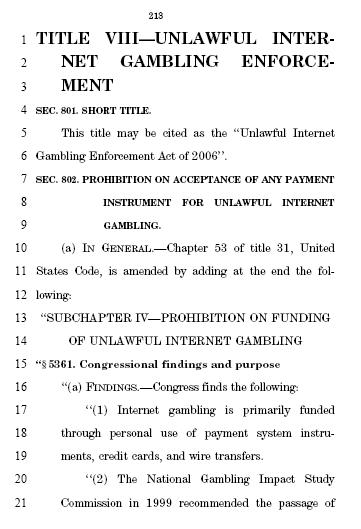
First page of the Unlawful Internet Gambling Enforcement ActNow that I have moneys back in Full Tilt Poker, I was able to pony up the buy-in for my first Ante Up Intercontinental Poker Series (AIPS) event yesterday -- Event No. 5, 6-handed NL Hold ’em. Not as versed these days in the multitude of strategies needed to succeed in no limit tourneys. Still, I was somewhat satisfied with my performance (finishing 23rd out of 51 entrants). Didn’t embarrass myself, at least. Was bounced by the eventual winner, in fact, when he won a duel with ace-king versus my pocket jacks. Win that coin flip and I’m middle of the pack at least with that final table not too far in the distance.

Aside from the very first hand of the tourney -- when I was dealt pocket kings (and won a whopping 105 chips with ’em) -- I didn’t see much of anything in the way of premium hands until those jacks came around nearly an hour later. Still managed to keep my stack level by stealing blinds now and then, then built it up a bit via a couple of fortunate flops and some fortunately-timed bluffs. Looking back through on Poker Tracker, I see that in the 88 hands I played prior to the last hand, I never lost more than 350 chips on a single hand, and never won more than 650. Talk about small-pot poker. I certainly played tighter than is probably recommended for a short-handed game. Like I said, I was out of my element a bit . . . . Still, a lot of fun. I may try one or two more events here before they finally award that big banana trophy on November 4th.

Meanwhile, I’ve been looking through all of the forums and whatnot in an attempt to educate myself a bit about the impending legislation. 2+2 remains the place to go for up-to-date info. You can waste some time on certain threads, but it isn’t hard to find good reporting over there. I've listened to several of this week’s podcasts as well. Ante Up! and Pocket Fives were both particularly informative. I recommend both of ’em to anyone wanting updates and/or analyses of where things stand at present. I've read I. Nelson Rose’s analysis of the Act, the response of Allyn Jaffrey Shulman (of CardPlayer) to the Act, and even the Act itself -- i.e., Article VIII (pages 213-244) of the Safe Port Act, titled the “Unlawful Internet Gambling Enforcement Act.” Hell, I’ve even read Bill Frist’s victory speech-slash-column offering his view of what he managed to engineer in Congress that night.

I think I now have some idea of what is going on, and even some clues about what might be happening down the road. This week I’m going to write three posts in which I’ll offer my thoughts about the Act and what it means. I’ll also be speculating a bit about how I think it might further affect my ability to play online poker (and keep a poker blog, for that matter).

The first post will talk about how the Act tries to redefine a “bet or wager.” What was passed on September 29th is a version of the Leach Act (which was a revision of the Goodlatte Act) minus that section attempting to update the 1961 Wire Act to include more than just sports betting. Even though the attempt to update the Wire Act was taken out, there remains in this new Act an attempt to redefine “bet or wager” to include not just sports betting, but also “risking . . . something of value upon the outcome of . . . a game subject to chance.” As Nelson Rose explains, that phrase “a game subject to chance” is specifically meant to include poker.

The second post will concern that part of the Act that discusses “Interactive computer services” -- a legalistic way of referring to Internet Service Providers (or ISPs). It is notable, actually, that the former name of the Act -- the Internet Gambling Prohibition Act -- was revised last week to become the Unlawful Internet Gambling Enforcement Act. The new version of the Act that Congress passed is mostly about how to enforce what some believe to be preexisting laws forbidding online gambling. One of the mechanisms described concerns federal agents being able to order ISPs to remove internet sites that are transmitting money to gambling sites. ISPs can also be ordered to block sites with hyperlinks to gambling sites (such as the one you are reading right now).

In the third post I’ll try to assess how various poker sites reacted to what happened in Congress last week. No one saw that coming, it seems. I imagine that Bush will have signed the Act into law by the time I post that one, so we may have even more news by then to consider.

In the meantime, I’m still playing . . . . In fact, I’ll be talking about one crazy hand in particular in my next post, one that I think helps to address this notion that poker is, indeed, “a game subject to chance.”

Image: Internet Gambling Enforcement Act of 2006.

Labels: , , , , , , , ,


Older Posts

Copyright © 2006-2021 Hard-Boiled Poker.
All Rights Reserved.