Saturday, June 07, 2008

2008 WSOP, Day 8: Keep Up the Pace

Keep Up the PaceThe first day of Event No. 11, the $5,000 No-Limit Hold’em Shootout, went reasonably well, I thought. Steve and I managed to keep up with quite a lot of the action at all 36 tables.

I was particularly proud of the fact that we got just about all of the final hands on all of the tables, and also caught most (not all) of the bustouts of the big names. Have gotten comments from several folks that the two of us are churning out posts at a high clip, which I’m glad to hear, as I don’t necessarily have a feel for how fast or slow it all appears.

As I’ve said before, it gets a bit hectic just trying to keep up, never mind be clear (or even witty or creative now and then), so getting to the end of the night with a sense that we’ve “covered” the action reasonably well is definitely satisfying.

Speaking of getting to the end of the night, we had one of the 36 tables linger well past all of the others, extending our work shift an extra three hours or so. Mike Sterling and Gregg Turk kept their heads up battle going for something like four-and-a-half hours before Turk finally won his way into today’s Round 2, and so we all stuck around to the very end to make our coverage complete.

The schedule of play for this event is kind of curious, I think, as players began yesterday with 10,000 chips and blinds of 100/200 in Level 1. The announcer at the start described the structure as “slow” and I reported him saying that in the blog, but soon after play began players were complaining that they only had 50 BB to start -- not enough (thought some) for a $5,000 buy-in event. (I reported those complaints, too.) I noticed posters debating this topic a bit over in the Two Plus Two threads sweating Event No. 11, as well.

But while starting with 50 BB might indicate a “fast” structure, I think the structure did slow down somewhat thereafter. Seemed that way, anyway. We noticed that once tables got down to four or fewer players, in most cases the blinds were quite small relative to the stack sizes.

For example, most of the tables were at heads up by Level 5 or 6 (each level lasted an hour). The blinds in Level 5 were 300/600, meaning the two players, who together had 100,000 chips, had an average of over 80 BB. Depending on the players’ styles, that could (and in some cases did) lead to some lengthy heads up battles. I think it was Level 7, when the blinds were 1,000/2,000, when Sterling and Turk started their heads up marathon, at which time they each had about 50 BB. Still allows for a lot of play heads up, yes?

Kind of curious to hear what people’s opinions are on this issue of the structure being fast, slow, or both. Today the schedule of play is almost identical to that of yesterday. They are starting with 100,000 chips today rather than 10,000, but the blinds and antes have all been multiplied by 10 as well. One big difference today, of course, is that they’ll be starting six-handed, rather than ten-handed as they did yesterday. (There are a couple of small differences with regard to the antes, too, though they aren’t terribly significant, I don’t think.)

I was pretty whipped by the time we wrapped things up around 11:30 p.m. We had not gotten a dinner break, and I hadn’t brought a lot in the way of snacks and whatnot, so I essentially hadn’t eaten anything since that bowl of Golden Grahams early yesterday morning. But some of my buds from the Vegaspalooza gang were descending on the MGM to play a mixed game, and I did want to get over there at least to meet some of them, if not actually play a bit.

So after a quick run over to my temporary summer digs, I drove up to the strip, parked the rental at the MGM, then walked the long, long walk from the parking deck to the poker room where I arrived some time after midnight. Put my name on a long list for the 2-4 mix game, then rang Gadzooks up on the cell to find out where they were. The other side of the poker room, she told me, all gathered at a table in the back. I made it over and finally “met” ’Zooks, Columbo (of the terrific “One Minute-Mystery” one can hear on Ante Up!), Falstaff, and a few others. The PokerGrump was there as well (with whom you’ll recall I’d got together last week).

The H.O.R.S.E. game was wild and loose and despite my fatigue I sincerely wished I could have gotten in on it, but I understood why no one was giving up their seat. Too damn fun, clearly. I enjoyed hanging out, nonetheless, chatting with ’Zooks, Falstaff, the Poker Grump, and fellow PokerNews blogger F-Train who arrived shortly after I did. All cool folks whom I hope perhaps to see again before they all go back home some time next week.

The game broke up about an hour after I arrived, as a number of the contingent had plans thereafter to visit one of the many adult-oriented establishments one finds in Vegas. Though invited, I took a pass -- Dr. Pauly, I clearly ain’t -- and made it back to the home-away-from-home by 2:30 or so, at which time I cooked up some pasta and finally fed myself.

I see the PokerGrump has a write-up of the night (with pics), and Gadzooks just posted a synopsis as well, if yr interested. And I’m sure all of the others will be chronicling Vegaspalooza on their blogs as well, so follow them links, too.

For now I think I’m gonna grab a bite, as I know now not to count on that dinner break later today. As Vera reminds me, I have to take care of myself if I hope to keep up.

Labels: , , , , , ,

Thursday, September 14, 2006

Thanks, Lord Admiral Radio

Card Club on Lord Admiral RadioAbout three months ago I spent a couple of posts writing up a “Podcast Line-Up” -- basically a ranking of ten poker podcasts of which I was aware at the time. For each of the ten I wrote a brief review -- here’s Part 1 (#6-#10) and here’s Part 2 (#1-#5). Since then, I’ve been regularly listening to a couple of other podcasts not mentioned in that list, including the weekly show produced by Pocket Fives (briefly discussed in a previous post) and Phil Gordon’s less frequently-produced The Poker Edge (part of ESPN’s “Poker Club”). I may in the not-too-distant future write a new post that updates the rankings by adding the new ones, dropping some of the old ones, and revising some of the reviews to reflect where some of these podcasts have gone since early summer.

Alas, any updated list of podcasts will necessarily omit the one I had rated at the very top of my rankings, Card Club on Lord Admiral Radio. Card Club bid us all farewell a couple of weeks ago, ceasing production after a whopping 84 episodes (and change). I just wanted to take a moment to thank “Cincinnati” Sean, Brent “Stacks,” “Headhunter” Mark, Evan “the Terrible,” Erik, Dan, and all the other Lord Admirals for having produced such a fine show over such a long period of time (from November 2004 through August 2006). There are numerous reasons why I enjoyed Card Club . . . I’ll just list three here.

The Lord Admirals letting us sit in . . . For one, Card Club was genuinely informative when it came to poker strategy and theory. The group often quizzed each other from their favorite poker books. They also intelligently discussed hands sent in by listeners and from their home game. And they didn’t just talk Hold ’em, but Omaha, Stud (five- and seven-card), Razz, and even the odd Anaconda hand. And, of course, Columbo’s terrific One Minute Mysteries (now relocated over to the Ante Up! podcast) added significantly to the proceedings.

Even though Sean and Stacks never once professed themselves to be experts about any game or aspect of poker, they were nevertheless routinely insightful in their discussions. The show was helpful in other ways as well. In their next-to-last broadcast (episode 83), Sean, Stacks, and Mark openly discussed the level of success each had achieved in their respective poker careers. I appreciated the openness with which they described their successes (and failures) at the tables. They also touched on their ambitions as poker players, all three identifying reasonable, modest goals for themselves.

Any successful poker player understands the importance of self-assessment, and it helps to hear or read others having such conversations as we try to interpret our own progress as players. I think most regular listeners would agree that they almost always benefitted in some tangible way from having listened to the show.

Secondly, the show was purposely geared toward the amateur player in a way that made it both unique and particularly rewarding to short-stacked types like myself. A few other poker podcasts aim for such a focus, and some (e.g., Ante Up!, PokerDiagram) are quite successful at doing so. Most podcasts still tend to be geared more towards the professional circuit, however. While shows like Rounders and CardPlayer’s The Circuit are always interesting and worth listening to, interviews with professional players are usually hit-or-miss affairs -- entertaining, perhaps, but not always of particular relevance to us players of lower limits.

Finally, I always appreciated the inclusive approach taken by the Lord Admirals -- indeed, listening to the show was a little bit like being part of a “Card Club” that met on a weekly basis. Sean repeatedly stressed the desire to build a community of poker players with the podcast. Judging from the always active Lord Admiral forum (located over on the Card Clubs Network), comments on the show’s blog, and the extensive network of poker bloggers who continually made the podcast a common point of reference, the show appears to have been successful at realizing such a community-building goal.

Thanks again, guys, for all of the effort creating and maintaining the show for so long. Well played.

(If you’re not familiar with Card Club, old shows remain available. Episodes 37-84 are still posted on the Lord Admiral’s blog; Episodes 2-24 & 26-36 are still up over at Feedburner.)

Image and Photo: Card Club on Lord Admiral Radio.

Labels: , , ,

Monday, June 26, 2006

Assuming the Worst

Assuming the WorstThis week’s installment of Card Club on Lord Admiral Radio (an entertaining, informative podcast primarily aimed at the lower limit player) featured the conclusion of Episode 19 of Columbo’s “One Minute Mystery,” titled “The Case of the Clichéd Players.” If you haven’t heard ’em, Columbo’s OMMs generally come in two parts, and usually the Card Club guys make us wait a week to find out how each OMM turned out for Columbo. (See my earlier review of Card Club for more about both the show and the OMMs.)

“The Case of the Clichéd Players” generated a thoughtful discussion on the Card Clubs forum that was continued on the show once the hosts played the second part of the OMM. An issue that arose -- really the main issue of significance, I’d say -- concerned the quality of play in online, low buy-in, multitable tourneys. In the hand, Columbo faced what appeared to be some very loose, very questionable betting and calling before and after the flop. Having to make a tricky post-flop decision, Columbo decided he was up against a couple of inexperienced and/or inexpert players and so acted accordingly. It turned out well for him, with his correct assumption that his two opponents were playing the hand poorly allowing him to triple up.

The OMM and the discussion surrounding it got me thinking a bit about how easy it is to underestimate one’s opponents at the table. I essentially agreed with Columbo’s cogitatin' in this here situation -- the minimum raises and calls of big bets by his foes did seem to indicate the likelihood that he was up against some untutored adversaries. It is easy, though, to fall into the trap of “assuming the worst” about the level of one’s opponents’ abilities, especially in these low buy-in tourneys or in low limit cash games. I know I’m guilty of making such assumptions -- sometimes on scant evidence -- and usually end up paying the price when an apparent donk turns out to be more crafty that I had realized.

In some of my recent posts I may have given the impression that I’m the only sane one at a table of lunatics -- that all of the other players at these low limits are operating at less than full capacity, thereby giving me the right to sit back and judge their awful play. Such is hardly the case. Looking back at the three hands I shared in “Life in the Land of the Blue Chips,” I can certainly question the level of my own thinking in a couple of instances (particularly “Hand 1” where I recklessly ride big slick to the bottom of the river). While those hands all certainly demonstrate some unorthodox play, none of them can be taken as irrefutable evidence that those involved (even me) are bad players. Indeed, the fellow in “Hand 1” (Underpants) who preraised with 82-suited could well have been pursuing a simple blind steal, was caught (with his pants down, so to speak) by my BB reraise and had to call, then fortunately flopped two pair and turned the boat. If I proceed from that point assuming he’s preraisin’ with any ol’ suited crap, I’m likely gonna be donating even more to his stack.

In Small Stakes Hold ’em, Miller/Sklansky/Malmuth make two sets of recommendations regarding starting hand selections, one for a “loose” table (where 6-8 players are seeing the flop) and one for a “tight” table (where only 3-5 players see the flop). When first arriving at a low limit hold ’em table where you don’t know any of the players, they recommend presuming you are at a loose table and continuing to think that way until proven otherwise. This advice goes against conventional wisdom, actually, which says to begin cautiously and try to learn about your opponents’ tendencies before mixing it up. However (argue Miller/Sklanskly/Malmuth), “at the small stakes there are so many confused and poorly-skilled players that failing to play extra hands should prove more costly those times when you should play them than they will save you those times you should throw them away.”

Notice that the authors are not saying to assume you are up against bad players -- rather, they say to assume you are up against loose players (implying, perhaps, that one or two or more might in fact be “poorly-skilled” enough to pay you off if you time things well). When I first arrive at a low limit table I try to follow the trio’s advice and assume it’s a loose table, but also try to avoid assuming the players are clueless. In fact, I attempt to give them all credit for knowing what they’re doing -- again, until they make a play that cannot possibly be interpreted as an intelligent one. In truth, I usually find it better policy to assume the worst about my own hand -- not about my opponents’ abilities -- and let folks showdown a few bottom pairs or busted draws to me before concocting any overly-elaborate theories about them.

If you haven’t done so, do check out Card Club and the OMMs. I always liked the Columbo TV series, where “who done it” was usually less of an issue than how it was done (and how Columbo is going to figure it all out). We all know the murderer will be caught in the end, so the result matters less to us than the process by which the result was achieved. The OMMs tend to operate similarly. It (usually) doesn’t matter so much how the hands turn out; what matters is process, that is, the thinking that leads to -- hopefully -- correct decision-making. And a big part of such correct decision-making is not assuming your opponents all think they’re playing blackjack.

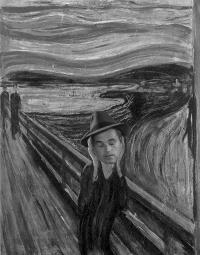
Image: Edvard Munch, The Scream (1892) and Tom Neal from the 1945 film Detour (adapted), public domain (both).

Labels: , , , , , ,


Older Posts

Copyright © 2006-2021 Hard-Boiled Poker.
All Rights Reserved.