Saturday, September 30, 2006

Deals in the Dead of Night
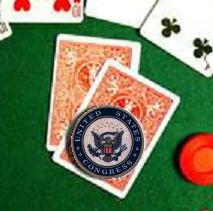
Congress Card GuardHad a marathon session last night over on Stars. At least by my standards. Was three-tabling it for quite a while, ultimately playing over 1,500 hands (of $0.50/$1.00 LH) before I finally hit the hay. Kind of unusual for me, as I usually prefer only to play a couple hundred hands (or less) during a given session. (Usually do better playing shorter sessions as well.) Did okay, though, ending about $27 to the good. And, as an unexpected surprise, I cleared my WCOOP reload bonus as well (for $100 more), so it was a lucrative evening.

Incidentally, while I was playing I also railed the final table of the WCOOP Event #15 Pot Limit Omaha ($530) in which a Finnish player named Trabelsi outlasted Humberto Brenes (Humberto B.), taking the bracelet and a cool $93,852.75. (There were no deals at this final table.) Listened to the audio broadcast as well with Wil Wheaton and Lee Jones, which was entertaining and informative. Poker Stars is replaying some WCOOP final tables, showing the hole cards of those players who have allowed it. Pretty interesting to watch, actually. As a limit player, I’m finding it useful to get a look at players’ hand selections and playing styles at the Event #7 Limit Hold ’em ($215) final table. (Look under the WCOOP tab in “Events” and click on “All” and you’ll see which final tables they’re replaying.)

So that’s one reason why I’m feeling a little fatigued today. There’s another reason, though.

While thousands of us were up late last night competing with each other in the game we love, Congress was also burning the midnight oil in an effort to pass legislation before heading into their October recess. One of the final items discussed last night (or, rather, early this morning) was legislation describing measures to protect the country’s hundreds of ports from potential terrorist attacks. This act (H.R. 4954, the “SAFE Port Act”) -- supported almost unanimously by representatives and senators from both sides of the aisle -- attracted several last-minute add-ons, including the Internet Gambling Enforcement Act (a version of the Internet Gambling Prohibition Act passed by the House back in July).

You might have heard about earlier, unsuccessful attempts to slide H.R. 4411 in with other legislation being brought before the Senate. Last week, Majority Senate leader Bill Frist (a Republican from Tennessee) tried to attach it to a defense spending bill, but was blocked from doing so by other senators. Frist has made clear his position that he believes internet gambling is harmful to families, “bringing an addictive behavior right into our living rooms.” Frist argues that internet gambling leads to other forms of criminal behavior, including money laundering, racketeering, and extortion. Frist has also made clear his intentions to run for president in 2008. He’s obviously betting that his chances won’t be affected should he lose the poker vote. (He’s probably right.)

Frist tried again last night, and this time he was successful. The Unlawful Internet Gambling Enforcement Act was added to the SAFE Port Act, which the House then overwhelmingly passed by a vote of 409 to 2. Then the Senate -- or at least those senators who were still around -- discussed and passed the act as well (not by vote, but by a procedural maneuver). Some had suggested Frist wouldn’t be able to pull off such a deal. But he rivered this one and how.

What comes next? Now that the Unlawful Internet Gambling Enforcement Act has been approved by both the House and the Senate, all that is left is for the president to sign it. And he will. Within the next ten days or so. Then things should get even more interesting . . . .

I wrote about the Act back in July. If you read that earlier post, you'll see a rundown of what the Act says and my thoughts about its possible consequences at the time. Think I'm slightly more apprehensive about the whole rigamarole today. For better informed views on the matter, check out the “Legislation” section of the 2+2 Forums for up-to-the-minute news and threads about how the Act might affect American online poker players.

Meanwhile, I'm gonna be turning in early tonight. Rather not try to battle the late night crazies while not fully rested and alert. Lot of sneaky deals happening when it gets late.

Image: Seal of the United States Congress (adapted), public domain.

Labels: , , , , , ,

Sunday, July 16, 2006

Raising a Glass to the Return of Prohibition

A Prohibition Poster, only slightly modifiedAll of Dashiell Hammett’s great hard-boiled novels -- Red Harvest, The Dain Curse, The Maltese Falcon, The Glass Key, The Thin Man -- take place during the time of Prohibition. Except for the The Thin Man, all were published prior to the 1933 passage of the 21st Amendment (repealing the 18th Amendment prohibiting “the manufacture, sale, or transportation of intoxicating liqours”). The Thin Man, published in 1934, is set a couple of years earlier and shows its protagonist couple Nick and Nora Charles and other characters easily locating drinking establishments (“speakeasies”) where they consume prodigous amounts of alcohol throughout the novel. Some see the high frequency of drinking in The Thin Man as adding up to a kind of commentary by Hammett on the futility of trying to enforce prohibition laws. Characters often end up in joints like the Pigiron Club ordering drink after drink, clearly nonplussed by the legality of such establishments. Early in the novel Nick and Nora wake up one morning and over the paper Nick suggests having “a drop of something to cut the phlegm.” “Why don’t you have some breakfast first?” Nora suggests. “It’s too early for breakfast,” Nick replies.

In truth, consuming or possessing alcohol was never illegal -- only the “manufacture, sale, or transportation” was. Still, the law helped create what many deemed a disproportiately large “criminal” class of citizens, not to mention handed bootleggers and organized crime leaders a readymade business opportunity of which toughs like Al Capone, Earl Weiss, and “Bugs” Moran took full advantage.

Some have linked recent legal efforts to criminalize online gambling to Prohibition, particularly those who oppose bills like the one passed last week by the House of Representatives. As a recent article in CardPlayer Magazine helpfully points out, the bill the House passed was not the so-called “Goodlatte Bill,” a.k.a., H.R. 4777, a.k.a. the “Internet Gambling Prohibition Act.” Rather, what passed was a different bill sponsored by Rep. Jim Leach, an Iowa Republican, that includes some but not all of Goodlatte’s proposals. Like Goodlatte’s bill, Leach’s bill (H.R. 4411) also (1) disallows online gaming sites from accepting payments via U.S. banks; (2) disallows U.S. banks from delivering payments to online gaming sites; (3) amends the definition of “wire communication” to include the Internet; and (4) places a “burden” upon ISP’s to block online gaming sites. There are other provisions in the bill, including dubious “carve-outs” or exceptions for lotteries and horse racing.

The bill now must be approved both by the senate and the White House. Word is the White House will support the bill, if it gets that far. However, the senate appears less concerned about even discussing the bill for now, and apparently (at present, anyway) there aren’t enough votes there for it to pass through. Still, the fact that H.R. 4411 passed in the House by such a large margin -- 317 ayes, 93 noes -- suggests that a lot of our elected representatives see reason to support such a bill. Allyn Jaffrey Shulman’s article “A Comprehensive Analysis of the Internet Gambling Prohibition Act” (from the May 2, 2006 issue of CardPlayer) explains what Goodlatte’s bill is, the political context for its having reached the House floor now, as well as the various implications of the bill should it ever pass. (Much of what she says about Goodlatte’s bill also applies to H.R. 4411.)

A lot of online poker players don’t realize that Goodlatte’s bill has been around for a long time -- longer than any of the online poker sites have been in operation. The bill actually originated over in the senate when Sen. Jon Kyl (R., Arizona) proposed it back in 1997. (Goodlatte then proposed the “House version” of an essentially similar bill shortly thereafter.) Thus when debate began nearly ten years ago about the possibilities of creating a federal law that would make online gambling a crime, there was no PokerStars or Party Poker or Full Tilt Poker. (While online gambling sites first came about in 1995, the first online poker site, Planet Poker, didn’t arrive until 1998.) This means that the sites on which we all play were (in most cases) constructed very deliberately so as to avoid possible legal hassles down the road. All are located offshore (i.e., not in America) in other countries, many of which in fact regulate internet gambling (such as the U.K.). Also, credit card companies and banks quickly began to disallow money transfers to and from these sites (even though they weren’t compelled by any law to do so); thus the popular “third-party” money transfer sites like Neteller and Firepay (also located offshore) stepped in to provide a means for players to get money to and from the sites.

The very way online poker has developed, then, proves what some observers were saying way back in the late 1990s when the Internet Gambling Prohibition Act was first presented. Back in May 1998, Andrea Lessani of the The UCLA Online Institute for Cyberspace Law and Policy argued that “the passage of the Internet Act would not eliminate online gambling and protect against the dangers of Internet gambling. Instead, its passage would drive online gambling underground and may even intensify the problems of Internet gambling.” (Her article can be viewed online at the Institute’s archive.) Lessani instead favors regulation and taxation -- not coincidentally, the same solution eventually settled upon in America regarding the manufacture, sale, and transportation of alcohol.

The fact that our favorite sites have already anticipated such a crackdown, putting into place the offshore “loophole” even before it was necessary, demonstrates in part how impotent bills like H.R. 4411 and H.R. 4777 potentially are. If either bill passes and ISPs indeed start to block Americans’ access to online poker sites, you can bet that other “loopholes” will already have been created well in advance to ensure uninterrupted play.

What’ll be different? Not much. Aside from the fact that, technically speaking, we’ll all be criminals. Some of us even before breakfast.

Image: Temperance poster, ca. 1910-15 (adapted), public domain.

Labels: , , , , , ,


Older Posts

Copyright © 2006-2021 Hard-Boiled Poker.
All Rights Reserved.