Wednesday, September 30, 2015

Positions and Juxtapositions: Nine Years Later, the UIGEA Then and Now

I’m just going to juxtapose a few items here today, inspired both by an anniversary and some items I’ve read and heard this week.

On this date nine years ago -- just a few months after I started the Hard-Boiled Poker blog -- I wrote a post here called “Deals in the Dead of Night” noting how the night before, after midnight in fact, a federal bill had passed through both houses that thereafter change the course of online poker in the United States once it was signed into law by then-president George W. Bush a couple of weeks later.

As it happened, that same bill -- the Unlawful Internet Gambling Enforcement Act of 2006 -- helped pave the way for the birth of a new online industry, fantasty sports.

1. “Senate Passes Bill on Building Border Fence” (The New York Times, Sept. 29, 2006)

“At the urging of conservative groups and the National Football League, among other interests, the port security measure carried legislation cracking down on Internet gambling by prohibiting credit card companies and other financial institutions from processing the exchange of money between bettors and Web sites. The prohibition, which exempts some horse-racing operations, has previously passed the House and Senate at different times but has never cleared Congress.”

2. “Frist Statement on Passage of Internet Gambling Legislation” (Sept. 29, 2006)

“U.S. Senate Majority Leader Bill Frist, M.D., (R-Tenn.) made the following statement after the Senate passed the Unlawful Internet Gambling Enforcement Act:

‘Gambling is a serious addiction that undermines the family, dashes dreams, and frays the fabric of society. Congress has grappled with this issue for 10 years, and during that time we’ve watched this shadow industry explode. For me as majority leader, the bottom line is simple: Internet gambling is illegal. Although we can’t monitor every online gambler or regulate offshore gambling, we can police the financial institutions that disregard our laws.’”

3. “Unlawful Internet Gambling Enforcement Act of 2006” (Oct. 13, 2006)

“The term ‘bet or wager’... does not include... participation in any fantasy or simulation sports game or educational game or contest in which (if the game or contest involves a team or teams) no fantasy or simulation sports team is based on the current membership of an actual team that is a member of an amateur or professional sports organization....”

4. “NFLPA Adds DraftKings to Partnership Lineup” (Sept. 25, 2015)

“The NFL Players Association (NFLPA), via its licensing and marketing arm NFL Players Inc., and DraftKings, a leading destination for daily fantasy sports (DFS), today announced a group licensing partnership that will allow some of the NFL’s top-rated players to participate in DraftKings’ marketing efforts this season.... The NFLPA licensing partnership will provide DraftKings the right to employ active NFL players for in-product and promotional campaigns across broadcast, print, social media, digital and mobile properties, as well as via experiential, memorabilia and content activations....

As the popularity of fantasy sports continues to grow with more than 56 million players in 2015, a nearly 40-percent year-to-year increase according to global market research company Ipsos, the deal provides DraftKings with a new degree of connectivity by directly involving a group of active NFL players in the marketing and promotion of its daily fantasy sports experience to fans.”

5. “Fantasy Sports Sites DraftKings, FanDuel September Spend Tops $100 Million” (Advertising Age, Sept. 30, 2015).

“According to iSpot.tv estimates, DraftKings and FanDuel together have funneled $107 million into the networks' coffers since Sept. 1. Nearly half ($50.3 million) of that outlay was spent on national NFL broadcasts on CBS, Fox, NBC, ESPN and NFL Network....

DraftKings ads have aired a skull-clutching 16,259 times over the course of the month, which works out to 135 hours and 25 minutes of 30-second spots. That's more than five-and-a-half days, or a full work week, of commercial messaging that's been hammered out in the span of a 29-day period.... By iSpot's reckoning, FanDuel ads have aired 9,463 times since Sept. 1. That translates to nearly 79 hours of total airtime, or a little north of three days.”

6. Dan LeBatard and Jon Weiner (Stugotz), The Dan LeBatard Show with Stugotz (ESPN, Sept. 29, 2015)

LeBatard: “DraftKings is spilling money all over the place, and now they have made an allegiance with the NFL Players Union where they are able to put players in their advertising. And I’m trying to find exactly the right analogy here, because what DraftKings and FanDuel and what the fantasy phenomenon has captured here is, it’s not quite legalized cocaine... because cocaine has a stigma with it.... But we are in an area right now where DraftKings and FanDuel... and their ilk have found this place.... They’ve found a place where it’s gambling -- it’s obviously gambling -- [and] they’re able to spill and sponsor everything in sports and everyone is taking their money.... People want it.”

Stugotz: “I agree with you about the stigma, but wasn’t online poker... didn’t they ban that?”

LeBatard: “Yes... but online poker is a little sketchier, not nearly as popular as this is....”

Stugotz: “I agree, but I’m just trying to figure out the difference between the two.”

LeBatard: “Oh, there is no difference. One’s legal and one’s not.... One is legal because it’s a game of skill, the other is illegal because, poker players will tell you, it, too, is a game of skill, but it’s the same thing.... It’s amazing to watch the arbitrary moralities that we have with this.”

LeBatard: “I just think it’s weird that we are always applying arbitrary moralities, and in this case we are doing it with our legal system and we’re doing it with our government. It doesn’t make any sense to me that this is legal and online poker isn’t.”

Labels: , , , , , , , , , , , , , ,

Thursday, October 13, 2011

Five Years of the UIGEA

Unlawful Internet Gambling Enforcement Act of 2006Today marks the fifth anniversary of George W. Bush signing into law the Unlawful Internet Gambling Enforcement Act of 2006. Or as many call it, the Awful Internet Gambling Act.

It was a Friday, as some of us remember -- an unlucky Friday the 13th for online poker players all over, but especially here in the United States.

What then-president Bush actually signed was something called the Security and Accountability For Every Port Act of 2006, a.k.a. the SAFE Port Act. There were a bunch of similar bills in Congress at the time designed to strengthen security at U.S. ports. A lot of that had to do with the fact that a few U.S. ports had been sold to a company in Dubai earlier that year, causing some to fret over whether or not national security might be put at risk.

Yeah, I know. What does online gambling have to do with that? A lot of people were wondering the same thing at the time.

Of course, fears about terrorist acts on U.S. soil had remained on a high level for more than five years since the attacks of 9/11. And so the SAFE Port Act -- like other legislation pushed through just before the 109th Congress closed up shop there at the end of September 2006 -- was viewed by many as "must pass" legislation.

We all know how Bill Frist, the Republican from Tennessee who was then the Senate Majority Leader (and who harbored presidential hopes as well), managed to tack on the UIGEA as "Title VIII" of the SAFE Port Act just before it was rapidly rushed through both houses literally minutes before Congress had finished its legislative business.

Today I found myself thinking back to that sequence of events from five years ago, and how many hadn’t necessarily expected to wake up on Saturday morning, September 30, 2006, to discover the damn thing had actually been passed.

UIGEA steamrollerFrist had tried just a week before to attach H.R. 4411 -- a UIGEA-like bill that the House had voted on and passed back in July 2006 -- to a defense spending bill, but several senators had stopped him from doing so. That I think gave a lot of us reason to believe such shenanigans weren't going to work should they be attempted once more.

But by the end of that week we were starting to hear some rumblings that Frist might try something similar again, perhaps pulling a "midnight drop" and adding the sucker to a bill at the last minute. The guys at Up for Poker were on to it, with Luckbox posting about the possibility during the day on Friday.

It was close to midnight that night when the SAFE Port Act was pushed through with almost no opposition. The vote was 409 to 2 in the House. Meanwhile over in the Senate they just affirmed it via a procedural maneuver. Such is the sketchy, not-always-fair-or-even-rational-seeming process by which bills can become laws.

Like I say, I think a lot of online poker players were surprised to learn of this development. I wrote a post that Saturday titled "Deals in the Dead of Night" describing both how I'd played a ton on PokerStars the night before and how the signing of the UIGEA into law had given me a bit of apprehension about what the future might hold.

Please Vote Against Online GamblingBut really, at the time we had only a faint idea of how what was to come. Over the next couple of weeks we studied up on the UIGEA. I wrote three posts as a kind of initial attempt to try to sort it all out (Part I, Part II, Part III). I had only started the blog a few months before, having no idea when I did how much time I would end up spending trying to parse bills and other legislative jargon.

In any case, while we still weren't too sure about it all, we knew it wasn't good.

That is to say, by the time Friday the 13th rolled around we knew that the UIGEA was kind of a BFD.

Some of us soon became further convinced of this fact when we were made to cash out from our PartyPoker accounts. I remember having a phone conversation with PartyPoker support sometime the following week, and the two of us kind of lamenting together how our relationship was coming to an end.

It really looked as though PokerStars, Full Tilt Poker, and everyone else might follow suit shortly thereafter and leave the U.S., too. But as we know that didn't happen. Indeed, nothing really happened for a long time, as it would take until mid-2010 for the UIGEA's "final regulations" to be established and compliance finally be made mandatory.

That’s when, of course, things got especially tricky for the sites that had chosen to continue to serve U.S. customers. Then came all those extra-curricular maneuvers by the biggest sites to keep Americans on board, including the bank fraud and money laundering that became part of the Black Friday indictment along with the allegations about violating the UIGEA and the Illegal Gambling Business Act.

I guess I still feel like we might not have seen the U.S. government go after the online sites for the UIGEA alone. That is to say, the bank fraud and money laundering charges gave the DOJ plenty of leverage to proceed with the indictment and civil complaint. But that’s hard to say, really.

UIGEA hammerYou could say the UIGEA is being challenged on a couple of fronts at the moment. Just last night the Merge network of sites reopened its doors to U.S. customers. While not every Merge skin is on board here, it sounds like many are, and so we’ll see whether the DOJ will be moved to try to bring down the UIGEA hammer again or not.

Also, a couple of those indicted back in April -- Chad Elie (a payment processor) and John Campos (Vice Chairman of that bank in Utah that processed payments) -- recently filed to have charges that they violated the UIGEA (and the IGBA) dismissed. As some had pointed out before, the UIGEA's vagueness about what exactly is unlawful (a "game subject to chance") is being highlighted by these two as grounds to absolve them. (See Subject:Poker’s report on their challenge for more.)

Might be sooner than later, then, for us to see how the UIGEA will continue to affect us going forward. Safe to say, though, that it has had plenty of influence during its first five years.

Labels: , , , ,

Wednesday, November 25, 2009

The Door is Closing: Hoping for UIGEA Delay

The Door is Closing: Hoping for UIGEA DelayYesterday on the Two Plus Two forums, a question was asked about “how pivotal are the next 24 hours” when it comes to the possibility that compliance with the finalized regulations for the Unlawful Internet Gambling Enforcement Act of 2006 -- scheduled to begin next Tuesday, December 1 -- will be delayed.

According to Rich “The Engineer” Muny, a member of the Board of Directors of the Poker Players Alliance, “If [the] Treasury decides to delay implementation of the bill, it could be announced tomorrow, or it could go to Monday just as easily.” Indeed, as Muny implies, since the Thanksgiving holiday is upon us, if we don’t hear anything today, then Monday is really the last chance.

It is very difficult for the average shamus to detect the odds of a delay with any precision here. I’ve been reading the forums and other sites, and occasionally see expressions of optimism about the feds stepping in here and extend the deadline. But it is hard to tell from where such optimism comes.

On November 20 (last Friday), an article titled “High Stakes for Online Gamblers” popped up over on the Newsweek blog regarding the impending deadline and the recent request for a delay. The article, by Jeremy Herb, makes reference to an unnamed “Federal Reserve official” saying that a decision regarding delaying compliance had yet to be made.

That’s with just a week-and-a-half to go. Talk about a sweat.

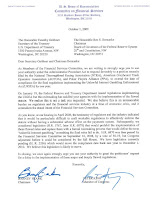
Petition to delay UIGEAHerb’s article additionally provides a decent overview of the situation, including some background on how the UIGEA came to be and the problems that still exist for banks and other financial institutions with regard to implementation. Herb references that October 1 letter from House Rep. Barney Frank (D-MA) and Rep. Peter King (R-NY) -- also signed by 17 other members of Congress -- asking the Department of Treasury and Federal Reserve “to extend the date of compliance for the final regulations implementing the Unlawful Internet Gambling Enforcement Act (UIGEA) by one year.” The feds do have the power to enact such a delay thanks to something called the Administrative Procedure Act.

He also notes that other November 3 letter, also sent to Timothy Geithner (Secretary of the Treasury) and Ben Bernanke (Chairman of the Federal Reserve) by Senator Jon Kyl (R-AZ) and Rep. Spencer Bachus (R-AL) in which they “strongly oppose” the request made by Frank et al. for an extension, arguing that “there is no justification for delaying the compliance deadline of the UIGEA regulations.”

Among other points made by Kyl and Bachus, they cite the fact that banks have already had nearly a year to ready themselves for compliance, and so should not need any further time in that regard. Also, the pair notes how the “Final Rule was adopted after a lengthy and open rulemaking process,” and that any “‘problems’ [they use the scare quotes] raised by certain interest groups are speculative.”

You remember Kyl as one of the first authors of the bill that eventually became the UIGEA, and Bachus as the clown who in House hearings rode a moral high horse while misrepresenting studies about gambling and Full Tilt Poker pro biographies. (If yr curious, here is a post in which I shared some details from Bachus’ mostly deranged contributions to the discussion of online gambling.)

The most infuriating moment in their letter comes at the end when they characterize the delay request as “a blatant attempt to circumvent the democratic process.” O RLY?

Let us think back to how the bill came to be passed by the House and Senate back on September 30, 2006 after being sneakily appended to the Security and Accountability For Every Port Act of 2006. There was zero discussion of the UIGEA part of the bill when the House and Senate hastily voted in favor of the SAFE Port Act in their final session of the 2006 Congress. Then President George W. Bush signed it into law two weeks later. Indeed, thanks in large part to then Senate Majority Leader Bill Frist (R-TN) and Sen. Kyl, their efforts represented as “blatant” an example of legislators working “to circumvent the democratic process” as it gets.

Timothy Geithner and Ben BernankeThe fact is, both Geithner (top) and Bernanke (bottom) -- the ones to whom the petition to delay compliance has been directed -- have a lot else on their minds at the moment. Geithner’s status as Treasury Secretary is presently more than a little tenuous. Just last week he was explicitly asked to resign by House Rep. Kevin Brady (R-TX). Said Brady to Geithner, “the public has lost all confidence in your ability to do your job. Conservatives agree... liberals agree... it is time for a fresh start.”

Bernanke is also facing a lot of opposition from Congress at the moment. President Obama has already nominated Bernanke for a second four-year term as Federal Reserve Chairman, but Congress has to approve the nomination, and it is expected that their approval -- if it comes -- will not be without a lot of strife. The first hearing on that matter is scheduled for next Thursday, December 3.

So the guys who have to step in here and do something for us... well, one wonders how high a priority the UIGEA really is to them at the moment.

It’s frustrating as hell. We took a big hit early on in this one, and have been playing with a short stack from the get-go. Now the blinds have finally caught up with us. We have to catch a hand to survive.

Here’s hoping we do get the word today of a delay, and thus have something else to be thankful for tomorrow.

(EDIT [added 11/25/09, 10:30 a.m.]: This just in -- the House Financial Services Committee, chaired by Rep. Barney Frank, will be meeting on Thursday, December 3 at 10:00 a.m. to discuss his two bills, the Reasonable Prudence in Regulation Act [H.R. 2266] and the Internet Gambling Regulation, Consumer Protection, and Enforcement Act [H.R. 2267]. Of course the former bill -- which seeks to delay implementation of the UIGEA regs one year -- would apparently be somewhat moot should the regs go into effect on 12/1. Again, hard to read this announcement as an indicator of anything specific with regard to a possible delay. Stay tuned!)

(EDIT [added 11/25/09, 3:25 p.m.): The Engineer is reporting there may be a six-month delay in the implementation of the finalized regs. Read here. Good news, if this turns out to be the case!)

Labels: , , , , , , , ,

Sunday, October 08, 2006

Considering the Unlawful Internet Gambling Enforcement Act, Preface

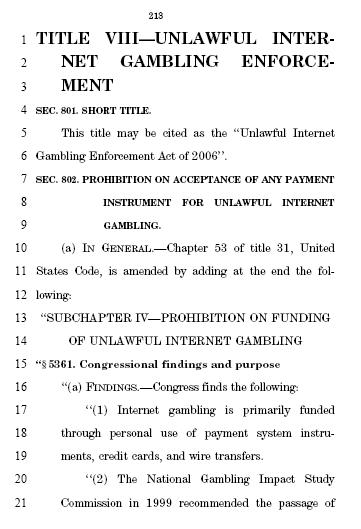
First page of the Unlawful Internet Gambling Enforcement ActNow that I have moneys back in Full Tilt Poker, I was able to pony up the buy-in for my first Ante Up Intercontinental Poker Series (AIPS) event yesterday -- Event No. 5, 6-handed NL Hold ’em. Not as versed these days in the multitude of strategies needed to succeed in no limit tourneys. Still, I was somewhat satisfied with my performance (finishing 23rd out of 51 entrants). Didn’t embarrass myself, at least. Was bounced by the eventual winner, in fact, when he won a duel with ace-king versus my pocket jacks. Win that coin flip and I’m middle of the pack at least with that final table not too far in the distance.

Aside from the very first hand of the tourney -- when I was dealt pocket kings (and won a whopping 105 chips with ’em) -- I didn’t see much of anything in the way of premium hands until those jacks came around nearly an hour later. Still managed to keep my stack level by stealing blinds now and then, then built it up a bit via a couple of fortunate flops and some fortunately-timed bluffs. Looking back through on Poker Tracker, I see that in the 88 hands I played prior to the last hand, I never lost more than 350 chips on a single hand, and never won more than 650. Talk about small-pot poker. I certainly played tighter than is probably recommended for a short-handed game. Like I said, I was out of my element a bit . . . . Still, a lot of fun. I may try one or two more events here before they finally award that big banana trophy on November 4th.

Meanwhile, I’ve been looking through all of the forums and whatnot in an attempt to educate myself a bit about the impending legislation. 2+2 remains the place to go for up-to-date info. You can waste some time on certain threads, but it isn’t hard to find good reporting over there. I've listened to several of this week’s podcasts as well. Ante Up! and Pocket Fives were both particularly informative. I recommend both of ’em to anyone wanting updates and/or analyses of where things stand at present. I've read I. Nelson Rose’s analysis of the Act, the response of Allyn Jaffrey Shulman (of CardPlayer) to the Act, and even the Act itself -- i.e., Article VIII (pages 213-244) of the Safe Port Act, titled the “Unlawful Internet Gambling Enforcement Act.” Hell, I’ve even read Bill Frist’s victory speech-slash-column offering his view of what he managed to engineer in Congress that night.

I think I now have some idea of what is going on, and even some clues about what might be happening down the road. This week I’m going to write three posts in which I’ll offer my thoughts about the Act and what it means. I’ll also be speculating a bit about how I think it might further affect my ability to play online poker (and keep a poker blog, for that matter).

The first post will talk about how the Act tries to redefine a “bet or wager.” What was passed on September 29th is a version of the Leach Act (which was a revision of the Goodlatte Act) minus that section attempting to update the 1961 Wire Act to include more than just sports betting. Even though the attempt to update the Wire Act was taken out, there remains in this new Act an attempt to redefine “bet or wager” to include not just sports betting, but also “risking . . . something of value upon the outcome of . . . a game subject to chance.” As Nelson Rose explains, that phrase “a game subject to chance” is specifically meant to include poker.

The second post will concern that part of the Act that discusses “Interactive computer services” -- a legalistic way of referring to Internet Service Providers (or ISPs). It is notable, actually, that the former name of the Act -- the Internet Gambling Prohibition Act -- was revised last week to become the Unlawful Internet Gambling Enforcement Act. The new version of the Act that Congress passed is mostly about how to enforce what some believe to be preexisting laws forbidding online gambling. One of the mechanisms described concerns federal agents being able to order ISPs to remove internet sites that are transmitting money to gambling sites. ISPs can also be ordered to block sites with hyperlinks to gambling sites (such as the one you are reading right now).

In the third post I’ll try to assess how various poker sites reacted to what happened in Congress last week. No one saw that coming, it seems. I imagine that Bush will have signed the Act into law by the time I post that one, so we may have even more news by then to consider.

In the meantime, I’m still playing . . . . In fact, I’ll be talking about one crazy hand in particular in my next post, one that I think helps to address this notion that poker is, indeed, “a game subject to chance.”

Image: Internet Gambling Enforcement Act of 2006.

Labels: , , , , , , , ,

Saturday, September 30, 2006

Deals in the Dead of Night

Congress Card GuardHad a marathon session last night over on Stars. At least by my standards. Was three-tabling it for quite a while, ultimately playing over 1,500 hands (of $0.50/$1.00 LH) before I finally hit the hay. Kind of unusual for me, as I usually prefer only to play a couple hundred hands (or less) during a given session. (Usually do better playing shorter sessions as well.) Did okay, though, ending about $27 to the good. And, as an unexpected surprise, I cleared my WCOOP reload bonus as well (for $100 more), so it was a lucrative evening.

Incidentally, while I was playing I also railed the final table of the WCOOP Event #15 Pot Limit Omaha ($530) in which a Finnish player named Trabelsi outlasted Humberto Brenes (Humberto B.), taking the bracelet and a cool $93,852.75. (There were no deals at this final table.) Listened to the audio broadcast as well with Wil Wheaton and Lee Jones, which was entertaining and informative. Poker Stars is replaying some WCOOP final tables, showing the hole cards of those players who have allowed it. Pretty interesting to watch, actually. As a limit player, I’m finding it useful to get a look at players’ hand selections and playing styles at the Event #7 Limit Hold ’em ($215) final table. (Look under the WCOOP tab in “Events” and click on “All” and you’ll see which final tables they’re replaying.)

So that’s one reason why I’m feeling a little fatigued today. There’s another reason, though.

While thousands of us were up late last night competing with each other in the game we love, Congress was also burning the midnight oil in an effort to pass legislation before heading into their October recess. One of the final items discussed last night (or, rather, early this morning) was legislation describing measures to protect the country’s hundreds of ports from potential terrorist attacks. This act (H.R. 4954, the “SAFE Port Act”) -- supported almost unanimously by representatives and senators from both sides of the aisle -- attracted several last-minute add-ons, including the Internet Gambling Enforcement Act (a version of the Internet Gambling Prohibition Act passed by the House back in July).

You might have heard about earlier, unsuccessful attempts to slide H.R. 4411 in with other legislation being brought before the Senate. Last week, Majority Senate leader Bill Frist (a Republican from Tennessee) tried to attach it to a defense spending bill, but was blocked from doing so by other senators. Frist has made clear his position that he believes internet gambling is harmful to families, “bringing an addictive behavior right into our living rooms.” Frist argues that internet gambling leads to other forms of criminal behavior, including money laundering, racketeering, and extortion. Frist has also made clear his intentions to run for president in 2008. He’s obviously betting that his chances won’t be affected should he lose the poker vote. (He’s probably right.)

Frist tried again last night, and this time he was successful. The Unlawful Internet Gambling Enforcement Act was added to the SAFE Port Act, which the House then overwhelmingly passed by a vote of 409 to 2. Then the Senate -- or at least those senators who were still around -- discussed and passed the act as well (not by vote, but by a procedural maneuver). Some had suggested Frist wouldn’t be able to pull off such a deal. But he rivered this one and how.

What comes next? Now that the Unlawful Internet Gambling Enforcement Act has been approved by both the House and the Senate, all that is left is for the president to sign it. And he will. Within the next ten days or so. Then things should get even more interesting . . . .

I wrote about the Act back in July. If you read that earlier post, you'll see a rundown of what the Act says and my thoughts about its possible consequences at the time. Think I'm slightly more apprehensive about the whole rigamarole today. For better informed views on the matter, check out the “Legislation” section of the 2+2 Forums for up-to-the-minute news and threads about how the Act might affect American online poker players.

Meanwhile, I'm gonna be turning in early tonight. Rather not try to battle the late night crazies while not fully rested and alert. Lot of sneaky deals happening when it gets late.

Image: Seal of the United States Congress (adapted), public domain.

Labels: , , , , , ,


Older Posts

Copyright © 2006-2021 Hard-Boiled Poker.
All Rights Reserved.