Tuesday, October 18, 2016

On the Move to Malta

Writing a quick one here from the airport where I’m waiting once again to begin another tourney journey. Heading to Malta this time for the European Poker Tour festival which has already begun there on the tiny archipelago just off Italy’s boot.

This’ll be a new destination for your humble scribbler. I’ll admit I don’t know a heck of a lot at present about where I’m heading.

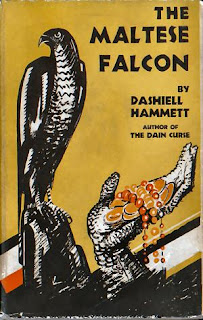
Back during my full-time teaching days I had a colleague swing a year-long sabbatical to Malta, although I never really talked much with him afterwards about his experience. Of course, Dashiell Hammett’s 1929 novel The Maltese Falcon is one of my fave reads, although that book has about as much to do with Malta as it does falcons.

In fact, toward the latter part of my detective novel Same Difference -- which is pretty deliberately meant as an homage of sorts to Hammett, Chandler, Cain, and other hard-boiled greats -- characters joke around a little about that novel’s story and how the Maltese falcon at the heart of it turns out to be a fake. (There’s a similar reference to the even more elusive postman in Cain’s The Postman Always Rings Twice.)

We’ll see what comes of this new poker plot I’m embarking on, and will try to sort out the important from the trivial. As always, I’ll try my best to keep in touch here as it goes.

More later from the Mediterranean!

Labels: , , , , , , , , , ,

Thursday, May 26, 2016

Don’t Egg Me On

More than 10 years ago, I picked the name of this blog along with a pseudonym -- “Short-Stacked Shamus” -- and at the time both the blog and the persona resided firmly within a poker-only world.

As such, most who came across either “Hard-Boiled Poker” or that nom de scribble at least had some idea what they meant. “Short-stacked” was a clear enough adjective for poker players, and while not everyone knew what a “shamus” was, it wasn’t difficult to bring up the genre of hard-boiled detective novels and films as a kind of thematic inspiration.

Now both the blog and the “Shamus” name exist outside of poker, too, which means I find myself in spots where I’m explaining the name of the blog (or “SSS”) to people who aren’t familiar with either poker or detective stories. The fact that I (crazily) use “shortstackedshamus” as part of my primary email address doesn’t help matters, either.

It all can be a little humorous, sometimes, especially when the “hard-boiled” adjective is first understood as having something to do with eggs.

It is a weird adjective, if you think about it, meant to convey the “hardness” or tough-natured quality of the characters populating those stories of crime and corruption. The protagonists -- guys like Raymond Chandler’s Philip Marlowe or Dashiell Hammett’s Sam Spade and the Continental Op -- are forced to deal with the worst examples of humans behavior while remaining somehow unmoved or impervious.

Thinking of eggs, though, couldn’t be further removed, in terms of what they suggest. Even hard-boiled eggs are pretty easy to smash, and when you get to the jelly-like whites and crumbly yolks they are kind of the opposite of hard.

Eggs don’t have a lot to do with poker, either. Unless, of course, we’re talking about eggsposed cards. Or eggspected value.

Okay, those were both pretty bad. Rotten, even. Really laid an egg there. Boy, do I have egg on my face. But hey, you can’t make an omelet without....

Labels: , , , ,

Wednesday, April 20, 2016

Now That’s a Lot of Cabbage

Something recently reminded me of that specialized “hard-boiled” lingo one finds in novels by writers like Dashiel Hammett, Raymond Chandler, James M. Cain, and others. I think it must have been a delayed echo from that Robyn Hitchcock show I was writing about a couple of days ago, specifically his tune “Raymond Chandler Evening” I’ve continue to hum all week.

I was going back through some posts on the blog recently -- just cleaning up some dead links here and there. Ended up lingering for a while, reading several including a few early ones where I tried (somewhat vainly) to write using that “hard-boiled” patois.

That didn’t last very long (thankfully), although a few phrases and words have stuck over the years, including using “cabbage” to refer to money. It wasn’t my normal voice, of course, and while my detective novel Same Difference has a few hard-boiled elements (including style-wise), I didn’t go for the lingo so much there, either, finding it hard enough to tell a story without giving myself that additional challenge.

I’ve toyed with another novel idea, a story set in the late 1920s, actually, where it would be not inappropriate to include characters sounding like Sam Spade or Philip Marlowe. So ripe for parody, that. Can only really be done with tongue partially in cheek.

Probably wouldn’t have made it to one year on here writing about poker had I tried to keep up that applesauce. Let alone ten, a milestone that’s coming up in just over a week. (No shinola.)

Labels: , , , ,

Monday, February 22, 2016

Travel Report, EPT12 Dublin, Epilogue -- “Hey, Shamus!”

On the way back to the train station in Dalkey on my last full day in Dublin (described here), I was walking on the platform when suddenly I heard a voice calling out behind me.

“Hey, Shamus!”

I turned around to see two Irishmen walking briskly toward a third, a fellow most obviously named Seamus (not Shamus). I laughed, thinking how occasionally people do actually call me Shamus, exclusively on poker trips. I could be forgiven for thinking perhaps the person was, in fact, calling to me.

“Shamus” of course is a slang term for a private detective, also used to refer to policemen. Starts turning up around the 1920s or so and at least one etymological explanation connects it to the preponderance of Irish-American cops (particulary in the northeastern U.S.). The word pops up in hard-boiled novels, with both Dashiell Hammett and Raymond Chandler using it. That spelling is in truth a misspelling, a phonetic representation of the traditional and popular Irish name, Seamus.

Flying home yesterday, I thought again of that funny moment and the little double-take that followed. Then I thought a little more about Ireland and how connected I seemed to feel with the place and the people while there.

I mentioned during some of the earlier trip posts some of the reasons for my affinity with Ireland, reasons which could also explain the not entirely expected experience of feeling “at home” while there (or something). All of that helped contribute to the feeling that it would never seem all that strange for someone to call out to me by name to greet me.

On the flight out of Dublin I happened to get into a conversation with the fellow seated next to me. Soon enough we figured out we were both heading to Charlotte, and in fact he lived in the neighboring town from me here on the farm. We were about 3,700 miles from our respective destinations, which were in fact only about half-dozen miles apart.

It was nice to chat and already to be thinking about home -- my real one -- and to enjoy talking with someone about things that were familiar. But my time in Ireland was been very pleasant, too, even comforting at times in a similar way.

Photo: “A large tricolour flying from CuChulainn House in the New Lodge, Belfast,” Ardfern (adapted). CC BY-SA 3.0.

Labels: , , , ,

Wednesday, February 17, 2010

The Flitcraft Parable

'The Maltese Falcon' (1930) by Dashiell HammettI am such a creature of habit. Almost obsessively so, I’d say.

Helps me in certain ways, for sure. While I haven’t even 1/100th of the stubborn stamina of most of these Olympic athletes I’ve been watching over the last few days, I’m pretty good at being able to focus on long-term tasks. I establish routines, stick to them doggedly, and little by little the work gets done.

Such had to have been the case for the writing of Same Difference, my hard-boiled detective novel (which you can now buy on Amazon -- check it out!).

But I’m not really talking about a trait that necessarily leads to achievement but rather a resistance to change -- a trait that likely more often than not makes it more difficult to succeed or achieve anything special.

One of my favorite moments in one of my favorite novels is the so-called “Flitcraft Parable” in Dashiell Hammett’s The Maltese Falcon (1930) -- a short digression completely unrelated to the novel’s plot in which Hammett’s detective, Sam Spade, tells a little story about a man named Flitcraft. The story is often cited as illustrating that sort of “existential” or “hard-boiled” view of the world adopted by Hammett and/or Spade. It also is all about being a creature of habit who resists change.

In the story, Spade explains how Flitcraft, a real estate agent and family man living in Tacoma, one day went to lunch and never returned. Five years later his wife comes to the detective agency where Spade is working with news that someone in Spokane told her of seeing a man who looked a lot like her husband. Spade tracks him down, and sure enough, it is Flitcraft, who then explains to Spade what he’s been doing all this time.

That day he had gone to lunch, he had walked by an office building under construction, and a huge beam fell from eight to ten stories up and stunningly landed on the sidewalk next to him, nearly killing him. It had the effect of snapping Flitcraft out of his existence for a moment. “He felt like somebody had taken the lid off life and let him look at the works,” says Spade. “The life he knew was a clean orderly sane responsible affair. Now a falling beam had shown him that life was fundamentally none of these things.”

He left for Seattle that very day, then moved around a bit before eventually coming back to Washington where he again got married and started a new family. “I don't think he even knew he had settled back naturally in the same groove he had jumped out of in Tacoma,” says Spade. “But that’s the part of it I always liked. He adjusted himself to beams falling, and then no more of them fell, and he adjusted himself to them not falling.”

Like I say, the digression has nothing specifically to do with the larger plot of The Maltese Falcon, but it does loudly sound a thematic point regarding what Hammett and/or Spade had come to discover about human nature. In our efforts to find meaning in our lives, we impulsively seek certain “grooves” or patterns that tend to help us reduce our sense of uncertainty. Could be explained as a kind of survival instinct. In any case, when it comes to these routines, humans tend not to be able to get along too well without ’em.

So I guess I’m saying I’m a bit like Flitcraft. But then, we all are, to some degree.
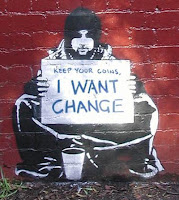
Keep your coins... I want change.Last April I wrote about my having this character trait in a post titled “The Ever-Present Existential Struggle With Change.” Indeed, the very fact that I’ve written about it before might be highlighted as further evidence of my “creature of habit” status.

There I explained how I am one of those “who generally has a hard time changing my routine once I find something that I like or at least is comfortable enough to endure without too much hardship. That’s not to say I am not able to adapt to changes that go on around me, but rather that I myself am less inclined to introduce such changes if not forced to do so.”

A few weeks ago I sat down at a Rush Poker table on Full Tilt, playing the game I’ve been playing pretty much without exception for the last year or so, pot-limit Omaha. Had a blast at first, particularly when it seemed there were quite a few not-so-hot players occupying the other virtual seats. After while the win rate finally dropped, and the novelty wore off. My graph ended up resembling an Isildur1-like rise and fall -- speaking in relative terms, of course, and thankfully not ending in a big ugly hole like the mystery man did back in December.

(Incidentally, Isildur1 has made a return to the high stakes tables over at Full Tilt Poker, where he apparently enjoyed a $730,000 winning session yesterday, most of which came versus Justin Bonomo. Read more here.)

But even though the enjoyment had waned, I still kept going back, instinctively joining the same silly game over and again. Not so much to satisfy some junkie-like fix such as Dr. Pauly lyrically detailed in his inventive “Memoirs of a Rush Addict” post in late January. Rather, I kept returning because of this strange inertia that takes over and prevents me from looking around and finding new challenges, and encourages me to keep to the safe, familiar path.

I guess trying out the Rush Poker format in the first place was something of a change, but it wasn’t really -- I probably wouldn’t have been so willing to try it if my game (at my stakes) weren’t available. So anyhow, there I was again earlier this week, sitting at another PLO25 table, stuck a bit for the session. And stuck in a larger sense, too.

Somehow I pulled away, and went over for some limit hold’em -- a previous obsession, you could say, though a game I hadn’t really played in over a year. Remembered it well enough, and picked up enough hands to leave up a pittance. And with a smile.

A small, relatively trivial move in the grand scheme of things, to be sure. But as a creature of habit, I found it meaningful.

In that post from last April I noted how “I tend to pick one game and stick to it in an almost obsessive (or superstitious) way, even though I know switching up would likely keep my poker instincts sharper in all games.” There I am, analyzing myself pretty accurately, I’d say. Though not appearing to do too much about it.

“I also tend to have a hard time moving around stakes-wise, especially if I’m extracting a modest win rate wherever I happen to be,” I added. “Kind of limits my ever seeing what exactly I’m capable of doing, poker-wise.”

Regarding my online play, I’m going to try to find a way to start incorporating change -- that is, playing different games and trying different stakes -- as part of my routine. In other words, I’m going to try to make change familiar. Will lessen my comfort level at times, I’m sure. But overall should increase the fun, and perhaps the “achievement,” too.

I mean, if I’m gonna be stuck in some groove, I might as well try to make it groovy.

Labels: , , , , ,

Thursday, May 08, 2008

Hammett's Op & the Perils of Stirring Things Up

'The Continental Op' by Dashiell HammettWas looking back through a volume of Dashiell Hammett stories, all of which feature that nameless private eye who is an operative of the Continental Detective Agency in San Francisco -- a character usually referred to as the “Continental Op.” Hammett started his career writing stories about the Continental Op, the earliest of which appeared in Black Mask way back in the early 1920s. Would end up writing over thirty stories featuring the savvy, hardened detective, some of which got compiled and refashioned as his first novels, Red Harvest and The Dain Curse.

Anyhow, was reading one particular story titled “The House on Turk Street” and was reminded of a situation that comes up now and again at the poker table. In fact, it recalled a particular hand of pot limit Omaha ($25 max. buy-in) I’d played earlier in the week.

In the story, the Op has been assigned the task of tracking down a particular person -- we’re not told why -- and so has been going door-to-door on a particular block of Turk Street with a fabricated tale designed to uncover the man’s whereabouts. After several unsuccessful visits, the Op finds himself having been invited into an elderly couple’s home for a cup of tea. The trio chat aimlessly, then with one sentence the light mood turns swiftly dark:

“Something cold touched the nape of my neck.”

It’s a gun, all right. Turns out the house is the hideout of a gang who has just pulled a bank heist in Los Angeles (they’ve paid the old couple to cover for them). Completely unrelated to the job for which the Op had been originally assigned. Before long, the Op is tied to a chair wondering how he’s gonna get out of the house on Turk Street alive. I won’t go through the rest of the plot, but eventually the Op succeeds in getting the gang members to turn against each other, thereby managing to wiggle himself free of a tricky spot.

What’s familiar here is that situation where you find yourself trying “to stir things up” (a favorite phrase of the Continental Op), then get into an entirely unexpected jam that forces you to find a completely new strategy in order to survive. You aren’t innocent, here. Like the Op, you were trying to get something from others and were using a bit of subterfuge to accomplish that task. But suddenly you feel something cold on the back of your neck and yr caught in an entirely different imbroglio than the one into which you thought you were entering. (Or creating.)

Here’s the hand. I was sitting in late position with 9-8-7-6 unsuited and it folded to me. I raised it up, as I’ll sometimes do with these rundown-type hands, and ended up getting two callers. The pot was around three bucks. (Sorry, don’t have the hand history.)

The flop wasn’t so hot -- Qd4h8d. Really only three viable outs for me there. The early position player thought a sec and bet two dollars, and the guy in between us calls. What do we have here? Coupla draws? I ended up calling. Not so hot, I know. That’s the moment where the entire situation had changed. Like the Continental Op, I started out thinking I was in charge of the proceedings, but now I’d found myself tied to a chair, wondering what exactly I’d gotten myself into.

The turn was the 2s and both players checked to me. This is one of those situations where it is probably better to be up against two players than one. They’re worried about each other, perhaps more so than about me. I checked as well, though I was starting to see a way out of this pickle.

The river brought the Kc, a card that completed no draws. Both checked to me again. I quickly made something like a two-thirds-pot-sized bet into the $9 pot, and both folded instantly.

Doesn’t always work out for me the way it tends to do for Hammett’s Op. Sometimes in that spot a player who flopped bottom set -- or who is sitting there with K-Q-x-x -- will look me up there, and I’m cooked . . . .

The Op usually winds up in the clear, though. Not conscience-wise, necessarily. But breathing-wise.

Labels: , , ,

Wednesday, July 19, 2006

Spillane Punches Out

Mickey Spillane might well have sold more “hard-boiled” fiction than any other writer of the twentieth century. When his first novel, I, the Jury, was released as a 25-cent Signet paperback in 1947, it was a genuine worldwide blockbuster, selling something like four million copies within five years. Spillane took advantage of his newfound fame, quickly producing four more novels featuring his narrator-private detective, Mike Hammer, over the next five years. (He'd ultimately produce over a dozen Hammer novels.)

Spillane died this week at the age of 88. Since I’ve already alluded to him in an earlier post or two, I thought I’d take the occasion to share a couple of thoughts about the man and his work.

Spillane began his creative career writing comic books, and his novels all exhibit a similarly-garish, “comic book”-type quality. The violence generally goes well beyond what one finds in earlier crime fiction. When Hammer finds a recently-shot John Hanson -- one of the many bodies strewn around I, the Jury -- we read how “He lay at the foot of the bed with his head in a puddle of his own blood and brains, and with a hole squarely between the eyes. On the wall was more of his goo, with the plaster cracked from where the bullet entered. He was a mess, this John Hanson.” And on to the next chapter. And body. There’s also in Spillane’s novels no shortage of sex -- sometimes presented in vivid, softcore colors. Brazen references to anatomical riches (“Her breasts were laughing things that were firmly in place”) are the norm whenever Hammer has to interview a new female suspect or witness. And while the earlier fictional detectives tended to avoid getting too distracted by romantic liaisons, Hammer screws around like a sailor on leave. Women throw themselves at Hammer from all directions, and more than occasionally, Hammer gives in to take what they're offering (“I was only human,” he’ll explain). Usually with little in the way of consequences.

Spillane often described the structure of novels as being -- as in some comics -- like that of jokes. As he is quoted saying in Speaking of Murder (ed. Ed Gorman and Martin H. Greenberg), “The biggest part of the joke is the punch line, so the biggest part of a book should be the punch line, the ending. People don’t read a book to get to the middle, they read a book to get to the end and hope that the ending justifies all the time they spent reading it. So what I do is, I get my ending and, knowing what my ending is going to be, then I write to the end and have the fun of knowing where I’m going but not how I’m going to get there.”

Poker players might well appreciate that. As interesting and important as the deal, flop, and turn are, the “biggest part” of the hand is the river, the ending. They don’t play to “get to the middle,” but “to get to the end and hope the ending justifies all the time they spent” getting there. Poker players might also appreciate Spillane’s unapologetic love of the green. Unlike many authors, Spillane saw actually selling books to be the point of it all, often referring to his readers not as “fans” but as “customers.” He also didn’t care much for critics, many of whom decried the overt violence and misogyny of his novels. “I don’t give a hoot about reading reviews,” he claimed. “What I want to read is the royalty checks.” The fact that most of us who were born well after his most popular novels were first published remember Spillane mainly for all of those Miller Lite ads he made in the 70s and 80s confirms the fact that “selling out” really wasn’t a concern of his.

Truth be told, novel-writing also wasn’t that big of a concern for Spillane. He often said he wrote his novels very rapidly, usually finishing one within two weeks, and also claimed never to revise. Unlike some authors, Spillane clearly wasn’t “driven” to write (other than by monetary-reasons), and on two occasions took long breaks from novel-writing (from 1953-1961 and from 1973-1989).

Still, Spillane did possess a kind of gift for crafting the page-turner. I tend not to recommend Spillane too highly as there are so many other better, more-rewarding “hard-boiled” writers from which to choose. Mike Hammer certainly collects all of those qualities we have come to expect from the tough-guy gumshoe prototype, although unlike other, better-realized fictional shamuses, he hardly exists as a character to which one can readily relate. More “comic book” than real, I’m afraid. Ultimately, even Spillane’s best novels are highly derivative of those by better writers like Dashiell Hammett and Raymond Chandler. (In fact, some have suggested the name of Spillane’s detective -- Hammer -- to be a hybridization of the names of these two greats.) And what’s “original” about Spillane -- the puddles of blood and brains, the “breasts that were firm and inviting,” etc. -- isn’t so special, particularly today when we’ve no shortage of graphic depictions of sex and violence on the cultural landscape.

But I, the Jury is probably worth a look, mainly for its historical significance. And for that ending, which still is startling (even if the reader sees it coming).

Image: Mickey Spillane, public domain.

Labels: , , , , ,

Sunday, July 16, 2006

Raising a Glass to the Return of Prohibition

A Prohibition Poster, only slightly modifiedAll of Dashiell Hammett’s great hard-boiled novels -- Red Harvest, The Dain Curse, The Maltese Falcon, The Glass Key, The Thin Man -- take place during the time of Prohibition. Except for the The Thin Man, all were published prior to the 1933 passage of the 21st Amendment (repealing the 18th Amendment prohibiting “the manufacture, sale, or transportation of intoxicating liqours”). The Thin Man, published in 1934, is set a couple of years earlier and shows its protagonist couple Nick and Nora Charles and other characters easily locating drinking establishments (“speakeasies”) where they consume prodigous amounts of alcohol throughout the novel. Some see the high frequency of drinking in The Thin Man as adding up to a kind of commentary by Hammett on the futility of trying to enforce prohibition laws. Characters often end up in joints like the Pigiron Club ordering drink after drink, clearly nonplussed by the legality of such establishments. Early in the novel Nick and Nora wake up one morning and over the paper Nick suggests having “a drop of something to cut the phlegm.” “Why don’t you have some breakfast first?” Nora suggests. “It’s too early for breakfast,” Nick replies.

In truth, consuming or possessing alcohol was never illegal -- only the “manufacture, sale, or transportation” was. Still, the law helped create what many deemed a disproportiately large “criminal” class of citizens, not to mention handed bootleggers and organized crime leaders a readymade business opportunity of which toughs like Al Capone, Earl Weiss, and “Bugs” Moran took full advantage.

Some have linked recent legal efforts to criminalize online gambling to Prohibition, particularly those who oppose bills like the one passed last week by the House of Representatives. As a recent article in CardPlayer Magazine helpfully points out, the bill the House passed was not the so-called “Goodlatte Bill,” a.k.a., H.R. 4777, a.k.a. the “Internet Gambling Prohibition Act.” Rather, what passed was a different bill sponsored by Rep. Jim Leach, an Iowa Republican, that includes some but not all of Goodlatte’s proposals. Like Goodlatte’s bill, Leach’s bill (H.R. 4411) also (1) disallows online gaming sites from accepting payments via U.S. banks; (2) disallows U.S. banks from delivering payments to online gaming sites; (3) amends the definition of “wire communication” to include the Internet; and (4) places a “burden” upon ISP’s to block online gaming sites. There are other provisions in the bill, including dubious “carve-outs” or exceptions for lotteries and horse racing.

The bill now must be approved both by the senate and the White House. Word is the White House will support the bill, if it gets that far. However, the senate appears less concerned about even discussing the bill for now, and apparently (at present, anyway) there aren’t enough votes there for it to pass through. Still, the fact that H.R. 4411 passed in the House by such a large margin -- 317 ayes, 93 noes -- suggests that a lot of our elected representatives see reason to support such a bill. Allyn Jaffrey Shulman’s article “A Comprehensive Analysis of the Internet Gambling Prohibition Act” (from the May 2, 2006 issue of CardPlayer) explains what Goodlatte’s bill is, the political context for its having reached the House floor now, as well as the various implications of the bill should it ever pass. (Much of what she says about Goodlatte’s bill also applies to H.R. 4411.)

A lot of online poker players don’t realize that Goodlatte’s bill has been around for a long time -- longer than any of the online poker sites have been in operation. The bill actually originated over in the senate when Sen. Jon Kyl (R., Arizona) proposed it back in 1997. (Goodlatte then proposed the “House version” of an essentially similar bill shortly thereafter.) Thus when debate began nearly ten years ago about the possibilities of creating a federal law that would make online gambling a crime, there was no PokerStars or Party Poker or Full Tilt Poker. (While online gambling sites first came about in 1995, the first online poker site, Planet Poker, didn’t arrive until 1998.) This means that the sites on which we all play were (in most cases) constructed very deliberately so as to avoid possible legal hassles down the road. All are located offshore (i.e., not in America) in other countries, many of which in fact regulate internet gambling (such as the U.K.). Also, credit card companies and banks quickly began to disallow money transfers to and from these sites (even though they weren’t compelled by any law to do so); thus the popular “third-party” money transfer sites like Neteller and Firepay (also located offshore) stepped in to provide a means for players to get money to and from the sites.

The very way online poker has developed, then, proves what some observers were saying way back in the late 1990s when the Internet Gambling Prohibition Act was first presented. Back in May 1998, Andrea Lessani of the The UCLA Online Institute for Cyberspace Law and Policy argued that “the passage of the Internet Act would not eliminate online gambling and protect against the dangers of Internet gambling. Instead, its passage would drive online gambling underground and may even intensify the problems of Internet gambling.” (Her article can be viewed online at the Institute’s archive.) Lessani instead favors regulation and taxation -- not coincidentally, the same solution eventually settled upon in America regarding the manufacture, sale, and transportation of alcohol.

The fact that our favorite sites have already anticipated such a crackdown, putting into place the offshore “loophole” even before it was necessary, demonstrates in part how impotent bills like H.R. 4411 and H.R. 4777 potentially are. If either bill passes and ISPs indeed start to block Americans’ access to online poker sites, you can bet that other “loopholes” will already have been created well in advance to ensure uninterrupted play.

What’ll be different? Not much. Aside from the fact that, technically speaking, we’ll all be criminals. Some of us even before breakfast.

Image: Temperance poster, ca. 1910-15 (adapted), public domain.

Labels: , , , , , ,

Friday, June 23, 2006

Shaddup and Play Already

It’s early on in Dashiell Hammett’s first novel, Red Harvest, when the Continental Op (Hammett’s nameless protagonist) pinches the bank teller, young Albury, for the murder of Donald Willsson. Various clues lead Hammett to conclude Albury to be the trigger man. More than anything, though, it was the young man’s eagerness to tell the Op everything about himself (including his infatuation with femme fatale Dinah Brand), that heightened the detective’s suspicion. Just before the Op coaxes Albury to confess his guilt, he spells out for him where the young killer went wrong: “You talked too much, son. You were too damned anxious to make your life an open book for me. That’s a way you amateur criminals have. You’ve always got to do the frank and open business.”

Low limit poker players are also, in their own way, amateur criminals. We try to deceive and mislead and out-clever each other. Sometimes we get away with it. Sometimes we give ourselves away. One of the worst mistakes we can make is the same one Albury makes -- to talk too much. With every word we offer free information about ourselves. Not to mention divert our attention in potentially detrimental ways.

When I first started playing online for play chips, I greatly enjoyed the socializing that went on in the chat box. Made some fast friends there. Even met one in Vegas last year when we both happened to have trips planned at the same time. Once I moved over to real money, though, I quickly discovered fewer players seemed interested in the barbering. I soon lost the urge to engage others, and now largely avoid the commentary altogether. Sure, I’ll concede a good play with a “gh” now and then. Mostly I’ll zip it, though, keeping dormy and letting the cards do all the conversatin’.

I realized this week how non-purposeful the jabber can be when I sat down at a table on PokerStars and saw a fellow whose screen name included “Fjodor” sitting to my right. On Stars, of course, you get to upload a picture for your avatar, and his icon happened to be the head of Dostoevsky, taken from the same famous painting of him by Vasily Perov that I had included in an earlier series of posts about one of the Russian writer’s novels. After ten hands or so, I couldn’t resist and so typed in the chat box “hey Dostoevsky . . . just read The Gambler.” No response. Did he speak английско . . . ? I think his hometown may well have been in Russia, actually.

In any event, for some reason talking to Fyodor inspired me to chat more than I usually do during the day’s play. No lengthy conversations, just things like asking a player from Jackson which state he was from or handing a good-natured dig to the fellow who cracked my kings with 42-offsuit. By the end of the day I had broken even, but felt certain that I’d played less well because my concentration had been scrambled unnecessarily by all the banter.

I know some players can handle the chat and in fact make it a fairly significant part of their game. Not me, though. I gotta remember to button up. Save the “frank and open business” for the blog. Less apt to get me in trouble there.

Image: Dashiell Hammett, Red Harvest (1927), Amazon.

Labels: , , , ,

Wednesday, May 03, 2006

Like an Open Book

Everyone knows about the "Hammer" (72 offsuit). However, when 73 offsuit became the hand that won $7.5 million last July, the quickly-anointed “Hachem” emerged as a new favorite for sneaks looking for ways to send opponents tiltward by cracking their premium holdings with obvious trash.

Not too long ago, I was in a game of six-handed limit hold ’em ($0.50/$1) when a mostly-tight player, Archer, opened with a preflop raise from the cutoff. The button and SB folded to me in the BB where I’d been dealt said Hachem. Now I’m a reasonable fellow. Not too bright, mind you, but reasonable. And it was the not-too-bright part that had me hesitating, oddly contemplating putting in the dollar to call.

Now there are a few sad sacks who hate hate hate to give up their blinds, no matter how unreasonable a defense appears to be. Not I, said the fly. I’ll happily donate my cabbage when such obvious weakness warrants doing so. For some reason, though -- perhaps just “to stir things up,” as Hammett’s Op might say -- I broke routine and made the call.

In a December 2005 CardPlayer column on “Defending Blinds,” Matt Matros notes how in heads-up situations such as the one I faced, one can be marginally more liberal with the calls, although one must be cognizant of other factors as well. One does get 3.5-to-1 to call here, with $1.75 already in the pot awaiting my additional $0.50 to make a flop happen. And, as Matros points out, one can virtually guarantee a postflop continuation bet from the raiser, thus, in a sense, making the odds 4.5-to-1. However, as Matros also explains, opening raises from the cutoff generally mean more strength than do button raises. The opponent’s tendencies (as far as one has a line on them) are essential to consider as well.

Of these three pieces of advice, then, only one (the first) could possibly be twisted into something resembling a recommendation to call. In other words, I’d crawled out on this limb all by myself, and yes I was more than vaguely aware what I looked like out there.

But there I was. And there was the flop. A real looker, in fact. Ace-seven-trey, all different suits. I check-raised Archer who after a bewildered pause called. Two more crying calls and I’d scooped an $8 pot when my two pair bested Archer’s ace-queen.

Now the gist of this here parable ain’t to supply the world with yet another example of the cold unfairness of our existence. Nor is it to prove any sort of special prescience at the table for your humble whatever. Rather, the crux of the matter is in what came next, when a suddenly-vocal Archer fumes to no one in particular

Archer: who calls a raise with 7 3?

A reasonable question, to be sure. No one at the table rushed to offer our crestfallen comrade any assistance with his query. So Archer tried again:

Archer: wtf
Archer: u r one lucky FISHHHH
Archer: ****er


And so forth. Within 40-50 hands, Archer’s once handsome stack of $35 had been reduced to $11 when one player after another pushed him off pots and/or showed down two pair, trips, straights, and flushes to his unfortunate run of second-best hands. As for me, I mostly stayed on the sideline, paring my fingernails and whistling, unable to take any real advantage of the new table image I seemed to have created for myself.

Although Archer may well have loosened up his starting hand requirements somewhat (e.g., limping from UTG w/A7o, etc.), I wouldn’t describe his subsequent play as overtly tiltish. And while his temporary slide certainly involved some more bad luck, it nevertheless appeared that everyone at the table had become suddenly able to take advantage, suddenly able to know when to reraise him, when to show down hands against him, when to fold to him. Archer had become an “open book,” so to speak. I wondered if perhaps a principle of poker might be hidden somewhere in the machinations I was witnessing. Something along the lines of

WITH EVERY COMPLAINT ABOUT OTHERS’ PLAY, YOU ANNOUNCE TO THE TABLE SOMETHING ABOUT YOUR OWN.

By articulating his frustration at having been called and beaten with 73o, Archer effectively broadcasted to everyone his own tendency to play “by the book” (and, even more significantly, his yearning for others to do the same). Indeed, his complaints communicated this message much more explicitly than did his play in the actual hand, which, if one had paid attention, might well have seemed unorthodox (calling down two more big bets after a check-raise to a board with no obvious draws). Such is a consequence of which “table coaches” don’t always seem aware.

The moral? You should know I don’t go in for morals very much. Let’s just say defend your blind with seven-trey only on special occasions. When heads-up in the WSOP main event, for instance. And think twice before complaining when someone else does.

Labels: , , , , , , ,


Older Posts

Copyright © 2006-2021 Hard-Boiled Poker.
All Rights Reserved.