Thursday, September 08, 2011

Talking Black Friday & Blame

Blame Blame BlameToday I wanted to draw your attention to two thought-provoking posts, both on the subject of Black Friday. Readers of this blog might’ve already encountered one or both by now, but I thought I’d recommend them nonetheless.

One was by Bill Rini, titled “Who to Blame for Black Friday?” As someone with extensive experience within the online poker industry, Rini routinely provides insightful commentary on it whenever he chooses to address the subject. I sometimes think the fact that Rini now resides in Thailand also perhaps lends him a better perspective on certain aspects of the industry, enabling him to see things that we here in the U.S. aren’t able to grasp quite so easily.

Those who listened to QuadJacks during their marathon broadcasts in the wake of BF might recall Rini occasionally appearing to share his thoughts. He came on the Two Plus Two Pokercast once or twice in there, too.

To me, Rini’s post offered a clear and persuasive account of how the industry as a whole tended to operate over the preceding decade, his primary argument being that pretty much everyone -- those who ran the sites, those who played on them, and those who reported on them as well -- could be said to share in the “blame” for allowing online poker to evolve into such a thoroughly corrupt and poorly-managed industry.

The other post I wanted to recommend was a response to Rini’s, penned yesterday by PokerLawyer. Speaking from the perspective of a player -- or “consumer” -- she offers a countering view to the one suggesting that she was to “blame” for the sites’ owners and others being indicted, for the civil complaint, or for any of the other unfortunate fallout from Black Friday.

If you check out PokerLawyer’s post -- titled “Responsible for Black Friday... who me?!” -- you’ll see in the comments how I responded by explaining how I identified with PokerLawyer’s “who me?” response but I also found Rini’s suggestion that we players became overly complacent with an obviously sketchy industry to ring true. (I might well have saved that comment for a post of my own here, but didn’t.)

Rini also added a thoughtful response, and PokerLawyer followed up as well. There is some interesting back-and-forthing going on in the comments to Rini’s post, too. If you’re interested in exploring this issue of how Black Friday came to be -- and where we as players may or may not have fit in -- both posts and the subsequent discussions are probably worth checking out.

Definitely intriguing to look back and see the past differently like this. And while assigning “blame” for Black Friday might be considered a mostly academic exercise at this point, it’s still worthwhile, I think, as we try to envision the future -- most particularly one that might include a new-from-the-ground-up online poker industry in the U.S.

Labels: , , ,

Wednesday, September 07, 2011

According to Whom? Edmond Hoyle and the Poker Hall of Fame

Edmond HoyleI think I’ve mentioned recently how I’m once again teaching my “Poker in American Film and Culture” course. I’ve tweaked my syllabus a bit this time, adding a few items and omitting others. The basic outline of the course remains largely the same, though, which means we’re again spending the first part of the semester mostly reading Cowboys Full: The Story of Poker by James McManus.

This week we read the chapter in which McManus talks about how poker first made its way into those rulebooks for games published during the 19th century as part of the “Hoyle” franchise. Edmond Hoyle, of course, was the author of important books about games like whist, backgammon, chess, and others back in the 18th century. After Hoyle died in 1769, similar books bearing his name continued to be published, thereby helping the phrase “According to Hoyle” become synonymous with any reference to a recognized authority.

(By the way, for those with an interest in Hoyle, the scholar David Levy is keeping a neat blog devoted to him, called “Edmond Hoyle, Gent.”)

Reference to poker in 1845 HoyleIt was in 1845 that poker gets its first mention in a “Hoyle” book, appearing in the American version of Hoyle’s Games. Shows up as “poke” in the table of contents but the name of the game is spelled correctly in a brief blurb about it near the end of the book. That 20-card version, incidentally, can be readily compared to the old French game poque, one of poker’s most primary precusors.

The 1857 Hoyle’s Games (American version) has a two-page section on “Poker, or ‘Bluff’” which speaks of playing with “a full pack of cards” and with as many as 10 players. What’s described there is basically “Old Poker” with a full deck -- i.e., five-card draw but with no draw (just one deal and a round betting). There’s also included a list of hand rankings as well as a short glossary of terms like “pass,” “call,” and “double head,” the latter referring to how the stakes get doubled if a hand goes by in which no one is willing to bet.

The 1864 Hoyle's Games expands the “Poker, or Bluff” section a little further, adding a prefatory paragraph noting how “success in playing the game of Poker (or Bluff, as it is sometimes called) depends rather on luck and energy than skill.” The reader is also warned that with poker “there are easier ways of cheating, or playing with marked cards, than in any other game.”

'According to Hoyle' by Richard L. Frey (1985)All of these mentions of poker are, of course, quite meaningful to the early history of the game. The “Hoyle” books continued to be published in the 20th century, with the poker sections becoming increasingly detailed. Indeed, it was more likely than not that the majority of poker players who came along mid-century and after probably had a “Hoyle” book pass through their hands at some point or another. (I know I did.)

Reading and thinking about Hoyle again got me wondering about his election to the Poker Hall of Fame. And how exactly that came to be.

Hoyle was part of the first class of Poker Hall of Famers elected in 1979. He went into the Poker Hall of Fame along with six others, all of whom were poker players: Johnny Moss, Nick “the Greek” Dandalos, Felton McCorquodale, Red Wynn, Sid Wyman, and Wild Bill Hickok. Of the 40 currently enshrined, only Hickok and Hoyle lived prior to the 20th century.

And Hoyle, of course, is the only one of the 40 never to have played any poker whatsoever.

We all know how the Poker Hall of Fame was first started by Benny Binion. I believe the idea was in some way connected to it being the 10th WSOP that year (1979). And of course, it is worth noting how Binion’s idea to start a Poker Hall of Fame wasn’t simply to honor its inductees, but also to draw more traffic into Binion’s Horseshoe. (Much like the original idea for the WSOP, in fact.)

I’d never suggest Hoyle should not be in the Poker Hall of Fame -- heck, by now his inclusion is itself part of poker lore. But I do wonder sometimes just how much thought was put into the decision to include him.

Doyle Brunson refers to the creation of the Poker Hall of Fame in his memoir, The Godfather of Poker. There he notes how including the 18th-century author "was an odd choice, considering Hoyle and died some one hundred years before poker was invented." Wasn’t quite a hundred years, but certainly well before poker came to be.

It would be an interesting bit of historical detective work, I think, to discover how exactly it came to be that Hoyle got included in that charter group. Was it really his “contributions to the world of gaming” (as often get cited) that got the Englishman in? Or could it have been a mistaken belief that Hoyle himself had actually penned books of poker rules once upon a time?

My feeling is that it could go either way. Perhaps with some luck and energy -- and maybe a little skill -- an answer can be determined.

Labels: , ,

Tuesday, September 06, 2011

Annie Duke on “The Late Late Show with Craig Ferguson”

Annie Duke on 'The Late Late Show with Craig Ferguson' (9/5/11)Was up late last night following the WCOOP on PokerStars (discussed yesterday). Yes, we Americans can at least follow it, although I’ve heard some have had trouble even downloading the client to do so.

Since I was up anyway, I found myself watching some late night television as well. Looked in on the U.S. Open some, surprised to see that Roger Federer match start just before midnight. I also did a little channel surfing and ended up catching Annie Duke’s guest spot over on “The Late Late Show with Craig Ferguson.”

I don’t watch Ferguson’s show regularly, but have enjoyed it well enough whenever I do. He seems to have that love of absurdity and non sequitur that works well sometimes in the absurd, non-sequential format of late night talk shows. I did take note a few months back when Ferguson devoted much of his opening monologue to discussing poker and Black Friday, something I wrote about a little in one of my “Community Cards” columns over on the Epic Poker site.

Duke appeared near the show’s conclusion, her visit only lasting 5-6 minutes or so. They began by asking each other “How are you?” and when Ferguson said he was was “very well” he then asked Duke if she knew whether he were telling the truth or not. That led to some initial small talk about reading people’s faces at the poker table.

Later they’d revisit the topic of tells, with Duke mentioning how licking or pursing one’s lips is supposed to be an indication that one was lying.

“Or coming onto you!” answered Ferguson.

They discussed how players often wear sunglasses or hoodies to help hide their expressions. When Duke mentioned how players wearing hoodies resemble the Unabomber, the crowd laughed, indicating how most people don’t think about Phil Laak as much as some of us might.

They only talked briefly about the Epic Poker League. Was interesting how when the league was brought up Ferguson noted “I thought poker became illegal or something.” “Only online,” Duke explained. Seemed to me that Ferguson was making the comment with tongue partly in cheek, knowing full well that poker isn't (utterly) illegal. I think it was also pretty clear that Ferguson was referring primarily to Black Friday -- which he talked about at length in that monologue last spring -- and that in her response Duke was simply clarifying that what happened in April did not concern live poker or the EPL.

They then spoke a little about Decide to Play Great Poker, the book she has co-authored with John Vorhaus.

"It's kind of complicated," Ferguson said after about a half-minute of strategy talk. "I kind of like playing cards, but I don't have patience to learn," he added, putting the book down as he did.

There was a little about Duke’s four children, with Ferguson asking if they played poker (no). Then Ferguson ended things by having Duke play a game I’ve seen him do with other guests, although I think the latter choice is a new option: “Awkward Pause, Mouth Organ, or Touch My Glittery Ball.”

Duke chose “Mouth Organ” -- an easy opening for various innuendo (“Which end do I blow?”) -- and the pair played harmonica together before saying good night.

A brief glimpse of poker in the cultural “mainstream,” then -- if we want to identify Ferguson’s show (airing at 12:35 a.m. Eastern time) as such. I suppose we could spend some time reading into it, talking about how poker was presented -- as vaguely illicit, as “complicated,” as a training ground for better reading others’ sincerity -- although doing so would probably be making more of it than was really there.

Still, it’s always interesting to see how poker gets discussed and presented in such contexts. Today many in the poker world will be looking to see how goes that second EPL main event which starts a little under a half-hour from now. There’s a much larger world, though, in which poker signifies all sorts of things of which we often make little note.

Labels: , , , ,

Monday, September 05, 2011

PokerStars’ 2011 World Championship of Online Poker Kicks Off

World Championship of Online PokerMight have titled that differently. Said the “Not-Quite-the-World Championship” or something.

As a lot of us surely noticed on our Twitter feeds yesterday, PokerStars’ World Championship of Online Poker (WCOOP) kicked off on Sunday. This marks the 10th year of the WCOOP, which began as a modest nine-event series of tourneys back in July 2002 and has grown to a three-plus week, 62-tourney spectacle.

Saw numerous instances of pros I follow talking about how they’d joined the exodus and moved to Canada or elsewhere to play the WCOOP. “First Sunday back, kind of surreal,” tweeted Shane “Shaniac” Schleger early yesterday, having newly settled in Vancouver in order to play. “Feels really weird that my friends can't play because they are in America.”

Since its inception, the WCOOP has consistently remained the largest online tournament series in poker. And while the numbers will surely be down this fall from last year thanks to the non-involvement of U.S. players, yesterday’s turnouts prove that PokerStars and online poker is doing just fine without America.

Last year the WCOOP had the same number of events (62), with pretty much the same schedule of buy-ins and games being offered again this time around, although the guarantees have all been lowered.

Those events in 2010 saw a total of 141,126 entrants, with 48,978 of them (34.7%) from the United States. U.S. players won 33 of the 62 tournaments, and overall players from America claimed just over $28 million of the $63,157,150 in prize money that was awarded. Canada was the next closest in terms of total cashes with about $3.93 million.

The first three events of the 2011 WCOOP began yesterday, featuring the same stakes/games as the ones offered on Day 1 of the 2010 WCOOP.

Event No. 1, a $215 buy-in, six-handed no-limit hold’em event attracted an even 7,500 entrants yesterday. Last year the same event drew 9,001 players, meaning a dip of 16.7%.

Event No. 2, the $10,300 NLHE “High Roller” event, saw exactly 200 sign up on Sunday. That’s down a bit from last year’s 313 (36.1%).

And Event No. 3, a $215 full-ring NLHE tourney, had 10,107 turn out yesterday, compared to last year’s 12,066, a decline of 16.2% (similar to Event No. 1).

The majority of the events on the WCOOP schedule are in the $215-$530 buy-in range, and I’m going to guess the numbers for those will probably remain similar throughout the three weeks, with around a 15-20% drop in participation those events from 2010.

So while Americans comprised a little over a third of the entrants a year ago, it looks like for many events about half of those missing U.S. players were made up for with players from other countries. Or Full Tilt Poker players who’ve secured other funds with which to play.

Or folks like Schleger who’ve moved on.

Going to CanadaDaniel Negreanu -- another player who has relocated from Las Vegas to Canada to play the WCOOP -- played in all three events yesterday. He tweeted early on regarding the turnout in Event No. 3.

“Poker is flourishing all over the globe,” he wrote. “10,107 entries in the $215 PokerStars tournament If you love online poker and can do it #MoveoutofUS.”

A pretty huge “if” there at the end. For most, anyway. Still, for the serious online tourney grinder, it isn’t hard to see why they’re making the move.

Labels: , , , ,

Friday, September 02, 2011

Epic Poker League Redux: Second Series Begins Today

from the Epic Poker League's inaugural main eventToday begins the second tournament series of the Epic Poker League’s Season 1.

This second series kicks off in a half-hour or so with the second $1,500 buy-in “Pro/Am” event, a three-day event (with two Day 1s). The top nine finishers win spots in the $20,000 buy-in Main Event that starts next Tuesday. In addition to that Main Event -- an eight-handed no-limit hold’em tourney this time (unlike the six-handed tourney they played last month) -- this second series also includes another charity tourney as well as a one-day, $2K “Turbo Event.”

Unlike back in August when the tournament circuit calendar was relatively free of potential conflicts, those eligible to play in next week’s EPL Main Event will be choosing between heading over to the Palms or perhaps going a number of other places next week to play.

The World Poker Tour Grand Prix de Paris event will be happening next week, as will a WSOP Circuit event (in Louisiana) and the UKIPT Dublin event. And right around the corner is the Partouche Poker Tour’s Main Event, for which some who go for the WPT Paris tourney will surely stick around. There’s also the World Championship of Online Poker starting up this weekend over at PokerStars for which anyone wanting to play is going to have to do so from outside the United States.

The list of eligible players continues to grow as more players meet the EPL qualifying criteria. Back in May when the initial Season 1 roster was announced, there were 217 names listed (plus Annie Duke, who as EPL Commissioner is not playing in the main events). By August 1, the list had grown to 251 players (again, plus Duke) thanks to WSOP cashes having made several new players eligible. Randy Dorfman was added about a week later following a review of his cashes, making the total 252 heading into that first EPL tourney series.

Today the EPL’s current list of league qualified players shows 260 are now listed (plus Duke). The extra eight -- Jeremiah DeGreef, Dan Fleyshman, Sean Getzwiller, George Long, Brandon Meyers, Steve O’Dwyer, Micah Raskin, and Clifford Waite -- all earned cards for the rest of Season 1 by virtue of final tabling the first Pro/Am event and winning their way into the first ME. (Andy Bloch also made that first Pro/Am final table, but he already had a two-year card.)

A total of 137 played that first EPL Main Event, including the aforementioned eight who won seats via the Pro/Am. I think it’s safe to assume that Andy Bloch probably would’ve played the Main Event whether or not he’d won his way in, so we can say 129 of the 252 players who could have played that first ME did. Next week there will be 260 players who can play, with (probably) seven or eight or nine who couldn’t otherwise play winning their way in via the Pro/Am.

There will be a lot of attention given to the final turnout and how it compares to the 137 that played the first ME. That figure -- which I took to be a fairly decent-sized field, all things considered -- was variously viewed as a “success” by some and something less than that by others.

Of course, when it comes to the well-being of the EPL and its prospects going forward, there’s a lot that matters that doesn’t have much at all to do with turnouts. Certainly an especially small field or a much-bigger-than-expected one will be meaningful, but it is the behind-the-scenes stuff (e.g., the courting of sponsors and other possible projects) that are probably of more importance than how many play.

Still, I’m as curious as anyone to see what happens next week.

Stella!I’ve also become more excited about the EPL blog where I’m getting to post occasionally. The most recent entry in my “Community Cards: Poker in Pop Culture” column went out earlier this week and has to do with the role of poker in the 1951 film A Streetcar Named Desire. For those of you who haven't seen the film, that picture to the left shows Marlon Brando as Stanley Kowalski moments after missing a flush draw.

If you do happen to check out the column, let me know what you think. ’Cos, you know, whoever you are, I have always depended on the kindness of strangers.

Labels: , ,

Thursday, September 01, 2011

More Full Tilt Poker Chatter

More Full Tilt Poker ChatterYou might have heard how on Tuesday night (August 30) there was a statement issued by Full Tilt Poker regarding its ongoing failure to refund players’ balances.

I first read this new statement over on Subject:Poker -- a good place to go to keep up with stories such as this particular one -- although if I’m not mistaken, the statement was initially sent to Nathan Vardi at Forbes.com, one of the financial site/magazine’s staffers who has been covering online poker-related issues and has reported several times on the situation at FTP and other Black Friday-related matters.

Seems kind of weird that Full Tilt Poker would send the statement to Forbes like that. Also seems weird that in his article Vardi didn’t initially pass along the entire statement -- not even 350 words long -- but only shared it in full after a commentator asked that he do so.

But then, you know, pretty much everything seems weird with regard to FTP.

The statement mostly looks back, not forward. And mostly casts blame on others for the dire straits presently being endured by those running Full Tilt Poker, not themselves.

Full Tilt Poker avatarsSpeaking of the past, the statement lists four items: (1) that during the two-year period leading up to Black Friday “U.S. government seized approximately $115M of player funds located in U.S. banks.”; (2) that “a key payment processor” -- Daniel Tzvetkoff (not named in the statement) -- “stole approximately $42M from Full Tilt Poker; (3) that at the end of 2010 and beginning of 2011 the site “experienced unprecedented issues with some of its third-party processors” that further added to its money problems; and (4) that “Full Tilt Poker never anticipated that the DOJ would proceed as it did by seizing our global domain name and shutting down the site worldwide.”

The latter item is the most odd-seeming of the bunch. In a few ways.

For one, as others have already noted, the first item regarding the seizure of funds seems a fairly strong indicator that the DOJ was no fan of what Full Tilt Poker was doing, and thus the events of April 15 were hardly to be regarded as something the site could not have anticipated. (The “issues” with processors might have been another clue that all was not going swimmingly as well.)

Also, while the domain was seized an agreement was reached within days between the DOJ and FTP (as well as PokerStars) for the domain to be returned in order to facilitate players cashing out. Furthermore, the “shutting down of the site worldwide” was not the DOJ’s doing. The site remained operating outside the U.S. for two-and-a-half months, only going offline after the Alderney Gambling Control Commission suspended its license to operate at the end of June.

But whatever. In fact, all of this talk about what has happened, how FTP didn’t see it coming, and how much blame FTP deserves is really beside the point. Most everyone right now is much more interested in what’s to come, not what’s already gone down.

The last paragraph does look forward a little, noting how FTP has been in talks with a half-dozen investor groups and has “engaged an additional financial advisor” to help them try to figure out how to achieve “an infusion of cash” that would enable them “to restore the site and repay players.”

Subject:PokerApparently we’ll be hearing a lot more from Full Tilt Poker, and soon. The Subject:Poker guys have contacts with some FTP folks, and they report that we should expect more statements from the site further detailing the causes for their current financial woes. This comes on the heels of the appearance of Jeff Ifrah, an attorney who had been representing FTP in one of those class action suits brought against the site, coming on just a few days ago over at Two Plus Two to answer questions.

In his posts Ifrah clarified that these talks with investors all involve the repayment of players -- that is, any deal that may happen whereby FTP does get bought and then subsequently run by others would necessarily entail current players getting their funds back. Ifrah also indicated that FTP was about to start issuing more statements and communicating more frequently regarding its status now that a “confidentiality agreement” with a potential investor group had finally expired.

Ifrah, meanwhile, after a few days of heavy posting over at 2+2 (more than 150 in four days), might be less actively involved in such discussions going forward, as Subject:Poker is reporting Ifrah and his law firm yesterday asked to step down from the case, stating that the firm couldn’t itself handle the “unreasonable financial burden” that would be required of them to continue representing FTP. (In other words, it sounds like Full Tilt can’t pay their lawyers.)

Those class action lawsuits, incidentally, will likely have some effect on what’s to come. Perhaps in these statements we are to anticipate coming from Full Tilt Poker those suits will be added to the list of things keeping FTP from getting that sought-after cash “infusion” and getting everyone paid back. Who knows?

What we do know is that more Full Tilt Poker chatter is likely on the way. I guess we’ll all just have to wait and see if anything else comes with.

Labels: , , ,

Wednesday, August 31, 2011

Life Magazine Tells of “‘Hold Me’: a wild new poker game” in 1968

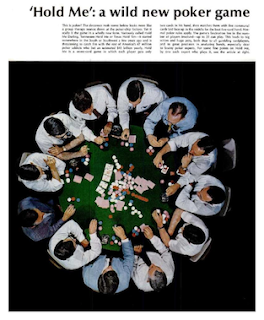
Life Magazine, Aug. 16, 1968When one looks at the relatively short history of Texas hold’em, the publication of the August 16, 1968 issue of Life magazine represents a fairly significant moment.

Just so happens then-presidential candidate Richard Nixon, considered by many to have been the most skilled poker player among all the U.S. presidents, was on the cover that week along with his wife, Pat, and Spiro and Judy Agnew. There is nothing about Nixon’s poker playing in the issue, though, as that part of his biography -- including how he’d actually funded his first Congressional campaign in 1946 with poker winnings earned while in the Navy during WWII -- was hardly being highlighted as part of his story.

Rather, it’s a short article within by A.D. Livingston titled “ ‘Hold Me’: a wild new poker game and how to tame it” that marks an important moment in hold’em’s history.

“This is poker?” begins the introduction to Livingston’s piece, referring incredulously to a nearby photo (see below). “The decorous mob scene below looks more like a group therapy seance down at the poker-chip factory. Yet it really is the game in a wholly new form.”

As will Livingston, the intro refers to the game by several names, including “Hold Me Darling,” “Tennessee Hold Me,” and “Texas Hold ‘Em.” Livingston’s piece is interesting because it speaks of the game as a relatively new phenomenon, addressing Life’s mainstream audience as mostly consisting of readers who have never heard of hold’em.

“I believe the game is a major event in the history of poker,” asserts Livingston, “and I predict it will replace stud for the rest of the century.”

'Hold Me,' a wild new poker game...Livingston’s piece begins with him describing a hand he played while trying to learn the game. Preflop betting caused him to become timid and fold AdKd to a professional player’s pocket queens. He admits he didn’t know the odds at the time, and a later session of trying to work them out at home leads him to conclude “it was really a mathematical toss-up.”

Livingston had to do such work himself because none of his poker books included any mention of the game.

“None of my books covered Hold Me or any game like it,” he says. “Nowhere could I find figures on the odds.”

The rest of his short piece spends some time speculating about why hold’em (in his view) is about to take over as the most popular poker variant -- more action (than stud or draw) is the big reason -- then concludes with a discussion of another hand involving the pro to whom he’d folded before.

In that hand, a huge three-way pot develops in which the pro somehow manages to fold pocket sevens on the river with the board showing 4-6-7-6-5, having correctly surmised one of his opponents had quad sixes. The analysis is a little specious, but we’re told the pro was able to use both his positional advantage and a knowledge of his opponent to surmise he was beaten. Meanwhile, the third player -- whom Livingston calls a “monkey” -- calls off his stack with a straight.

The piece ends with Livingston describing how he’d contacted a friend in Colorado to see if he had heard of this new game called “Hold Me Darling.” “‘Never heard of it,’” his friend says, adding “‘but a new game has really caught on. High Hold ’Em. Each player gets two cards down....’”

It’s the same game, it turns out, being played with a different name.

I take Livingston’s piece -- which is available online, if you're curious -- as strong evidence that hold’em’s history really only begins around the 1950s or thereabouts, not earlier in the century as some have claimed. I brought this matter up back in the spring in a post titled “Hold’em’s History Makes a Good Mystery.”

While the game was certainly around for some time prior to 1968, it’s having different names in different places suggests that while it was gaining in popularity, the game was -- as Livingston seems to assume -- still quite new to most. Its absence from poker books (most of which would have been books of rules, not strategy texts) also suggests a later start date -- say mid-century -- for hold’em.

All of which makes me appreciate even more Livingston’s prediction that hold’em was going to become the game of the late 20th century.

Nice call, sir!

Labels: , , , ,

Tuesday, August 30, 2011

On the Super Committee

The Capitol Puts Out the Bat $ignalSounds like an excruciatingly boring version of, say, the Super Friends or Justice League of America or other comic book/cartoony teams of superheroes, doesn’t it? With deadeningly dull super powers, too.

Creating compelling agendas faster than a speeding bullet! Formulating and passing along recommendations more powerful than a locomotive! Untangling knotty procedural questions with flawless applications of Robert’s Rules in a single bound!

Once again, online poker players in the U.S. find themselves scratching their heads over our government’s legislative machinations, trying to sort out what exactly our fearless leaders are up to now. This time the focus is upon this new Joint Select Committee for Deficit Reduction -- a.k.a., the “super committee” -- that was created as part of the resolution of that whole “debt ceiling” crisis earlier this month.

The 12-member, bipartisan committee was created in order to discover both places to cut and potential revenue sources in order to reduce the budget by a hefty $1.5 trillion. The group has a short time to formulate recommendations, having to pass them along to Congress by November 23. The House and Senate will then have just one month to vote “up or down” on what the super committee has given them, with no amendments or filibusters allowed.

Supporters of licensed and regulated online poker in the U.S. believe it is possible that the super committee might include some form of internet gambling legislation in its recommendation. If such were to happen -- and Congress were to approve the committee’s recommendations -- that would speed up the process by which Americans could get back online to play poker, making such happen much more quickly than via the usual, laborious legislative process of introducing a bill (such as we’ve seen Rep. Barney Frank try multiple times, or the more recent “Barton bill”), getting it through committee, having the House and Senate both vote in favor, and then finally having the president sign it into law.

The so-called 'Super Committee'Some are pointing to various gestures made by Senator Majority Leader Harry Reid (D-NV) (who is not on the super committee), the newfound interest in internet gambling of chief UIGEA-architect Sen. Jon Kyl (R-AZ) (who is a member), and the significance of various lobbying efforts and other noise around Capitol Hill thought to suggest the time is ripe for finally entertaining online gambling. (Here’s a summary of various “circumstantial” evidence that regulating online gambling may be something considered by the super committee.)

Last week Rich Muny, VP of Player Relations for the Poker Players Alliance, appeared on the Two Plus Two Pokercast (the 8/22/11 episode) to say he was “as enthusiastic about this as I've been since this [fight to license and regulate online poker] started,” calling the super committee “a golden opportunity” to get some sort of legislation passed.

All of which perhaps sounds like something might happen here (and soon). Still, I can’t help but remain somewhat guarded -- if not dubious -- about it all, for a couple of reasons.

One has to do with the current political climate in the U.S. The fast-approaching presidential campaign seems to be highlighting so-called “moral” issues more and more, with (sometimes) related matters of faith getting mixed in frequently, too. And, as Barney Frank once pointed out in one of those House Financial Services Committee meetings, “there is a moral disapproval of gambling” among many legislators as well as those whom they represent.

I might be wrong, but it feels as though today supporting online gambling -- even in the context of (heroically?) attempting to alleviate the country’s budgetary woes -- is less politically savvy than it would have been just a couple of years ago. So that could present an obstacle to online gambling becoming part of the super committee’s recommendations.

My other reservation comes from the idea of the federal government actually passing such legislation and thereby being the ones to oversee online gambling -- including poker -- in the U.S. Nothing specific here other than the usual, vague worries over how exactly that would play out.

I mean it might work out just great. But something tells me it wouldn’t be exactly super.

Labels: , , , , ,

Monday, August 29, 2011

Charlie Hustle, A-Rod, Gambling & Poker

My autographed photo of Pete RoseMy love of baseball probably peaked around the age of nine. That’s when I played little league, collected cards, tuned into games on AM radio, and never missed the “game of the week” on television. When we eventually got cable, I watched more games, and would even sometimes score them as I did. (No shinola.) I also sent letters a few times to players asking for autographs, and in just about every case I received replies, often with signed photos.

The only one of those pictures I managed to save from those days was from Pete Rose, who for a while there was right at the top of the list of my favorite players. That's the photo to the left, and the envelope in which it arrived is below. (I feel like I might have told this story before on the blog at some point, but searches aren’t turning up anything, so I suppose I have not.)

The envelope in which Pete Rose sent me an autographed photoIt was some time later, well after my fascination with the game had waned, that Rose, a.k.a. “Charlie Hustle,” was accused of having bet on games and was banned from baseball in 1989. Despite a mountain of evidence against him, Rose would deny the accusations for the next 15 years before finally admitting that he did, in fact, bet on games, but only for his own team to win. By then no one was really listening to him, though, that long period of denial having made it difficult for many to give him any credit for finally ’fessing up.

Now that I think about it, I’m pretty sure it was Rose’s troubles that helped ensure I’d hang on to his autographed picture while losing track of the others. Might’ve partly been out of an idea that it’d be worth more as a result, although I’ve never thought much about selling it. Could’ve also been just because I felt sorry for Rose, in a way, I don’t know. In any case, while the kid in me still gets a kick out of him sending me the picture, my more mature self agrees with most that what he did was very wrong, and his refusal to admit to it for so long made it all even worse.

Found myself thinking about Rose after reading about Alex Rodriguez’ meeting last Friday with “officials” of Major League Baseball to talk about his poker playing -- or at least about the allegations of such. Despite being injured for much of the summer, Rodriguez has been in the news quite a bit over recent weeks. But all of the stories seem to concern his poker-playing, not his bum knee.

One such story came in the wake of those lawsuits being filed against participants in that big Hollywood home game who won money off of Bradley Ruderman, the hedge fund guy who ended up convicted of swindling his clients via some sort of Ponzi scheme. Tobey Maguire was kind of singled out among those who were sued, but other famous folks like Gabe Kaplan, Nick Cassavetes, and Rick Salomon were targeted, too. (I wrote a bit about Maguire’s situation in my latest Epic Poker “Community Cards” post, if you’re interested.)

Shortly after those lawsuits came to light -- they’re being brought in order to try to recover some money for Ruderman’s victims -- a story emerged that Rodriguez apparently played in the games, too, although that was soon refuted both by Rodriguez as well as one of the participants, the poker pro Dan Bilzerian.

Alex Rodriguez playing pokerThen last week came another story about Rodriguez allegedly playing some high-stakes poker at the Mohegan Sun at Pocono Downs near the end of his stint rehabbing with the Yankees’ Triple AAA affiliate, the Scranton/Wilkes-Barre Yankees. That story also was refuted both by Rodriguez and representatives of the casino. (That photo of Rodriguez and Jay-Z is from much further back -- a celebrity tourney back in 2006.)

In any event, the MLB wanted to talk to Rodriguez in part because he’d been connected with underground poker games in New York previously (back in 2005). And because the league is obviously super-sensitive to any players being connected with gambling in any fashion, not least because of situations like the one involving Pete Rose years ago.

A-Rod of spadesThere wasn’t much in the way of specific news about the meeting on Friday, other than Rodriguez saying he’d answered all of the questions asked of him. The Wall Street Journal piece about the meeting tells about how Rodriguez was asked if he thought it wasn’t fair that his trip to the Pennsylvania casino -- just for a steak dinner, Rodriguez alleges -- drew so much attention, Rodriguez sounded kind of melancholic about it all.

"I guess that’s just the world we’re in,” he said. “There’s a moving goal post. Those are the rules and it is what it is. Sometimes you just want to say uncle."

When Rodriguez refers to the “rules” here it is hard to tell what exactly he’s referring to, although it sounds like he’s talking about “unwritten” rules in our culture regarding gambling (“that’s just the world we’re in”) or perhaps more specifically the MLB’s recommendations that players steer clear of casinos or any gambling-related activities. At least that’s what the “moving goal post” comment seems to suggest -- namely, that the “rules” outlined to Rodriguez in the meeting perhaps haven’t been spelled out anywhere in particular.

Interestingly, the last time I wrote about Rodriguez here it had to do with his breaking an “unwritten rule” by running over the mound on his way back to first base after a foul ball. And, of course, Rodriguez is also well known for having broken another written (but poorly-enforced) rule when he used performance enhancing drugs from 2001-2003. Rodriguez admitted to the latter in 2009 after a list of players (including A-Rod) who’d failed tests in ’03 was published by Sports Illustrated.

My buddy Rich Ryan wrote a thoughtful op-ed for PokerNews a couple of weeks ago titled “Sports and Poker Don’t Mix” in which he essentially says pro athletes should say “uncle” and stop courting trouble by playing poker. I can see where Rich is coming from, but I can also see how some would object to players being unreasonably restricted or discouraged from entering a casino and/or participating in legal poker games.

Pete Rose in Las VegasI think again of Pete Rose. I remember visiting Las Vegas a few years back and while walking down the strip suddenly coming upon Rose sitting at a table, signing autographs. Looked a little closer and (if I remember correctly) saw it was $50 for an autograph, and $100 for a photo with the all-time hits leader.

Many who’ve visited Vegas over the last few years have seen the same sight, and probably shared the same thought I had about Rose and his legacy -- forever linked with his gambling -- and how Vegas perhaps seems a weirdly appropriate setting for him now.

I didn’t bother to wait in line to pay for a signature or photo or anything. I did stand and watch Rose a short while, though, thinking about the autograph I’d gotten for free so many years ago.

You know, way back before our heroes all started to fail us, with Rose (for me) one of the first to go. I guess for some Rodriguez would be one of the more recent examples. If so, I’d hope it’d be for reasons other than his poker playing.

Labels: , , ,

Friday, August 26, 2011

On the Exodus

On the ExodusThese tweets, blog posts, articles, and other items relating how players are leaving the United States in order to play online poker elsewhere are starting to become increasingly prevalent. With the WSOP in the rearview and things like the World Championship of Online Poker on PokerStars coming up soon (in a little over a week), more and more players are announcing that they have either already made the move or are intending to do so soon.

In just in the last few days I’ve read articles or have seen messages alluding to more than a dozen different players who have either left or are about to, among them Justin Bonomo, Steve Gross, Isaac Haxton, Jason Koon, Phil Galfond, Tom Marchese, Daniel Negreanu, and Steve O’Dwyer.

The newly-enganged, WSOP Main Event-crushing couple David “Doc” Sands and Erika Moutinho are heading out of the country as well. “Up early tomorrow lots to do before Vancouver!” tweeted Moutinho earlier this week. “Excited for a new adventure :)”

PokerStars has now added to its Frequently Asked Questions page for U.S. players a section addressing those who are moving elsewhere and trying to set themselves up with non-U.S. addresses. And you probably heard something about that “Poker Refugees” player relocation service launched by Pocket Fives a couple of weeks back.

We also keep hearing reports of the smaller online sites choosing to leave the U.S. This week it was the Poker Pros Network (PPN), one of the Cake Poker skins, that announced it was cutting loose.

Looking at PokerScout, the Merge Network of sites (including Carbon, Hero, and others) currently ranks highest as far as U.S. facing sites/networks go, although they still aren’t accepting new U.S. sign-ups at the moment. Word is they will soon reopen their doors, although with each passing day that seems increasingly uncertain. And I know Hero Poker, for example, is not planning to open things back up to U.S. players (though I’m not sure what the plan is for those of us still playing over there). Incidentally, I believe I read something else from PokerScout noting that something like 90% of the U.S. players shut out following Black Friday have not moved to play on any of these remaining sites.

The party's overFor those of us remaining behind, it’s hard not to feel some misgivings about all of this poker-related movement away from the U.S. I mean, it’s all perfectly understandable, but it still feels a little like being at a party that started out awesome, then a big ugly fight broke out and now everyone is suddenly leaving.

But, well, I live here. Somebody’s gotta stay behind and clean up and deal with all this.

So I can’t really say I’m enjoying hearing all the stories of folks leaving too much. But I certainly wish them well as they embark on their new adventures.

Labels: , , , ,

Newer Posts
Older Posts

Copyright © 2006-2021 Hard-Boiled Poker.
All Rights Reserved.