Monday, August 08, 2016

Passive Viewing

Dipping into the Olympics here, as I imagine you have been doing as well. It appears that between the rack of channels coming in via the dish and the Roku, we can watch practically anything whenever we want, which is nice.

Funny, though, I’m still finding it preferable in the evening simply to tune into the local NBC channel and let the network decide what events to show me and when. I suppose I fall into the large category of “passive” Olympics viewers. I’m referring to those of us who aren’t super enthused about being delivered every moment from every sport, or even that curious about any one sport in particular.

The same is probably true for most of those who end up watching the WSOP Main Event coverage on ESPN. They aren’t hanging on every twist and turn back in July like some of us, and so it’s actually more palatable for them to watch the sucker get strung out over several months however ESPN sees fit.

Vera is interested in the dressage portion of the equestrian events, of course (which don’t really crank up for a couple of days). And I’m dialing up men’s basketball sometimes, too, particularly when the U.S. is playing as they need earlier tonight. But otherwise, we’re content just to let it play as ambient sound-and-image, looking up whenever the announcers’ excitement captures our attention.

Speaking of that men’s basketball game earlier, the U.S. team found itself tied 18-18 with Venezuela after the first 10-minute quarter. Was a sorta-kinda surprising start considering they’d opened up the Olympics beating China by 57 points and were expected to do something similar in their second game tonight. (The matchup with Australia on Wednesday ought to be more competitive, I’d think.)

Even so, it felt an awful lot like a much-outclassed poker player winning a few pots early on in a session, but destined to lose it all back eventually -- and likely sooner than later. Sure enough the U.S. outscored Venezuela 30-8 in the second quarter, ultimately going on to win by 44.

When games go in that direction, they, too, become part of the background as I do other things, only looking up occasionally to check the score and watch another U.S. fast break.

Image: “Play the long ball,” (adapted), Craig Sunter. CC BY-ND 2.0.

Labels: , , , , , ,

Tuesday, May 10, 2016

Poker & Pop Culture, the Return

A quick post today to let you know of a new series of columns I’ve begun over on PokerNews. In truth, it’s not entirely new, and in fact is focused entirely on the past. Let me explain.

Way, way back, I had the opportunity to begin writing some columns on PokerNews under the title “Poker & Pop Culture.” Then-editor Haley Hintze proposed the idea, and if I remember accurately she did so after I’d written a two-parter here on Hard-Boiled about poker references in Rolling Stone magazine (here those are: Part 1 and Part 2).

For a good while I wrote columns every couple of weeks about how poker popped up in various films, books, television shows, and so on. I think the one I got the most response from both right away and over the years since was one discussing the many references to poker on Star Trek: The Next Generation.

That lasted less than a year, during which time I wrote not quite 20 of those columns. Sometime after that I freelanced my way over to Betfair Poker where I occasionally would write columns in a similar vein, then had a spell writing a similarly-themed column titled “Community Cards” for the ill-fated Epic Poker League site. Then after that I had a nice opportunity to revive the idea yet again for PokerListings, where we called the column “Pop Poker.”

Meanwhile I developed this college course I’ve mentioned here many times, “Poker in American Film and Culture,” which I teach in the American Studies program at UNC-Charlotte. Between all of those columns and the course -- not to mention the many posts here at HBP that have highlighted poker references in non-poker contexts -- I’ve now amassed a lot of material under this heading.

That inspired the “Poker & Pop Culture” revival, with the idea this time being the columns will eventually be collected (along with other material) as a book. I’m doing the series in a roughly chronological fashion, and so after starting with an introduction last week did a kind of “pre-poker” survey of references to gambling and cards today. Then next week we’ll finally get going with actual poker history, starting with the very first reference in print to poker.

If you’re curious to see the first couple, here they are (first one’s headline shares the title of the book):

  • Poker & Pop Culture: Telling the Story of America’s Favorite Card Game
  • Poker & Pop Culture: If I Gamble, Will I Go to Hell?
  • Would be keen to hear either feedback or suggestions along the way, if anyone has any. These first couple do a lot of stage-setting, and I expect the ones starting next week will each be more focused on telling distinct, stand-alone stories and anecdotes, hopefully in new and entertaining ways.

    Labels: , , , , , ,

    Friday, August 07, 2015

    America Is In Serious Trouble

    Ended up sitting through the entirety of the debate last night -- that is, the “prime time” one in which 10 Republican presidential candidates took turns filing one-minute speeches (more or less), with an occasional bit of accusatory back-and-forth between a few of them now and then. I had on the earlier “happy hour” one, too, featuring seven candidates put through a similar format.

    In other words, like most presidential debates (these days), these weren’t really “debates” per se but something else... something resembling, say, shows like The Voice or Big Brother or Survivor or American Idol. I’m referring to the dynamic of having the show’s contestants perform in some manner and then endure some form of judgment, including the ceremonial voting off of some as the field winnows down to finalists and then a winner.

    The candidate getting the most attention both during the two hours and afterwards was, not coincidentally, the host of his own reality competition show, The Apprentice (and its popular offshoot Celebrity Apprentice). Or at least he used to be, as apparently NBCUniversal cut ties with multi-billionaire Donald Trump in late June following his controversial statements about Mexicans made not long after announcing his presidential candidacy.

    Trump made more, similarly outrageous remarks last night, as those who watched saw and heard, revealing along the way a mostly untutored, almost adolescent-seeming frustration with everything that at times recalls outrage of the mentally-unstable news anchor Howard Beale in 1976’s Network. The more Trump repeats his fallback mantra that the U.S. is in “serious trouble” and “we don’t win anymore,” the more it sounds like Beale’s similarly non-specific cry that he’s “mad as hell” and is “not going to take this anymore!”

    Setting aside all of what was said on the stage at the Quicken Loans Arena in Cleveland by the 17 hopefuls yesterday, the most remarkable takeaway I have is the report that 24 million watched the later one on Fox News Channel, kind of a staggering total.

    It was apparently the most-watched show ever on Fox News. Reuters says that previously the most-watched primary debate drew less than half that total, with 10.7 million tuning in for a Hillary Clinton-Barack Obama one in 2008. Jon Stewart’s Daily Show finale that aired just afterwards drew 3.5 million, the second-highest ever for that show (just a little less than the viewership for an Obama appearance in late October 2008).

    For further comparison, for a WSOP Main Event final table to draw 2 million viewers was considered a big audience in the past, although it has been several years since that total has been reached. An article on Sports Business Daily offers the following numbers for WSOP ME final table viewers: 2.364 million (2008), 2.199 million (2009), 1.563 million (2010), 1.223 million (2011), 735,000 (2012), and 1.234 million (2013). (The last two years were for the 15-minute delayed “virtually live” shows; previously the ratings were for the edited FTs.) Meanwhile I’m seeing various references to the 2014 WSOP Main Event final table drawing about 1.15 million viewers.

    Presidential debates -- i.e., between the major parties’ candidates (not before or during the primaries) have traditionally drawn significantly more viewers. More than 60 million watched those Nixon-Kennedy debates in 1960 I was referencing yesterday, as was the case for the Obama-Romney debates in 2012. The biggest debate audiences ever, apparently, came in 1980 when around 80 million watched the only debate between Carter and Reagan in late October.

    Obviously Trump’s chaotic role in the debate lead-up helped create conditions for the huge viewership. We’ve all seen tournaments where a novice player manages to accumulate a huge stack and the chip lead early without demonstrating much skill at all beyond repeatedly making a similar, aggressive move and managing to survive over and again. We’ll see how far Trump similarly gets along.

    The longer he survives, though, the more evident it will become that his mantra regarding America being in trouble is in fact true -- although perhaps not in the way he intends it.

    Labels: , , , , , ,

    Thursday, May 21, 2015

    Last Call for Late Night

    Along with about 14 million others I watched David Letterman’s show last night, his last after more than three decades of being a fixture on late night television. Was laughing pretty hard from beginning to end thanks to a lot of well chosen and edited clips and other funny business.

    I remember when Letterman was late, late night -- as in a 12:30 a.m. start. In fact I even dimly remember his stint with a morning show, too. I was barely a teen when Late Night with David Letterman first premiered in early 1982, at time which happened to coincide with that period in my life when I would be staying up late a lot, too.

    Watched enough of him during those years to be as influenced as anyone else by what was then considered a somewhat alternative style of comedy and general TV spoofing. Like most of my generation I continued to pay fairly close attention to Letterman right up until those “late night wars” surrounding Johnny Carson’s retirement in 1992.

    Kept watching occasionally after the CBS show began airing in the summer of ’93, although by then whatever late nights I kept were school-related as for the next several years I’d be pursuing graduate degrees. Then came “real life” and full-time employment, and thus fewer late nights watching the tube.

    After that came this second career writing about poker which again has me up all hours, although more often watching people play cards than crack jokes on the teevee. So while I occasionally would keep tuning in to watch the Late Show it would only be now and then, and rarely in the elective way I’d watched the NBC show.

    I wasn’t paying attention, then, when Letterman had Chris Moneymaker on as a guest after he’d won the 2003 World Series of Poker Main Event -- in June, that is, before that year’s WSOP had aired on ESPN. That episode doesn’t seem to be online anywhere, although Moneymaker told me once how he was pretty sure he had a tape of it somewhere.

    I do recall Joe Cada’s turn on Letterman’s show in 2009, where the youngest-ever WSOP ME champ appeared just a day or two before he turned 22. Earlier that same year I wrote something here after a Steve Martin appearance on Late Show which included a funny story about Martin playing online poker after taking Ambien.

    I’ve found myself distracted some over the last couple of days reading others’ stories about Letterman’s show and its significance while also looking at various clips, mostly from that first decade or so he was on the air and I was watching practically every night. And I greatly enjoyed the finale, primarily because of how Letterman characteristically downplayed the significance of the event -- entirely expected, and fitting, of course, given the self-deprecating core around which most of his humor has always been based.

    I liked the sweet yet not overly sentimental way he acknowledged his mother (whom we all remember fondly, too). And I also liked how he found a spot to include his wife and son (whom we hadn’t met before), saying to them “I love you both and really nothing else matters, does it?” without being at all maudlin about it, but rather just stating a fact.

    Others have (and will continue to) assign significance to his contributions to television, comedy, and the culture in general. Like Letterman himself, though, I’m dissuaded from trying to articulate any profundities explaining what it all was about.

    Labels: , , , , , ,

    Tuesday, April 21, 2015

    Ever Heard of the “Silent Bowl”?

    Was reading an article over at the newly-designed ESPN site this afternoon about the NBA playoffs in which there was a reference to LeBron James’s practice of watching recorded games with the sound down. In the article his teammate Kyrie Irving noted how he’s picked up the habit, too.

    “One of the things I took from Bron is putting the games on mute and just listen to music while you watch the game,” Irving is quoted as saying. “No disrespect to the announcers or halftime show, but you want to be in silence. Watch good basketball, high-intensity basketball, just watch the game.”

    I love watching basketball, and indeed sometimes will have games on with the sound down as it is eminently easy to follow nearly everything without the commentators. More often than not I’ll keep the sound up, but it’s not a problem at all knowing where things stand at any moment after hitting that mute button.

    The story reminded me of an NFL game from way back in 1980 aired on NBC, a late-season contest between the New York Jets and Miami Dolphins that came to be known as the “Silent Bowl.” In an effort to boost ratings for a meaningless regular season game between a couple of mediocre teams, Don Ohlmeyer (then the executive producer of the network’s sports division) came up with the experiment.

    A quick search about that game took me to a feature about it from a few years back on the ESPN site. There a few more details about the broadcast are shared, including how NBC used more graphics than usual while also having the stadium’s public address announcer make more descriptive comments to help viewers track the action.

    They didn’t have the score on screen at all times, though, nor an inset showing the clock. In fact, those didn’t become regular features for televised football until 1994 (later than I would have guessed).

    Ratings were higher for the game than would have been expected without the gimmick, and apparently response to the broadcast was more favorable than not, although no one ever thought for a moment that announcerless games would ever become the norm. From the perspective of three decades later, Ohlmeyer sounds like he kinda sorta regrets being remembered for the stunt, but I think it was an interesting idea to have tried.

    While not perfectly analogous, televised poker seems as though it cannot do without commentators (even though some live streams -- including at the WSOP -- have tried to do without). That said, I spend a fair share of time watching online poker tournaments which though not necessarily nail-biting are nonetheless easy enough to follow given all of the detailed information available -- including “instant replay,” even.

    Now that I think about it, I turn the sound down for that and listen to music, too.

    Labels: , , , , , , , , ,

    Friday, April 17, 2015

    Jacob on Jeopardy!

    Tuned in tonight to watch Jeopardy! in order to see Alex Jacob, the poker pro (or former poker pro) who is currently enjoying a massive run on the show.

    Most in the poker world first met Jacob nearly a decade ago when he won that United States Poker Championship in Atlantic City in 2006, an event that was televised and thus got him some notice even though he’d already made final tables at the World Poker Tour and World Series of Poker by then.

    He’d continue to collect cashes up through 2012, earning over $2.6 million total. I feel like he never was a full-timer on the circuit, though, and over the last couple of years has been even less conspicuous, perhaps having stepped away entirely.

    In any case, you’ve probably heard about him popping up again on Jeopardy! where he’s been crushing. Going into tonight he’d won five times in a row, winning $129,401 total with mostly dominating performances. At the start of this sixth try, host Alex Trebek noted how Jacob had gotten to Final Jeopardy four of five times with leads of greater than double the nearest competitor, meaning he’d already clinched the win.

    I did watch the end of one of those shows and laughed at the end when during Final Jeopardy Jacob appeared to push “all in” by moving his hands forward when his final betting amount was revealed -- $0, actually. At the start of tonight’s show Trebek introduced Jacob as a currency trader, so I’m not even sure they’ve discussed his poker background at all.

    Hearing about some of Jacob’s strategies -- e.g., not going top-to-botton with categories but jumping all around the board with his clue selections, and usually betting everything on the Daily Doubles -- I thought back to that fellow from about a year ago, Arthur Chu, who also got a lot of press and poker players’ attention during a run of 11 straight wins on the show.

    Chu became known as the “Jeopardy Villain” because of both his unorthodox strategy and his humorous baiting of folks over Twitter during the time of his reign. Chu would also pick clues out of order and routinely go “all in” on the Daily Doubles. Jeopardy! legend Ken Jennings wrote an article for Slate at the time discussing Chu, explaining how that latter decision to go for “true Daily Doubles” was correct.

    “Like a poker player trying to increase the size of the pot when he has a good hand,” Jennings wrote, “Jeopardy! contestants should maximize their upside when the odds are in their favor.”

    There was one other quirk Chu exhibited during Final Jeopardy. When leading but not having more than twice the “stack” as his nearest foe, he’d bet exactly enough to tie should his opponent bet everything and both players answered the clue correctly.

    For example, if Chu had $12,000 and his opponent had $7,000, Chu would bet exactly $2,000 -- not $2,001, as some tend to do -- to end with $14,000 if he were to be correct and tie with his opponent if that player bet everything and was correct as well. In fact, one time that’s what happened and after tying both he and his opponent were able to return for the next show.

    That strategy, as I understand it, makes it just a tiny bit less likely Chu could lose should his opponent happen not to bet everything but a lesser amount. In the above example, for instance, if he bet $2,001 and was incorrect he’d end with $11,999, and if his opponent only bet $5,000 even and was correct that player would have $12,000 and win by a buck.

    I noticed someone retweeting Chu commenting on Jacob, in fact, interestingly bringing up his own poker playing as he did.

    Getting back to Jacob’s performance tonight, Trebek introduced things by alluding to Jacob’s recent run, advising Jacob’s opponents Nikhil and Scott to “get him early, and then try to get him late, too.” Jacob ruled during much of the first round, though, quickly building a big lead before the others finally were able to buzz in and start notching some correct answers.

    Then Scott got the Daily Double and with just $600 -- several thousand behind Jacob -- he surprisingly bet only $5. The questioned turned out to be an easy one for him and he won the $5, but it felt a lot like a player too timid to bet without a sure thing.

    By the second round Jacob was well in front and in fact went a long stretch without buzzing in at all while the totals of other two went up and down. Scott got another Daily Double, and this time said “Alex is too good, I gotta do it... true Daily Double.” Alas for him he got a tough one about an Italian painter and lost his stack.

    A little later Nikhil got the other Daily Double at a point when he had $4,200 and Alex $7,200. Betting it all and being correct would put him in the lead, but he chose only to bet $2,000. The category was “In the Dictionary” and the clue “Fittingly it means ‘Empty Orchestra’ in Japanese.” Nikhil guessed “What is kabuki?” but the correct response was “What is karaoke?” and Jacob’s lead increased again.

    There was a clue about “Manhattan prosecutor Preet Bharara” -- he of Black Friday fame -- that perhaps got poker players’ attention. It got Jacob’s attention, too, as he finally buzzed back in to guess correctly that Bharara had vowed sweeping reform of Rikers Island.

    Jacob then rattled off a few more correct answers, seeming at one point to pause unnaturally after buzzing in to answer an easy one about a Halloween TV special featuring a character who instead of candy gets a rock.

    “Who is... Charlie Brown?” he said, and for a moment I thought he might have been stalling a little as the round was winding down. But he immediately picked back up the pace thereafter, and the trio was able to complete the entire board with Jacob sitting with $17,400, Nikhil $10,200, and Scott $3,600.

    The Final Jeopardy category was “Book Reviews” and the clue was an easy one (I thought) -- “A 2008 review of this novel, later filmed, compared it to ‘Battle Royale’ & said it’s ‘a future we can fear.’” -- although I guess it might not have been easy if I hadn’t read The Hunger Games.

    Nikhil missed it, though, while Jacob got it correct. He bet $3,001 -- meaning he did not choose the Chu approach -- and ended with $20,401 to bring his six-day total close to $150K.

    To be honest, while it’s probably safe to say Jacob is using some of the same skills and strategic thinking he honed at the poker tables while playing and winning at Jeopardy!, there wasn’t that much in his play that obviously recalled his poker background. In fact, it was the timidity of the other two players that made me think more of poker, as well as a kind of “tell” from Scott when he declared he didn’t like one category as he was selecting it.

    I guess, though, at the very end of the show I was reminded again that Jacob played poker. “Smile, Alex... smile!” said Trebek to Jacob who remained stoic even as the audience applauded his victory. He reminded me of a seasoned player who has just won a big pot and who has trained himself not to show emotion afterwards.

    Jacob may be a “currency trader” now, but he still has that poker face.

    Labels: , , , , , , , ,

    Friday, April 10, 2015

    Jesse May Interview, April 2011 (Part 2 of 2)

    Here’s the second part of that interview with Jesse May, conducted just about four years ago in the spring of 2011 (Part 1 here).

    In this part we focus more particularly on the story behind Late Night Poker, the first series of which appeared in 1999. That picture down below of the two of us, by the way, comes from this year’s PokerStars Caribbean Adventure where I had a chance to interview Jesse once again for the PokerStars blog (photo by Neil Stoddart).

    * * * * *

    “The Betfair Poker Interview: Jesse May, Part 2”
    [Originally published at Betfair Poker, 8 April 2011]

    This week we present the second half of my conversation with poker player, author, and commentator Jesse May. After focusing primarily on May’s 1998 poker-themed novel Shut Up and Deal, we turned our attention to the early days of Late Night Poker, the groundbreaking show that debuted in the U.K. on Channel 4 in the summer of 1999.

    Short-Stacked Shamus: Late Night Poker is one of those shows I’ve always been curious to learn more about. A lot of fans of poker on television -- especially those of us over here in America -- don’t necessarily realize how important and influential Late Night Poker really was when it comes to televised poker. What are some of your memories from the show’s early days?

    Jesse May: I remember the whole thing very well. It was one of the most formative things in my life, really.

    I was invited as a player for the first series. I had become friendly with Nick Szeremeta. My book [Shut Up and Deal] had been out, and I was spending more time in Europe around that time. I had recently gotten married and was trying to get some gigs as a writer, and Nick was getting me some work.

    Nick had been contacted by Rob Gardner [the show’s original producer] to help get players for the show. In fact, they’d had a lot of trouble getting players for this first series of Late Night Poker. Most people turned them down. At the time I was on the way to going broke. After about five years I was kind of at the tail end of my professional poker career. And the action had been drying up a little bit.

    SSS: What was the buy-in for that first series?

    JM: The buy-in was £1500. It was a massive, massive buy-in (laughs). At that time there might have been three tournaments during the entire year with a buy-in bigger than £1500. And I had about £1800 to my name... that was it! And I can’t remember why, but I felt like I needed to be a part of this.

    And as it turned out, most of the people who showed up at that first series of Late Night Poker had the same sort of idea. In that first series there were maybe three or four legitimate pros -- Dave “Devilfish” Ulliott, Surinder Sunar, and a couple of others. There really weren’t many, a lot of the pros had turned it down. Everybody else, we were all just kind of chancers in a sense. But for some reason I felt like I had to be part of it.

    SSS: So they taped all of the heats for that first series at once.

    JM: Yes, it was in Cardiff in the spring... it must have been April. I remember I played in the very first heat. Back then, all the players who had bought in got a free hotel room for the week, which was quite a big bonus (laughs)! [That meant] everyone showed up and stayed all week.

    So I played in the first heat, and I embarrassed myself, basically. I didn’t know anything about tournaments -- I probably hadn’t played 10 tournaments in my life! I ended up getting third in the heat. I got knocked out after going all in with something like 9-3-offsuit... it was pretty embarrassing. People were giving me pretty awkward looks as I walked out the door (laughs).

    So then I had the rest of the week to hang out, and I had those thoughts: “What the heck am I going to do next?” I thought I might be back to selling storm windows or something.

    SSS: But then you ended up being brought in to be a commentator on that first series.

    JM: Yes. In fact, the original idea for Late Night Poker was that there would be no commentators. They filmed it thinking that the table talk was going to carry the show. Today that might work, but back then nobody had been on television before. Everybody just froze up! Aside from maybe the Devilfish there might not have been ten words said during the entire tournament. So the producers were panicking a bit and they decided they were going to have to have commentary.

    And I volunteered to do it for free. I said I’d be happy to do it, that it sounded like a great idea. I was just thinking, really, at least I can try and give some explanation for being such an idiot -- you know, maybe I won’t come across so badly (laughs). And [I was also thinking I would] maybe get a chance to promote my book or something, although I didn’t really even think that through. Who knew at the time that would actually turn into a career for me!

    SSS: The show really was pioneering. When it first aired in July 1999, we were still about four years away from the World Poker Tour debuting and Moneymaker’s WSOP victory being shown on ESPN.

    JM: The thing about Late Night Poker that most people don’t realize, it wasn’t just the first poker TV show. I mean, it was that. And it was the first to use the under-the-table hole card cameras. But if you go back and watch those first few series, what made it great and the reason it took off was because of the way it was edited and the way it was filmed.

    Rob Gardner was the producer of the first three series, and Rob really understood that it wasn’t enough to just show everything. He knew that what was going on here was a mini-drama, and it was filmed and edited to show that. I’m talking about the shots, the way they used to reveal the hands, the way they used to show the decisions being made... plus the atmosphere! The shots of cigarette smoke and looking up at the players from under the table... the fact that they used the under-the-table cameras -- and still do, in Europe, for a lot of the stuff, while in America they use the hole-card cams and put the graphics on afterwards -- that shot of the camera from under the glass, with the person’s cards and then his face, was such a new and exciting and dramatic type of shot!

    SSS: You’re right, that low-angle shot looking up at the player, who now has the knowledge of the hole cards -- a secret that we now know, too -- it’s very cinematic, really.

    JM:: Yes, and it all would be worked into [the telling of the story]. And when it took off, most of the people who watched it didn’t know anything about poker. They were drawn in by the natural drama of the TV show.

    Later when the World Poker Tour started -- and I think the WPT and Mike Sexton are great and majorly responsible for the growth of poker -- it was really so much different. What they were really capitalizing on was the big money that they were playing for, and the “all ins” and things like that. It was not at all like what Late Night Poker had been doing.

    SSS: Well, it definitely works. Even going back and watching those old shows today, they definitely hold your interest.

    JM: Rob’s background is kind of interesting -- it was actually in dance. He was a modern dancer with a dance troupe or something like that, and didn’t know anything about poker. He was hired by Presentable Productions to come up with new ideas for TV shows. And he just came up with the poker idea out of the blue, and got in touch with Nick Szeremeta and it went from there.

    They sold it to Channel 4 in the U.K. which back then used to do some very, very out there kind of stuff, especially late at night. They used to have this thing called “4Later” or something like that when they would air these shows. It was the kind of idea that would never, ever get sold today. But they took a flyer on it and it just went from there. But Rob was really a driving force behind that.

    Rob passed away three years ago and the European Poker Awards set up an award in his honor. It was originally called the “Rob Gardner Poker Innovation Award” and I think now has been changed to the “Poker Personality of the Year,” perhaps because there aren’t enough innovators in poker anymore.

    [Speaking of,] there was a lot that came later regarding Henry Orenstein having taken credit for having invented the hole card camera...

    SSS: The “lipstick camera.”

    JM: Yes, the lipstick camera and how Orenstein had come up with the idea of showing hole cards. And nothing could be further from the truth. It upsets me, obviously, to see Rob denied this because I was such good friends with him.

    Henry Orenstein was a poker player, of course. I used to play with him in Atlantic City. He was also an inventor and a toymaker -- he came up with the Transformers, I think -- and had many patents. And to get a patent on an idea, all you have to do, basically, is write three sentences on an A4 and get it through the committee. I think you can find the patent [for the hole card camera] online, and if you look at it, you’ll see it’s not even an idea. It basically just says “What if you could see the players cards when they are playing poker?” or something like that. And that’s it.

    And so Rob knew nothing about Henry Orenstein when he came up with the idea for the under-the-table cameras for poker. But later on, when there was talk of putting Late Night Poker or something like that on in the U.S., all of a sudden Henry Orenstein found his patent and said “I own this.” And later when Steve Lipscomb got the idea for the WPT, even though it was expressed a bit differently, the idea was completely based on Late Night Poker.

    SSS: The show found an audience right away. In For Richer, For Poorer, Vicky Coren refers to its debut and how “more than half a million people [were] tuning into this cultish new programme, broadcast after midnight on Channel 4.”

    JM: It was an amazing time. I remember when the Devilfish won the first series of Late Night Poker, there was no question that he was the greatest winner of all. Nothing could have been better for poker or for televised poker than having the Devilfish win -- because of his personality and the fact that he really was a good player.

    Right after he won they threw a big party in the hotel at Cardiff, and everybody was there. Devilfish bought a couple of cases of champagne for everybody, and basically, besides the Devilfish, of the 40-something people who had played in this, at least 39 of us were dead broke (laughs)! We’d all gone broke in this tournament! Guys like all the Hendon Mob and myself and Mad Marty [Wilson]... we had gone completely skint.

    Yet there was such a fantastic feeling that night in the bar about what we had done. There was a real idea that something special had happened there. It was a great experience. I mean, we hadn’t seen the show and had no idea what kind of response it would get, but we just kind of felt that people were going to see what we loved about poker so much -- which is what ended up happening, really. It was a slow-burner, really, but it ended up growing, and there are so many people who got into poker through Late Night Poker. And I really give all the credit to Rob not only having the idea but being able to execute it.

    I think a lot of poker television, especially in America, has gone backwards in the sense that they’ve forgotten what makes the game interesting. It’s not that there is just too much poker TV and people have gotten bored with the game. It’s that they are not creating formats and they are not filming them in a way that conveys the natural drama of the story.

    SSS: I think about this issue in tourney reporting a lot, actually -- the challenge to find the “story” of the event. There’s kind of what might be called a “functional” approach to tourney reporting -- and this happens in TV shows, too -- where it is really just about delivering data with very little attention being given to the importance of creating characters or plot or something for the reader or viewer to be able to identify with on some level.

    JM: Yes, and in many cases you’re facing a much tougher task now than people used to, because there is no story! I mean, there is a story -- someone is going to win a million dollars -- but that story is completely uninteresting. That happens now 365 times a year in poker. So that’s not the story. Is the story something about trying to find out who the best poker player is? No... for a lot of reasons people aren’t convinced that’s the story, either. Is the game exciting? Well, a lot of people aren’t even sure that’s the story. The fact is, there’s a lot of trouble with the narrative right now in the poker world.

    SSS: Like you say, the editing and choice of shots and atmosphere are all important, but as a commentator you had a hand in the shaping of the story, too. Tell me, when you did the commentary for the first series, where did the idea come from to use a pseudonym -- to take your character’s name [from Shut Up and Deal] and be “Mickey Dane”?

    JM: Well, we got in there and were doing the commentary and they said it was going to be awkward if you’re commentating on yourself, so why don’t we just pretend it’s somebody else?

    SSS: I guess you weren’t talking too much at the table, then, so there wasn’t a situation where viewers were going to say “Hey, that guy sounds like that guy?”

    JM: Right, it just worked out. It never really came up, because I didn’t last that long anyway (laughs). There was so much care taken with Late Night Poker. Nowadays a lot of commentating will be done live, but this was all done in post-production, and you could really be a perfectionist back then.

    And there was a real camaraderie among those guys, too. No one was really making money at poker back then. Everybody was trying to survive as well as they could, but it still two or three years before people really started to think they could do well at poker. You know, once online poker started and sponsorships came and so forth. It was a special time.

    * * * * *

    Thanks again to Jesse for this one! Check out as well his memories of Dave “Devilfish” Ulliott over at PokerNews.

    Labels: , , , , , , , , , , ,

    Friday, February 27, 2015

    When They Introduced Mr. Spock to Poker

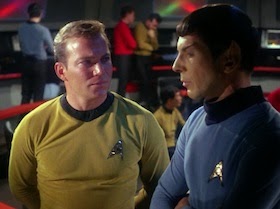
    Sad news today regarding the death of Leonard Nimoy at age 83. Nimoy was most famous, of course, for portraying the half-Vulcan, half-human character Mr. Spock on the original Star Trek series that aired for three seasons (1966-69), then reprising the role again later in several films.

    Some years ago I wrote a lengthy column over at PokerNews detailing all of the many references to poker in the later series Star Trek: The Next Generation. That one ran much longer than the original did, airing for seven seasons (1987-1994).

    In that column I referred in passing to “poker turn[ing] up here and there amid the franchise’s many incarnations,” although in truth at the time I was mainly focused upon (and familiar with) poker being a kind of recurring theme in ST:TNG. (The series even ends with a poker game punctuating the final episode, titled “All Good Things....”)

    I remember at some point later on tracking down other connections between Star Trek and poker, and did find one instance in the original series that involved the character of Spock. It came up during the first season in an episode titled “The Corbomite Maneuver.”

    The episode begins with the Enterprise starting to notice an approaching object that proves increasingly worrisome the closer it gets. It won’t respond to any communication, and eventually they try to race away from it but it follows the ship, shooting radiation toward the Enterprise. They end up destroying the object, then a little later a second, larger object appears to threaten them.

    This time they are able to communicate with the object -- it’s a ship called the Fesarius and its commander, named Balok, is threatening to attack. Things are looking pretty dire, and while others are getting emotional the always logical Spock discusses the situation with Captain Kirk, letting him know that he sees no way out for them.

    “Chess,” Spock says to Captain Kirk by way of explanation. “When one is outmatched, the game is over. Checkmate.” “Is that your best recommendation?” asks Kirk with a sneer. “I regret that I can find no other logical alternative,” answers Spock.

    Kirk isn’t ready to give up, though, and eventually he stumbles on a plan.

    “Not chess, Mr. Spock... poker. You know the game?” asks Kirk. He does not.

    Kirk then turns his attention to Balok, explaining there’s a substance on the Enterprise called corbomite that will cause a “reverse reaction” ensuring the destruction of the Fesarius should it attack. It’s a bluff, of course, and it works, earning a “well played” from Spock.

    “A very interesting game, this poker,” says Spock. “It does have advantages over chess,” answers Kirk. “Love to teach it to you,” adds Chief Medical Officer “Bones” McCoy.

    There’s more to the story, including a twist of sorts showing that the Fesarius was bluffing, too (and the menacing-looking figure that is supposedly Balok is actually a much less frightening figure played by then-child actor Clint Howard).

    I could be mistaken, but I don’t believe they ever did teach Spock poker, which obviously could have led to some interesting scenes highlighting the battle between logic and emotion his character always evoked on the series. Meanwhile the later poker games on ST:TNG involving the similarly emotionless android Data did get to explore those areas.

    You can check out “The Corbomite Maneuver” streaming over on Netflix, if you wish. All 79 episodes plus the pilot of the original Star Trek can be seen on the site, one to which I imagine quite a few this weekend will boldly go.

    Labels: , , , ,

    Monday, February 16, 2015

    Highlight TV

    Last night there were a couple of shows on against one another that ended up drawing a lot of eyes -- that three-and-a-half-hour 40th anniversary Saturday Night Live show and the almost-as-long NBA All-Star Game.

    Reading over on ESPN today, it looks like the ratings for the SNL show added up to 23.1 million viewers, which they’re saying is the “most watched prime-time entertainment telecast” for NBC since 2004. Meanwhile the NBA says the All-Star Game drew 6.1 million viewers -- big for the game, but still behind shows like 60 Minutes (10.4 million), CSI (almost 7 million), and a couple of others (according to TV by the Numbers).

    I had various work to do during those prime time hours last night -- including taking care of the horses as we ready for a winter storm later today -- but when in front of the teevee I ended up flipping back and forth between SNL and the NBA. Neither was all that compelling, as it turned out, which made it easy to tear away from one to check in on the other.

    There was a lot of buzz for that SNL special, and while the show featured a lot of fun “call backs” it overall seemed to fall well below expectations. The All-Star Game was hyped as usual, too, although I think most basketball fans know better than to expect too much from what is traditionally more an exhibition than a competition -- although really all that gets exhibited is a predilection for three-pointers, alley-oops, and lackadaisical defense.

    Perhaps going back and forth between the two artificially encouraged the identifying of parallels, but the two programs struck me as being very similar in both form and content.

    Both were in New York. Both were essentially live, albeit with a lot of pretaped material interspersed and a healthy percentage of time taken up by commercials. The SNL show was sort of a “best of” or “greatest hits”-type package, while the All-Star Game is also nominally presenting the NBA’s best, though in truth there was a lot of non-greatest stuff mixed in with both.

    The SNL show featured a lot of montages that rather than present entire skits just showed a few seconds so as to trigger the memory for those in the know. The All-Star Game similarly kind of boils down basketball to a nonstop highlight reel of dunks and flashy plays, with both teams operating as if the shot clock were six seconds rather than 24. (I suppose one might compare both to the all-in fests that characterize many televised poker shows, although there you still often get some variety in the pacing.)

    I guess both programs were varieties of entertainment once-removed -- shows about shows, in a sense -- that served as reminders of the actual entertainment to which they referred without exactly providing the same.

    Labels: , , , ,

    Friday, September 05, 2014

    Remembering Rivers Duking It Out With Duke

    I’m a big fan of old recorded comedy, having spent many years fishing LPs out of the used bins to build a big but not too embarrassingly large of a collection. And of course now that practically everything exists online to be hunted down if one desires, I’ve filled a lot of gaps when it comes to those old records and radio shows, in particular from the ’60s, ’70s, and ’80s.

    Both Robin Williams and Joan Rivers were significant figures during that era of comedy, and of course both became even more central in popular culture during the decades since. Both recorded a few LPs, though none of them found their way into my collection. Still, I appreciated how both contributed importantly to American comedy.

    When news of Rivers having passed began circulating yesterday afternoon, many in poker immediately recalled her venomous tête-à-tête with Annie Duke on Celebrity Apprentice from five years ago. I found myself looking back at a post I’d written here the day after the finale of that quasi-competition.

    For Rivers the show existed amid what became an extended final run of heightened fame marked by her appearance on several reality shows, “red carpet” hosting gigs, and the E! network show Fashion Police that helped keep her a household name.

    For Duke being on Celebrity Apprentice was the most notable of several television-related ventures that included turning up on other game shows and a couple of failed attempts starting shows centered around her own then-growing celebrity such as Annie Duke Takes on the World (a game show in which she played poker against amateurs) and All In (a sitcom based on her life -- no shinola).

    At the time Duke was still representing UltimateBet (or UB) well after the site’s massive insider cheating scandal had become public. Indeed, she’d been spending much of the previous year defending the site, repeatedly claiming the site had shown “grace and integrity” in its handling of the matter when even then it was clear that was hardly the case, and of course later on further corruption within UB became even more evident. (She’d part with the site at the very end of 2010, three-and-a-half months before Black Friday.)

    In other words, some of the poker community was already uncertain about Duke’s status as a “spokesperson” of poker even then in the spring of 2009, although on Celebrity Apprentice she was absolutely regarded that way by others on the show and by the mainstream audience. Indeed, when it came to the Rivers-vs.-Duke rivalry on the show, it was Duke’s poker player identity that earned the most remembered bit of vitriol from the comedian, at least among those of us in poker -- even more remembered than Rivers calling Duke a “Nazi” and comparing her to Hitler.

    From that 2009 post:

    “Even if you haven’t been watching the show, you’d probably heard about Rivers’ shots at poker and Vegas. How she referred to the money contributed by poker players to Duke’s cause as ‘money with blood on it.’ How she referred to her many years performing in LV by saying ‘I’ve met your people in Vegas for forty years -- none of them have last names,’ suggesting the nefarious and/or criminal backgrounds of the inhabitants of Sin City...”

    “You’re a poker player... a poker player,” Rivers continues in the clip we all passed around at the time. “That’s beyond white trash.” “Poker players are the most awesome people in the world,” Duke responds, not necessarily her finest moment as a debater. “Poker players are trash, darling... trash,” reiterates Rivers.

    Duke’s subsequent move from UB to the doomed Epic Poker League didn’t do much to prove Rivers wrong, either, when it came to her judgment of Duke. Speaking of, Jeffrey Pollack -- whose reputation in the poker world would sink in the EPL ship along with Duke’s -- was still the WSOP Commissioner at the time of Duke’s appearance on Celebrity Apprentice, and in the WSOP conference call that year would maintain that Duke’s appearance on the show represented a “leap forward for the mainstreaming of poker into our pop culture” and that the “net effect was going to be very good for poker.”

    I’m wondering otherwise in that post, given how badly the game was portrayed on the show. And of course, years later, even poker players are today unhesitatingly siding in retrospect with Rivers against Duke.

    For Rivers, Annie Duke was just one of several with whom she battled heads-up in a long career, her unrestrained comedic style (and personality) often being much more savage than subtle (or more Juvenal than Horace). And while poker and its image might have suffered some collateral damage from their exchange years ago, the game would persevere nonetheless -- despite both of them.

    Labels: , , , , , , , , ,

    Monday, August 11, 2014

    Watching Golf, Watching Poker

    Got thoroughly caught up in the PGA Championship yesterday. Such high quality play from the leaders at the end, and Rory McIlroy more than proved himself with his comeback, making shot after shot to top that tough field and claim yet another major. Three straight weeks’ worth of wins by McIlroy is pretty incredible, too -- perhaps slightly more likely than a poker player winning three successive tournaments, but still a very rare feat to pull off.

    I’ve written here before about the many similarities between golf and poker, both of which are games that players of wildly differing levels of skill and commitment can enjoy. Amateur golfers like myself can watch pros and still feel somewhat connected with what we are seeing, having ourselves attempted similar shots even if we’re competing on a much lower level. I’m not sure that’s really so much the case, though, with poker. Not currently, anyway.

    I was realizing yesterday that when we think back to televised poker’s heyday during the mid-2000s, one of the primary attractions for a lot of us was the fact that we could make a similar connection with what we were watching. Whether it be the WSOP Main Event, the prelims that got some play on ESPN during those couple of years, the WPT, or other poker on TV, many of us watching were players ourselves and without too much effort could readily appreciate similarities between hands we were playing and those we were watching.

    It was kind of like one big game then (if that makes sense), with online poker especially helping all of us feel connected in a much more immediate way than is the case today. Even if we didn’t necessarily think “one day that’ll be me” as we watched, we still recognized the games on TV as analogous to what we were doing when we played.

    Some of us who continue to tune in and watch televised poker today still think in similar terms as we watch -- that is, we connect somewhat with the players and the game -- but I think the gap between what’s happening on screen and what most of us experience with poker is a lot wider now. Certainly when it’s the “Big One for One Drop” being shown none of us identifies that much with those participating in a $1 million buy-in event. But even in other tourneys I’d venture to say many of us find it hard to relate to what we’re seeing.

    During the PGA broadcasts this week they would occasionally show short instructional segments featuring Lou Guzzi, the 2013 PGA Teacher of the Year. That’s a shot of him above, getting set to deliver a quick lesson about how to hit the ball out of a fairway sandtrap. The lesson didn’t seem out of place at all within the context of the coverage. Players could benefit from the instruction, and even non-players might have found it interesting to see the mechanics of such a shot being explained.

    I know in televised poker there have been various attempts to introduce strategy discussion into the coverage. In truth, every single hand shown is usually accompanied by some talk along those lines. But I think most of such commentary is received simply as describing the action, not prescribing potential plays we viewers might make. The level of engagement by the viewer just isn’t the same with poker as it is with golf.

    I’m discussing this phenomenon as if it isn’t just personal but applies more broadly among most viewers, which could be incorrect. This might just be me. Or what I’m describing might primarily apply to recreational players of both golf and poker (in which categories I put myself in both cases), and not as much to others.

    Still, I think for all the similarities between golf and poker, there are some big differences, too, particularly when it comes to trying to make the card game into a game as engaging to watch as golf can be.

    Labels: , , , , , , ,

    Friday, August 01, 2014

    Writing and Playing

    A thread was started over on Two Plus Two last week by a poster complaining about commentary regarding a particular player on a poker broadcast. The poster was specifically talking about Dan Shak and referring to some commentary on EPTLive.

    The poster had some things to say about how some players might be discussed more favorably as players when compared to others, although might have been a little unfair in this particular instance as the subsequent discussion helped point out.

    In fact EPTLive co-host James Hartigan posted a few times to help clarify some of the commentary highlighted by the original poster, with his response being both interesting to read and constructive. From there the short thread moved on to talk more broadly about poker commentary before winding down a few days later.

    One of the more interesting points made in the thread came from Jimmy “Gobboboy” Fricke who contributes to the EPTLive shows and for that reason was encouraged to join in the discussion. He spoke humbly about the challenge to produce good, insightful strategic commentary on poker, noting how easy it is to be wrong with one’s read of a situation or player.

    “Writing about poker correctly is a lot like playing poker,” Fricke then added.

    Fricke mainly refers to writing (or discussing) strategy, and what he says makes a lot of sense. Commenting on hands well presents a challenge very similar to playing them well.

    I was tempted, anyway, to apply the point more broadly to other kinds of poker-related writing which likewise can require technical knowledge, analytical ability, and creative thinking. You could even take the analogy further and talk about how writing about poker well also involves being able to read others, understanding how stories are put together and affect others, and even sometimes enjoying luck in the form of good timing or other external factors that lie outside one’s “skill.”

    In what other ways is writing about poker like playing poker?

    Labels: , , , , , ,

    Wednesday, May 14, 2014

    Field Report: Poker from the Outside

    Was a day of errands and TCB-ing around here today, carrying me away from the farm for awhile. I use the “TCB” acronym (referring to taking care of business), although more often than not we’ve come to use “GSD” instead. I’ll let you guess what that stands for, with the clue that it’s inspired by the frequent and highly necessary task of stall-cleaning.

    Won’t go into particulars, but one stop today involved an interaction with someone who after discovering my work writing about and reporting on poker shared some interesting observations with me about the game. Was another of those conversations that reveal how poker sometimes plays to the larger audience of non-fanatics (or “enthusiasts” as I have taken to call this group to which I belong, and I presume you probably do, too).

    The person was a bit older than me, and after I’d told her that I frequently write about poker tournaments and professional players, even sometimes traveling to other countries to do so, this was her first response:

    “I can’t believe Phil Ivey cheated!”

    I had to laugh, and when she asked me what I thought I explained in a very general way some of the details of the Ivey-Borgata story, including how not everyone in poker necessarily thinks he “cheated” per se. I was reminded, though, how the Ivey story played out -- or rather, the soundbite version of it that was briefly trumpeted -- in the mainstream, and how succinct (and persuasive) was that quick-hitter that a famous poker player had been accused of cheating at cards.

    We continued to talk about poker on television, and it was clear she’d watched quite a bit about a decade ago when the World Poker Tour had first debuted and that perhaps she’d also seen the WSOP some during those first couple of “boom” years. I helped her recall the name of a favorite player of hers -- Paul Darden -- who I remembered had won a WPT way back during the first season and had been featured a lot on the show then.

    She then explained how she didn’t much care for how these days “they made it into a big 30-day tournament,” preferring only to watch the final tables. I assumed she was referring to the expanded coverage of the WSOP Main Event lasting several months from late summer to November. I know I’ve had conversations with other casual poker fans before who get lost in all of that lead-up, not knowing, really, when the sucker actually ends or caring enough to figure it out.

    She wasn’t a big fan of all of the internet players, she said, although wasn’t more specific than that. She added, too, that she liked to play poker, but didn’t feel like she was anywhere close to good enough to play in a casino. I nodded sympathetically, agreeing that “it’s a lot harder than it looks.”

    I’m sure you’ve had similar discussions of poker with “non-poker people” that revealed to you certain particulars of how the game and its surrounding subculture is perceived from the outside. I got the sense she definitely respected the skill of those who play at the highest levels. Meanwhile it was also apparent that a lot of the details of the game including the logistics of tournament poker were a bit cloudy to her.

    There was more to our conversation, which was kind of a fun one to have amid all of my running around today, but you get the general idea. I’d share more, but I need to go GSD and PDQ. Or at least ASAP.

    Labels: , , , ,

    Monday, February 17, 2014

    What Am I Watching?

    Like many on this globe, I’ve had the XXII Olympic Winter Games from Sochi on as a more or less uninterrupted accompaniment to household activities for the last week.

    Most of the time I’m not fully focused on whichever of the 98 events in 15 different disciplines is on, although once in a while I’ll stop what I’m doing to watch in response to an excited announcer’s reaction or to catch the conclusion of whatever competition is playing out.

    Curling strangely keeps my attention, the back-and-forth strategy somehow appealing to me (and reminding me of other two-player games). Hockey does, too, of course. While curling isn’t perhaps an obvious one to figure out for those unfamiliar with the sport, I understand it well enough to recognize what is happening at any given moment, and thus both of those sports require little extra explanation for me.

    Last night I became engaged for a while by women’s snowboard cross, one of the events in the snowboarding discipline for which it also seemed immediately apparent what was going on. There were a series of races, with the winners winning and the losers losing. Fast and exciting, with little need to know who was who to get a kind of visceral enjoyment from viewing.

    However, for many of the events it is much more difficult to know how performances are measured. As I write I have on something called “Men’s Aerials,” an event I thought at first was part of the “ski jumping” discipline but after looking it up I see it is part of “freestyle skiing.”

    There are spectacular jumps with judges awarding points, but I have no idea what a good score is and what a bad score is, and only when a poor fellow crash lands do I know for certain his chances for medaling have decreased.

    Sports like these make me think a little of poker’s constant struggle to attract non-poker audiences and the various experiments tried over the years to create “must see” television out of poker cash games or tournaments.

    Those who televise the Olympics have established a complicated strategy for presenting unfamiliar sports, one that involves all sorts of editing choices that mix live and delayed programming, combinations of in-game commentary, event-related features, and interviews, and of course the profiles of athletes that have become a hallmark of Olympic narrative-creation. They aren’t always on target, but the programmers have a plan and it generally works for a lot of us.

    On Friday I was referencing one recent poker-related debate on Twitter. Last week there was another one concerning whether or not people watch poker on television primarily to learn more about how to play or for other reasons. While a minority maintained education to be the biggest draw, most seemed to suggest that was less of a priority than simply to be entertained (by the competition, the players, the spectacle, and so on).

    It’s difficult -- and unfair, really -- to compare the Olympics to other sports or types of programming. And while I might be learning a little bit about these various disciplines and the particular events, I know that primarily what I’m experiencing when I watch is a pleasurable form of distraction that is engaging in an ephemeral way.

    When poker was at its most popular on television (nearly a decade ago), it provided similar, fleeting thrills that captured an audience of both players and non-players, watching -- and being compelled to watch -- for all sorts of reasons.

    That’s hard to do anymore, I think (again for all sorts of reasons).

    Labels: , ,

    Thursday, September 26, 2013

    It Goes On and On and On

    Was reading about this 21-plus hour “filibuster” by Senator Ted Cruz (R-TX) this week, with much of the commentary focused on reducing it to a peculiar kind of political performing with little practical consequence beyond the already controversial freshman senator alienating colleagues in both parties. And perhaps promoting his own star among a certain, small segment of the American voting public.

    Some of the articles noted how “filibuster” was not really an accurate way of describing the performance, since Cruz knew even before starting that he had no way of achieving his ostensible goal of preventing the Senate from voting on a budget plan to keep the government open through a deadline coming up next Monday and thus maintain funding for the new “Obamacare” law. Thus was the speech and its inordinate length even more strange.

    Like I say, Cruz began making enemies shortly after joining Congress this year -- even the iPhone-poker playing John McCain called him a “wacko bird” (along with a couple of others) back in the spring. And his speech contained a lot that appeared pretty wacko, especially out of context, including references to Duck Dynasty, White Castle burgers, the Friday the 13th and Nightmare on Elm Street film franchises, The Little Engine That Could, Ashton Kutcher, Darth Vader, Toby Keith, and Green Eggs and Ham.

    Setting aside the specific political context for Cruz’s marathon play, there’s something curious about the wildly out-of-proportion step of speaking for 21-plus hours in such a forum.

    Cruz came a bit shy of the longest ever filibuster speech by Strom Thurmond lasting 24 hours and 18 minutes in which he spoke against the Civil Rights Act of 1957, one of many actions in the South Carolinian’s long career in which he established his lamentable opposition to racial equality. Like Cruz, Thurmond also peppered his speech with a lot of obscure, irrelevant matters, most famously a digression on his grandmother’s biscuit recipe.

    I’m thinking yet again about the debates this week about televised poker, and how the long, uninterrupted and unedited broadcasts may be better for demonstrating the game’s skill component, but are much less likely to retain an audience. Thus is TV poker necessarily reduced to highlights and other unusual moments that in real time disrupted the monotony but in an edited package are made to seem representative.

    Much as commentators on the crazy-long senatorial speeches focus on irrelevant or tangential biscuit recipes and Dr. Seuss readings, so, too, does an hour-long program condensing a day’s worth of poker focus on the unusual.

    Speaking of long-winded politicians, I’ve been continuing my Nixon studies and am now in the middle of his 1,100-plus page post-presidency opus, RN: The Memoirs of Richard Nixon.

    I have to read it at home, as it’s too big to take anywhere. I mean, really, I’d need an extra suitcase to carry it on a tourney trip.

    I could filibust open somebody’s head with this sucker.

    Labels: , , , , , , ,

    Wednesday, September 25, 2013

    A Slowrolling Spot

    Sounding a theme not too distant from the one contemplated in yesterday’s post, this week has come a teaser reel from that Poker Night in America show shot back in August.

    You might remember some cash games were played at the Turning Stone Resort Casino involving a somewhat eclectic cast of poker players flown there from all over the country to participate.

    They streamed some of the action online, although as I recall technical issues tended to mute the impact of the presentation somewhat. However, some edited programs were made from the games, and it’s from those that this short video showing a couple of hands was compiled.

    Take a look:

    I say the clip kind of highlights a theme explored yesterday. I say that not so much because the hands featured are of that same all-in-and-let’s-see-what-the-cards-bring variety that Salon contributor Argun M. Ulgen fretted over as having dominated a lot of ESPN’s coverage of the World Series of Poker over the years, especially during those formative “boom” years starting with the 2003 Main Event and after.

    Rather, I’m referring to the latter hand in the clip in which Shaun Deeb flops quad fives and then delivers a wicked slowroll to Mike “The Mouth” Matusow. Deeb and the other players at the table enjoy a great laugh, but Matusow responds with mood-killing venom.

    The clip has already generated a lot of debate, with some responding to Deeb’s play in much the same way Ulgen was lamenting ESPN’s WSOP coverage, namely, by complaining that it misrepresents poker in some fashion, or perhaps portrays the game in way that is unfavorable (according to some).

    Whereas Ulgen complained that ESPN’s version of poker minimized the game’s skill component and thus made it out to be more of a gambling game than deserved, some critics of this clip have suggested it advances a notion that poker is a game that somehow encourages the abandonment of sportsmanship, also thought by some to be a non-representative portrayal.

    There have been a lot of other responses, too -- to Deeb, to Matusow, and to perceived ideas about what Poker Night in America is going to be all about. Rather than toss out my own, I thought I’d just share the clip, point out how it has gotten poker people talking, and invite you to consider what you think of it.

    Labels: , , , ,

    Monday, August 12, 2013

    When Everything Seems Like Everything Else

    Last Friday I was writing in part about feeling a little distanced from poker at the moment, pointing out how not playing regularly has lessened my enthusiasm somewhat when it comes to watching others play. Yesterday I found myself again kind of in a position of sitting over to the side while others collectively enjoyed participating in a different sort of shared activity.

    It started early yesterday morning on my Twitter feed, countless references to the upcoming episode of Breaking Bad scheduled to premiere on AMC later in the evening. They continued throughout the day, then intensified during the airing of the show and afterwards, with nearly everyone (save a few outliers) in unanimous agreement that it was pretty much the greatest thing ever in the history of everything.

    My tone likely gives away the fact that I’m not a watcher of the show. The fact is, over the last couple of decades I’ve kind of fallen out of the habit of watching TV altogether, other than sports or news. Or, when Vera’s on the couch next to me, various programs about buying or renovating houses on HGTV.

    I can’t even remember the last non-sitcom I made it a point to watch regularly. The old Barry Levinson-produced Homicide: Life on the Street from the 1990s springs to mind as a possible candidate. I seem to remember watching almost all of that first season of Survivor back in 2000, but didn’t continue with it after that and never got into any of the myriad other “reality” shows that have come to dominate since. I always preferred less intense comedies, although even there I never did follow too many, and even fewer today. I’ll burn a half-hour with Family Guy or old eps of Seinfeld or Cheers when they run, but that’s about it.

    For me watching TV remains a non-immersive activity. I never made the transition over to the sort of “binge watching” of TV series that has become the most popular means by which viewers now tend to consume TV shows. We don’t even have DVR, so when we do turn on the tube we’re stuck watching whatever happens to be on at the time (and it has never seemed a burden). We do have a VCR, actually, still hooked up and ready to tape programs, if desired, although we almost never do.

    That said, this weekend I did in fact tape and watch that CNN Films presentation Our Nixon over the weekend, which was kind of intriguing in the way it was driven by Tricky Dick’s supporting cast (Bob Haldeman, John Ehrlichman, and Dwight Chapin) and the home movies each had taken during their years working for him. So it isn’t like I avoided TV altogether. In fact, I even sent a tweet yesterday about the documentary, commending the choice of Kirsty MacColl’s transporting “They Don’t Know” to accompany the opening credits.

    Like everyone else seemed to be doing for much of the rest of the day, I wanted to share with others something about what I was watching on television, I guess in part to see if anyone else was watching, too.

    But all of this about my own TV-consuming habits is really just a digression from the primary point I meant to make regarding all of those Breaking Bad tweets. Obviously they held less meaning for someone who doesn’t watch the show. But I realized something kind of interesting, nonetheless, about the tweets people were sending.

    All wanted to communicate to their followers that they were watching the show, with some going further to praise it within Twitter’s familiar constraints, the character limit presenting an obvious obstacle to more in-depth evaluations or analyses. All were further restricted as well by the need not to speak directly about the episode’s plot or be detailed enough to introduce any “spoilers” for other potential viewers.

    We’re all now well accustomed to the “Spoiler Alert” disclaimer borne from the new way of consuming cultural products like television shows, movies, video games, sports, and other varieties of entertainment. Since everything is more or less “on demand” -- aside from those rare instances when everyone is made to wait for a particular time before first being able to see an episode of their favorite show -- the collective experience of, say, a new show is accompanied by a lot of tiptoeing and whispering as individuals strive to avoid being too detailed about what it is they are experiencing.

    Eventually time passes and people begin to share thoughts and responses more openly with one another, but during that earlier moment in the life of the cultural product, the community’s response to it is marked by a couple of curious traits -- namely, that everyone seems to be talking about it while no one is actually saying anything specific about it.

    I suspect the catching up that happens later is also full of problems in communication, with the different methods of viewing and varying degrees of attention given to the show introducing various gaps when it comes to sharing ideas about it afterwards with others. Like a poker hand which every player at the table experiences from a different point of view, so, too, do these seemingly “shared” moments get fragmented into all sorts of experiences that are related but not identical.

    One of those I follow on Twitter who was not tweeting about Breaking Bad last night was the fiction writer Joyce Carol Oates. She’s an interesting follow, full of opinions and insights and seemingly quite comfortable with delivering pithy, maxim-like thoughts about culture, politics, literature, or anything else. I’m convinced some Ph.D. student has already come up with a dissertation topic focusing primarily on her tweets and using them as a lens through which to study her novels and stories.

    Anyhow, about a week ago Oates offered an observation that in part covers all of these online interactions passing through our consciousness such as occur on Twitter:

    “Perhaps it’s a superficial aesthetic but online everything looks, feels, behaves, ‘seems’ like everything else,” she wrote. “Print culture more diverse.”

    All of those tweets from yesterday certainly seemed alike, especially to this non-Breaking Bad viewer. But like I say, that was largely due to the fact that while everyone wanted to talk about the same thing, everyone couldn’t talk about it, too. Not really.

    I guess again watching those tweets go by was sort of like watching others play a poker game. Everyone looked pretty much the same and seemed to be doing pretty much the same sort of thing. And no one could really tell me what they were experiencing as it happened, either, because to do so would ruin the game.

    Labels: , , , , ,

    Friday, August 09, 2013

    Falling Out of Sync

    Spent a little time this afternoon looking in on this live streaming cash game from the Turning Stone Resort Casino over on the Poker Night site involving Kristy Arnett, Tom Schneider, Mike Matusow, Greg Mueller, Shaun Deeb, David Levi, and some others. Or trying to, anyhow.

    As anyone who has taken a peek at the webcast knows, there have been some technical difficulties with the presentation. The audio has been about 15-20 minutes ahead of the video and the onscreen graphics describing the hands are not always matching up, either. I am sure they will get these issues resolved eventually, but for now these difficulties are making it hard to stick with the show for very long.

    The various elements of the webcast falling out of sync got me thinking momentarily about each of those elements individually, perhaps more so than I would have otherwise. I was thinking about the importance of seeing the hole cards and how that affects one’s enjoyment when watching others play poker. I also was considering separately the value of commentary, hearing table talk, and other aspects of the show.

    Meanwhile I had the PGA Championship playing on the television, too, which I also was following only in a vague way, looking up now and then to see a shot and learn how certain players were doing thus far today in the tournament’s second round. Obviously the production and presentation of that broadcast was much better handled for the TNT network, although like I say I was only really following it intermittently and without any serious concentration.

    I guess you could call my viewing of both events “passive” insofar as I was watching without any serious rooting interest or even curiosity about results. The coincidence of having both on at once reminded me a little of a post I wrote a little over a year ago about how golf somehow attracts my interest as a spectator even though I don’t play the game.

    That post was written while watching the Masters that spring and was titled “A Tradition That’s Totally Way, Way Different From All the Other Ones.” I contrasted golf’s success at attracting non-golfers to watch with the special challenge poker faces when it comes to getting non-poker players to find a reason to be interested in watching others play.

    In the end I concluded the two weren’t really so comparable -- not just “apples and oranges,” but “apples and orangutans” -- the main difference being, I decided, that when it comes to poker nearly everyone who finds the game interesting to watch plays the game in some fashion, whereas such is not the case for golf.

    Without online poker for the last two-plus years, I now most often speak of myself as someone who “used to play” poker. Sure, I played this summer in Vegas and will play again in the future when given the opportunity, but for the most part I’m not identifying myself as an active player these days. And I’m starting to recognize that because of that my interest in watching others play via a webcast or on television has been severely limited.

    It’s much different watching poker as a reporter, where I’m locked into what’s happening in a much more direct way. As a non-playing spectator -- or a non-active player who is watching -- I feel kind of “out of sync” with the game in a way that significantly affects my interest level. Perhaps it has something to do with not really identifying with or feeling invested in the players’ decisions or the outcomes, because I don’t really see myself playing hands and facing similar decisions myself anytime soon.

    In any case, as time goes by and I slide further and further “out of sync” from those who are playing the game, I’m sensing more and more how much harder it becomes to remained tuned in.

    Labels: , , ,

    Monday, October 22, 2012

    Here’s Johnny, Welcoming Us To His Mansion

    Like some of you, I spent six minutes and 22 seconds yesterday watching a YouTube video titled “Full House with Johnny Chan.”

    On the surface, the video appears to be some sort of promo short designed to drum up interest in a possible television series. It only just appeared on YouTube, and despite advancing a concept that seems nearly a decade too late, apparently was produced quite recently.

    The video begins with reference to Johnny Chan and Doyle Brunson having each won 10 WSOP bracelets. We briefly see the two pretending to play a heads-up home game against one another. Then Chan is shown walking down a staircase and introducing himself as “the most famous poker player in the world.”

    Then Chan stops, holds his arms outward in an inviting pose, and declares “Welcome to my mansion!”

    Seriously, what an opening. Harrowing stuff.

    From there we are introduced to the show’s scenario. Chan explains how he’s invited five poker pros to live in his house, staking each $200,000 to engage in some sort of poker competition. The explanation of that competition is fairly fuzzy -- something to do with the pros playing nine-handed sit-n-gos with the viewer also somehow able to participate (?).

    In any event, the rest of the video introduces us to “Johnny’s Line Up,” i.e., the five “poker pros” who’ll be engaged in the competition. They are presented as though filling certain imagined roles for poker pros -- the Playboy, the Genius, the Bully, the Queen of Hearts, and Chico Loco.

    “I don’t consider poker gambling,” says Jay, a.k.a. “The Genius.” That’s Jay Ishimaru, listed at the end as a co-producer along with Javier Prato.

    “It’s more like stealing candy from a child,” he continues. “I enjoy the game.”

    Hey, who doesn’t enjoy stealing candy from children? It’s so easy, and candy is delicious. Am I right?

    The clip is filled with other howlers, amateurish acting, and additional awkwardness filling the spaces between montages of Las Vegas and Chan pushing people into pools. Unsurprisingly, the video has earned a lot of derision on a 2+2 thread devoted to it (a thread likely started by one of the producers). There were also a number of “dislikes” and other negative response on the video until comments were disabled.

    The most common response has been to question the “reality” of this apparent attempt at some sort of poker-themed “reality television.” Is it sincere? Are there actual plans (or hopes) to produce such a show? Or is it all a goof? A satirical send-up of both poker stereotypes and reality TV?

    Clearly, we need some “immersive” critics to go to work and uncover the true meaning here. You know, like those guys who figured out The Shining is really about how Stanley Kubrick helped fake the moon landing. Like Chan’s signature orange, it’s a mystery in need of unpeeling.

    Whatever it is or its intentions, the chance that there will ever be anything more than these six minutes and 22 seconds’ worth of “Full House with Johnny Chan” seems unlikely.

    Which means in the end all we’ll be left with will be this short clip, a brief, uncertain postscript to the “golden era” of poker television, a period which ended emphatically at least a year-and-a-half ago, although for many had already jumped the shark much earlier.

    And, of course, at least one new, sure-to-endure catch phrase:

    “I pay my rent in Euro, baby!”

    (EDIT [added 10/23/12]: PocketFives offers more information regarding the video, as well as an interview with one of the co-producers, in an article humorously titled “Johnny Chan Poker Reality Show: It’s Real.”)

    Labels: , , ,


    Older Posts

    Copyright © 2006-2021 Hard-Boiled Poker.
    All Rights Reserved.