Was reading through the
Full Tilt Poker Strategy Guide: Tournament Edition the other day. A lot that is worthwhile in there, I think.
In Howard Lederer’s chapter on limit hold’em tourneys (one of the few discussion of LHE tourneys you’ll find, actually), he brings up a concept regarding tournaments that I remember Mike Caro at one time making a lot of noise about. Kind of a curious idea (as most of Caro’s ideas are).
Early in the chapter, Lederer extols the virtues of making it to the cash -- and in fact ultimately makes simply cashing a primary goal for tourney players, kind of countering what a lot of folks will say about the importance of winning or finishing near the top where one usually finds the big money. He admits that he might have won more money in his career overall if he’d adopted a looser, more aggressive approach, but for him that was “not a style I’m comfortable playing.” This business of approaching tourneys conservatively is not the concept I want to talk about, though.
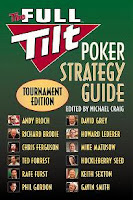
Amid that discussion, Lederer offers the observation that when you cash in a tournament, but don’t finish first, “you have, by definition, taken advantage of the tournament structure.” Why? “Because you ended up broke -- zero chips -- but they paid you a big check anyway.”
It’s kind of an interesting point, I think -- this idea that, as Lederer goes on to say, “the winner actually is the one that pays the biggest price for the tournament structure,” because “the winner gets all the chips but does not get all the money.”
Like I say, this is an idea that I first saw Mike Caro address as what he calls a “conceptual problem” with tournaments. In Caro’s discussion, he points back to the mid-1970s when tourneys stopped being “winner-take-all” affairs and the prize pools began to be distributed among several of the top finishers, not just the winner.
The history of the World Series of Poker Main Event exemplifies this trend. For the first eight years of the WSOP (1970-1977), the winner of the Main Event won the entire prize pool. When Doyle Brunson won his second title in ’77, there were 34 entrants in the event, each of whom paid $10,000 to play. That meant Brunson’s first prize was $340,000.
However, in 1978 the WSOP began to divide up the prize pool. There were 42 entrants that year, and Bobby Baldwin won. But he only got $210,000 for winning, and the other half of the money was divided among those finishing second, third, fourth, and fifth.
Another big change in the payout schedule at the WSOP Main Event happened in 1986, the year Berry Johnston won the WSOP. There were nearly the same number of players in the Main Event in ’86 (141) as there were the previous year (140). However, in 1985 only the top nine finishers cashed, while in 1986 the top 36 players cashed (although those finishing 28th-36th got less than their buy-in back -- $7,500). So Johnston’s first prize of $570,000 was considerably less than the $700,000 Bill Smith got the year before for winning.

For Caro, this change created a “conceptual problem” with tournaments insofar as the way he views it, “first place is punished and all other close finishers are rewarded.” For the Mad Genius of Poker, this makes tournaments much, much less attractive to him, and in fact becomes a reason for him not even to play them. He goes on to suggest that “in terms of strategy... if you play to win first place... you’ll probably lose money in the long run.”
Because if you win you lose. Get it?
Caro thus offers the same advice as Lederer and insists “the way to make a profit in these tournaments is to survive” -- that is, play conservatively, try to make the cash, and be satisfied with knowing that when you do cash (but do not finish first) you have taken advantage of the structure. Ever the iconoclast, Caro probably takes the whole idea a bit too far when he adds that “you should not go out of your way to win the first-place trophy, because the winner of the tournament is penalized.” (
Here’s an article in which Caro explains his idea, if you’re interested.)
I’ve heard him made this argument in other contexts, and he usually insists that finishing second is really where it’s at. The guy finishing second is the one who makes the most money despite losing all of his chips.
Now I’m no mad genius. (In fact, I’ve been known
to have trouble operating a cell phone.) But I think the point being made by Caro and Lederer actually depends on a particular view of the relationship between tournament chips and buy-ins -- namely, a view that essentially sees tournament chips as directly representing the money one paid to enter the tournament. Which sort of makes sense when we talk about tournaments in a theoretical way, but creates a different “conceptual problem” (I think) once we sit down and start playing the actual tournament.
For example, there’s gonna be somewhere around 5,000 players entering that $1,000 no-limit hold’em “stimulus special” tournament (Event No. 4) this year. Let’s just say exactly 5,000 enter. All players will be receiving 3,000 chips, meaning, in a sense, that every chip cost them 33.33 cents.
Of course, since some of the prize pool is going to be taken out before the first hand is dealt, you could say the players will already be getting the worst of it just by entering the tournament. According to the WSOP, 7% of the prize pool is going to be withheld for entry fees, and another 3% taken for the tourney staff. With 5,000 players, that means there is going to be 15 million chips in play. Players will have paid $5 million total, but the prize pool is going to be $4.5 million after the juice. That means every chip is technically worth exactly 30 cents, even though players paid 33.33 cents per chip to play. If we view tournament chips as the equivalent of cash, every player is going to be down $100 just for entering the tournament.
Now I’m going to guess somewhere around 9% of the field is going to cash in this event (judging from the payout schedules of similar, big field events from the 2008 WSOP). That’s 480 players. Not sure what the prize will be for first place, but last year Grant Hinkle took a little over 15% of the prize pool for winning that first no-limit hold’em event -- the one that had nearly 4,000 enter. So let’s say the winner of the $1,000 “stimulus special” gets 15% of the prize pool for winning -- that’s $675,000. That means the other $3,825,000 will go to 479 players who finish with zero chips. If we think of tournament chips as cash, well, then it does appear that 479 of the 5,000 players entering are getting a pretty good deal here.
But really, once the entry fee is paid, that $1,000 each player handed over is long gone. All that’s left are the 3,000 chips waiting at the player’s seat at the start of Day 1. And it doesn’t make a lot of sense (to me) to think any longer of those chips bearing
any relationship at all to the money spent for them, because
you can’t go back and cash them in. Once the tourney starts, the trick is to turn those chips into more chips, and hopefully all of the chips. That’s the only way to maximize their value from that point.
I understand Caro’s lament about tourneys moving away from the “winner-take-all” format. And I even appreciate the “conceptual problems” that result, thus making him less inclined to play tournaments. But I don’t think I’m going to buy the conclusion that the winner of a tournament is in some sense the biggest loser, even if it is the case that he or she has won all the chips but is only claiming a small portion of the prize pool.
But that’s my choice, of course. I can buy what I want -- chips, concepts -- as long as I can afford to do so.
Labels: *shots in the dark, Full Tilt Poker Strategy Guide, Howard Lederer, Mike Caro
 Well, the flight is booked. Still a few details to be ironed out, but I’ll be back in Las Vegas this summer, again helping PokerNews cover the World Series of Poker. Will be arriving in LV in just a week-and-a-half (no... really?), and once more I’ll be there for the duration, all the way ’til mid-July when the new November Nine is set.


 . Both the blinds call. The flop comes

 . Checks to me, I bet, and only the SB sticks around. The turn is the
  . Again: check, bet, call. The river is the
  and my opponent bets. Really? Okay, let’s see. I call. He turns over
 .
.




 under the gun (6-max., $0.50/$1.00). I think I might’ve already sat out on my other table and so was out the door anyway, but did indeed click “Sit out next hand” as I watched four of my five opponents call my raise.
 , though now we’re looking at another flush draw out there. All four stayed for one more card. The river was the
  (Flippin’ sweet!), and I led out again. Others seemed to like that river card, too. Here’s how it played out (RSS readers might have to click through):