Thursday, May 30, 2013

Confounded by the Mad Genius of Poker

I’ve always liked Mike Caro as both a personality in poker and a good dispenser of strategy advice. I have a few of his books and like many players benefited from some of the ideas he’s shared over the course of more than three decades’ worth of writing about poker, highlighted early on by a contribution on five-card draw to the original Super/System in the late 1970s.

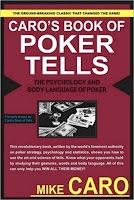
Caro is most famous for his Book of Poker Tells, a book which I read long ago although have to admit never really gleaned too much from as far as help at the table goes. (I’ve always been more of an online player than live, anyway.) I appreciate the book’s historical significance, though, and think that when you step back and consider Caro’s overall contributions to the game via his writings and ideas, they are substantial.

The “Mad Genius of Poker” is still writing, of course. His style tends toward what I would call “revelatory” in that he’s almost always aiming to produce these big “a-ha!” moments in his readers when it comes to explaining various ideas or frequently-encountered actions or situations at the table.

If you follow him on Twitter, you know that pretty much once a day he tweets links to pieces he has written -- many old, some new -- pointing to his always-under-construction website called “Poker1.” His tweets always come in the form of initiating that gesture to reveal of some hidden nugget of poker wisdom, with the articles then continuing in a similar vein.

For instance, today he tweeted “Astonishing poker truth about how to play aces in hold’em,” with a link following. Yesterday he tweeted a link to an article about “a common notion” in poker that turns out (he says) to be “horribly wrong.” That’s his favored and most frequently inhabited rhetorical position, namely, to function as a kind of poker detective who has unearthed the meaning of clues the rest of us have failed to notice.

As I say, I like Caro’s writings and style, and I think a lot of times the ideas he’s sharing are quite good and useful. Even in those instances when I don’t want to follow him down a particular path of reasoning, I still usually find what he’s saying to be interesting and thought-provoking in a constructive way.

Like I say, a lot of what Caro points us to in those tweets are pieces he’s written in the past. As far as new stuff goes, he does regularly contribute a column to Poker Player Newspaper, and usually there is also talking strategy or theory. However sometimes he branches out to address other topics, as he did a couple of weeks ago in an article in which he addresses “rampant” cheating in online poker and his considerable efforts -- unsuccessful thus far -- to do something about it.

“Time to go public,” Caro begins, again taking the position of someone who knows something the rest of us don’t, and who is now setting the stage for the sharing of his knowledge. He refers to his having been conducting a “behind-the-scenes campaign to protect online poker” from cheaters, noting that his campaign has failed.

“I believe that cheating is so rampant that many honest players, with superior skils, have no chance whatsoever of winning online,” states Caro. Knowing that some -- most (?) -- readers might respond skeptically, he then asks for patience while he explains why he believes what he does.

Unfortunately, Caro immediately becomes opaque again, vaguely referencing his study of “computer code” and other data connected to the “operations structures of five major poker sites” (identifying none). He’s done all of this work covertly, he tells us, “working secretly with these online poker sites and entities” like some sort of poker spy on a classified mission. Highlighting his investigation is anecdotal evidence of having lost while playing online poker at a higher rate than he believed to be “mathematically possible.”

The references to his losing session are as unclear as everything else, I’m afraid. So is the chronology, as it seems as though he’s referring to a session that took place at least six or seven years ago, possibly longer. I say that because after reporting his suspicions to the site and being told no evidence of cheating could be determined, he suggests his complaint to have been somehow uncannily prescient since cheating “scandals... eventually rocked the industry years later.”

Caro says his efforts to help the industry develop more accurate methods to detect cheating have been “stonewalled by mysterious forces deep within these organizations.” In other words, while he’s been given privileged access to sites’ “operations structures” where he has been “working secretly,” there’s still an inner circle deep in there somewhere where Caro hasn’t been allowed. No one seems interested in his new system, called Caro’s Online Poker Solutions (COPS), a name which he himself admits “probably is too cute by half.”

He concludes the piece by asking readers to help him and his colleague, Bill Handy, with their efforts, although once more he remains frustratingly imprecise about what exactly he wants others to do. He then signs off by saying he’ll “be adding more detail” on his website “in the near future.”

It’s kind of a baffling column, really, and like some of his “new/old” strategy pieces it’s hard to tell whether he wrote it recently or perhaps is sharing an idea he had many years ago. The fact that his follow-up PPN column appearing on the website this week doesn’t even address the same topic also makes it hard to figure out where Caro is coming from or where he is going.

It makes me think of a professor I once had in grad school who one day began a lecture saying “On September 16, 1958” (or some other date well in the past). As he paused before continuing, all of us in the seminar took the opportunity to jot down in our notebooks the words he just uttered. “On... September... 16... 1958....”

Finally he continued. “I had an idea,” he said.

He went on to explain the idea he’d had on September 16, 1958 was about the reading we’d been assigned that day, giving away with his opening the fact that he was reading from decades-old lecture notes. We all looked up at each other grinning, having been duped into thinking the date he’d referenced was somehow important enough for us to be writing down.

Sure, cheating in online poker is obviously an important issue worth talking about. But I don’t think Caro’s favored “revelatory” method really works so well with this particular topic, especially when he doesn’t ever quite get around to revealing anything at all.

Labels: , , ,

Thursday, March 04, 2010

For Four-Color?

Four-Color CardsA new issue of Bluff Magazine arrived in my mailbox this week (March 2010), containing an article by Mike Caro in which he shares what he calls “My Least Popular Poker Opinions.” As we all know, Caro has had a lot of opinions over the years regarding not just poker strategy, but the rules and functioning of the game, too. And being the iconoclast he is, his ideas generally tend to illustrate genuine attempts at rethinking traditional approaches -- one reason why I always find Caro one of the more interesting poker writers.

One of the ideas Caro briefly discusses in the article was his campaign back in the 1990s to introduce a four-color deck -- i.e., a deck featuring blue diamonds and green clubs to go along with the red hearts and black spades. The piece notes how players immediately objected to the attempted innovation, thus forcing him to add it to his list of “failed” ideas.

The story of Caro’s campaign has been told many times in many places over the years. Apparently it was at the World Poker Finals at Foxwoods in 1992 that Caro first successfully persuaded tourney organizers to employ the four-color deck, the colors of which had been determined following a vote among students at one of his seminars. Incidentally, Caro has insisted that he didn’t “invent” the four-color deck -- in fact, he believes the two-color deck was itself an “innovation” of sorts, borne from a desire to save money on printing costs.

In any event, the new deck was not appreciated at Foxwoods, partly due to the fact that the colors hadn’t been properly shaded, causing some confusion to go along with the general opposition to change. By the second day of the tourney, the decks were removed and the traditional two-color decks restored.

In the Bluff piece, Caro makes reference to a later attempt to introduce the four-color deck, a story that Diane McHaffie describes in more detail in a 2006 article in Poker Player Magazine. There McHaffie tells how Caro tried once more to introduce the four-color deck in early 1995, getting 65 different cardrooms to employ the decks on a single day -- dubbed “C-Day” (or “Color Day”) by the Mad Genius of Poker.

“Although most players seemed impressed,” writes McHaffie, “some were indifferent and then there were those who voiced their discontent rather loudly.” And, in predictable fashion, losing players “took this opportunity to blame their misfortune on the color change” of the decks.

McHaffie quotes Caro explaining how he’d “spent years lobbying, cajoling, and publicizing an event [C-Day] that was intended to change the very nature of playing cards forever and it just resulted in two hours of agony.” The decks were thrown out, and thus ended the experiment. In live poker, anyway. Online poker -- which allows players to modify the playing experience individually in numerous ways -- makes the four-color deck an option which I would venture to guess most players choose to take.

I have trouble coming up with a good reason not to use four-color decks in live play, though I assume some have objections that go beyond the uncritical appeal to tradition. I suppose one could argue that poker is a game that rewards attention to detail, and thus requiring players to make the extra mental effort of distinguishing hearts from diamonds and clubs from spades is yet another way to test that skill. Then again, one could find ways to make the cards even more difficult to read (remember those “Poker Peek” cards from the 2007 WSOP?), providing an even greater challenge -- something no one could rationally argue for, I wouldn’t think.

Printing costs probably remain a factor here, although probably less a factor than in the past. So what other reasons might there be not to use the four-color deck?

Labels: , ,

Friday, July 24, 2009

Play Poker, Quit Work and Sleep Till Noon! by John Fox

'Play Poker, Quit Work and Sleep Till Noon!' by John Fox (1977)When in Vegas this summer I did get a chance one afternoon to visit the Gamblers Book Shop again. The store has a new location since my last visit, having moved from its previous spot over on 11th Street near Charleston Blvd. to a smallish strip mall over on E. Tropicana Ave. The new store has just about everything the old one did, although I missed the room full of old magazines and used books which didn’t make the trip.

I bought one book while there, one with kind of a historical value as far as poker literature goes. The book is by John Fox and is called Play Poker, Quit Work and Sleep Till Noon! or The Complete Psychology, Mathematics and Tactics of Winning Poker.

When one opens the cover, the title page looks like it might have been patterned after the title pages of 17th- or 18th-century British novels and satires, extending on and on down the page: Play Poker, Quit Work and Sleep Till Noon! or Play Poker With “The Fox,” or Poker for the Greedy Player, or The Complete Guide to Winning Poker, or Poker: Who Wins, Who Loses, and Why, or The Secrets of a Professional Poker Player, or The Mathematics Professor Plays Draw Poker, or How to Be the Best Poker Player on Your Block (or the World), or Draw Poker Tactics and the Science of Behavioral Deductions, or How You Can Make a Living Playing Casino Poker, or How to Win at Poker Without Being Really Lucky, or A Brief Outline of Some of the More Fundamental Aspects of Draw Poker (in 600 Pages).

Fox’s book was first published in 1977, and as that long version of the title indicates the game on which it focuses is five-card draw. However, though much of the strategy discussed concerns that largely outmoded game, the majority of the book concerns psychological issues, with lots of specific pointers regarding tells, projecting an image, various strategems to elicit desired responses from opponents, and other advice not necessarily specific to draw poker.

Title page of John Fox's 'Play Poker, Quit Work and Sleep Till Noon!'As that long version of the title also probably suggests, Fox is quite the humorist, and employs a witty, engaging style throughout, peppering his discussions with funny anecdotes (some of which are laugh-out-loud hilarious) and what he calls “stratefices,” a word he invented to refer to “a tricky, extremely useful, carefully selected, profound, and more than a little underhanded maxim, principle, or rule.” When introducing the word, he explains its etymology in detail, claiming it combines elements of Greek, Latin, and Sanskrit, “in keeping with the learned nature of this erudite tome.”

The book was self-published, and has all the quirky, unexpected shifts in typeface, spacing, and sometimes erratic copy editing one might expect. Like I say, the book kind of reminds me of an old British satire, what with all of the digressions, the pseudo-academic apparatus, and other idiosyncracies -- including the author’s sort-of-crazy-sounding persona. For those who are familiar, think Robert Burton’s The Anatomy of Melancholy or Jonathan Swift’s A Tale of a Tub.

Fox’s book has a definite historical importance in poker literature, appearing a couple of years before Doyle Bruson’s Super/System and seven years before Mike Caro’s Book of Tells. Arnold Snyder, whose Poker Tournament Formula books I’ve recommended here before, speaks highly of Fox’s discussions of the psychology of poker and bluffing both in Play Poker, Quit Work and Sleep Till Noon! and in Fox’s second book, How to Hustle Home Poker (1981).

Says Snyder, Fox’s discussions “are truly exceptional,” adding that Fox’s first book “truly is in a class by itself as poker books go.” Snyder also points out how some of the “old timers I’ve talked with told me when Fox’s book first came out in 1977, it was viewed by many of the top players as a groundbreaking book on the game that did for poker what Ed Thorp’s Beat the Dealer did for blackjack.”

Snyder also commends Fox for the way he understands the relevance of mathematical probabilities in poker -- that is to say, knowing odds and frequencies are important, but not everything, and in some cases of no relevance whatsoever. Such a position provides fuel for Snyder in his ongoing fight with the “math heads” -- Mason Malmuth and David Sklansky. (I might come back to discussing this conflict in a post next week, actually.)

John Fox (center) in a photo from Mike Caro's 'Book of Tells'Caro acknowledges Fox in his Book of Tells, and in fact Fox appears in one of the photographs in Caro’s book (see left) in which he’s shown doing a poor job concealing his hand from the player to his right.

If you are interested in learning more about John Fox and his Play Poker, Quit Work and Sleep Till Noon!, the poker author John Vorhaus wrote a three-part series of columns for Card Player about the book last spring, titled “The Ageless Wisdom of John Fox.” The first two parts are available online (Part I, Part II), but I am not seeing the third installment, which appeared in the March 31, 2009 issue (Vol. 22, No. 6) -- apparently it didn’t make the cut for the online archive for that issue.

Anyhow, like Snyder and Vorhaus, I recommend Fox’s book as both an entertaining and useful read -- if you can find it, that is. It has long been out of print, and I’m seeing copies online being offered for $100 or more. I know the Gamblers Book Shop had a couple more on their shelves for considerably less than that, if yr really interested.

Labels: , , , , ,

Thursday, May 07, 2009

The Winner is the Loser?

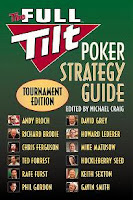
Winners & LosersWas reading through the Full Tilt Poker Strategy Guide: Tournament Edition the other day. A lot that is worthwhile in there, I think.

In Howard Lederer’s chapter on limit hold’em tourneys (one of the few discussion of LHE tourneys you’ll find, actually), he brings up a concept regarding tournaments that I remember Mike Caro at one time making a lot of noise about. Kind of a curious idea (as most of Caro’s ideas are).

Early in the chapter, Lederer extols the virtues of making it to the cash -- and in fact ultimately makes simply cashing a primary goal for tourney players, kind of countering what a lot of folks will say about the importance of winning or finishing near the top where one usually finds the big money. He admits that he might have won more money in his career overall if he’d adopted a looser, more aggressive approach, but for him that was “not a style I’m comfortable playing.” This business of approaching tourneys conservatively is not the concept I want to talk about, though.

'Full Tilt Poker Strategy Guide - Tournament EditionAmid that discussion, Lederer offers the observation that when you cash in a tournament, but don’t finish first, “you have, by definition, taken advantage of the tournament structure.” Why? “Because you ended up broke -- zero chips -- but they paid you a big check anyway.”

It’s kind of an interesting point, I think -- this idea that, as Lederer goes on to say, “the winner actually is the one that pays the biggest price for the tournament structure,” because “the winner gets all the chips but does not get all the money.”

Like I say, this is an idea that I first saw Mike Caro address as what he calls a “conceptual problem” with tournaments. In Caro’s discussion, he points back to the mid-1970s when tourneys stopped being “winner-take-all” affairs and the prize pools began to be distributed among several of the top finishers, not just the winner.

The history of the World Series of Poker Main Event exemplifies this trend. For the first eight years of the WSOP (1970-1977), the winner of the Main Event won the entire prize pool. When Doyle Brunson won his second title in ’77, there were 34 entrants in the event, each of whom paid $10,000 to play. That meant Brunson’s first prize was $340,000.

However, in 1978 the WSOP began to divide up the prize pool. There were 42 entrants that year, and Bobby Baldwin won. But he only got $210,000 for winning, and the other half of the money was divided among those finishing second, third, fourth, and fifth.

Another big change in the payout schedule at the WSOP Main Event happened in 1986, the year Berry Johnston won the WSOP. There were nearly the same number of players in the Main Event in ’86 (141) as there were the previous year (140). However, in 1985 only the top nine finishers cashed, while in 1986 the top 36 players cashed (although those finishing 28th-36th got less than their buy-in back -- $7,500). So Johnston’s first prize of $570,000 was considerably less than the $700,000 Bill Smith got the year before for winning.

Mike CaroFor Caro, this change created a “conceptual problem” with tournaments insofar as the way he views it, “first place is punished and all other close finishers are rewarded.” For the Mad Genius of Poker, this makes tournaments much, much less attractive to him, and in fact becomes a reason for him not even to play them. He goes on to suggest that “in terms of strategy... if you play to win first place... you’ll probably lose money in the long run.”

Because if you win you lose. Get it?

Caro thus offers the same advice as Lederer and insists “the way to make a profit in these tournaments is to survive” -- that is, play conservatively, try to make the cash, and be satisfied with knowing that when you do cash (but do not finish first) you have taken advantage of the structure. Ever the iconoclast, Caro probably takes the whole idea a bit too far when he adds that “you should not go out of your way to win the first-place trophy, because the winner of the tournament is penalized.” (Here’s an article in which Caro explains his idea, if you’re interested.)

I’ve heard him made this argument in other contexts, and he usually insists that finishing second is really where it’s at. The guy finishing second is the one who makes the most money despite losing all of his chips.

Now I’m no mad genius. (In fact, I’ve been known to have trouble operating a cell phone.) But I think the point being made by Caro and Lederer actually depends on a particular view of the relationship between tournament chips and buy-ins -- namely, a view that essentially sees tournament chips as directly representing the money one paid to enter the tournament. Which sort of makes sense when we talk about tournaments in a theoretical way, but creates a different “conceptual problem” (I think) once we sit down and start playing the actual tournament.

For example, there’s gonna be somewhere around 5,000 players entering that $1,000 no-limit hold’em “stimulus special” tournament (Event No. 4) this year. Let’s just say exactly 5,000 enter. All players will be receiving 3,000 chips, meaning, in a sense, that every chip cost them 33.33 cents.

Of course, since some of the prize pool is going to be taken out before the first hand is dealt, you could say the players will already be getting the worst of it just by entering the tournament. According to the WSOP, 7% of the prize pool is going to be withheld for entry fees, and another 3% taken for the tourney staff. With 5,000 players, that means there is going to be 15 million chips in play. Players will have paid $5 million total, but the prize pool is going to be $4.5 million after the juice. That means every chip is technically worth exactly 30 cents, even though players paid 33.33 cents per chip to play. If we view tournament chips as the equivalent of cash, every player is going to be down $100 just for entering the tournament.

Now I’m going to guess somewhere around 9% of the field is going to cash in this event (judging from the payout schedules of similar, big field events from the 2008 WSOP). That’s 480 players. Not sure what the prize will be for first place, but last year Grant Hinkle took a little over 15% of the prize pool for winning that first no-limit hold’em event -- the one that had nearly 4,000 enter. So let’s say the winner of the $1,000 “stimulus special” gets 15% of the prize pool for winning -- that’s $675,000. That means the other $3,825,000 will go to 479 players who finish with zero chips. If we think of tournament chips as cash, well, then it does appear that 479 of the 5,000 players entering are getting a pretty good deal here.

But really, once the entry fee is paid, that $1,000 each player handed over is long gone. All that’s left are the 3,000 chips waiting at the player’s seat at the start of Day 1. And it doesn’t make a lot of sense (to me) to think any longer of those chips bearing any relationship at all to the money spent for them, because you can’t go back and cash them in. Once the tourney starts, the trick is to turn those chips into more chips, and hopefully all of the chips. That’s the only way to maximize their value from that point.

I understand Caro’s lament about tourneys moving away from the “winner-take-all” format. And I even appreciate the “conceptual problems” that result, thus making him less inclined to play tournaments. But I don’t think I’m going to buy the conclusion that the winner of a tournament is in some sense the biggest loser, even if it is the case that he or she has won all the chips but is only claiming a small portion of the prize pool.

But that’s my choice, of course. I can buy what I want -- chips, concepts -- as long as I can afford to do so.

Labels: , , ,

Thursday, January 08, 2009

Keeping Score

Bill James' 1984 'Baseball Abstract'When I was a kid I watched a lot of baseball. Collected cards, scored the games, bought yearbooks, and all the rest. Loved it. Then other stuff came along that had the effect of lessening my interest considerably. Stuff like free agency. Huge salaries. Girls.

Before all that, though, I’d always get a copy of Bill James’ Baseball Abstract each preseason and read and reread the sucker all year. James is a long time baseball writer who specializes in various kinds of statistical analyses. James called his discipline “sabermetrics” (after the Society for American Baseball Research or SABR). Was responsible for all sorts of innovative ways of analyzing players’ performances, including inventing certain stats like “runs created” and “power/speed numbers” and the like.

I was scrounging around in the attic yesterday looking for those Abstracts. Came up empty, though I’m sure they are around somewhere. Hope I find them, as there should be a dozen or so complete sets of cards in the near vicinity, I’m guessing. I wanted to find the one with an essay proposing a new kind of box score, one that provided more detailed information than the relatively sparse ones we used to get in the sports page every morning. (Box scores have changed considerably since then, partially because of James’ influence, I think it is safe to say.)

Looking online I’m seeing the article I’m looking for was probably the one titled “Project Scoresheet.” Besides introducing a new kind of box score, James was also hoping to recruit fans from around the country to help compile data from all games in a more thorough way than was being done in the early 80s. (This was way before the internet, dontcha know.)

After a bit more hunting online, I see that James’ “Project” indeed was successful and continued through 1991, after which James joined a group called STATS, Inc. (“Sports Team Analysis and Tracking Systems”) that tracks statistics for other sports, too. He also apparently was hired by the Boston Red Sox a few years back as a consultant.

Why was I interested in such stuff? Well, I happened to have grabbed Mike Caro’s Caro’s Book of Poker Tells off the shelf the other day and as I was rereading I found myself recalling James’ Abstracts.

Caro and James have certain qualities in common, I think. Both are analytical thinkers, and both in their writings can be found time and again explicitly trying to be iconoclastic or innovative or whatever adjective you want to use for someone who is not satisfied with simply rehearsing “received wisdom.”

Mike Caro's 'MCU Poker Chart'In fact, as those of you who have read the Book of Poker Tells no doubt recall, Caro (like James) there introduced a new kind of “box score” or way of recording poker hands. In the book he explicitly (vainly?) expresses a desire that his “MCU Poker Charts” become “universally accepted” as the standard for conveying a poker hand. (“MCU” stands for the fictitious “Mike Caro University” from which emanate all of Caro’s seminars, writings, etc.) If you click on the picture you can see a larger version the chart, if yr curious.

The charts work well enough in the book, although obviously they never really came close to becoming the “standard” for recording and conveying all of the information from a poker hand. In fact, they are probably too busy and non-intuitive, although when reading the book one gets used to them easily enough. No surprise, really, that the “Charts” never really came close to becoming any sort of standard.

Mike Caro's 'Caro's Book of Poker Tells'In fact, one kind of gets the feeling Caro himself didn’t really have a lot invested in the idea of the “MCU Poker Charts.” I can’t find them anywhere on his website, nor are Word documents with the charts available on planetpoker.com (as even the most recent edition of Caro’s book promises).

I like Caro and would be one of those who’d argue he’s made significant contributions to poker over the years, the most significant being the way he helped shaped players’ awareness and analyses of physical tells. Them “Poker Charts,” though, are somewhat less significant, although I’ll give Caro some credit for drawing attention to the fact that when reporting poker hands one needs to be as thorough as possible.

Labels: , , , ,

Monday, May 29, 2006

The Big Slick Assumption

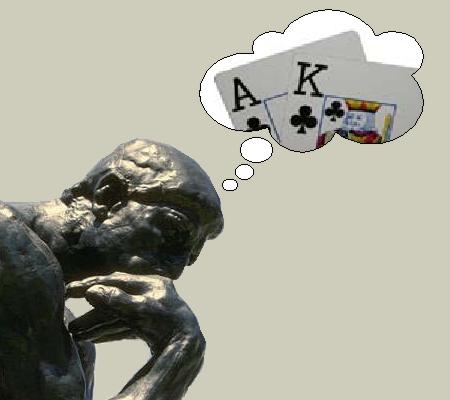
The Big Slick AssumptionHad a goofy hand yesterday swimming with the fishes in a game of $0.50/$1.00 6-handed limit over on Party. The kind of thing one sees fairly regularly in that particular aquarium, actually. The hand itself doesn’t have a lot to offer in terms of life lessons, but it did get me thinking a bit about how certain players -- chiefly inexperienced ones -- tend to interpret preflop raises in limit.

We had two empty seats at the time, actually, so there were only four of us for this particular hand. I was on the button where I was dealt Ac Kc. UTG folded, I raised, the SB folded, and the BB called. So far so what. The flop comes 7c Jh Tc and the SB open bets. Looking at the nut flush draw, a gutshot draw, and two overcards (a whopping 18 outs, potentially), I decide to raise. The SB reraises, quickly erasing from my mind the 4 outs represented by the non-club aces or kings. Still, I figure I’m close to 50-50 here even if my friend has 98 and has flopped a straight, and so I decide to cap it. (Checking later on CardPlayer’s Texas Hold ‘em Calculator, I see I’m 47% to win if my opponent indeed has 98 and no clubs.)

I’ll make this play occasionally with a strong draw and position with the hope of misleading my opponent into thinking I already have a made hand and am protecting. The SB calls, of course, and there is $6.25 in the pot when the Qc charmingly falls on the turn, giving me my nut flush.

My initial response to seeing the queen was mixed. After all, if my opponent only has a pair (the most likely hand), the queen should scare him or her away. My mood changed quickly, however, when my opponent again open bet. Must really have the 98, I think gleefully as I raise, am reraised, and then cap again. The pot is up to $14.25 when the river brings the Ks. Finally my opponent slows down and checks. I bet, s/he calls, and I collared $15.50 (minus the rake), netting 7.5 BB all told.

What did my opponent have? 10d 5c. I jive you not. Either s/he was completely wet behind the ears (a definite possibility), or perhaps believed on the turn that even if those crummy tens were no longer good there was the possibility of a fourth club and a hand-winning flush on the river. Hey, it could happen. And NBA refs’ll start calling travelling once we get to the finals.

Showdown Surprise


The hand made me think of how when I first started playing limit I would routinely put preflop raisers on AK. Only after a few months of disillusionment did I realize how damaging to one’s stack such reflexive “putting-on-a-hand” can be. The Big Slick Assumption is directly consequent to wishful thinking about one’s pocket pair or the pair one flops after calling the preraise. You’ve seen it, I know. It’s heads-up after the preraise, the board shows no A or K, and the preflop caller commences to duel with the raiser. As I said, I’ve been guilty, too (though hopefully less often now than when I first began playing).

The hand seemed remarkable to me precisely because my opponent appeared not to have made the Big Slick Assumption (acting utterly unfazed with QJT on board). Perhaps s/he has yet even to reach that stage of development as a player, not yet ready to make reads or assumptions at all. In any event, while the hand itself was hardly special, it did remind me of at least two truths for microlimit play: (1) When you’ve hit your hand, bet bet bet (avoid slow-playing, check-raising, or other examples of “Fancy Play Syndrome” as Mike Caro puts it). (2) Don’t let the Big Slick Assumption talk you into thinking your bottom pair is going to be enough to beat the preflop raiser. Especially if he raises you on the turn.

Image (top): “The Thinker” (1902), Auguste Rodin (adapted), public domain.

Labels: , , ,


Older Posts

Copyright © 2006-2021 Hard-Boiled Poker.
All Rights Reserved.