Thursday, December 01, 2016

“It was a Euphenism”

I’ve graded thousands of student essays over the years. I’ve long considered such work one of the more important and meaningful aspects of teaching, regardless of the subject matter. Helping students learn how to communicate effectively is another way of helping them learn how to think in logical, constructive ways. That’s what they’ll carry forward and will help them later, more so than anything else they learn in a given class.

As important as it is, though, I’ll admit grading papers is among my least favorite things to do. It can be especially challenging when the essay is so riddled with problems -- both “surface-level” errors (grammar, usage, punctuation, etc.) and issues having to do with the content (poor reasoning, factual errors, improper citation, etc.) -- that it becomes hard to decide where to start with one’s response.

In such cases, it becomes necessary to prioritize the problems, picking one or two big ones to concentrate on rather than fuss over every detail and thus overwhelm the student with negative feedback.

Imagine the poker pro hearing a novice player describe a misplayed hand riddled with mistakes at every step. Rather than highlight each one, the pro decides to focus on the decision to limp in from early position with king-six offsuit as an initial misstep. Let’s talk about position and starting hand selection, thinks the pro, and for now leave aside other errors coming later in the hand.

Earlier today our president-elect gave a brief speech during the afternoon in Indianapolis, and I happened to tune in as it began. He spoke at a facility belonging to Carrier, the company that manufactures and distributes heating, ventilating, and air conditioning systems. The point of the speech was to celebrate news that the company would not follow an earlier plan to outsource jobs to Mexico and shut down its Indianapolis plant, with Trump himself claiming credit for having brokered the deal.

It was a complicated bit of propaganda, frankly, and a few (though not many) reporting on it have already pointed out the claims made by Trump regarding both the deal itself and the planned-for outsourcing of jobs aren’t necessarily to be taken at face value. It’s also highly unorthodox and even threatening to a free-market system for a president or president-elect to be directly involved in attempts to save individual companies or jobs in such a fashion. Again, some have noticed that, but most seem not to be focusing on that so much with their reports.

Setting those deeper issues aside, though, near the start of Trump’s remarks he referred to having made a promise on the campaign trail that the Carrier plant wouldn’t close and jobs wouldn’t be outsourced. In telling the story, he confessed he’d forgotten he’d ever made such a promise for Carrier specifically, though did recall making more general statements about keeping jobs in the U.S.

Apparently, Trump saw a worker -- “great guy, handsome guy” -- on television reiterating Trump’s assurance, saying “Trump promised us that we’re not leaving.” He had no memory of making such a pledge, but then he saw a video showing that indeed he had said exactly that. “They played my statement,” said Trump. “I said ‘Carrier will never leave.’”

“But that was a euphenism,” Trump continued. “I was talking about Carrier like all other companies from here on in.”

I had to rewind the DVR to make sure, and indeed that was what Trump said. Like a teacher grading a paper, it was one of those “where to begin?”-type moments.

In fact, transcripts and articles of the speech are silently editing out Trump’s weird mispronunciation, with those responsible perhaps feeling too embarrassed to bother drawing attention to the mistake.

But I will.

First, the word is euphemism, not “euphenism.” As they say on Monday Night Countdown, C’MON, MAN!

Second, what Trump is describing is not a euphemism. That would be choosing a less harsh way of describing something in order to remain polite or observe a certain level of decorum. You know, like saying “to pass away” instead of “to die.” Not really Trump’s style, if you think about it. I mean, after all, his catch phrase on Celebrity Apprentice wasn’t “You’re being let go.”

No, it was more accurately metonymy, although no one outside of English class is going to say “I was using metonymy” there. That’s when a speaker refers vaguely to something specific (like, say, “Washington”) in order to suggest something more general (like “the government”).

Third, it seems more clear that what Trump really intended to say was that the promise he’d made (and forgotten) on the campaign trail regarding Carrier shouldn’t have been taken literally. “I didn’t mean it that way,” said Trump, implying a kind of amazement that the worker he’d seen on TV had taken his words at face value.

“I wonder if he’s being sarcastic,” added Trump when recalling how he initially responded to seeing the fellow saying “Trump promised us that we’re not leaving.”

You can see where this is going.

There’s a surface-level problem, a bald-faced, easy-to-spot “error” that can be easily corrected by circling a word and writing out the correct spelling nearby.

But the word is the wrong word, so that would require more writing in the margin to correct.

But there’s an even more serious problem being demonstrated regarding a lack of appreciation of the relationship between words and what they normally signify. The speaker doesn’t believe what he is saying, and when someone else does he’s surprised, thinking his auditor perhaps isn’t being truthful (is “sarcastic”) when expressing such belief.

There’s not enough room in the margin to explain all of this. And even if there were, someone with such a strange understanding of words and their meanings would likely have a hard time following the explanation, anyway.

I think this is the position in which a lot of media covering Trump might be at present, finding it a lot easier to make “silent edits” than to try to investigate and explain all of the deeper, more profound errors being demonstrated just about every time he opens his mouth.

I liked the tweet appearing below that popped up in my timeline yesterday after the speech. Its conclusion is not really an available option to the writing teacher, but it’s one the present circumstance seems to be forcing upon a lot of people:

Image: “blah blah blah” (adapted), Michelle Milla. CC BY 2.0.

Labels: , , , , ,

Thursday, March 12, 2015

Chilling in Chile (Again)

Mentioned yesterday how I’d had a chance to dine with some of the Brazilian players and media on the last night of LAPT Chile. Started out as a small group with just me, Brazilian blogger Sergio and his girlfriend Rebeca, and Andre Akkari.

Eventually a few more showed to fill seats at the other tables we’d had the waiters at Tierra de Fuego slide together. Then we had more tables moved as more and more arrived. Eventually there were more than 25 in our party, and I joked with Felipe (another of the Brazilian media) how the building wasn’t going to be big enough for the table.

“They’ll be able to build an extension after tonight,” he grinned.

Indeed, it turned out to be quite the feast (and quite the bill). Most had steak, but since that's what I'd had the night before I went with the swordfish, which was scrumptious. As happened the night before, I found myself surrounded by Portuguese, a language about which I haven’t the first clue. Some (like Sergio, Felipe, and others) spoke some English, too, but I’d sometimes go several minutes only listening and watching.

It reminded me a little of living in France years ago where I knew some French but occasionally would be thrust into situations where I couldn’t keep up well enough to speak myself, and thus could only listen. The fact that there were so many top poker players among the group made me think about non-verbal “tells” a little, and how one can develop a kind of literacy in that realm that is analogous to learning a language.

Unlike in France, though, here I didn’t have much chance of picking up words, except when the conversations had to do with poker in which case I realized I could follow pretty well the gist of what each speaker was saying even without the vocabulary. It’s interesting how a bad beat story transcends verbalized language, with expressions, shrugs, polite nods, sympathetic smiles and laughter, and other gestures adequately conveying all.

Got up early Thursday to get some work done before being forced to check out at noon, then spent much of the afternoon with Caue, another of the Brazilian contingent. We enjoyed a ceviche lunch at the Peruvian restaurant, Ica, where I had eaten once before last year, then explored the city a bit before he was due to leave. Caue and I had a chance back at Panama to visit the Canal together before, and again we had a good time discussing various subjects, seeing some sights, and enjoying what turned out to be a beautiful sunny day.

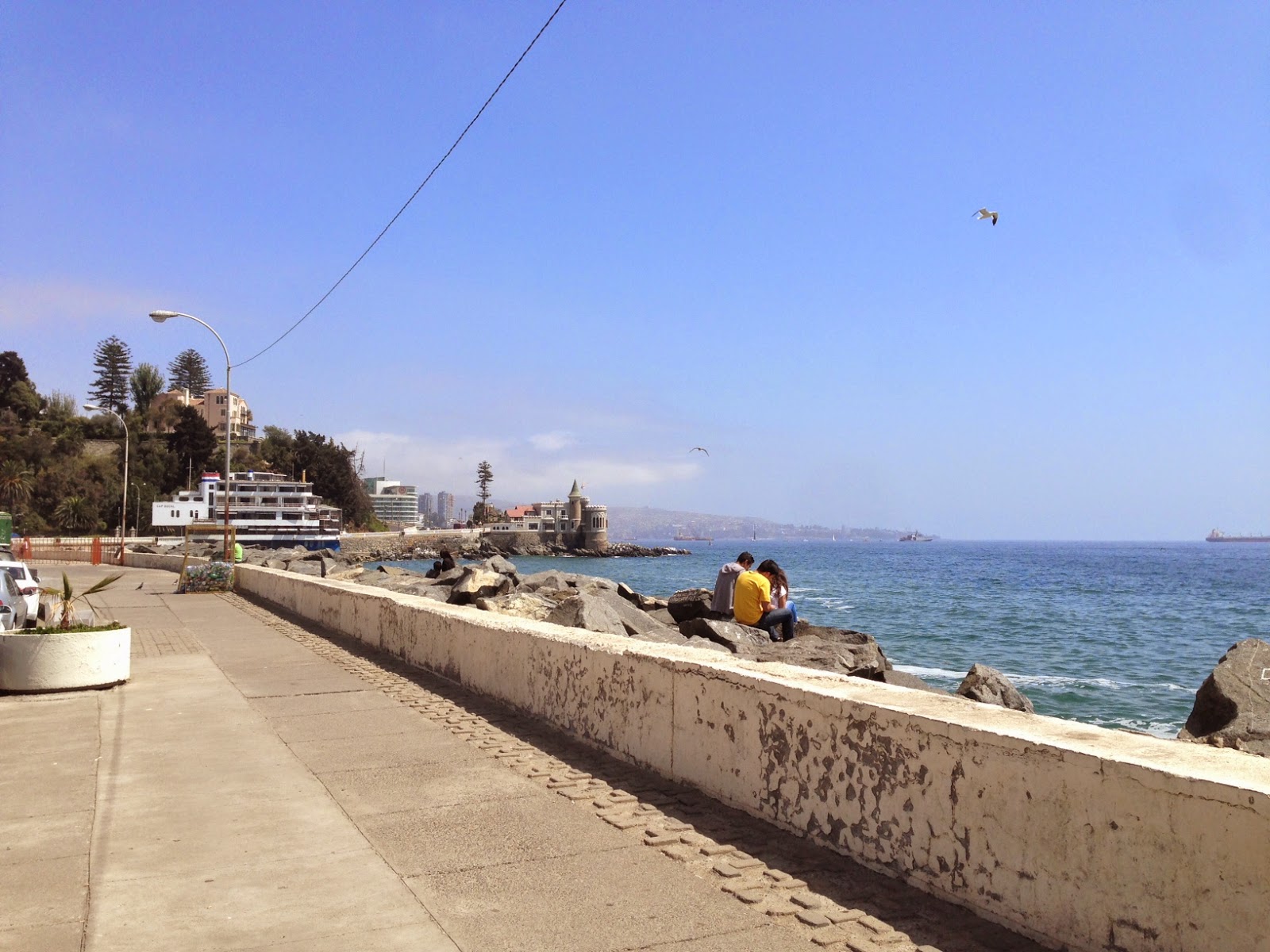
Was on my own near the end of the afternoon and so spent some time on the beach reading and people-watching, and also looking out on all of the cruise ships passing to and fro not far from the shore. At the center of that one to the left is El Castillo Wulff, which hangs out over the sea not far from my hotel and the Enjoy Casino Viña del Mar. (Click any of the pics in this post to enlarge.)

Eventually I caught my shuttle to Santiago, winding back through the mountains and vineyards as the sun started to set on the day. The overnight flight was about as good as it gets, comfort-wise, as I drew a row to myself and was able to sleep a little after watching an episode of Ken Burns’s The Roosevelts -- the one in which TR gets shot while delivering a speech and continues on another hour before getting medical attention.

After stopping through Dallas finally touched down around noon today, getting back to the farm an hour after that. The horses remembered me, or at least they pretended to after I greeted each with a carrot. Vera definitely did, and while it was another fun trip -- made more so by the great LAPT staff and others with whom I got to work again -- I was glad once again to be back in my home hemisphere.

Labels: , , , , , , ,

Monday, December 15, 2014

On the Importance of the The

I was thinking this morning about a Wallace Stevens poem and a class in modern American poetry I had as an undergraduate.

Like a lot of what we read in that course, the poem was especially challenging for someone barely 20 years old to appreciate. The professor was fantastic, however, and successfully convinced me over and over why the problems these poets were exploring -- linguistic, artistic, historical, psychological, philosophical -- were worth considering. And were, in fact, often fascinating.

The poem I thought of is called “The Man on the Dump” and like a lot of the poetry we read in that course features a great deal of physical description, in this case of seemingly scattered shards of items in a trash heap. Besides a fairly constant feeling of befuddlement, the main, decades-later impression I retain from that course was the unending stream of stuff in those poems -- all of the descriptions of things like Eliot’s yellow smoke or Williams’s red wheelbarrow or Frost’s wall with a frozen-ground-swell erupting at its base.

I’m not going to pretend to possess any special insight about these poems. After being sincerely intrigued for a semester by Pound’s puzzles, Larkin’s larks, and Plath’s plight, I made a hasty retreat back to the 18th century in grad school to study long novels and satire instead. But as I say, a few of them stand out starkly for me, mostly because of those images like the withered flowers strewn among the dirt and tin cans and old mattresses in Stevens’s poem.

The real reason I thought of Stevens’s poem was because of the way it finishes. It ends with one of those weird poetic punch lines -- you know, like a question about telling the difference between the dancer and the dance. Coming at the end of a series of rhetorical questions, the speaker asks “Where was it one first heard the truth?” He then concludes with a two-word sentence that either answers the question or perhaps clarifies it somehow: “The the.”

No, that’s not a typo. The first “the” is a definite article, and the second “the” is (seemingly) a noun. That explains the grammar of the sentence, anyway. Meanwhile, to pinpoint what the the is referring to -- a physical location? a point of origin? objective truth? -- is hardly as simple a matter. As I recall we took the better part of an hour working on that problem in class.

Later I’d think back fondly on that discussion. The particulars of it have long faded, but I still get a kick out of the sheer audacity of spending that much time talking about a single word -- and perhaps the most mundane, pedestrian word in the English language at that.

The poem and the class rushed back to mind today after having had a quick back-and-forth with someone about whether or not to include the word “the” in something he had written. I liked that exchange. It proved something I already knew about both of us, namely, that we both cared about language and thought a word like “the” to be worth discussing.

After all, deciding to use the “the” takes a stand, to give a different, more particular status to the noun coming after the article. It’s a decision that shouldn’t be made casually.

It’s an all-in push. It’s the the.

Labels: , , , , ,


Older Posts

Copyright © 2006-2021 Hard-Boiled Poker.
All Rights Reserved.