Whatcha Gonna Do With All Them Chips? (On Changes to the Structures at the 2009 WSOP)
 Two months from today (May 27), the first event of the 2009 World Series of Poker kicks off at the Rio Hotel and Casino. Event No. 1, the Casino Employees no-limit hold’em tourney ($500 buy-in), begins that day (a Wednesday) at noon, followed the next day by Event No. 2, that $40,000 buy-in “40th Annual” no-limit hold’em event.
Earlier this month, officials rolled out the structures for the 57 events, with a major change being a difference in the starting stack sizes from 2x the buy-in to 3x. In other words, for those $1,500 events, players will begin with 4,500 chips rather than 3,000. Same goes for the other events, too -- e.g., 120,000 chips for that $40K event, 150,000 chips for the $50K H.O.R.S.E., and 30,000 chips for the $10K events, including the Main Event. All of the structure sheets can be found on the 2009 schedule page over at the World Series of Poker website.
Some recall a similar change being made two years ago, when the WSOP doubled the starting stack sizes. However, when that change was made the blinds and antes were also doubled throughout the schedule, making the change in starting chips relatively insignificant. Such is not the case this year, as most of the tournaments are keeping similar structures. For instance, in those $1,500 events, the blinds still begin at 25/50. I haven’t looked through all of the structure sheets, but I’m noticing a few have been altered somewhat -- e.g., the $50K H.O.R.S.E. event looks like it has a lot of differences in the way the blinds/antes/bring-ins increase in response to the larger starting stacks.
In fact, looking more closely at the structure sheet for Event No. 7, the first of those popular $1,500 no-limit hold’em tourneys, not only have they kept the same schedule with blinds/antes increasing at the same rate (with one-hour levels), but they’ve even added a couple of levels, too. There’s a 75/100 level now (Level 3), whereas before players went straight from 50/100 to 100/200. There’s also a 1,200/2,400/300 level (Level 14) that hadn’t been there before.
The structure for the Main Event is identical (i.e., no new levels), but as mentioned the players will have 30,000 chips to start rather than 20,000.
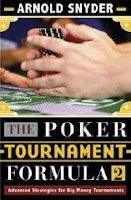
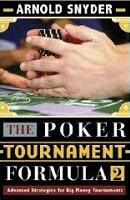
 These changes made me want to go back to Arnold Snyder’s Poker Tournament Formula books to help me see just how significant they might be. In his two-book sequence, Snyder provides formulas for calculating the “patience factor” and “skill level” of a given tournament according to its structure. The second book, The Poker Tournament Formula 2, concentrates more closely on slower-structured tournaments that require a higher skill level to play competitively, and thus adds another consideration to the mix which Snyder calls “utility factor.”
You can go over to Snyder’s website and read around to learn more about these concepts, if you are interested, perhaps starting here with this excerpt from the first book. There’s even an Excel spreadsheet over there you can download that can be used to calculate “patience factor” and “skill level.”
I did a little bit of number-crunching using the spreadsheet to try to get a quick estimate of how the changes might affect the some of the tournaments might go. I’ll just share here what I found regarding those $1,500 buy-in NLHE events (like Event No. 7).
The “patience factor” for the 2008 version of the $1,500 event was 14.93 according to Snyder’s formula. That number comes from looking at the structure and figuring out how many hours the “World’s Most Patient Player” (i.e., someone who folds every hand) would last, then squaring that number. According to the 2008 structure, the WMPP would last 3.86 hours, thus making the PF 14.93.
 From the PF, one then can derive both the “skill level” and “utility factor” of a given tournament. For Snyder, any tournament with a PF of more than 10 is a “Skill Level 6” tournament -- that is the top of his range, indicating the tournament should be for highly-skilled players only. His first book, by the way, focuses on the faster-structured tourneys, while the second one gets into talking about distinctions between slower-structured, “Skill Level 6” tourneys. Thus, in the second book, he introduces this idea of “utility level” to address some of the distinctions between the different slower-structured tourneys.
The increase in starting chips and extra Level 3 in the 2009 version of the $1,500 NLHE tourney means the WMPP can last 5.29 hours by folding every hand, making the PF 27.94. Still a “Skill Level 6” tourney, but now players have a much greater “utility factor” to consider.
The “utility factor” comes from comparing the PF to what Snyder calls the “starting competitive factor.” Assuming a stack of 60 big blinds gives one what Snyder calls “competitive utility” (i.e., you can make just about all the moves you’d like to make at all points during a hand), Snyder looks at how one’s starting stack compares to that figure, then multiplies that ratio times the PF to get the “utility factor.” The point here is to show that a higher PF doesn’t necessarily translate into a higher UF -- the rising blinds may still force you to action more quickly, depending on the relative ratio of your stack to the current size of the big blind.
So for those $1,500 events, back in 2008 the UF was in fact identical to the PF -- i.e., 14.93 -- since players started with exactly 60 big blinds (3,000 chips, with a big blind of 50). This year, those playing in the same events will start with 90 big blinds and the PF is higher, too, meaning their UF will be considerably higher at 41.91 (i.e., 90/60 = 1.5 x 27.94 = 41.91).
According to Snyder, tourneys with a UF between 6-20 are “Rank 1 Tournaments” in which “you definitely want to build a big stack early or bust out trying... because after an hour or two, the players who manage to build early stacks will not only be able to dominate their tables, but may also be able to play real poker against each other.”
Meanwhile, tourneys with a UF of 40-60 are “Rank 3 Tournaments.” In these “early risks are still required as you definitely need to double up before the third blind level,” but you won’t be quite as desperate early on (i.e., in the first two levels) as you would have been in a tournament with a lower UF.
All of which is to say, there’s going to be a difference here, I think, although it won’t be an inordinately huge alteration in the way the tourneys are played. I do like the changes, though, as they appear to make these $1,500 “donkaments” (as we reporters affectionately called them last summer) slightly less manic there at the very start, perhaps admitting a bit more play (or “skill”) to dictate how things go.
I should note as a postscript that not everyone buys into Snyder’s formulas and theories, but I think he has a good way of explaining such ideas and giving his readers useful ways of preparing for a variety of tournament structures.
And since we’re only two months away, I’d say it’s time to start planning!
Labels: *high society, Arnold Snyder, The Poker Tournament Formula, The Poker Tournament Formula 2
posted by Short-Stacked Shamus at 3/27/2009 07:59:00 AM
2 comments