Tuesday, May 13, 2008

Awareness (in One Act)

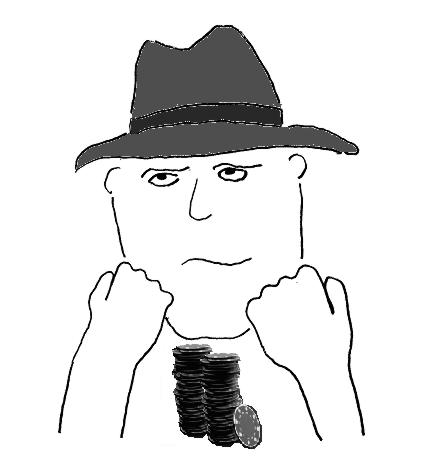
Many players are so unaware, they wouldn’t notice an elephant defecating in the middle of the table“Whatever general style you play, you must always modify it to reflect the styles of your opponents, and the current texture of the game . . . . That said, many players are so unaware, they wouldn’t notice an elephant defecating in the middle of the table.”
--Roy Cooke, “Managing Your Game Style,” CardPlayer, Vol. 21, No. 8 (April 29, 2008)
Seat 8: “Nice hand.”
Seat 7: “Thanks.”
Seat 8: “Has it gotten darker in here?”
Dealer [tapping felt in front of seat 2]: “Big blind, please.”
Seat 3 [exhaling]: “Am . . . I . . . ever gonna get a hand?” [mucks cards]
Seat 4: “Waitress!” [Waves hand.]
Dealer: “On you, sir.”
Seat 4: “Ehhh . . . [mucks] . . . Somebody dim the lights . . . ?”
Seat 7: “I should have bet more on the end there.”
Seat 8 [shaking head]: “Nah.”
Seat 7: “You do call forty there.”
Seat 5: “Fifteen.”
Seat 6: “Call.”
Seat 8: “Not forty . . . .”
Seat 7: “Thirty?”
Dealer: “Fifteen to stay.”
Seat 7 [mucking hand, chuckling]: “Oh . . . you’d’ve called forty . . . ”
Seat 8: “I call.”
Seat 9 [mucking hand]: “I’m out.” [Stands up.]
Seat 10: “Mmm . . . [mucks]”
Seat 1: “It is darker in here . . . [mucks].”
Seat 2: “Call . . . now, c’mon dealer . . . do me right now . . . ”
Dealer: “Four to the flop.”
Seat 8: “I can’t see the board. Where are the lights?”
Dealer: “Nine of clubs, nine of hearts, ten of clubs.”
Seat 2: “Ten.”
Seat 1: “What’s that noise?”
Seat 5: “I raise . . . forty-five.”
Seat 6: [mucks]
Seat 3: “I been sitting here for three hours and I’ve seen exactly one pocket pair for three . . . Whaddya . . . what noise?”
Seat 4: “Gimmeya . . . Dos Equis. Please. Thanks . . . ”
Seat 2: “Sounds like a generator or something . . . what is that dealer?”
Seat 8: “Why would they turn the lights down . . . [mucks]”
Seat 1: “Call.”
Dealer: “I don’t know. Two to the turn.”
Seat 2: “Sounds like the air conditioning . . . ”
Dealer: “Jack of clubs.”
Seat 5: “Action card.”
Seat 7 [voice lowered]: “Folded a nine.”
Seat 7: “Dunno.”
Seat 1: [taps table]
Seat 5: “All in.”
Seat 3: “Lord, what is that smell?”
Seat 4: “Huh?”
Seat 3: “You smell that?”
Seat 1: “How much?”
Dealer: “One-twenty . . . twenty-five . . . thirty . . . . One-forty-two.”
Seat 8: “What’s that?”
Seat 7: “Jack. Clubs. He’s filled up.”
Seat 3: “Somebody hit the buffet . . . HARD.”
Seat 4: “Man, oh man . . . you’re right . . . ”
Seat 3 [voice lowered]: “Must’ve been . . . .” [Points thumb toward the empty seat 9.]
Seat 1: “A little quiet, please.”
Seat 5 [holding nose]: “Gawd . . . . Sorry.”
Seat 1 [turning head back from Seat 5]: “I call.”
Seat 5: “Boat?”
Seat 1: “Not yet . . . . Trips.”
Seat 5: “Club please.”
Seat 8: “What’s he got?”
Seat 7: “Club draw . . . and . . . there’s a shadow . . . ”
Dealer [taps table, burns, deals]: “Three of clubs . . . flush beats three of a kind . . . ”
Seat 1: “Cra-a-a-a-p.”
Seat 7: “That stinks.”
Seat 8: “What?”
Seat 7: “He got there.”
Seat 8: “Oh . . . right . . . . Why is it so dark in here?”
Seat 5: “Sorry, dude. That was nuts.”
Seat 2: “There is that sound again.”
Dealer [tapping felt in front of seat 3]: “Big blind, please.”
Seat 3: “Can I get a seat change . . . ?”

Labels: , ,

Tuesday, July 04, 2006

Is Patience a Virtue?

Shamus waits to play his first hand.Played some Stud 8/b yesterday and had a decent, brief session. Had a hand where I managed to catch a wheel on sixth street, capturing a nice pot. With the antes and bring-ins, Stud has a different character than blinds-driven games like Hold ’em. One of several ways Hold ’em plays like a circle, Stud like a straight line.

I ended up back at the limit Hold ’em tables afterwards. I joined one table (full limit, $1.00/$2.00) and got a seat just after the big blind had passed. So I clicked “Wait for the BB” (as I usually do) and watched six or seven hands. I almost always choose to wait for the BB, particularly if I am looking at calling the blind from middle position or earlier. Finally we came to the point where the next hand would bring the BB back to me. That’s when the player to my right decided to leave, thereby causing the button to pass me by yet again. So once again I sat there watching the wheel go 'round (only a few minutes, although online a few minutes can seem an eternity) until I finally got to play.

I had considered going ahead and putting my BB out there the second time I was given the opportunity to do so -- from the cutoff -- but by force of habit did not. There’s certainly a benefit to sitting and watching other players for a few hands before jumping in. A few months ago, Roy Cooke wrote an article in CardPlayer titled “Increasing Edge by Observing a Hand” in which he discussed this very topic. One can often learn quite a bit from paying attention to what the players around you are doing while you await the big blind.

Of course, by choosing to wait you are also signalling something about yourself as a player -- cultivating an image of sorts even before you play your first hand. At the low limits, folks aren’t always paying a lot of mind to this sort of thing. Still, by not playing right away, I may well be announcing (quite accurately, in fact) to attentive players that I am a somewhat conservative player, selective with his starting hands and careful not to take too many unreasonable risks.

I’m reminded of one of my favorite sentences in Miller/Sklansky/ Malmuth’s Small Stakes Hold ’em -- not so much for what it says but for the trio’s curious choice of vocabulary. “When you enter a game,” they explain, “you usually have the option either to post an amount equal to the big blind and take a hand immediately or wait for the big blind to come to you. Mathematically, the choice you make does not much matter. (Nevertheless, people seem to like to debate this picayune topic.)”

Picayune? What a word. I can just imagine the look on Sklansky’s face when he pronounces it. (Try it -- pick-uh-YOON -- you can’t help but sneer.) A fancy way of saying “trivial” or “petty.” Etymologically, the word actually refers to money, coming as it does from the French word picaillon (meaning "small coin"). Le chump change.

As the trio go on to explain, while there is little mathematical significance to whether or not you decide to wait, there can be -- as I’ve already suggested -- a significant psychological significance. “If you sit out seven hands before you play,” they explain, “you will appear too serious” to your opponents, causing them to play more carefully against you. This phenomenon is certainly more meaningful in the live game situation than online, I’d venture. Still, it makes me think that perhaps I should go ahead and jump into the fray once in a while and perhaps mislead the table into thinking I’m a looser cannon than I actually am.

I’m curious to hear what others think about this issue. Do you routinely wait for the blinds, or jump right in? This topic is probably more meaningful for limit games, although I’m interested to hear what the difference might be for NL players as well.

Or is it all just too picayune to matter?

Labels: , , , , , , , ,


Older Posts

Copyright © 2006-2021 Hard-Boiled Poker.
All Rights Reserved.