Monday, May 30, 2016

Watching the Super High Roller Bowl

I actually had Day 1 of the 2016 Super High Roller Bowl on from start-to-finish yesterday.

Took a little while for the live stream to work out the kinks during the first hour or so, but the PokerCentral channel finally got up to speed and I had it on the teevee via the Roku. Then starting at 7 p.m. ET I switched over to the CBS Sports Network (which I rarely watch but thankfully get) and left it running all night until 3 a.m.

That’s not to say I paid close attention every step of the way, and indeed I think that would have been hard to do even for dedicated televised poker watchers. But I watched a lot, generally enjoying the show and tolerating well enough all of those Dollar Shave Club commercials.

We’ve been listening to Ali Nejad do poker play-by-play for a decade now, and he was solid as usual. Nick Schulman was doing commentary as well. I haven’t heard him do a lot before, but he was an absolute natural (I thought), very funny and quick with Nejad while also giving good analysis, often smartly directed toward a wide audience.

Interestingly, a $300K buy-in “super” high roller doesn’t really provide all that much novelty anymore. Or excitement, even, given how common six-figure buy-in events have become since they first started cropping up in early 2011. But this free-to-play “MVMT Million Dollar Final Table Challenge” game being put on by PokerCentral and MVMT watches has added an extra incentive to follow this one, even if the challenge being presented by the contest is all but impossible to meet.

You probably heard about it. Seven players will cash in this tournament, splitting a $15 million prize pool with $5 milly going to the winner. For those who entered the contest, guessing all seven cashers correctly -- in order -- wins a $1 million prize. (No shinola.) And if no one gets that, the closest to doing so wins $10,000, with the top 25 getting fancy watches.

Sure, as Fedor Holz (one of the players who I’ve picked to make my final table) joked on Twitter yesterday, “Don't miss the 0,000006$ EV and bet the Final Table order in this 300k @PokerCentral #SuperHighRollerBowl #value.” Even so, the game added a bit of fun to watching, and the ability to change your line-up at the end of Day 1 (and jettison those who had already busted) enables that to continue into today for most who are playing along.

Just for fun, I pulled together an article on Friday for PokerNews titled “Finding a Million-Dollar Strategy for Picking the Super High Roller Bowl Winners.” I didn’t really pretend to present a sure-fire strategy for playing what is mostly a lottery-like contest, but rather went through and gave a history of sorts for all 49 players in events with buy-ins of $100K or more. That is to say, I shared how many times each had cashed in such events before (or not, as some never have), not being able to share also how many times the players had entered super high rollers.

I then picked a final table comprised of dudes who’d gotten to the money in these things many times. Two of my original picks -- Scott Seiver and Isaac Haxton -- didn’t make it to today’s second day of play, and so before the window closed to change picks I swapped them out for Timofey Kuznetsov and Daniel Negreanu (both of whom finished Day 1 with big stacks).

Looking at past super high rollers seems as good a way as any to play a game like this. I was just reading this afternoon an ESPN article by Bill Barnwell discussing tonight’s Game 7 between the Golden State Warriors and Oklahoma City Thunder (which is going to interrupt my SHRB viewing for certain). He essentially did something similar, going back through history and looking for examples of teams who like OKC blew Game 6 leads in which they’d have clinched series (both in basketball and baseball), then seeing how they did in Game 7s.

In truth I think the only people who can truly handicap something like this are the players themselves, as they know more than anyone the relative skill level and potential for success of those who are participating.

Anyhow, that’s my card up top. Wish me -- and those seven guys listed above -- luck.

Labels: , , , , , , , , , , ,

Wednesday, August 06, 2014

A 2006 WSOP Time Capsule

Didn’t watch the “One Drop” last night (DVR’d it). Instead what time I did spend looking at poker actually involved viewing some of the 2006 World Series of Poker Main Event -- not the ESPN episodes, but the live pay-per-view that was shown that August night (the eighth anniversary of which comes this weekend) when Jamie Gold won the biggest first prize in WSOP Main Event history.

The program brings back some personal memories. That final table occurred just a few months after I started this blog, and about six weeks prior to the passage of the Unlawful Internet Gambling Enforcement Act of 2006. Thus it exists within a rosy context, a time when my absorption in all things poker was at an all-time high. As was the case for a lot of people.

The playing styles at the final table are of course conspicuously different from what we see today, with everyone opening for at least three times the big blind before the flop (sometimes more), lots of overbetting of pots after the flop, and many all-ins that today would automatically be read as “ICM suicide.”

The commentary by Phil Gordon doesn’t have the benefit of eight years’ worth of hindsight, and so while he does point out what seem like misplays or less-than-recommended bet-sizing here and there, most of his observations -- like the plays themselves -- are essentially time-bound, perfectly fine then while highlighting in retrospect changes in tournament strategy that have happened since.

Other comments by the many guest hosts rotating through during the broadcast are similarly time-bound, and since it was such an interesting time those comments are all the more intriguing.

At one point Doyle Brunson stops by. It happens to be his 73rd birthday. He’s just finished playing a 14-hour day the night before, finishing 21st in one of those post-Main Event bracelet tournaments they ran that year.

“What are your impressions... eighty-seven hundred players this year?” begins Gordon, and Brunson answers that he was one who expected there would be an increase in players from 2005. There were 8,773 players in the WSOP Main Event that year -- still a record. That was more than 3,000 more than had played in 2005, and more than 10 times as many as had played in 2003.

“I think that it’s just going to get bigger and bigger,” Brunson continues. “I don’t see any stopping it. In fact if there were some way to bet, I would like to bet there would be something like 40-50 thousand players in 10 years.”

“Oh boy,” says Gordon, who begins to disagree. “I think so,” affirms Brunson. “The only thing that would stop it, you know, if the internet....”

At that point Brunson gets interrupted by another “Oh boy” from Gordon as a hand has developed that will result in Sweden’s Erik Friberg getting knocked out in eighth place by Gold.

“Hold onto that thought,” says Nejad as the hand starts to play out. But the bustout distracts them and they never do get back to the topic.

Not unlike the way the idea itself would be interrupted just a few weeks later. That vision of 50,000 WSOP Main Event players -- perhaps spread all over Las Vegas and/or the internet -- would be left behind, time-bound.

Labels: , , , , , , ,

Monday, July 16, 2012

2012 WSOP, Day 50: Racing to the End

The final four tables at the 2012 WSOP Main EventIt has come fast. The last day of the 2012 World Series of Poker -- save the Main Event final table, to play out in late October -- has arrived.

Yesterday’s Day 6 was a marathon, made both longer and more challenging by the many breaks taken throughout the day and night.

I mentioned yesterday how this year ESPN essentially has five “feature” tables around which they can shoot -- the main one in the “mothership” arena, a secondary one to the side, and three more over in what used to be called the “Blue” section but last night was dubbed “Gold.” Those pictures were from when they had gotten down to four tables, with the main, the secondary, and the two on the side.

They played down from 97 to 27 players yesterday, which meant in addition to those five tables there were six more “outer” tables set up to begin play, but gradually as players busted those were broken, the remaining players reseated, and the tables literally broken down and taken out of the Amazon room.

The various areas are quite far apart, actually, which was one reason why extra breaks would come up in order to give players time to find their new locations. They’d occasionally switch entire tables sometimes, too, in order to make one or another “featured,” and that do led to the extra 10-minute pauses in the action.

So it was a long one. All in all, it would take until after 2 a.m. (five two-hour levels plus part of a sixth) to eliminate 70 players and establish today’s final three tables. (I should mention the ESPN folks have been great to work alongside, and we’ve had many occasions to help one another out while making space for each other, too.)

The knockouts came quickly at the start, though the pace would slow down as the day wore on. There was some minor buzz about all of the “big names” getting knocked out on Day 6, including Gavin Smith, Vanessa Selbst, Jason Somerville, David “ODB” Baker, and 2011 November Niner Sam Holden. At the dinner break I joked on Twitter that there were still big names left, including Martinezalonso, Israelashvili, and Gwennael Grandmougin. Typing those made me think of players from past WSOPs such as Manoj Viswanathan and Meenakshi Subramaniam.

There will be plenty of intrigue today among the final 27, led currently by Marc Ladouceur who finished 63rd in the Main Event just last year. Also of note is the fact that two women still remain as well, Gaelle Baumann and Elisabeth Hille, with Hille currently fifth in the counts. I will have to look it up to be sure, but I think 2000 might be the last year two women made the final 27 when Annie Duke finished 10th and Kathy Liebert 17th.

Today may take a while, with the average stack still deep at a little over 61 big blinds, and only four players returning to less than 30 BBs. Who knows, though? I’m remembering 2009 when everyone was sure the 27-to-9 day would be lasting until dawn and they ended up racing to the end by 9 p.m.

Establishing ground rulesSpeaking of racing, I’d be remiss not to mention the late night chair racing competition that came after all was done last night in which Remko, Rich, B.J., and Ali Nejad invented a competition and executed it in the most hilarious fashion imaginable.

The contest required participants to run with a dealer’s chair, gathering momentum and then jumping on it at a certain point to see how far they could ride afterwards. Kind of like bobsledding, although the ultimate goal was distance, not speed.

The order and results could not have been funnier.

First the sight of Remko, literally a flying Dutchman, establishing the mark to beat.

Then Rich, despite his best efforts coming up short of Remko’s mark.

Then B.J., who looked for all the world as though he was about to cruise past Remko when he leaned too far and fell forward, crashing to the sound of laughter all around.

And finally Ali, there to shoot the last of his ESPN video reports for the WSOP, providing his own commentary then expertly gliding past Remko to victory.

We were still laughing as we left, racing back to get a few hours rest before today’s Day 7. Like I say, today may take a while. But I’m guessing no matter how long it takes it’ll seem like we’re flying.

(EDIT [added 7/23/12]: "The Great WSOP Media Chair Race" on YouTube.)

Labels: , , , , , ,

Monday, October 03, 2011

Epic Poker League Makes Television Debut

Epic Poker League makes TV debutWas home Saturday night and happened to be in front of the teevee when the debut of the Epic Poker League popped up at 10 p.m. Actually I think this might have been a “preview” show, not the official “premiere” which I believe is slated for this coming weekend. Here’s the full schedule, if you’re curious.

I’d seen a few references to the show coming up here and there, although I can’t say I made specific plans to watch. I wasn’t even sure the channel was included among the ones we receive, but a quick search just before ten o’clock revealed it was, and so I took a look. I was curious to see it, not just because I am writing that “Community Cards” column for the EPL blog (although feel free to take that for what it’s worth, if you like, when reading my evaluation of the show).

This first hour-long program introduced the EPL, filled in details regarding the early days of the first Main Event which drew 137 players, then picked up the action with 18 left gathered around three six-handed tables. Over the course of the hour the field was trimmed to 10, at which point I assume the next broadcast will pick things up.

I’ve seen no ratings numbers, but I’m guessing the show couldn’t have attracted a huge audience. It aired on Discovery HD theater, a channel which I believe will be redubbed Velocity sometime this week. Didn’t really notice a lot of chatter on Twitter about it while I was watching, although to be honest I’m not seeing much talk lately on Tuesday nights, either, during ESPN’s WSOP shows.

Televised poker most certainly lost its novelty for many long ago. And I think among U.S. players and viewers, the sudden unavailability of the online game (for the most part) has probably further muted a lot of folks’ excitement over the idea of watching others play cards. Thus has the impact of a new poker show lessened considerably.

Nonetheless, I did find the hour’s worth of poker entertaining, and so thought I’d share just a few impressions.

Shamus watches EPLThe overall look and feel of the show was excellent, the signature style of 441 Productions -- who had presented the WSOP on ESPN prior to this year -- evident throughout. The shots, the sound, the editing, the graphics, and everything to do with the presentation was top-notch, and I think might well make some wish 441 was still involved with the WSOP.

Pat O’Brien and Ali Nejad did fine with the commentary. O’Brien’s sports background kind of furthered the idea that we were watching a sporting event, an impression I think the EPL would like to encourage. There wasn’t much goofing or Norman Chad-style joking around, but rather what seemed like a mostly no-nonsense, efficient approach to the way the pair described the action.

There were a couple of interesting hands, strategy-wise, along the way. I liked the way stack sizes were incorporated into the graphics, with adjustments made as each bet was made. The numbers appeared in a subtle way beneath the players’ cards, meaning if a viewer didn’t care about such stuff, he or she could easily ignore it.

There were a few segments presenting backgrounds on players -- “human interest” stuff that worked well enough, I thought. I found it interesting that O’Brien and Nejad did allude to David “Chino” Rheem’s money troubles, explaining how he had over $4 million in career earnings (prior to this event) but had lost it all and then some. Also noticed how there were plenty of PokerStars patches to be seen, but no Full Tilt Poker ones (as far as I saw). (The event took place in early August.)

Global Poker IndexI’ll make one last observation. References to the Global Poker Index were made frequently, and especially toward the end of the hour it felt a little like an “argument” (of sorts) was starting to be advanced about how these rankings and the EPL should be regarded as heralding a new chapter in professional poker.

Much was made of the fact that three of the top four ranked players at the time -- Jason Mercier, Eugene Katchalov, and Erik Seidel -- were among the final players left in the event, the implication being that the tourney was proving, in a way, that the best players tend to win out in the end.

Was kind of weird, actually, to see these rankings brought up while hands were being played. Thus, say, when a hand arose in which Gavin Smith (ranked 101st at the time) was up against Katchalov (then ranked 3rd), it was a little like an underdog-favorite situation was being suggested such as when a lower-ranked team plays a top five team in college football, or a lower seed is matched with a top seed in tennis.

I guess the rankings do help bolster that feeling that it’s sports we’re watching, but most of us -- and by “us” I mean semi-serious or serious poker players -- know that such stuff doesn’t matter, really, when a hand is playing out. Still, I guess I’m curious to see how the GPI evolves and whether or not it really can effect some sort of alternate way of thinking about professional poker.

Like I say, it’s hard even for us poker fanatics to get too up for a poker show anymore. Still, it was an engaging hour of poker television. Not wholly absorbing or riveting, but engaging. Enough for me to try to find the sucker on the menu once the next episode rolls around.

Labels: , , ,

Friday, September 01, 2006

WSOP Final Table Hand No. 122: You Going All the Way?

In Hand No. 122, Richard Lee cruised past the point of no return . . . Have now made my way through five-and-a-half hours or so of ESPN’s pay-per-view broadcast of the WSOP Main Event final table. The commentary by Phil Gordon and Ali Nejad has been hit-or-miss, though I’d say they’re doing about as well as could be expected. The interview with Erik Friberg (out in 8th place) was more than a little cringe-worthy, peppered as it was with lots of awkward questions about Swedes. They also spoke with Douglas Kim (out in 7th); he seemed like a smart young man who had a decent idea of what he’d just been through. Two-time WSOP bracelet-winner David Grey came in and made some intelligent observations about the pressure the players were experiencing. And Phil Hellmuth stopped by to remind everyone how great he is.

(I’m not even going to comment on the Rochambeau nonsense Gordon and Nejad keep perpetrating on their unwitting guests.)

As far as the play goes, Jamie Gold had spent several orbits mostly keeping out of the way while others attempted to outlast the short stacks (Michael Binger and Rhett Butler). Then came Hand No. 104. Gold put in a preflop raise, got two callers (Paul Wasicka and Richard Lee), and with a board of QQJJ put in a smallish bet that made his opponents fold. Gold then showed his hand -- 3s2h. Gordon and Hellmuth both suggested showing the bluff to have been a poor decision on Gold’s part. A few hands later, Allen Cunningham made a spectacular call of another Gold bluff, calling a bet of 2 million on the river with ace-high. Thanks in part to that hand, Cunningham had built himself back up to 14.5 million or so (third place), while Gold still sat comfortably in the lead with 37.5 million.

Then comes Hand No. 122, involving Gold and the man in second place, Richard Lee. Lee had bled some chips during the previous orbit -- in reckless fashion (or so it appeared). During the last six hands Lee had lost around 3.8 million in chips, knocking him back down to 16.5 million. Hand no. 119 saw Lee raise to 800,000 from middle position and get called by Gold from the big blind. As he had done back in Hand No. 5, Gold checked in the dark. When the flop came 2h7h5d, Lee bet 1.1 million, Gold check-raised to 3 million, and Lee got out.

So there are a couple of trends worth considering as this pivotal hand begins. Gold’s early momentum had appeared to wane, particularly following Cunningham’s successful call. However, he had just won the last three pots (all without showdowns) and looked ready to reassume the role of table captain. Meanwhile, Lee’s chair might have become slightly less comfortable after the last round of play. I wouldn’t say he was steaming, but it’s clear he’d become anxious to make something happen.

The cards are dealt and the table folds around to Gold in the cutoff. He looks down, takes a quick glance across the table at Wasicka (in the big blind), then calls (for 240,000). Rhett Butler folds on the button. Lee, in the small blind, looks at his cards and announces he’s going to raise. He deliberates, then bets 1.2 million. Wasicka folds and the action is back on Gold.

Gold looks at his cards again, peers over at Lee for ten seconds or so, then says “I raise.” As we’ve seen before, Gold announces his intentions with a kind of dismissive air, as though he’s utterly unconvinced whomever he’s up against is too weak (lacking the cards and/or the courage) to face up to him. He raises to 4 million. Gordon claims Gold’s hands are shaking a bit as he stacks his chips and pushes them into the pot, but I’m not seeing it. Gold has to stand up, actually, to reach the chips at the front of his stack, and he remains standing, hands in pockets, looking down on Lee considering what to do next.

Lee spends a few moments moving his chips around and Gold abruptly asks “You going all the way?” Lee quickly replies “All in.” Gold eagerly shows QdQs. Lee turns over JhJs. Gold is ecstatic. We hear him telling his friends “I can only make the right play . . . I can’t do anything about what comes out.” Lee appears amiable, sipping his coffee and smiling as he asks the dealer for a jack. It’s obvious, though, that he’s less than thrilled.

The flop comes 3dKdKs. Lee is shown with his eyes closed, as if in momentary meditation. The turn is the 6h. Gold points at the dealer and says “no paint . . . nice and low.” The river is the Tc. Lee is done, and Gold now has over 51 of the 88 million chips in play.

What’s to say here? While the play perhaps does not descend to the level of Scott Lazar’s meltdown at the 2005 Main Event final table (where he blew through his entire stack in two hands calling all-in bets with K9-suited & QT-off), Lee clearly blundered when calling Gold's reraise. Lee was in much better shape than Lazar had been chipwise, and definitely should have finished higher than Lazar did last year. But he didn’t. Both landed in sixth place.

Following the hand, the five remaining players headed for the dinner break. I may well take a break, too, and save further posts about the final table for later. A person can only take so much rock-paper-scissors . . . .

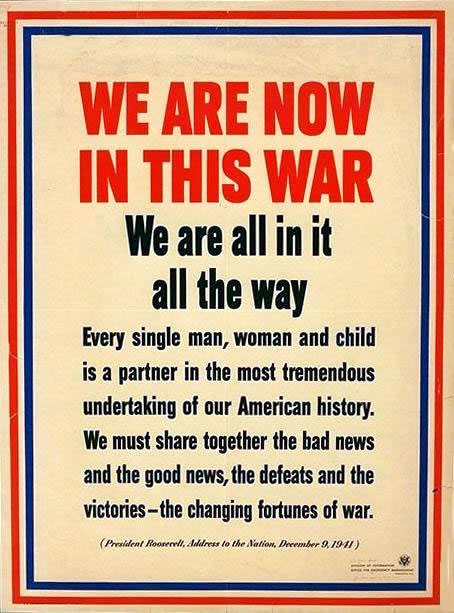
Image: A U.S. World War II poster calls for all members of American society to contribute to war effort, public domain.

Labels: , , , , , , ,


Older Posts

Copyright © 2006-2021 Hard-Boiled Poker.
All Rights Reserved.