Tuesday, November 10, 2015

2015 WSOP November Nine, Day 2: McKeehen’s Still On Top

Watched every hand again last night as the 2015 World Series of Poker Main Event final table played down from six players to three, with Joe McKeehen remaining in a dominant position going into three-handed play for tonight’s finish.

It’s reminding me once again of that WSOP Circuit final table from a couple of years ago that I’ve mentioned before, the one at Caesars Atlantic City I helped cover where McKeehen entered the final day with a big lead and never seemed to be challenged much at all on his way to the win.

Kind of remarkable, really, to think how easily things have gone for McKeehen at the final table thus far. Not only has he avoided making any bad decisions, he’s barely even taken that many risks at all even with decent hands in good spots. Both his opponents’ styles and the cards have dictated that result somewhat, but the overall impression has been that it’s hard to imagine how things could have gone much differently for McKeehen up to this point.

Easily the most interesting hand last night was the one that came relatively late when they were four-handed and Josh Beckley managed to three-bet and then fold pocket jacks to a reraise from the chip leader. We knew when watching that McKeehen had four-bet with pocket queens, which helped raise the eyebrows a little further when we saw Beckley avoid getting hooked by his two hooks.

The hand reminded me of one from the 2006 WSOP Main Event final table, something I brought up in another “what would you do?”-type PokerNews article today. I’m referring to a hand in which Richard Lee reraised all in with pocket jacks versus Jamie Gold’s queens and was knocked out in sixth.

Even though the two hands were similar, it’s funny to go back and think about how crazily different the play was at the ’06 final table -- where, it should be said, most of those there were amateurs, with Allen Cunningham being the exception. In fact in the hand Gold limped in with his queens, something that is hard to imagine happening today. So, too, have the 3x-and-above opening raises at that final table become a thing of the distant past.

Will be there ’til the end again tonight. While it’s hard to envision McKeehen in trouble, it sure would be interesting to watch should either Beckley or Neil Blumenfield manage to get in a position where they can present him some difficulty to complicate the conclusion.

Labels: , , , , , , , , ,

Friday, September 01, 2006

WSOP Final Table Hand No. 122: You Going All the Way?

In Hand No. 122, Richard Lee cruised past the point of no return . . . Have now made my way through five-and-a-half hours or so of ESPN’s pay-per-view broadcast of the WSOP Main Event final table. The commentary by Phil Gordon and Ali Nejad has been hit-or-miss, though I’d say they’re doing about as well as could be expected. The interview with Erik Friberg (out in 8th place) was more than a little cringe-worthy, peppered as it was with lots of awkward questions about Swedes. They also spoke with Douglas Kim (out in 7th); he seemed like a smart young man who had a decent idea of what he’d just been through. Two-time WSOP bracelet-winner David Grey came in and made some intelligent observations about the pressure the players were experiencing. And Phil Hellmuth stopped by to remind everyone how great he is.

(I’m not even going to comment on the Rochambeau nonsense Gordon and Nejad keep perpetrating on their unwitting guests.)

As far as the play goes, Jamie Gold had spent several orbits mostly keeping out of the way while others attempted to outlast the short stacks (Michael Binger and Rhett Butler). Then came Hand No. 104. Gold put in a preflop raise, got two callers (Paul Wasicka and Richard Lee), and with a board of QQJJ put in a smallish bet that made his opponents fold. Gold then showed his hand -- 3s2h. Gordon and Hellmuth both suggested showing the bluff to have been a poor decision on Gold’s part. A few hands later, Allen Cunningham made a spectacular call of another Gold bluff, calling a bet of 2 million on the river with ace-high. Thanks in part to that hand, Cunningham had built himself back up to 14.5 million or so (third place), while Gold still sat comfortably in the lead with 37.5 million.

Then comes Hand No. 122, involving Gold and the man in second place, Richard Lee. Lee had bled some chips during the previous orbit -- in reckless fashion (or so it appeared). During the last six hands Lee had lost around 3.8 million in chips, knocking him back down to 16.5 million. Hand no. 119 saw Lee raise to 800,000 from middle position and get called by Gold from the big blind. As he had done back in Hand No. 5, Gold checked in the dark. When the flop came 2h7h5d, Lee bet 1.1 million, Gold check-raised to 3 million, and Lee got out.

So there are a couple of trends worth considering as this pivotal hand begins. Gold’s early momentum had appeared to wane, particularly following Cunningham’s successful call. However, he had just won the last three pots (all without showdowns) and looked ready to reassume the role of table captain. Meanwhile, Lee’s chair might have become slightly less comfortable after the last round of play. I wouldn’t say he was steaming, but it’s clear he’d become anxious to make something happen.

The cards are dealt and the table folds around to Gold in the cutoff. He looks down, takes a quick glance across the table at Wasicka (in the big blind), then calls (for 240,000). Rhett Butler folds on the button. Lee, in the small blind, looks at his cards and announces he’s going to raise. He deliberates, then bets 1.2 million. Wasicka folds and the action is back on Gold.

Gold looks at his cards again, peers over at Lee for ten seconds or so, then says “I raise.” As we’ve seen before, Gold announces his intentions with a kind of dismissive air, as though he’s utterly unconvinced whomever he’s up against is too weak (lacking the cards and/or the courage) to face up to him. He raises to 4 million. Gordon claims Gold’s hands are shaking a bit as he stacks his chips and pushes them into the pot, but I’m not seeing it. Gold has to stand up, actually, to reach the chips at the front of his stack, and he remains standing, hands in pockets, looking down on Lee considering what to do next.

Lee spends a few moments moving his chips around and Gold abruptly asks “You going all the way?” Lee quickly replies “All in.” Gold eagerly shows QdQs. Lee turns over JhJs. Gold is ecstatic. We hear him telling his friends “I can only make the right play . . . I can’t do anything about what comes out.” Lee appears amiable, sipping his coffee and smiling as he asks the dealer for a jack. It’s obvious, though, that he’s less than thrilled.

The flop comes 3dKdKs. Lee is shown with his eyes closed, as if in momentary meditation. The turn is the 6h. Gold points at the dealer and says “no paint . . . nice and low.” The river is the Tc. Lee is done, and Gold now has over 51 of the 88 million chips in play.

What’s to say here? While the play perhaps does not descend to the level of Scott Lazar’s meltdown at the 2005 Main Event final table (where he blew through his entire stack in two hands calling all-in bets with K9-suited & QT-off), Lee clearly blundered when calling Gold's reraise. Lee was in much better shape than Lazar had been chipwise, and definitely should have finished higher than Lazar did last year. But he didn’t. Both landed in sixth place.

Following the hand, the five remaining players headed for the dinner break. I may well take a break, too, and save further posts about the final table for later. A person can only take so much rock-paper-scissors . . . .

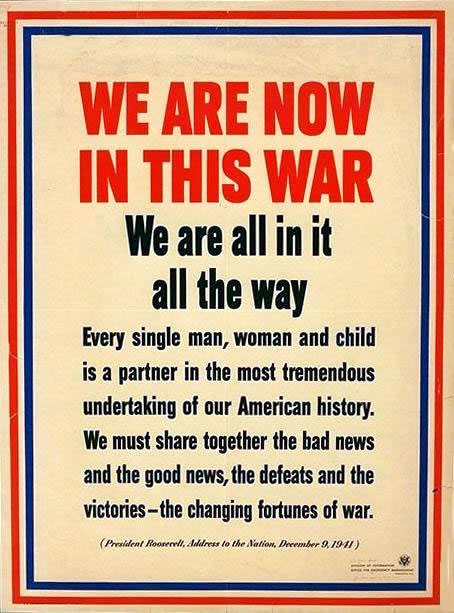
Image: A U.S. World War II poster calls for all members of American society to contribute to war effort, public domain.

Labels: , , , , , , ,

Friday, August 11, 2006

Assessing the Gold Standard

It took 236 hands and nearly 14 hours before Jamie Gold finally claimed all 88 million chips in play to become this year’s WSOP Main Event winner. In terms of time and number of hands, this year’s final table was similar to 2005, when Joe Hachem also needed nearly 14 hours (and 232 hands) to take the bracelet. Unlike last year, however, when the chip lead changed several times and the eventual winner was short-stacked for most of the night, Gold dominated throughout. His performance will undoubtedly inspire much analysis and talk of “playing the big stack” -- something Gold obviously did successfully as the chip leader for the last five days of the tournament.

Gold came to the final table with 26,650,000 chips -- about 30% of the total chips in play and about 9 million more than his nearest competitor, Allen Cunningham. He demonstrated aggression from the start, taking five of the first 11 hands (four without having to go to showdown). After three hours Gold had built his stack to 33 million, knocking out the first two players in the process. An hour later Gold went over 50 million after eliminating Richard Lee in what appears to have been a pivotal hand. Lee was second in chips with approximately 16 million when he decided to put them all in the middle with JhJs. Unfortunately for him, the one man at the table with more chips held QdQs. The board came KdKs3d6hTs, and Lee was on the rail.

Around 2 a.m., Gold knocked out Cunningham in fourth place. Around 3 a.m., Gold dispatched Michael Binger in third. And after seven hands of heads-up, Gold took out Paul Wasicka around quarter ’til four. In the end, Gold eliminated seven of the eight players at the final table. I didn’t pony up the 25 clams for the pay-per-view broadcast, but I am curious to find out how many did -- and how much those who did enjoyed what they saw. Given Gold’s dominance throughout the night, it may well have been less than exciting to watch. Still, it had to be marginally more fun than purchasing a heavyweight fight that ends with a first-round knockout. Lasted longer, anyway . . . .

Prior to the final table there appeared an interesting article over on Bodog Nation which quoted Gold saying he wasn’t interested in all of the fame and publicity that would come should he win the Main Event. In the article, Gold talks about how being thrust into the limelight “tears apart” some people. He even mentions the possibility of avoiding such scrutiny by cutting a deal at the final table -- the kind of talk regarded by many in the poker world as utter heresy. “I don’t want to be the next poker ambassador,” Gold says in the article. “I love my life just like it is. I make a good living and I’m happy. Why would I want that to change?”

Given Gold’s huge chip lead throughout the night, the idea of cutting a deal could never have been genuinely considered. When heads-up play began, Gold had nearly an 8-to-1 chip advantage over Wasicka -- not the sort of scenario that would lead any sane chip leader to commit to a deal.

As far as Jamie Gold’s reluctance to be the “ambassador” of poker goes, I think it should be understood that winning the bracelet need not require one to fill any particular, Miss-America-type diplomatic role. (The hosts of CardPlayer’s The Circuit smartly addressed this topic during last night’s episode.) Whether Gold stays in the spotlight or hides away in relative obscurity ultimately will make little difference to the industry as a whole. He needn’t feel it necessary to live up to the “standard” established by Moneymaker, Raymer, and Hachem, nor should his actions over the next year be regarded as any “standard” for future winners to follow.

No, the true “Gold standard” -- that which should prove genuinely influential at the tables in the months to come -- is the man’s play last night and throughout the Main Event. For that he’ll be both celebrated and looked to as a guide by the many who hope to follow his successful path.

Image: Trademark Poker 24k Gold Playing Cards, Amazon.

Labels: , , , , , ,


Older Posts

Copyright © 2006-2021 Hard-Boiled Poker.
All Rights Reserved.