Monday, May 15, 2017

Nine Years Enough for November Nine

I never liked the November Nine. I got used to it, like everyone else. But I never liked the idea.

The World Series of Poker first introduced the “delayed final table” format for the Main Event in 2008, stopping the tournament at nine players in July and restarting it in November. That was also the first summer I went out to help cover the WSOP.

The announcement came at the beginning of May that year, a couple of weeks after I’d already signed on to go out for PokerNews. I remember being disappointed to learn at that late date that I wouldn’t be seeing the Main Event play to a conclusion. I thought the idea to pause a poker tournament for four months was absurd, wildly distorting whatever “standard” might have been established for tournament poker since its rise in popularity.

It’s a little silly, I know, to speak of poker tournaments as a format unable to withstand too much variation. That’s the beauty of poker, of course -- namely, the way the game can accommodate all sorts of imaginative twists and alterations. And in fact, over the last decade we’ve seen an incredible number of different kinds of poker tournaments developed, both live and online, to challenge all sorts of “traditional” ideas of what a poker tournament is or should be.

Tournaments are like novels in that way -- an incredibly elastic “genre” under which heading a seemingly endless array of different kinds of “narratives” can qualify.

But the idea of playing for a week-and-a-half, then waiting four months, then playing another day or two or three was just too much. Even the most experimental novelist would have difficulty selling the idea of presenting 90 percent of the book all at once, then withholding the last couple of chapters until everyone has forgotten the story and characters.

The WSOP and ESPN did what they could with the idea, and by the last couple of years managed to build it into something that was genuinely interesting to follow. Even so, the disconnect between what happened in the Main Event during the summer and how it ended always made it seem more like two, separate “events” than not.

Today -- at an even later date than in 2008 -- we learned the November Nine is finally being scrapped this year. And that there will be a lot of televised coverage in July on both ESPN and PokerCentral, starting with the Day 1 flights and lasting all of the way through to the end. All welcome news, as far as I’m concerned.

Sure, there will be no more coaching and simulations filling those four months in between to challenge ideas of “integrity” and further shape the Main Event into something barely resembling other poker tournaments. Most importantly, though, the story’s momentum won’t be interrupted, which means the building drama over the first seven days of poker will get to continue into the last three days of the final table.

There is still a delay before the final table, but one lasting just two days. Plenty of time, I think, to get to know the players and build some interest and excitement heading into the finale -- like that extra week before the Super Bowl.

After being away a few summers, I’m also plotting a return to the WSOP this time, meaning if all goes as intended I’ll be there to watch this Main Event play out -- all the way out, that is.

I’ll even get to lend a hand when it comes to telling the story of how the sucker ends, too. Finally. Nine years later.

Talk about a final table delay.

Image: PokerNews.

Labels: , , , , , , ,

Thursday, August 25, 2016

Travel Report: EPT13 Barcelona, Day 9 -- Friberg Reflects

Day 3 of the European Poker Tour Barcelona Main Event went smoothly enough, ending at a decent hour. They’ve now played down from a starting field of 1,785 players to just 98. Starts to get a little more interesting from this point onward.

One of the players making it through to tomorrow is Erik Friberg of Sweden. Those with longer poker memories will remember him from the 2006 Main Event final table where he finished eighth. That was the biggest WSOP Main ever, won by Jamie Gold.

Was kind of intriguing today hearing Friberg talk to a tablemate (Felipe Oliveira) about the experience of making that WSOP Main Event final table just over 10 years ago. Oliveira asked him if he enjoyed it, and Friberg immediately responded “no.” He then explained how he’d made a couple of mistakes, he felt, partly because of the pressure of the situation and not being able to be as mentally strong as he would’ve liked.

Most interesting (I thought) was hearing Friberg say he wished there had been some kind of delay before the final table such as has been introduced and made the norm with the November Nine (in place since 2008). Even just a week, he said, would’ve helped him get his wits together and perhaps helped him to have performed better.

Of course, we can all argue how being able to handle those pressures and the stress of many consecutive days of poker is “part of the game,” so to speak. That’s what those making the final table of this event will have to handle, all of whom will be playing their sixth day of poker in either six or seven days.

Meanwhile I’m on nine straight days here, and as I’m tired I’m gonna cut it short. Talk again mañana.

Photo: courtesy Neil Stoddart/PokerStars blog.

Labels: , , , ,

Thursday, November 05, 2015

Compiling the November Niners’ Hands Shown on ESPN

Okay, folks... this is going to seem a little obsessive. But I took all these notes and ended up deciding not to use them for anything else, and so I’m going to share it all here rather than just keep them to myself.

A couple of days ago I mentioned again how I’d been watching the ESPN coverage of the WSOP Main Event fairly closely this year, pulling out interesting hands for “what-would-you-do?”-type strategy articles over on PokerNews. That meant I watched every hand from all 16 episodes, taking notes as I did.

I had an idea this week that it might be interesting to pull out the hands involving the November Niners -- Joseph McKeehen, Zvi Stern, Neil Blumenfield, Pierre Neuville, Max Steinberg, Tom Cannuli, Josh Beckley, Patrick Chan, and Federico Butteroni -- and find out what perhaps could be gleaned from the hands that were shown. I already had notes from each episode which to work, and so initially thought it might be a reasonable task, but eventually I got kind of bogged down with it all and the idea got aborted.

There were 284 hands (including partial hands) shown in the coverage. Of those about half of them involved November Niners, although about 20 or so of those hands were just them folding preflop. Still that left 121 hands in which we could actually talk about meaningful strategic decisions involving these players. These would be the hands, I’d imagine, that the players themselves focused on if they chose to study the ESPN shows at all when preparing for the final table.

Like I say, I didn’t want to do all of this and just toss it in the circular file, so I’m going to leave it here if only to remind me not to give myself such a ridiculous task again. What follows are short-hand notes of those 121 hands -- my actual notes for each hand are much, much more detailed, but they are also very messy and inconsistent. That’s not to say what appears below isn’t also messy and inconsistent, but at least the entries are short and easy enough to scan.

The numbers represent the episode (1 through 16) and the hand on that episode, so “1.10” means show #1, hand #10. An asterisk before the number means a November Niner was at risk of elimination in the hand. Most of them were shown in that spot at least once (including McKeehen with 46 left), Chan was twice, Butteroni three times, Blumenfield five times, and Beckley six times. In fact the only remaining player not shown all in and at risk at least once is Pierre Neuville.

McKeehen unsurprisingly got the most exposure in these hands among the nine (30 hands total, I believe), while Chan got the least by far (just five hands).

Tomorrow I’ll come back with a short post summarizing some thoughts about what I got from these hands insofar as they suggest anything meaningful about each player. Meanwhile I hope the list is understandable enough, for those who are curious.

1.10 McKeehen -- 535 left, gets Costello to make bad river call (knocks out Costello)

2.11 Butteroni -- 428 left, successfully bluffs Ron Ilani

4.13 Beckley -- ~285 left, successfully bluffs Schwartz

5.13 Steinberg -- 186 left, wins three-way hand with Bonomo (overcalls)
5.16 Steinberg -- 171 left, wins J-J vs. A-Q to knock out Jae Kim
5.19 Blumenfield -- 168 left, wins A-A vs. K-K to knock out Esfandiari

6.1 McKeehen -- 162 left, wins A-K vs. Q-Q to knock out Racener
6.6 McKeehen-Stern -- ~160 left, Stern bluffs river with air vs. McKeehen’s full house
6.8 Butteroni -- 138 left, wins A-A vs. 8-8 to knock out Lily Newhouse

7.3 Neuville -- 109 left, gets shoved on river, calls w/flush, knocks out Divella
7.10 Blumenfield -- ~100 left, wins with A-A w/o showdown vs. De Silva
7.11 Steinberg -- ~100 left, wins w/K-K w/o a showdown (gets value) vs. Bonomo (A-K)
7.15 Blumenfield -- ~100 left, wins multi-way hand calling down with flopped top pair
*7.20 Stern -- ~100 left, luckily survives AI Ac-9c vs. Diveglia’s Qs-Qc (rivers straight)
*7.21 Butteroni -- ~90 left, wins AI with K-K vs. Bonomo’s 10-10

8.1 Neuville -- ~90 left, wins with A-A vs. K-Q, knocks out Barabino
8.3 Blumenfield -- ~85 left, loses with J-J vs. Negreanu’s A-A (perhaps lucky to survive)
8.7 Neuville -- ~85 left, wins w/Q-7 vs. Morgenstern’s J-9 latter double-barrels, folds
8.8 Cannuli -- 83 left, wins with A-A vs. A-10, knocks out Diana Svensk
8.16 Blumenfield -- ~80 left, loses big (73% stack) w/K-K vs. Jarvis’s 6-6 (set)

*9.3 Beckley -- 69 left, gets AI after flopping set (three-way hand), survives
*9.4 Blumenfield -- ~69 left, luckily survives with K-J vs. Hastings’s A-3
9.6 Cannuli -- 63 left, wins A-K vs. KK, knocks out Mackoff
9.7 Steinberg -- ~63 left, 3-way vs. Negreanu/Anand; flops middle pair, c-r, wins
9.10 Beckley -- ~60 left, gets value vs. Jarvis calling down, then rivering flush
9.15 Butteroni-Neuville -- ~60 left, b-v.-b hand, Butteroni turns two pair, gets value
9.16 Cannuli -- ~60 left, wins smallish hand vs. Toole (and Berman who folds flop)
9.18 Beckley -- 58 left, tries to bluff Morfe and Morfe calls him down
*9.19 Blumenfield -- 58 left, AI on turn w/queen-high, luckily draws out vs. Hastings
9.20 Neuville-Butteroni -- ~58 left, 3-way hand, Neuville successfully bluffs pot
9.21 Cannuli-Steinberg -- ~58 left, four-way hand, smallish pot
9.25 Cannuli -- ~57 left, 3-way small hand with Minkin and Negreanu

10.3 Steinberg -- ~55 left, 3-way, Steinberg folds top pair to Schwartz turn bluff
*10.5 Beckley-Chan -- huge 3-way hand in which both Beckley & Chan AI, Chan wins
10.6 Beckley -- 53 left, knocks out Lewis after making tough call on turn
10.7 Cannuli -- ~52 left, 3-bets Schwartz from BB w/Q-7, flops two pair/folds to S flush
10.8 Steinberg -- ~50 left, wins small pot with J-J
10.12 Cannuli -- 49 left, wins one vs. Schwartz after drawing out two pair
10.15 Stern -- ~49 left, raises river w/second pair after Power’s bluff, gets fold
*10.16 Beckley -- ~46 left, 4 limp, Beckley r BB w/A-A, wins vs. Buckenmayer AI w/K-Q

*11.1 McKeehen-Beckley -- 46 left, M luckily wins AI A-Q vs. B’s A-K; rivers straight
11.4 Butteroni -- 44 left, loses hand to Clinger
11.5 Cannuli -- 43 left, raises over Steinberg/Schwartz limp w/Q-J, flops straight
11.8 Steinberg-Cannuli -- 41 left, multi-way pot; Cannuli loses to Negreanu w/trip J
11.9 Butteroni -- ~40 left, raises, then folds 9-9 after Turyansky AI
11.10 Chan-McKeehen -- 39 left, 3-way, M AI Q-Q, Chan f A-Q, Buckenmayer out A-K
11.13 Cannuli-Blumenfield -- 36 left, C raises K-6, Blum calls BB 10-9; Blum wins
11.15 Cannuli -- 35 left, loses small three-way pot
*11.17 Butteroni -- 34 left, luckily doubles with 6-6 vs. Brand’s 10-10 (flops quads)
11.18 Steinberg-Cannuli -- 34 left, S r K-K, C calls 9-9; C folds flop, S KOs Toole
11.20 Blumenfield -- ~34 left, makes ballsy AI bluff w/queen-high on river v. Ahmar
11.21 Stern -- 33 left, folds pocket nines after raise, call, reraise

12.2 Steinberg -- 31 left, opens w/9-9 and ends up getting value vs. Ahmar
12.3 Blumenfield -- 31 left, loses big to DNegs w/A-K vs. DN 6-3 (DN better str8)
12.4 Neuville -- 31 left, raises 5-5 then folds to a three-bet
12.5 Beckley-Neuville -- 31 left, Beckley triple-barrels, gets PN to fold better
12.8 Blumenfield -- 31 left, raises with J-J, AI on six-high flop, wins
12.9 Steinberg-Blumenfield -- 31 left, 3-way, Blum calls raise, wins decent pot (DN)
12.11 Blumenfield-Steinberg -- 31 left, Blum folds 9-9 to AI, Stein calls/loses w/7-7
12.14 Blumenfield -- 30 left, Blum calls BB w/Q-9, lets Schwartz bluff him out
12.15 Stern -- ~30 left, four-bets with 10-10, then folds to a big shove
12.16 Cannuli-Steinberg -- 30 left, C calls r w/J-J, S calls w/K-7, DN rr, both fold
12.17 Butteroni -- 29 left, limps SB with Q-10, flops trip 10s and knocks out Minkin
12.19 McKeehen -- 28 left, wins with A-Q vs. A-10, knocks out Moreno

*13.2 Butteroni -- 27 left, luckily wins with Q-Q vs. A-K, ace on flop, queen on turn
13.5 Butteroni -- 27 left, calls raise w/A-5, bluffs at flop, gives up on river (vs. DN)
13.4 Blumenfield -- 27 left, ends up earning some value vs. a bluffy Morgenstern
13.5 Neuville-Beckley -- 27 left, B flops top pair, but N runner-runner deuces
*13.6 Steinberg -- 27 left, doubles up with A-A vs. Negreanu’s 8-8
13.7 Neuville -- 27 left, calls raise with 5-4 suited, then folds to an all-in
*13.8 Chan-Beckley -- 27 left, Beckley (J-J) doubles through Chan (6-6)
13.12 Cannuli -- 24 left, wins with 10-8 vs. 3-3 to knock out Brand
13.13 Cannuli -- 23 left, DN raises, B folds 6-6, C reraises A-K, DN calls; C wins
13.16 Blumenfield -- 23 left, loses a lot with A-A vs. Hinds who rivers nut flush
13.17 McKeehen -- 23 left, wins big pot with K-K vs. Kearney’s 10-10, takes lead again
*13.18 Beckley -- 22 left, triples up with K-K (Neuville c/f K-Q pre)
13.19 Butteroni-Steinberg -- 22 left, table talk, Stein bluffs Butteroni out on river
*13.20 Blumenfield -- 21 left, AI with K-K and doubles through Hinds’s A-K
*13.21 Blumenfield -- 21 left, very next hand AI w/A-A, doubles through Hinds’s 10-10
13.22 Neuville -- 21 left, knocks out Sequiera in very interesting K-6 vs. Q-Q hand

14.1 Cannuli -- 19 left, battles with DNegs over small pot
14.2 Steinberg -- 19 left, a nothing hand
14.3 Butteroni -- 19 left, has J-J, to river w/Schwartz before S bluffs him out
14.7 McKeehen -- 18 left, battles with DNegs
14.8 Steinberg -- 18 left, wins with A-K vs. A-Q, knocks out Kramer
14.10 McKeehen -- 16 left, has A-A and five-bets DNegs who tank-folds A-K
14.11 McKeehen -- 16 left, calls Guan raise w/6-6, makes set, then quads, value
14.12 Neuville -- 16 left, wins with 8-8 vs. A-K, knocks out Stefanski
*14.13 Neuville-Cannuli -- 15 left, Cannuli (A-K) doubles through Neuville (A-9)

*15.1 Beckley -- 15 left, B calls BB 10-8 flops str8, AI flop/doubles thru Turyansky
15.2 McKeehen-Butteroni -- 15 left, both battle DNegs for pot, McKeehen wins
15.3 Cannuli -- 15 left, wins with A-10 vs. Q-Q, knocks out Kearney
15.4 Butteroni -- 14 left, calls BB w/8-5 suited, c-r flop w/mid-pair, Schwartz folds
15.5 McKeehen -- 14 left, set over set to knock out Schwartz
15.6 McKeehen -- 13 left, K-K gets value vs. DNegs with Q-J and top pair on flop
15.7 Cannuli-Chan -- 13 left, Cannuli 4-bets AI w/Q-Q, Chan folds J-7 after 3-bet
15.8 Cannuli-Stern -- 13 left, C (7-6) beats Stern (A-K); turns trips, Stern kings
15.9 Cannuli-Neuville -- 13 left, C raises with 10-5, bluffs N off hand on turn
15.10 McKeehen -- 13 left, DNegs doubles through with 4-4 vs. M’s A-7
15.11 Steinberg-Stern -- 13 left, Stein wins w/K-J vs. Stern A-Q; Stern b-f river
15.12 McKeehen-Beckley -- small hand
*15.13 Chan-Neuville -- 13 left, Chan survives with A-Q v. N’s J-J (flops flush)
15.14 Stern-Cannuli -- 13 left, Stern r/c 3-bet (A-K) w/Q-8; raise flop w/air, wins
15.16 McKeehen-Butteroni -- 13 left, w/Turyansky... Butteroni wins
15.17 McKeehen -- 13 left, raises with 8-7, then folds to a DNegs AI
15.18 McKeehen-Butteroni -- Butteroni wins with A-A vs. Q-Q, KOs Guan out 13th
15.19 Stern -- 12 left, raises w/10s8s, 4-bets AI, wins vs. Q-Q, McDonald 12th

16.1 McKeehen-Beckley -- 11 left, McK raise 6-6, Beck 3-bets A-J, McKeehen fold
16.2 McKeehen -- 11 left, raises/folds to a DN AI
16.3 Blumenfield-Stern -- 11 left, Stern AI on turn w/air v. Blum flush/doubles
16.4 Beckley-McKeehen-Butteroni -- 11 left, M 3-bets 7-6, Bu folds 8-8; Be folds pair
16.5 McKeehen -- 11 left, loses small one to DNegs
16.6 McKeehen -- 11 left, loses another small one to DNegs
16.7 McKeehen-Beckley -- 11 left, M rivers straight, goes AI, Beckley folds top pair
16.9 McKeehen -- 11 left, KOs DN after raising with J-3, DN just call BB w/A-4
16.10 Steinberg-McKeehen -- 10 left, S raise A-K, M 3-bets w/7-6, S 4-bets, M folds
*16.11 Beckley-McKeehen -- 10 left, B doubles w/A-Q vs. M’s 9-9 (Cannuli folded 9-9)
16.12 McKeehen -- 10 left, Turyansky luckily survives with A-J vs. M’s A-K
16.13 McKeehen-Neuville -- 10 left, Neuville flops set with J-J & wins big one vs. McK
16.14 Blumenfield-Neuville -- 10 left, Neuv wins 9-9 vs. Blum’s 8-8, Blum folds river
16.15 McKeehen -- 10 left, wins with Q-Q vs. A-K, knocks out Turyansky in 10th

Labels: , , , ,

Tuesday, October 27, 2015

WSOPE Fast Fade

I realized today that the World Series of Poker Europe played down to its conclusion over the weekend, and it never even crossed my mind to write a thing about it here yesterday. This is due to a couple of factors.

The relative lack of fanfare regarding the series from the WSOP, most poker news sites, and over Twitter meant it was hard ever to get into the sucker from afar. The time difference mattered somewhat, but in truth that never lessens my interest in the European Poker Tour events. Heck I was already tuning in today for a short while to watch coverage from Malta on EPT Live.

Another factor was that neither the WSOPE Main Event final table nor the WSOPE High Roller final table were streamed at all, the Twitching from Berlin having stopped last Thursday. In other words, just when most of us might have gotten interested, the shows stopped. (I believe that choice was made in order to facilitate shooting those final tables to be aired in edited versions later on.)

I was aware that Kevin MacPhee managed to win the Main Event, topping a field of 313 (down from the 375 who played the WSOPE ME in 2013). And Jonathan Duhamel’s victory in the High Roller -- his third career bracelet -- got more of my attention thanks to Twitter where the congratulations were coming frequently thereafter. Duhamel joins Phil Hellmuth as the only players to win both the WSOP Main Event and the WSOPE Main Event.

Like I say, though, Malta is already front-and-center for now, while the November Nine is now less than two weeks away. Meanwhile the WSOPE fade out happened fast, or at least it seemed that way from here.

Labels: , , , , , ,

Wednesday, July 15, 2015

WSOP “Play Down” Day: The Might-Have-Beens Begin

Well, that was exciting.

Everyone’s still reeling from Daniel Negreanu’s suspense-filled near-miss of the World Series of Poker Main Event final table, incredibly matching his best-ever finish from 2001 after getting knocked out in 11th.

The “Twitter rail” was tremendous last night, with Negreanu’s agent, Brian Balsbaugh, tweeting every hand Negreanu played and even every street at times, right up through the fateful knockout hand when Joe McKeehen spiked a needed card on the river. See the sequence at left, which I’ve turned upside down from earliest to latest to recreate the tension (click pic to embiggen).

After winning the first couple of hands yesterday to boost his stack well above average, Negreanu slipped back soon thereafter and was more or less just outside of or squarely within the danger zone most of the night as they played down from 27 to 11. Just before dinner he survived an all-in versus chip leader McKeehen that produced a lot of drama, but later on couldn’t fade his opponent’s many outs... and he was out.

There’s a lot worth discussing regarding what happened last night as well as what’s to come in November. I like McKeehen, whom I mentioned on Monday I first encountered when covering his victory in the WSOP Circuit Main Event at Caesars Atlantic City in early 2013.

From that tournament I recall he also experienced some run good near the end of the penultimate day, picking up pocket aces a couple of times to earn knockouts and carry a big lead to the final day. I remember him clearly being a solid tournament player, seemingly comfortable in every situation and especially well-suited to play with the lead (I don’t recall him being challenged much at all at that final table).

I also recall McKeehen being very social at the table and even supportive of others, including some obvious amateurs who made it relatively deep in the event. I’m not talking about Negreanu-level good will -- no one has that -- but enough for me to have banked it as one of my impressions of the guy at the time, and to make it nice to have seen him win the sucker. With more than twice the chips of his nearest challenger (the Israeli, Zvi Stern) heading into the final table, McKeehen is certainly a big favorite, and again I wouldn’t mind seeing him get there at the end.

Pierre Neuville (in fourth position) making it to the final table is another very cool story. The amiable Belgian is 72 years old -- the oldest November Niner ever -- and last night I enjoyed chatting with my Dad who also happens to be 72. Here’s hoping the hashtag “#NeuvemberNine” picks up again as the final table nears.

Meanwhile the 61-year-old Neil Blumfield (in third) also significantly skews the average age of this year’s ME final table. Max Steinberg (in fifth) is the only bracelet-winner of the bunch, and is a fun, talented player to watch. The others -- Thomas Cannuli (sixth), Joshua Beckley (seventh), Patrick Chan (eighth), and Federico Butteroni (ninth) -- we’ll get to know eventually, too.

My thoughts this morning, though, were mostly taken up with two takeaways from last night. One was the lamentable lack of any live stream for what was easily the most exciting night of the summer at the Rio. If you were on Twitter, you saw the frequent references by many to the fact that because of the ESPN contractual obligations our game’s “Super Bowl” must be necessarily experienced piecemeal when it is happening live -- via updates and other “coverage” such as Balsbaugh and others were providing -- and then only in an edited, spaced-out form months later.

It’s bad, and like others I wish it weren’t so. But clearly there was nothing the WSOP could do about that last night. The other focus of my thoughts, though, concerns something the WSOP did have control over.

After George McDonald got his queens cracked by Stern’s 10-8-suited to go out in 12th, they were six-handed at the outer table and five-handed at the feature. At the latter were seated McKeehen and four short stacks, Negreanu among them. A huge pay jump had arrived as well, as the next player out in 11th would earn $526,778 while the 10th-place finisher was due $756,897 -- a more than $230K jump which oddly was greater than the jumps from 9th to 8th, 8th to 7th, and 7th to 6th.

From that point forward, reading the updates on WSOP.com makes it glaringly apparent the pace of play at the feature table was much, much faster than on the outer table, with several hands being reported for the former in each post versus just a couple per post in reports from the latter.

With one less player and with players generally acting more quickly, the main feature table was blitzing along while the outer table inched slowly from hand to hand. If I’m counting correctly, by the time they reached the next break they had played 48 hands on the feature table and just 26 on the outer table.

After about an hour-and-a-half of this, with the start of a new level tournament officials finally decided to have the tournament played hand-for-hand. This was something I’d anticipated they’d do as soon as they’d gotten to 11 players, as I mentioned at the end of a PokerNews article yesterday titled “From 27 to 9: How Might the New Payouts Affect Play on Day 7 of the WSOP Main Event?”

In that article I talk about how the pace of play differed between the last few tables on “play down” day at the WSOP ME over the last couple of years. With such a huge pay difference, it seemed to me a trivial decision to go to hand-for-hand at 11 this year, but somehow they didn’t.

For a decent part of that sequence, McKeehen was the overwhelming chip leader and the other four players at his table were 8th, 9th, 10th, and 11th in the counts. McKeehen hammered away at them throughout, and they had to play nearly twice the hands as those at the feature table did during the same 90 minutes. A quick skim through those 48 hands shows McKeehen predictably involved in the great majority of them, and winning 26.

It only took four more hands before Negreanu’s bust at the start of the new level. The fact that they did at last go hand-for-hand shows they could have done it earlier. And they should have, because not doing so introduced unfairness into what was the most crucial period of the tournament up to that point.

Those are the thoughts I’m mulling over this morning. I suppose I’ll eventually get around to thinking about what might have been had Negreanu made it. But for now I’m distracted by this other “might have been” having to do with the decision not to go hand-for-hand immediately after McDonald’s knockout.

Labels: , , , , , , ,

Thursday, November 20, 2014

Charting and Graphing the 2014 WSOP Main Event Final Table

Darrel Plant who writes the Mutant Poker blog has a couple of nifty items over on the PokerNews Strategy section this week to which I wanted to draw your attention.

One is a post detailing all of the many times 2014 World Series of Poker Main Event champion Martin Jacobson pushed all in on the first day of the final table (when they played down from nine players to three).

If you recall, Jacobson entered the final table eighth in chips out of final nine, and thus had few options early on besides open-shoving or reraising all in. Even after he’d accumulated some chips, he slipped back down under 10 big blinds again at one point and so had to revert back to a push-or-fold strategy.

Darrel goes through all 19 instances (!) of Jacobson going all in on that first day of the final table, sorting out what his equity would have been every time had opponents called (which by and large they did not). Check it out: “Pushing His Way to a WSOP Main Event Title: A Look at Martin Jacobson’s All-Ins.”

Darrel’s other piece this week is a groovy graph showing chip movement throughout the 328 hands of the final table, complete with annotations highlighting knockouts, double-ups, and other important moments along the way.

That’s a small version of the graph up above -- to see the big one in all its colorful glory, check out “Graphing the Changing Chip Stacks at the 2014 WSOP Main Event Final Table.”

Labels: , , , , , ,

Friday, November 14, 2014

Newhouse’s Ninth (Second Movement)

Back in mid-July when I was churning out preview articles during the World Series of Poker Main Event, I noted before the start of Day 4 how of the 746 players remaining, the only November Niner from 2013 left in the field was Mark Newhouse.

I made a reference in that day’s preview to Dan Harrington’s back-to-back final tables in 2003 and 2004, stubbornly suggesting the possibility that Newhouse could be the first since then to achieve the feat despite his being 131st of the 746 in the counts. I was as amazed as everyone else to see him sticking around through the next three days’ worth of poker -- even leading at the end of Day 5 with 79 left -- to make it to the final table again.

In 2013 he was eighth of nine to start the final table, and so his ninth-place finish wasn’t too unexpected. This year he was third in chips with nine to go, encouraging most to expect a deeper run.

On Monday night he’d suffer a setback in Hand #44 versus Andoni Larrabe. In that one Newhouse held pocket eights, but lost after Larrabe turned a set with his pocket fives -- a hand nicknamed “presto,” also the tempo performance direction of the second movement of Beethoven’s ninth.

As it would happen, Newhouse would choose a speedy pace thereafter in what would prove his final hand.

Newhouse would get back what he lost to Larrabe and then some right away, chipping back to 23.7 million (47 BBs) just a few hands before his showdown with William Tonking in Hand #56.

I’d been following the updates on PokerNews beforehand, and so knew when watching the hand develop what was about to happen. Was still suspenseful to see play out, though, in that oh-no-don’t-go-in-there-that’s-where-the-boogeyman-is kind of way. Particularly during the 10-second interval between Tonking’s river check and Newhouse’s fateful shove.

Newhouse had another middle pair -- pocket tens -- in the hand, and would bust in ninth when Tonking called his shove holding pocket queens. As it would happen, Martin Jacobson would be holding two tens as well in the hand that won him the bracelet a night later.

Jonathan Grotenstein has written an entertaining account of the final table for All In that touches on Newhouse’s story (among others). He notes the contrast between the extensive preparation of the other Niners over the last four months and the hiatus from poker taken by Newhouse, a time spent “doing his best not to think about anything at all.”

Speaking with several non-poker playing friends the last few days about what happened in the Main Event, Newhouse’s story is the easiest one to foreground. That would be true even if he weren’t from Chapel Hill, North Carolina, making his story kind of a “local” story, too.

“Chapel Hill’s Mark Newhouse stunned after early elimination at World Series of Poker” went the headline in The Charlotte Observer. The article describes him as “the man who said he wanted to finish anywhere but ninth,” though doesn’t mention that incredible-in-retrospect tweet from Newhouse from back in July (see left).

I tell my friends about how remarkable it was for Newhouse to make the final nine of 6,352 one year then do it again in a field of 6,693 the next, never mind to finish ninth both times. Searching for analogies to help describe going out first at the final table both years, I reach initially for the Buffalo Bills’ four straight Super Bowl defeats, another example of an incredible achievement ending in defeat. Or the Patriots going 18-0 and then losing Super Bowl XLII.

But neither seems quite right as a comparison. Newhouse’s second straight ninth-place finish in the WSOP Main Event is a unique feat, a wonder highlighting poker’s capacity not only to provide us with a head-spinning number of possible outcomes but sometimes also to produce the one result that would seem the least likely of all.

Labels: , , , ,

Thursday, November 13, 2014

2014 WSOP Main Event Final Table Hole Cards (Complete)

As I did in 2012 and 2013, I’ve once more gone through the final table of the World Series of Poker Main Event to chronicle all of the hole cards shown during ESPN’s broadcast. Unlike in the past, you can find this year’s list over on PokerNews in a handy table form with the added bonus of links to each of the hand reports. I have also added the players’ positions, something I didn’t do in past years.

Here it is: “Complete List of All Hole Cards Shown During the 2014 WSOP Main Event Final Table.”

This year ESPN handled the hole card thing a little differently, although some may not have realized it. In the past they’d only show hole cards after a hand completed, and only of the players who were still in the pot at the very end. This time they’d show cards whenever a player entered a pot voluntarily from the start of the hand.

Thus there was no guesswork when watching the hands regarding what cards players held, which changed the nature of the commentary quite a bit. I saw a lot of divisive commentary on Twitter on Monday and Tuesday nights about Antonio Esfandiari’s analyses. While I only listened to it in bits and pieces as I gathered hands today, I’m gonna say he, Lon McEachern, and Norman Chad all acquitted themselves just fine once again on that front -- a very challenging task, really.

While there could be errors in my list -- there were 328 hands all told -- I think it’s likely more accurate than my lists from the past two years, in part because I was able to use both my DVR recording and some backup from WatchESPN online to help with a few hands my recording didn’t catch. If you can believe it, I actually used an old school VCR before, which made putting the list together a lot more taxing.

Anyhow, I hope the list will be of use to some looking to analyze more deeply the play at the 2014 WSOP ME final table. Excuse me now if I step away from the keyboard for a while, as my fingers are tired and brain is a big bowl of mush at the moment.

Labels: , , , , , , ,

Wednesday, November 05, 2014

Scrambling Before the Scramble

Was starting to look like “one of those days” early on yesterday. In the end, though, it turned out thankfully unremarkable (if you don’t count what happened in the U.S. Senate, that is).

First off went to my local polling place to try to vote and discovered I was unable to. I suspected I might run into difficulty given that I’d only mailed in my new registration a couple of weeks ago, and I think the cutoff for getting that sucker in was 25 days out.

Having moved to the farm about 10 months back, I’m in a new county now and so have to change my voter registration in order to vote here. But since it has been too long since I lived at my last address, I couldn’t go back and vote where I used to before. There might actually have been a way for me to vote yesterday, but after wasting an hour on it I had too much work to do to look into it any further, so unfortunately my efforts were thwarted there.

After that excursion I ran an errand to pick up some items for the horses, but there was no one there and so that turned out to be a wasted trip as well. I drove back home, and upon arrival discovered I’d locked myself out of the house with another six hours or so to go before Vera got back home.

Not good, I thought. Thankfully, though, Vera was able to save me from an afternoon of grazing with the horses, and I didn’t have to lose all those hours, work-wise.

Am scrambling around trying to get a lot of things done before I take off tomorrow for a relatively short tourney trip down to Jacksonville. There I’ll be helping cover the World Poker Tour bestbet Bounty Scramble, a $5,000 tourney with two starting days, $2,500 bounties on select players, and a $5,000 “chip leader bonus” for Days 1a and 1b.

I had fun at the Jax bestbet a year ago where the venue is nice and inviting and the staff great, too. Will do what I can to provide the occasional reports here as it goes, although I imagine like with LAPT Peru last month all I’ll likely be able to manage will be a few quick hits along the way.

I will be in Jacksonville during the November Nine, as this event’s final table will be next Tuesday when that will be finishing up. I might see if I can figure out how to DVR all that to see it after I return, but I won’t be there watching every hand this time as I have the last few years.

Travel day tomorrow, then more to come from the Sunshine State after that. Here’s hoping all goes as smoothly as things turned out today despite the rocky start.

Labels: , , , ,

Monday, November 03, 2014

PokerNews Predictions for the November Nine

There’s a new article over on PokerNews sharing predictions of staff and contributors for next week’s November Nine which gets underway a week from today. Kind of a fun way to remind yourself who the final nine players are and some of the stories that’ll be in play when things get going again (finally).

I participated in something similar at the start of this year’s WSOP when we made some predictions for the series. Can’t say mine were all that remarkable, although it’s kind of interesting to look back and compare all the prognostications with what actually happened.

Looking back, none of us picked George Danzer to win this year’s WSOP Player of the Year. Several of us (including myself) said Ole Schemion would be the newcomer with the biggest impact (he didn’t cash).

I said neither Phil Ivey nor Daniel Negreanu would win a bracelet, and Ivey snagged one while Negreanu nearly won two (getting two runner-ups). I did say “three final tables between them,” though, which turned out to be correct.

When asked to guess the total number of entrants in the Main Event, I went a little high (7,039). Brett Collson got closest to the actual total of 6,683 by guessing 6,700.

None of us guessed correctly who would win the “Big One for One Drop.” Meanwhile I got a couple of easy ones, guessing that neither Chris Ferguson nor Howard Lederer would be playing any events and selecting Michael Mizrachi as a “big-name pro” who would have a disappointing series (he had two small cashes).

Among this new set of predictions, I chose Martin Jacobson to win despite being eighth in chips entering the final table. I also decided on 295 hands as the number needed to complete the final table with 71 hands of heads-up. And for a “bold prediction” I said two players would get knocked out on one hand.

Head over and see the whole list of questions and what everyone else came up with in the way of answers.

Labels: , , , ,

Friday, July 25, 2014

Travel Report: LAPT7 Panama, Day 1b -- November Niners

Another long day yesterday for Day 1b of the LAPT7 Panama Main Event. A huge turnout actually ended up bringing the total number of entries to 550 for the event, just a little under the 570 from last fall and I think above expectations.

Had a couple of highlights along the way, one being a quick chat with Badih “Bob” Bounahra of Belize who traversed Central America to play. We talked just a little about his November Nine run from 2011, his WSOP this year (which included a third place in a $1K event), and his continued love of deuce-seven.

Sort of an interesting turn of events today as Bounahra got seated at the feature table with Scott Montgomery, who also of course made a November Nine back in 2008 (the first one). Most agreed it was certainly the first time two November Niners had been seated at the same table at an LAPT event, and possibly the first instance of two playing in the same tourney.

Looks like 179 made it through to Friday’s Day 2, which apparently will be a shorter day -- just eight one-hour levels without a dinner break. Then there will be a party at the pool afterwards, which should be a good chance to relax a little and possible get some good eats as well.

I’m most excited, though, about having booked a trip to see the Panama Canal on Saturday morning. Gonna have to get up early to make it there and back before the noon start of the tourney, but it’ll be worth it, I’m told. More on that when it happens.

Labels: , , , ,

Wednesday, October 23, 2013

World Series Time

Sitting down to watch Game 1 of the World Series tonight between the St. Louis Cardinals and the Boston Red Sox. Was joking a little last week about how baseball really doesn’t capture my attention so much anymore until the postseason rolls around, and with the playoffs now extending deeper into October the Series is probably the only time when I’ll sit down and watch every game, or at least most of every game.

If this year’s Series goes the full seven games it will be ending on Halloween, which means it will be over and done with when that other World Series -- the World Series of Poker -- finally cranks back up with the “November Nine” starting on Monday, November 4.

Thanks to the way ESPN now presents its coverage of the Main Event, most who watch probably think of the WSOP as only the Main Event. That is to say, there must be a decent number of casual viewers who are aware of the WSOP having a big tournament every year in which a world champion is crowned, but aren’t necessarily aware or concerned about all of the preliminary events, never mind what’s happening at WSOP Europe, WSOP Asia Pacific, or even all the other tours and tourneys filling up the calendar from January to December.

Interestingly enough, though, I feel like the actual final table of the WSOP Main Event has kind of receded relatively speaking when it comes to its imprint on the broader cultural memory. In fact, when I compare baseball’s World Series to the WSOP Main Event, it almost seems like for poker its the long lead-up -- the “regular season” or early playoff rounds, we might say -- that gets at least as much attention and/or review, ultimately, as does the final table.

Think about how often we saw the WSOP ME final table rerun on ESPN from 2003-2005, that seemingly incessant loop of showings that we all basically memorized by the time the next year rolled around. Then think about how little the 2006-2012 final tables have been shown -- or watched, I should probably say.

I watched every hand of the 2012 WSOP Main Event final table last year -- all 399 of them -- focusing on it quite closely when it was all playing out. But while I was aware of later edited showings of it on ESPN that followed, I never really paid that much attention to them nor was I that aware of others discussing those broadcasts or even hands in that much detail in the months that followed.

It’s certainly the case that the “almost live” coverage of the WSOP ME final tables is lessening interest in the later reruns, but even so, it feels like the “highlights” from Greg Merson’s win a year ago have already faded almost entirely.

Anyhow, what happens between the Cards and Red Sox over the next week will certainly be relived over and again until next spring, and I suppose that once the WSOP ME plays out November 4-5 we’ll spend at least a week or two talking to each other about that, too. But after that I wonder if we’ll think about it much at all, already having moved on to something else.

Labels: , , , , ,

Tuesday, September 17, 2013

Lehavot’s Leveraging

One of this year’s November Nine, Amir Lehavot (currently second in chips), yesterday announced that he was selling pieces of himself to interested buyers. He tweeted the news, linking to a Two Plus Two thread he’d begun outlining the details of his offer.

In the thread-starter Lehavot makes reference to past results (mostly online) and to the fact that going into the Main Event he had 80% of his action. Of that, he’s now offering up 30% (overall) while keeping 50%.

The price Lehavot is setting on shares he’s deriving from the value of his current stack as determined by the Independent Chip Model (ICM) such as is often used when negotiating final table chops. Subtracting the ninth-place money he and each of the other final tablists have already been given ($733,224) and then comparing his current stack to the remaining prize money still up for grabs, this makes his stack of 29.7 million chips “worth” $2,924,822 according to ICM.

Thus the price for 1% of Lehavot for potential buyers is $29,248, nearly three times the Main Event buy-in.

Lehavot will need to finish third or better in order for investors to make any profit at all. To finish third would mean earning a $3,727,023 payday for Lehavot. Take away the $733,224 he’s already gotten, that adds up to $2,993,799; thus, every 1% purchased for $29,248 would get back $29,938, or just a little less than $700.

If Lehavot finishes fourth, that will only yield $20,588 per 1% (a loss of more than $8K), and so on down to a ninth-place finish which would mean investors get zero return. If he finishes second, 1% would be worth $44,399 (about $15K profit), and if he wins, 1% would be worth $76,263 (about $47K).

From Lehavot’s perspective, if he were to sell all 30% he’s offering, that puts another $877,440 in his pocket before he plays a hand in November, which added to the ninth-place money is a little better than the total prize for finishing sixth.

While most responding in the thread are critical of the deal, a few are not. Meanwhile, responses to Lehavot’s original tweet are mostly characterizing it a less than attractive offer for buyers (“it’s only a good deal if your name is Amir Lehavot,” says one).

I think I belong to that latter, skeptical group when it comes to assessing the merits of Lehavot’s offer. But setting the actual deal aside, it seems to me that the whole idea of a November Niner selling pieces of himself at the delayed Main Event final table must be creating a headache for the WSOP.

The issue of deal making at the WSOP has always been complicated. Unlike on the European Poker Tour where everything is done out in the open -- such as was exemplified with a little bit of extra drama at the recent EPT Barcelona Main Event final table -- the WSOP doesn’t acknowledge or help broker deals. There have even been suggestions here and there that the WSOP doesn’t allow deals at all, although that isn’t really the case.

Back in 2010 in a $1,500 limit hold’em shootout event there was a notable instance of a player -- Yueqi Zhu -- being disqualified at the start of the tourney’s second round after having made a deal heads-up with his short-stacked opponent in the previous round to ensure he would advance. At the start of the next day Zhu was disqualified, with WSOP Tournament Director Jack Effel at the time announcing “there is no deal making at the World Series of Poker.”

In truth, Zhu’s case wasn’t simply “deal making” but an instance of a player essentially giving up his chips to Zhu at the end of their match, an action considered as having violated the WSOP’s rule about “Ethical Play” which states “Poker is an individual game. Soft play will result in penalties that may include forfeiture of chips and/or disqualification. Chip dumping will result in disqualification.”

The WSOP has no specific rules (that I know of) forbidding final table deal making in the traditional sense, although like I say they don’t help players make the deals nor do they recognize them when it comes to payouts and tax documents. (Thus does Lehavot also add a note to his offer about needing SSNs from investors to handle potential tax issues later on.)

I have to guess the WSOP isn’t crazy about Lehavot selling shares of himself this way -- i.e., so publicly -- and thus foregrounding the whole idea of final table deal making. What would happen if all nine of the players were to make similar offers? What if they started buying pieces of each other? Or what if all nine arrived at a more traditional arrangement to flatten out the payouts prior to the start of play in November?

Four-plus months of down time obviously gives us lots of time to imagine such scenarios. Gives the players a lot of time to ponder them, too.

Labels: , , , , , ,

Monday, May 27, 2013

On Winners and the Image of Poker

Was somewhat diverting last week to see how that $25K World Poker Tour World Championship played out and all of the surrounding hubbub concerning the deep runs of Erick Lindgren (the eventual runner-up) and David “Chino” Rheem (who won the sucker). I actually barely followed the tournament itself, to be honest, but I couldn’t help but overhear some of the hooting and hollering that resulted from that particular pair making it to heads-up.

Both obviously occupy interesting, similar places in the poker community at present. Lindgren’s story is perhaps somewhat better known thanks to a recent BLUFF feature discussing his significant gambling debts and even a stint in rehab, as well as the openness with which his many creditors have reported on sums owed.

Rheem’s story might be a little less well known, although that absurd-in-retrospect judgment placed upon him by Epic Poker’s Standards and Conduct Committee back in August 2011 broadcast his reputation for failing to pay back debts a little more widely than had been the case previously.

Recall how the EPL placed its first Main Event winner on probation “in order to effectively monitor the personal conduct of Mr. Rheem as he works to meet his personal financial obligations as required under the Players’ Code of Conduct”? Provides a chuckle today, that, as we now understand the extent of Epic Poker’s own significant financial obligations, and the way Federated Sports + Gaming weaseled out of those obligations by taking the bankruptcy route. Heck, some of us are still receiving legal notices helping us monitor that, too.

Both Lindgren and Rheem provide a lot of forum fodder, obviously, and their performances in the WPT World Championship created another occasion for further judgments, jokes, and conjecture about the players’ backing arrangments as well as the possibility of certain debts getting settled thanks to their large scores ($1,150,297 for Rheem and $650,275 for Lindgren).

My initial reaction upon seeing those two in the top spots heading into the final table and then learning they had finished 1-2 was to think back to what I was writing about a week ago regarding “The Shifting Place of the WPT World Championship.” There I was noting how the event has become much less central on the poker calendar over the last several years, both for players and for fans.

One idea I had in mind when writing that post that I didn’t really discuss explicitly was the way the $25K WPT World Championship seems to have evolved into an event reserved for only a select few -- namely, those who can afford and/or be backed for the $25K buy-in. Thus my initial thought about Lindgren and Rheem both playing and coming away with the top two prizes was to think how that result seemed to confirm such an idea that the tournament is kind of segregated from others on the schedule, something only for those like Lindgren and Rheem who even with their debts (or perhaps because of their debts, and, of course, their skills as players) can get backers and play.

But then I had a different thought about it all, partly inspired by the EPL’s fretting over its image once Rheem won that first Main Event. I thought about how curious it is that people place so much importance on who wins a poker tournament and the way the story of that person’s triumph might reflect on the game itself.

The NBA playoffs are currently down to four teams -- Miami, Indiana, San Antonio, and Memphis -- and some commentators are already talking about how the upcoming finals will probably fail to earn high television ratings because of the absence of “big market” teams (e.g., from New York or Los Angeles). But no one is worried about the state of the game itself being negatively affected by who ends up winning in the end. Or affected at all, really.

Meanwhile in poker, discussion about how winners are perceived both within the community and beyond often forms part of the post-tourney response, particularly in the case of the highest-profile tournaments.

Such discussion always surrounds the WSOP Main Event, of course. Remember the first year of the “November Nine” (2008), when all of the talk was about how the final nine featured a bunch of nobodies? Coincidentally -- or ironically -- it was Rheem alone who initially stood out among that group as the only “pro” among them, thus causing a lot of uncertainty about whether or not the whole delayed-final table experiment was ultimately going to be “good for poker” if no one knew the players involved.

Such has been the case ever since the WSOP Main Event started to attract notice by those outside of poker. I’m thinking of the end of The Biggest Game in Town by Al Alvarez in which he reports on the 1981 WSOP. Alvarez describes one player, Bill Smith, drinking heavily throughout the tourney on his way to the final table, and quotes an unnamed poker pro worrying “If Bill ends up beating all of the nice guys, like Bobby [Baldwin], it’s going to set the image of poker back ten years.”

Smith ended up busting in fifth, leading Alvarez to say (with tongue clearly in cheek) that “the new, clean-living image of poker had been spared for another year.” That Stu Ungar would go on to win that year -- an amazing character, to be sure, though obviously not exactly a wholesome representative of the game -- perhaps provides yet another one of those hindsight-producing ironies here.

In any case, this whole idea of assigning such significance to the winner’s character or identity and its ultimate effect on the “image of poker” is curious to say the least. After all, the game attracts such a wide variety of people, and the very nature of the game -- with chance a significant element -- makes it impossible to exert any sort of control over who is going to win and thus be perceived as representing the game going forward.

Looking back, I’d say that was one of a few impossible goals the EPL was striving for during its brief, quixotic existence, i.e., to try to exert some sort of control over who the winners in poker were going to be, ensuring they be both skillful and of acceptable character. (Wrote a little on that idea way back in early 2011 when the EPL was first announced in a post titled “A League of Their Own.”) But in truth, it is foolhardy to suggest the fate of the game depends so heavily on outcomes.

So Rheem wins and Lindgren almost does. So what? Poker endures.

Labels: , , , , , , , , ,

Thursday, November 10, 2011

This, That, and What Was That Other Thing...?

Rick Perry can't rememberI saw that Rick Perry gaffe from last night’s Republican Party presidential candidates debate, too. The one where he set himself up by saying there were three governmental agencies he would eliminate if elected, then proceeded to name two and amazingly forget what the third one was.

Never mind the agencies. Probably eliminated himself there, yes?

Public speaking ain’t as easy as it looks, of course. I’ve had a lot of experience with it, but primarily in situations where the group is small and more or less attentive and engaged (e.g., a class of students), and where I have a reasonable command of the subject matter.

But I can sympathize. In fact, I’m sure somewhere along the way I have probably run into that same rhetorical trap myself of promising “three” items and somewhere in the middle of the second one realizing I might not have three after all.

There’s a good way to avoid that trap, actually. Don’t promise three.

Am a little behind today and so without too much time for scribblin’. Have probably written way over my usual number of words this week, anyhow, thanks to those “Almost Live” blog posts from Sunday and Tuesday.

And if those posts aren’t enough, I have written up some further thoughts about the big ESPN show this week, that comprehensive coverage of the 2011 World Series of Poker Main Event final table (a.k.a. the “November Nine”), for the Epic Poker League blog.

Epic Poker LeagueMy response as published over on the EPL blog comes in two parts. The first part gives an initial impression while going back to discuss how much televised coverage of the WSOP has changed over the decades. The second part then talks in more detail about this week’s shows and speculates a little about the future of the WSOP on television.

As I have been suggesting here all week, I very much enjoyed the shows and find all of the extra attention being given to the WSOP finale a nice, positive development coming here in the midst of what has been an especially bad year for poker, generally speaking. Meanwhile, I am especially curious to see what the ratings were for the two days’ worth of shows, totaling more than 15 hours, I believe. That more than anything is probably going to affect whether or not we will see such start-to-finish final table coverage and/or the November Nine again in 2012, I would imagine.

Could’ve said more about all of it than I do in those EPL posts. But I think I ended up sharing most of the impressions I had there.

Hey, at least I didn’t start the first part saying there’d be three.

Labels: , , ,

Wednesday, November 09, 2011

Making Stories That Make Sense

Story sandwichWas thinking a little about the 15-plus hours of coverage of the 2011 WSOP Main Event final table aired on Sunday (on ESPN2) and Tuesday (ESPN). I enjoyed nearly all aspects of the coverage, and really it was only during the latter hour or two of heads-up between Pius Heinz and Martin Staszko that my attention flagged much at all.

That said, the marathon-like nature of the shows got me thinking about how well they might have played for the so-called “casual” poker fan. In particular, I wondered how well some were enjoying watching without knowing hole cards until after a hand had concluded.

Or, perhaps, were not enjoying watching.

Many of us enjoy not knowing the cards beforehand. We like the strategy talk and speculating about players’ holdings as a hand plays out. For us, the drama and intellectual engagement and even the emotion of watching is heightened by that unknown element. As players, we perhaps identify more easily with the “characters” in the “story” when the hole cards aren’t told to us beforehand.

But a lot of viewers aren’t as moved by such things, and in fact much prefer knowing the hole cards in advance. Rather than have to think about “what if,” they get to enjoy the benefits of knowing more than the “characters” do as a hand plays out. In other words, they are more likely to experience the pleasure that can be produced by perceiving dramatic irony.

You know what I mean. We know Juliet hasn’t really died, but only drank a sleeping potion. But the other characters don’t, including Romeo, and thus his misapprehension heightens the drama as we watch him act with an incorrect assumption about his beloved.

Think about that Hand #211 from last night -- actually the 33rd hand of the evening and the 29th of heads-up -- in which Staszko shoved with king-high on the turn over a bet by Heinz and forced a fold.

Heinz had almost 125 million and Staszko 81 million to start the hand. With the blinds 800k/1.6m with a 200k ante, Staszko opened with a raise to 3.5 million, Heinz reraised to 10.1 million, and Staszko called.

The flop came 7d2hTs. The pair looked at each other for several seconds while Heinz riffled his chips, then after almost a minute Heinz bet 9.8 million. Staszko looked at Heinz some more, then after about 30 seconds called.

The turn brought the Ac. “What an interesting card,” said Esfandiari, who then went through possible hands for Heinz. For A-K or A-Q, it was a good turn. For pocket queens or jacks, not so good. The big three-bet by Heinz before the flop -- and Staszko sticking around with calls both pre- and post-flop -- certainly made that ace on the turn interesting.

As Heinz thought further, so did Esfandiari. “There’s a very good chance that he’s up to it again,” Esfandiari finally said, meaning Heinz could well have something considerably less than a premium starter. “I mean, I would not be surprised if he turned over king-jack.”

Finally, after about 90 seconds, Heinz bet 21.3 million and looked back over at Staszko. A half-smile appeared on the normally emotionless Czech’s face as he looked back at Heinz, then down at his stack. About 15 seconds later he looked up and told the dealer he was all in, and Heinz immediately folded.

We then got to see their hands -- Jd9s for Heinz, and KdQh for Staszko!

Esfandiari and Norman Chad each expressed amazement at Staszko’s play, and Lon McEachern summarized their response by noting that “Heinz’ story did not make sense to Staszko.” Now the Czech had the lead with over 122 million while Heinz was back down under 84 million.

A thrilling hand, really, but it wasn’t until the end that we knew just how remarkable it was. And then only for a moment as the next hand was already being dealt.

Imagine knowing the cards beforehand. In other words, imagine enjoying the dramatic irony produced by the knowledge that Heinz was (as Esfandiari correctly guessed) “up to it again.” And that Staszko was up to something, too!

There are other problems with the comprehensive coverage -- namely, the long, less-than-thrilling stretches that come in between such interesting hands. But I genuinely wonder which way of presenting a hand like this one would be preferable. Which method of presentation -- with hole cards known from the start or only after the action is complete -- would produce the best or most pleasurable “story” for the most viewers?

McEachern said the line taken by Heinz in the hand “did not make sense.” But I think for many viewers not knowing hole cards all but ensures that most hands won’t make a lot of sense regardless of what the players are doing.

Make sense?

Labels: , , ,

Tuesday, November 08, 2011

Almost Live Blog: 2011 WSOP Main Event Final Table (November Nine), Day 2

Final Jeopardy at the WSOP Main EventA couple of hours away from the restart. Kind of funny -- much like several of the events this summer that ran into that “hard stop” rule causing just three or four players to come back the following afternoon to play out their tourneys, the Main Event is following suit in the way it stopped the final table Sunday with three remaining.

But as I was saying yesterday, I like that we have three players left rather than just two. It’s sort of like “Final Jeopardy” or something, with the leader’s advantage a bit less secure thanks to dynamic of having two opponents and not one, vying both against each other as well against him.

Here’s how the stacks will look like with tonight’s first hand, the 179th of the final table:

Pius Heinz -- 107,800,000

Ben Lamb -- 55,400,000

Martin Staszko -- 42,700,000

The winner tonight gets $8,715,638, the runner-up $5,433,086, and the third-place finisher $4,021,138.

They’ll still be in the middle of Level 40 when they resume, where the blinds are 600k/1.2m with a 200k ante. Meaning Staskzo starts tonight with about 35 big blinds, Lamb about 46, and Heinz nearly 90. Not sure but I think they’ve got about an hour to go there before the end of the level.

Last year Jonathan Duhamel and John Racener came back to heads-up near the end of Level 40, then played a little more than half of the two-hour Level 41 before finishing up. In 2009, Joe Cada finished off Darvin Moon just before Level 40 was completed.

Much depends on the cards, of course, but I’m leaning toward thinking tonight will be a relatively short one. I can say that without hesitation, of course, since I’m not there working the sucker. Usually if someone covering an event live says something out loud about the night being a short one, that automatically dooms everyone to a long, long night. And that person is then given appropriate hell for having uttered such folly.

No, I’m home watching the coverage “almost live” on the teevee on ESPN. Those outside of the U.S. can watch it streaming online over at WSOP.com. And there are some other ways to see the action, too -- see the start of my Sunday post for details.

Gonna grab some dinner. Will be back here in a couple of hours once the show gets started.

5:45 p.m.
As I did on Sunday, I’ll time stamp these posts using Vegas time even though I’m three hours ahead here on the east coast. Just finished dinner and am now settling on the couch, readying for the big show.

Got to watch the live stream of the Poker Hall of Fame induction ceremony over on the WSOP site, which was a nice thing for them to make available. As I mentioned earlier today, I was glad to see both Greenstein and Johnson make it this year as deserving candidates.

Turning our attention to the restart of the final table... we can assume all three players watched the nine-plus hours of coverage from Sunday with a close eye. Extra information all around, although again I think we might be assuming too much to think it necessarily will affect the players’ strategies too greatly.

Then again, having seen something on the broadcast might well alter just one decision. And as we know, in a poker tourney just one decision can alter everything.

6:20 p.m.
Whoa. Even before the live feed began, I’d seen the tweets about Ben Lamb’s king-jack jam. What the heck?

“Ben Lamb has been on top of his game” throughout the Main Event said Antonio Esfandiari in the intro. “I cannot remember one blow up,” he added. Hmm... gotta see this hand!

By the way, it’s Esfandiari doing the analysis, Lon McEachern handling the play-by-play, and Norman Chad providing a few jokes here and there tonight. No Phil Hellmuth this time, I don’t believe. Nor are they planning to have guests come around, either.

Day 10 beginsThe excited tweets continued as the players were shown sitting down. By then I was reading how Staszko had already moved from third to first (in just two hands!). Meanwhile the commentators spoke of the aggressive Heinz surely controlling the table.

In that first hand, Lamb opened with a raise to 3 million from the small blind, then Staszko quickly made it 7.5 million from the BB. Lamb thought about a minute, then pushed all in. Staszko didn’t take that long -- maybe 20 seconds -- then called.

Lamb tabled KhJd and Staszko 7s7h. “This is insane action” said Esfandiari. The board ran out 3h9s2d3sTc, and just like that Lamb’s down to just over 10 big blinds!

“I can't blame him for doing what he did,” said Esfandiari afterwards, alluding to how Staszko may well three-bet light there. He also referred to the players having watched the video from Sunday, implying that may have affected Lamb's thought process. Well, there will be plenty of time to break that one down in the coming months.

And Czech this... Staszko took the second hand from Heinz and now has the chip lead! He picked up pocket kings versus the K-Q of Heinz and ended up getting a couple of postflop streets of value from the German. What a start!

6:35 p.m.
“Now he is down to almost mutton,” tweeted Scarlet “PokerScar” Robinson about Lamb just a moment ago. And now, just four hands in, it’s over for the Oklahoman.

Lamb down to one cardIn the small blind again, Lamb open-shoved his last 10.9 million with Q-6 and Staszko woke up with pocket jacks. (That makes three pocket pairs in four hands for the Czech.) Board came 5-5-2-2-7, and Lamb’s night ends quickly.

He seemed in good spirits talking to Kara Scott afterwards as he briefly broke down the reasoning for the K-J shove.

Two to go. Will be a first-ever bracelet for either Germany or the Czech Republic.

Martin Staszko -- 117,300,000
Pius Heinz -- 88,600,000

6:50 p.m.
Heinz has retaken the chip lead in a big one where he pushed all in on the river to force a fold from Staszko (Hand #187).

Staszko limped from the button (as he has done a few times), Heinz raised, and Stasko called. Heinz then fired two bullets as the board came 9d5c8dQd, and Staszko called both. The river brought the Tc and a check from Heinz, and Staszko took the invitation to bet. Heinz then surprisingly check-raised all in, and Staszko relented.

On the feed we saw the hands -- Staszko had a pair with As8c (and had limp-called the button with an ace). Meanwhile Heinz had made two pair with 9s8s.

7:30 p.m.
After that initial flurry and Heinz retaking the lead from Staszko, the pair have settled in and traded chips for a couple dozen hands, with Heinz gradually chipping a bit at the Czech player’s stack.

Was an exciting opening to the broadcast, but I’m starting to wonder how well this sequence is holding the audience on ESPN. Folks on Twitter are debating the advantage of seeing hole cards from the start of the hand, something that helps sustain the interest of casual viewers a lot more than the strategy discussions and speculation about holdings we poker players enjoy.

Level 41 has begun (200k/800k/1.6m).

Pius Heinz -- 128,200,000
Martin Staszko -- 77,700,000

8:10 p.m.
Dr. Pauly is live blogging again tonight from the Rio. Check his coverage here. Am also refreshing the PokerNews page, although I could do without that autoplay “Entertainment” video on there that you can’t turn off until after the first clip completes.

Starting to look like these two might take a while to settle this sucker. There’s been plenty of action, including several hands not just making it to the flop but all of the way to the river and a showdown, but no big all ins. And no one (since that Hand #187) looking too anxious to start flipping for the bracelet. Not yet.

In Hand #203 (the 25th of the final-table and 21st of heads-up), Staszko grabbed the lead when a river card gave both players two pair, but Staszko's were better.

Then three hands later a river bet by Heinz pushed Staszko off a hand and gave the German the advantage once more.

Hand #210 saw Heinz four-bet preflop and get a fold from Staszko. Heinz had As3h in that one, and Staszko Ks2s.

8:25 p.m.
Well that was interesting.

Staszko stareOn Hand #211, Staszko called a preflop three-bet from Heinz, then a half-pot c-bet on the 7-2-10 flop. An ace fell on the turn, and Heinz bet 21.3 million -- about half the pot. Staszko gave Heinz a quick look, studied his chips for a moment, then declared he was all in. Heinz quickly folded.

Expected to learn Staszko had an ace at least, but he had K-Q! And Heinz J-9. Good read.

Starting to dig that plaid shirt.

Martin Staszko -- 122,400,000
Pius Heinz -- 83,500,000

8:55 p.m.
The 50th hand of the day (Hand #228 overall for the final table) saw Staszko push out to a better than 2-to-1 lead over Heinz.

Heinz opened for 3.4 million from the button and Staszko called. The flop came Ad9s3d and Staszko check-called a 3.8 million bet from Heinz. The turn was the As, and Staszko checked again. Heinz bet 8.4 million this time, and Staszko check-raised to 18.5 million. Heinz called.

The river was the 6d and when Staszko bet 20.25 million Heinz let it go. Staszko, it turns out, had the nuts with Ac9c, while Heinz had gone to the river with 7c6s.

Have to wonder what would have happened if Staszko had checked the river -- would Heinz have tried to bluff it? That had to have been the plan after the turn call. Staszko has over 141 million now, while Heinz has slipped under 65 million.

9:05 p.m.
It does not appear as though either player is leaving the table at all to consult with their respective rails about what is being shown on the 15-minute delay. I’m sure they’ll get caught up on the breaks, particularly with regard to the bigger hands. But for now it looks like they’re essentially playing this out without constantly collecting the extra available info.

9:35 p.m.
They’ve pushed all of the way through to the end of Level 41, with Heinz taking a series of small-to-medium pots from Staszko to pull back even, then take the lead.

Oskar Garcia's graph of the chip movement on Day 10 of the 2011 WSOP MEOskar Garcia, the Associated Press reporter who covers casinos and the gambling scene there in Vegas, has tweeted this groovy graph showing how the chips have been moving around thus far tonight.

Looks like those yellow and blue lines have intersected more than a half-dozen times already, each instance denoting another lead change. By the way, for poker people, Oskar is a guy worth following (@OskarGarcia).

9:55 p.m.
Yet another lead change. On the first hand of Level 42 (300k/1m/2m), preflop back-and-forthing ended with Staszko five-bet shoving and Heinz letting his hand go.

We got to see Heinz had gotten a little randy with 9h7d while Staszko held Ac2c. A little over 20 million goes from Heinz to Staszko on that one.

Martin Staszko -- 109,900,000
Pius Heinz -- 96,000,000

10:25 p.m.
The tide appears to be turning in the Czech's direction in a significant way.

In Hand #257 -- the 75th of heads-up play -- the board showed JhTc3hQh6s and about 20 million sat in the middle. Heinz checked, Staszko bet 10 million, and after a lot of hemming and hawing Heinz finally called to see his plaid-shirted opponent flip over Kd9c for a turned king-high straight.

Heinz hurtingHeinz looked pretty disgusted as he mucked, and we got to see he had Qd2c for top pair.

Staszko picked up another pot shortly after that and is closing in on a 3-to-1 lead now.

Martin Staszko -- 146,300,000
Pius Heinz -- 59,600,000

11:20 p.m.
This heads-up match is turning into the opposite of what televised poker has traditionally been in the post-"boom" era. Far from an endless sequence of preflop all-ins, there has not been a single all-in bet and call between these two during 100 hands of heads-up play.

Gotta wonder how the ratings are doing now that we have moved past 2 a.m. here in the east.

Heinz did manage to close the gap between himself and Staszko during that last stretch of hands, but the Czech then pushed back out ahead and now sits with nearly 160 million while Heinz has about 47 million. Staszko certainly appears much more comfortable than does Heinz, not to mention patient.

They are still in Level 42, where the blinds are 1m/2m.

11:50 p.m.
During the last sequence we saw Heinz fold to a river bet and for the second time tonight discover he had a full house -- not the nuts, but very possibly the best hand. (And, in fact, it was the best hand both times.)
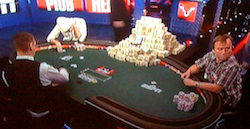
Approaching end of Level 42Then Heinz won seven of the next eight hands to push back up close to 80 million. Along the way came one hand in which Heinz c-bet a 5h4hJd flop, then Staszko raised. Heinz shoved and after a lot of thought Staszko folded. We then saw Heinz had Td5d for fives. Meanwhile Staszko folded Qh6h, surprisingly deciding not to continue with his flush draw, even after raising.

The pair then traded next few pots and reached the end of the level and another 15-minute break.

Martin Staszko -- 124,750,000
Pius Heinz -- 81,150,000

12:15 a.m.
They have begun Level 43 (300k/1.2m/2.4m), and on the very first hand of the level came the first all-in and call of heads-up.

After Staszko limped, Heinz raised to 7.9 million and Staszko called. The flop came Tc7cKs. Heinz bet 8.2 million, and after a couple of minutes Staszko raised to 17.5 million. Heinz riffled his chips and thought. "I don't think Heinz is gonna fold," said Esfandiari. He didn't -- he shoved all in. And Staszko called.

Heinz had two overs -- AhQh -- and Staszko Qc9c. The Czech decided to go with the flush draw this time. He had a gutshot, too, but the jack would give Heinz a better straight. (His nine was live, though.)

Heinz doublesThe turn was the 3h and river the 6s, and suddenly Heinz had 161.5 million to Staszko's 44.4 million (less than 19 big blinds).

Heinz open-shoved the next hand with Q-10 and Staszko folded. Might well be looking at another all-in here pretty soon.

12:35 a.m.
It’s over! In the 301st hand of the final table -- the 119th of heads-up play -- Martin Staszko open-shoved his last 39.5 million with Tc7c and Pius Heinz quickly called, having picked up AsKc. The board ran out 5c2d9sJh4d, and that was that.

Heinz winsBoth Heinz and Staszko played especially well, and had Staszko hit a seven, eight, or ten there on the end they might have gone on another hour.

I think a lot of folks underestimated the Czech, who came into the final table with the most chips but nowhere near the most respect of the final nine. And he appeared to have his way with Heinz for the better part of their heads-up battle, but the German hit a couple of hands on the end and things went the other way.

Fun stuff again from ESPN, although I'll admit getting a bit bleary-eyed once they'd crossed the six-hour mark. And as I mentioned before, I'm very curious to see what kind of ratings they had tonight, particularly beyond the first hour.

Am curious as well to see where all this “almost live” stuff is heading in the future. But I’m feeling almost dead right now, and so off to bed I’ll go. Thanks for reading.

Labels: , , ,


Older Posts

Copyright © 2006-2021 Hard-Boiled Poker.
All Rights Reserved.