Monday, May 27, 2013

On Winners and the Image of Poker

Was somewhat diverting last week to see how that $25K World Poker Tour World Championship played out and all of the surrounding hubbub concerning the deep runs of Erick Lindgren (the eventual runner-up) and David “Chino” Rheem (who won the sucker). I actually barely followed the tournament itself, to be honest, but I couldn’t help but overhear some of the hooting and hollering that resulted from that particular pair making it to heads-up.

Both obviously occupy interesting, similar places in the poker community at present. Lindgren’s story is perhaps somewhat better known thanks to a recent BLUFF feature discussing his significant gambling debts and even a stint in rehab, as well as the openness with which his many creditors have reported on sums owed.

Rheem’s story might be a little less well known, although that absurd-in-retrospect judgment placed upon him by Epic Poker’s Standards and Conduct Committee back in August 2011 broadcast his reputation for failing to pay back debts a little more widely than had been the case previously.

Recall how the EPL placed its first Main Event winner on probation “in order to effectively monitor the personal conduct of Mr. Rheem as he works to meet his personal financial obligations as required under the Players’ Code of Conduct”? Provides a chuckle today, that, as we now understand the extent of Epic Poker’s own significant financial obligations, and the way Federated Sports + Gaming weaseled out of those obligations by taking the bankruptcy route. Heck, some of us are still receiving legal notices helping us monitor that, too.

Both Lindgren and Rheem provide a lot of forum fodder, obviously, and their performances in the WPT World Championship created another occasion for further judgments, jokes, and conjecture about the players’ backing arrangments as well as the possibility of certain debts getting settled thanks to their large scores ($1,150,297 for Rheem and $650,275 for Lindgren).

My initial reaction upon seeing those two in the top spots heading into the final table and then learning they had finished 1-2 was to think back to what I was writing about a week ago regarding “The Shifting Place of the WPT World Championship.” There I was noting how the event has become much less central on the poker calendar over the last several years, both for players and for fans.

One idea I had in mind when writing that post that I didn’t really discuss explicitly was the way the $25K WPT World Championship seems to have evolved into an event reserved for only a select few -- namely, those who can afford and/or be backed for the $25K buy-in. Thus my initial thought about Lindgren and Rheem both playing and coming away with the top two prizes was to think how that result seemed to confirm such an idea that the tournament is kind of segregated from others on the schedule, something only for those like Lindgren and Rheem who even with their debts (or perhaps because of their debts, and, of course, their skills as players) can get backers and play.

But then I had a different thought about it all, partly inspired by the EPL’s fretting over its image once Rheem won that first Main Event. I thought about how curious it is that people place so much importance on who wins a poker tournament and the way the story of that person’s triumph might reflect on the game itself.

The NBA playoffs are currently down to four teams -- Miami, Indiana, San Antonio, and Memphis -- and some commentators are already talking about how the upcoming finals will probably fail to earn high television ratings because of the absence of “big market” teams (e.g., from New York or Los Angeles). But no one is worried about the state of the game itself being negatively affected by who ends up winning in the end. Or affected at all, really.

Meanwhile in poker, discussion about how winners are perceived both within the community and beyond often forms part of the post-tourney response, particularly in the case of the highest-profile tournaments.

Such discussion always surrounds the WSOP Main Event, of course. Remember the first year of the “November Nine” (2008), when all of the talk was about how the final nine featured a bunch of nobodies? Coincidentally -- or ironically -- it was Rheem alone who initially stood out among that group as the only “pro” among them, thus causing a lot of uncertainty about whether or not the whole delayed-final table experiment was ultimately going to be “good for poker” if no one knew the players involved.

Such has been the case ever since the WSOP Main Event started to attract notice by those outside of poker. I’m thinking of the end of The Biggest Game in Town by Al Alvarez in which he reports on the 1981 WSOP. Alvarez describes one player, Bill Smith, drinking heavily throughout the tourney on his way to the final table, and quotes an unnamed poker pro worrying “If Bill ends up beating all of the nice guys, like Bobby [Baldwin], it’s going to set the image of poker back ten years.”

Smith ended up busting in fifth, leading Alvarez to say (with tongue clearly in cheek) that “the new, clean-living image of poker had been spared for another year.” That Stu Ungar would go on to win that year -- an amazing character, to be sure, though obviously not exactly a wholesome representative of the game -- perhaps provides yet another one of those hindsight-producing ironies here.

In any case, this whole idea of assigning such significance to the winner’s character or identity and its ultimate effect on the “image of poker” is curious to say the least. After all, the game attracts such a wide variety of people, and the very nature of the game -- with chance a significant element -- makes it impossible to exert any sort of control over who is going to win and thus be perceived as representing the game going forward.

Looking back, I’d say that was one of a few impossible goals the EPL was striving for during its brief, quixotic existence, i.e., to try to exert some sort of control over who the winners in poker were going to be, ensuring they be both skillful and of acceptable character. (Wrote a little on that idea way back in early 2011 when the EPL was first announced in a post titled “A League of Their Own.”) But in truth, it is foolhardy to suggest the fate of the game depends so heavily on outcomes.

So Rheem wins and Lindgren almost does. So what? Poker endures.

Labels: , , , , , , , , ,

Monday, January 07, 2013

On Lindgren and “Rehab”

Over the weekend BLUFF magazine posted an interview with Erick Lindgren focusing primarily on the poker player’s significant sports-betting woes. Titled “Broken: The Erick Lindgren Story,” the article by BLUFF Editor in Chief Lance Bradley relates how Lindgren recently spent two weeks in a California rehab facility “trying to work through his addiction to gambling.”

The piece describes how Lindgren, once something of a favorite among poker-TV celebs thanks both to his amiable personality and talents at the table, has seen his reputation plummet of late following reports of his multi-million dollar gambling losses and comprehensive failure to cover debts.

Reference is made to last spring’s revelations regarding the extent of Lindgren’s losses/debts, which at the time were much greater than most realized. I wrote a post then titled “Hero Call” that discusses what was being said about Lindgren while also reflecting on how his story had become yet another example of a one-time popular figure in poker proving disappointing to some.

Clearly an action junkie who cannot help himself when it comes to sports betting, Lindgren speaks in the BLUFF article of having “the degenerate gene” and thus having had a goal of “removing” it via his stay at the rehab facility. The article explains how as a member of Team Full Tilt, Lindgren received payments “upward of $250,000 per month,” all of which (it seems) was squandered via betting on sports and participation in high-stakes fantasy leagues. And then some.

When the dividends stopped coming following Black Friday, Lindgren’s ability to make payments and/or hold off creditors lessened considerably. According to Lindgren, his gambling debts total about $3 million at present, although at one time he had been more than $10 million in the hole. He is also currently in the process of filing for bankruptcy.

The mention of “rehab” and the acknowledgment of having “degenerate” tendencies perhaps suggest that Lindgren is looking for a way to stop gambling entirely, much like an alcoholic might try once and for all to give up drinking. But that is not the case, as Lindgren describes himself at the end of the piece having “been staked in poker and some sports (betting) to try and raise some money.” As Bradley puts it earlier, “Lindgren wasn’t in rehab to cure him of gambling -- that’s his day job and he knows he needs to continue to play poker and work in Las Vegas if he has any hope of paying all his debts and beginning the process of repairing his name.”

It all sounds very odd and not at all encouraging. A cynical response would be to say that the primary goal of the two-week stay -- not to mention submitting to the interview -- was to rehabilitate Lindgren’s reputation, not really to try to help him directly address his gambling addiction (and thus, by improving his reputation, improve his shot at finding backers). But even a more generous reading of Lindgren’s words and situation has to be filled with trepidation thanks to the obvious disconnect between addressing one’s gambling problem by formulating plans to figure out how to continue gambling.

Thanks to Bradley’s balanced approach, the reader is allowed to form his or her own opinions regarding Lindgren and his plight. As Lindgren’s example well proves, the poker world tends to enable such “degen” behavior, allowing those who are self-destructive to continue down the same path as long as doing so doesn’t negatively affect others too greatly. And in some cases those who write and report on poker might be said to contribute even further to the process of enabling by romanticizing wild, reckless gambling without acknowledging the damage often done. But Bradley avoids that tendency in the article, mostly letting Lindgren speak for himself and thereby allowing readers to make their own judgments regarding the poker player’s future prospects.

While I’m as hopeful as anyone that Lindgren makes good, it seems to me that most who read “Broken” and respond rationally will probably come to a similar conclusion regarding Lindgren’s proposed method of recovery.

Not to bet on it.

Labels: , , ,

Thursday, October 11, 2012

Heroes, Villains, and Haralabos Voulgaris

Way, way, way back when I first started this blog, Haralabos Voulgaris was one of the very first poker pros about whom I wrote a post. It was a short one, just praising him for being so friggin’ funny on an episode of the old Circuit podcast with Scott Huff, Joe Sebok, and Gavin Smith. The post was titled “Hilarious Haralabos.”

In fact, looking back I think that was probably the very first post in which I tried to write about something other than my own play or to pretend to offer some kind of pseudo-strategy-type talk. This was late May 2006. Over the next few months I’d write about other things happening in the poker world, including that year’s WSOP. Then in October came the UIGEA, and that’s when the blog really started to focus more on the poker world at large with my own little poker stories only occasionally appearing as part of the overall mix.

Voulgaris would go on to co-host a podcast with Huff, Big Poker Sundays. That show was very well liked, I recall, in part because of Voulgaris’s readiness to share opinions and not pull punches regarding things like the insider cheating scandal at Absolute Poker and other knotty matters. (People also liked BPS because Voulgaris is a funny dude, as is Huff.)

More of a sports bettor than a poker player, Voulgaris kind of receded from the poker scene a bit over the next few years, although he did turn up on High Stakes Poker and also participated in the “Big One for One Drop” at the WSOP this past summer. He also has kept contributing now and then to certain conversations in the poker community via Two Plus Two posts and his Twitter account (@haralabob).

Back in March of this year, when the extent of Erick Lindgren’s gambling debts became public and inspired one of those conversations in the poker community, Voulgaris shared some details of “E-Dog” owing him considerably (i.e., millions) and his six-year struggle to get paid. I wrote some about all that here in a post titled “Hero Call.”

There I discussed (in part) the idea of “heroes” in poker. “I can’t really say I ever thought of any players in such a way,” I wrote, “although perhaps that says more about me and my (modest) aspirations as a poker player than anything.” I went on to suggest that when it came to identifying heroes among professional poker players, it was perhaps best not to choose from those who are the biggest winners (see Phil Hellmuth), but rather to look at “those who are best able to promote and preserve the game -- the ‘ambassadors’ or others who actively work to keep the game going (so to speak) for the rest of us.”

Anyhow, I was reminded of that post and the issue again this week when Voulgaris published a post on his blog titled “Heroes and Villains in Poker.” (Apologies for having a similar title for this post, but really, the alliteration was too alluring to avoid.)

In the post, Voulgaris primarily addresses “Black Friday and the FTP fiasco,” although additionally shares more about his dealings with Lindgren. He also has some things to say about Daniel Negreanu’s calling out of certain figures (e.g., Howard Lederer) while omitting doing so with others (e.g., Lindgren).

“Black Friday turned the poker world on its ear,” writes Voulgaris. “People who were heroes (as much as a poker player could be I suppose) have since been cast as villains, and it has actually become quite difficult to discern (aside from a few obvious choices) who the heroes and the villains in [the] post Black Friday poker world are.”

Voulgaris makes an excellent point, and his post provides still more food for thought, too. And for those wanting more details regarding Lindgren and his debt to Voulgaris, he’s added a lengthy addendum in a contribution to a Two Plus Two thread discussing his original blog post.

While offering some criticism of Negreanu, Voulgaris also praises him for mostly being what I’m describing above as a worthy “ambassador” of the game. That is to say, a “hero” (of sorts), although like Voulgaris I share that urge to add qualifiers when using such a term in the context of poker and poker players.

Anyhow, check out Voulgaris’s post which offers some genuine insight and goes well beyond just dishing more dirt on another now-fallen poker “hero.”

It’s not nearly as hilarious as that appearance on The Circuit, of course. Unfortunately those old shows have all disappeared from the CardPlayer site, although as I was talking about a few weeks ago, I have a number of old poker podcasts saved and in fact do have that very show. (I’d post here, but am sure CardPlayer would object.)

Gonna go listen now. Seem to remember something pretty good in there about Freddy Deeb....

Labels: , , , ,

Tuesday, March 13, 2012

Hero Call

Super GusI had already decided on both the topic and title of this post when I saw the latest cover of BLUFF Europe featuring Gus Hansen as some sort of superhero (the March 2012 issue). Kind of a funny image, made more so by our knowledge of the many wild ups and downs Hansen has had as a player over the years, especially online.

Speaking of ups and downs, most readers of this blog probably at least heard something about Erick Lindgren’s troubles of late with regard to gambling losses. He became the subject of a much viewed and discussed thread on Two Plus Two in which some to whom he owed money called him out, then others joined in to form a loud chorus of voices that together effectively drowned out echoes of former praises sung over the years for the charismatic and talented poker player.

With over $8 million in tourney winnings, a couple of WPT titles, a WSOP bracelet, and a deep run in last year’s WSOP Main Event (finishing 43rd), Lindgren has well established his credentials as a top tourney player. Winning those WPT titles in 2003 and 2004 helped ensure him landing a central spot amid the cast of new poker celebs featured during the “boom” and heyday of televised poker, making him a star in our little poker world.

Those following either the thread on Two Plus Two or other reports about Lindgren’s considerable gambling debts are familiar with that story’s main theme, namely, that while E-dog had successfully crafted a very likable image of himself to the larger public, those in the know understood the reality much better, including his degen tendencies to gamble it up big and apparently not consider paying off debts a very high priority.

Probably the most compelling and thoughtful contribution to the hubbub came from Haralabos Voulgaris in a post detailing his six-year quest to get Lindgren to settle debts owed to him. There Voulgaris notes how Lindgren not only owed (and still owes) him money but also owes “a bunch of people spread all around the gambling world.” The amounts and number of people owed have increased over several years, the result of Lindgren’s being (in Voulgaris’s estimation) “basically allergic to paying his debts.”

Also worth noting is Phil Galfond’s latest blog post, “Lindgren, Loans, and a Little Advice,” in which he steps back and provides a lot of great food for thought regarding the poker community as a whole and the complicated, mutually-dependent system by which it sustains so many.

Hearing about Lindgren’s troubles reminded me of his WSOP bracelet win back in 2008. It was early in the Series, a memorable $5,000 Mixed Limit/No-Limit Hold’em event in which Lindgren outlasted Justin Bonomo heads-up for the win. I believe it was the first final table I’d ever covered at the WSOP, with Steve Horton and I reporting every hand for PokerNews.

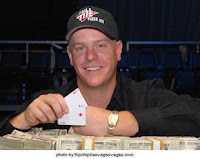
Erick Lindgren after winning his first WSOP bracelet in 2008Looking back, I see I wrote a post here afterwards noting the “genuine sense of joy and even a kind of weird camaraderie in the arena as everyone seemed to share in Lindgren’s triumph.” Most did seem to pull for him to win and thus shed the “best-without-a-bracelet” tag, and while I didn’t necessarily care one way or the other, his being there and winning the sucker did make for a fun, exciting story for a new WSOP reporter to tell.

So yeah, I guess remembering that night did make this recent story a tad more disappointing to hear. Indeed, one aspect of the story of Lindgren’s gambling debts that has cropped up is how it parallels what seem to have been a number of “falls from grace” that have occurred among that generation of TV poker stars with whom we all became familiar during those first couple of years after Moneymaker’s 2003 Main Event win. We could quickly construct a lengthy list of once-revered pros who over the last few years have been involved in various controversies, some much more serious and image-damaging that others.

Got me thinking a little about the whole idea of “heroes” in poker. I can’t really say I ever thought of any players in such a way, although perhaps that says more about me and my (modest) aspirations as a poker player than anything. I’ve heard some players -- serious players -- talk of other players as being “heroes” to them and I don’t doubt their sincerity when they do. But while I’ve been fascinated by certain characters and their stories, I can’t really name any player whom I’ve thought of in that way.

Was writing yesterday about poker being in part an “antisocial” game -- in other words, a necessarily self-interested endeavor in which the idea of having friendly attitudes toward others or even just admiring or respecting them is diminished. That may in part help explain why the idea of a poker “hero” is hard for some of us to imagine. The best, most obviously-skilled players all have their haters, too, right?

Where, then, might we find heroes in poker, if we can’t simply choose among the game’s biggest and most consistent winners? Probably among those who are best able to promote and preserve the game -- the “ambassadors” or others who actively work to keep the game going (so to speak) for the rest of us.

Certainly easier to imagine villains than heroes in that regard, too, I’m afraid. That is, it is easier to think of people who have clearly hurt the game of late than to list the helpers. But there are a few whom we might say are presently trying to improve things, in different ways.

Perhaps this rash of less-than-heroic seeming actions and characters that have given us so many negative stories in poker recently might inspire more to start acting in ways that help poker rather than hurt it.

Labels: , , ,

Thursday, April 09, 2009

Bonomo Ban No Mo’

Justin BonomoLast summer I had the chance to help cover the World Series of Poker for PokerNews, and the first final table I live blogged was a good one -- Event No. 4, the $5,000 Mixed No-Limit/Limit Hold’em event won by Erick Lindgren. The table went nearly 200 hands, the last 40 or so were heads up between Lindgren and Justin “ZeeJustin” Bonomo.

Was looking back at the blog, where Tropical Steve and I alternated reporting hands. Bonomo had the chip lead once it got to heads up (about 3-to-2), and at the time it looked a lot like he would probably take it down. Really, for most of the night it seemed as though Bonomo was the one in charge. Which was saying something, given who else was at that final table: David Williams, Howard Lederer, Isaac Haxton, Roland de Wolfe, David Rheem, Andrew Robl, and Pat Pezzin.

This was a televised FT, and when it was all over Lindgren was interviewed by Norman Chad. Those interviews generally end up going on for six or eight questions or so, from which ESPN chops out the little ten-second clip that gets tacked on to the end of the broadcast. In the blog I reported some from that interview, including relating how Lindgren noted that once he’d gotten the lead on Bonomo he remained worried his opponent might still come back on him, right up until the last river card was dealt.

I remember Lindgren also in there somewhere saying some nice things about his opponent, and stating very confidently that Bonomo was going to be winning multiple bracelets himself in the future. I think everyone there watching that final table was thoroughly convinced -- if they weren’t already -- that Bonomo was indeed a hell of a player.

Amid the buzz this week is the fact that Bonomo has been allowed back on PokerStars after being banned from the site for over three years (since February 2006) for having been caught entering tournaments multiple times with different accounts. This was shortly after Bonomo had been caught doing something similar over on PartyPoker, from which site he was banned as well.

Justin Bonomo at the 2008 WSOP Event No. 4 final tableBonomo turned 21 later that year, and soon began tearing up the live tourney poker scene. He barely missed a WPT final table that December, finishing seventh at the Five Diamond World Poker Classic (the one Joe Hachem won). He made a final table at the 2007 WSOP in a NLHE event, where he also made a deep run in the $50K H.O.R.S.E. event, finishing 18th, just a couple of spots away from the money. He has already tripped up to over $1.5 million in tourney winnings. All of which further establishes Bonomo’s poker prowess.

If you’ve heard Bonomo interviewed on any of the podcasts or on his own show, All Strategy (which now may well be on a permanent hiatus), you know he’s articulate, too, and has a gift (I think) for communicating poker-related concepts. And he’s also obviously remorseful for what he did, never shying from questions about the cheating and accepting full responsibility (unlike some others have done). At least that has been the case every time I’ve heard him talk about the issue.

That being said, I guess I’m still scratching my head as to why PokerStars would make this decision to allow “ZeeJustin” back on the site. I’m not saying I don’t think Bonomo understands the gravity of his transgressions, and in fact I do believe that besides being a great player, he has a lot to contribute to the poker community as well. In fact, my wondering has nothing much to do with Bonomo at all -- I agree with the notion that his is something of a special case and therefore probably deserves to be considered differently than others.

I guess I just don’t quite see what exactly PokerStars has to gain here.

One PokerStars customer wrote the site to complain about the unbanning of Bonomo, and received a reply that pointed out how Bonomo had “accepted the consequences of his actions” and as far as PokerStars knew never “tried to circumvent his suspension.” The support person additionally notes how Bonomo has not only “expressed regret for his actions” but “has even become a crusader for fair play” since his banning.

A poll over on PocketFives currently has about 64% of respondents saying they agree with the decision to let Bonomo back on the site, with 36% saying it was not a “good move” by Stars to do so. On the TwoPlusTwo PokerCast this week, the hosts mentioned the thread on that forum discussing the matter, and estimated there, too, the split was about 60-40 in favor of the decision.

I suppose my instinctive response is negative, as I don’t like the idea of letting others believe there exists a (legit) avenue back onto an online site after one has been caught cheating in such a flagrant manner. (That’s ignoring the particulars of Bonomo’s case, I know.) I suppose it would be helpful if somehow Stars additionally provided a way for Bonomo to continue being “a crusader for fair play,” although I’m not sure exactly how that sort of “community service” could be done.

Thinking back to the respect Lindgren expressed for Bonomo after that WSOP final table, I think it’s pretty clear E-dog wouldn’t have been so generous about his opponent if Bonomo had been previously caught cheating in a live setting.

But he wasn’t. More evidence in support of the thesis that everything is different online.

Labels: , , ,

Thursday, June 05, 2008

2008 WSOP, Day 7: Last Night’s Final Table

Erick Lindgren, 2008 WSOP Event No. 4 winnerLast night’s final table of Event No. 4, the $5,000 Mixed Limit/No-Limit Hold’em event, ended around 2:00 a.m. or thereabouts. I can’t remember. Was kind of a whirlwind from beginning to end as Steve and I tracked all 197 hands, right up to Erick Lindgren winning his first WSOP bracelet.

We got there well before the scheduled 3 p.m. start time, but the final table didn’t get crankin’ ‘til almost 5, the delay due (I think) to ESPN having to get everything in place to shoot the thing. Nine hours later or so and we were done. I got home too wired to sleep, but also too written out to write anything more over here. If yr curious, you can check out my sign-off post over on PokerNews detailing Lindgren’s triumph.

If you traipse back through the Day 3 blog, you’ll see descriptions of every hand, with the two of us only occasionally missing a card or bet amount. The limit rounds were especially unrelenting, as hands went by very quickly, about one per minute (or faster). Was kind of maddening at times as we were surrounded at the press table by a lot of folks yammering away, making it difficult to hear the announcer reporting the bets -- something we relied on utterly, as we could not see those perfectly from our vantage point.

We tried to add a few “color” posts along the way, but there really wasn’t much time for that. Phil Hellmuth did come around in his UltimateBet get-up at one point, which gave me a chance to write the following:

Hellmuth Cameo
Phil Hellmuth just stopped by to say hello to Erick Lindgren. The announcer asked the audience for a round of applause for Hellmuth, and after a pause a chorus of boos rained down, followed by laughter.

“Tough crowd, man!” said Hellmuth.

Oh, and there was this one from earlier in the evening, too:

Limit Hold'em Not Everyone's Fave
Just overheard near the press table:

“I’m going to bring a Chia pet next time we have a limit event so I can watch it grow.”

When it was over, there a genuine sense of joy and even a kind of weird camaraderie in the arena as everyone seemed to share in Lindgren’s triumph. At the start of heads up play, he had made some gestures toward buying everyone a Milwaukee’s Best Light (as we reported in the blog), which garnered him some cheers, though the waitresses never seemed to come around to take care of that. Lindgren didn’t need to buy the crowd’s support, though, as a lot of those present were already clearly on his side.

Was glad to have been a small part of the whole spectacle. I have the day off today, but frankly am so sapped I don’t know if I’ll do much of anything. Will try to come back on later with a bit more about today’s events. Once again, six different tourneys are in action. The WSOP express keeps rollin’ along, and, as always, you can follow everything over at PokerNews.

Labels: , , , ,


Older Posts

Copyright © 2006-2021 Hard-Boiled Poker.
All Rights Reserved.