Monday, March 31, 2008

A New Sheriff in Town

There's a New Sheriff In TownDecided yesterday to go ahead and make that last push toward getting the Silver Star on PokerStars. I was close when the day began, having to pick up nearly 100 more FPPs/VPPs to get there. Besides, I did get over to the gym on Saturday (finally), so that made me feel relatively less guilty about wasting away a few more hours in front of the laptop.

Ended up putting in several hundred hands of pot limit Omaha ($25 buy-in), limit Hold ’em ($1/$2), and Stud Eight-or-Better ($0.50/$1). Took a while, but I finally crossed the 1500 FPP/VPP mark around nine last night, after having taken a break to watch Davidson nearly pull the huge upset. (Didja notice how on CBS they abbreviated Davidson as “David” on the score line? They shoulda just gone ahead and listed Kansas as “Goliath.”) Logged off a winner for the day (about twenty-five clams up), though was a bit miffed at having made a dumb PLO play near the end that essentially cut my profit in half.

All in all, though, I think I did well not to push too hard (i.e., multitabling, playing too high) in order to rack up the points. As I mentioned over on the PokerSift blog yesterday, I know folks frequently end up getting into trouble chasing bonuses, oftentimes losing at the table more than they stand to gain from the bonus. I know that has happened to me a time or two. During these last few bonus chases, though, I’ve realized I’ve actually been able to play with extra patience, perhaps knowing that even when I’m folding a hand I’m still “earning” something just by sitting at the table.

Shamus Gets His StarNow, of course, I am curious to learn what exactly being a Silver Star means. When you reach Silver Star, PokerStars sends you a little email with a link leading you to the VIP Club page where you can read more about just what your little shiny star gets ya.

There are daily VIP tourneys for Silver Star peoples. Just 10 FPPs to enter, and they have $500 prize pools. Will likely have to try a few of those.

There are weekly VIP tourneys every Saturday afternoon, too. Those cost 100 FPPs, and have $20,000 prize pools. Might have to try a couple of those as well, if I can. Saturday afternoon is an excellent time for me, although I might end up having to multi-table it so as to play in Saturdays with Pauly (which I’ve missed the last few weeks).

Then there’s a big VIP tourney at the end of the month with a huge $100,000 prize pool. Looks like I’d have to satellite into that sucker.

A couple of other perks. One is that for April I’ll be earning FPPs at 1.5 times the usual rate, although one still earns VPPs at the same clip. (Meaning I probably can’t hope ever to rise above Silver Star status, practically speaking.)

Then there is the VIP Store where those with Silver Stars are allowed to purchase certain items others cannot. Hunted around there a little while, but didn’t really see a whole lot that I couldn’t also have gotten as a measly Bronze Star. I don’t care about clothing or coffee mugs or that folderol. The books are all the same (and at the same prices). There are a few electronics items that look interesting, such as the iPod 8 GB Nano, but I’d have to accumulate a whopping amount of FPPs this month to get there. Other stuff (tourney entries, gift certificates, etc.) would also be well above my FPP budget.

The only other item of interest here would be to trade 5,000 FPPs for $50 cash, an offer only Silver Stars are invited to take. If you look around on the forums, most judge that trade to be a relatively poor investment compared to playing certain SNGs and MTTs. There’s a lot of debate on the topic, but I’m seeing a lot of people calculating 62 or 63 FPPs to be equivalent to one dollar (a figure usually arrived at by comparing FPP price tags for various items and/or tourney entries). Trading 5,000 for fifty bucks would make each FPP worth only a penny (100 FPP = $1) -- on the surface, not such a good use of the FPPs, although since I rarely play tourneys it might be an option worth considering.

Stuff to ponder. Any of you Silver Stars out there have any ideas on the matter?

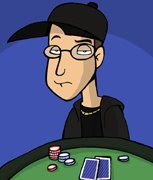
Meanwhile, if you were wondering, I pulled an Iggy with that photo above. You might recall how about three weeks ago the Blogfather published a first-ever photo of himself on Guinness and Poker. Actually this is not the first photo of me that has appeared on Hard-Boiled, but in the other I wasn’t facing the camera.

That’s a two-year-old Shamus up there. Check out those striped pants. Strikes fear in yr hearts, don’t it?

While we’re on the topic of public embarrassement, keep a watch on this space for the debut of The Hard-Boiled Poker Radio Show, due tomorrow. (Publishing the first episode on April Fool’s Day means I can always claim it was a joke later.)

Labels: , , ,

Friday, March 28, 2008

Brief Observations Designed To Accommodate Our Fast-Paced Lifestyles

Busy, busy. Too busy. Am in desperate need of physical exercise. I have a membership at the YMCA, and once a month they send me reports on my workouts. I won’t get into specifics, but let’s just say if I manage to get over there one time before March is done, I will eclipse my stats for February within the first minute.

For now, here’s a brief digest of my poker-related thoughts of the moment . . .

Name That Event

The World Series of PokerMentioned last week how I’ll be in Vegas this summer for the 2008 WSOP, which I’ll be helping cover for PokerNews. In the last few days I began looking into possible housing scenarios. We’re still just about two months away (the first event kicks off on Friday, May 30th), but I’m hoping to have all of that sorted out here earlier than later.

Aside from deciding where I’m gonna stay, the other great question hanging over this year’s WSOP has to be whether or not officials will adopt my suggested name for Event 8, the $10,000 buy-in World Championship Mixed Event (begins June 4th). My idea was that this event will be showcasing poker in all of its S.P.L.E.N.D.O.R. as the players rotate through the eight different games: Stud, Pot Limit Omaha, Limit Hold ’em, Stud Eight-or-Better, No Limit Hold ’em, 2-7 Triple Draw, Omaha Eight-or-Better, and Razz. Here’s the full pitch.

Okay, maybe there are other questions of greater importance. But we’ve still got sixty-plus days to get to those.

Shamus Plugs

ApplesauceHad a prospective advertiser bargaining with me this week over a possible text ad. Dude tells me according to his analysis, I had fewer than ten unique hits during a particular 24-hour period. I told him he was full of applesauce. He didn’t respond.

It is possible, of course, he may not understand what exactly applesauce means. In any event, I tend to doubt we’ll be seeing his ad on Hard-Boiled Poker.

Perhaps I, Too, Might Become a Very Important Player

PokerStars Silver StarAm closing in on my Silver Star over at PokerStars. Am sitting at about 1,260 VPPs, meaning I have to grab 240 before month’s end to get my shiny badge. Am a bit ambivalent about the whole thing, frankly -- it seems like all I “win” here will be cheap entries into some April freerolls and the ability to accumulate FPPs at a higher clip (1.5 for each 1). But now that I’m getting close I realize I don’t want to have to start over again on April 1. So I’m putting in hands of LHE 1/2, where one picks up a point about every other hand. (A bit more quickly than at the PLO25 tables.)

Is That My Voice? Sheesh.

The Hard-Boiled Poker Radio ShowFinally, I wanted to mention that a new poker podcast is in the works. If all goes according to plan it will debut on April Fool’s Day. What will it be called . . . ?

The Hard-Boiled Poker Radio Show. No shinola.

Gonna try to do some final editing on the first episode over the weekend. I can tell you right now, this stuff is a lot harder than it sounds. Probably looking at a once-a-month type deal here. We’ll see. Anyhow, will be posting more info about the show -- and (hopefully) a link to the first ep. -- next week.

Have a good weekend. And let’s all try to make it to the gym at least once, okay?

Labels: , , , ,

Thursday, March 27, 2008

Numbers & Psychology

The Crazy BetLots of news these days about the current mortgage crisis. Heard yet another story on NPR’s Morning Edition today about it, after which came a interesting little report about a recent study conducted by a couple of Cornell University researchers concerning the attitudes of prospective home buyers.

The study looked into how home buyers tend to respond to asking prices. Specifically, the researchers wanted to figure out whether or not it mattered to buyers if the price was listed as a rounded-off figure -- say $680,000 -- or a non-rounded off figure like $682,417.

After conducting some tests, the researchers concluded that buyers have what they describe as a “built-in bias in favor of precise numbers.” (They kept referring to non-rounded-off numbers as “precise” in the report, although I think one could argue the term is not necessarily being used accurately here.) That is to say, the buyers were more likely to view a rounded-off number as higher, and thus were more inclined to buy the home with a non-rounded off price tag.

In their conclusion, the researchers decided this bias in favor of non-rounded-off prices is a vestige of our retail shopping experience. When we shop at the local hardware store and see an item priced at $9.02, we instinctively assume the price reflects some sort of savings to the consumer. Therefore, as the reporter explained, “when people see houses with precise numbers, somewhere in the back of their minds they think ‘discount shopping.’”

The segment concluded with a representative from a New York real estate company expressing skepticism about the researchers’ findings. According to her way of thinking, a non-rounded-off price tag wouldn’t necessarily be met with enthusiasm by some buyers. Indeed, the odd-looking figure might give the buyer pause since, as she put it, the price “would seem a little strange.”

You can probably guess where I’m headed here. This is a poker blog, after all.

Just so happened that right after I heard the NPR story I got out the iPod-like device and listened to the March 25th episode of PokerRoad Radio (with Brandon Cantu). At one point about halfway through the show, the hosts engaged in a brief digression concerning bet amounts. Gavin Smith talked about how he had been experimenting with differently-sized raises during the first day of the WPT World Poker Challenge, betting 225, then 275, etc.

That led Joe Sebok to make a comment about players online betting strange-looking amounts like 2,222 and how it makes him “want to go through [his] machine and punch them in the face.” Ali Nejad suggested that response was precisely why people make such odd-looking bets -- it puts opponents on tilt. (Sebok denied the bets actually affected his game.) “We’re anal. We want round numbers,” argued Nejad. Thus do some of us object when the bets come out all weird-looking.

With regard to that idea that we “want” round numbers, the Cornell researchers did point out how the non-rounded-off numbers “momentarily confuse” consumers, and while they surmised home buyers ultimately overcame that confusion to conclude the prices were favorable, the N.Y. real estate company rep suggested that confusion produced a different consequence, perhaps even turning off the prospective buyer.

We’ve all encountered that rogue at the poker table who keeps betting weird, hard-to-explain amounts. The bets usually come as the first raise on a given round, e.g., it is preflop, the blinds are 50/100, and someone open bets 333 or something. Such a bet certainly can “momentarily confuse” the table. Such a bet can also give the bettor a crazy-seeming image (possibly part of the plan).

Additionally, the non-rounded-off bet might be said to produce a practical consequence, namely, it makes it more difficult (for most of us) subsequently to calculate pot odds. Have talked more than once this week about my own struggles to calculate on the fly my “equity” in a given hand. Such problems can be even harder to solve when we ain’t dealin’ with easy-to-manage, round numbers.

In any event, I think I share the N.Y. real estate rep’s skepticism about the Cornell researchers’ conclusions. I don’t think the non-rounded-off price tag encourages buyers all that much.

I know it doesn’t work that way at the poker table, anyway.

Labels: , , ,

PLO Puzzle (2 of 2)

PLO Puzzle (2 of 2)Great feedback, guys, to yesterday’s puzzle. Much appreciated. So my three questions were . . .

(1) What do you think my opponents have?

What did I think? Brigid O’Sh. made that preflop raise, then with two players behind checked that 8d3h7s flop. Whatever Brigid has, I’m reasonably certain I like the flop better than she does. She could be lying there in the weeds with a set, but I’m going to guess she had more than a pair of eights or sevens to make the mid-position preflop raise. (Could also have a big wrap, of course.)

Then Wilmer Cook bets out $2.50, less than half of the $6 pot. Kind of a curious bet, really. My first instinct was to put him on a set. I didn’t actually think he was on a draw, though looking back I see that’s more than a reasonable possibility. In fact, with a set the bet doesn’t really make too much sense as it doesn’t protect him very well against draws calling.

I, of course, like the flop a lot. Couldn’t be better for me, really. As anonymous spelled out, no less than 16 cards make my straight -- four 5s, three 6s, three 9s, three Ts, three Js -- and all of those outs are to the nuts.

(2) Answering that, what, then, are my chances of making the best hand?

Let’s just say Wilmer does have top set. That seems like about the best possible hand he could reasonably have here (unless he somehow has my same big wrap draw). Going back over to Two Dimes, it looks as though Wilmer is going to have a slight edge over me if he has a couple of eights in his hand. His other two cards matter, of course, but most combinations yield around 52-55% equity for Wilmer. If he has just two pair, we’re just about a coin flip.

(3) How should I respond to Wilmer’s bet?

This was what made this hand a bit of a puzzle for me. I actually posted this one over in the Omaha forum on Two Plus Two yesterday, and most who responded said the pot-sized bet was the correct play. Indeed, a couple kind of dismissed the hand as being all that puzzling -- they’re probably right, particularly since I’m playing the short stack here. (Probably would’ve made a much more interesting hand to post if I had had a deep stack, too.)

Even so, I’m wondering if pushing is, in fact, the best play in a situation where I am at best only 50% to win? I should say I’m wondering that now, because at the time I was indeed looking to gamble. Here’s what I did:


A not-quite pot-sized bet, made with the hope that I could push Brigid O’Sh. out and get Wilmer to reraise me. Which is what happened. Brigid stepped aside, Wilmer and I got it all in, and then . . .


Wilmer’s top-and-bottom pair meant we were almost dead even with two cards to come. Of course, that eight on the turn settled the matter with cruel swiftness.

I’m essentially fine with my play, though am still wondering about pushing in a 50-50 spot like that when I can surely find better risks to take. Am also still wondering what might’ve been the proper path had I have been deep-stacked myself here. Then a call seems more appropriate.

Maybe by the time I learn how to build myself a big stack I’ll have a better idea what to do when such a situation arises.

Labels: , ,

Wednesday, March 26, 2008

PLO Puzzle (1 of 2)

PLO PuzzleThanks to MacAnthony for clearing up a mistake on my Monday post. After spelling out that weird four-way all-in for that pot limit Omaha hand, I entered all of the hands into Two Dimes to see what each player's chance was, but somehow mucked the form so as to produce incorrect percentages. Turned out I was in much better shape with two cards to come than I had thought.

Obviously I hadn’t noticed the error, likely because even with top set and a straight draw I couldn’t comprehend being a favorite against three other hands. Can be quite challenging sometimes -- even after the fact -- to figure out what sort of equity one has in a given PLO hand. Had another interesting situation arise in a hand yesterday where I found myself faced with a quick, not-so-obvious decision regarding odds and outs. Tell me what you would do here.

Was at a PLO50 table (blinds $0.25/$0.50). I had bought in short -- just twenty bucks -- and had been folding hands for a couple of rounds. Then I get 6cJh9sTd in the cutoff. Am wanting to play this hand, but a player two to my left -- Brigid O’Sh. -- raises it up to $1.75. The player in between us, Wilmer Cook, who was sporting the table’s biggest stack ($78.40), called the bet. I thought a sec, and decided to call as well:


(For funsies I thought I’d recreate this sucker over on PokerXFactor to help illustrate the story.)

You might want to argue with my call there -- if so, please do. But the real quandary (in my opinion) comes up after the flop. Both of the blinds folded, so there were three of us left. Pot was $6 even. Here’s what happened next:


The original raiser, Brigid O’Sh., checked, and Wilmer Cook bet out a little less than half the pot. Let me ask you three questions:

(1) What do you think my opponents have?

(2) Answering that, what, then, are my chances of making the best hand?

(3) How should I respond to Wilmer’s bet?


Will return tomorrow with the results.

Labels: ,

Tuesday, March 25, 2008

“M”

Harrington's 'M' Will Likely Not Be RivalledGot the opportunity to catch up on a few of the podcasts I missed last week. Most interesting among them was Dan Harrington’s appearance over on the Two Plus Two Pokercast.

“Action Dan” is an intriguing figure. Particularly notable is his overall lack of gamble -- i.e., his aversion to taking unnecessary risks -- perhaps the only trait he possesses that I can reasonably claim to share. Definitely distinguishes him from yr average poker pro. Also enjoyed the discussion of pot limit Omaha at the end of the show with Ian “iggymcfly” Gordon, frequent contributor to the 2+2 Omaha forum.

Of course, everyone’s currently a-buzz over the new Harrington books on NLHE cash games. Can’t say I’m as excited as most (since I’m not really playing NLHE these days), but I may still have to have a look. Harrington himself admitted on the show that while he believes the new books are even better written than the famed Harrington on Hold ’em series, they aren’t likely to be regarded as ground-breaking as the tourney books were.

Probably the single most-cited concept from the Harrington on Hold ’em series is the idea of “M” or “M-ratio” -- that figure intended to represent the number of rounds a player can survive in a tournament without voluntarily putting any chips into the middle. One’s “M” equals the size of one’s stack divided by the blinds and antes required per round. Harrington explains at length in the second HOH volume how changes in one’s “M” should affect one’s starting hand requirements and other decisions.

Listening to the other podcasts reminded me that even though Harrington is often lauded with having been a pioneer of sorts for having presenting the idea of “M,” he didn’t really originate it. In fact, in the book Harrington himself credits the concept to fellow backgammon whiz Paul Magriel (to whom the “M” refers). Couple of other references in the other shows from last week also indicated the idea had made the rounds a bit before finding its way into HOH.

On Ante Up! last week, Kill Everyone co-author Steven Heston talked about the circumstances under which the new book and its predecessor, Kill Phil were composed. Heston claims that he and his co-contributors had been speaking of a couple of different ideas -- referred to in the books as “CPR” (“cost per round”) and “CSI” (“chip status index”) -- even before Harrington’s books had come out. Indeed, if I understand the term correctly, “CSI” is essentially the same thing as Harrington’s “M.”

Also heard Kirk Morrison make reference last week to “CPR” on Phil Gordon’s podcast, The Poker Edge. Morrison, of course, was a successful tourney player in the 1990s, then took a hiatus until a couple of years ago when he made a triumphant return to the circuit. Although he didn’t specify it on the podcast, his use of “CPR” seems as though it might’ve dated from his earlier time on the tour. Steve Zolotow, in his CardPlayer articles about “CPR” from the summer of 2006 (Part I & Part II), says he’d “used the abbreviation CPR for years, and was surprised to learn that Blair ‘Kill Phil’ Rodman had independently started using it.” Harrington actually mentions Zolotow on the Two Plus Two show as a fellow member of the old Mayfair Poker Group (along with Howard Lederer, Erik Seidel, and Jay Heimowitz).

Of course, even if the groundwork for Harrington’s “M” was laid well before he spelled out the theory in the second volume of HOH, he deserves a lot of credit for helping elevate the concept to such an significant status in discussions of tourney poker strategy and theory. Indeed, one cannot reasonably enter such discussions without at least acknowledging the concept, regardless of what significance one does or does not ascribe to it.

Harrington on Cash Games, Vols. 1 & 2Will be interesting to see if the Harrington on Cash Games books provide any ideas that even come close to rivalling the popularity of “M.” (Would bet against it.)

Labels: , , , , , , , ,

Monday, March 24, 2008

Response Time

The Waco KidBack home. And back online. Played last night for an hour or so, two-tabling some PLO25. Had played about a hundred hands and was up a pittance (five bucks or thereabouts) when Vera asked if I’d run to the store for some milk and juice.

No problemo, was my response. I closed one table, then put the tic in the little “Sit out next hand” box just as the cards were being dealt on the other. Hmm, aces. Other two cards not so bad, either -- QdAsJdAd. I leaned forward. Guess I’ll have to play this one.

I was UTG+1. Folded to me and I raised it pot to 85 cents. I’d been raising in other spots and with other holdings, so my bet didn’t necessarily announce to the table I had aces. Whatever it did announce, several players quickly responded by calling. Six players (including me) stayed for the flop, making the total pot $5.10.

I remained ambivalent. Unlike some Omaha players, I don’t mind letting aces go when faced with an unappealing board. If an ace or flush draw doesn’t pop out here with those first three board cards, I’m out the door and on my way to the Food Lion.

Flop came TcAc9d. Faster than you can say "Waco Kid," the small blind bet out $4.85, leaving himself only five or so bucks behind. The action was on me.

You’ve been there, I know. You’ve had a reasonable little session and have already made up your mind to leave, when suddenly you find yourself plunged into do-or-die territory. Whatever happened here was gonna color the whole friggin’ session a bright, cheery rose or dismal, charcoal gray.

I had $19.55 left in my stack. Of the other players acting after me, all but one had me covered.

If I someone other than the short-stack called, I’d surely be an overall dog to make it to the river unscathed. I did have my own open-ended straight draw, though (minus the clubs), to go with my top set. What to do?

I couldn’t fold. Didn’t really want just to call, either, although I suppose I could have waited to see if the turn was safe. Could I have . . . ? Nah, I couldn’t. I had to push. I bet as much as I was allowed -- $19.40 -- leaving me just fifteen cents behind.

Player to my left thought a bit, then pushed his entire stack ($27-plus) in as well. Then another dude called. The short stack called, too, of course, so we had ourselves a four-way all-in with two cards to come. Total pot was $88.50, although I was only playing for about $70 of that.

This was on Stars, so it was not until the hand concluded that I got to see the others’ cards. Turned out three of us had flopped sets. Coupla guys gunning for flushies, too. Here’s how Two Dimes calculated all of our chances with two cards to come:


(EDIT [added 3/25/08]: I didn’t quite enter the cards into Two Dimes correctly, so these percentages aren’t right. I was, in fact, better off than this. See MacAnthony's comment -- or click here for the gen-u-wine figgers.)

Turn was the 7d, and the river 2h. Made it! A smile on my face as I ran out the door. Such is PLO (sometimes).

By the way, for some reason my hands weren’t saved to the hard disk last night, so this morning I requested the hand history from PokerStars suppport. Got an answer within an hour-and-a-half telling me they were on the case, then the hand histories were sent about an hour after that. Most reading this blog know it already, but no one beats Stars for support.

Finally, while we’re on the subject of getting responses, I did want to make sure you saw a couple I received in relation to last week’s posts.

On Monday of last week, I wrote about Full Tilt Poker’s new agreement with CardRunners, pointing out how the decision to allow the CardRunners guys to create temporary “alternate” accounts appeared to violate one of the Kahnawake Gaming Commission’s “Regulations Concerning Interactive Gaming.” I wrote an email to Full Tilt asking them about it, and they did respond to me on Friday. I appended their response to the post. Also, I’m seeing over on Two Plus Two their plans to create so-called “educational” tables to handle these CardRunners folks, so it does appear Full Tilt took heed of complaints & queries about the original plan.

You might also check out the comments on last Friday’s post, “PPA Can Do Better.” All three of the PPA State Directors mentioned in that post came around to leave thoughtful replies, which I do appreciate.

Labels: , , , ,

Friday, March 21, 2008

Past, Present, and Future

Still in San Fran. Will be heading home on Sunday. I had thought I might get over to Lucky Chances today, but that ain’t gonna happen.

Had the opportunity to reconnect with a friend from way back and this afternoon was the only time we could make it work. And tomorrow Vera is finally free from her conference-related duties, and I surely couldn’t abandon her on our one free day together in S.F. Could I? No, no, no. Talk about negative EV . . . .

Was glad, though, to have squeezed in that quick trip over to Emeryville to the Oaks Card Club, as I hadn’t really expected to play any live poker at all on this here voyage. Incidentally, for those of you with an interest in northern California poker, Sports Illustrated has recently made all of its articles available on-line (going back over fifty years, I think), and there was an old article from 1985 titled “If You Play Your Cards Right, You Can Make It Big in Tiny Emeryville.”

(A poster over on Two Plus Two went searching for old SI articles pertaining to poker and created a list with links. Check it out.)

Had a good time having lunch with Tim Peters yesterday. You know Tim as the book reviewer over at CardPlayer. You can read all of his reviews and other good stuff at his website, “The Literature of Poker.”

We ate at a Mexican place near Union Square. The place is famous for its many varieties of tequilas and Margaritas, but as it was midday we settled for iced teas to wash down a tasty sampling of appetizers, tortillas, and chips.

CardPlayer Daily, 2006 WSOPWe talked about reviewing books (something I’ve done myself from time to time), hard-boiled fiction, and, of course, poker. Tim told me about the time he covered the 2006 World Series of Poker for CardPlayer. If you happened to have followed CardPlayer’s coverage that year, you might recall the “CardPlayer Daily” -- a nifty four-page newsletter that appeared every single day of the WSOP. Although he had some help, Tim was the primary writer and editor for that. You can still read ’em all over at CardPlayer.

Tim described the experience as intense, but incredibly rewarding. I told him I was glad to hear him say that, because I’ve just learned I’m heading to Vegas this summer myself to cover the 2008 WSOP. That’s right. Yr short-stacked, fedora-wearin’ friend is Rio-bound to join the PokerNews crew at this year’s series. (More details to come.)

Gotta run meet my friend now. Has been almost exactly five years, so it’ll be interesting to try to gauge how much we both have changed. Five years is a long time. Hell, just look at what’s happened to poker during that period . . . .

Have a good weekend, all. I’ll see you when I get back.

Labels: , , , ,

PPA Can Do Better

Poker Players AllianceBack in January, Frank “Life’s a Bluff” Frisina started a thread over on the Poker Players Alliance forum regarding the Absolute Poker scandal. Specifically, Frisina was wondering why the PPA had not chosen to issue any sort of statement regarding the AP scandal.

Some reasonable discussion ensued. Rich “TheEngineer” Muny offered his thoughts on the subject. The subsequent back-and-forth between the two then moved onto some other PPA-related subjects, and while Frisina and Muny disagreed on several points, there was a genuine dialogue going on between them. Incidentally, Muny is actually one of those PPA State Directors (he represents Kentucky). He’s also a PPA Board member, and made clear to Frisina that his responses to him were as a board member, not as a state rep.

The thread died down after the first week or so, but in February another State Director, Randall Castonguay (of Massachussetts), chimed in to point out some of the good things the PPA has been doing.

In fact, earlier this week the PPA helped stage a rally across from the Mass. State House to oppose a recently-proposed casino bill that included a clause making playing online poker a felony for which one could get two years in prison and/or pay a $25,000 fine. The turnout for the rally was apparently light -- Foucault was there (see his summary). In any event, the protestors’ efforts were not in vain as the bill was thankfully voted down by the committee considering it, so it never went to the full MA Congress for its consideration.

Anyhow, after lauding the PPA’s efforts in his state, Castonguay ends his post by censuring Frisina for having raised his criticisms. Writes Castonaguay, “So, you wanna b%$#@ and moan because you think the PPA isn't doing enough of this or that...then look in the mirror and ask how much action YOU have taken to support the cause.”

That’s how one PPA State Director responded to Frisina’s criticisms. Not the sort of tone one would like to see from someone charged with leading others, but there it is.

Then another State Director, Steve Brubaker (who represents Illinois), added his two cents yesterday. After dismissing worries about Ultimate Bet -- Brubaker says he continues to play at UB because he sees the current troubles there as an “isolated incident” -- he echoes the sentiment of some others by saying that the PPA doesn’t need to publicize any given online scandal since “most people know about it and can make decisions based on their trust of the site.” A few debatable claims in there -- that UB is A-OK, that “people know about” the scandals -- but Brubaker is certainly entitled to his view.

However, his post doesn’t end there. After making his point and defending the PPA, Brubaker saw fit to add this bit of paranoia-fueled vitriol:

“Now - a word on ‘trolls’. In any open forum, trolls (haters that only want to stir up problems) abound. I think Lifesabluff [i.e., Frisina] is a troll. Perhaps he's an employee of casinos or others that want to see the PPA or online poker fail. I think he should be blocked from posting.”

Again, this is a State Director of the PPA, here characterizing a member who has raised questions about the organization as an enemy combatant who needs silencing.

Can’t say I blame Frisina for cancelling his PPA membership. I realize those who have volunteered to serve as State Directors are especially passionate people who believe not only in fighting for citizens’ rights to play poker but in the PPA’s strategy for accomplishing that goal. They have to be that way -- the organization would be ill-served by State Directors who didn’t feel so strongly about the cause.

Even so, I find the responses of Castonguay and Brubaker to Frisina to be appalling. State Directors simply cannot come onto the PPA forums and address members in this way, no matter how much they might disagree with the opinions to which they are responding.

As the PPA’s recently-altered mission statement claims, the organization allegedly “consists of enthusiasts from around the United States who have joined together to speak with one voice” in the effort to preserve our rights to play poker. How can that happen if issues raised by members are met with derision and/or calls to suppress those offering a dissenting view?

Labels: , ,

Thursday, March 20, 2008

One (Ex-)Member Inspires PPA to Alter Its Mission Statement

Frank Frisina of 'Life's a Bluff'Still in S.F. Vera and I ended up at Fisherman’s Wharf last night for a wind-blown walk up and down the bay. Stopped off for some seafood and a glass of Anchor Steam (supersized), then took a rowdy bus back to our hotel. Along with my Oaks Card Club excursion earlier in the day, I probably walked at least six miles altogether yesterday, and so I was fairly zapped when we made it back last night.

Wanted to weigh in briefly on Frank Frisina’s interesting interview with John Pappas, the Executive Director of the Poker Players Alliance. Frisina posted the interview on Life’s a Bluff yesterday, along with his own comments regarding some of Pappas’ answers. There have also been a number of comments by others added there as well, including some from Rich “The Engineer” Muny, a PPA Board Member and frequent (& helpful) contributor to the 2+2 Legislation forum.

If yr interested, you should check out the interview and subsequent discussion. I just wanted to touch on a couple of items I found intriguing.

One point of interest concerns the issue of PPA’s funding. I had not previously realized the PPA wasn’t solely maintained by those dues some of us have sent to the organization. (By the way, I sent ’em my twenty bucks back in October 2006, shortly after the UIGEA was signed into law. My member number is 16,290, although I think there were actually over 100,000 members when I signed up.) According to Pappas, “the PPA receives its funding from member dues, merchandise sales, individual contributions, and financial support from the Interactive Gaming Council.”

The Interactive Gaming Council is a not-for-profit outfit located in Vancouver whose interests cover not just online poker, but all forms of “interactive” or online gaming. According to their website, the IGC’s purpose is essentially twofold -- (1) to establish fair trading guidelines and practices so players can be sure the sites they play on are legit ; and (2) to be a public policy advocate (e.g., fight things like the UIGEA).

Like a lot of us, Frisina was interested in having Pappas explain why the PPA hasn’t bothered to speak publicly about the various scandals that have plagued online poker over the last year or so, including the Absolute Poker insider “super-user” scam from last year. From an outsider’s perspective, it seems that the PPA would be very interested in talking about such scandals as they could be used to further their case for the passage of bills like Barney Frank’s H.R. 2046 -- a bill that would invite governmentally-run, industry-wide regulation.

Frisina suspects the IGC’s support of the PPA may have something to do with the PPA’s reluctance to weigh in on the matter. He points to the presence of Mohawk Internet Technologies on the IGC’s member list as potentially significant here. Mohawk Internet Technologies is that server farm where something like 60% of the world’s online gambling sites are hosted, and it is owned by the Kahnawake Mohawk territory (located just outside of Montreal). That’s where you’ll also find the Kahnawake Gaming Commission, the group that adminsters licenses to 400-plus online gambling sites.

You remember the KGC. They’re the ones who made public that report back in January telling how Absolute Poker had violated four of their regulations, and so the Commission put AP on a kind of probation (the site is subject to random audits for two years, and if they fail any they’re no longer a KGC permit holder), made the site get rid of the guilty guy(s), forced them to pay a fine, etc. (Here’s the full report.)

Of course, Absolute Poker is owned by Tokwiro Enterprises ENRG, which is located there in the Mohawk territory and is owned and run by the tribe. Tokwiro is presently headed by Joe Norton, former Grand Chief of the Mohawk Territory of Kahnawake. Norton has also served as the CEO of Mohawk Internet Technologies, though I don’t believe he presently holds that position. All of which means it isn’t obvious how separate Absolute and the KGC really are, thus making the Commission’s $500,000 fine of AP more than a little suspect-seeming. (Who was paying whom?)

So what we have here is a lengthy, possibly-curious chain linking the PPA to the IGC to Mohawk Internet Techologies to the KGC to Absolute Poker, all of which makes it reasonable to wonder (as Frisina does) whether there might be something in the way the PPA is funded that prevents them from weighing in on the AP scandal. I can’t really say one way or the other here -- the web of obligation and influence is too tangled for me to see through clearly. However, something else came up in the interview that perhaps explains even more directly why the PPA isn’t interested in being involved when online poker cheating scandals erupt.

In the context of asking Pappas about the AP scandal, Frisina asked the PPA’s Executive Director to comment on the organization’s mission statement, specificially its reference to wanting to “ensure the integrity” of the game. Pappas responded by saying “Admittedly, our mission statement overstates the PPA’s interest in serving as the ‘integrity police’ for the poker industry.” Rather, said Pappas, the organization is more directly focused on “providing the legal/legislative framework for licensed and regulated poker to prosper,” thereby establishing “a secure and safe place for poker players to enjoy the game they love.”

Sort of a weird, unexpected response here, I thought, to say the PPA isn’t going to act as the “integrity police” while also saying the PPA wants to make poker not just legal, but “safe and secure” for everyone.

Even more eyebrow-raising, the PPA has apparently altered its mission statement in the wake of the Life’s a Bluff interview. Up until this week, the PPA described itself as a group “who have joined together to speak with one voice to promote the game, ensure its integrity and protect the right to play poker” (emphasis added). If you go to the PPA website today, you’ll find the organization now consists of people “who have joined together to speak with one voice to promote the game and protect the right to play poker in all its forms.” The reference to “integrity” has now been removed.

Perhaps it makes sense, on a practical level, to get rid of the “integrity” stuff. Hell, I don’t know of any group, now matter how big, who can do that for online poker at present. Even so, doesn’t it strike you as just a little bit disingenuous to alter your mission statement after nearly a million people have joined your group?

The PPA definitely should have made it clear from the outset it was simply a lobbying organization looking to keep poker legal (“in all forms”), and not anything more than that. Easy for me to say that now, of course. Then again, it isn’t clear to me that supporting bills like H.R. 2046 really is going to result in accomplishing that goal, either, as discussed here previously (“Do We Want Online Poker Regulated? (1 of 2)” & “Do We Want Online Poker Regulated? (2 of 2)”).

Anyhow, lots of stuff to ponder. Gonna meet up with Tim Peters (of “The Literature of Poker” and CardPlayer) later today -- looking forward to that. There is a possibility I might get over to Lucky Chances tomorrow; I’d say the odds are about 70-30 against at the moment . . . .

Looks like another windy day out there. Better take my hat.

Labels: , , , , , ,

Newer Posts
Older Posts

Copyright © 2006-2021 Hard-Boiled Poker.
All Rights Reserved.