Tuesday, March 01, 2011

Choose Your Own Adventure

Choose Your Own AdventureCaught up with PokerRoad Radio this week, a podcast I’ll admit I hadn’t really paid too much attention to over the last few months. Just too many out there at the moment -- including some relatively new ones -- that have been competing for (and winning) my attention of late.

The Rabbit Hunt (over on CardRunners) and a few episodes of the PokerNews podcast are a couple I’ve found myself dialing up over the last few weeks. And, of course, the “Cold Call Show” on DonkDown Radio has claimed extra hours on the listening schedule, too, thanks to all of the Travis Makar-UB drama.

Feeling the void left by the recent end of The Poker Beat, I did manage to find time to check in on a couple of the new PRR shows from the L.A. Poker Classic, specifically the 2/27 and 2/28 episodes, co-hosted by Joe Stapleton and Barry Greenstein.

Both episodes were quite entertaining and informative, I thought, with Stapleton and Greenstein both quite funny and interesting throughout. There were a long catalogue of items covered, including some observations from Greenstein about the Makar revelations (on the 2/27 show), plus a number of interviews along the way, too.

I’m not going to summarize it all, but will point you to the PKRGSSP! blog where you can find daily rundowns of a number of podcasts, blogs, news sites, and other pokery productions. Also, over on Pokerati our buddy Merchdawg is offering weekly “podcast round-ups” as well, usually on Fridays, I believe, so check those two sources if you’re looking for poker podcast suggestions.

I did, however, want to highlight something from the 2/27 show I found particularly thought-provoking. Among those interviewed on that show was Joseph Cheong, third-place finisher at last year’s WSOP Main Event, an articulate, humble, and intelligent guest whom it’s hard not to like.

There was, as you might imagine, discussion with Cheong of the hand from the WSOP when at three-handed Cheong six-bet shoved with A-7-offsuit (a hand which I, too, discussed here). While the merits of the play weren’t necessarily being debated, Greenstein did ultimately express some appreciation for the fortitude Cheong showed in the hand and in the way he’s answered questions about it ever since.

“In some sense, Joseph sleeps well at night knowing that he didn’t dog it,” says the Bear, acknowledging that while things didn’t turn out so well in that hand or subsequently for him in the Main Event, Cheong at least had committed to a play that his decision-making process had suggested he make at the time, and thus wasn’t left wondering what might have happened if he hadn’t done so.

PokerRoad RadioThat discussion also included some more talk about how winning a tournament completely changes the way one looks back on it afterwards -- how, in other words, results really do tend to affect our thinking about our play. “When you win,” says Greenstein, “you don’t have to think about the stupid hand you could’ve played [differently], because it’s like all sins are forgiven.”

“Because it’s all on the path to victory, is what you’re saying?” asks Stapleton, and Greenstein agrees, saying further how not winning automatically causes one to think “well, if I’d have done this different, [or] if I’d have done that different, I might have won.”

Amid all of that Stapleton tosses in a quick analogy by referring to those old “Choose Your Own Adventure” books some of us read as kids. Remember those? In which you would read a page or two and then get to choose what the characters did next, each choice sending you to a different page in the book? At some point, say when “you ended up in the pit” (as Stapleton says in his example), you might end up having to backtrack to find the choice that led you astray.

I liked thinking about that analogy afterwards and how well it applies to the labyrinth-like experience each player has when playing a poker tournament. Every decision sends each of us in a different direction, with many other possibilities constantly occurring to us as we wind our way through our chosen adventure.

I still had those “Choose Your Own Adventure” books in mind later in the 2/27 show when Greenstein related the story of an interesting hand he’d played in the L.A. Poker Classic Main Event involving Josh Arieh, Allen Cunningham, and two other players. (The story begins around the 50-minute mark and lasts about five minutes.)

Tournaments are like labyrinthsIt’s a complicated hand, but to sum it up quickly, Greenstein found himself in an awkward spot, not knowing what exactly to do preflop with AQ-suited in middle position. He ended up just calling an early-position raise along with four others, then getting out after a ten-high flop encouraged significant action from Arieh and Cunningham.

In the end, Arieh’s pocket kings were crushed by Cunningham’s flopped set of fours, but that didn’t prevent Greenstein from indulging in a lot of second-guessing regarding his own play. All through the narration of both the pre-flop and post-flop action, Greenstein humorously points out time and again how he was wondering if he could’ve either forced everyone out or set up a reasonable heads-up situation with the all-in shove he never did make.

Even after Arieh and Cunningham end up all in on the flop, Greenstein jokes he had to sweat the turn and river, even though he was already out of the hand. “This is a self-centered story,” laughs Greenstein. “How did this affect Barry?”

As he explains, if an ace had spiked on the turn or river, he’d have felt bad thinking he’d missed that opportunity to shove before the flop and set up a heads-up situation versus Arieh’s K-K which Greenstein would have won.

In fact, a queen landed on the turn, giving Greenstein more (theoretical) outs. “Thankfully, no ace or queen came” on the river, Greenstein says, which amid all of this second-guessing enables Greenstein to congratulate himself -- again, with a lot of humility and self-deprecating humor attached -- that from a gleefully unembarrassed, results-oriented perspective he had indeed made the right decision not to have shoved all in. “I got to feel good that I didn’t go broke.”

In a way, Greenstein is acknowledging here (quite humorously) that he didn’t have the fortitude he was crediting Cheong for having earlier. Admitting that he was feeling “out of sync” with his play throughout the event, he further confesses to second-guessing himself constantly in this particular hand, only feeling better about things after the result of the hand shows he managed to avoid making a decision that would’ve resulted in his elimination.

Would seem self-contradictory but for the fact that the Bear obviously knows what he’s saying here about his own uncertain play. In any event, I found his “self-centered story” quite entertaining, not to mention further proof of how in tournaments we are constantly “choosing our own adventures” -- as well as how we tell of those adventures afterwards, too.

Labels: , , , ,

Sunday, November 21, 2010

Buying Bids at Bidibot

The auction gameMentioned a few days ago how I’d found myself back over on eBay, a site I once used several years back but hadn’t had occasion to visit very much of late. I remember enjoying the auction thing for a while there, although now that I think about it I also remember Vera Valmore always rolled her eyes whenever I told her I’d “won” something. Yeah, right, she kidded me. You won. Congrats. How much did it cost you?

Speaking of auctions, I was listening to PokerRoad radio about a week ago when I heard the U.K. poker pro John Tabatabai being interviewed about a new site he’d developed called Bidibot, a “penny auction” site with an emphasis on poker and other types of online gambling. I’d actually heard about the site from someone else and was asked if I’d perhaps take a look at it, which I finally did this week.

I think one of the things that previously appealed to me about eBay -- and, perhaps, that I eventually grew tired of -- was the way the auctions did require at least a modicum of “strategy” when it came to bidding, both in terms of the amount of one’s bid and the timing. Kind of like online poker in some ways, I guess (which was something I don’t think I’d even tried when I first messed around on eBay). Bidibot also perhaps has a similar appeal -- that is to say, if you’re into the auction format and enjoy the “game”-like nature of auctions, the site may well appeal to you.

It looks as though Bidibot has linked up with a number of poker/gambling sites, functioning as an affiliate for all. Among those sites are a few non-U.S. facing ones (Betfair, 888, etc.), as well as some at which we Yanks can still play (PokerStars, Victory, etc.). Up for sale are various items of value at these sites, primarily tourney tickets and cash credits, all being auctioned to the highest bidder. Most of these items range between $11 and $50, although there are a few higher-dollar items scattered in there as well.

As Tabatabai explained on PRR, one way to think of the “penny auction” is to consider it as sort of like a “raffle with skill.” Indeed, as with the traditional auctions, there really is a kind of “game” involved the understanding of which can help one well in these things, I think. In fact, among the info one finds on the site, there’s a “strategy” page outlining a few tips for bidding.

BidibotTabatabai also mentioned on the show how there is kind of a negative stigma associated with some of these penny auction sites, mainly because in a lot of cases they function in such a way so as to create only a few winners and a lot of losers. And, understandably, most of those in the latter group usually give up on the sites after just one or two unsuccessful attempts, not necessarily recommending it to others thereafter.

Another potential negative here is the way the penny auction actually charges per bid, meaning it is quite possible one can spend money and actually come away with nothing at all. Unlike, say, an eBay auction, where only the “winner” (as I liked to call myself) spends any cash, in these penny auctions one pays for each bid placed.

For example, on Bidibot all auctions begin with a starting price of $1.00, with each bid raising the purchase price by either $0.01, $0.05, or $0.10 (as determined by the bidder). The standard cost for a bid, however, is $1.00, meaning one is paying a buck -- which you don’t get back -- just to place the bid. There are packages for buying bids in bulk so as to lower the cost per bid (e.g., for $100 one can get 115 bids). And there are other offers, including getting 10 free bids for signing up, 100% more free bids with one’s first purchase, and so forth.

There are additional deals available, too, such as auctions reserved just for “players” who have yet to win an auction, or earning credit on some of the poker/gambling sites even if one doesn’t win anything in the auctions. The idea, as I understand it, is to keep people interested in the site and to prevent them from giving up on it quickly as apparently happens on most penny auction sites. On the PRR show, Tabatabai explained that since the site is also looking to pick up some affiliate money, the auctions are not Bidibot’s sole source of income, thus enabling them to give more freebies, thereby “reducing the attrition rate from having the secondary revenue stream.”

Once the auctions begin, each bid both increases the final purchase price and adds 30 seconds to the clock (which is where some of that gamesmanship might well come in). At the moment it does appear that there’s a chance for folks to get a lot for very little at the site, especially as the traffic there has yet to build. In a lot of cases, the auctions look like they are not currently attracting very many bidders, with many of them only being contested by two or three at most.

You could say the scene over there right now is kind of like a tourney with a lot of empty seats with stacks, where the blinds are there for the taking. I’m noticing some of the auctions ending without bids or with only one or two, meaning items such as $20 credits to poker accounts at various sites or $22 buy-ins to tournaments are either going unsold or are being bought for $1.01 or something.

Sort of a variation, then, on the bonus-hunting some like to do -- and have profited from -- on the various sites. And like I say, if you’re at all fond of the auction “game,” there might be other benefits to using Bidibot. So even though I haven’t messed with auctions for a while, I’m curious....

If anyone does end up trying the site out -- and perhaps comes away a “winner” -- let me know how it goes. I won’t tell Vera.

Labels: , , , ,

Monday, March 01, 2010

Persona Problems

Still from Ingmar Bergman's 1966 film 'Persona'Was a busy end of February here at Hard-Boiled Poker, highlighted by that trip to help cover the NAPT Venetian. Spent the weekend catching up on various things, including reading through emails and listening to a few poker podcasts.

Among the latter was that highly disappointing 2/25/10 episode of PokerRoad Radio in which the “B-Team” (Jimmy Fricke, Bryan Devonshire, and Court Harrington) kicked off the show by offering a mostly misleading, unfocused criticism of some of the reporting done from the NAPT Venetian.

Am not gonna rehearse all of the details of what was said, nor explain the obvious irony of trying to support a charge of unprofessionalism with misquotes, misattributions, and profanity. (Also, I’m probably a little too close to the situation here to be entirely objective about it, anyway.) Read here for details, and see the comments, too, for further reaction/apologies/etc.

Speaking of misfires, there was another one among the items I found when going back through my email box. Again, others have commented on this one at length and so I’m not planning to do much more than just mention it here -- that recent “special invite” to bloggers from PokerStars to write some posts about the upcoming Spring Championship of Online Poker in exchange for a ticket to play in an event. (By the way, click here to see the newly-revised schedule of SCOOP events, which takes place May 2-16.)

I’d noticed this email in passing last week, but only read it more carefully after the Poker Grump told me more about it when I saw him at the Venetian. The title of the Grump’s explanation and response -- “Thanks but no thanks” -- gives an idea of what he thinks of the promotion. Readers of this blog have no doubt already read the reactions of other poker bloggers, too, to the invitation to write not one but five separate posts containing particular phrases (with links) in return for a $22 SCOOP ticket.

Most of those who have written about the offer appear to have concluded the invite didn’t seem to represent a fair exchange -- i.e., less than $5 per post (and we’re not even talking about actual money, but a non-transferable tourney ticket). Some additionally pointed out how the offer implies a kind of disregard for poker blogs’ editorial integrity -- as though these were just so many words fired off into the intertubes, the primary purpose of which is to affect search engines or attract click-throughs and not to communicate actual thoughts or ideas.

Again, as with the PokerRoad incident, my instinct here is both to be disappointed and to recognize that having come into the debate a little late, I’m not seeing a lot of point in participating further in the piling on.

There is one common theme in both items, though, that might be worth pointing out. Something to do with that weird disconnect that occurs when people communicate online -- via blogs, emails, podcasts, news sites, what have you. This is going to be hard to put into words, I think, but I’ll try nonetheless.

When we read or hear something online, it often seems like it takes a conscious, extra effort to appreciate the “reality” of the person communicating those words and ideas. That is to say, our instinctive response is not the same as occurs in more direct forms of interaction, but rather to take what we are reading or hearing as the product of a “persona” or “character” or something not necessarily fully human but mediated in some fashion that necessarily affects how we react.

I fully realize, by the way, that I am trying to communicate this idea to you via a persona (Shamus). Bear with me, though, and believe that what I’m saying represents a real idea thought up by a real human being.

Because of this “ethos displacement effect” or whatever you want to call it, people are much more willing to criticize or fail to appreciate the significance of a real live human “author” whose thoughts and ideas are represented by the words. The same effect tends to fuel the flame wars in forums, or cause chat box crack-ups. Not believing you’re communicating with a real live human tends to lessen the urgency to be humane.

Seems to me both of the examples of less-than-ideal-communication listed above could be said to have demonstrated this phenomenon in different ways.

Labels: , , , ,

Thursday, December 18, 2008

The Secret Struggle of the Starmaker (on Marketing the 2008 WSOP Main Event final table), Postscript

November Nine starI continue on my “poker sabbatical,” taking a break from poker for a few days here following that nasty week-long run at the tables.

I actually punctuated the bad streak with a big withdrawal of funds -- which had a terrific psychological effect, by the way. Instantly went from singing “I’m a Loser” to “Feelin’ Groovy.” Hello, lamp post. Whatcha knowin’?

I did leave myself enough on both PokerStars and Full Tilt to go back, although when I do I’ll necessarily be moving down in stakes so as to secure the now smaller rolls.

Still allowing myself to play the freebies, though, and so will be taking a shot again this afternoon at another World Blogger Championship of Online Poker event, once again no-limit hold’em. Couldn’t play in the one last night as it didn’t start until 10 p.m. Eastern. Too late for shleepy Shamus.

Of course, the one WBCOOP event I am most intrigued about comes tomorrow. That’ll be the mixed game event Stars generically refers to as “8-Game Mix” but I prefer calling “S.P.L.E.N.D.O.R.” That’s the one that rotates between the five H.O.R.S.E. games (limit hold’em, limit Omaha/8, razz, stud, stud/8), no-limit hold’em, pot-limit Omaha, and limit 2-7 triple draw. Have practically zero experience in the latter, so may well have to skim Daniel Negreanu’s chapter in Super/System 2 to have a clue.

Meanwhile, I wanted to add a quick postscript to a post from a few weeks back called “The Secret Struggle of the Starmaker (On Marketing the 2008 WSOP Main Event Final Table).” That was the post in which I talked about what Harrah’s Sports and Entertainment Director of Communications Seth Palansky said on Gary Wise’s podcast (the 11/19/08 episode) regarding the efforts to heighten publicity surrounding the so-called “November Nine.”

You’ll recall that Palansky claimed on Wise’s show that one of the nine players had been offered a chance to appear on The Tonight Show with Jay Leno, while another had been given an opportunity to appear on Ellen, the daytime talk show hosted by Ellen Degeneres. According to Palansky, both players turned down these offers.

In my post I was critical of Palansky’s decision to “break” such news on Wise’s show, as well as of the many strange assumptions he subsequently made about the players’ responsibilities when it came to marketing the WSOP. I did not outwardly doubt the validity of the claim, though I did imply that it sounded a bit far-fetched, and so left that as an unresolved question.

Incidentally, I also posted over on Pokerati a brief summary of what Palansky said on Wise’s show, again not claiming to affirm or deny the validity of Palansky’s claim, but merely passing along what was said on Wise’s podcast.

Anyhow, after a month hiatus, PokerRoad Radio came back on the air this week with shows from the Five Diamond WPT Classic going on at the Bellagio. On the 12/13 episode (with guest Annie Duke), host Ali Nejad belatedly reported the story Palansky told on Wise’s show.

Nejad’s co-hosts expressed skepticism of the truth of Palansky’s story, with Gavin Smith in particular saying he “called bullsh!t.” “I don’t believe it happened,” said Smith. “Are we saying that Seth [Palansky] is trying to cover [himself] or the WSOP?” asked Sebok. “I don’t see any other way around it,” answered Smith.

Then, on the 12/14 episode (with guest Greg Raymer), the hosts again discussed for a minute or so an email that Joe Sebok had received from an “unnamed source” on the subject. This email, from a “person in poker,” explained to Sebok “that what [Smith] said was correct, yesterday,” namely, that “some of the people that supposedly were invited to these media tours actually were not invited.” Sebok added that the message “even took it a step further by saying that -- I don’t know if it was the World Series of Poker or Seth Palansky in particular -- had... scheduled this media tour through New York to go on all of these shows, but then... at the last second, the shows cancelled.”

In other words, it was not the players who bailed, but the shows. Sebok concludes by characterizing the incident as “a little egg on the face” for the WSOP who subsequently appears to have tried “to cover their own ass” via the story about players refusing to go on Leno or Degeneres.

As I implied in the earlier post, I think there’s a lot to criticize regardless of whether the story of the invites was truthful, a fiction, or somewhere in between. Does seem, though, that we didn’t exactly have a situation where, say, chip leader Dennis Phillips was asked to be on The Tonight Show and he turned Leno down.

Which would make it all the more odd (and uncool) for anyone to suggest that might have been what happened.

Labels: , , ,

Tuesday, December 16, 2008

The Ultimate UltimateBet Post

'The Long Goodbye' by Raymond ChandlerQuick show of hands. Who else here is gettin’ tired of UltimateBet? Just goes on and on, this stuff. In the last few days, I realize everywhere I look or listen I am being confronted with more UB “news.”

I’ll be completely honest. I am just about done with writing about UB. As I have mentioned before, the search stats tell me a lot of folks come around Hard-Boiled Poker looking for information on the insider cheating scandals at UltimateBet. Those that do land on a number of posts (although frankly, the real, hard information is better found on the forums and elsewhere). Those posts do provide okay summaries, though, and some point to other, better sources. These are the ones the seekers normally hit:

March 8, 2008: “Cheating ‘Scheme’ Confirmed at UltimateBet
May 6, 2008: “Report on UltimateBet Cheating ‘Scheme’ Due Soon
May 16, 2008: “Multiple ‘Super-Users’ Cheated on UltimateBet
May 23, 2008: “UltimateBet Cheating Scandal Finally ‘News’ (Sort of)
July 23, 2008: “On the Horizon: The Future of UltimateBet?
September 18, 2008: “Former UltimateBet Owners Face $75 Million Claim
October 1, 2008: “Hamilton, UltimateBet, & the WSOP

Like I say, seems like over the last couple of days all I’m hearing is UltimateBet this and UltimateBet that. So here’s one last recap of the latest. Then, like I say, I may have to let this here subject go for a while. As I was writing about yesterday, I have a lot of other interests I’d like to be pursuing.

PocketFives podcastFirst, over the weekend I listened to the latest Pocket Fives podcast (the 12/11/08 episode), the first half of which included a brief interview with Tokwiro Enterprises Chief Operating Officer Paul Leggett.

The first three minutes of the interview involve questions about the 11/30/08 segment on 60 Minutes reporting on the insider cheating scandals Absolute Poker and UltimateBet. As he has done at length elsewhere (such as on his new UltimateBet blog), Leggett roundly dismissed the segment as “superficial,” “inaccurate,” and “biased,” adding that the producers “tried to sensationalize everything about Tokwiro and the KGC [the Kahnawake Gaming Commission].” (Not to defend UB or the KGC, but Leggett ain’t completely off-base with these charges, actually.)

Then, after a quick question about Cliff “JohnnyBax” Josephy leaving UltimateBet, the last half of the interview (five minutes or so) is taken up with talking about all the great things associated with the launch of the new Cereus network. Basically a commercial, that. Feel free to skip.

David 'Guess What I Heard?' SklanskyNext, on Sunday (12/13), David Sklansky started yet another enigmatic thread over in the “News, Views, and Gossip” forum on Two Plus Two which he titled “Major Player Doubts Russ Hamilton’s Guilt.”

You’ll recall Russ Hamilton, the 1994 World Series of Poker Main Event champion and a consultant-slash-possible-part-owner of UltimateBet, was specifically implicated by the Kahnawake Gaming Commission as “the main person responsible for and benefiting from the multiple cheating incidents” (from the KGC’s September 29th presser). Hamilton was also a focus of sorts for part of that 60 Minutes segment.

Ever the provocateur, Sklansky begins his post saying the player “specifically told me I can’t use his name but you all know him.” He then goes on to say that while he himself doesn’t know enough about the situation to have an opinion on the matter, this “major” player said he believed Hamilton was not, in fact, guilty (presumably) of the KGC’s charge, adding “that he [the unnamed player] believed that Russ was a convenient scapegoat for the present owners.”

For what it’s worth, Barry Greenstein hops in the thread on the second page to inform the world that what Sklansky heard wasn’t all that newsworthy. Or even gossipworthy. “People come up to me every day with their theories about why Russ wouldn't be involved or how he was too greedy and is involved,” writes Greenstein.

Poker News DailyThen yesterday morning I saw another piece over on the Poker News Daily site (dated 12/15/08), an interview with Phil Hellmuth by Dan Cypra (also part of the PocketFives staff).

Here is the first question of the interview: “You’re the main face of Ultimate Bet. What makes the online poker site so attractive?” You can guess how the piece goes from there. (Not incidentally, the article -- like all articles on the site -- is full of affiliate links to UB.) Hooray for Hellmuth! Hooray for UltimateBet! So attractive!

PokerRoad RadioFinally, I heard Annie Duke interviewed on PokerRoad Radio (the 12/14/08 episode). Unlike Hellmuth, who barely addresses the fact that the site has had “some issues,” Duke willingly discusses the situation with the PokerRoad guys.

As if to counter directly Sklansky’s second-hand report, she professes her steadfast belief in Hamilton’s guilt, saying there “isn’t any question that he’s at the center of the storm.” She hopes he ends up in jail and/or the “seventh ring in hell [with] fire and having sulphurous crap poured over [him] and fingernails pulled out and things like that.” To be fair, Duke has tongue in cheek with that last fantasy. And yes, the seventh ring of hell is the one Dante reserves for those guilty of fraud.

Duke also throws out a number of other interesting items regarding the UB scandal (though fatigue prevents me from addressing them all here). She says the company has “made everyone whole” -- i.e., has fully refunded all who were cheated. However, Duke also says other accounts involved in the cheating could still be found, though that is “unlikely.” Thus, the case isn’t necessarily “closed” and more refunds could still be made if other such accounts were discovered.

Along those lines, Duke says all players who have played on UltimateBet can request their hand histories from the site, and “we’ll send anybody who requests it their lifetime hand histories.”

I found that statement especially interesting, since back in October I did, in fact, request my lifetime hand histories from UltimateBet, and was told then that “due to the amount of information, we are not able to send you all your hand histories.” I only played on the site for about a year (perhaps less), and sporadically at that, so I cannot believe the “amount of information” for which I am asking is that overwhelming. We’re probably talking less than 10,000 hands, total. I mean, damn, when I asked PokerStars the same question they promptly sent me four years’ worth of hand histories -- over a quarter million hands!

So I thought I’d try again. Here’s an email I sent to UB this morning:


I’ll add a postscript here with their response, so I won’t have to bother with yet another post on UB. ’Cos like I say, I’d rather post about other stuff. Such as sites I like, e.g., PokerStars, where I’ll be playing in this evening’s World Blogger Championship of Online Poker event.

Okay, that’s it. UB done now.

(EDIT [added 12/17/08, 4:30 p.m.]: I heard back from UB and they tell me they are indeed willing to send me my hand histories, although the process may take up to two weeks.)

Labels: , , , , , ,

Tuesday, November 25, 2008

Staying Tuned

Been keeping up with a number of podcasts (see the list over in the right-hand column), but I thought today I’d recommend three particular episodes for your listening pleasure.

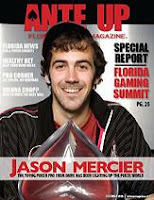
Ante Up! Magazine, December 2008 issueThe guys on Ante Up! continue to roll along, still managing not to have missed a single week since the podcast’s debut way back in the spring of 2005. They are now producing a magazine, too, which one can find in Florida cardrooms (or to which one can subscribe). The mag is somewhat oriented toward the Florida poker scene, although they also include less local items like interviews with pros and other features. The Ante Up! blog appears now to be solely devoted to Florida poker news, but the podcast remains directed toward a more general audience of poker enthusiasts.

Last week’s show (the 11/21/08 episode) featured the first of a two-part interview with the Mad Genius of Poker, Mike Caro. Now I know not everyone thinks Caro is the bee’s knees when it comes to poker strategy and advice, with some wanting to judge him harshly for his paltry tourney record. But one can’t deny his poker acumen, not to mention his importance to poker history and literature as a chief contributor to the original Super/System and author of hundreds of columns. He is also a pretty funny dude. Lotsa grins in this first part of the interview, and he even addresses that question about why he has so few tourney cashes.

Lou Krieger's Keep Flopping AcesAnother show worth your time is the most recent episode of Keep Flopping Aces, hosted by Lou Krieger. On last week’s show (11/20/08), Lou had Tim Lavalli, a.k.a. the Poker Shrink, a.k.a. winner of Event 1 of Run Good Challenge 2: Electric Boogaloo, on to discuss various items related to poker and psychology. Tim offered some terrific observations about tilt (a discussion that resonated with me a bit after that brief bout I had with tilt last week), as well as some specific responses to a couple of infamous episodes from the 2008 WSOP -- Scotty Nguyen’s behavior at the $50 H.O.R.S.E. final table & Phil Hellmuth’s end of day 5 outburst at Cristian Dragomir and penalty (subsequently rescinded) during the Main Event.

I was there at the Rio for both of those events, but witnessed neither of them first hand, having been working a different tourney during the H.O.R.S.E. final table and covering the outer tables on Day 5 of the Main Event. Tim, meanwhile, was right there watching both, and has some interesting insights into both the players’ psychology as well as some opinions about how the tournament directors handled (or mishandled) the situations. Lou and Tim also speculate a bit about plans for next summer’s WSOP, including talk of going to some sort of “yellow card/red card” system like is used in soccer.

Will Failla and Eugene Todd on PokerRoad RadioFinally, if you are looking for a genuine howler of a show you might go back and check out the 11/5/08 episode of PokerRoad Radio. This was their first show from the World Poker Finals at Foxwoods. I usually end up listening to most of the PokerRoad shows when they come out, although I’ve found myself sometimes skipping through some of the “game show”-like segments (e.g., “How Much Would It Take?”) if I’m pressed for time. Ali Nejad’s humor is usually hit-or-miss for me -- sometimes he genuinely cracks me up, though not always. However, I do think he’s particularly good with interviews, which is why I’ll occasionally skip ahead to the latter half of the show when the guests come on.

On that 11/5/08 show, Nejad, Joe Sebok, and Court Harrington had two guests on at once, Eugene Todd (bro) and Will “the Thrill” Failla. As anyone who has heard Todd on the show before can attest, the man is pretty friggin’ hilarious. Failla (also from New York) is equally funny (and foul-mouthed), and the pair play off each other to good effect during this interview. To give you an idea what the interview was like, on a subsequent show they reported that someone had emailed them that the “F-bomb” had been dropped something like 115 times during this particular episode. (Needless to say, don’t follow this here recommendation if yr among the easily offended.)

Anyhow, dial up the show and skip ahead to the interview which starts at about the 42-minute mark. Then, around the 49-minute mark comes one of the funniest damn hand recaps ever chronicled. Failla tells the story of a hand he played early in the Foxwoods tourney, a hand he simply was not going to lose. Trust me, you will not be able to listen to this without laughing. Easily one of the funniest things I’ve heard on a poker podcast since Beyond the Table or perhaps that appearance by Haralabos Voulgaris on The Circuit a couple of years ago.

Hope you enjoy these. Meanwhile, for you old time radio fans a tenth episode of The Hard-Boiled Poker Radio Show is in the works and should be appearing in the near future. Stay tuned!

Labels: , , ,

Monday, October 27, 2008

Fail Better

Try again. Fail again. Fail better.“Ever tried. Ever failed. No matter. Try again. Fail again. Fail better.”
--Samuel Beckett


Had a late one Friday, and so ended up hitting the hay relatively early Saturday evening. So I didn’t see what they pulled on Saturday Night Live this week (or how they managed without Amy Poehler who was having her baby). Nor was I able to keep up with B.J. Nemeth’s World Poker Tour updates of the next-to-last day of action at the Festa al Lago at the Bellagio.

I had been checking in most of the day. Some interesting names in the final dozen, including PokerRoad co-founder and PokerRoad Radio co-host Joe Sebok. Sebok had held the chip lead with ten players remaining when I signed off, and so I was a little surprised (and disappointed) to find out the next morning he’d hit the rail in ninth, missing yet another WPT final table.

I was one of those who started listening to the old Circuit shows back when Matusow was co-hosting them with Scott Huff. That show started way back in December 2005, and I think I first picked it up sometime during the spring of ’06. I remember hearing Sebok do some guest spots in there somewhere, then reading a couple of his pieces in Card Player for which he wrote a regular column from May 2005 to June 2006. Liked his humor and self-effacing wit right away, and have basically been keeping up with his audio adventures fairly closely ever since.

We’ve interacted a few times via email, but just in passing. Had a couple of chances to talk to him this summer at the WSOP, but it seemed like every time he showed up I was feverishly working a final table and thus unable to stop long enough to introduce myself. I’ll try harder next time. He’s definitely one of those dudes that strikes me as very good for poker, adding a great deal to a lot of folks’ enjoyment of the game via his podcasting efforts at what he’s managed to pull off thus far with the PokerRoad website.

Suffice it to say, I was pulling for the Cub to break through this weekend. So were a lot of folks, it seems.

Yesterday I listened to the 10/25 episode of PokerRoad Radio on which Sebok and his fellow co-hosts Ali Nejad, Gavin Smith, and Court Harrington discussed Sebok’s bustout, then for a change of pace they let Sebok take a turn as the guest and interviewed him. He talked about growing up the son of a poker legend (Barry Greenstein), his college days at Berkeley, his stint in the dotcom world, and some of his experiences prior to becoming a poker pro, such as a lengthy, months-long cross-country trip he embarked upon alone.

Throughout Sebok repeatedly talked about how important it is to him to challenge himself. The cross-country trip, for instance, represented a significant test from which he firmly believes he benefitted greatly. Have to admit I found myself identifying pretty strongly with some of the points Sebok was making. Hell, my decision to go out to Vegas last summer to help cover the WSOP for PokerNews was just such a challenge -- one I’m especially glad I accepted.

Near the end of the interview, Sebok talked a bit about why he played poker, and again brought up his primary motive to seek challenges. He especially likes giving himself “projects” (the PokerRoad website being an example). “To me poker is a project,” he added. “And it is a project that is ongoing.... I’m not trying to elicit sympathy, but I still consider myself a failure in poker, because I haven’t done any of these things that I still want to do.”

That reads a bit more desperate-sounding than Sebok intends, I’m sure. His reference to “failure” simply stands for the notion that, in his mind, when it comes to poker, work remains to be done. A frankly healthy attitude, I’d venture to say, whenever we’re talking about an endeavor for which one shouldn’t be too easily satisfied with one’s modest successes. (In other words, anything worth doing.)

Sebok’s co-hosts were quick to provide encouragement, and Smith shared what I thought was an interesting analogy to describe tournament poker. Sounded like the sort of thing that has likely been around for awhile, but I can’t remember hearing it before.

“Poker’s a funny thing,” said Smith. “You can feel like you’re not being successful, but poker is a lot like a hole-in-one.... It’s great to get it. [But] that’s not skill to get a hole-in-one. The skill in the hole-in-one is getting the ball close. It goes in? That’s where the luck comes in. And that’s the same in tournament poker, you know? The skill is knocking on the door and getting there, and eventually you’ll walk through.”

A little mixing of the metaphors there at the end, but you get the idea. Skill keeps you in the fairway and/or gets you on the green consistently, but to sink that tee shot on a par three certainly also requires a bit of luck. Doesn’t happen often, though it’s damn sweet when it does.

But then you have to tee it up again. And fail. Again.

Which is good. ‘Cos that’s how you know it was worth trying.

Labels: , , ,

Tuesday, May 20, 2008

Sartre’s Gambler (3 of 3)

Jean-Paul SartreIf you ever to listen to PokerRoad Radio, you’ve probably heard a clip of T.J. Cloutier from his appearance on PRR back in early March. They’ve been using it repeatedly as a bumper on all of their shows. The clip begins with co-host Ali Nejad asking Cloutier what advice he has for players who are running bad or “who feel snakebit.”

“I wake up every day with a new attitude,” Cloutier responds. “I’m not gonna worry about what happened yeseterday. I just go on to the next day.” Then he adds, “How can anybody who’s won about 11 million in poker and lost about 3 million in craps worry about what happened yesterday?”

That last question elicits laughter -- and a bit of sarcasm -- from the PokerRoad crew. It’s a very existentialist thing for Cloutier to say, actually. In fact, every time I hear that clip, it makes me think again about Sartre’s gambler.

By describing each day as a new one -- or, to say it differently, to distinguish between what one is or does today from what one was or has done previously -- is to regard the past as Sartre does, as an example of “nothingness” that Cloutier says he chooses not to draw upon as he endeavors to make meaning of the present.

Of course, it isn’t as though Cloutier is “reborn” each day. There’s obviously a lot that he has experienced during those previous thousands of days that does help him figure out what today means for him. But his “attitude” or philosophy is basically existentialist, at least in the way he puts it. And frankly, all poker players who have enjoyed long-term success almost without exception adopt a similar approach in the way they view and interpret the game.

As a way to close the discussion, let me refer to three examples of poker writers also evoking this very existentialist view of life in their discussions of poker.

One comes from one of my favorite passages in Small Stakes Hold ‘em by Ed Miller, David Sklansky, and Mason Malmuth, that short little section early on titled “Random and Independent Events.” After talking a bit about how the human brain has a remarkable capacity for seeking out and identifying patterns, the trio explain how easy it is at the poker table to make the error of seeing patterns where none exist. “When it comes to gambling,” they point out, “mistaking false patterns as real has led many to ruin.”

In particular, many sometimes falsely conclude that the cards dealt in one hand have something to do with what gets dealt in the next. The authors underscore the importance of avoiding such a fallacy by using italics: “The cards dealt on any poker hand are, for practical purposes, completely random and independent of the cards dealt on any previous hands.” Indeed, the cards are simply “existents,” or “pieces of plastic” with “no knowledge, no memory, no cosmic plan.” An obvious point, perhaps, but we’ve all made that mistake at one time or another. (He can’t have aces again, can he?)

The second passage I’ll quote comes from the first volume of Dan Harrington’s Harrington on Hold ’em. It’s a point he makes over and over again when talking us through sample hands, particularly when he is narrating one in which his player has made an error early in the hand, and now faces a new quandary later on. “Once you’re in a hand,” he explains, “every subsequent decision has to be determined by your hand, the pot odds, and the total table situation.” Like the authors of SSHE, Harrington brings in the italics to emphasize the point: “Every betting decision is a new problem. Don’t forget that.”

Finally, I’ll share something from Barry Tanenbaum’s epilogue to his terrific Advanced Limit Hold ’em Strategy (published last year). Tanenbaum is especially gifted at explaining poker-related concepts, and in fact a lot of them apply regardless of the game one is playing.

The epilogue is titled “Forgive Yourself” and there Tanenbaum stresses the importance of not brooding over yr screw-ups (which, for most of us, are inevitable) and instead focusing on the next hand. “A positive attitude is essential,” Tanenbaum argues, thus the need to avoid beating oneself up over that missed bet or incorrect fold. “The better you get at not dwelling on past mistakes other than to learn from them and move on,” says Tanenbaum, “the better your play will be.”

Sounds a lot like Cloutier. And Sartre, in a way . . . .

The point, I suppose, is to understand that as humans we necessarily allow a lot of stuff that isn’t really “there” -- a lot of “nothingness” -- to creep into our understanding of what is there, such as all the different “existents” (cards, chips, people) gathered around a poker table at any given moment. We take that “nothingness” (be it from memories of the past, or ideas of the future, or wherever) and make meaning of our present. We can’t help it. We’re human.

But as we do, we should try to recognize and avoid those circumstances when we might be tempted to make meaning and then apply it incorrectly (and thus go down that path that “has led many to ruin”), e.g., expecting the next hand to balance the previous one, allowing a preflop mistake to affect unduly a post-flop decision, letting a bad session affect our play in the next one, and so forth.

All important to keep in mind, I would think. I just hope I remember it tomorrow.

Labels: , , , , , , ,

Thursday, March 27, 2008

Numbers & Psychology

The Crazy BetLots of news these days about the current mortgage crisis. Heard yet another story on NPR’s Morning Edition today about it, after which came a interesting little report about a recent study conducted by a couple of Cornell University researchers concerning the attitudes of prospective home buyers.

The study looked into how home buyers tend to respond to asking prices. Specifically, the researchers wanted to figure out whether or not it mattered to buyers if the price was listed as a rounded-off figure -- say $680,000 -- or a non-rounded off figure like $682,417.

After conducting some tests, the researchers concluded that buyers have what they describe as a “built-in bias in favor of precise numbers.” (They kept referring to non-rounded-off numbers as “precise” in the report, although I think one could argue the term is not necessarily being used accurately here.) That is to say, the buyers were more likely to view a rounded-off number as higher, and thus were more inclined to buy the home with a non-rounded off price tag.

In their conclusion, the researchers decided this bias in favor of non-rounded-off prices is a vestige of our retail shopping experience. When we shop at the local hardware store and see an item priced at $9.02, we instinctively assume the price reflects some sort of savings to the consumer. Therefore, as the reporter explained, “when people see houses with precise numbers, somewhere in the back of their minds they think ‘discount shopping.’”

The segment concluded with a representative from a New York real estate company expressing skepticism about the researchers’ findings. According to her way of thinking, a non-rounded-off price tag wouldn’t necessarily be met with enthusiasm by some buyers. Indeed, the odd-looking figure might give the buyer pause since, as she put it, the price “would seem a little strange.”

You can probably guess where I’m headed here. This is a poker blog, after all.

Just so happened that right after I heard the NPR story I got out the iPod-like device and listened to the March 25th episode of PokerRoad Radio (with Brandon Cantu). At one point about halfway through the show, the hosts engaged in a brief digression concerning bet amounts. Gavin Smith talked about how he had been experimenting with differently-sized raises during the first day of the WPT World Poker Challenge, betting 225, then 275, etc.

That led Joe Sebok to make a comment about players online betting strange-looking amounts like 2,222 and how it makes him “want to go through [his] machine and punch them in the face.” Ali Nejad suggested that response was precisely why people make such odd-looking bets -- it puts opponents on tilt. (Sebok denied the bets actually affected his game.) “We’re anal. We want round numbers,” argued Nejad. Thus do some of us object when the bets come out all weird-looking.

With regard to that idea that we “want” round numbers, the Cornell researchers did point out how the non-rounded-off numbers “momentarily confuse” consumers, and while they surmised home buyers ultimately overcame that confusion to conclude the prices were favorable, the N.Y. real estate company rep suggested that confusion produced a different consequence, perhaps even turning off the prospective buyer.

We’ve all encountered that rogue at the poker table who keeps betting weird, hard-to-explain amounts. The bets usually come as the first raise on a given round, e.g., it is preflop, the blinds are 50/100, and someone open bets 333 or something. Such a bet certainly can “momentarily confuse” the table. Such a bet can also give the bettor a crazy-seeming image (possibly part of the plan).

Additionally, the non-rounded-off bet might be said to produce a practical consequence, namely, it makes it more difficult (for most of us) subsequently to calculate pot odds. Have talked more than once this week about my own struggles to calculate on the fly my “equity” in a given hand. Such problems can be even harder to solve when we ain’t dealin’ with easy-to-manage, round numbers.

In any event, I think I share the N.Y. real estate rep’s skepticism about the Cornell researchers’ conclusions. I don’t think the non-rounded-off price tag encourages buyers all that much.

I know it doesn’t work that way at the poker table, anyway.

Labels: , , ,

Tuesday, March 04, 2008

On the Poker Haters

On the Poker HatersWas thinking a bit about why so many folks find poker such an objectionable activity. Probably because I heard the fellows over on PokerRoad Radio talking about the issue over the weekend (on the 3/1 episode).

In a brief “Poker News” segment they mentioned how Barney Frank had managed to secure a 46th co-sponsor to sign on to his Internet Gambling Regulation and Enforcement Act (H.R. 2046). I’d heard that last week. Incidentally, I’m not sure why Julia Carson’s name continues to appear on the list of co-sponsors (She died in December.) I suppose the deceased still count as co-sponsors (?).

Anyhow, co-hosts Joe Sebok, Gavin Smith, and Ali Nejad mentioned that bit of news, then goofed around a little while, trying unsuccessfully to determine just how many individuals actually comprise the House of Representatives. Such information would be helpful when trying to determine whether 47 supporters of the IGREA (including Frank) signified a meaningful number. (Answer below.)

Then they briefly lamented the UIGEA, the general prejudice against gambling, and the particular demonization of poker. Sebok pointed out how a segment of society believes “gambling -- it’s evil, it’s wrong.” Gavin Smith brought up the old bingo argument, asking why bingo is okay when poker is not. “Because it’s socially acceptable,” answered Sebok.

What makes poker socially unacceptable for so many? There are probably other explanations, but off the top of my head I came up with three different reasons why. Incidentally, all three arguments assume poker is gambling (a view with which I don’t happen to disagree), although all three also minimize or altogether fail to acknowledge poker’s skill component (a view with which I take issue).

The first objection comes from those who believe playing poker indicates the possibility of some kind of psychological disorder -- a symptom, perhaps, of a serious malady in need of correction. Those who make this objection tend not to distinguish between poker and other forms of gambling. I’ve written about this idea before in a post where I talked about mentioning to a co-worker that I played poker and his response was to ask if I thought I could develop a gambling problem. In the documentary No Limit: A Search for the American Dream on the Poker Tournament Trail, Mike Sexton says he believes “gambling is inherent in our blood.” Those who believe the person who gambles is exhibiting a psychological disorder may in fact agree with Sexton; the difference, though, is that while Sexton accepts this condition as a part of who we are, those others believe it a flaw that needs to be rectified.

The second objection is the moral one -- that poker playing is an example of an activity that fails to conform to societal codes of conduct. This objection also frequently is made with regard to other forms of gambling, although as Sebok suggests, one is more likely to see it directed toward poker than toward bingo or the lottery. There are various factors potentially in play here (including faith/religion), but it is the law -- the most patent influence on our notions of “codes of conduct” -- that has the most relevance in this context. Whereas poker is legal in certain places and under certain conditions, other forms of gambling enjoy a great deal more legal sanctioning, thereby causing them to be viewed as conforming to society’s mores -- to be morally unobjectionable.

The third objection is the ethical one, and I think this is the one that more often applies to poker than to other forms of gambling. With ethics we start talking more particularly about “good” and “bad” conduct. There are some who view all forms of gambling as “bad” because of the potential for it to cause harm to those who gamble and to others. Then there are those who especially object to poker because of how the game is played. To succeed, we must take money from other poker players; thus is our welfare dependent on others’ suffering (in a sense). Unlike the lottery or other games where we all play against the house (a faceless, unsympathetic foe), poker pits us against one another, encouraging what some believe to be “bad” forms of treating one another. An irony: that which we poker players might say makes poker more of a skill game than other forms of gambling -- the fact that we are competing against others, and not solely subjecting ourselves to chance -- is precisely that which some say makes poker ethically dubious.

By the way, there are 435 members of the House, meaning at the moment Frank still needs another 171 of the remaining 388 Congressmen and women to come along to have a majority. A long, long way to go . . . .

And, to be realistic, I gotta believe most of those remaining 388 are gonna be held back from supporting the IGREA by one or more of these objections. Don’t you?

Labels: , , , , , , ,


Older Posts

Copyright © 2006-2021 Hard-Boiled Poker.
All Rights Reserved.