Wednesday, April 30, 2014

Live and Learn

A busy Wednesday has already almost gotten away from me. I’d wanted today to write something here about this story of yet another U.S.-facing “rogue” online poker operator embarking on a dubious strategy for survivng in a mostly desperate marketplace. I’m referring to the Equity Poker Network apparently closing accounts of so-called “aggressive” players -- that is, winning players who put in lots of volume. You can read more about it over at pokerfuse.

Seems like there is some kind of symbolism worth teasing out of the story, one showing how an online poker network that can only serve U.S. customers by not allowing winning players to remain among the player pool is itself emblematic of online poker’s current status in the U.S. -- i.e., it’s a “loser’s game.”

Kind of a downer proclamation to make on this, the one-year anniversary of legal, regulated online poker’s introduction into the U.S. (Ultimate Poker debuted in Nevada one year ago today.) So rather than pursue that topic further I’m instead going to point you to a cool series of articles by Carlos Welch over on Learn.PokerNews which he’s dubbed “Cash Catastrophes.”

Carlos is writing articles about hands from his home game in which he’s made what he deems mistakes that have cost him money (hence the series title). All four of the articles illustrate situations that are familiar and have caused me to recall decisions with which I myself have struggled.

Here are the four “Cash Catastrophes” Carlos has shared thus far, the titles of which give an indication of the dilemma being faced in each:

  • Out of Position and Out of Ideas
  • Folding Aces Leads to Paranoia
  • Missing Value With the Nuts
  • Hero-Calling Unexpected River Bets
  • I appreciate Carlos’s willingness to share his missteps. It’s hard sometimes even to look into one’s own play and acknowledge to oneself mistakes made, never mind share them with an audience as he is doing. But doing so is obviously helpful all around.

    Of course, if you aren’t interested in working on improving your game, apparently there’s an online poker network that is built just for you!

    Labels: , , , ,

    Tuesday, April 29, 2014

    A High Roller in the Family

    Had a couple of people draw my attention to an article in The New York Times Magazine from over the weekend written by PokerStars’ Team Online member Isaac Haxton’s father, Brooks Haxton, titled “Playing the Cards.” It’s an interesting article, kind of pointing out a familiar lesson regarding poker in a different way.

    The piece begins with Haxton telling the story of he and his wife discovering just a year ago that Isaac was playing for hundreds of thousands of dollars online. We don’t get the full context and I think can probably assume the parents knew all about Isaac’s profession and that he played for significant sums, but it sounds like they hadn’t known before that point that he was playing for quite so much.

    In any case, Haxton immediately relates the circumstance of his son’s tolerance for mega-swings and high-stakes risk and reward to a very difficult decision he and his wife had to make regarding Isaac’s health shortly after his birth. I won’t rehearse all of the details, but it was literally a life-or-death situation, and while Isaac survived in good health, the parents came away having learned something important about risk-taking, “play[ing] the cards as they were dealt,” and also getting lucky.

    This experience in turn appears to help Haxton understand both his son’s special skill set and what it means to face risk and make decisions logically and under pressure. It’s an interesting twist on a somewhat familiar idea that poker can teach us about decision-making away from the tables -- in this case, it was a non-poker experience that appears to help the elder Haxton understand poker (and poker players).

    I’d seen the piece even before people drew my attention to it in part because Isaac had tweeted about it while also letting his followers know that his dad has written a memoir that appears as though it is concentrated largely on his son’s poker playing. The book is called Fading Hearts on the River: A Life in High-Stakes Poker and is due out next month.

    Isaac is a thoughtful guy -- and great, of course, in the commentary booth, as we heard him today on the EPTLive stream from the Grand Final. The profile done by Ryan Firpo and the 918 Films crew is a good one (that is a still from it up top), and adds further to our understanding of why he such a talent at the tables. (It also includes that awesome reraise-shove on the river with 3-high from the PokerStars Caribbean Adventure from way back in 2007 when we were all first introduced to Haxton, then looking like Joey Ramone.)

    His dad seems pretty thoughtful, too, making me look forward to reading his book once it hits the shelves. And perhaps by doing so learning still more about poker and poker players.

    By the way, that photo at the bottom (click to enlarge), is of Haxton checking the payouts at the final table of Event No. 2 of the 2009 World Series of Poker, the $40,000 “40th Annual” No-Limit Hold’em event in which he’d eventually finish runner-up to Vitaly Lunkin. I believe B.J. Nemeth was the one who snapped it (perhaps he remembers).

    Labels: , , , ,

    Monday, April 28, 2014

    What’s Four Plus Four?

    Had a terrific weekend here on the farm as we had another family visit, this time hosting Vera’s mom, sister, and our five-year-old nephew for a couple of nights. It was their first visit since we moved here at the start of the year, and we all had a ton of fun.

    It was especially cool to introduce our young nephew to Sammy (pictured) and Maggie, our horses. He was fascinated -- riveted, even, while watching Vera ride.

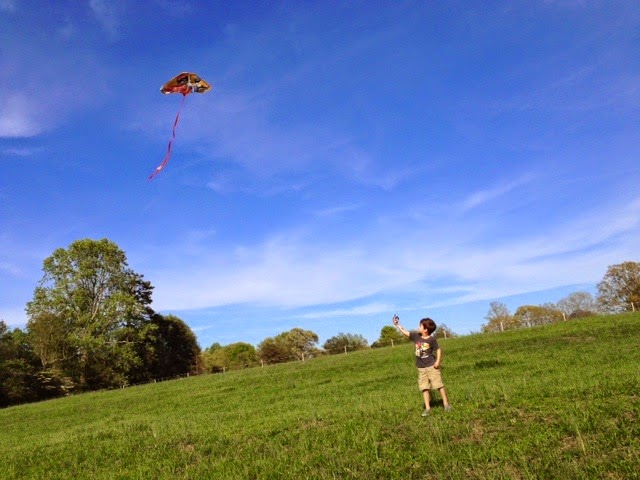
    Such was one of several highlights of a weekend that included playing lots of War, flying kites, playing putt-putt on the back deck, goofing around in the riding arena (a.k.a. the world’s largest sandbox), sitting on the tractor, playing with the barn cats, playing in the creek, enjoying “the best spaghetti ever,” and lying on our backs outside to look at the stars.

    My nephew has his own iPhone, and we actually played War on an app that lets two players play via connected devices. He’d run into the next room while we played, and cried out either with glee when winning or with consernation when losing.

    “I looove kings, Unca Martin,” he declared during a post-game analysis of our play. Then after thinking for a moment, he had an addendum to add.

    “But I love aces better.”

    Kid’s got starting hand selection down. Needs to learn more about handling variance, though.

    At one point my nephew got caught up in one of those cycles into which five-year-olds sometimes successfully trap older relatives, asking a series of addition questions that proved difficult to avoid answering.

    “What’s one plus one?” he’d ask. “Two,” I’d say. “What’s two plus two?” “Four.” “What’s four plus four?”

    And so on. That sequence would end shortly thereafter, only to be followed by another.

    “What’s one hundred plus one hundred?” he’d ask, eyes wide. "Two hundred,” I’d say. “What’s one hundred plus one hundred plus one hundred?” he’d counter. “Three hundred.” “What’s one hundred plus one hundred plus one hundred plus one hundred?”

    And so on. We’d get up to about 1,600 before we both would lose track. Then a half-hour later -- just when I thought he’d finally dropped the subject altogether -- he’d circle back around to his earlier line of questioning.

    “What’s one hundred plus one hundred?”

    Speaking of precocious youngsters -- and things that go on and on and count into the many hundreds -- the blog turns eight years old today. Actually I remember a couple of years ago someone telling me that “six is like a hundred in blog years,” so it’s probably better to think of Hard-Boiled Poker as by now more senior citizen than elementary schooler.

    While other projects -- the management of the farm being one -- have begun to crowd in on my time, I’m still motivated to continue this sucker. I see my nephew doggedly continue with something well beyond what seems an appropriate length of time for a given pursuit, and can’t help but think we’ve got something in common.

    So I’ll keep on running, and thus keep this thing flying. Thanks again, everyone, for looking in.

    Labels: , , ,

    Friday, April 25, 2014

    More On Victoria’s Victory (for Poker)

    In a hurry today and so just wanted to take today’s post to point you over to something else to read, an article in The Guardian penned by my friend and colleague Chris Hall, a.k.a. “Homer” with whom I’ve worked reporting on various events over the last few years.

    Following Victoria Coren Mitchell’s big win last weekend at Sanremo to claim her second European Poker Tour Main Event title -- the only player ever to do so -- Chris picks up one of many threads resulting from her win in “Poker has been dealt the right cards for a female-based boom.”

    Chris spends the first part of the article noting how most often mainstream news about poker -- especially over recent years -- has been of the negative variety, thus making the story of Coren Mitchell’s triumph contrast sharply.

    He then spends a few paragraphs sharing other reasons why “this card game of skill and temperament” has much more to offer than might be suggested by such negative press before concluding with some speculation about how Coren Mitchell’s win might well encourage more women to play.

    It sounds like from Chris’s tweets today that there was more to his piece, including further discussion of women in poker, but the editor -- as editors will do -- had to trim it back. In any event, the article still does a nice job presenting the game to a wider audience while promoting poker in a reasoned, convincing way.

    So click through and give it a read. And if you do let me know if you see any puns in there... I’m not, and knowing Chris, I’m having to guess those must’ve gotten cut, too.

    (Pic above from EPT Sanremo via PokerNews.)

    Labels: , , , ,

    Thursday, April 24, 2014

    The Crowded Calendar

    As has become traditional for the European Poker Tour, its season is ending with two stops coming in close succession at Sanremo, Italy then just over the border in Monaco (about an hour’s drive away, I believe). This is the seventh straight year the EPT has done it that way, in fact, ending its season with those two stops with only a few days off in between. Many tourney pros arrange their plans to play both stops, taking advantage of the convenience.

    Was writing a couple of days ago about the World Poker Tour’s season-ending WPT World Championship also happening at the Borgata right now. Looking back through the ten seasons of the EPT, this is the first time such a conflict has arisen between the two tours’ finales. There were a few years when the WPT’s last event started just a day or two after the EPT Grand Final had ended, but never have they overlapped. (The WPT World Championship final table comes this Saturday, also Day 1a for the EPT’s Main Event.)

    While the dates are such that players could play at Sanremo then fly over to Atlantic City, or play and bust the WPT and get to Monaco, the overlapping of the schedule makes it tricky to do so. Thus many are choosing one or the other, either taking part in the conclusion of the EPT’s Season 10 or the conclusion of the WPT’s Season XII.

    Speaking of conflicts, yesterday the European Poker Tour its preliminary Season 11 schedule, with a return to London coming October 8-18 of this year. The World Series of Poker also yesterday announced dates for the WSOP Asia Pacific series, with 10 bracelet events coming this time around. Dates for the 2014 WSOP APAC are October 2-18, meaning an overlap with EPT London with the Main Events of both happening just about concurrently.

    A few players complained today about having to choose between the EPT and the WSOP APAC this fall. Made me think a little about my own often busy schedule and how as a freelancer I’m forced sometimes to make choices, having occasionally to pass on opportunities because of conflicts. Indeed, this summer is starting to shape up a little differently than past summers for your humble scribbler, with the additional obligations of farm living adding a wrinkle to the usual plan (more to come on that).

    Some of the chatter today focused on the different tours needing to coordinate so as to avoid the overlaps, although I know the factors affecting all of them are inordinately complicated, thus making it a lot easier said than done when it comes to picking and choosing among available dates for particular venues.

    In any event, a calendar so packed with tourneys all over does further prove the undying popularity of tournament poker. And the likelihood of still more conflicts to come.

    Labels: , , , , ,

    Wednesday, April 23, 2014

    The 2,170-Player Chop

    Spent a short while today finally taking some time to read about the resolution of the Borgata brouhaha from January. As you’ll recall, the first event of the 2014 Borgata Winter Open was canceled with 27 players remaining thanks to allegations of cheating committed by one player, Christian Lusardi, by means of introducing counterfeit chips into the event.

    Have to use that word “resolution” tentatively, I suppose, as it seems like there will be more to come from this one, namely potential lawsuits filed by unsatisified players. In any event, about 10 days ago the New Jersey Department of Gaming Enforcement released its “Final Order” directing the Borgata how to distribute both the $1,433,145 in prize money that had yet to be won in the tournament (i.e., the total of the prizes scheduled to go to the top 27 finishers) as well as $288,720 more in revenue the Borgata had collected from entrants.

    That adds up to $1,721,805 total. Somewhat surprisingly, the DGE decided not just to award money to the final 27, but also to refund $560 entry fees to 2,143 other players “who may have been impaced by the alleged criminal conduct who were eliminated from the event” without cashing.

    The refunds to eliminated players total just over $1.2 million, leaving about $521K for the final 27. The DGE directed the Borgata to distribute that money “in equal amounts of approximately $19,323 to each of the 27 entrants” who still were alive in the event at the moment it was canceled. The Borgata also issued a statement reiterating the DGE’s directive and making known its intention to comply.

    Many have been critical of such a “resolution,” in particular pointing out how the final 27 players, otherwise due to play for over $1.43 million, together came away with just over a third of that total.

    Today I listened to respected Tournament Director Matt Savage (not the TD at the Borgata) on the latest Two Plus Two Pokercast explaining why he found the resolution unsatisfactory and also troubling in terms of how it might affect tournament poker going forward. Savage’s point was that given such a resolution, players aware of cheating in future tournaments may well become reluctant to make their awareness known to tournament officials out of fear that they may themselves lose potential winnings should the tournament be canceled.

    I said back in January that there didn’t seem to me any wholly satisfactory way to resolve the situation that would prove satisfying to all concerned, but it does seem as though there were several different ways it might have been resolved that would have been preferable to the one chosen. And as Mike Johnson and Adam Schwartz pointed out on the Pokercast, of all the possible scenarios imagined by both players and observers prior to the DGE’s order, few (none?) ever considered the possibility that nearly two-thirds of the unawarded prize money would not only not go to the players still alive in the event (and due to divide it up), but would go to eliminated players instead.

    Anyhow, for more on the “Final Order” and what it lacks, check out Savage on the Two Plus Two Pokercast (he appears during the first hour) as well as Haley Hintze’s discussion over on Flushdraw.

    Labels: , , , , , , ,

    Tuesday, April 22, 2014

    Following the WPT Finale

    Been kind of wandering in and out of the live updates this afternoon from Day 1b of the WPT World Championship at the Borgata, both on the WPT site and over at PokerNews. (Photo from PN.)

    Culminating Season XII of the tour, the World Championship made a big move away from the Bellagio this year following several years’ worth of declining entries and prize pools for the tour’s signature event. Here’s how the tournament -- which had been a $25K event for the first 11 seasons -- grew and shrunk over that period (with winners and first prizes noted):

  • Season I (2003): 111 entries (Alan Goehring, $1,011,886)
  • Season II (2004): 343 (Martin De Knijff, $2,728,356)
  • Season III (2005): 453 (Tuan Le, $2,856,150)
  • Season IV (2006): 605 (Joe Bartholdi, $3,760,165)
  • Season V (2007): 639 (Carlos Mortensen, $3,970,415)
  • Season VI (2008): 545 (David Chiu, $3,389,140)
  • Season VII (2009): 338 (Yevgeniy Timoshenko, $2,143,655)
  • Season VIII (2010): 195 (David Williams, $1,530,537)
  • Season IX (2011): 220 (Scott Seiver, $1,618,344)
  • Season X (2012): 152 (Marvin Rettenmeier, $1,196,858)
  • Season XI (2013): 146 (Chino Rheem, $1,150,279)
  • Wrote something here last May about that trend, then another post in September following the announcement that this year’s finale would play out in Atlantic City rather than Las Vegas.

    Just like those first prizes listed above, the total prize pools went up and then back down in the WPT World Championships during those first 11 years, too, with last year’s total of $3,540,500 marking the lowest for the tourney since Season I’s $2,691,750. It peaked in Season V with a mind-boggling $15,495,750 prize pool.

    Besides moving to the Borgata, this year’s tourney also sports a lowered $15,000+$400 buy-in. Also, as has been the case in recent years, re-entry is an option for players, with one re-entry allowed today for those who busted on Day 1a.

    They set a $5 million guarantee on this year’s WPT World Championship, and while yesterday’s modest turnout of 105 players for Day 1a led some to think that mark wouldn’t be hit today, a bigger field for today’s Day 1b has brought the total up to 318 with a couple more levels’ worth of late registration still available. They are still therefore a few away from hitting the guarantee and may miss it -- in any event, they’ll certainly be close.

    There was a little bit of debate today on Twitter comparing the WPT World Championship with the recently finished Seminole Hard Rock Poker Showdown in Florida, a $3,500 buy-in event that also had a $5 million guarantee. With three Day 1 flights and re-entries allowed (with “best stack forward” an option, too), that one drew 1,795 total entries to make a prize pool of $5,788,875 with the Canadian Eric Afriat winning to claim a $1,081,184 first prize.

    The two events seem fairly different and hard to compare, although both did draw lots of big names and as happened at the Seminole Hard Rock, this week’s WPT World Championship will almost assuredly feature well known players at its final table.

    The WPT generally speaking and its World Championship in particular still carry a little extra prestige that distinguishes this week’s tourney from the one in Florida, too. That said, the last couple of EPT stops bookending it -- Sanremo finished Sunday, the Grand Final in Monaco starts Saturday -- reminds us how EPT titles are now probably just as coveted if not more.

    Labels: , ,

    Monday, April 21, 2014

    Queen Victoria!

    Was simply a terrific day here on the farm yesterday where Vera and I hosted family for an Easter meal and a very relaxing time amid perfect spring weather.

    Would eventually turn on NBA playoff basketball to watch my Bobcats play their first playoff game in several years, hanging tough for two-and-a-half quarters before fading versus the Miami Heat. Charlotte’s a huge underdog, obviously, even to take a game off the defending champs. And speaking of pulling for underdogs, like a lot of you I followed closely the delayed online stream of the final table at EPT Sanremo, enjoying watching Victoria Coren Mitchell’s come-from-behind win to grab the title (photo by Danny Maxwell for PokerNews).

    Coren Mitchell had begun the penultimate day of play 16th of 16 in chips on Saturday, then managed to squeak into yesterday’s final table still on the short side and in fact eighth of the remaining eight to start play. Thus did it seem reasonable to think she probably wouldn’t be getting too much further. Even she consistently downplayed her prospects pretty much the whole way this weekend, demonstrating what Rick Dacey on the PokerStars blog styled “the power of positive pessimism.”

    She didn’t really begin to build a stack, either, until after there had been a few eliminations, then took the lead with three left after a hand in which both she and start-of-day chip leader Jordan Westmorland flopped trip tens, but she had him outkicked.

    That hand saw Coren Mitchell having to call a Westmorland river shove after having led out, a call that had to be made but was nonetheless still difficult. And while she’d been dealt some good cards in that hand as well as in the final one in which she flopped two pair with Q-J to crack runner-up Giacomo Fundaro’s pocket aces, she also made some good decisions and savvy plays throughout the final table.

    Today on Learn.PokerNews Nate Meyvis talks about one small hand from early on that showed Coren Mitchell playing smartly postflop. There were other good hands for her, too -- including an inspired four-bet from the hijack seat at seven-handed when she was holding 7c5h after Fundaro had defended his small blind with a reraise (and happened only to have had 10d2h).

    So because of the chip situation for much of the last couple of days, her winning was unexpected. Also the fact that the EPT had gone 97 tournaments and nearly 10 full seasons without having a two-time Main Event winner (!) made the prospect of it actually happening this weekend with Coren Mitchell seem all the more unlikely to occur.

    It had become a running gag of sorts with the PokerStars bloggers who have been more or less obligated to trot out each EPT over the last several years the fact that no one had won the sucker twice. As every Main Event wound down to the last couple of days, if there were a former champ around in the field notice had to be given regarding the “streak” and the prospects for it finally ending.

    I’ve written here before on several occasions about Coren Mitchell. She’s been a prominent presence on the poker scene for more than a decade now.

    She was a participant during Season Two of Late Night Poker back in 2000, the popular U.K. show about which we recently ran a three-part history by one of the show’s creators, Nick Szeremeta, over on Learn.PokerNews. She then took a turn as a commentator on the show with Jesse May during the show’s third season.

    It was at EPT London during Season 3 that she won her first Main Event title back in 2006, becoming the first woman to win an EPT. She’d join Team PokerStars soon after, then in early 2010 her excellent “poker memoir” appeared, For Richer, For Poorer: A Love Affair With Poker, a book I continue to recommend to anyone looking for interesting (and sometimes laugh-out-loud-funny) nonfiction poker writing.

    I reviewed For Richer, For Poorer for Betfair Poker when it first appeared (here, too), then interviewed the author as well. Among my questions for her was one about the book’s title, an obvious allusion to marriage and the wedding vows.

    “Well, poker is not a job for me (I enjoy it too much) and it’s not a hobby (I devote too much time to it),” she answered. “It's a way of life; I have embraced a life. In that sense, it’s like a marriage -- or like a marriage should be. For better for worse, for richer for poorer, in sickness and in health, poker and I are together for the long haul. I might kick against it sometimes, it might annoy me, I might hate it, but deep down I will love it for ever and I never plan to say goodbye. If I ever get married, I hope I’ll feel the same way about my unlucky groom.”

    Of course, she would get married in November 2012 to the actor and comedian David Mitchell who is probably best known for his role on the British show Peep Show where he stars with his comedy partner Robert Webb (one of several hilarious productions with which Mitchell has been involved). Meanwhile Coren Mitchell has an especially large following of non-poker people in the U.K. thanks to her weekly columns in The Observer and The Guardian and her co-hosting of the popular quiz show Only Connect.

    The mainstream press across the pond have already been trumpeting Coren Mitchell’s win loudly, encouraging some to whisper about another “boom” of sorts for British poker perhaps being a consequence of her win yesterday. And as often happens when women win big tourneys -- no longer as great a rarity as back in 2006, although still noteworthy especially given the disproportionate number of women who play big buy-in events versus men -- that, too, won’t hurt going forward when it comes to promoting the game and getting women interested in poker.

    Of course, as even just that quote above suggests (I think), Coren Mitchell is a tremendous ambassador for poker, not just because of her mainstream connections and celebrity but also because she’s great at explaining why the game is both fun and worthwhile, especially to newcomers. “Queen Victoria!” tweeted a few following her win yesterday, a title she’s earned not just for having beaten the other 97 EPT Main Event champs to two-time-champ status but for her already-established position as an influential promoter of the game.

    Lots of reasons, then, why her win yesterday should rightly be considered “good for poker” (in the general sense). Inspiring, too, for those of us who like to write about poker, and who like her have a great enough love for poker and the endless stories and characters it can produce that it has become more than just a hobby but a “a way of life.”

    There are a lot of us who thanks to that love of the game are in poker “for the long haul.” It’s fun, then, to see someone else who is as dedicated to our favorite game and who does well describing what’s so good about it do well.

    Labels: , , , , , , ,

    Friday, April 18, 2014

    Tanks for Nothing

    Was watching a lot of the EPTLive coverage today from Sanremo as the Main Event played down to just 16 players. Lot of big names in there, including Victoria Coren Mitchell who is short-stacked but the only one left with a chance to break the decade-long streak of no double-EPT winners ever.

    The EPTLive shows are terrific in my estimation, with James Hartigan and Joe Stapleton always entertaining. I like hearing Marc Convey and the PokerStars bloggers on there, too, as well as the players they recruit to come do commentary. Very easy to get locked in when watching and not want to turn away, especially as the tourneys wind down toward the latter stages.

    There was one small hand early in the day on the TV table this afternoon involving Dinesh Alt (who eventually went out in 25th place) and Raul Mestre (who survived and is second in chips overnight). Not at all a remarkable hand, but on the turn Alt tanked for nearly two minutes before folding, during which time Hartigan and Stapleton eventually had to fill the space by talking about the length of time he was taking to act -- not just on that hand, but generally.

    A little later I clicked over to the High Roller updates on PokerNews and noticed a hand reported involving Davidi Kitai and Jonathan Duhamel in which Kitai apparently spent more than 10 minutes making a river decision before folding and showing he’d had a strong hand with trip aces on a board with no flush and only one unlikely-looking straight possible. The pre-river action wasn’t described and it looked like a legitimately difficult decision, but that’s still a lot of time.

    There’s much talk these days about tanking and players taking inordinate time to make decisions, with that “shot clock” idea continuing to get kicked around with varying degrees of seriousness.

    As I was watching the Alt-Mestre hand, I realized that I actually like the way the pace of poker will alternate between fast and slow. Sure, I get impatient as the next guy when at the table. Even when reporting sometimes I dread those hands with super-long tanks that end with anticlimactic folds and therefore (occasionally) a page full of scribbles that aren’t necessarily even worth reporting.

    I’ve mentioned before here how I’m no fan of the shot clock idea in poker, and I think one other reason why I don’t like it would be the way it would eliminate this variety in the pacing of the game, which adds a kind of unpredictability to it that makes it more enjoyable to follow.

    All things considered, then, I don’t mind the tanks. I also like Stapes’s jokes during the long wait for a player to act.

    (So who couldn’t read that post title without thinking about Caddyshack?)

    Labels: , , , , ,

    Thursday, April 17, 2014

    The New Frontier and the Bay of Pigs

    This morning I was up early feeding and taking care of barn business, and entirely at random dialed up an old Mort Sahl LP, one of about a half-dozen on my iPod -- The New Frontier (1961). I mentioned getting into these records a while back as part of one of the detours I’ve found myself going down with these Nixon studies in which I’ve been engaged.

    Like pretty much all of Sahl’s records, I believe, this one is recorded live and captures a single performance, in this case at “the hungry i” nightclub in San Francisco where Sahl frequently performed.

    “Here we are on the new frontier,” Sahl opens, getting a chuckle as he pauses afterwards. “Cuba,” he continues, and gets a bigger laugh.

    The “new frontier” of course referred to John F. Kennedy’s administration, then only a few months old, and the ambitious goals and “vigah” (as JFK would say) characterizing it. Kennedy first used the phrase when accepting the Democratic party’s nomination for president in July 1960 where he spoke of “a new frontier -- the frontier of the 1960s -- a frontier of unknown opportunities and perils, a frontier of unfulfilled hopes and threats.”

    That same speech finds Kennedy characterizing his Republican counterpart Nixon as an unworthy successor to Eisenhower, and in fact Kennedy employs a poker reference during that section of his speech that also evokes domestic programs of the most recent Democratic presidents, Franklin D. Roosevelt and Harry Truman.

    “We know that it will not be easy to campaign against a man who has spoken or voted on every known side of every known issue,” says JFK of Tricky Dick. “Mr. Nixon may feel it is his turn now, after the New Deal and the Fair Deal -- but before he deals, someone had better cut the cards.”

    Getting back to Sahl, his cynical reapplication of the “new frontier” idea to Cuba refers to the volatile climate then present in the spring of 1961 and the U.S.’s perception of the danger posed by the Fidel Castro-led Communist country located about 90 miles off the shore of Florida.

    Just a little later, Sahl expresses that cynicism again when he jokingly speaks of being in Florida and residents there telling him “he’s a real threat, Castro, because you can see the island.” “I used to look and I’d say ‘Well, I still can’t see it.’ And they’d say, ‘Well, it’s right behind that aircraft carrier.’” That line gets a big laugh, too.

    Sahl also refers at the very start of the record to the Academy Awards taking place the night of his show. That got me curious to look up when exactly that might have been, and it just so happens today is the anniversary -- April 17, 1961 -- kind of a weird coincidence. Then I realized that today is also the anniversary of the start of the Bay of Pigs, the failed attempt to overthrow the Castro regime that marked a major early misstep by Kennedy.

    “The invasion of Cuba is on,” says Sahl, referring to the news of that very day. Still early, it’s clear from the way he speaks of it that the American public isn’t yet aware of what exactly is happening.

    Sahl mentions as well a speech given that afternoon by former presidential candidate and newly-appointed U.N. Ambassador Adlai Stevenson in which Stevenson declared there was no U.S. involvement in the invasion. In the speech, Stevenson -- who lost presidential elections twice to Eisenhower in 1952 and 1956 -- is essentially repeating a CIA cover story that the Cuban exiles leading the invasion were rebels operating on their own and with no U.S. help.

    “He said that Castro can look to our government for help if he’s been rejected by his own people,” says Sahl, paraphrasing from Stevenson’s speech of that day. “And uh... Stevenson should know.” (About such rejection, that is.)

    It wouldn’t be long before the invasion would fail and Kennedy would own up to the involvement of the U.S. in the plot just a few days later (on April 21). Thus was Stevenson made to look especially bad for his claim that afternoon, and in fact would consider resigning his position though was eventually encouraged to stay on. And, of course, Kennedy and his administration would take a big hit, too.

    The Bay of Pigs would set the stage for the Cuban Missile Crisis that took place about a year-and-a-half later, a historical event that we discuss in my “Poker in American Film and Culture” class thanks to its frequent comparison to a poker hand full of bluffs and re-bluffs between Kennedy and Nikita Khrushchev.

    Anyhow, just wanted to share that weird coincidence of having dialed up Sahl’s record on the anniversary of it having been recorded. Here is that opening to Sahl’s The New Frontier, if you’re curious to hear it yourself:

    Labels: , , , , , , , ,

    Newer Posts
    Older Posts

    Copyright © 2006-2021 Hard-Boiled Poker.
    All Rights Reserved.