Saturday, May 26, 2007

Crawling Toward the WSOP

Boiled crawfish with cornVera and I went to one of our favorite places for dinner last night, a joint just a few miles up the road that specializes in Louisiana-styled cuisine. I had a big steaming heap of boiled crawfish, with some corn and potatoes thrown in as well. (Why do I feel a little like Roy West starting a column here?) Good stuff. Chatted with the proprietor -- a native of the Louisiana bayou -- about his crawfish boil formula, which besides the usual salt, cayenne pepper, lemon, garlic, and bay leaves also includes a “secret” ingredient he wasn’t at liberty to divulge.

We also talked about how crawfish is making a comeback this year after a meager, Katrina-affected 2006 season. Crawfish season generally runs from Christmas to the fourth of July, with the freshwater crustaceans gradually increasing in size as the season wears on. If you’ve never had crawfish, now’s the time (they tend to toughen up as they get larger). So named because they’re “crawling” fish, ya know. Like miniature lobsters, they are. Tasty little suckers.

We end up there every couple of weeks anyway, but I think we went last night because I’d spent part of the afternoon perusing the final results of the 2007 WSOP Circuit Championship Event in New Orleans, a.k.a. the Bayou Poker Challenge. Then I listened to Phil Gordon -- who placed fourth in the event -- interview the winner, part-time player Lou Esposito, on Gordon’s poker podcast, The Poker Edge. Gordon had been the chip leader for much of the tournament -- including all of day 2 (of the three-day event) -- and had a huge chip lead going into the final table (three times what second-place had). But a few cold decks landed him in fourth.

A bit of a disappointment for Gordon, although making fourth didn’t seem very possible when he was down to just 525 chips on day 1. On the show, Gordon tells about how he’d made a bad play about four hours in that put him on the super-short stack. With the blinds at 100/200 (level 3), Gordon was forced to put in his remaining chips from the big blind with K2-offsuit and found himself heads-up against AQ. The flop came KJT, giving his opponent the nut straight. Gordon was down to something like 2% to win. And even if he won, as Gordon explains, he’d only win 1,700 in chips in a tournament where there was nearly 3.5 million in play. After briefly noting his what his “tournament equity” was, Gordon calculates that “at that point . . . my chances of winning the tournament were 1 in 200,000.”

Well, the turn was a jack. And the river another jack, giving him the improbable full house. A couple of double-ups later he was back to 8,000 and on his way to an impressive, Louisiana-crawfish-like comeback.

That was the last WSOP Circuit event before the crown jewel of the poker year, the 2007 World Series of Poker, gets started next Friday at the Rio in Vegas. The schedule is packed, with 55 events in just 47 days. And all but one of those events will be completed by July 5th, so we’re looking at about two bracelets being awarded per day for all of June and the first days of July.

There’s already been a lot of talk about this year’s schedule, particularly the inclusion of a number of non-hold ’em and/or mixed game events. The very first event is the $5,000 buy-in World Championship Mixed Hold ’em Limit/No-Limit, with each of the one-hour long levels combining 30 minutes of NL play and 30 minutes of limit. Never tried before at the WSOP, so that should prove curious at least. Then on Sunday, June 3rd comes another new event, the $2,500 buy-in Omaha/Seven Card Stud Hi-Low-8 or Better (Event No. 5). As with Event No. 1, the games will change every 30 minutes. A total of 19 of the 55 events are designated by the WSOP as “new” this year, although some of those are not really new but simply feature different buy-in amounts than we’ve previously seen.

With the exception of the Main Event -- which is scheduled to feature eight “days” of play stretched out over nearly two weeks -- all of the events are being designated as either “two-day” or “three-day” events. Two different events will be starting most days, and thus there will be quite a bit of overlap with at least two and sometimes four or even five events happening at any given moment.

All of which means those pros planning to play as many events as they can better pace themselves. Otherwise, by the time the Main Event begins they’ll risk looking like this guy:

Labels:

Thursday, May 24, 2007

Learn, Cheat, and Play Poker with the Pros

Why did Clonie Gowen admit to cheating?Been thinking about that odd, awkward moment from last week’s Poker After Dark when Clonie Gowen openly admitted to having once dragged a pot even though she knew the deck had been fouled. I’m not going to go into the ethical question here. A lot of us could never imagine cheating in the way Gowen gleefully described herself doing. Others among us wouldn’t have a problem with it, and, in fact, might consider such behavior entirely warranted. The more curious question -- to me, anyway -- is why would a pro openly admit to something so underhanded? What could Gowen possibly think might be gained by such a confession?

It was “Ladies’ Week” on Poker After Dark, so there were five other women present at the table to hear Gowen’s anecdote: Jennifer Harman, Dee Luong, Evelyn Ng, Vanessa Rousso, and Cyndy Violette. It was near the beginning of Tuesday’s show when Gowen related how she had once been involved in a hand where she had been dealt As, then saw another As on board. Having managed to win the pot without a showdown, Gowen dragged the chips without informing the table the deck had been fouled. It was suggested to Gowen that she should have pointed out the problem as soon as she noticed it. Rousso then asked what the ruling would be in such a case, to which Harman quickly responded “it’s split -- everyone gets their money back.” Gowen concluded the story by suggesting such a rule means one should therefore drag the pot before pointing out any discrepancy.

Brian Mulholland wrote an interesting CardPlayer article some time ago in which he described facing a similar situation. There he tells about playing a game of Omaha high-low in which he was dealt AK99, double-suited, all red cards. By the turn there were two diamonds and two hearts on board, at which point Mulholland rechecked his hand to remind himself the suit of his ace. When he looked again, Mulholland discovered that in fact both of the nines he’d been dealt were the 9d. He immediately asked the dealer to call the floor manager, then turned his cards over to show everyone his corrupt hand.

As it happens, the ruling that Harman described -- that everyone gets his or her chips back as if the hand had never taken place -- only applies if the player with the fouled hand does not actually place a bet. Unfortunately for him, Mulholland had unwittingly bet his fouled hand, and thus his cards were declared dead (with the others continuing as before). In other words, he was the only one at the table to be penalized by his own honesty. In the article, Mulholland takes issue with that particular rule, and while he makes a good argument for why it might not be fair, I can understand the need for it. One cannot be allowed to bet a fouled hand, then get one’s chips back if the hand doesn’t go as desired.

In the hand Gowen was describing, I’m not certain when exactly she discovered the deck was fouled, but I assume she had already placed at least one bet on her hand when that second As turned up as one of the community cards. If that were the case, then it is true the only way she could avoid losing chips on the hand would be to keep her knowledge to herself.

Gowen’s story provoked a decent debate over on 2+2. The discussion isn’t half-bad, actually. The majority of the more serious-minded posts are critical of Gowen, with some suggesting her attitude to be emblematic of a “general breakdown in etiquette” currently taking place in poker. Others defend her. Says one poster, “lol she is a hustler like everyone else[;] at least she has the honesty to admit it.”

Not surprisingly, among the more salient comments are mixed the usual catalogue of slanders one comes to expect whenever female poker players are discussed. I’m certain that here -- as we’ve seen elsewhere -- the level of criticism is somewhat increased due to the fact that the player in question is a woman. Such prejudices exist in the world at large, to be sure, but are almost always magnified in the still male-dominated world of poker.

Of course, it may also be the case that Gowen is a somewhat more vulnerable target thanks to that April 2006 incident when one of her Full Tilt Poker “Tips from the Pros” contained material plagiarized from a Pocket Fives post. In her tip about playing rebuy tourneys, Gowen’s article contained an entire paragraph taken almost verbatim from a post by jsup over on P5s. Gowen subsequently penned an “Open Letter to the Pocket Fives Community” in which she apologized about the plagiarism, characterizing it as “the most foolish thing I have ever done” and “the type of action that you might expect from a teenager, but certainly not from a Full Tilt Poker Pro.” The letter goes on to explain how her “editor/collaborator” introduced the plagiarized material into her article -- raising yet another ethical question, by the way -- although she ultimately takes full responsibility for the mistake. (If you’re curious, here’s a full rundown of that incident over on O-Poker.)

Not sure if we’ll see a similar apology (or even acknowledgement of the controversy) from Gowen this time around. Something tells me we won’t. Still, the question remains: Why would a professional -- a “Full Tilt Poker Pro” -- boast so openly about having cheated her way to winning a hand?

I can’t help but wonder if it might be relevant here to consider the particular challenges and pressures faced by women players to which I just alluded. In my view, there appears to have been an explicit, deliberately-evoked subtext to Gowen’s boastful story of cheating and getting away with it, something along the lines of this: “It doesn’t matter that I am a woman -- I am as ruthless and cutthroat as anyone else at the poker table.”

Let me try to explain.

That the story came up during “Ladies’ Week” -- and not, say, during Gowen’s earlier PAD appearance when she competed against five men -- is not without significance here, I’d say. All week viewers were constantly being reminded that we were watching something different. Amid all the table talk, Shana Hiatt’s interviews with the players, Phil Hellmuth’s gauche drop-in visit, some of the commentary, and the prerecorded segments, viewers were consistently being invited to draw comparisons between male poker players and female poker players.

Such an emphasis continued right up to Hiatt’s postgame interview with Gowen (who won the tournament) about what it was like to play an all-female table. Referring to Dee Luong, Gowen said “after about three hands I was like [censored] this girl can play poker!” Gowen also claimed (sincerely or otherwise) it had been the “toughest” table she had ever faced. Gowen’s comments seem to play up the “tough,” uncompromising persona she demonstrated during the game itself -- she was the most aggressive player during the week, by far -- deliberately positioning herself against stereotypes associated with femininity.

And so does the “I cheated and got away with it” story, I’m suggesting. That is to say, one way to answer the question “Why did she admit it?” would be to say she was interested in communicating her “toughness” to the rest of the table and/or the television audience. I’m reminded of Annie Duke’s response to James McManus’s question in Positively Fifth Street about why she wasn’t interested in playing the women’s event in the 2000 WSOP. “When I asked her why she skipped the women’s event,” writes McManus, “I’m treated to a wince of disdain . . . . ‘Not very interesting money,’ she says. ‘And I can’t stand the smell of perfume,’ she adds, pregnantly macho.” Later she tells him there’s “Nothing worse than a table full of women.”

Duke is obviously having fun here with McManus, delighting in the irony of “slamming” women while being one the most conspicuously-successful women playing at the 2000 WSOP Main Event. I think perhaps there’s something similar going on with Gowen, a kind of deliberate attempt at being “macho” that appears to have misfired. More than a little.

That’s the only conclusion I can draw. Otherwise, it just comes off as just another ill-conceived goof “you might expect from a teenager,” not a professional poker player.

Labels:

Tuesday, May 22, 2007

The Idea of the IGREA

The Battle of the BillsJust listened to Barney Frank’s recent Hold ’em Radio interview, conducted May 9th. The Hold ’em Radio website is currently being renovated, I believe, so you can’t hunt around there for the interview at present. Meanwhile, I've posted it here if you’re interested. (The interview is about 20 minutes long.) I’ve listened to Frank speak several times regarding the UIGEA in the past, but this was the first interview I’d heard since he’d introduced the Internet Gambling Regulation and Enforcement Act (H.R. 2046) on the House floor at the end of April.

Have to say, Frank is a likable, smart guy. Good one to have on one’s side, I’d venture. Can think of at least three reasons why I much prefer hearing Rep. Frank discussing issues related to online poker than the Poker Players' Alliance chief lobbyist Alphonse D’Amato.

For one, Frank is always articulate and often succinct, thus making him an excellent communicator. You’re never wondering what exactly his “point” is, as is sometimes the case with D’Amato. Secondly, while D’Amato’s political influence is somewhat difficult to gauge at the moment -- it has been eight years, after all, since he was a senator -- Frank is not only a current member of Congress, but he’s also the chair of the House Financial Services Committee. (There are about 70 representatives on that committee, nearly one-sixth of the entire House.) That is to say, unlike D’Amato, who can only encourage others to act, Frank is someone who can actually do something. Like introduce new legislation, for example.

And thirdly, my personal impression is that Frank knows a hell of a lot more about his subject here than does D’Amato. Always a help when trying to convince others. I’ve yet to hear Frank mischaracterize the current situation with regards to online gambling, or even be less than realistic about the future possibility of doing anything about the UIGEA.

If you’re curious about what I mean, go listen to Frank’s interview. Meanwhile, I’m going to take the opportunity here to discuss the legislation he’s introduced -- the IGREA -- and to share my initial impressions of the bill. (Apologies in advance for the monstrous length of this here post, but I wanted to go ahead and publish all of these thoughts here in one shot.)

The Internet Gambling Regulation and Enforcement Act of 2007


Technically speaking, the bill doesn’t really “repeal” the Unlawful Internet Gambling Enforcement Act, although if it were passed it would render the UIGEA even more legally impotent than it already is. Frank’s bill is essentially a regulatory mechanism, allowing for individual businesses on a case-by-case basis to be licensed by the Director of the Financial Crimes Enforcement Network (working under the aegis of the Secretary of the Treasury) to operate an online gambling site. Anyone trying to operate a site without going through the process of getting licensed would thus still be subject to the penalties described in the UIGEA.

After outlining the need for and some of the purposes of the bill, the IGREA then describes this new licensing program and how it would work. Say you live in the U.S. and you want to start up your own online poker site. First you would apply to the Director of the Financial Crimes Enforcement Network who would then oversee an extensive background check and study of your fitness to operate such a site. Before obtaining the license, you’d have to prove you had safeguards in place to prevent minors from playing on your site. You’d have to demonstrate that you could keep out individuals who live in states that prohibit online gambling. Additionally, you’d have to show you had procedures in place to pay taxes on whatever revenue you earn (and to have your clients pay their taxes, too). You would also have to show you could prevent your site from being used for the purposes of fraud or money-laundering, that you could ensure the privacy and security of its clients, and that you were doing something to combat compulsive gambling.

Having satisfied all of those provisions (and a few more), you’d be granted a one-year license take your site online. By the way, you probably want to have some capital handy before you begin here, since you’re going to be responsible for paying for any expenses accrued during the evaluation process. There’s a “user fee” you’re going to have to pay up front, too.

Still here? Well, congratulations! You are a fully-licensed operator of an online gambling site! Remember, the Director can look at the books whenever he wants, so you need to keep your house in order or the license can be revoked at any time. Any “contumacy” (i.e., failure to obey the government’s authority) is gonna get you sent to the Attorney General’s office. So keep in line . . . or else!

The bill goes on to explain how banks, credit card companies, and the like can now do business with the licensed online gambling sites with no worries. That is to say, those “financial transaction providers” targeted by the UIGEA would be free to work with these new, licensed and regulated sites without fearing any of those penalties described by that law. The bill also importantly adds a couple of sections explaining how individual states and Indian reservations can individually “opt out” should they wish to prohibit online gambling within their jurisdictions.

There’s also a section specifically stating that “sporting leagues” can also “opt out” (so to speak) by refusing to allow online gambling sites to offer the chance to bet on their contests. On the surface, this section seems unnecessary given that the 1961 Wire Act has already been widely interpreted as prohibiting sports betting via the internet. I can see the benefit, however, of being more specific about online sports gambling here. If the IGREA were to pass, it would be much easier to crack down on such activity should the government wish to do so.

Near the end, there is a section explicitly stating how the IGREA has “no effect on other law” -- that is, it doesn’t repeal existing laws regarding gambling in the U.S., just clarifies and allows for the possibility of online gambling within these here carefully-monitored guidelines.

What Would Happen If the IGREA Became Law?

A huge “if,” by the way. Early in the interview, Frank mentions having some bipartisan support for the bill, particularly among certain members of the House Financial Services Committee. Later he admits “at this point, because there are a lot of prejudices against gambling, I don’t have the votes to pass it.” As the chair of the Financial Services Committee, Frank has the authority to push for a vote, though has already stated his intention not to do so unless he were confident the bill would pass.

My first impression, then, of the IGREA is that it probably will never pass out of the House, never mind be considered by the Senate (or ultimately signed by the President). So we’re on a bit of a quixotic journey here. Still, I understand Frank’s point that there are benefits to be had from having debates about online gambling even if the bill never becomes law.

Let’s pretend, though, that the IGREA has a chance. If somehow it did pass, I see at least three consequences worth our consideration.

REGULATION

Have been seeing a lot of fretting about long-delayed payouts and other customer service woes on the forums lately. Some sites are doing better than others, but generally speaking the online poker player has been jerked around a lot over the last year. I heard Paul Wasicka interviewed on Ante Up! a few weeks ago (episode 98) about his controversial “joint sessions” article in Bluff from a while back. I’ve written before about that issue, suggesting that while I didn’t necessarily like people playing joint sessions, I wasn’t sure it was correct to call the joint session “unethical.” As Wasicka argues,
There are risks . . . associated [with playing online] . . . . I accept the risk that there might be collusion at the table. There might be two friends sitting at the same table talking to each other and typing each other’s hands [via instant messages] at the table. I accept that risk, just because I know that there [are] people out there that . . . are very unethical and will do anything -- even trying to cheat -- to win . . . . It would be too naïve to think that there aren’t bots or there isn’t cheating going on. Of course there is. But you accept that risk as an online professional . . . and if you can still beat the game, [then] do it.
All of which makes sense, I think. Or is at least understandable. But then Wasicka goes on to say the online player faces the “same thing with Neteller.” Huh? “You know,” he explains, “if they shut down, that’s a risk you took to trust your money with them. It’s just a game of what you’re comfortable with and what you’re not comfortable with. You know? And I . . . think that if somebody is uncomfortable with all of those uncertainties, then they should [just] play live.”

Okay, so my opponent might be getting advice from his friend. Fine. And he’s using Poker Tracker and a half-dozen other programs that help him monitor what’s happening at the table. Again, no problem. And he might even be colluding with someone else at the table. Uh . . . I don’t like that, but I understand it can happen.

But why the hell should my choice of a third-party vendor also be part of the “game,” another risk among the many I must take in order to win? The fact that Wasicka thinks sites like Neteller or even the poker sites themselves are able at any moment to run away with your money indicates how a lot of online players have internalized the uncertainty and lack of fairness surrounding online gambling these days. The IGREA would certainly help change that situation for the better, if it were to pass.

TAXES

Since gambling is a “voluntary activity,” Frank thinks it is appropriate to tax it. Says Frank, “I think a small fee -- essentially let the government be the ‘house’ and get a small cut of the pot -- I think that could be very useful.” If the IGREA were to pass, we’d certainly see both the online sites and the players paying taxes on whatever profits they earn to a much greater degree than is currently the case.

Poker players would complain loudly about such a circumstance, but honestly they shouldn’t. Only those who do not presently pay taxes on their winnings would moan; those who do would in fact benefit, since they would be able to spread out their tax obligation over the course of the year, rather than having to pay out that lump sum every spring. Of course, if the percentage of taxation was more burdensome than it presently is -- not unlikely -- then there would be reason to grieve.

Sites also would face extra costs, including a heavier tax burden, should the IGREA pass. If the U.K. example is any indicator here, that would prove problematic for these U.S. sites. A similar bill to regulate online gambling was passed in Britain in April 2005, and when it was finally implemented earlier this year the Chancellor of the Exchequer Gordon Brown announced a hefty 15% “Remote Gambling Duty” would be taken from sites’ profits. That caused some outfits like SportingBet to relocate offshore, and likely has discouraged others from opening up shop in the U.K. Licensed online gambling sites in the U.S. should also anticipate extra taxes, assigned at the discretion of the Director of the Financial Crimes Enforcement Network. Not so hot for the players, either, as such taxes would necessarily translate into larger rakes, fewer bonuses, and other cuts into their potential profits.

STATE OPT-OUTS

A Democrat with Libertarian leanings, Frank is a proponent of states’ rights, and so has included in his bill instructions to governors to inform the Director if his or her state “prohibits such business within such State.” If so, licensed sites would not be allowed to permit any betting or wagering by individuals who reside in that state.

What would happen, then? Well, the state of Washington already has made it a felony to engage in most forms of online gambling. (Horse-wagering is a-okay.) So there it would be a relatively simple matter for the governor of Washington to inform the Director of her state’s prohibition. In my opinion, other states -- even those without clear-cut legislation regarding online gambling -- would probably follow a similar path. I may be wrong here, but the bill appears to say the governor or any “other chief executive officer” of a given state simply has to inform “the Director of such prohibition or limitation [within his or her state], in a manner which clearly identifies the nature and extent of such prohibition or limitation” within 90 days of the IGREA becoming law. In other words, it doesn’t appear to me that a congressional vote or any other measure would be required beforehand.

If the bill were to become law, then, I think we’d likely see a large number of states “opting out” immediately, with relatively few states actually allowing online gambling. Bob Ciaffone partly anticipated this version of the future in his article “What the New U.S. Gambling Bill Means for You,” written a week after the UIGEA was made law. In fact, he sees those states that choose to license online gambling taking over the business entirely. He sees each state only allowing a single “site” within its borders to operate legally, “but license a number of marketing companies to recruit players and be ‘skins’ off the site.” He also predicts that given the legislative process, such state-regulated online gambling couldn’t come to be until 2009 at the very earliest.

All of which is to say, for a variety of reasons, if the IGREA were to become law, an immediate effect would probably be a hell of drop in the number of Americans (legally) playing online poker -- a much greater drop, in fact, than we saw back in October when the UIGEA became law. Eventually, over the course of several years, those players might be permitted to find their way back online. But the game they’d play -- while perhaps safer and better-regulated -- would never be as lucrative as it is today. (Nor would the market likely be as competitive.)

* * * * *

Frank plans a hearing in June regarding the IGREA. There’s also another bill, authored by Rep. Shelley Berkeley (D-NV), proposing the National Academy of Sciences conduct a year-long study of online gambling. Depending on the findings, such a study would certainly have some influence over any vote on Frank’s legislation.

In the Hold ’em Radio interview, Frank strongly urged every listener to contact his or her representative and two senators to let them know Congress should not be interfering with his or her right to gamble online. “If enough people call their congressmen and tell them that,” says Frank, “I can get this thing passed.”

The more I think about this IGREA, though, the more it seems to me that it ultimately invites more governmental interference between myself and the online poker sites where I want to play. I do think the bill would make online poker safer and more reliable, but I fear it may actually make it easier for those who oppose online gambling to keep a lot of us from playing.

That being said, I do respect Frank and appreciate what he’s doing. I sense that despite statements to the contrary, Frank himself doesn’t necessarily believe his bill has much of a future. As he states in the interview, “even if we can’t get this one [the UIGEA] repealed, if enough people hear that people are unhappy they may be less eager to go and do the next interference [of civil liberties]. You know, I’d like to get this undone, but it’s often easier in politics and in a lot of other places to prevent the next bad thing from happening than to undo the previous one . . . . It is very reasonable to make it clear to them [i.e., those who backed the UIGEA] that when they do this kind of thing they pay a price. Obviously I don’t want to settle for that, I’d like to go further and get it repealed.”

Already covered how passing the IGREA won’t really “repeal” the UIGEA. But the idea that discussions of the IGREA might have some influence down the road makes sense. And I also believe debating Frank’s bill and the issues it raises may well lessen the UIGEA’s impact here in the near term, since such debates will necessarily highlight that law’s several shortcomings.

Not enough to topple the UIGEA gorilla, of course. Enough to put some heat on where it is vulnerable, though.

Labels:

Sunday, May 20, 2007

Something for Nothing, the Return

Something for Nothing, the ReturnSaw in a few places news about PokerStars’ 10 billionth hand which finally went off yesterday. Hadn’t really been angling for that one, myself, though I have to say I have enjoyed following some of the buzz surrounding it.

Noticed that one maybe-it’s-a-joke, either-way-it’s-hilarious thread on 2+2 titled “10 BILLION hand auto folding team.” Also read Michael’s funny post over on Counting My Outs where he talked about witnessing one of the lead-up milestone hands take place at a $1.00/$2.00 limit table -- and how one player decided to fold preflop from UTG. (This despite having already won $200 for just sitting there and having a chance at $500 if he or she had won the hand.)

Then this morning I read over on Plan3t Gong about the big one -- the 10 Billionth hand -- for which each player seated at the table won $10,000, and the winner of the hand claimed a cool $100,000. All of the players won a WCOOP Main Event ticket as well, worth 2,600 in tournament dollars.

Was late yesterday afternoon when lightning struck a micro limit NL hold ’em table -- $0.01/$0.02 stakes. The first player raised all-in, pushing his $4.83 to the middle. AND THE NEXT PLAYER FOLDED! There was a reraise all-in -- the table’s big stack with $6.43 pushed -- AND ANOTHER FOLD! So two of the six players seated at the magic table folded preflop, neither of whom had even three dollars to risk. (See Mark’s post for the entire hand history, including chat.)

The first player who folded -- thereby preserving his $1.73 -- turned down a chance to win 57,803 times his or her stack. The second player had $2.95, deciding to keep it rather than try to multiply it 33,898 times. During the pre-hand chat, that second player actually typed “i seriously have AKs, but don’t think it’s worth to risk it.”

Have to believe these guys didn’t quite understand the terms of the deal, thinking perhaps they would be risking the $10,000 they’d won just for being there if they had played and lost the hand. Then again, perhaps they were stubbornly adhering to their beliefs that poker is NOT (nor ever should be) gambling. We laugh at the guy who forgoes 50,000-to-1 odds, but most of us refuse even better odds every day that we don’t buy a lottery ticket. After all, this week’s U.S.A. Powerball jackpot, to be drawn on May 23rd, is currently up to $63 million -- and it’s only two bucks to play . . . !

Nah. I’ll pass, too. Not worth it.

Speaking of getting something for nothing, this here post is intended to be a follow-up to a couple of posts from about six months ago. Back in November, I wrote about having won one of those FPP turbo tourneys on Stars, netting me 215 worth of tourney dollars. After a bit of hand-wringing, I decided against playing in the Sunday million and instead thought I’d use the funds to play in smaller buy-in tourneys.

I did so -- very sporadically -- over these last six months, with not a lot to show for it. Ended up running through nearly 100 $T with less than $30 in winnings to show for my efforts. Something like a negative 76% ROI or some horrific figure, if I’m calculating correctly.

Donked off a bit in some ill-managed rebuys. The highest single buy-in I tried was $8.00+$0.80. I played a bunch of tourneys back in December, then only one or two a month since. To be honest, I was having a hard time thinking of the T$ as actual cash, which might have been causing a bit of a disconnect when playing the tourneys. Dunno if I’m explaining myself clearly or not, but what I’m trying to say is I tend to concentrate much better when I know if I don’t cash my buy-in gets subtracted from my overall roll. (Make sense?)

So I decided today just to cut my losses and sell the rest for real, honest-to-goodness cabbage. And by cabbage I mean bread. You know, dinero, coinage . . . . CASH, dude! Good wherever anything is sold. I sold my T$ to CashmanBrian, getting the 90% back he pays for tourney dollars. A quick, painless procedure. (My first experience with CashmanBrian, and it was positive.) So, altogether, I ended up taking home about $140 for that 375 FPP I spent back in November. Decent return, that.

I’d like very much to get back into the tourney scene, although I fear my brain is essentially wired more properly in the direction of cash games. I’ll agree with most of the poker world, however, and admit tourneys are much more sexy. There people win thousands (and more) on a single hand all the time. Whereas the rest of us low- and micro-limit types have to wait around every ten billion hands or so for such drama to occur.

If we don’t fold preflop, of course.

Labels:

Saturday, May 19, 2007

AIPS II Event No. 5 -- Short-handed NL Hold 'em

'Going AIPS' image modified from the cover of a booklet 'Astronomical Image Processing System' containing documentation, located at http://www.aoc.nrao.edu/aips/aipsdoc.html#GOAIPSPlayed the Ante Up! Intercontinental Poker Series II: Electric Boogaloo Event No. 5 on Thursday night -- short-handed NL hold ’em. $5.00+$0.50 buy-in. 112 players signed up. Not much to say about my performance, really. For the almost one hour I lasted, my cards were mostly lousy and my play about the same. Was much too tight (and weak) to be successful. Have to say I’m more than a little out-of-sync when it comes to tourney play at the moment. Ended up deciding to push my short-stack with JdTd and unfortunately got cracked by pocket queens.

Had Columbo (of those smart & funny “One-Minute Mysteries” regularly appearing on Ante Up!) on my right at my first table, with whom I had one semi-interesting encounter early on. We were in Level 2 (blinds 25/50). I had 1,490 in chips -- almost the starting stack. Columbo was down to 765 and from UTG raised it to 175. I had been dealt AcQd. Thought for a moment, and decided just to call. (Not gonna say I “smooth-called,” given how rough my play was Thursday night.) Everyone else got out and the two of us saw a flop of Ks4hKd. We both checked. The turn was the 3d, to which Columbo responded by pushing his remaining 590. I thought a moment. Didn’t put him on king, necessarily, but felt reasonably sure he had a pocket pair, so I let it go.

Right play? I suppose I could have pushed preflop and either taken his 175 chips or raced with him for over half my stack. Seemed too early for that, though. To be honest, the play had more to do with the generally-weak style I couldn’t seem to overcome Thursday night than anything else.

I haven’t been playing very much on Full Tilt Poker lately. Main reason is the smallish roll I currently sport over there, although I have to say there are a few other factors discouraging me from hanging out in the land of the geckos, cowboys, and clowns much more.

There was that nefarious SEO Black Hat applesauce back in late March wherein Full Tilt allowed a notorious spammer/scraper outfit to run a private freeroll tourney on its site. SEO even claimed Full Tilt had “sponsored” the freeroll, adding $5,000 to the prize pool -- a dubious assertion, though never specifically denied by Full Tilt. (See here if curious to learn more.)

Then there was that milquetoast response from FTP to the recent bots-on-the-loose terror. While I’m not personally too uptight at the moment about the bots coming to get me, Full Tilt’s “what-can-we-do?”-styled shrug at such an unmistakable example of edge-creating collusion doesn’t exactly inspire consumer confidence.

Finally, there was a royal screw-up with the AIPS event the other night wherein Full Tilt somehow mismanaged the payout structure for the tournament. As the number of registrants grew, it became apparent that the prizes being awarded weren’t being adjusted accordingly. By midday on Thursday, over 60 players had registered, yet only the top four finishers were scheduled to win any cash. Folks started to notice, and while emails were sent to Full Tilt over six hours before the tournament was scheduled to begin, FTP failed to respond prior to the tournament’s start.

So instead of paying out the top 12 spots (as the normal schedule would have done for a 6-handed tourney with 112 entrants), we ended up with an extremely-top heavy structure in which only the top four cashed. The prize for first place ended up being around 200 clams. Didn’t necessarily affect how I played the tournament, though I have to say it was a bit discouraging to lay down my moneys like that for a tourney in which less than 1 in 25 players cashed. And I do think the structure had to have influenced how a lot of folks played, particularly once they got down to 30-40 left.

Full Tilt eventually agreed to refund $5.50 into the accounts of those players who finished 5th through 12th. The right thing thing to do, all things considered. Nevertheless, I’m starting to see a trend here regarding the level and speed of Full Tilt’s response to their customers.

Ante Up! recently celebrated its 100th episode. If you haven’t heard it yet, check it out -- definitely one of the better poker podcasts going. I do like participating in the AIPS events and very much like taking part in the great Ante Up! community. Wouldn’t mind seeing the tourneys move over to PokerStars, though, where quick, effective customer support is much more obviously a concern than at FTP.

Labels:

Thursday, May 17, 2007

Das Ist Poker

M.C. Escher's 'Tower of Babel'One of the books I picked up at the Gambler’s Bookshop last month was David Spanier’s The Hand I Played, A Poker Memoir. The book is a collection of essays published posthumously in 2001, just after the author’s sudden death the year before. Spanier is one of those much-revered poker writers sometimes placed in the same category as Al Avarez (The Biggest Game in Town) and Tony Holden (Big Deal, Bigger Deal). Indeed, Spanier played with Alvarez and Holden in the famous “Tuesday night game,” one of the many topics he writes about in The Hand I Played.

The essays take various forms. Some are primarily autobiographical, such as the initial entry -- “Rambling ’n Gambling” -- documenting Spanier’s first forays into gambling and poker as a child and young adult. Others delve into the psychology of poker, such as “Gambling, Joy of,” which begins with Spanier discussing his own poker-related predilections, then moves outward to a more general assessment of why people take risks. There’s a chapter on internet poker (circa late 1990s) which is a bit dated but still hits on a lot of the still important issues, particularly the integrity of the online game. There’s a compilation of reviews of books about Las Vegas. And there’s a rundown of Spanier’s experience playing in the 1997 WSOP Main Event, an event he had covered as a writer pretty much since it began, but in which he had never played.

I was playing pot limit Omaha again today when I was reminded of a passage from The Hand I Played in which Spanier talks about how poker players tend to relate to one another. The passage begins with an analogy between people sitting around the poker table and a group of musicians jamming together:
At the table it is how everyone plays that counts. The same kind of relationship applies to musicians, who do not even have to speak each other’s language. The only criterion in a jam session is how they play. A common language obviously helps: conversations take place at the poker table which players might never venture in ‘real life.’
David Spanier's 'The Hand I Played' (2001)He goes on to talk about how the “social dimension of poker gives it a warmth and value notably absent from other forms of gambling,” and characterizes the relationship between players -- particularly those who have played a lot with one another -- as “far more than a casual acquaintance . . . yet far less than true friendship.”

I was playing on Stars -- $0.10/$0.25 PLO ($25 max. buy-in). I started the table. Have been doing that more and more lately, finding it silly how folks line up four and five deep at tables when it only takes a few hands to build another full ring. Once all of the seats were filled, I sat and basically played a quiet, mostly conservative game -- not chatting, not getting involved in too many big pots. Meanwhile, several of the other players who’d come to the table were very active, doing a lot of wild raising & reraising preflop and also chatting constantly. And all of the chat was in German.

I took a moment to glance around the table to see where everyone was from. The three primary chatters were all from Germany -- Buxtehude, Meckelfeld, Barsbüttel. Another was from Neunkirchen, which could be Germany or Austria, I think. The others were from Pasching (Austria), Sydney (Australia), Helsinki (Finland), and Arlington (Texas). A regular U.N. meeting, it was. Well, sort of.

Like most sites, Stars has an “English only” policy as far as chat goes. An anti-collusion measure. I wasn’t too worried about these guys chatting in German, though -- they seemed to be playing pretty aggressively against one another. I was curious to know what they were saying, of course. Finally, when one called another a “Dummfick” I decided I simply had to know. Where along the spectrum between “casual acquaintaince” and “true friendship” did these guys belong?

I logged out, called up the hand history, and fiddled a bit with AltaVista Babel Fish & my German dictionary. Here is most of what the three Germans said. I’ve changed their screen names to their home cities. To give a little context: Meckelfeld was bleeding chips profusely the entire time I was there, rebuying for $25 at least three times; Buxtehude had a nice rush, building his stack up over $80, then losing it all in a mere six hands; Barsbüttel ended up the big winner of the three, taking a lot of the other two players’ chips and then some. So you can imagine several suckouts and other examples of questionable play going on as these exchanges took place.

The translations are fairly close, I think, if a bit clunky. (I’m likely missing the point of an idiom or two here.)

Meckelfeld: “lucker!” [in English]
Buxtehude: “you are as stupid”
Barsbüttel: “am blond :)”
Meckelfeld: “as stupid as you . . . I am blond”
Buxtehude: “Next to Barsbüttel you are cool”
Meckelfeld: “Oh, I see!”

Barsbüttel: “Buxtehude had a powerfully big hand :)”
Buxtehude: “That is poker.”
Barsbüttel: “correct :)”
Buxtehude: “plus, it was suited”
Meckelfeld: “Gluecksschwein :-)” [which I think means “lucky pig”]
Barsbüttel: “should I watch out for you?”
Barsbüttel: “y”
Buxtehude: “all right then”

Buxtehude: “mmmuuuuaaahhhhhaaaaa” [after raking a $75 pot]
Barsbüttel: “nh”
Buxtehude: “that was my first straight flush”
Meckelfeld: “nice” [in English]

Buxtehude: “how much have you already lost today?”
Barsbüttel: “30$”
Meckelfeld: “lol”
Buxtehude: “since which [time] I am $50 [up] here”

Barsbüttel: “I was just pulling your leg :)”
Buxtehude: “what do you want now”
Buxtehude: “go play”
Meckelfeld: “stop the nonsense rascal”
Buxtehude: “me?”
Buxtehude: “uncle?” [in English]
Meckelfeld: “yep”
Buxtehude: “lol”

Buxtehude: “that’s so bad"
Meckelfeld: “lol :-)”
Barsbüttel: “who is the father of your beautiful daughter, Buxtehude? :)”
Meckelfeld: “exactly and drunk”
Buxtehude: “correct”
Buxtehude: “my daughter is not, however, all the same”

Meckelfeld: “Dummfick” [not translated]
Buxtehude: “greetings to your mother”
Buxtehude: “and now stop your [nonsense]”
Meckelfeld: “lol”

Barsbüttel: “what did you have, Buxtehude?”
Buxtehude: “nerve”
Barsbüttel: “much nerve”

Meckelfeld: “yes!” [in English]
Meckelfeld: “nh”
Meckelfeld: “only 3 of a kind” [in English]
Barsbüttel: “are again in the black”
Buxtehude: “this is only small money for me . . . ”
Buxtehude: “got to go, time to work”

Buxtehude: “is 4 hearts not enough here???” [after losing a hand with a four-flusher]
Meckelfeld: “it works nevertheless LOL”
Barsbüttel: “today is Father’s day :)”
Buxtehude: “it looks like at times you are as stupid”
Meckelfeld: “exactly”

Barsbüttel: “my boss also always says I am dumb :)”
Buxtehude: “I believe you”
Meckelfeld: “you are as stupid sometimes!”

Meckelfeld: “send my greetings to Buxtehude” [after Buxtehude had busted and left the table]

Didn’t understand much at all at the time, but I’d picked up the gist. Guys crackin’ on each other, geben it as good as they took it. (Still not sure what the references to fathers and daughters were about.) A little more than casual, though perhaps less than friendly. In the end, Spanier was right. Didn’t matter so much to the rest of us what they were saying, but how they were playing.

Labels:

Tuesday, May 15, 2007

This Is Your Brain on Poker

This is Your Brain on PokerStill hanging’ out primarily at the PLO tables. Which is one reason why I’ve resisted posting a lot of hands and “On the Street” stuff here lately. Figure most folks aren’t as intrigued as I am by the fascinating Omaha hands with which I’ve been involved. For example . . .

I was sitting UTG with about $20 in chips where I was dealt 5h9h6sTs. I called and it folded around to the button who raised pot to $1.10. One of the blinds called, and I called as well, making the total pot $3.65.

The flop comes 2s7d8h. That’s right. Twenty friggin’ outs for your humble servant -- any of the four jacks, the three tens, the three nines, the three sixes, the three fives, or the four fours. I should point out a 9 or 10 wouldn’t give me the absolute nuts, but even so, throw in a couple of back-door flush draws, and I’m actually a favorite over any other possible hand -- even trip 8s.

Quite the challenge -- psychologically speaking -- to be sitting there with ten-high and be the favorite. Ended up all-in against the fellow with the 8s . . . and none of my outs came, so he took down what ended up a $45 pot.

I continue to do fairly well overall. Was riding very high at one point not too long ago -- after 9,000 hands or so, I was actually dragging around 35 BB/100 hands, if you can believe that. A miracudiculously-high number. Am up to 12,000-plus hands now, and thanks to a pretty rocky stretch have fallen back down to just over 20 BB/100 hands. Am starting to realize what folks mean by the big swings in Omaha. (As that 20-out hand aptly demonstrates.)

Like I said, I’ve been collecting and saving these wild hands. Dunno if I’ll bring ’em up here or perhaps use them for some other purpose -- like a second Omaha blog or something. Gonna wait and see if I’m still playing PLO here at the end of the summer.

Meanwhile, I did play some NL hold ’em, jumping into one of those huge freerolls on UltimateBet yesterday. I have no funds at UB, and was thinking even a single-dollar cash might give me the seed money to follow Chris “Jesus” Ferguson’s path of making a ton of cabbage out of nothing at all. For this freeroll there were 3,003 entrants, with only 18 spots cashing. Pretty crummy odds, but all it cost me was time.

I hung around for the first couple of hours, mostly playing tight while watching a couple thousand players hit the rail. Once the antes had kicked in, I got slightly more aggressive and accumulated a few chips. Had one particularly fortunate hand where I picked off a bluff (more out of inertia than reading-ability) and found myself up above 30,000 in chips with about 120 players left. That put me below average, but fairly comfortable as far as the blinds were concerned (300/600 with a 75-chip ante).

Then came the hand I wanted to tell you about. Not as psychologically fraught as that PLO hand, but interesting nonetheless. Perhaps you hold ’em MTT-ers might have an opinion on this one.

I was in late position -- the cutoff, I think -- where I was dealt Ah5h. (Can’t be utterly precise with details, as I don’t have the hand history.) There were a couple of limpers, and I limped as well. Then the small blind raises to 2,200 -- about 3.5 the BB. Everybody calls and I call, too. I’m in last position now, as the button folded. There’s around 12,000 in the pot when the flop comes KhJh8d.

I’ve flopped the nut-flush draw. The SB checks, and the UTG player bets around 4,000 -- about a third of the pot. I should mention that the UTG player has been making a number of minimum raises preflop as well as some half-hearted steal attempts at what appear to be orphaned pots. So it’s hard to know exactly what his bet represents. Two other players call.

The pot is at around 24,000, so I’m getting something like 6-to-1 to call here. Of course, I still have the SB -- the preflop raiser -- to consider. So what should I do?

As you might’ve guessed, I called. And as you also might’ve guessed, the SB suddenly awakes with an all-in. He started the hand with 70,000 or so, so he’s got me and the rest of the table covered. The UTG player instantly calls, putting in the rest of his stack. Now the pot is up around 100,000 chips. I’ve got about 24,000 left, so again I’m looking at decent odds here -- 5-to-1 or so. Again, I ask . . . what should I do?

I knew I wasn’t going to be able to cruise into the money with what I had. I also knew that winning this pot would propel me into the top ten chipwise. So I made the call.

What do you think they had?

Good guess. (Damn, you’re smart.) Although you had it reversed -- the small blind had the eights, and the UTG player actually had the kings. This is in fact good for me. If my flush comes in, that’s a couple fewer outs for my boat-seeking opponents.

The turn brought the 7h. Hot dog! Now, just hold . . . just HOLD . . . !!!

Damn.

The river is the case friggin’ eight. C’est la vie . . . .

I know calling off the rest of one’s chips -- on a draw, no less -- ain’t exactly recommended play. But what do you do there? Teach me. See, my poker brain has been warped into that weird Omaha shape, so I can’t rightly see for myself.

Labels:

Sunday, May 13, 2007

Night of the Living Bots

Night of the Living BotsIn the wee hours last Wednesday morning, a frequent poster to the Two Plus Two forums started a new thread called “NL Bots on Full Tilt.” The post is a terrific read. It begins with a bold claim -- “I discovered NL bots on Full Tilt earlier this year” -- then proceeds to provide what at first blush appears to be convincing evidence that, indeed, he’d encountered four different players at the NL200 tables whose play looks as though it has been thoroughly determined by a computer program of some sort.

For the most part, the narrative trajectory of the post reads like one of those Invasion of the Body Snatchers/The Thing from Another World paranoia-fueled sci-fi thrillers. It is a normal winter’s day. Our hero decides to play some no limit HE and to prepare does some extensive datamining on Full Tilt. He notices bizarrely-similar stats for several different players, ultimately whittling his list of suspected “bots” down to three. (Later on, a fourth player will emerge as another “bot” suspect.) Having gathered 100,000+ hands for two of the players, 80,000+ for a third, and 40,000+ for a fourth, he notes how all four sport nearly identical numbers for voluntarily putting money into the pot, preflop raising, calling preflop raises, continuation betting (on all streets), folding blinds to steal attempts, folding to bets (on all streets), and so forth.

Later he’ll collect other evidence -- e.g., timing tells, the absence of chat -- that further fuels his suspicion that not only are the decisions being determined by a computer, but that the players’ actions (bet-sizing, mouse-clicks) have been accomplished by a script. In other words, just as he set up his datamining software to run while he was away, so, too, has someone set up some sort of program to run on its own -- only this one is actually playing poker.

Rather than alert Full Tilt immediately, our hero decides to play against the so-called bots, “trying to exploit their tendencies” for his own benefit. He enjoys some success, until one of the “bots” begins to alter its play. When the “bot” chats back at him, he knows definitively that its “owner” has taken over. He begins to recognize the difference between “supervised” and “unsupervised” play among the players. Then in early February he notices that every time he logs on, all of the “bots” instantly log off (apparently avoiding him). That’s when he decides to email Full Tilt to complain.

A few weeks after his email, our hero notices the “bots” are no longer appearing on the site. Finally, nearly three months after his initial complaint, Full Tilt responds to say the case has been closed. FTP won’t provide any further information about the matter, other than to say over 40 accounts had been thoroughly investigated. “It’s finally over,” writes our hero.

This is the point where the story changes into more of a Halloween/Friday the 13th-styled horrorshow. Last weekend, our hero sits down for a little NL on Full Tilt and what does he see? The “bots” are back! “Just seeing the usernames at the tables again made me physically angry,” he writes. He then concludes with a petition to 2+2ers to flood Full Tilt support with emails in the hopes the “bots” will be killed off once and for all.

Provocative stuff. Enough to ignite just over 1,000 replies within the next twenty-four hours. (At the moment, the thread appears to be losing steam at around 1,800 total replies.) Reading through the thread -- especially that first wave of crazed response -- put me in mind of another variety of horror film, George A. Romero’s zombie series (Night of the Living Dead, Dawn of the Dead, Day of the Dead, Land of the Dead), films that neatly combine both the us-vs.-them theme of 50s paranoid SF and the coming-back-from-the-dead motif of the “boogeyman” horror flicks of the 70s/80s.

Early in the thread, some Encyclopedia Brownesque detective work leads discussants to determine the “bots” to have originated from the Pittsburgh area. A couple of usernames allude to Pittsburgh sports franchises, and another turned up over on Pocket Fives as belonging to a player living in Johnstown, PA (about an hour-and-a-half drive from Pittsburgh).

Of course, the zombies came from Pittsburgh, too -- that’s where each of Romero’s Dead films is set.

There are other ways the issue and the thread evoke the zombie series. The whole discussion is tinged with apocalyptic dread -- as the original post suggests, “The threat everyone assumed was a few years away is already here.” While such “end of the world” fears are certainly warranted when dead people are coming back to life to munch on the living, it isn’t clear how such rhetoric contributes to the debate over poker bots.

Another similarity concerns the almost comprehensive failure to recognize the irony surrounding the original poster using a computer program to play poker, then discovering -- horrors! -- another player is using a computer program to play poker. (See Kick Ass Poker’s smart explanation of this facet of the story.) The Dead films also frequently provide examples of how the living resemble the dead -- and how the living fail to recognize the similarities.

Finally, all of the Dead films feature survivors failing to work together to confront the threat they are facing. Such a failure to communicate effectively leads to the living often killing each other before the dead can get to them. This theme flares up occasionally in the “NL Bots on Full Tilt” thread as well, with posters frequently turning on one another in non-productive ways. Anyone who doubts the original theory regarding the bots is immediately suspected as being in league with the programmers. (Anyone with a low post count is also to be distrusted.) Even betraying some link to Pittsburgh gets a poster some grief.

What’s the moral? Well, it ain’t the end of the world. (In fact, none of Romero’s films end that way, either.) It ain’t even purely “bots” here, either. Still, the case does illuminate how online poker can never really be the sort of authentic interaction between real live humans that happens in the casino. On Thursday evening a representative of Full Tilt started a new thread -- “Official Full Tilt Poker Response to Bot Thread” -- that says “We take bots very seriously” and that given the “inconclusive” evidence of the case “We stand by our decision” to unfreeze the accounts. Some responded to say they would no longer play on Full Tilt Poker. Perhaps they are justified. But if they move on to play on other online poker sites, they’ll necessarily encounter the same mixture of man-and-machine across the table there as well.

You frequently hear attempts to gauge what percentage of poker is skill and what percentage is luck. When it comes to online poker, it is probably more apt to ask what percentage is human and what percentage is not. ’Cause 100% “living” it ain’t. Not ever.

Labels:

Friday, May 11, 2007

Tagging Along

Tag! You're It!Amy tagged me. Felt a sharp jolt when it happened, like an electric shock. Frightening at first, then quite pleasant. How nice.

What? I have to do something . . . ?

Okay, seven things about me that people don’t know . . . .

1. I have a ruinously poor sense of direction. Whether driving or walking, if I turn two corners it is no longer possible for me to remain certain how the hell I am going to get back to my starting point. (A small miracle I ever found my way out of the casinos in Vegas last month.) The immediate vicinity of my neighborhood is currently undergoing a lot of growth, including the installation of not one but two roundabouts within a mile of my house. Am currently living in abject dread of ever having to enter either of those mystifying vortices. (If weeks go by with no post, instruct authorities to begin their search near the roundabouts, please.)

2. I once attended a Black Flag concert. The In My Head tour. Took place in a National Guard Armory. Just a gym, basically. No seats. Opening acts were Painted Willie and Gone, Greg Ginn’s instrumental outfit. For most of the show I stood cautiously at the perimeter of the wide circle of agitated slam dancers who occupied the area nearest the stage. At one point Kira, the bassist, broke a string, and during the longish break that followed Henry Rollins waxed profanely about the meaning of it all.

3. This afternoon I am reading Joyce Carol Oates’s latest novel for which I have a review due next week. Called The Gravedigger’s Daughter. So far so good. Creepy, unsettling, dark -- as Oates usually is. About a third of the way in there’s a game of gin rummy in which a character is described dealing cards “like glittering blades.”

4. During one golden, the-hoop-is-as-big-as-the-Grand-Canyon afternoon at a large midwestern university some years ago, I scored 33 points in an intramural basketball game. Most of those came in the form of three-pointers raining down from all possible angles. Particularly upsetting to our opponents, who couldn’t quite fathom the skinny kid with glasses actually having a game. It was a close contest (we won), and I recall both legs cramping up as the last seconds wound down. The unchallenged pinnacle of my modest athletic career.

5. I think Firesign Theatre’s Don’t Crush That Dwarf, Hand Me the Pliers is the funniest damn record ever made.

6. Lived in France for a year, during which time I wrote a lot of fiction, including an entire novel. Hard-boiled, in fact. Kind of a Chandler rip-off, set in New York City, 1976. My detective is six-foot-eight. (I’m not short, but I think there might be a bit of wish-fulfillment in there somewhere.) Despite favorable reviews from the select few who read it, I was unable to get any publishers interested at the time. Am presently considering sending that sucker out this summer via something like Lulu, just for grins.

7. Despite the literary leanings, I am a committed numbers freak. Not saying I’m particularly great at figgerin’. I just like ’em. There exists in the familial chronicles a story of a young Shamus looking out the back car window and tallying the precise number of dotted lines on the road to grandma’s house. I have no memory of such applesauce, but doubt seriously my parents capable of making something like that up.

* * * * *

Hmmm . . . (Shamus rubs hands) . . . to whom shall I now forward this here little torture device . . . ?

Cadmunkey
Cell 1919
Eblonk
Gadzooks64
Microlimit Donkey
Yorkshire Pudding
And any of the Pokerati gang with the guts . . . .

Labels:

Thursday, May 10, 2007

No Third Party Rule for WSOP Not All Bad

'I said 'top-top'!Wanted to weigh in here on the issue of WSOP online qualifiers. After some knee-jerky reactions, followed by a few months of semi-informed speculation, it is starting to appear increasingly likely that the UIGEA will negatively affect numbers at this year’s WSOP. The Main Event, in particular, should feel some impact -- not only in terms of the number of entrants, but also in terms of the tourney’s dynamic. In some ways, I think the WSOP -- particularly the Main Event -- will benefit from this change. Before I explain what I mean by that, let’s see where we are at present . . . .

Harrah’s Says No To Third-Party Registrations

In late February, Harrah’s announced it had begun allowing players to preregister online for the 55 scheduled events of the 2007 World Series of Poker. Players may continue to do so until two weeks prior to the start of the event in which they wish to participate (after which time they must register in person at the Rio). According to the “Tournament Rules” (also made public at the end of February), “third-party registrations for players are not permitted unless submitted by Official WSOP sponsors.” In other words, unless Harrah’s has “officially licensed” the third party to hold satellite tournaments or arrange other ways of giving away seats, that entity will not be permitted to register a player for an event.

By way of clarification, Harrah’s added the following statement to the rule: “No third-party registrations will be accepted from online gaming sites conducting business with U.S. residents.” That is, none of the online poker sites serving us Yanks -- e.g., PokerStars, Full Tilt Poker, Absolute Poker, Bodog, Ultimate Bet -- will be allowed to register participants. For those who still don’t follow, the “Frequently Asked Questions” sheds further light: “Can someone else Pre-Register for me? No, unless they are Official WSOP Satellite Licensees or have official Prize Agreements with the WSOP.”

For Harrah’s to take this position makes perfect sense given how the UIGEA is written. Taking third-party registrations from online poker sites still serving Americans may or may not put Harrah’s/WSOP in violation of the law, actually. But it’s a risk they obviously need not take. Doing so would essentially make them a “financial transaction provider” (like a bank or credit card company) who knowingly faciliated a monetary transaction with an entity in violation of section 5363 (e.g., online poker sites who serve Americans). Depending on how such an action is interpreted, it is possible that Harrah’s could be made subject to whatever penalties the feds decide are appropriate for financial transaction providers who fail to comply with those yet-to-be-delivered regulations.

The More Things Change . . .

One would think the rule is clear. However, scanning through the forums and other media reveals there are many who remain uncertain about the “no third party” rule.

One reason for continued confusion is probably due to the fact that back in October 2006 -- a few days after the UIGEA was made law -- WSOP Communications Director Garry Thompson was quoted saying that the new law would not cause the WSOP to do anything differently. “There has been no change in our registration policy,” Thompson told PokerListings. “We do not accept third-party registrations from online pay-to-play poker sites that do business with U.S. residents. We didn’t do that in 2005 or 2006 either.”

That latter statement caused a few months of head-scratching among those who’d won their seats via online satellites before. Even though someone else most certainly preregistered those players, the WSOP appears to have interpreted those transactions somewhat creatively so as not to consider them third-party registrations. Not sure why they saw fit to do that, really -- the UIGEA doesn’t apply to anything occurring prior to October 13, 2006, of course. Still, the WSOP Communications Director saying that what happens in 2007 will not be different from what happened previously necessarily caused some misunderstanding.

Another reason why players are confused is the fact that many of the sites are still describing their tourneys as “WSOP Satellites.” PokerStars continues to have a “WSOP” tab there under “Events” where they run what appear to be World Series satellites. One also sees a host of tourneys under the “World Series of Poker” tab on Bodog. Likewise does Absolute Poker has several “WSOP Qualifier” tourneys peppering their schedule. All of these sites are essentially ignoring Harrah’s “Trademark Usage Guidelines,” particularly the one stating that “the WSOP acronym and the WORLD SERIES OF POKER non-stylized word mark may not be used in the official names or headlines of any contests or promotions.” (Interestingly, Full Tilt Poker appears currently to be complying with these guidelines, referring generically to its satellites as affording winners entry into the “Main Event.”)

Finally . . . Word from the Sites

So it’s understandable that players are still a bit mystified. Many wrote emails to their favorite sites after apparently winning “seats” into the Main Event, asking for some explanation regarding what they had actually won. Finally -- within the last couple of weeks -- we’re starting to see some responses from the sites regarding the true significance of those satellite wins. As PokerStars explains on its “World Series 2007 FAQ” page, they “were unable to come up with an arrangement with Harrah’s that would allow us to register players directly into the Main Event. Therefore, we are depositing the money directly into your PokerStars account. This means that you will have to register yourself directly into the Main Event.” Those who do win satellites are additionally being emailed instructions how to register themselves. Full Tilt is also emailing its satellite winners a message stating that they “have determined that the only expedient method of awarding our online qualifiers their WSOP Main Event seats is to credit their account the buy in. As Full Tilt Poker cannot register you for your seat, we have deposited funds sufficient to cover your tournament entry into your Full Tilt Poker player account.”

So now, less than a month before the WSOP is set to begin, players are getting word that, in fact, they are going to have to cash out from their accounts and either register online or in person at the Rio. Good luck to them. Thanks to some Omaha success, I was able to cash out some cabbage from both Bodog and Absolute recently. This was my first try at cashing out since losing access to Neteller. In both cases, I simply requested a check be mailed to me. Absolute took about 10 days to get my check to me. Bodog took almost exactly a month. I imagine anyone who has qualified online for a WSOP Main Event seat and who has not already cashed out those funds is going to be cutting it close as far as having that money available to purchase their seat.

Implications

When the UIGEA first passed, many acknowledged the comprehensive failure of online poker sites as far as lobbying efforts and other measures to prevent the Act’s passage were concerned. Again, I think here we are witnessing a failure to anticipate on the part of many sites, all but ensuring their much-muted representation at this year’s WSOP.

I do think the overall number of participants will be down (although perhaps not as dramatically as some have suggested). More significant, though, will be the overall “feel” or dynamic of the tourneys, especially the Main Event. With fewer online qualifiers participating, I would anticipate not only that the style of play will differ, but so will the manner in which players conduct themselves at the tables. I’ve seen several sources suggesting that up to 75% of those who entered the Main Event last year did so via online qualifiers. Let’s just say half of those players were relatively inexperienced when it came to live tournaments or the WSOP. To run a tournament of that size -- 8,773 total entrants -- wherein nearly half of the players aren’t necessarily well-versed in tournament rules and/or table etiquette, you are very likely going to encounter a high quantity of amateurish antics (as infamously represented by figures like Eric Molina and Jamie Gold last year).

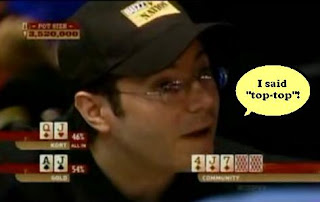
To sum up, while much will be made of how the number of players in the Main Event fails to exceed that of last year, the more significant difference between 2007 and 2006 will be the play itself. More pros should advance deeper this year. The overall quality of play -- difficult, if not impossible, to gauge accurately -- should be higher. And we shouldn’t see as much taunting, card-flashing, or “top-top” applesauce either.

All of which might well help Jeffrey Pollack realize that oft-stated goal for this year’s WSOP to “top” last year’s -- quality-wise, that is.

Labels:

Newer Posts
Older Posts

Copyright © 2006-2021 Hard-Boiled Poker.
All Rights Reserved.