Tuesday, January 09, 2007

Poker Review: The Cincinnati Kid

Original poster for 'The Cincinnati Kid' (1965)Here’s my review proper of The Cincinnati Kid. If you haven’t seen the film and plan to, you should know that this post and the next one (in which I specifically discuss the final hand) contain spoilers.

Although highly esteemed by many in the poker world, The Cincinnati Kid is not generally rated as one of the “all-time” greats in film history. It certainly didn’t appear on the American Film Institute’s “100 Greatest Movies of All Time” list. (Then again, neither did The General, Meet Me in St. Louis, or The Conversation.) Generally speaking, critics tend to praise certain elements -- the acting, the suspenseful direction/editing, the mostly successful atmospheric recreation of 1930s New Orleans -- while dismissing the plot (as inconsequential or improbable) and/or theme (as superficial or obvious). Most critics give it at most three stars (out of four), some less -- e.g., Leonard Maltin gives it two-and-a-half stars, censuring its “side episodes of meaningless romance.” Even the director, Norman Jewison, introduces the film as his “ugly duckling” in the DVD commentary.

There are a few reasons why the film tends to get demoted to the “watch-it-only-when-there-isn’t-something-better-on” category, I think. One is the fact that despite boasting a truly remarkable, accomplished cast (Steve McQueen, Edward G. Robinson, Karl Malden, Ann-Margaret, Rip Torn, Tuesday Weld, Joan Blondell, Jack Weston, Cab Calloway), every single one of these actors (except perhaps Calloway) appeared in films that are markedly better than The Cincinnati Kid. (E.g., if you haven’t seen any films with Karl Malden, rent On the Waterfront already.) Another is its reputation -- not entirely undeserved, actually -- as having borrowed too heavily from the better-known, more highly regarded 1961 film, The Hustler. Finally, the fact that the film is, after all, a “poker movie” has relegated it to a kind of cult status for mainstream audiences -- in other words, the common view is that one probably has to be a poker player (or at least have an interest in poker) in order to find the film at all engaging.

The Kid prepares to call a bluffCan’t say I entirely disagree with any of these criticisms. Nor am I willing to go against the general consensus and try to elevate The Cincinnati Kid as some “forgotten classic” overlooked by critics and scholars. However, I do believe there’s a lot to like about the film. The performances by each of the above-named actors are all admirable. McQueen, Robinson, and Malden are terrific, of course, but I particularly enjoy Rip Torn as the embittered and corrupt William Jefferson Slade. (Ann-Margaret’s turn as bad girl Melba Nyle is probably overdone, but nevertheless effectively serves to create the contrast with Tuesday Weld’s Christian.) I think we care enough about the Kid and the other characters to be reasonably affected by the suspense of the story. And the atmospheric interludes presenting us Depression-era New Orleans are all fine, although in the end I find the decision to relocate Jessup’s story from St. Louis to be mostly arbitrary. (In his commentary, Jewison says the film was originally to be set in St. Louis, but was moved to New Orleans since the latter has “more of a special feeling” -- i.e., brief injections of ragtime jazz proved an economical way to affect mood.)

I additionally think the plot is cleverly constructed in a way that makes the film’s primary theme more evident and more affecting. Even though I don’t see much use in having moved the story to New Orleans -- and I also don’t really see any compelling reason to set it in the 1930s rather than the 1950s -- I do like other changes the film makes to Jessup’s story. The most significant alteration involves the character of the Shooter (played by Malden). Unlike in the novel, the Shooter is less of a mentor figure to Eric in the film. He’s a friend -- a longtime, loyal friend -- but he’s no role model for Eric, and actually ends up evolving into a kind of antagonist who hinders the Kid in his attempt to achieve his goal.

In the film, the Shooter is locked in a loveless marriage with the much younger (and wilder) Melba. He also has accrued some gambling debts -- Slade has $12,000 worth of markers on him. Slade also has a grudge against Lancey (whose last name has been changed from Hodges to Howard here), having suffered a large loss to the Man in a private match early in the film, and therefore wants to see the Kid humiliate him. Using the markers as leverage, Slade blackmails the Shooter (who is dealing in the game) into trying to cheat for the Kid. The Shooter does so during some of the early hands, but the Kid catches on and has the Shooter replaced as dealer.

Melba further complicates matters for the Kid. The subplot between the Kid and Christian essentially follows the same trajectory that occurs in the novel: she loves him and he loves her, but he makes it clear to her that the game is more important and she steps aside in order to allow him to pursue his goal of beating the Man. The film, however, has Melba chasing the Kid in Christian’s absence. He resists for most of the film, but during a break in the big game he succumbs to her temptations and sleeps with her (a decision that’s clearly linked to his disappointment with the Shooter for trying to cheat). Christian arrives shortly afterwards and learns of his betrayal -- a significant distraction he then must try to overcome when he returns to the game. (After the game is over and the Kid has lost, there is a brief shot of a forgiving Christian reuniting with him outside the hotel. This is the tacked-on last shot Jewison objects to in his commentary.)

Unlike Leonard Maltin, I don’t think these additions represent mere “side episodes of meaningless romance.” All of these changes heighten challenges faced by the Kid. It is certainly tempting to draw a causal connection between the Kid’s decision to sleep with Melba and his losing to Lancey. (This connection may well be intended by the filmmakers.) By doing so, he not only betrays Christian, he also betrays his friend, the Shooter, and thus could be seen as being “punished” for doing so. He also perhaps seems to violate a rule for male poker players not to allow women to dull their edge. (As Lancey tells him during a break, “Women are a universal problem in our business.”)

The last handBut is the Kid’s failure ultimately caused by his having allowed himself to be unduly distracted from the task at hand? I don’t think so. Despite all, he outplays the Man, right down to the final hand. Lancey only wins the all-or-nothing last hand thanks to a particularly fortunate river card -- a one-outer, in fact. As the Man says afterwards, he made “the wrong move at the right time” and won despite his error. (Details of that last hand to come in the next post.)

So I say I think the film does a good job plotting the story in a way that helps communicate the overall theme. But what is that theme? I see The Cincinnati Kid as being about the struggle to make meaning of one’s life, here fashioned as a maturation process (from “Kid” to “Man”). Eric has a goal and knows what is required of him to achieve that goal. However, the world isn’t necessarily going to cooperate -- there are factors out of his control that will affect whether or not he can succeed. Ironically, that is the very lesson -- no one, not even the Man, utterly controls one’s fate in this world -- that allows Eric to “grow up” into a fully-realized adult. When he loses the climactic hand to Lancey, he fails to become “the Man,” yet it is also clear he is no longer just a “kid.”

The successful exploration of this theme is why I particularly admire the film as a poker movie. Why? Because not only does it effectively “use” poker as a means to convey its overall theme, the theme is itself of central importance to poker. As we all know, we can play a hand utterly correctly, trapping our opponent beautifully and causing him to put all of his chips in with only the faintest trace of a chance of winning -- and still lose. Being a “man” (or adult) and not a child means understanding this can happen -- that the world is, ultimately, indifferent to our plight. The Cincinnati Kid ably conveys this truly existential idea.

As I’ve said, I want to add one more post that compares how that last hand appears in Jessup’s novel and how it goes down in the film. The result is the same -- Lancey’s straight flush bests the Kid’s full house -- but the way they get there (the betting, the cards drawn) is different. Significantly so, in my view.

Labels: ,

Sunday, January 07, 2007

Richard Jessup's The Cincinnati Kid

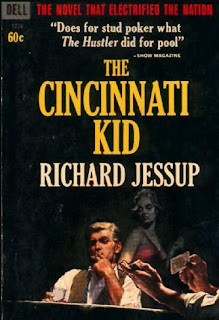
Richard Jessup's 1964 novel, 'The Cincinnati Kid'Last post I talked a bit about the commentaries that come with Warner Home Video’s DVD of The Cincinnati Kid. Now I want to say a few words about Richard Jessup’s 1964 novel on which the film is based. (By the way, those unfamiliar with the story can safely read this post without worrying about me spoiling anything too significant plot-wise for you.)

Jessup was born in Savannah, Georgia on New Year’s Day in 1925. He grew up in orphanages, then in his late teens ran away to become a merchant sailor, a career he continued until he started writing novels in his mid-twenties. Thus by the time he started writing, he had travelled widely and experienced much. He’d also read a great deal; in a 1970 interview he said he “read himself around the world” when working as a seaman, reading a book per day. At some point he also had a job as a dealer at a gambling joint in Harlem, an experience he certainly drew from when writing The Cincinnati Kid. Jessup would eventually pen 35 novels (or more), including a series of spy novels featuring an operative named Montgomery Nash. He also wrote a number of well-received westerns under the pseudonym Richard Telfair. He died of cancer in 1982.

The Cincinnati Kid is a novel of modest length (probably 35,000 words or so) that genuinely exemplifies a lot of the qualities one expects to find in “hard-boiled” fiction. There are no detectives or crimes or murders to investigate, but several other hallmarks of hard-boiled writing are evident. Looking at Bill Pronzini and Jack Adrian’s attempt to define the genre (in the introduction to their anthology, Hard-Boiled), Jessup’s novel certainly follows their guidelines. According to Pronzini and Adrian, a hard-boiled story first and foremost “deals with disorder, disaffection, and dissatisfaction.” The Kid’s dogged pursuit to beat “the Man” (Lancey Hodges) clearly signals his unease with his present circumstances. His ambition -- understood by some within the gambling world he inhabits, but incomprehensible to most of “straight” society -- also marks him as a “loner”-type operating outside the “system” (as hard-boiled protagonists often do). Furthermore, as Pronzini and Adrian point out, “good does not always triumph,” in such stories, “nor is justice always done.” Again, The Cincinnati Kid fits the bill.

So even though it isn’t a crime novel, there are a lot of reasons to liken Jessup to other hard-boiled authors. As Pronzini and Adrian explain, “A hard-boiled story must emphasize character and the problems inherent in human behavior. Character conflict is essential; the crime or threat of crime with which the story is concerned is of secondary importance.” Not surprising, then, to see the blurb from The Chicago Tribune reviewer claiming “Richard Jessup does for poker much the same thing that the late Raymond Chandler did for murder.”

I recommend the novel -- to fans of hard-boiled writing, certainly, but also to poker players. The novel offers a detailed look at the underground “rambling-gambling” poker scene, circa 1950s. (The film pushes the action back a couple of decades or so.) The reader is exposed to a lot nifty poker-related jargon here. The loose-aggressive player willing to take risks is described as having a lot of “cock” in him. The player who busts out of a game and must accept a loan from other players has gone “Tap City” (and is not allowed to play again until he’s paid back those debts). In five-card stud (the featured game) there is playing “no stay” (i.e., folding), and those players left in the hand vie for “no stay” money (i.e., dead money). When the players examine new packs of cards by sniffing their wrappers, it is explained they are looking for “the tell-tale odor of a hot iron and a tampered seal.” (The players perform this action in the film as well, and in his commentary Phil Gordon admits he has no idea why they do.) Such details -- clearly gleaned from Jessup’s dealer experience -- significantly add to the novel’s verisimilitude.

The story is set in St. Louis (the film moves the action to New Orleans), and Jessup’s descriptive style presents a succinct yet wide-ranging overview of the scene and many of the characters who populate it. Jessup frequently delves into the psychology of poker, carefully establishing the various reasons why poker and nothing else has the potential to satisfy Eric’s yearning to become “the Man.” Other pursuits fail him, as do other card games. Blackjack he dismisses as “a game of short bluff and limited scope.” “He gave bridge a try, but didn’t like the idea of partners.” He found craps harmless fun, “but still there was something in him that wanted a game where there was more personal control.” At last he comes around to poker, “first to draw poker and then he found stud to be the game that was right as rain.”

Incidentally, the film gives Eric a last name -- Stoner -- apparently meant as a reference to his poker face (and not intending any other connotations). In the novel he’s simply Eric, or, more often, “the Kid.” The Freudian implications in the nicknames of the story’s two combatants are more than a little obvious, of course. Jessup doesn’t shy away from exploring the connection between Eric’s wish to “be the Man” (i.e., be regarded as the best five-card stud player) and his struggle to mature into adulthood (i.e., to be a man, and not a “Kid”).

As in the film, the novel explores the subplot of Eric’s relationship with his girlfriend, Christian, and considers the extent to which that relationship interferes with his poker-related goals. When Eric visits Christian’s family (prior to his big showdown game with Lancey), her father quizzes him about the importance of his beating “the Man.” “Are you doing it for fun, then? Just to see if you can be king?” he asks. “No,” replies Eric, “it’s important to me.” “Now . . . which is more important to you, this king business, or Christian?” “If you got the guts to ask that question . . . I’ve got the guts to answer it. Christian, if you came right down to it, is not as important as doing what I have to do.” Christian’s father respects Eric’s position. “Son,” he says, “there never was a man worth a damn to my mind that let a woman -- his woman -- stand in the way of a thing he had to do.” Eric understands the principle. But can he live accordingly?

(Maybe I’ve just got the late, great James Brown on my mind, but Eric’s struggle in some ways reminds me of the one dramatized in the Godfather of Soul’s “It’s a Man’s Man’s Man’s World” -- first recorded in early 1966.)

As you might expect, Christian’s name also possesses symbolic value. During this same conversation her father asks Eric if he’s a believer. “In what?” responds Eric. “Religion.” “No.” (Although the film does take a number of chances, it doesn’t broach this particular subject.) Eric is pretty clearly presented here as an existentialist. “And you only play cards for a living?” incredulously asks Christian’s father. “Only play cards,” he responds.

The novel also presents the character of the Shooter differently than does the film. In Jessup’s story, the Shooter is more obviously a mentor figure for the Kid, having gone through precisely the same trial at an earlier stage in his poker career. He, too, took his shot at (his version of) “the Man,” unable when younger to resist making the attempt. Now the Shooter has settled into a less-risky, more methodical style of play. Unlike in the film, the Shooter has no woman here (and so there is no subplot involving her). He’s also a much more admirable character here than in the film, one who is clearly respected by others -- and deserving of such respect.

To say much more would indeed spoil the plot for those unfamiliar with it, so I’ll leave it there. Suffice it to say, the novel has a lot going for it, and ultimately stands as an important (though infrequently discussed) contribution to literature about poker.

The film is even better, though -- one of those rare instances of the adaptation exceeding the original. As I said before, I’ll review the film proper in the next post. I’m also going to add a fourth and final post to discuss that famous (or infamous, according to some) last hand that culminates the story, particularly concentrating on some of the differences between the way that hand is presented in the novel and the way the film portrays it.

Labels: ,

Friday, January 05, 2007

Commentary on the Commentary: The Cincinnati Kid

A few posts back I mentioned how I’d found a copy of the DVD version of The Cincinnati Kid (dir. Norman Jewison, 1965) in my stocking this year. The single best poker movie, as far as I’m concerned. That’s right -- better than Rounders (in my narrow view).

For all Rounders has going for it -- a compelling plot, decent characterization, an effective (occasionally transfixing) soundtrack by Christopher Young -- I’ve never really been all that big of a fan. I think my ambivalence has something to do with the fact that while the main character, Mike McDermott, often expresses ambition to “take a shot” at higher stakes, the film itself doesn’t ever take the same sort of chance. To be honest, if it weren’t for the poker I might well have forgotten this movie soon after I saw it. Though entertaining, Rounders is a mostly tame Hollywood fairy tale that I think misses out on several opportunities to introduce genuine tension into the lives of its characters. And, of course, (almost) all is resolved for our hero with that happily-flopped straight in the end.

The Cincinnati Kid
, meanwhile, is a film (and story) that strikes me as genuinely ambitious. There’s a sincere attempt made to examine from a number of different angles the game of poker and its significance -- to demonstrate how poker can enter into the process of “meaning-making” with which we all struggle (whether we play the game or not).

I thought I’d take three posts to talk about this here DVD (first released back in the spring of 2005). In this one I’m just going to offer a few words about the two commentary tracks that come with the disc. In the next one I’m going to talk a little bit about Richard Jessup’s novel (a bestseller in 1964) on which the film is based -- a fine, lean example of “hard-boiled” fiction. Then the third post will be my review of the film. (And if you have seen the film, read the book, or heard the commentary -- or just want to defend Rounders -- I’m curious to learn your thoughts as well.)

I should say those who haven’t seen The Cincinnati Kid and who don’t want to run into spoilers can safely read this post (regarding the commentary) and the next one (regarding Jessup’s novel). The third and last post will ruin it for you, though, and so you might well skip that one.

The DVD features two commentary tracks: one by Phil Gordon and Dave Foley (who, at the time, were co-hosting Celebrity Poker Showdown) and the other by the director, Norman Jewison. (There's also a short, mildy interesting “featurette” called “The Cincinnati Kid Plays According to Hoyle,” a promotional short for the film in which Jay Ose, a magician/gambler who served as a technical advisor for the film, performs a few card tricks for Joan Blondell.)

Gordon and Foley only comment on the poker-related scenes (one can program the disc to skip through scenes on which they do not comment). This led me to believe their commentary would include more genuine analysis regarding specific hands, or perhaps some ins and outs about five-card stud (the film’s featured game), but they don’t really offer anything along those lines. Frankly there’s nothing in the pair’s commentary regarding poker that a reasonably aware amateur player wouldn’t already know. I suspect that as was the case with Celebrity Poker Showdown, Gordon and Foley acted as though they were speaking to a wider audience than simply poker players. Don’t feel as though you’ve missed much if you pass on this track.

On the other hand, Jewison’s commentary is much more relevant and engaging -- both to film scholars/fans and to poker players. He offers a lot of inside dope regarding the mechanics of filming/cinematography, talks about what it was like working with McQueen and the other actors, and even makes some genuinely insightful observations about characterization and plot. (Regarding the latter, Jewison reiterates here his previously-stated objection to the studio’s tacked-on final shot of the film -- a plot addendum Jewison himself never endorsed.) Jewison even has some smart things to say about poker and its significance (both to the plot and generally speaking). I found it interesting to hear him say that back in the mid-sixties poker wasn’t considered a subject worthy of filming -- that few thought watching people playing a game of cards would be engaging enough for an audience. (How times have changed.) Jewison clearly understood then how compelling poker can be -- if presented carefully, that is. And Jessup’s tale of the Kid and the Man proved a terrific vehicle to support this theory.

Lewison also retells the story of why he took over directing the film from Sam Peckinpah, and he talks about how Ring Lardner, Jr. (the son of the great sportswriter/humorist and accomplished screenwriter in his own right) and Terry Southern (whose screen credits include Dr. Strangelove, The Loved One, and Easy Rider) came on board to pen the screenplay.

I thought it odd how amid all of the discussion of the plot and screenplay Jewison doesn’t mention Jessup’s novel a single time. (Neither do Gordon and Foley.) The way he talks about the screenplay and the crew’s decision to add this or that detail to a given scene, it almost sounds like the script is not an adaptation but an original work created by Lardner, Jr. and Southern. All of which is somewhat unfortunate for Jessup, whose novel contains many of the same qualities that make the film so special.

As I said, I’ve got a few things to say about Jessup’s novel, then will offer a “poker review” proper of the film after that.

Labels: ,

Wednesday, January 03, 2007

Getting Off to a Good Start, Part 2 (or, Who You Jivin' With That Cosmik Debris?)

I wrapped a newspaper 'round my head so I looked like I was deep . . .Big thanks to Iggy for the reference in his latest uber-post. Go check it out, y’all. (A slipped apostrophe makes my name Shamu -- a cool guru-sounding moniker, no? Is that a real poncho or is that a Sears poncho?) Note also his announcement that PokerWorks has added a few more bloggers to its roll, including Amy Calistri (of Aimlessly Chasing Amy, Keep Flopping Aces, and Poker Pages). Nice play, PokerWorks.

In my most recent post, I boasted a bit about having had an especially fortunate first hour of play with which to start of the new year. My friend Vera Valmore happened to see the post. “You’re setting yourself up,” she told me. Probably true, I thought. The chances of my second hour of play even coming close to that first hour (during which I scooped an absurd $55, or 27.5 BB) were slim indeed.

The point of that post (in part) was to recognize how starting a session well or poorly tends to affect one’s frame of mind, thereby also affecting one’s ability to play well. I talked about Barry Tanenbaum’s idea to “Always Start Slowly” in order to increase your chances of winning that first big hand you play. My January 1st session began with a nice big win in a hand where I flopped a set, turned a boat, and had three callers following me most of the way. What followed appeared to confirm Tanenbaum’s thesis about the good effects of winning that first hand.

(By the way, Barry Mulholland has a decent article in the current CardPlayer that relates pretty closely to this topic. The article is titled “Sometimes You Have to Play Poker Right Away.”)

So how did the second hour go? And the third?

I sat down at a full ring, $1.00/$2.00 limit game on Stars. Completely ignoring Tanenbaum’s advice to wait an orbit before posting, I went ahead and blithely tossed in a buck from the cutoff where I was dealt 4cAd. UTG raised and it folded around to me.

This, friends, seems precisely the “marginal situation” Tanenbaum says he avoids when first sitting down at a new table. There is $4.50 in the pot, and I’m looking at chucking in a second dollar for what is likely going to be a heads-up situation. Is 4.5-to-1 good enough with ace-rag unsuited? Compounding the problem, I have zero information about the raiser. I’m pretty sure Tanenbaum lets this one go. (In fact, he would’ve never posted the blind from the cutoff like I did.)

Of course, I called. The button also cold-calls the two bets, so we end up having three players seeing the flop: 4sAh7h.

About as good as it gets for A4-unsuited. Must be my year, thinks Shamus. The UTG preflop raiser bets out a buck and I, of course, raise it up. The button calls, the UTG reraises, and all three of us end up capping before the round is through. The UTG raiser runs out of funds here, so we’ve begun a small side pot. Altogether there’s $19.25 in the middle.

The turn card is the Th, possibly completing someone’s flush. I bet and when the button just calls I feel as though he doesn’t have it (although, again, I have zero knowledge of the player from which to draw, and so really have no idea if he’s capable of slow playing here). Then comes the river -- the Td. Crap on a cracker. Oh, right -- that’s why you don’t call preflop raises with ace-rag. I can’t be good anymore and so check, and the button also checks and turns over JhAc to take the hand. (UTG had been whistling in the dark with Kh9d.)

I’m $8 down and my seat isn’t even warm. Not just $8 down, actually. I’m something like 80% to win heading into that river, just needing to avoid a jack, a ten, or a seven (nine outs). If any of those other 37 cards come out, the button is surely going to pay one more big bet, and I’m going to take a $26.25 pot (removing a dollar for the rake). I’d have netted $16.25 on the hand, so I could cry that I’ve lost around $25 (or 12.5 BB) on this hand alone thanks to that river card!

Bad luck? Sure. But the hand began with what I immediately judged to be two bad decisions on my part -- to post the big blind from the cutoff rather than wait an orbit, and to call the preflop raise with ace-rag. Wonder if anyone else noticed that, I thought . . . .

I ended up taking it more slowly following that first hand, sitting through the next couple of orbits without playing too much. Wasn’t winning too much, either (I only took a single small pot of $3 during that stretch.) I was down about $15 total when I finally picked up pocket rockets in the cutoff. The table folded around to me and I raised. Much to my dismay, the button called, the small blind called, the big blind called, and the UTG player who was new to the table and had posted also called. So it was my AA vs. four other players, all of whom called my preflop raise without having voluntarily put any money in the pot beforehand.

I wondered for a moment if my loose play on Hand #1 had perhaps invited so much action. Stopped fretting, though, when the flop came 2h6hAd. The big blind bet out, I raised, the small blind reraised, and the three of us ended up capping it. (Hmm . . . didn’t seem like such an action flop.) The turn was the 6d, giving me the boat, aces-full. Both players checked and I also checked to give someone a chance to catch up and really pay me off. The river was the 9d and big blind again bet out. He and I ended up capping the betting (the small blind bailed). The pot had mushroomed to $37 (taking out the rake). What did he have?

You guessed it -- 6s6c. “Wow,” he typed when he saw my aces. “Last hand [I] thought you were on.”

I was down $30 (15 BB), not having played even 30 hands yet. I thought a bit about his comment. What could he have thought I had, if not aces? Ace-rag? Big slick, played recklessly against a board showing a pair and a flush possibility? Was I stubbornly running kings or queens through that board? If you look at how I played the hand -- particularly my check on the turn -- AA was the only hand I could possibly have had. If I knew what I was doing, that is. (Had my play on Hand #1 perhaps suggested otherwise?)

Ended up falling deeper in the hole, then regrouped and scraped my way back to a $20 loss for the entire session. When I told Vera how the day had gone, she passed on the opportunity to tell me “I told you so.” She did, however, make sarcastic reference to that gaudy win rate I’d established in the earlier session. Always good to be reminded poker ain’t as easy as it sometimes seems.

Labels:

Monday, January 01, 2007

Getting Off to a Good Start

Sat down earlier today for a short session on Bodog. First hand of the new year ($1.00/$2.00 limit, 6-max) goes like this: I get a pair of threes in the big blind. Three players call, the SB folds, I check. Flop comes TdAs3d. I bet and all three players stick around. Turn is the Tc. I bet again, and again all three players call. I’m doubting the ten is out there -- more likely a bunch of draws. River brings the 2d, completing somebody’s flush draw, probably. I bet once more. One player raises, the other two fold, I reraise, he calls. He turns over Jd5d for second-best. I scoop $27.25 after rake ($17.25 net on hand).

Decent start to the year, eh? Ended up netting around $55 (27.5 BB) for a hour’s worth of play (half 6-max, half full ring). (Wouldn’t it be nice to enjoy such a win rate for the rest of ’07!) That first hand was fortunate, of course. The fact that it was followed by such a successful session made me think of something Barry Tanenbaum said when he appeared on Keep Flopping Aces a couple of months ago (during the 10/26/06 show) when asked about the importance of getting off to a good start.

Near the start of that show’s third segment, co-host Lou Krieger asked Tanenbaum why he thought it was important whenever he sits down at a new game to try to win the first hand that he plays. Tanenbaum responded by saying he had a “philosophy” which he called “Always Start Slowly.” As he explained, “starting slowly” means not necessarily getting involved right away in those “marginal situations” he normally explores as part of his usual game. Don’t post the blind right away, he advises; rather wait an orbit and observe the other players. (Here Tanenbaum answers a question I pondered over in an earlier post.) Then, once you begin play initially adopt a conservative approach, continuing to observe and gather information about other players’ tendencies as you do.

According to Tanenbaum, another reason to try your best to win that first hand is to create a “winning” image that will subsequently help you in later hands. If you have a winning image, you will more likely succeed when later trying to represent a hand, to bluff off an opponent, to isolate an opponent, to get a free card, and so forth. Tanenbaum here essentially describes what I experienced today. Truth be told, that first hand really played itself -- any moron could’ve won with that sweet draw, probably netting exactly the same profit as I did. Nevertheless, after winning that first big pot the table essentially deferred to me from that point forward any time I showed aggression or even interest in a hand. I won a few more medium pots, but also lost smaller pots when better hands refused to raise me. For example, on a later hand I raised preflop with AK and had two callers. The flop was three baby cards (663 or something), I bet and one player called. The turn was another baby card (a seven, I believe), but put three spades on the board. We both checked. The river was a deuce, we both checked again, and he took the pot with a pair of tens. I’m certain my “winning image” (deserved or not) encouraged caution in my opponent, probably saving me at least one big bet.

I like Tanenbaum’s advice about trying to win the first hand. I haven’t checked my records, but intuitively I believe that my better sessions usually begin with a win (even a modest one), while my less successful sessions begin with a loss. I’ve said before how much I like Tanenbaum’s teachings for limit hold ’em. If you’re a limit player, go listen to that 10/26/06 episode of Keep Flopping Aces (lots of great advice in there -- here are Part I, Part II, and Part III), check out Tanenbaum’s website, and look up some of his archived CardPlayer columns. You’ll be glad you did.

I’ll add a couple of other observations to this “getting off to a good start” idea. For one, I don’t think Tanenbaum is saying necessarily that when sitting down for a new session you absolutely have to win the first hand you play. You do depend on the cards somewhat in limit hold ’em, and can’t always control the outcome of a hand with your betting (the way you might in NL). You could sit there and wait three orbits until you get dealt a pair of queens, then push hard only to be forced to pay off an opponent who with ace-rag spiked an ace on the river. Such things cannot be helped, really. Rather, I think Tanenbaum is essentially telling us not to push “marginal situations” (like, say, flopping middle pair) as aggressively so as to avoid making your first big showdown a hand that (1) you lose, and (2) creates the impression that you’re a “loser” who thinks middle pair is the cat’s pajamas.

The other benefit to getting off to a good start (that Tanenbaum doesn’t explicitly talk about in the interview, though he does imply) is the way it helps your confidence. I don’t know about you, but every time I start a new session I experience a small bit of apprehension about how it is going to go. It’s always nice to receive that initial verification that yes, indeed, I do know how to play this game (somewhat) and can even be successful at it. Perhaps the best players never suffer from such minor insecurities, but for those of us who do even a small, early victory can go a long way.

Anyhow, here’s hoping all of you get off to a good start here in 2007.

Labels:

Saturday, December 30, 2006

Bodoggin' It

Could anyone possibly be influenced to do anything by an ad like this?Mentioned last post I’d been playing some over on Bodog. Just opened the account this month. Probably never would have if I hadn’t been blocked from other sites post-UIGEA. Went through Poker Source Online to sign up and now have some poker books headed my way as soon as I play the requisite hands. Bodog also kicked in 10% of the deposit right away, which is fine by me. So the experiment begins.

I’d always been a bit leery of Bodog, mostly because of the way Bodog pushes the “image” thing a bit harder than most. Sure, all sites target that younger male demographic, but Bodog always struck me as trying just a bit too hard. I remember back in January CardPlayer had one of those advertisement-slash-features on Bodog’s owner and CEO, Calvin Ayre, identifying Ayre as “poker’s lifestyle architect.” The article (by ex-Circuit host Scott Huff) breathlessly described the “adrenaline charged world of the Bodog Entertainment Group,” lauding Ayre as a “true renaissance man” out there “living the Bodog lifestyle.” What the hell is this, I thought. Not looking for a lifestyle, really. Just want to play some cards.

Then there were the ads, all promoting this tough-guy, “We Don’t Believe in Fear” folderol that must appeal to somebody somewhere. The faux-Jay-Z-ish “New American Dream” campaign (“They Gave Me Their Money, Their Dignity, and Some Bling . . . This Pimped Out Ride Was an Added Bonus”). The varietes of “poker predators” prowling around the poker “jungle” (the Ringer, the Wildcard, and, of course, the most envied of the lot, the Founder). The Freudian directive to “play hard.” The silly self-censoring (“No Bullsh#!t”). And so forth.

Speaking of advertising, I’m not so sure Bodog doesn’t believe in fear. Check out these two, nearly identical ads that have recently appeared in Card Player. Notice any difference?

Before and AfterBodog recently announced their plan to to censor themselves right out of the American advertising landscape, actually.
(See Falstaff's Poker Works article.) They’re not going to block U.S. customers, apparently.
But they are no longer going to solicit them, either.

Can’t say I’ll miss the ads, which always struck me as more than a little adolescent. For me, the stories and ads together together formed this impression of Bodog being a goofy, not entirely well-adjusted teenaged boy. Sort of like that dude who sat in the back row during study hall. Must’ve flunked a grade somewhere along the way, ’cause he was older than everyone else. Maturity-wise, though, he was still a step or two behind. Dressed and acted tough, but was mostly harmless, and in fact turned out to be kind of a jokester once you got to know him. Could easily be talked into all sorts of transgressive behaviors. Tell him to hide the chalk and erasers, he’d do it. Thumbtacks in the teacher’s seat? He’s your man. Plant a centerfold on the rolled up map of the world at the front of the class? Bodog’ll do it. He doesn’t believe in fear . . . . (At least that what he’s always saying.)

How does the site play? Well, I’ve only logged a few hundred hands so far, but I’ll go ahead and say the interface is terrific -- best layout and feel of any of the sites except for Poker Stars, in my opinion. Not crazy about the multitable view, but I’ve only been playing one at a time here as of late so that’s not so much of an issue for me at present. I’m also not at all happy with the way Bodog handles hand histories. Unlike every other site on which I’ve ever played, Bodog does not save them to a file on the hard drive. That means I cannot import the hands into Poker Tracker (or use Poker Ace, which I’m currently trying out) unless I do some additional monkey business with the CPU. I could install yet another program -- something called “Dogwatch” -- which apparently doesn’t function unless I also install Microsoft .NET Framework Version 2.0. Too much extra hassle for me . . . I’ll just have to fly without a net when I play on Bodog, I think.

Have tried a couple of low buy-in SNGs. They have some novel payout structures for these -- e.g., a 10-player $3.50+$0.30 SNG that pays $26.95 to the top spot, with second and third each getting $3.85; a 10-player $4.00+$0.40 SNG that spreads out cashes among the top five spots ($12, $10, $8, $6, and $4). Tried the latter variety and cashed both times I played (a second and a fourth). Don’t know if I like those structures better or not, but they are different.

We’ll see if Bodog bails on us Yanks here in the new year or sticks it out. Meanwhile, I’ll continue with this experiment. Speaking of experiments, I’ve taken a woman’s name as my screen name on Bodog -- probably an unconscious response to all that “lifestyle” applesauce. None of those predators has tried to hit on me yet. Maybe once I’ve uploaded a photo . . . .

Images: Bodog advertisement; Card Player advertisements, fair use.

Labels:

Thursday, December 28, 2006

Jumping in the (Full) Ring

Have been playing full ring games lately, as opposed to my usual 6-max. Started doing so in last couple of weeks, mainly because I’m now playing $1.00/$2.00 and thus desirous to lessen my variance as I acclimate myself to the larger pots. So far so good. While I can get wild now and then, I do believe my “natural” character as a player is to be conservative, so I don’t have a problem folding and being patient.

Indeed, I used to play full ring exclusively, then got locked into the 6-max world after having some success. Going back to ten-handed games has caused me to observe important differences between full ring and 6-max. As you probably noticed earlier in the week when you saw that cousin whom you haven’t seen since last Christmas, differences become more conspicuous whenever we’ve been away for a while. At the beginning of Jean-Paul Sartre’s novel Nausea (1938), the narrator, Roquentin, talks about why he’s decided to start the journal that forms the novel’s narrative. He figures if he writes down his day-to-day activities, he’ll have a better grasp of the changes that occur in his life. Otherwise, “a crowd of small metamorphoses accumulate in me without my noticing it, and then, one fine day, a veritable revolution takes place.” Not unlike what I’m experiencing going back to the full ring game -- it’s like a “revolution” or “overthrow” has taken place, with all sorts of crazy changes standing out to me in glaring ways. Lemme mention three of them here:

(1) When ten-handed, players play, for the most part, much much tighter than in the 6-max game.

Obvious, I know. I’ve mentioned before here how Small Stakes Hold ’em doesn’t really offer much specific advice for short-handed games. There are a few references here and there to how hand values change in heads-up or short-handed situations, and during the discussion of preflop play there is that one footnote that says “For a short-handed game, assume that your game is ten-handed and that the first few players have folded.” That’s about it, though. I have always taken that footnote to mean that when it comes to Miller/Sklansky/Malmuth’s recommendations regarding preflop hand selection, one can essentially omit “early position” altogether (the first three seats to the left of the blinds), and consider the six seats as follows: SB, BB, MP1 (UTG), MP2 (UTG+1), LP1 (the cutoff), and LP2 (the button). May not be what the authors are intending, but that’s what the footnote seems to imply. Of course when it comes to actual play, you cannot really “assume that your game is ten-handed” when sitting at the 6-max tables. If you restrict yourself to Miller/Sklansky/Malmuth’s preflop hand selection criteria when playing the 6-max games, you probably won’t be playing enough hands to survive the blinds’ relentlessly eating away at your stack.

When I first picked up SSHE some time ago, I went through all of the recommendations for preflop hand selections and took some time to calculate how many hands a person would likely be playing if he or she followed the recommendations to the letter. For each seat at the table, I took into account what the trio was recommending as far as whether or not to play a hand given the preceding action, then I figured out the likelihood of being dealt each hand (e.g., 6/1326 for a pair, 12/1326 for a non-suited non-pair, 4/1326 for a suited non-pair), the likelihood of there being a raise or reraise in front, and so forth. In the end, I found that playing the SSHE hands as instructed would mean playing something like 23% of the hands you were dealt. If you drop out the first, second, third, and fourth position seats and get down to a 6-max table, SSHE is still telling us to play around 27% of the hands.

(That’s after my somewhat-tedious-but-by-no-means-infallible calculations. If anyone knows of more precise numbers along these lines, by all means send ’em on.)

In practice, though, one really has to play more than 27% of the hands in 6-max limit games to get by -- particularly since you’re paying a blind 33% of the time! So I make the obvious declaration here: people tend play more hands in 6-max, and fewer in full ring. Now that doesn’t necessarily mean that I have to tighten up in the full ring game (not always, anyhow). But it does mean that I have to understand most of the other players are likely playing a tighter game, and thus are more likely to have the goods should they go deep into a hand with me.

(2) When ten-handed, players tend not to raise preflop with marginal hands from early or middle position.

One of the very first things I noticed when I started playing 6-max games was how some players kept preflop raising with hands like A7-offsuit, then pushing with them regardless of what came on the board. Other players would preraise with any Broadway card. Kind of thing that previously never even occurred to me to do, to be honest. Some used this strategy to good effect, especially if they were agile playing after the flop (getting away cheaply from their obvious losers, craftily disguising their winners, etc.).

In the full ring game, such craziness is less likely to occur. There are steal attempts from late position, to be sure, but if someone preraises UTG in the full ring game, he or she usually has something close to a premium hand, if not an actual monster.

(3) When ten-handed, players tend not to reraise preflop (from any position) without a premium hand.

Something else I’ve noticed a lot in the 6-max game is how often players reraise (from any position, really) in order to isolate the raiser. Very often the player who does this is holding a small or middle pair, or even just J9 or QT or the like. It isn’t such a crazy play in the 6-max game, really, since getting heads-up is easier to accomplish when you only have one or two other players to discourage from calling your three-bet. QT wants to play AJ heads-up -- he’s 40% to win, if he can. 55 wants to play AK heads-up -- he becomes a favorite (55% to win), if he can.

However, since the isolation tactic is less likely to succeed when you’ve got a half dozen players left to act, you are less likely to see preflop reraises from folks who aren’t pretty sure they’ve got the advantage when they put in the three-bet. I had a hand today where I was in fourth (early middle) position and was dealt JdJs. It folded to me and I raised, then the player to my immediate left (also in middle position) reraised. Everyone folded and I called. The flop came Ad5h4c and I led out with a bet, hoping my opponent didn’t like that ace. He immediately raised me. I thought for a bit (eight seconds, to be precise -- I was playing on Bodog where the hand histories record the exact second each action occurs), then folded.

I realized as I let the hand go that I probably would’ve pushed back had we been playing short-handed. There I would’ve figured it more likely than not my opponent also held a pocket pair, with the odds being in my favor that it would be less than my jacks. However here in the full ring game I felt about 80% sure that my opponent either had a big ace, KK, or QQ. I could’ve been wrong, of course (we’ll never know) -- if anyone thinks I could have been, do let me know why. In any event, here was a clear example of me playing a hand differently because it was ten-handed as opposed to 6-max.

I could probably add a few more items to my list here, including the fact that bluffing seems to me to be much more significant (and useful) in the 6-max limit game than in full ring games. But I probably need to gather some more experience before making any more fancy declarations about how to play poker.

In fact, to prove to all that I shouldn’t be pretending to give advice about poker, I offer as evidence the following chat transcript from a game I played about a month ago. I’ve changed the names, but otherwise everything is exactly as it happened. (I’ve highlighted the more interesting moments in bold.) The only action you need to follow occurs in the first hand; for the rest just read the highlighted chat. You’ll notice I only contribute a single line to the proceedings, and even that wasn’t original, but lifted from some advice delivered to me by my friend Yorkshire Pudding (in his comment to an earlier post). Thanks, Yorkie! Enjoy!

POKERSTARS GAME #----------: HOLD'EM LIMIT ($0.50/$1.00)
Table ‘Hammett’ 6-max Seat #5 is the button
Seat 1: Short-Stacked Shamus ($34.05 in chips)
Seat 2: nickandnora ($1.80 in chips)
Seat 3: Leggett-Dain ($20.70 in chips)
Seat 5: CasperGutman ($13.15 in chips)
Seat 6: blackmask ($12.80 in chips)
blackmask: posts small blind $0.25
Short-Stacked Shamus: posts big blind $0.50
*** HOLE CARDS ***
Dealt to Short-Stacked Shamus [Kd Qh]
nickandnora: calls $0.50
Leggett-Dain: folds
CasperGutman: calls $0.50
blackmask: folds
Short-Stacked Shamus: raises $0.50 to $1
nickandnora: calls $0.50
CasperGutman: calls $0.50
*** FLOP *** [6d Ts 8h]
Short-Stacked Shamus: checks
nickandnora: checks
CasperGutman: bets $0.50
Short-Stacked Shamus: calls $0.50

nickandnora: calls $0.50
*** TURN *** [6d Ts 8h] [Jh]
Short-Stacked Shamus: checks

nickandnora: checks
CasperGutman: bets $1
Short-Stacked Shamus: calls $1
nickandnora: calls $0.30 and is all-in
*** RIVER *** [6d Ts 8h Jh] [9s]
Short-Stacked Shamus: bets $1
CasperGutman: calls $1

*** SHOW DOWN ***
Short-Stacked Shamus: shows [Kd Qh] (a straight, Nine to King)
CasperGutman: mucks hand
CasperGutman said, "lmfaoi"
CasperGutman said, "lmfao"

Short-Stacked Shamus collected $3.25 from side pot
nickandnora: mucks hand
Short-Stacked Shamus collected $5.40 from main pot
CasperGutman said, "what is wrong with u"
CasperGutman said, "????"
CasperGutman said, "moron"

*** SUMMARY ***
Total pot $9.05 Main pot $5.40. Side pot $3.25. | Rake $0.40
Board [6d Ts 8h Jh 9s]
Seat 1: Short-Stacked Shamus (big blind) showed [Kd Qh] and won ($8.65) with a straight, Nine to King
Seat 2: nickandnora mucked [9h Ad]
Seat 3: Leggett-Dain folded before Flop (didn't bet)
Seat 5: CasperGutman (button) mucked [Jd 8c]
Seat 6: blackmask (small blind) folded before Flop

POKERSTARS GAME #----------: HOLD'EM LIMIT ($0.50/$1.00)
Table ‘Hammett’ 6-max Seat #6 is the button
Seat 1: Short-Stacked Shamus ($39.20 in chips)
Seat 2: nickandnora ($15 in chips)
Seat 3: Leggett-Dain ($20.70 in chips)
Seat 5: CasperGutman ($9.65 in chips)
Seat 6: blackmask ($12.55 in chips)
Short-Stacked Shamus: posts small blind $0.25
nickandnora: posts big blind $0.50
*** HOLE CARDS ***
Dealt to Short-Stacked Shamus [8s 9d]
Leggett-Dain: folds
CasperGutman said, "terrible play idiot"
CasperGutman: raises $0.50 to $1
blackmask: folds
CasperGutman said, "terrible"
Short-Stacked Shamus: folds
nickandnora: calls $0.50
*** FLOP *** [3d 5c 9c]
nickandnora: checks
CasperGutman said, "terrilbe"
CasperGutman: bets $0.50
nickandnora: folds
CasperGutman said, "just terrible"
CasperGutman collected $2.15 from pot
*** SUMMARY ***
Total pot $2.25 | Rake $0.10
Board [3d 5c 9c]
Seat 1: Short-Stacked Shamus (small blind) folded before Flop
Seat 2: nickandnora (big blind) folded on the Flop
Seat 3: Leggett-Dain folded before Flop (didn't bet)
Seat 5: CasperGutman collected ($2.15)
Seat 6: blackmask (button) folded before Flop (didn't bet)

POKERSTARS GAME #----------: HOLD'EM LIMIT ($0.50/$1.00)
Table ‘Hammett’ 6-max Seat #1 is the button
Seat 1: Short-Stacked Shamus ($38.95 in chips)
Seat 2: nickandnora ($14 in chips)
Seat 3: Leggett-Dain ($20.70 in chips)
Seat 5: CasperGutman ($10.80 in chips)
Seat 6: blackmask ($12.55 in chips)
nickandnora: posts small blind $0.25
Leggett-Dain: posts big blind $0.50
*** HOLE CARDS ***
Dealt to Short-Stacked Shamus [2h Td]
CasperGutman: folds
blackmask: folds
Short-Stacked Shamus said, "hang on i can play worse"
Short-Stacked Shamus: folds
nickandnora: folds
Leggett-Dain collected $0.50 from pot
Leggett-Dain: doesn't show hand
*** SUMMARY ***
Total pot $0.50 | Rake $0
Seat 1: Short-Stacked Shamus (button) folded before Flop (didn't bet)
Seat 2: nickandnora (small blind) folded before Flop
Seat 3: Leggett-Dain (big blind) collected ($0.50)
Seat 5: CasperGutman folded before Flop (didn't bet)
Seat 6: blackmask folded before Flop (didn't bet)

POKERSTARS GAME #----------: HOLD'EM LIMIT ($0.50/$1.00)
Table ‘Hammett’ 6-max Seat #2 is the button
Seat 1: Short-Stacked Shamus ($38.95 in chips)
Seat 2: nickandnora ($13.75 in chips)
Seat 3: Leggett-Dain ($20.95 in chips)
Seat 6: blackmask ($12.55 in chips)
Leggett-Dain: posts small blind $0.25
CasperGutman: is sitting out
blackmask: posts big blind $0.50
*** HOLE CARDS ***
Dealt to Short-Stacked Shamus [5s Jc]
CasperGutman leaves the table
Short-Stacked Shamus: folds
nickandnora: folds
Leggett-Dain: folds
blackmask collected $0.50 from pot
blackmask: doesn't show hand
*** SUMMARY ***
Total pot $0.50 | Rake $0
Seat 1: Short-Stacked Shamus folded before Flop (didn't bet)
Seat 2: nickandnora (button) folded before Flop (didn't bet)
Seat 3: Leggett-Dain (small blind) folded before Flop
Seat 6: blackmask (big blind) collected ($0.50)

Labels:

Wednesday, December 27, 2006

The Circuit 2.0

The holidays are swiftly coming to a close. I’ve noticed a few folks starting to get back to their blogs. The combined effects of heavy doses of tryptophan & spiked egg nog have apparently finally begun to recede. Most seem to be gravitating toward “year end review/new year resolution”-type posts. Dunno if I’ll bother with either of those. For some good year-end reviews of what happened in the poker world in 2006, go to the Poker Prof.’s blog and/or Pauly’s always-worthwhile Tao of Poker. Poker News has also been working its way through a month-by-month recap. As far as resolutions go, I got nothin’ other than to try to keep having fun (and making a few berries here and there) playing our favorite game.

After a few days away from the tables, I logged onto Full Tilt today and found professional player (and new co-host of The Circuit) David Singer sitting at a $1.00/$2.00 limit table. Easy to tell which one was Singer. Besides the custom avatar, he was also the only one with over $20,000. (Your guess is as good as mine as to why he thought he needed to bring so much.) I jumped on the waiting list, thinking perhaps I’d get to experience a little of that “mixing it up” I wrote about last post, but unfortunately Singer left before I’d made it to the top of the list.

Ended up watching several of the hands, and saw Singer chatting it up in a very friendly way with the rest of the table. He seems like a nice enough fellow. Not sure, really, how good of a fit he is for The Circuit, though. The new crew -- which includes Singer, Konan Luce, and Rich Belsky -- made its debut a couple of weeks ago at the Five Diamond World Poker Classic. Singer is the lone pro of the trio, and while he’s certainly knowledgable and even demonstrates a dry sense of humor now and then, his understated monotone probably makes it difficult for most listeners to remain attentive. Of the amateurs, Belsky seemed fairly comfortable and did a fair job during the shows asking guests about particular hands. Luce seemed mostly out of his element, however. I don’t think the group necessarily deserves all of the negativity spewing on the Circuit forum (over at CardPlayer), but they do have a lot of room to improve, I think.

The Circuit is fairly unique among all of the podcasts in its on-the-spot coverage of the major tournaments. (Have yet to check out The Tournament Trail over on Hold ’em Radio.) I’m pulling for the new hosts to figure out how to make the show work. I mentioned something before about how the new hosts -- whoever they turned out to be -- were going to have Shana Hiatt-esque shoes to fill thanks to the high mark set by Scott Huff, Gavin Smith, and Joe Sebok. (Posted that observation over on the Circuit forums and here’s what Circuit intern, forum moderator, and funny guy Justin “Shronk” came up with in response.)

Think I’ll go take a look that DVD of The Cincinnati Kid I found in my stocking Monday morning. Probably looking at a review here in the not-too-distant future.

Welcome back, all!

Labels:

Saturday, December 23, 2006

Mixing it Up

Another example, like the dancing baby or the Brandi Hawbaker saga, of an internet 'meme' (click to learn more).Finally got a chance to hear this week’s Beyond the Table. Missed the live show on Wednesday night, but the podcast version is available here. Favorite moments: (1) Tom hollerin’ “Shamus, get yr ass in here!” (gotta figure a way to sample that somehow); (2) Karridy likening me to a boss having called in a wayward employee (friggin’ hilarious); (3) Dan recognizing the oddity of the trio spending a portion of this week’s show reading a transcript of last week’s show, and wondering if someone might transcribe them reading the transcription (we’d all probably vanish into some sort of self-reflexive, M.C. Escheresque vortex if anyone dared try that, I think). Anyhow, fun stuff -- go check ’em out, if you haven’t already.

The show -- along with some other events this week -- got me thinking about how poker uniquely enables truly meaningful interaction between pros and amateurs. I mentioned before how Beyond the Table brings us dialogue between a professional player (Tom) and two amateurs (Karridy and Dan). A number of other poker podcasts (e.g., Bluff Poker Radio, The Circuit, Joe Average Poker Radio, Keep Flopping Aces, Rounders, The Poker Edge) feature a similar dynamic. These shows work best (or, I should say, are most interesting to me, the amateur player listening in) when there is some genuine communication occurring between the amateur and the pro. (Not always the case, actually, on some of these.)

Sure, I’m as curious as the next sap to hear the pros describe their lives and gossip about the circuit scene. And it can be useful sometimes to hear them share their theories and strategies. However, when the pro then gives sincere attention to the amateur’s situation -- asking questions about his or her life and/or play -- that’s when someone like me becomes genuinely engaged. That’s when I not only become more likely to profit from whatever wisdom about poker (or other things) the pro might be imparting, but I get to feel as though I’m participating -- in a meaningful way -- in a wider community. Poker is great for many reasons, but the way the game provides a means to community-building is one of its truly special qualities.

I remember when I first started playing poker. I’d hop online and play hands for pennies, then go watch the WSOP or WPT on the tube and think about how the rules of the game were the same, only the stakes were different. I used to think of poker as being like golf in this respect -- what I’m watching is the same damn game, only it’s being played at a different level (and thus not really the same damn game, but resembling it in a number of ways). Amateur golfers follow the same rules and try to employ the same strategies as do the pros. They even sometimes get to play the same courses, maybe even start from the same tees. And certainly, whatever level at which they’re playing, they get to experience a lot of the same highs and lows the game produces.

There are differences, though. Golf tournaments may begin with a “Pro-Am” event early in the week, but such exhibitions don’t count for much, really. (Not for the pros, anyhow.) By contrast, every major poker tournament involves amateurs competing against pros. At this year’s WSOP Main Event, for example, it was estimated that of the 8,773 entrants only a thousand or so could be reasonably described as “professional” poker players. I’d estimate there were probably more than that, but certainly well over half the field were amateurs, meaning that every starting table likely featured a mix of pros and wannabes. And the same is true for just about every major circuit event -- there are amateur players at every stop who pony up the entry fee and give it a go. Why? Because they can.

The fact is, pros and amateurs play poker together all the time -- online and live. (Probably one way to define who belongs to which group, actually -- the pros are the winners and the amateurs the losers.) I’ve never had the experience, but I know some who have played over at the Bellagio and had pros come around and sit in at their low limit (3/6 or 4/8, I don’t remember) game for an orbit or two. Kind of a public service, I suppose. A true thrill for the amateurs, as you might imagine. There’s Negreanu’s “protégé,” the Full Tilt pros chatting with customers and playing low limit tourneys, other sites inviting amateurs to knock out pros for bounties, and so forth. Chris Cosenza on Ante Up! told about seeing Kathy Liebert warming up for the WPT Foxwoods main event (where she final tabled) by playing in the 1-2 NL games -- and having a hell of a time. Not at all unusual, really. For fun or for profit, pros and amateurs mix it up on a regular basis.

Which brings me to the other reason why I was thinking this week about pros and amateurs mixing it up -- the whole Brandi Hawbaker saga that started on the 2+2 Forums exactly one week ago and has since swiftly mushroomed into one of those internet “memes” like the dancing baby or Mahir Çağrı. Hawbaker got some attention back in October by finishing 35th at the WPT Festa Al Lago main event (after being an early chip leader) -- her first significant cash on the circuit. We heard her interviewed on Pocket Fives and saw her picture leading off the Card Player Photo Gallery in the 11/28/06 issue. Then last Saturday (12/13/06) she started a thread on 2+2 (in the “News, Views, and Gossip” section) with a lengthy post describing her dealings with “Captain” Tom Franklin, a professional player since the early 70s who holds one WSOP bracelet and has earned over two million dollars in tourneys.

Hawbaker’s post describes Franklin’s offer to serve as a mentor/protector for her as she began her career, then goes on to accuse Franklin of a number of offenses ranging from simple lying to stealing a large portion of her (modest) bankroll to attempted sexual assault. At the moment, the thread has over 130,000 views and 4,500 replies. Here’s the thread, and here’s a summary version. Go read if you’re interested (and/or, like most of us, something of a voyeur). If not, just consider it a low rent, Glitter-Gulch version of Clarence Thomas vs. Anita Hill.

What really happened between the amateur and the pro? Who knows. What’s clear is the interaction was not at all positive, and perhaps an unfortunate by-product of the ease with which members of both groups enjoy mostly unrestrained access to one another. Generally speaking, such access is a good thing, I think. As I said, us amateurs benefit greatly from the pros occasionally taking an interest in us -- not just in terms of improving our play, but simply being able to connect meaningfully with the mostly positive community that is “the poker world.” Hopefully poker’s continued growth (or other factors, like the UIGEA) won’t make positive interactions -- like the one I had this week -- harder to come by.

Image: Ha! Ha! Guy via Know Your Meme, fair use.

Labels:

Thursday, December 21, 2006

Amateur

Played a $5.00+$0.50 MTT today on Stars and bubbled. Well, technically I went out around 110th (of 660 or so), and 90 places paid. But I was sitting pretty with close to 10,000 chips in Level 8 -- around 35th of the remaining players -- when I managed to donk off the whole bleeding stack in a short, severe sequence of blunders, all committed in the same hand.

Now I could describe my mostly solid play for the first 118 hands of the tournament. I could talk about the hand where I laid down AK-suited preflop to an all-in, suspecting he had aces (he did). Or I could describe the hand where I turned a set and managed to lure second pair to follow me to the river, then pay me off 4,000 chips’ worth. Or I could even narrate the hand where I was in the big blind w/56-offsuit, flopped bottom pair, then correctly raised the SB who’d bet the turn w/44.

But no, I’m gonna describe this here embarrassing nightmare of a hand instead. I figure this one includes at least a couple of lessons that might be of use to somebody (maybe even me). To give a little context, I had 8,900 chips, at the time the third-biggest stack at the table. The blinds were 200/400 (with a 25 chip ante), so stealing had become worthwhile. On the previous hand I had been in middle position where I’d been dealt a pair of eights. I would’ve open-raised the hand, but the fellow with 20,000 chips sitting to my right beat me to it with a preraise to 1,200. I let my eights go, although calling might not have been a bad move.

That brings us to the next hand -- the fatal hand. I was dealt ThAc, and when it folded to me (still in middle position) I raised to 1,300. That might well be interpreted as the first error of the hand. I might’ve been partly influenced by the missed opportunity of the previous hand. Still, while the preraise here might have been sketchy, I’ll defend it by referring to the table dynamic. I had developed a somewhat tight image, so I thought my raise would be respected. I also thought the players left to act -- mostly short stacks -- would likely fold since we were getting close to bubble time.

However, the player to my immediate left -- the only one left who had me covered (with 13,004 chips) -- called me. “Trouble,” I actually said out loud (no lie), as the rest of the table folded. I was already mentally letting go of the hand when the flop came KcQcAs.

The pot was 3,425. I had 7,600 chips remaining and my opponent 11,704. The action was on me. I checked and my opponent made a tiny bet of 800 which I then check-raised to 3,600. Without hesitating, he went all-in. Facing what had by now suddenly become nearly 4-to-1 odds to call, I put in my last 4,000 chips. Our cards were turned over.

What do you think he had? What do you think I think he had? (This is the truly embarrassing part.) I actually thought he might have KQ and that somehow I would get him to fold if he thought I had AK, AQ, or a big set. Terrible, terrible logic. Think about it. What hands would he have called my preflop raise with that he could possibly fold to me here? Ace-rag, perhaps. A middle or lower pair. KT, QT, etc. That’s right . . . every hand he would fold would be a hand I had dominated. Conversely, every hand with which he’d call (or raise) my check-raise with would have to be a hand where I was dominated (e.g., AK, AQ, AJ, KK, KQ, QQ, JT). Sort of thing pegs me pretty obviously as an amateur, no?

As it turned out, he had probably the least threatening of all of these possibilities -- the AdJh. With two cards to come, I still had ten outs to tie or win (the case ace, the three kings, the three queens, and the three jacks). Come on, paint! But the turn was a deuce and the river a seven, and I was done.

If we forgive the reckless steal attempt preflop, there are still at least three more errors I made in this hand (quite a lot for a hand where the action ended before the turn!). Number one, my check on the flop meant I’d missed an opportunity to find out if he liked the flop or not. Number two, my crazy check-raise essentially screamed I did not want a call (perhaps someone might play the same way here with AA, KK, QQ, AK, or KQ; nevertheless, my opponent wasn’t deterred from correctly putting me to the test with his all-in). And number three, I put my tourney life on the line by calling off my remaining chips.

Perhaps somebody might defend me in there somewhere, but I know I didn’t have to go out on this hand. I’m capable of folding after a failed steal attempt. I’m even capable of keeping pots small and check-calling my way to a manageable loss. But I didn’t, and thus screwed myself right outta there.

Hopefully my decision not to edit my tournament experience in a way that covers over my flaws will benefit you somehow, dear reader. Avoid Shamus’s shame! Don’t needlessly put your chips at risk! For now, though, let’s cheer ourselves up with a video (coincidentally, titled “Amateur”) demonstrating how to edit oneself more flatteringly:

Labels: , ,

Newer Posts
Older Posts

Copyright © 2006-2021 Hard-Boiled Poker.
All Rights Reserved.