Tuesday, August 22, 2006

The Burnt Orange Heresy, or a Lesson in How to Bluff

'The Burnt Orange Heresy' by Charles WillefordWhen it comes to bluffing, pros often describe the need to “sell a story” about a hand. For the bluff to be successful, your opponent has to interpret your bet as not violating the logic of previous action (of that particular hand or even of how you’ve played earlier hands). If the bet doesn’t fit with what has gone before, the bluff is that less likely to work. For example, say you’re in a limit game and it folds around to the cutoff who raises. The button and SB both fold to you in the big blind where you’ve been dealt KcTc. You call and the flop comes Ac9h7c. You bet your nut flush draw, your opponent raises, and you call. The turn is the Td. You check and he checks. The river is the 2d. You check and he bets.

Now you’re reasonably certain the deuce didn’t help him. He represented an ace on the flop, but then checked behind on the turn, thereby allowing you a free card that might complete all sorts of draws. With any sort of hand at all, he should have bet. Even if he had the absolute nuts on the turn -- i.e., J8 (an unlikely hand with which to preraise) -- he’s still mistaken to allow you a free look at the river. All of which is to say the river bet looks mighty sketchy and probably deserves to be called here. Of course, he could still have a number of hands that beat you (e.g., KK, QQ, JJ, AT, 99, etc.). Even so -- his “story” doesn’t add up, so if he is bluffing, you’re not buying it.

One encounters a lot of bluffing in hard-boiled fiction. For example, Charles Willeford’s The Burnt Orange Heresy, a 1971 novel about an art critic interested in furthering his career by any means necessary, is a book that in many ways is all about bluffing. Willeford wrote two dozen or so novels from the 50s to the 80s, the best probably being Cockfighter (1962) which was made into a curious, largely unseen film in the early 70s. (Two other novels, Miami Blues and The Woman Chaser, were adapted for the screen in the 1990s.) Like other hard-boiled authors, Willeford’s fiction often explores those existential questions that haunt all of us now and again. One frequently finds in Willeford’s novels characters who are convinced that life is without any real meaning, but who nevertheless find reasons to behave in certain ways and do certain things -- and, most importantly, to believe in those actions in such a way as to motivate them to act (and even realize a kind of compromised pleasure or happiness from performing such actions).

In The Burnt Orange Heresy, the critic -- James Figueras -- gets a once-in-a-lifetime opportunity to interview a reclusive French “Nihilist surrealist” named Jacques Debierue. A collector tells Figueras where he can find Debierue, asking only one thing in return for the information -- that Figueras steal one of Debierue’s paintings for him. In fact, thanks to a variety of circumstances (e.g., a fire that destroyed much of his work), not a single one of Debierue’s paintings is known to exist; his reputation as an artist is entirely due to earlier critics’ interpretations of his work over the years. Figueras agrees to steal the painting, knowing that if he can interview Debierue and see some of his work, he could then write an article that would firmly establish his own international reputation as an art critic.

What follows is a gripping, dense plot that includes several twists readers won’t necessarily anticipate. In order to execute his plan, Figueras ends up having to bluff several people -- his girlfriend, the art collector, Debierue, among others. In the end, the novel puts forth the idea that all art is in a way a kind of bluff. As is art criticism. And everything else, really.

Figueras fits right in with other highly skeptical -- even existential -- first-person narrators of hard-boiled fiction like James M. Cain’s Frank Chambers (from The Postman Always Rings Twice) or Jim Thompson’s Lou Ford (from The Killer Inside Me). Because these characters tell their own stories, their authors are particularly challenged to try to justify to the reader both their (often reprehensible) actions and their decision to talk about those actions. Willeford does a great job here with The Burnt Orange Heresy. We buy what Figueras is selling us. As do the other characters. (Even if it turns out they shouldn’t have.)

Image: Charles Willeford, The Burnt Orange Heresy (1971), Amazon.

Labels: , , ,

Sunday, August 20, 2006

May I Ask Why You Are Calling?

Used to be an everyday annoyance -- those unwanted solicitors interrupting your dinner with subscription offers, charity petitions, or questionnaires. Then came voice mail, the “National Do Not Call Registry,” and cell phones with caller ID. Not so many telemarketers on the other end of the line anymore, it seems. Not so many occasions to be asking that question “why are you calling?”

Nonetheless, I found myself repeatedly asking that question aloud to myself during a curious session of limit hold ’em yesterday ($0.50/$1.00, 6-max). I’d been running fairly badly over on Party (losing over 40 BB in just a couple hundred hands). This was partly due to a run of so-so cards, but really mostly thanks to my having run up against some aggressive, fairly crafty players. (Yes, they do turn up now and then, even at these levels.) So I moved over to Stars and multitabled a bit. I actually ran three tables, something I don’t normally do. I might have been partly inspired by my friend derbywhite’s recent four-table experiments, but mostly I was looking to get back even a little more quickly (not always a good strategy for me, as I’ve written about before). Things worked out, however, as I got it all back and then some. I won modest amounts on two of the tables (about 5 BB) and absolutely killed on the third (taking over 50 BB). That third table was the one where I found myself wondering why exactly some of my opponents were calling (rather than raising or folding) so often. Here are a couple of examples.

Had a hand where I was dealt JdJc in the small blind. Two players called, I raised, and the big blind and both limpers called. The four of us then saw a flop of Kd5d9c. Now I was already up about 20 BB at this table by simply playing it straight. (Indeed, I don’t think I’d lost a single showdown to this point.) I bet out, planning to let it go should any undesirable action ensue. The big blind folded, as did the first limper. The fellow in late position called, making me think diamond draw, gutshot straight draw, middle pair, or (most likely) King-lousy kicker. The turn was the Tc, now giving me a gutshot. I felt sure I was behind, but bet out anyway, again considering the possibility of letting it go in the face of a raise. Once again, my opponent called. The river was the Qs, completing my straight. I bet, he called. I showed my straight. He showed Kh9s.

I can almost understand the slow play following the flop, particularly if he has me on big slick, AQ, or KQ (a justifiable assumption, given that the table had only see me preraise premium hands to that point). The call on the turn I don’t really get, however. I suppose I could have KT, QJ, or tens, but still . . . when you call a preflop raise with a dog hand like K9 and hit a flop like that, you can’t just keep on calling. Stop barking and take a bite!

A few hands later I limped in from the cutoff with QdJh. The button called, as did the BB. The flop came 8c8sJd and the BB checked. I bet, the button folded, and the BB called. The turn brought the 4h, and again I bet and the BB called. The river was the 8h and the BB checked once again. I bet my boat, and he called to show Kc3d.

It’s easy to feel like a hero against a table like this. I knew better, though, having taken my lumps earlier over on Party. Indeed, thanks to pursuing some busted draws then having to fold on the river more than once, I’m sure some of my earlier opponents thought me a passive, unimaginative calling station as well. They didn’t ask me why I was calling, though. Nor did I ask those fellas over on Stars. As they say, ask not good fortune . . . .

Labels: , , ,

Wednesday, August 16, 2006

More from the Tourney Journey

Shamus at the tablesTried a couple more SNGs yesterday and faltered a bit, bringing down that gaudy ROI I’d established after cashing in the first two. Both were on Party (same as before -- $5.00+$1.00, limit hold ’em, ten-handed, 2,000 starting chips, top three places paid). In the first I needlessly bled some chips early trying to push people off pots and found myself down to 1,190 within a half-hour or so. Then I had an unlucky hand where I flopped top pair-top kicker, then got called down by a fellow who made a runner-runner flush. That crippled me (I was left with just 280 chips), and I ended up all-in a couple of hands later with crummy Kd9s. I was called by an ace, didn’t improve, and scampered out of there with my tail between my legs in eighth.

Suitably chastened, I tried again and played much better the second time around. Started off more patiently, then took a nice pot (1,230) in level 2 when I turned a straight. Took another (2,440) in level 4 when I pushed with QdKs and was called all the way by a short stack as the board came 2hJcQcKdQs. Didn’t pick up much for the next level or two and by the time we got down to four players I had 3,300 chips, placing me just ahead of the other short stack who had 3,120. The blinds were 400/800, so I didn’t have a lot of room to manuever. Still, I felt confident if I could get heads-up with the chip leader I could take him. He’d made several passive (though luckily-timed) plays that made his big stack less threatening to me.

Then came hand no. 58. Not sure what to think of my play here. (Anyone with ideas, please chime in.)

I was the BB (with 3,300). The chip leader (7,220) was UTG and the other short stack (3,120) was on the button. The SB had 6,360. I was dealt KsJs and was a little surprised to see the entire table call it around to me. (I don’t believe we’d had a single family pot since we’d gotten to four-handed.) I checked my option. Looking back, I can say that at the time I didn’t even consider raising here from early position. Perhaps I should have. The flop came 2hJc 7s and the SB bet.

The SB -- I’ll call him WilyWilly -- was actually the only player left about whom I had much concern. For about ten hands Willy had been showing a lot of aggression, successfully building his stack thanks to others’ growing tentativeness in the face of the bubble. My read here was he’d hit the flop in some way, but not as well as I had, so I raised. It folded around and Willy reraised. Here’s where I had to decide whether to commit fully to this hand or give it up. There was 4,000 in the pot. I had 2,100 left in my stack and it was 400 more to call. If I do call, it is very unlikely I’m giving up the hand unless the turn and river are particularly scary. And, of course, calling down the rest of the way (at 800 chips a pop) would mean exhausting my entire stack. What to do, what to do . . . ?

"We run heedlessly into the abyss after putting something in front of us to stop seeing it." So says Pascal, anyway. I capped it. The turn was the 2d, pairing the board. I actually liked the look of that card. Didn't seem like WilyWilly would have reraised me before with just bottom pair. So we got it all in. The river was a blank, and Willy turned over 7d7h for a boat. I was out in 4th, which pays the same as 10th. Zip.
Given how WilyWilly had been pushing us around, I felt I couldn’t have gotten away there. If I had not raised and then capped the flop, I might have escaped with at least a few chips left. Whether I’d have survived for long with the blinds where they were is another story. We only had a hand or so to go in level 5, and the blinds would’ve risen to 600/1,200 the next time around. Indeed, I was pretty far past what Harrington calls an “inflection point.” Not a good place to be.

Live and (hopefully) learn. I know better than to think I’m going to cash every time out in these, especially being so out-of-practice. I’ll probably keep at it, though, even if the SNG’s aren’t ultimately as lucrative for me as the ring games tend to be. Meanwhile, the jury’s still out on whether I’m trying an FPP satellite to the WCOOP. The satellites are set up as Turbo-style crapshoots, so I ain't got much in the way of expectations if I were to try one. Other than to flop sets every other hand, that is . . . .

Photo: Tom Neal from the 1945 film Detour (adapted), public domain.

Labels: , , ,

Monday, August 14, 2006

A Change of Pace

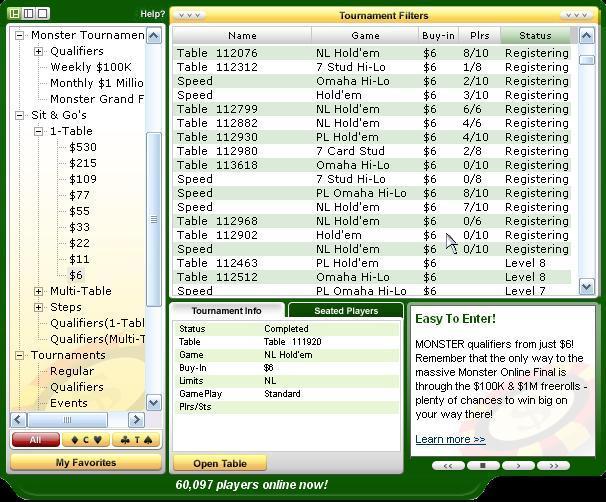
Looking for a change of pace . . . Was looking for something different and so decided to try a sit-n-go. Looking through my records, I noticed I hadn’t ponied up any actual cabbage to play a tourney since May. I'd merrily hopped into a few massive-entry freerolls with cash prizes (w/o much success). But no cash tourneys. So I gave it a go, partly thinking of it as a warm-up for trying to weasel my way (w/FPPs) into one of those WCOOP events on PokerStars.

I used to play a great deal of NL hold ’em, both ring games and tourneys. Lately, however, it’s been nothing but limit, usually 6-max. I decided that all of this short-handed limit experience might well have translated into some preparation for a limit tourney, so I joined a one-table, limit SNG over on Stars ($5.00+$0.50). I sat tight for the first two levels, as did most of the other eight players. At the start of level 3 (30/60) I got AhJd in middle position and raised it up and had a single caller. The flop brought an ace, scaring him off, and I won a smallish pot. Lost it back on a hand where I had to let my KQ go after a board with two jacks and two nines incited some worrisome action. Picked up big slick and 600 more chips and was up to 2,180 by the end of level 4.

The next couple of levels were uneventful for me. Meanwhile, three other players were sent to the rail. Then came a hand where I turned the nut flush and I was up to 2,830 in chips (2nd place). A dead-card stretch followed, and by the end of level 6 we were down to four players and I was down to 955 chips. I was dealt 7dAc and had to go all-in; unfortunately, the chip leader was there with me holding AdQc. A seven hit, and I was still alive. I was crippled the next hand, however, when I was dealt another ace and flopped top pair-nut flush draw only to lose the hand to pocket rockets. I was down to 410 chips (barely two big blinds) and had resigned myself to bubble boy status when I saw the third place player (with 1,540) raise it up from the BB. I folded and watched the chip leader (with over 8,000) call him from the SB. The flop came 3d9c6h. Check, bet, call. The turn was the 3h. Again -- check, bet, call. The river brought the As. Bet. The third place player paused and put in his last 340 chips. He had kings. The chip leader had an ace. I was in the money.

I was bumped in rapid fashion, happy to escape with $9.00 (a $3.50 profit) for my efforts. I wasn’t particularly proud of how I’d played, but the cash nevertheless gave me the confidence (and part of the buy-in) for another limit SNG, this time over on Party Poker. The structures there are slightly different ($5.00+$1.00; 10 players instead of 9; start with 2,000 chips instead of 1,500). The players were different as well, with a lot more loose (and downright erratic) play then I’d seen in the first tourney. Some of these guys clearly seemed like NL players who’d stumbled into a limit SNG by accident. (They may well have . . . it isn’t hard to do, the way Party arranges and displays their tourney list.)

Had a weird hand early on where I picked up kings in late position and had two players call. The flop came 7d7hAd. The first player to act bet out and the second raised. I thought for a moment and gave it up, figuring one must have the ace (and the other possibly the seven). They battled to the end of the hand, building a largish pot for so early (about 1,700 chips by the end), only to show King-high and Queen-high. I’d been successfully bluffed out of the hand -- something that would’ve been a lot harder to pull off in a ring game. How was I gonna deal with these crazies?

It was simple, really. Patience. Indeed, both of those involved in that hand were gone by the end of Level 4, and by the end of level 5 we had already made it down to three (and the $$$). This time I had more of a fighting chance, with about 4,000 chips (my opponents each had around 8,000). Even though I was outchipped, I sensed both of my opponents to be on the tight side, and was able to steal blinds and pots with regularity. Once we got to heads-up, I had about a 2-to-1 chip lead. My opponent escaped a couple a times with fortunate rivers, but I finally took his last chip when my Ks8s outlasted his Qs2s. A nice $25 cash (minus the $6 buy-in) for a little over an hour’s work.

Felt pretty good to win the second time out, although I know better than to think too greatly of the accomplishment. I played the second SNG well, but also benefitted quite a bit from being up against some below-average players early on, then some timid ones at the end. I do believe all the short-handed ring games helped, though. Now that I think about it, playing the SNG really wasn’t that much of a change of pace. Since the blinds come around more frequently in the 6-max game than in full-table, one is generally forced to act with some frequency -- it simply isn’t profitable to sit and wait for premium hands. The ever-increasing blinds (and the threat posed by larger stacks) in the SNG forces action in a similar way. Also, both games reward well-timed aggression and tend to punish passivity.

There are probably other parallels, but I haven’t sorted them out. Will probably keep giving the SNG’s a go here, at least as long as they remain interesting and profitable. Don’t know yet if I’ll waste my FPPs on that WCOOP satellite or not. I’ve mostly preferred buying books with those, actually, over in the PokerStars FPP store. That’s the way it is with us short stacks. Always playing the angles. Always on the cheap.

Image: PartyPoker screenshot.

Labels: , , , ,

Newer Posts
Older Posts

Copyright © 2006-2021 Hard-Boiled Poker.
All Rights Reserved.