Tuesday, March 04, 2014

Assigning Bradshaw and McGuire

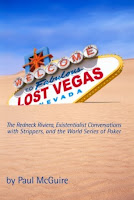
Among the readings I assign in my “Poker in American Film and Culture” class is a chapter from Paul McGuire’s Lost Vegas: The Redneck Riviera, Existentialist Conversations with Strippers, and the World Series of Poker.

The chapter comes from the latter part of the book when Dr. Pauly is at his most cynical regarding the commercial spectacle of the WSOP, the chapter ending with a funny punchline about Phil Hellmuth’s increasingly elaborate entrances to the Main Event up to that point (2008).

Pauly suggests Hellmuth try riding in one year on a donkey. “I can only imagine the snarky headlines,” he writes. “‘Ass Rides Ass to WSOP.’”

I assign the reading alongside another favorite of mine, Jon Bradshaw, writing in Fast Company about a much smaller World Series of Poker happening some 35 years before. I’ve reviewed Bradshaw’s book here before, an excellent example of long form journalism that includes several great essays, including the one about Johnny Moss I have my students read.

Unlike McGuire, Bradshaw is much more admiring of his subjects whom he treats almost as though they are larger than life. Both authors are insightful about the WSOP and poker’s broader relationship to American culture, and the contrast of their perspectives gives the students a lot to consider which makes the discussions especially enjoyable for me.

Some occasionally find Pauly a little snarky. But most are entertained and enjoy the inventiveness of his style. And they respond, too, to his overall point about the commercialization of the game, something which indeed reflects larger trends happening in America not just in poker but in other cultural forums, too.

Anyhow, the discussion this week reminded me of how much I enjoyed Pauly’s book. If you’re interested in the WSOP’s history -- and in particular that 2005-2008 period he covers most closely -- and haven’t read Lost Vegas before, I recommend it.

A lot has changed over the last five years at the WSOP, I think, and, of course, in poker, generally speaking and its place in the U.S. over the same period. And of course it has all changed even more dramatically since the 1970s when Bradshaw wrote about poker and gambling and the WSOP. But many of the observations made in both books still apply, too, which along with the strong writing is why I recommend both.

Labels: , , , , , ,

Friday, December 10, 2010

eBook Gift Ideas (McGuire & Angelo)

eBookI suppose I’m pretty much an “old school” guy. In some respects, anyway.

To give you an idea, it really wasn’t until I was pretty far along in my academic career that I started writing papers on a computer. Up to then used a typewriter, natch. In fact -- if you can believe it -- I would sometimes literally “cut and paste” sentences out of drafts when putting together an essay.

Yeah, I know what your thinkin’. Right, grandpa... and this was all done by candelight, yes? And did you ride on back of the horse or were you pulled in a carriage to get to class?

All of which means when it comes to books, it shouldn’t be that surprising to hear that I’ve yet to try out the Kindle or any of the other many “eBook” readers out there about which I’ve heard such good things. I’ve also resisted making my hard-boiled detective novel, Same Difference, available as an eBook, although perhaps I should consider doing so at some point.

Anyhow, I wanted to share the news about two poker-related titles that have recently been made available in the eBook form. These are both books I like a lot (in the print versions I own), and would certainly recommend either to any of you trying to come up with holiday gift ideas for your poker-playin’ buds who can presently handle this whole eBook thing more comfortably than can I.

'Lost Vegas' by Paul McGuire (2010)One is Dr. Pauly’s chronicle of his Vegas experiences, circa 2004-2008, titled Lost Vegas: The Redneck Riviera, Existentialist Conversations with Strippers, and the World Series of Poker. The book mostly focuses on the good Doctor’s reporting on the WSOP, although there is much else in there, too, that together helps create an interesting and provocative commentary on Las Vegas and its current place in our culture.

I reviewed Lost Vegas for Betfair shortly after it appeared this summer, if you want a more extensive rundown of what you can expect to find in the book. And like I say, if the eBook thing works for you, you can now pick up a copy in that form (click here for more info).

Another fave poker title of mine has also recently become available as an eBook, Tommy Angelo’s excellent Elements of Poker. It has been just about three years since this one first snuck onto the scene, not really a strategy book but more of a “how to think about poker” kind of text that features a lot of insightful, clever writing and discussion.

'Elements of Poker' by Tommy Angelo (2007)I reviewed Elements here on Hard-Boiled Poker some time ago. Just a couple of weeks ago the book became available as an eBook, and you can head over to Angelo’s site for more info on that.

Taking the new eBook version of Elements as an occasion to do so, I interviewed Angelo for Betfair poker, and that interview just went up today. Those familiar with Elements or his articles -- or who might have heard him interviewed elsewhere -- know that he’s an especially interesting (and funny) guy. And if you aren’t familiar with the poker coach and author, the interview should serve as a decent introduction.

Like I say, I’ll get around to this here eBook stuff soon enough. Am actually looking at moving here soon, and am feeling a little sick inside at the thought of boxing up these hundreds and hundreds of books I’ve accumulated during my lifetime and carting them to a new location. I’m thinking this move may very well push me over the edge to give the eBook thing a try. If I survive it, that is.

Labels: , , , ,

Friday, August 20, 2010

Scott Pilgrim’s Progress & Poker

'Scott Pilgrim vs. the World' (2010)Vera Valmore and I went to the movies last night. Haven’t done that too often lately. Seems like doing so always requires more time and money than we’re willing to spend. But the stars aligned and we found ourselves at the nearby cinema watching -- and enjoying -- Scott Pilgrim vs. the World.

I didn’t know too much about the movie going in, other than it was based on a comic book or graphic novel or something. And George Michael from “Arrested Development” was in it.

The movie’s style definitely reproduces the narrative cues of comic books and graphic novels. Sort of like Creepshow did way back when with its mimicking of old ’50s horror comics. Scott Pilgrim also incorporates a lot of the elements of storytelling from video games, especially those in which one creates characters and engages in various battles in order to rise through different levels and “unlock” new features.

All of which made for a fun ride with lots of action and, well, cool stuff to look at. Like a lot of movies these days.

On the level of theme, one could argue the movie also reproduced the depth of some video games and/or comic books. Not saying it wasn’t a thoughtful story with some reasonably meaningful insights about human nature and relationships. It’s just that the surface perhaps tends to distract the viewer from all that.

Thus do you end up in the parking lot afterwards not really thinking about deep messages, but instead practicing your karate kicks.

As I’ve already suggested, the story involves the main character fighting a series of battles (against “the world,” it seems)... a little like moving up in stakes or advancing in a tournament in poker, I suppose.

The character of Pilgrim does experience the highs and lows that often happen in poker when you move from novice to amateur to whatever you call yourself now. Such as when you feel like a world-beater after hitting that draw, or like an incapable failure when you miss. There’s even a bit in there about playing against yourself that poker players might be able to relate to as well.

All of which is to say, Scott Pilgrim vs. the World may well have some appeal to online poker players. More so than Eat, Pray, Love, I’m just guessing.

So, if you’re reading this blog (in which case you probably do play online now and then), and are looking for a movie this weekend, you might check it out.

Paul 'Dr. Pauly' McGuireIf you’re reading this blog you probably also read Dr. Pauly’s Tao of Poker, and thus might be interested to read my interview with the Doc which went up over on Betfair Poker today. I asked him a few questions about his recently-released book, Lost Vegas, as well as about writing, generally speaking. Enjoy.


Okay, signing off now. Have a good weekend. Gotta go practice my karate kicks.

Labels: , , , , ,

Friday, August 06, 2010

Her Name Is Rio

Rio All-Suite Hotel and CasinoToday my review of Paul “Dr. Pauly” McGuire’s Lost Vegas appeared over on the Betfair Poker site. For those of you who haven’t picked up a copy yet, check out the review to learn what the book covers and my overall take.

Book reviews are always a bit challenging to write, for a variety of reasons. One problem I always end up facing is having to choose between several different points I want to make about the book. That is, I can’t reasonably share every little response or observation I might have had while reading the sucker, so I have to be selective and often end up setting aside certain points in order to keep the review at a manageable length.

One point about Pauly’s book I had written down but didn’t end up including in the review regarded his account of the 2005 WSOP, in particular his description of Binion’s Horseshoe where the Main Event was concluded -- the last time the WSOP was played there.

As is the case throughout Lost Vegas, Pauly doesn’t shy away from telling it like it is when it comes to describing Binion’s, noting how the place had deteriorated by then into a less than desirable destination for anyone traveling to Vegas, let alone for the WSOP.

However, as Pauly notes, “What Binion’s lacked in class, it made up for in character.” Here Pauly ends up writing a nifty little elegy to the Horseshoe, a tribute of sorts to the birthplace of the WSOP focusing on the moment the WSOP left it for good. Rather than go on at length here, I’ll let those of you who have picked up the book read what Pauly has to say about how “Benny’s Bullpen was a post-modern version of the Roman Coliseum where gladiators fought to the death.”

Like I say, I ended up leaving that comment about Pauly’s discussion of Binion’s out of my review. I was thinking about it again this morning, though, as I read some of the rumors about Harrah’s having finally sold the Rio All-Suite Hotel and Casino.

Some are saying the deal has been done, and thus the WSOP will necessarily be looking for a new home in 2011. Pokerati’s short blurb about the sale a couple of days ago appears to have gotten the rumor mill churning in earnest this week. However, the official word from the WSOP appears to be that as far as its concerned the Rio remains a Harrah’s property and thus plans for the 2011 WSOP -- at the Rio -- continue to proceed.

Actually, rumors about the WSOP leaving the Rio began back in the spring, and there was a lot of talk this summer about where it might possibly go. When I interviewed Nolan Dalla, the WSOP Media Director, for Betfair last month, I asked him about the rumors, knowing full well that even if he knew anything he wouldn’t be able to tell me one way or the other what was up.

Dalla’s answer to me was nevertheless forthright. He said to me that “anybody who thinks they know the answer to that question [then, in early July] doesn’t know what they are talking about.” He added that the issue would be examined by Harrah’s soon after the WSOP concluded, but that “those discussions really haven’t started that much yet.”

Whatever happens with the WSOP in 2011, I think it is interesting to compare what people are saying about the WSOP perhaps leaving the Rio with the often nostalgia-tinged sentiments expressed back in 2005 when the Series left Binion’s.

Of course, for me the WSOP and the Rio will always be closely associated, given that I’ve never had the chance to see it played anywhere else. I haven’t any particular fondness for the place, but it has seemed to me a suitable enough location to accommodate the spectacle the WSOP has currently become.

Will be curious, though, to see what happens next for the WSOP. And -- if it does leave the Rio -- what sort of “elegies” (if any) will be written about the WSOP during the Rio years.

Labels: , , , , , ,

Friday, July 30, 2010

Summer Reading

Summer ReadingNot a lot of time to write today, I’m afraid. I assume that’s okay, though. Lots of other summer reading available to you, if yr looking for such.

For example, there have been a ton of articles popping up all over concerning that House Financial Services Committee vote in favor of H.R. 2267, the Internet Gambling Regulation, Consumer Protection, and Enforcement Act. Seems like everyone has something to say about it. I added a couple more cents on the subject over on the Betfair poker site today, too: “Online Poker in the U.S.: On the House Financial Services Committee Vote.”

Incidentally, I have decided to create an archive page from which I’m linking all of my Betfair columns. Have had the chance to do a lot of fun things over there, including interviewing several folks and reviewing a number of poker books. I’ve made a little banner down the right-hand side which will get you to the page, or you can just click here to see it.

Was thinking of doing something similar with some my old PokerNews stuff, too -- that is, creating a page that links to the book reviews and all of those “Poker & Pop Culture” columns I wrote for them. In fact, I’m still working on all of my archive pages, including those for the various sections here on Hard-Boiled Poker (e.g., On the Street, The Rumble, etc.). Hope soon to have all that stuff in order and up to date.

'Lost Vegas' by Paul McGuire (2010)Speaking of book reviews and interviews, I’m continuing to read and enjoy Dr. Pauly’s chronicle of his time reporting on the WSOP (plus his other Las Vegas-based adventures). I am of course referring to his recently-published book Lost Vegas: The Redneck Riviera, Existentialist Conversations with Strippers, and the World Series of Poker. I’ll probably be penning a review of the book soon, and plan to try to interview the author about it, too.

Kind of an uncanny feeling, reading about all of these “characters” I’ve gotten to know over the last few years. Indeed, a lot of what I’ve been experiencing thus far has been a lot of filling in of gaps in my personal knowledge of my fellow bloggers and other media types, as well as in the recent history of the WSOP. A lot of “ahh... so this is where he/she came from” moments so far. Also a few “a-ha!” moments, too, with regard to certain mysteries and other behind-the-scenes stuff at the WSOP circa 2005-2008.

I haven’t quite finished the book, although I can already recommend the book to anyone interested in the poker media, Las Vegas, and particularly the post-boom growth of the WSOP over the last few years. Kind of feeling like PokerVixen was a few days ago when she tweeted “I’m this >< close to finishing @LostVegasBook. I’ve stopped though because I don’t want it to end.” Go visit Dr. Pauly’s Lost Vegas site for details about ordering.

And after you’ve done that, go have yourself a relaxing, air-conditioned weekend.

Labels: , , , , ,


Older Posts

Copyright © 2006-2021 Hard-Boiled Poker.
All Rights Reserved.