Tuesday, April 12, 2016

Nolan Dalla Interview, July 2010

This morning I noticed a bit of conversation over Twitter regarding this petition that has appeared online. The petition seeks to encourage the World Series of Poker to eliminate all rake from the Main Event as well as to start a “revenue-sharing program to supplement the prize pools” with money generated from ESPN and other sources.

It’s a pipe dream, no doubt, although the petition did cause some to recall how, in fact, the WSOP Main Event was not raked as recently as 2002 (when it was still under the Binion’s Horseshoe aegis). That historical tidbit reminded me of a conversation I’d had several years ago with Nolan Dalla who for many years served as the Media Director for the WSOP. (I believe his current title is “WSOP.com Senior Writer.”) Actually the conversation was an interview I did of Dalla during the 2010 WSOP for Betfair Poker.

We started that interview talking about the WSOP circa 2002, in fact, just before the “boom” happened and Harrah’s acquired the WSOP. After a little hunting around I found that like other older articles I’d done for Betfair the interview with Dalla also is no longer available online. It took some more hunting, but I eventually found the sucker, and as I’ve done before here with some of those items that have disappeared I thought today I’d share the Dalla interview here.

I like this one a lot, not just because of the nostalgia it evokes thinking back to 2010 and the various WSOP-related topics of interest back then. I think my favorite stuff comes at the end where we get into the topic of tournament reporting and the relative place of writing about poker.

* * * * *

“The Betfair Poker Interview: Nolan Dalla”
[Originally published at Betfair Poker, 7 July 2010]

The WSOP Main Event is now underway, and I remain at the Rio both this week and next to help cover the Series for PokerNews.

Anyone who comes to the World Series of Poker to report on it likely comes into contact at some point with Nolan Dalla, Media Director for the WSOP, and -- I would venture to add -- likely benefits immensely from having done so. As one of my colleagues noted just a day ago, “Nolan Dalla is better at his job than anyone I know is at theirs.”

I had the opportunity this week to sit down with Dalla to ask him a few questions about his involvement with the WSOP over the years and about how this year’s Series has gone.

Short-Stacked Shamus: You’ve been WSOP Media Director since 2002. Let me start by asking -- how did you end up in this role?

Nolan Dalla: Well, quite by accident, really. I was in the middle of a perfect storm, so to speak. Back in 2002, we really didn’t have many media here coming to the World Series. There were a few poker writers, and 300 or 400 people played in the Main Event -- nothing like the scale of today. Then everything pretty much changed my second year with the World Series working for Binion’s Horseshoe.

I had moved to Las Vegas and was the Director of Public Relations for the Horseshoe. A lot of people don’t remember that right before Chris Moneymaker won the WSOP Main Event in 2003, the Horseshoe and the World Series were on the rocks. The World Poker Tour had just started and their numbers were enormous over at the Bellagio -- they were actually beating us. And here I was working at the Horseshoe and it felt like we were rearranging the deck chairs of the Titanic and the ship’s getting ready to go down. That really was the prevailing attitude.

SSS: Wasn’t the World Poker Tour talking about buying up the World Series?

ND: They actually made a cash offer. I remember I was in the office when a fax came in. I can’t say what the figure was, but I remember that figure was looked at and considered, and boy, it was a bargain basement price at the time, considering what [the WSOP is] worth now. Nobody could really have foreseen how everybody’s life would change in May 2003 when Moneymaker won.

When I talk about a perfect storm, it was ESPN’s first year [doing a multi-part series on the WSOP], Chris Moneymaker, the everyman, wins the Main Event, and I just happen to be the Media Director. I think I knew it was going to be a big moment, but I don’t think I realized how big a moment until I looked at my cell phone [after Moneymaker won] and I saw the David Letterman show, CBS, the New York Times, the Washington Post, ESPN... it was like whoa! And everyone’s life, including my own, changed from that point forward.

SSS: So here we are in 2010 and the Main Event is underway. From your perspective, how has the 2010 World Series of Poker gone thus far?

ND: Well, the World Series is up. The economy is still bad in a lot of places, but the World Series just seems to be recession-proof. I have to admit that every year I think “When is it ever going to catch up?” You would think at some point that this momentum shift would stop, but again it appears that the [2010] World Series is going to be way up from last year. This Main Event could and should be the second-largest poker tournament in history. [Indeed, the Main Event drew a total of 7,319 entrants, making it the second-largest live poker tournament ever behind the 2006 Main Event.]

SSS: A lot of us were curious about how the World Series would go after the departure of Jeffrey Pollack as Commissioner, who I think a lot of people felt like contributed quite a bit during his tenure. Is there anything that has been different without a Commissioner?

ND: It’s a fair question. I think that most of us who worked with Jeffrey look at that period very fondly. He did enormous things for the World Series from 2006-2009, and certainly he’s left an indelible imprint upon the World Series. However, I will say that the new management team -- starting with Ty Stewart, Seth Palansky, Howard Greenbaum, and others -- have been around this game for many years and they have learned, as we all have, from some of the mistakes we’ve made years ago and we seemed to have gotten it a little bit better every year until we’ve reached this point.

I think anyone who has come to the World Series this year has to say that the facility, the comfort level, the organization, everything about it is much better. Is it perfect? No. Can it get better? Yes. But I think that as far as the World Series of Poker experience goes, I don’t think it’s ever been higher in terms of satisfaction.

SSS: I had a chance this year to help cover the Ladies Event, where there was some controversy when a few men entered. So I was there when you came and said a few words before the final table in support of the Ladies Event. Comment a bit on what you said there.

ND: We need more women in poker. No one can disagree with that. That is a good thing. And women’s poker tournaments and the Ladies World Championship fosters that greater participation. No one can disagree with that. That’s a fact.

I think for anybody to upset what I call a fragile balance that exists, I think that’s a bad thing and is counterproductive to the game -- not just to the women in poker, but to the game. I understand other people have their own agendas and they may have their political views with regard to equal rights issues and all of these things -- that’s all fine. But the bottom line is what is good for poker? What is good for the World Series of Poker? And that is to protect the integrity and tradition of that event. The Ladies event started in 1977 -- that is 33 years!

Unfortunately we have to let this issue play out, maybe in the courts or wherever this fight and this discussion is going to take place next. But I think there are a lot of us who really want this tournament to continue and are going to do everything we can to make sure it continues.

SSS: Back in February I enjoyed an article that you wrote about your most embarrassing moments at the World Series...

ND: Ha ha.

SSS: Not to make you draw attention to a particular embarrassment from this summer, but is there anything that’s happened here in 2010 that maybe would wind up on an a list like the one you compiled for that article?

ND: As you know in this job there are a lot of hours you put in and if you see a lot of things it is kind of like the law of large numbers -- you make more errors. And I’ve sure made my fair share over the years. And sure, I’ve had a few more this year and I think that I’ll do a follow-up column and it won’t be the ten most embarrassing moments but maybe the 20 most!

SSS: I can identify with this very strongly. You put in a 14-hour day and you do your best to be perfect and cover everything, but it can be a challenge.

ND: Yes, and it’s a shame also that you just don’t have the mental capacity to talk to everybody you want to, to get to know everybody you want to. Because, really -- and I really believe this -- there are 65,000 people who have played in events this World Series so far, and there are 65,000 stories out there, if you go after them. Everybody has something to say. The problem is there are only 24 hours in the day.

SSS: Even if you knew, I don’t think you could answer this next question. But where do you think the World Series of Poker is going to be next year?

ND: Yes, everyone is speculating [about whether the WSOP will relocate from its current home at the Rio All-Suite Hotel & Casino]. That is the big question everyone will probably be asking once this Main Event ends. It’s appropriate because people care where they are going to be playing. And I can tell you that anybody who thinks they know the answer to that question doesn’t know what they are talking about. The Harrah’s organization will examine all of the options, and those discussions really haven’t started that much yet. So anybody who thinks they have inside information, they really don’t.

SSS: What I keep hearing is “A dealer told me that it was going to be...” and generally the sentence is finished with wherever it is that dealer is dealing.

ND: Haha, yes. Any property in Las Vegas would love to have the World Series, with all the people eating in the restaurants, staying in the hotel, gaming, and the excitement and publicity that it generates. The World Series of Poker is really Las Vegas’ best infomercial. Forget about that “What happens in Vegas, stays in Vegas” campaign, the best informercial for Las Vegas is the WSOP. And so any casino would love to have this event at their place, and it is just a matter of seeing where it will end up.

SSS: Okay, last question. You’re the WSOP Media Director, so you spend a lot of time helping those of us who report on the WSOP and try to give us what we need and make it so that the covering of the World Series is as successful as it can be. What is your impression about how the WSOP is covered currently and do you have any ideas about how it could be done differently?

ND: Boy, that’s a great question. I don’t think I’ve ever been asked that. I had a very interesting conversation with a reporter from USA Today -- we were talking last night at dinner, in fact. And he said that he thought poker was tailor-made for the internet. And he’s right -- the immediacy of the internet, and people turning on a computer in 115 different nations and say -- bam -- Phil Hellmuth just busted out two seconds ago, that’s incredible.

Really no other sporting event is quite like that. With football, you watch it live and after it’s over it’s done. But with poker afterwards you have these logs, and hand histories, and you can look it over and have this great amount of information. I don’t think that really exists in football or baseball or in major sports -- the detailed information of what goes on, which is really a testament to what the reporters do. To be able to detail all the hands, all the players, all the quirks, all the stories...

So I agree that this is a game that is tailor-made for the internet, and I expect that to be the major focus [of WSOP coverage] as we move into the next few years.

SSS: When you say that it makes me think that there is something about poker -- that ESPN can do what they do, and we can put cameras on people playing and watch it happen -- but there’s something about poker that almost requires it be narrated, that is, put into words. And the immediacy of the internet helps us tell those stories almost as they are happening.

ND: You just nailed it there. If you watch something, sure it is interesting. But having someone there creating a mental picture of what happened... it’s kind of like how they say the book is always better than the movie.

I’ll tell you something, I’m astonished the talent that has come into this game as far as writing goes, especially in the last three years. There are some really fine writers, and people who come from all walks of life, who have come into this game. We didn’t really have that five years ago. Not that poker writers were bad, but we’ve got some extraordinary talent and people who love and are passionate about the game and that really comes through in the coverage now. I mean on many sites, not just the news sites, but the bloggers, reporters, everybody.

Much thanks to Nolan Dalla for taking the time. And speaking of good poker writing, if you are looking for a excellent read about one of poker and the WSOP’s most fascinating figures, let me recommend to you One of a Kind: The Rise and Fall of Stuey ‘The Kid’ Ungar by Dalla and Peter Alson.

* * * * *

Here are some other, older interviews I’ve reupped here, if you’re interested:

  • Catching Up With Kevmath (from February 2010)
  • Jesse May Interview, April 2011 (Part 1 of 2)
  • Jesse May Interview, April 2011 (Part 2 of 2)

    Labels: , , , , , ,

  • Wednesday, June 25, 2014

    Couldn’t Have Played It Any Better, Mike

    Heard that recent announcement that Mike Johnson, the longtime co-host of the Two Plus Two Pokercast and before that Rounders, the Poker Show, is going to be stepping away from the poker podcast game in mid-July following the end of festivities this summer at the WSOP. His co-host Adam Schwartz started an “Official Mike Johnson retiring from the Pokercast thread” over on 2+2 where many are chiming in with appreciations and other grins inspired by Johnson.

    I can’t begin to count how many times I’ve written here about either the old Rounders show (which I began listening to shortly after it came on the air way back in April 2005) or the Pokercast (which started at the beginning of 2008). Those shows have inspired countless topics over the years that I’ve taken up here, with Mike and Adam both consistently presenting thoughtful, interesting takes on innumerable issues affecting the always interesting poker world.

    Last year I had a chance to interview the two of them for Betfair Poker, and they shared a lot of great stories about the history of the show as well as thoughts about the place of it within our little idiosyncratic world of “poker reporting” (or whatever you want to call it).

    I’ve also had the chance to meet Mike a few times at the WSOP over the years, including covering him occasionally when he played in events. The most memorable such instance of the latter concerned what was probably one of the more painful moments Mike ever endured at the WSOP.

    It was 2011 and Mike was playing in the Main Event, and right near the end of one of the Day 1 flights he got involved in a big hand versus the Russian player Yury Gulyy. In the hand Mike successfully got Gulyy to commit his entire stack on the turn on a 10-high board, at which point Gulyy then turned over Q-Q and Mike showed his K-K.

    It was a huge pot, one that would’ve placed Mike right near the chip leaders to end the day. But alas for him a queen came on the river, knocking him almost all of the way back to the starting stack.

    “Did you see that, Shamus?” I remember Mike calling out to me that night, just after the hand had ended and the chips were being shipped to his opponent.

    It was during the end-of-night scramble for counts and other loose-end-tying activities, and for some reason I just happened to have been passing through his section on my way to where I was stationed on the other side of the Amazon Room. That’s when he related the hand details to me, which I’d report for PokerNews and then write-up a more detailed story of later on Betfair. Regular listeners of the Pokercast might well recognize that hand, as it continues to come up from time to time.

    As we talked about a little in that Betfair interview, I think Mike and Adam have provided an incredible service to the poker community over the last almost-decade. Sure, they’ve been doing something they love to do -- it’s obvious -- but while doing so they’ve given a valuable voice for players and everyone else who cares about the game with their reporting and interviewing. They’ve also kept us plenty entertained, too -- check that 2+2 thread for dozens of memorable instances proving that. That pic above, by the way, is a still from Bet Raise Fold containing a shot of Mike (left) and Adam (right) doing their show.

    As someone who has stuck with them pretty much without interruption since the very beginning, I’ll miss Mike and what he’s given to us over the years, although as someone who has also been plugging away at discussing poker for nearly as long, I can definitely sympathize with wanting to take a break. It’s an endlessly fascinating game and subculture, but it can be exhausting, too -- it just never stops!

    Anyhow, wanted to use some space here to wish Mike Johnson well and encourage everyone to tune in for these last few shows with one of the poker podcasting greats.

    “Oh, I couldn’t have played it any better!” said an exasperated Mike after that painful Gulyy hand. Looking back at his long, consistently high-quality career helping create Rounders and the Pokercast, I’d have to say the same thing about that performance, too.

    Labels: , , , , , ,

    Friday, May 10, 2013

    Here’s Mike and Adam

    Had a chance recently to interview a couple of dudes with whom I’d guess just about anyone reading this blog is familiar -- Mike Johnson and Adam Schwartz of the Two Plus Two Pokercast. The interview is now up over at Betfair Poker, and features the pair talking about what has now become an eight-plus year run at poker podcasting.

    I’ve written here many times over the years both about Mike and Adam’s original podcast, “Rounders, the Poker Show” (that ran from April 2005 to December 2007) and the 2+2-based show they’ve been doing since January 2008. A remarkable run not just for podcasting, but for poker, too, where there are very few on the reporting side of things who’ve lasted that long.

    In the interview the pair start out talking about how the original “Rounders” show got started, discuss the move to 2+2, and then share some thoughts about memorable moments and guests. The conversation next moved over to consider their contribution to the chronicling the story of poker -- especially online poker -- over the last eight years. I got them to opine a little toward the end about the state of “poker media” (so to speak), too.

    Regarding that latter subject, Mike brought up a point about the passion many who get into reporting on poker demonstrate, which he attributed to the fact that the great majority of those who write and report on poker play the game as well. (Such is true of the two of them.)

    I think Mike’s right on that count, that is to say, just about everyone who takes a shot at podcasting about poker or writing/reporting on poker in some fashion is at the very least a casual poker player, with many being a lot more serious about the game than that. I also think that among those who end up sticking with poker reporting for a lengthy period the amount of time spent playing the game often begins to wane (something I’ve experienced), but there nonetheless still exists that ability to think about the game from a player’s perspective.

    Kind of makes poker different from other sports and/or other subjects of news reporting, if you think about it, in which that overlap between participant and observer isn’t so great.

    With most sports, for instance, ex-players frequently become broadcasters or get involved with the media, but they necessarily do so after their playing days are behind them. Poker, meanwhile, doesn’t really feature players “retiring” and then moving over to the media side (except perhaps when it comes to that sort of gradual sliding away from playing to which I was just referring). That is, the line between the two -- player and reporter -- is not just blurry, it’s essentially non-existent.

    To build a little further on Mike’s point, when it comes to those few who have reported on poker as long as Mike and Adam have, it’s probably safe to say just about all of them have a special passion for the game that has sustained them. I know that is the case for Mike and Adam, and I think the poker community has a lot to be grateful for when it comes to what those two have contributed to the game over the years.

    It was definitely fun to talk to a couple of guys with such enthusiasm for poker, not to mention take a shot at interviewing a couple of the best interviewers in poker (in my opinion). Check out the interview.

    Labels: , , , , ,

    Monday, December 03, 2012

    Cliffs and Bubbles

    The term “fiscal cliff” has become ubiquitous these days, appearing in front-page headlines and being uttered by legislators and talking heads nearly every time they appear on our teevees. It is being used, of course, to characterize what may happen at month’s end should certain scheduled tax increases and spending cuts designed to reduce the U.S. budget deficit be allowed to occur once the calendar turns over to 2013.

    I believe the metaphor was partly chosen as a reference to the quick, sudden reduction in the deficit that would result if the so-called Bush tax cuts were allowed to expire (and thus many folks’ taxes go up) and all of these spending cuts mandated by the Budget Control Act of 2011 allowed to kick in as well. Imagine a graph with a line steadily going up, then plunging downward to indicate the deficit reducing. Resembles a cliff.

    Of course, the metaphor takes on a much more fatalistic feel when people start explaining the immediate consequences of such abrupt changes, namely a big short-term hit to the overall economy as well as significant hardship to many. I’ve seen articles describing how Congress not acting to avoid the “cliff” would negatively affect pretty much everyone, in particular the lower- and middle-classes, while also having immediate impact on education, health, jobs, local governments, and so on. Rather than simply referring to a graphic representation of the deficit being suddenly cut in half, then, the “fiscal cliff” becomes a kind of impending doom that will necessarily befall many should lawmakers fail to act to extend current policies and delay those mandatory tax increases and cuts to spending.

    All is apparently on the table when it comes to these negotiations. In fact, last week The Motley Fool even brought up online poker again as a potential revenue source, kind of obliquely suggesting that some sort of federal legislation regarding online poker could crop up amid the discussions. But with four weeks to go the headlines suggest that an agreement resulting in something other than the “cliff” is still some ways off.

    Thus are the talking heads becoming increasingly despairing as the metaphor further evolves into something even more dire. Now the nation is said to be speeding along together in a car with our elected officials fighting with one another over the steering wheel, gear shift, and pedals. We’ve passed a “BRIDGE OUT” sign, but are continuing forward nonetheless. I suppose if nothing changes by the time we reach December 21st -- i.e., the date long targeted by popular yet misguided interpreters of Mayan history and other kooks as having been scheduled for Armageddon -- the apocalyptic tone of “fiscal cliff” references might accordingly increase.

    Makes me think a little of that favorite metaphor in tournament poker, the bubble. I once wrote a piece for Betfair Poker -- “On the Bubble” -- in which I discussed the origins of the term and speculated about its entrance into poker lingo. Real bubbles are so ephemeral, yet the metaphorical bubble seems as though it has become a permanent part of poker tourney talk.

    As I allude to in that piece, the term became linked with failed investments or schemes like the “South Sea Bubble” of the early 18th century wherein people saw their investments in a trading company become suddenly worthless. In that context the bubble bursting is a disastrous event for all. But by the time the bubble bursts in a poker tournament, only one person experiences hardship. Meanwhile, for everyone else the moment represents something decidedly more pleasant (and profitable).

    Even so, approaching “the bubble” is much, much less anxiety-producing than approaching a “cliff,” wouldn’t you say? Something I assume those who originally thought to use the latter term to characterize the current scenario well knew.

    Labels: , , , ,

    Tuesday, March 06, 2012

    Something for the Short Stacks

    For the short stacksOnline poker players falling into the “micro” or “low” stakes groups probably noticed a few tourney series happening in March that include events that potentially jibe with our short-stacked budgets.

    The one over on the Merge network of sites, called Poker Maximus, started a couple of days ago and features 70 different events over the next three weeks. A lot of these tournaments have small entry fees which encourage those of us with tiny rolls on the sites to participate.

    The first Poker Maximus event happened on Sunday, a $10+$1 no-limit hold’em tourney that had a $15,000 guarantee. A total of 5,055 entered, which meant a prize pool of more than $50K, with the winner earning a cool $7,384.85. Looks like there are about 15 more of these $11 buy-in events, as well as a few with smaller buy-ins, too. Meanwhile, other events go as big as $200+$15, with a $500+$30 one at the end.

    Merge Network's Poker Maximus seriesI’ve mentioned before I do have a little bit of scratch on two Merge sites, Carbon and Hero, having won my rolls there in freebies last year (post-Black Friday). I continue to toil for pennies and nickels on both sites. Occasionally I’ll hover the cursor over my opponents’ avatars to see what countries they are from, and invariably all or nearly all are United States players. Not surprising, given how Americans looking for where to play poker online have so few options.

    I’ll probably risk a few bucks here and there to play in a couple of these Poker Maximus events, although I’ll need to be careful not to risk so much as to find myself out on my gluteus maximus should I bust.

    Another series even more squarely aimed at the micros is the one recently announced by PokerStars, the MicroMillions (which, sadly, we Yanks cannot play). That one will feature 100 different events with buy-ins ranging from $1 to $22, including a $0.11 rebuy tourney to kick it off.

    PokerStars' MicroMillionsThe Stars series will run from March 15th through March 25th. Here’s the full schedule, if you’re curious. You know they’ll be attracting some monstrous fields -- way, way bigger than the Merge ones -- meaning some decent prize money despite the low buy-ins. There will also be an ongoing leaderboard with the top 100 performers winning additional goodies, including $109 SCOOP tickets (11th-100th), $1,000 SCOOP tickets (2nd-10th), and a full 2013 PCA package for the 1st-place finisher.

    This would be the sort of series I would’ve loved to play if it had come around on PokerStars a year earlier. Indeed, just about all of my multi-table tourney play online has been of the low buy-in, big-field variety, which really is one of the cooler things online poker can provide that makes it different from live poker.

    Grand Series of Poker VIII at Betfair PokerFinally, the eighth annual Grand Series of Poker is happening right now over on Betfair Poker, another site unavailable to us Yanks. This one began last week and will be continuing through March 11, and features 18 different events covering a variety of games and buy-ins.

    And for the short-stacked types, there is a parallel "Mini-GSOP" happening at the same time in which the same events are playing out in which all of the buy-ins range from $5.50 to $22. My buddy Matthew Pitt is playing all 18 of the events (in both the regular GSOP and the Mini version) and writing about his experiences over on the Betfair Poker blog.

    Meanwhile I will have to settle for a few, carefully chosen shots in the Merge series, though, where we Americans play with those additional, vague worries about cashing out should we win. Not to mention the site remaining open to us, period.

    Labels: , , ,

    Friday, February 03, 2012

    Playing By a Different Set of Rules

    The rules don't apply to meWorked on a couple of different poker-related stories this week that shared kind of a common theme. Both involved people in power -- who, not coincidentally, were people with money and/or access to money -- enjoying considerably greater freedom and influence than the rest of us poor saps (jingle-brained and otherwise).

    One appeared over on Epic Poker, an entry for my “Community Cards” column on poker and pop culture that was inspired by the current presidential election. As we watch the Republicans continue with their debates, primaries, and caucuses in an effort to determine who will be their nominee to run against President Obama in November, I was reminded of an old story about another election in which Republicans were also trying to decide upon a nominee, this one for a U.S. senate seat in Minnesota back in the 19th century.

    The story appears in a neat 1899 collection of poker tales by David A. Curtis called Queer Luck and describes how two backers of opposing candidates found themselves pitted against each other in a high-stakes poker match.

    'Queer Luck' by David A. Curtis (1899)Eventually a five-card draw hand develops in which both pick up huge hands and after betting all of the money they have decide to add another, curious element to the pot -- namely, the promise of one that he’ll leave the state until the nomination and election is over so as not to be able to use his financial influence to promote his candidate.

    You can find out what happens in the column, titled “When a Poker Party Influenced a Political Party.”

    The other story concerned the recent headlines coming out regarding Full Tilt Poker, including those having to do with ongoing efforts to finalize that deal whereby Groupe Bernard Tapie will be taking over the site.

    You’ve certainly been following these stories, too, including the one from last week in which Subject:Poker alleged Chris Ferguson and his lawyer, the appropriately-named Ian Imrich, were seeking payment of about $14.3 million from FTP, with the article suggesting the situation could possibly threaten the deal from being completed. Both Imrich and the GBT lawyer have since refuted S:P’s take on the situation.

    Then yesterday Matt Kaufman (a.k.a. PokerSmell) of PokerStrategy shared another very curious bit of news regarding GBT’s lawyer saying Full Tilt Poker is actually owed “between $10 and $20 million” by several pros, including Team Full Tilt guys (Phil Ivey, Erick Lindgren, and Mike Matusow), ex-red pros (Layne Flack and David Benyamine), and perhaps most surprisingly, Barry Greenstein (of PokerStars).

    Kind of an odd juxtaposition of stories, with one involving FTP apparently owing a pro and the other concerning players owing Full Tilt. I delved into all of it for a feature over on Betfair that went up today, titled “More Full Tilt Poker Headlines for Players to Fret Over.”

    In any case, both of those stories highlight the extreme difference in status between the guys with money and/or access to it -- and the resulting freedoms and influence such status provides -- and the rest of us.

    Wimpy's dealWith regard to the FTP situation, I realize certain individuals are obviously at greater fault than others, but I still can’t help but be enormously peeved at the idea that pretty much all along there were those who were able to borrow hundreds of thousands from the very site on which they then played with the money. Never mind the fact that we now know thanks to FTP’s failure to segregate operating expenses from player accounts that the money being loaned to these players came (essentially) from our accounts!

    Anyhow, click on those links above for a couple of poker-related stories about corruption and injustice. And about how whenever there is money and power involved, there is generally always going to be a lot going on that is well hidden from the view of most.

    Labels: , , ,

    Friday, January 27, 2012

    Teachers Talking Out of School

    TeachersOne of the neat consequences of teaching my “Poker in American Film and Culture” class has been getting contacted by others with an interest in the course and/or who are themselves teaching college classes in which poker has a place.

    Recently I ended up starting a correspondence with a fellow named Bruce McCullough who has taught a neat honors course over at Drexel University called “Poker, Probability and Decision-Making.” He sent me his syllabus and I sent him mine, and we ended up exchanging a few messages before I suggested possibly interviewing him for a Betfair poker column.

    He agreed, and today the interview was posted. His class looks very interesting, and he really makes a great case for how poker serves as an excellent tool for learning about probability and decision-making. His own story about how he got into poker is quite fun, too.

    If you’re interested, go check out the interview, titled “Poker in the Classroom: Teaching Probability and Decision-Making.” I’m now imagining perhaps eventually taking to other folks teaching courses involving poker and having a little series of “Poker in the Classroom” interviews with them.

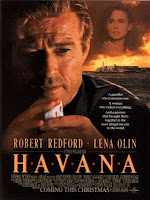
    During our exchanges Bruce recommended the 1990 film Havana to me as one I might want to consider including in my course. It’s an interesting and entertaining film starring Robert Redford as an American poker player named Jack Weil who finds himself kind of caught in the middle of the last days before the Castro revolution in Cuba at the end of 1958.

    'Havana' (1990)I ended up writing about the film this week over on the Epic Poker blog for my “Community Cards” column where I talked about the way it uses poker to flesh out Jack’s character. I also noted how there seemed to be a connection between poker and American identity being advanced in the film, with Jack -- the supposedly non-political American only interested in playing cards -- getting caught up in the revolution thanks largely to his attraction to a woman.

    The movie also has more than a few parallels to Casablanca which make it even more interesting to those of us who are fans of that film. I talk some about that as well in the “Community Cards” piece, but one item I don’t mention there is the fact that Jack owns some high-level textbooks on probability. Bruce found that detail quite interesting, as you might imagine, and so back over in the Betfair piece I asked him a little about that at the end of our conversation.

    So if any of these things interest you -- college courses involving poker, the subjects of probability and decision-making, the film Havana -- click them links above and let me know your thoughts.

    And if you happen to teach a class that involves poker or know about one, let me know about that, too!

    Labels: , , , , ,

    Thursday, August 25, 2011

    Linking Out

    Today I wanted to point to a few items elsewhere on the intertubes. What I've been doing besides sitting on the couch, seeing if it is going to wiggle again.

    My partner-in-crime Jen Newell and I contributed a couple of new columns this week for our “He Said/She Said” series over on Woman Poker Player. This time we decided to write about the incredible WSOP Main Event run made by the couple, Erika Moutinho and David “Doc” Sands, who finished 29th and 30th respectively.

    'He Said/She Said'There are a few reasons why I especially like writing these WPP columns. For one, they generally concern interesting topics and allow a chance to offer some personal opinion/perspective. I also get a kick out of seeing what Jen comes up with, too, as she invariably brings up different points or ideas. There’s also a significant challenge involved, trying to write as though representing the perspective of all men (not really possible, I’d argue, but interesting to try).

    Anyhow, if you click over you will find Jen commenting on how she responded to coverage of/response to the Moutinho-Sands story. Then you’ll see me share my response to it (while also talking about covering it), and in fact admitting to some of the biases Jen brings up.

    Epic PokerThere are couple of other items I’ve written recently I wanted to pass along. My “Community Cards” column on poker in popular culture continues over on the Epic Poker site. The most recent one, titled “Your Friendly Neighborhood Spider-Man Plays Poker,” concerns that lawsuit against Tobey Maguire being filed by those hoping to recover money he allegedly won off of a Ponzi schemer in that big Hollywood home game.

    Betfair PokerAlso, last week over on Betfair Poker I wrote something about the restart of my “Poker in American Film and Culture” course titled “Shuffle Up and Study.” There I talk a bit about the experience of teaching the class as well as how doing so has affected the way I’m seeing poker’s role and significance in the “mainstream.”

    Finally, if you’re not completely Shamus-ed out -- or if you are just curious for some more personal stuff -- I recently had the pleasure of being interviewed by Mary Coopman for the Pondering Poker podcast.

    Pondering PokerMary and I had a wide-ranging, fun discussion in which we talked about writing, podcasts (including the still-on-hiatus Hard-Boiled Poker Radio Show), the WSOP, Black Friday, my class, and a few other topics. Mary ended up posting the interview in two parts: Part 1 & Part 2.

    Like I say, it was a most enjoyable conversation, and while it probably covers a lot more than most would ever want to know about your humble scribbler, I figured there might be a few reading this blog who might be curious.

    Labels: , , , ,

    Friday, April 01, 2011

    True Story

    Truth... liesliesliesLast week I had the chance to chat with Jesse May, author of the poker novel Shut Up and Deal (1998) and much-traveled poker commentator. Great fun, that.

    Our paths had intersected a couple of times before on the tourney circuit, and I always enjoyed talking with him as someone very knowledgeable both about the world of poker today as well as the history of the game. I am also a big fan of May’s podcast, The Poker Show, which is always entertaining and informative.

    I decided to include Shut Up and Deal on the syllabus in my “Poker and American Film and Culture” class -- part of the literature unit -- and we read and discussed the book over the last few classes. I thought this would be a good time to speak with May, especially about Shut Up and Deal since my students and I were in the middle of discussing it.

    May and I talked about a number of topics, but mostly concentrated on his novel as well as his involvement with the early years of the historically-important U.K. poker show “Late Night Poker.” Today on Betfair I posted the first part of our interview, focusing mainly on Shut Up and Deal, and next week I’ll be sharing his memories of “Late Night Poker.”

    Many times when I interview someone there will be material that doesn’t make it into the final product -- “outtakes” that might be interesting but have to be cut out, usually as part of the effort to keep the interview a reasonable length. I thought I’d pass along one such item from the first part of my interview with May, something that I didn’t include over on Betfair but which I thought for a couple of reasons would be appropriate to share here.

    One reason is that it relates to Al Alvarez’s The Biggest Game in Town, a book to which I not long ago devoted a series of posts. The other is it has to do with how difficult it can be sometimes to tell the difference between truth and fiction, a topic which somehow seems appropriate to write about on April Fool’s Day.

    We’d gotten to the part of the conversation where I mention some of the themes I see present in Shut Up and Deal. One such theme is this struggle between “reality” and “romance” that occurs in the book -- how some characters seem to view poker “realistically” while others have a more “romantic” idea of the game. And a couple of characters seem to be going back and forth between the two points of view, including Mickey, the narrator and central protagonist.

    Anyhow, when I mentioned that theme I noted how it also comes up a lot in The Biggest Game in Town. (In fact, one of my posts a few weeks ago about the book -- titled “Reality and Romance” -- focused squarely on that very topic.) I said something to May about how Alvarez's book addresses this same struggle in poker to be “realistic,” and May had what I thought was a very interesting response.

    Jesse May“Listen, I love The Biggest Game in Town... it’s one of my favorite books,” said May. “But it’s a funny thing... [Alvarez] went out to Vegas and sat around and met Benny Binion and Moss and Amarillo Slim and Puggy and basically whatever they told him, he just accepted as gospel as [though] that’s the way it happened... [when in fact a lot of it] is about as far from the truth as possible!”

    May noted how he’d researched a lot of the stories told in the book, coming to find that many aren’t quite as “realistic” -- and are more embellished or “romanticized” -- than we might realize.

    “The amazing thing about those guys is that they basically [all] got their stories straight.... They knew that the reality was not for mass consumption. And [so] these stories were created and repeated with enough detail and by enough of them that they just became accepted as the truth. And maybe some of them even believe now that that’s what actually happened, but it’s not.”

    May added that he’d talked with Alvarez about this a couple of times, and his response was that it was “incredible” how all of those whom he interviewed could have agreed upon all of the details of some of the stories, “especially stuff about Johnny Moss and Nick ‘the Greek.’” Indeed, I knew already that Alvarez’s account of that big heads-up match between Moss and Dandalos at Binion’s that took place somewhere around 1951 includes details many have since disputed, and that a great deal regarding that event is highly uncertain.

    “Those guys know that to survive they have to be aware of their own reality,” added May, “but they certainly are not going to tell anybody about it!”

    I told May how interesting it was to consider how Alvarez’s book talks so much about being “realistic” -- with quotes from several players furthering the exploration of that topic -- yet the book itself perhaps reports things as true that are in fact embellished or at least “romanticized” somewhat.

    Like I say, I thought that was an interesting enough item to share here. Especially on a day devoted to trying to fool each other into second-guessing what’s “real” and what’s not.

    Have a good weekend, all. And -- today, particularly -- don’t believe everything you read!

    Labels: , , , , ,

    Friday, February 25, 2011

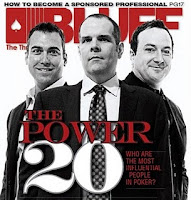
    Man Power: The BLUFF Power 20

    BLUFF Magazine, March 2010Been looking over this year’s “BLUFF Power 20” that was released a few days ago. Always interesting to see who is being considered the 20 “most influential people in poker.”

    Howard Lederer sits atop the list this year, his association with Full Tilt Poker the primary reason for his being handed the crown of “most influential.” The founder of PokerStars, Isai Scheinberg, is runner-up. And Ty Stewart, WSOP Executive Director and Caesars VP, is third. Click here for the full list as it appears over on the BLUFF site.

    For more on the list, Dr. Pauly has offered some entertaining and insightful commentary on all 20 names. And F-Train posted recently about the list, too, noting suggestively how his ballot differed from the final one collectively created by the 101 voters. I say “suggestively” because F-Train, being the wise and judicious sort he is, doesn’t give up precise details of where he differed from the final vote.

    I offered a few observations as well about the latest Power 20 over on Betfair today. This is the sixth year that BLUFF has published its Power 20 list, so I thought it would be interesting to take a look at how this year’s list compared the ones from 2006-2010.

    By looking back at those earlier lists, I was able to confirm a hunch of F-Train’s, shared in a footnote to his post. “I’m not sure a woman has ever made the list,” F-Train suspects. Indeed, he’s correct -- if you look back at all of the Power 20s, not a single woman has ever been named among the top 20 most influential people in poker.

    Was a little surprised not to see Annie Duke’s name pop up at least once on any of those previous lists. (F-Train says he had two women among his Power 20 for this year, and I think it is safe to assume Duke was one of them.) I suppose we’ll have to wait and see how this here “Federated Poker League” experiment goes in 2011, but if it proves even a marginal success in its first year, I imagine Duke would probably have to crack the Power 20 the next time it comes around, wouldn’t you think?

    Do any other women spring to mind as possibly having deserved a spot among the Power 20 over the past six years? I can think of a couple, but like F-Train I think I’ll keep ’em to myself and instead give you a chance to ponder how you might answer the question.

    1300Just noticed this is post #1,300. Perhaps another reason to cut it short. As I usually say whenever these milestones come up, that’s a damn lot of scribblin’!

    Labels: , , , ,

    Friday, February 04, 2011

    The Search for Inspiration; or, You Get What You Pay For

    InspirationHad a six-handed, pot-limit Omaha hand a couple of days ago in which I open-raised from the button with 2dAdQsAh and only the big blind called. The flop came 8d6dQd -- the nuts for me -- and not surprisingly my opponent checked.

    I have no standard line for this situation, although generally speaking I’ll usually bet something here. The continuation bet doesn’t mean I’ve necessarily hit the flop, and so while often it will induce folds, suspicious players occasionally will call, especially if they have a lower flush, a set, or even two pair. And at the low limits I play (with dime-and-a-quarter blinds), some will happily stack off with less-than-nut flushes, too, so it is often worth at least trying to build a pot.

    Here I bet about half the pot, and my opponent called. The turn was a harmless Ks, and again when it was checked to me I bet again, a little more than half the pot this time. Once more my opponent called.

    The river brought the 7d and my opponent surprised me a little with a half-pot-sized bet of his own. The straight flush was quite possible here -- indeed with that board there were several ways to make the hand. I minimum-raised, and when my opponent responded by pushing all in I was fairly convinced he had it. I had been playing with him a while and he had done nothing to make me suspect he didn’t know what he was doing. So, after a bit of thought I folded my ace-high flush, and the two of us engaged in some chat after the hand.

    My opponent initially denied having had a straight flush, but the more we chatted the more I was certain he had. Somewhere in there I said, “if not, an inspired bet” and complimented him on a good hand, and it was after that he appeared to let down his guard, suggesting I’d made a good fold.

    It’s possible, of course, that I folded the best hand. But at these low limits such “an inspired bet” -- i.e., an attempt to force the ace-high flush to fold by representing a straight flush like that -- is pretty out of place. Folks simply aren’t folding here, not for less than ten bucks or whatever it was. Such was my thinking when I did fold. I didn’t believe my opponent would be so foolhardy as to reraise all in without a straight flush, not after the way I’d played the hand up to that point, anyway. (Was my play “inspired”? Or just timid?)

    In any event, the hand stood out for me in a couple of ways. One was the way it gave me that funny “I-lost-but-I-won” feeling that comes with making a correct fold. Even if it weren’t correct, I still felt that way afterwards. As John Lukacs says in that “Poker and American Character” essay I’ve been referring to off and on over the last few months, poker is a unique game, one in which “free will prevails over philosophies of fate or of chance, where men are considered free moral agents, and where -- at least in the short run -- the important thing is not what happens but what people think happens.”

    The other reason why the hand stood out for me was the way it encouraged me to think about non-straightforward plays and/or “Level 2” thinking (and above) -- something that basically doesn’t happen a heck of a lot when playing the dime-and-a-quarter games. Kind of ensures that those of us who stick to these limits are probably only going to grow so much as players, perhaps developing to the point of being able to fold an ace-high flush once in a while when it appears warranted, but not to explore more advanced or “inspired” plays. Not really.

    Before signing off, let me point to a couple of other items you might check out sometime before we meet again on Monday.

    TroubleSpeaking of looking for inspiration, I greatly enjoyed writing up a piece for Betfair this week about Jack Ury, the oldest-ever WSOP participant who died on Tuesday at the age of 97. Got to relive some Ury’s most memorable hands from the last four WSOP Main Events in that one, including the epic “slowroll” from 2009. Check it out -- I promise you grins if you do.

    Also let me point you to a piece over on Full Tilt’s “Poker on the Rail” blog by Dr. Pauly regarding the recently-announced 2011 WSOP schedule. More chuckles and some other benefits to be had there, too.

    Enjoy the Super Bowl weekend, all.

    Labels: , , , , ,

    Friday, October 08, 2010

    Poker & Pop Culture, Revisited

    Poker & Pop CultureIn yesterday’s post I referred to some references to poker in popular culture. Got me thinking further about other, similar examples, both of late and from further back in history.

    I have a piece over on Betfair Poker today that refers to one such example, the awesomely-named Thanatopsis Pleasure and Inside Straight Club, a poker club that involved members of the famous Algonquin Round Table from the 1920s. The article kind of revives an old series of columns I had begun over on PokerNews some time ago.

    These “Poker & Pop Culture” columns have had a bit more shelf life than some of the other articles I’ve written, and I find myself going back to them every now and then. In fact, just yesterday on Twitter my friend B.J. Nemeth made a reference to how poker came up a lot on the old “Star Trek: Next Generation” series, and I was able to point him to a fairly long piece compiling all of those references.

    Anyhow, here’s a list of all 20 of those “Poker & Pop Culture” columns I’ve done, with links to each.

    The Thanatopsis Pleasure and Inside Straight Club (10/8/10)
    Poker and Space Exploration (7/21/09)
    ‘Star Trek: The Next Generation’ (5/19/09)
    Herbert O. Yardley’s ‘The Education of a Poker Player’ (4/28/09)
    ‘California Split’ (4/14/09)

    Mainstream Magazines on the Poker Boom (3/31/09)
    Wild Bill Hickok and the Dead Man’s Hand (3/17/09)
    Hold’em Hand Nicknames (3/3/09)
    Mark Twain (2/17/09)
    Matt Damon and Ed Norton Enter the 1998 WSOP (2/3/09)

    The Films of W.C. Fields (1/20/09)
    Kenny Rogers’ ‘The Gambler’ (12/30/08)
    Dogs Playing Poker (12/17/08)
    Bret Maverick (12/2/08)
    Gabe Kaplan (11/18/08)

    Poker-Playing Presidents (11/4/08)
    CBS and the World Series of Poker (10/21/08)
    Critical Reception of ‘The Cincinnati Kid’ (10/7/08)
    Amarillo Slim Goes on Johnny Carson (9/23/08)
    Moss & Dandalos, Dazzling With Dollars (9/9/08)

    Some of these are definitely better than others, I think, but I’m gonna guess there’s bound to be at least one or two items of interest to most folks in there somewhere. My favorites include the one about C.M. Coolidge's “Dogs Playing Poker” paintings, the one telling the story behind ”The Gambler,” and the Star Trek one.

    I’ve had more than a few posts here on Hard-Boiled Poker that have fit under this “Poker & Pop Culture” heading, too. I think I might create a separate page listing all of those posts/articles in the near future.

    If you happen to click through and read any of those pieces, come back and let me know what you think. Meanwhile, have a good weekend all.

    Labels: , ,

    Friday, August 20, 2010

    Scott Pilgrim’s Progress & Poker

    'Scott Pilgrim vs. the World' (2010)Vera Valmore and I went to the movies last night. Haven’t done that too often lately. Seems like doing so always requires more time and money than we’re willing to spend. But the stars aligned and we found ourselves at the nearby cinema watching -- and enjoying -- Scott Pilgrim vs. the World.

    I didn’t know too much about the movie going in, other than it was based on a comic book or graphic novel or something. And George Michael from “Arrested Development” was in it.

    The movie’s style definitely reproduces the narrative cues of comic books and graphic novels. Sort of like Creepshow did way back when with its mimicking of old ’50s horror comics. Scott Pilgrim also incorporates a lot of the elements of storytelling from video games, especially those in which one creates characters and engages in various battles in order to rise through different levels and “unlock” new features.

    All of which made for a fun ride with lots of action and, well, cool stuff to look at. Like a lot of movies these days.

    On the level of theme, one could argue the movie also reproduced the depth of some video games and/or comic books. Not saying it wasn’t a thoughtful story with some reasonably meaningful insights about human nature and relationships. It’s just that the surface perhaps tends to distract the viewer from all that.

    Thus do you end up in the parking lot afterwards not really thinking about deep messages, but instead practicing your karate kicks.

    As I’ve already suggested, the story involves the main character fighting a series of battles (against “the world,” it seems)... a little like moving up in stakes or advancing in a tournament in poker, I suppose.

    The character of Pilgrim does experience the highs and lows that often happen in poker when you move from novice to amateur to whatever you call yourself now. Such as when you feel like a world-beater after hitting that draw, or like an incapable failure when you miss. There’s even a bit in there about playing against yourself that poker players might be able to relate to as well.

    All of which is to say, Scott Pilgrim vs. the World may well have some appeal to online poker players. More so than Eat, Pray, Love, I’m just guessing.

    So, if you’re reading this blog (in which case you probably do play online now and then), and are looking for a movie this weekend, you might check it out.

    Paul 'Dr. Pauly' McGuireIf you’re reading this blog you probably also read Dr. Pauly’s Tao of Poker, and thus might be interested to read my interview with the Doc which went up over on Betfair Poker today. I asked him a few questions about his recently-released book, Lost Vegas, as well as about writing, generally speaking. Enjoy.


    Okay, signing off now. Have a good weekend. Gotta go practice my karate kicks.

    Labels: , , , , ,

    Friday, August 13, 2010

    Gambling on Grades

    GradesLittle time today, I’m afraid, to do much more than point you to an article of mine over on the Betfair poker site that went up today --> “Cash for Grades?

    You might have read something this week about a website -- called Ultrinsic -- that is allowing U.S. college students (at 36 different schools) to place real money wagers on the grades they receive in their courses. No shinola!

    The story came via the Associated Press and got picked up by dozens of papers and websites across the U.S.

    One element of the story of particular interest to poker players (I think) was the discussion of whether or not the site -- based in New York -- was, in fact, offering “online gambling.” Our buddy I. Nelson Rose, the law professor and gambling law expert, actually turns up in the article to opine on the issue with regard to Ultrinsic.

    As you’ll see if you go read my article, I’m no fan of the idea of college students betting on their grades. Obviously I’m not opposed to gambling per se, but I don’t like the idea of artificially adding this extra significance to grades (which I already think are made out by many to be more significant than they should be).

    Besides, the site itself also looks more than a little sketchy to me. Check it out if you are curious, and tell me what you think.

    And then have a good weekend!

    Labels: , , ,

    Friday, August 06, 2010

    Her Name Is Rio

    Rio All-Suite Hotel and CasinoToday my review of Paul “Dr. Pauly” McGuire’s Lost Vegas appeared over on the Betfair Poker site. For those of you who haven’t picked up a copy yet, check out the review to learn what the book covers and my overall take.

    Book reviews are always a bit challenging to write, for a variety of reasons. One problem I always end up facing is having to choose between several different points I want to make about the book. That is, I can’t reasonably share every little response or observation I might have had while reading the sucker, so I have to be selective and often end up setting aside certain points in order to keep the review at a manageable length.

    One point about Pauly’s book I had written down but didn’t end up including in the review regarded his account of the 2005 WSOP, in particular his description of Binion’s Horseshoe where the Main Event was concluded -- the last time the WSOP was played there.

    As is the case throughout Lost Vegas, Pauly doesn’t shy away from telling it like it is when it comes to describing Binion’s, noting how the place had deteriorated by then into a less than desirable destination for anyone traveling to Vegas, let alone for the WSOP.

    However, as Pauly notes, “What Binion’s lacked in class, it made up for in character.” Here Pauly ends up writing a nifty little elegy to the Horseshoe, a tribute of sorts to the birthplace of the WSOP focusing on the moment the WSOP left it for good. Rather than go on at length here, I’ll let those of you who have picked up the book read what Pauly has to say about how “Benny’s Bullpen was a post-modern version of the Roman Coliseum where gladiators fought to the death.”

    Like I say, I ended up leaving that comment about Pauly’s discussion of Binion’s out of my review. I was thinking about it again this morning, though, as I read some of the rumors about Harrah’s having finally sold the Rio All-Suite Hotel and Casino.

    Some are saying the deal has been done, and thus the WSOP will necessarily be looking for a new home in 2011. Pokerati’s short blurb about the sale a couple of days ago appears to have gotten the rumor mill churning in earnest this week. However, the official word from the WSOP appears to be that as far as its concerned the Rio remains a Harrah’s property and thus plans for the 2011 WSOP -- at the Rio -- continue to proceed.

    Actually, rumors about the WSOP leaving the Rio began back in the spring, and there was a lot of talk this summer about where it might possibly go. When I interviewed Nolan Dalla, the WSOP Media Director, for Betfair last month, I asked him about the rumors, knowing full well that even if he knew anything he wouldn’t be able to tell me one way or the other what was up.

    Dalla’s answer to me was nevertheless forthright. He said to me that “anybody who thinks they know the answer to that question [then, in early July] doesn’t know what they are talking about.” He added that the issue would be examined by Harrah’s soon after the WSOP concluded, but that “those discussions really haven’t started that much yet.”

    Whatever happens with the WSOP in 2011, I think it is interesting to compare what people are saying about the WSOP perhaps leaving the Rio with the often nostalgia-tinged sentiments expressed back in 2005 when the Series left Binion’s.

    Of course, for me the WSOP and the Rio will always be closely associated, given that I’ve never had the chance to see it played anywhere else. I haven’t any particular fondness for the place, but it has seemed to me a suitable enough location to accommodate the spectacle the WSOP has currently become.

    Will be curious, though, to see what happens next for the WSOP. And -- if it does leave the Rio -- what sort of “elegies” (if any) will be written about the WSOP during the Rio years.

    Labels: , , , , , ,

    Friday, July 30, 2010

    Summer Reading

    Summer ReadingNot a lot of time to write today, I’m afraid. I assume that’s okay, though. Lots of other summer reading available to you, if yr looking for such.

    For example, there have been a ton of articles popping up all over concerning that House Financial Services Committee vote in favor of H.R. 2267, the Internet Gambling Regulation, Consumer Protection, and Enforcement Act. Seems like everyone has something to say about it. I added a couple more cents on the subject over on the Betfair poker site today, too: “Online Poker in the U.S.: On the House Financial Services Committee Vote.”

    Incidentally, I have decided to create an archive page from which I’m linking all of my Betfair columns. Have had the chance to do a lot of fun things over there, including interviewing several folks and reviewing a number of poker books. I’ve made a little banner down the right-hand side which will get you to the page, or you can just click here to see it.

    Was thinking of doing something similar with some my old PokerNews stuff, too -- that is, creating a page that links to the book reviews and all of those “Poker & Pop Culture” columns I wrote for them. In fact, I’m still working on all of my archive pages, including those for the various sections here on Hard-Boiled Poker (e.g., On the Street, The Rumble, etc.). Hope soon to have all that stuff in order and up to date.

    'Lost Vegas' by Paul McGuire (2010)Speaking of book reviews and interviews, I’m continuing to read and enjoy Dr. Pauly’s chronicle of his time reporting on the WSOP (plus his other Las Vegas-based adventures). I am of course referring to his recently-published book Lost Vegas: The Redneck Riviera, Existentialist Conversations with Strippers, and the World Series of Poker. I’ll probably be penning a review of the book soon, and plan to try to interview the author about it, too.

    Kind of an uncanny feeling, reading about all of these “characters” I’ve gotten to know over the last few years. Indeed, a lot of what I’ve been experiencing thus far has been a lot of filling in of gaps in my personal knowledge of my fellow bloggers and other media types, as well as in the recent history of the WSOP. A lot of “ahh... so this is where he/she came from” moments so far. Also a few “a-ha!” moments, too, with regard to certain mysteries and other behind-the-scenes stuff at the WSOP circa 2005-2008.

    I haven’t quite finished the book, although I can already recommend the book to anyone interested in the poker media, Las Vegas, and particularly the post-boom growth of the WSOP over the last few years. Kind of feeling like PokerVixen was a few days ago when she tweeted “I’m this >< close to finishing @LostVegasBook. I’ve stopped though because I don’t want it to end.” Go visit Dr. Pauly’s Lost Vegas site for details about ordering.

    And after you’ve done that, go have yourself a relaxing, air-conditioned weekend.

    Labels: , , , , ,

    Tuesday, May 25, 2010

    Flying By the Seat of My Pants

    Keep Your Pants OnDoin’ a little airport blogging today. Am sitting here at my gate with my laptop, readying for the flight to Vegas.

    Was just now once again going through the routine of removing shoes, emptying pockets, and so forth with which we’re all familiar. For some reason I keep making this mildly amusing mistake the last few times I’ve flown. Did it again just now.

    Once I remove my belt and place it in the bin, I instinctively begin undoing my pants as well (no shinola). There I was again a few moments ago -- unbuttoned, zipper down, then realizing I’m not undressing at home.

    Thankfully I’ve managed to catch myself each time -- before anyone else has had to tell me not to strip down entirely. Would make the subsequent full body scan unnecessary, though.

    Lemme point y’all to a few different things elsewhere to listen to and/or read while I'm hurtling my way across the continent. Or at least to make you forget about me absent-mindedly stripping in public.

    Gambling Tales PodcastYesterday I had a chance to listen to Episode 14 of the Gambling Tales Podcast on which I appeared as a guest along with Falstaff and Special K. Falstaff and I had a fun conversation about tourney reporting -- both live and online. We did it over Skype, and the quality is pretty good. Was glad to hear myself sounding somewhat coherent, too, given that I had been up for 40-plus hours or something just before we spoke (covering SCOOP). Click here to get to that episode, and you can confirm for me whether I'm making any sense.

    'DUCY?' (2010) by David Sklansky and Alan SchoonmakerHave a couple of other items to share. I recently read the new one from David Sklansky, DUCY? Exploits, Advice, and Ideas of the Renowned Strategist, written in collaboration with Alan Schoonmaker. This is the book in which Sklansky offers thoughts and theories about a host of non-poker topics, including things like health care, the economy, legalizing drugs, gun control, the death penalty, and so forth. An interesting read, about which I’ll probably have more to say over here eventually. Meanwhile, I wrote a review of DUCY? for the Betfair poker blog, if yr curious.

    Woman Poker PlayerFinally, California Jen and I contributed a new pair of “He Said/She Said” columns for Woman Poker Player for this month. This time we separately addressed all of this “Year of the Woman” talk we’ve been hearing in the wake of big wins by women in major events (Annie Duke in the NBC National Heads-Up Poker Championship, Vanessa Selbst at NAPT Mohegan Sun, and Liv Boeree’s at EPT San Remo).

    Click here to read what Jen said. And here’s my contribution.

    Will try my best to keep my pants on for the rest of the trip. See y’all on the other side!

    Labels: , , , ,

    Friday, May 14, 2010

    Completing the Circle: WSOP Bloggers Roundtable

    WSOP Bloggers RoundtableThe second part of my “WSOP Bloggers Roundtable” is now up over on Betfair Poker. This one includes contributions from Change100, “Mean Gene” Bromberg, AlCantHang, ESPN’s Andrew Feldman, Chops, and Pokerati Dan.

    If you missed part one -- featuring F-Train, Brad “Otis” Willis, Benjo, Michele Lewis, Dr. Pauly, and Jason “Spaceman” Kirk -- the idea was to ask some of your favorite poker bloggers (who have covered the World Series) questions about the 2010 WSOP as well as about their past WSOP experiences.

    I seriously could have asked a couple dozen more to contribute here, but I had to stop somewhere. Will probably try something similar down the road, at which time I might try to recruit others.

    I asked six questions altogether. The first was simply asking which stories and/or players the bloggers were most looking forward to covering. I then asked about the new events (the $50,000 “Poker Player’s Championship,” the $25,000 NLHE six-max event, the newly-formatted Tournament of Champions, etc.) as well as their opinions about the November Nine, back for a third year.

    Next was a question about the current status of the World Series of Poker and its overall significance to poker, generally speaking. That is, to what extent does the health of the WSOP serve as an indicator of the health of the game overall? Some interesting -- and varied -- responses to that one.

    Finally came two questions about covering the WSOP -- one asking about the bloggers’ most memorable experiences while reporting, and the other asking what they liked most/least about working the Series. Those questions might have elicited the most compelling responses of all -- some great stories in there.

    I can’t say I necessarily anticipated anything in particular when coming up with this here ideer, but in the end I was blown away by how thoughtful and entertaining the responses were. If you like poker, the WSOP, and good writing about both, you’ll absolutely dig this roundtable.

    I know we live in a “tl, dr” (“too long, didn’t read”) world, where anything over 140 characters is viewed by many as an undesired commitment. But if you’re reading this blog, I’m gonna go ahead and assume you’re probably the sort of person who doesn’t mind lengthier stuff -- so go check it out!
  • WSOP Bloggers Roundtable, Part 1 (F-Train, Brad “Otis” Willis, Benjo, Michele Lewis, Dr. Pauly, and Jason “Spaceman” Kirk)

  • WSOP Bloggers Roundtable, Part 2 (Change100, “Mean Gene” Bromberg, AlCantHang, ESPN’s Andrew Feldman, Chops, and Pokerati Dan)
  • Labels: , , ,


    Older Posts

    Copyright © 2006-2021 Hard-Boiled Poker.
    All Rights Reserved.