Thursday, May 07, 2009

The Winner is the Loser?

Winners & LosersWas reading through the Full Tilt Poker Strategy Guide: Tournament Edition the other day. A lot that is worthwhile in there, I think.

In Howard Lederer’s chapter on limit hold’em tourneys (one of the few discussion of LHE tourneys you’ll find, actually), he brings up a concept regarding tournaments that I remember Mike Caro at one time making a lot of noise about. Kind of a curious idea (as most of Caro’s ideas are).

Early in the chapter, Lederer extols the virtues of making it to the cash -- and in fact ultimately makes simply cashing a primary goal for tourney players, kind of countering what a lot of folks will say about the importance of winning or finishing near the top where one usually finds the big money. He admits that he might have won more money in his career overall if he’d adopted a looser, more aggressive approach, but for him that was “not a style I’m comfortable playing.” This business of approaching tourneys conservatively is not the concept I want to talk about, though.
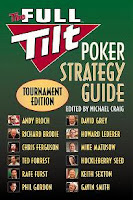
'Full Tilt Poker Strategy Guide - Tournament EditionAmid that discussion, Lederer offers the observation that when you cash in a tournament, but don’t finish first, “you have, by definition, taken advantage of the tournament structure.” Why? “Because you ended up broke -- zero chips -- but they paid you a big check anyway.”

It’s kind of an interesting point, I think -- this idea that, as Lederer goes on to say, “the winner actually is the one that pays the biggest price for the tournament structure,” because “the winner gets all the chips but does not get all the money.”

Like I say, this is an idea that I first saw Mike Caro address as what he calls a “conceptual problem” with tournaments. In Caro’s discussion, he points back to the mid-1970s when tourneys stopped being “winner-take-all” affairs and the prize pools began to be distributed among several of the top finishers, not just the winner.

The history of the World Series of Poker Main Event exemplifies this trend. For the first eight years of the WSOP (1970-1977), the winner of the Main Event won the entire prize pool. When Doyle Brunson won his second title in ’77, there were 34 entrants in the event, each of whom paid $10,000 to play. That meant Brunson’s first prize was $340,000.

However, in 1978 the WSOP began to divide up the prize pool. There were 42 entrants that year, and Bobby Baldwin won. But he only got $210,000 for winning, and the other half of the money was divided among those finishing second, third, fourth, and fifth.

Another big change in the payout schedule at the WSOP Main Event happened in 1986, the year Berry Johnston won the WSOP. There were nearly the same number of players in the Main Event in ’86 (141) as there were the previous year (140). However, in 1985 only the top nine finishers cashed, while in 1986 the top 36 players cashed (although those finishing 28th-36th got less than their buy-in back -- $7,500). So Johnston’s first prize of $570,000 was considerably less than the $700,000 Bill Smith got the year before for winning.

Mike CaroFor Caro, this change created a “conceptual problem” with tournaments insofar as the way he views it, “first place is punished and all other close finishers are rewarded.” For the Mad Genius of Poker, this makes tournaments much, much less attractive to him, and in fact becomes a reason for him not even to play them. He goes on to suggest that “in terms of strategy... if you play to win first place... you’ll probably lose money in the long run.”

Because if you win you lose. Get it?

Caro thus offers the same advice as Lederer and insists “the way to make a profit in these tournaments is to survive” -- that is, play conservatively, try to make the cash, and be satisfied with knowing that when you do cash (but do not finish first) you have taken advantage of the structure. Ever the iconoclast, Caro probably takes the whole idea a bit too far when he adds that “you should not go out of your way to win the first-place trophy, because the winner of the tournament is penalized.” (Here’s an article in which Caro explains his idea, if you’re interested.)

I’ve heard him made this argument in other contexts, and he usually insists that finishing second is really where it’s at. The guy finishing second is the one who makes the most money despite losing all of his chips.

Now I’m no mad genius. (In fact, I’ve been known to have trouble operating a cell phone.) But I think the point being made by Caro and Lederer actually depends on a particular view of the relationship between tournament chips and buy-ins -- namely, a view that essentially sees tournament chips as directly representing the money one paid to enter the tournament. Which sort of makes sense when we talk about tournaments in a theoretical way, but creates a different “conceptual problem” (I think) once we sit down and start playing the actual tournament.

For example, there’s gonna be somewhere around 5,000 players entering that $1,000 no-limit hold’em “stimulus special” tournament (Event No. 4) this year. Let’s just say exactly 5,000 enter. All players will be receiving 3,000 chips, meaning, in a sense, that every chip cost them 33.33 cents.

Of course, since some of the prize pool is going to be taken out before the first hand is dealt, you could say the players will already be getting the worst of it just by entering the tournament. According to the WSOP, 7% of the prize pool is going to be withheld for entry fees, and another 3% taken for the tourney staff. With 5,000 players, that means there is going to be 15 million chips in play. Players will have paid $5 million total, but the prize pool is going to be $4.5 million after the juice. That means every chip is technically worth exactly 30 cents, even though players paid 33.33 cents per chip to play. If we view tournament chips as the equivalent of cash, every player is going to be down $100 just for entering the tournament.

Now I’m going to guess somewhere around 9% of the field is going to cash in this event (judging from the payout schedules of similar, big field events from the 2008 WSOP). That’s 480 players. Not sure what the prize will be for first place, but last year Grant Hinkle took a little over 15% of the prize pool for winning that first no-limit hold’em event -- the one that had nearly 4,000 enter. So let’s say the winner of the $1,000 “stimulus special” gets 15% of the prize pool for winning -- that’s $675,000. That means the other $3,825,000 will go to 479 players who finish with zero chips. If we think of tournament chips as cash, well, then it does appear that 479 of the 5,000 players entering are getting a pretty good deal here.

But really, once the entry fee is paid, that $1,000 each player handed over is long gone. All that’s left are the 3,000 chips waiting at the player’s seat at the start of Day 1. And it doesn’t make a lot of sense (to me) to think any longer of those chips bearing any relationship at all to the money spent for them, because you can’t go back and cash them in. Once the tourney starts, the trick is to turn those chips into more chips, and hopefully all of the chips. That’s the only way to maximize their value from that point.

I understand Caro’s lament about tourneys moving away from the “winner-take-all” format. And I even appreciate the “conceptual problems” that result, thus making him less inclined to play tournaments. But I don’t think I’m going to buy the conclusion that the winner of a tournament is in some sense the biggest loser, even if it is the case that he or she has won all the chips but is only claiming a small portion of the prize pool.

But that’s my choice, of course. I can buy what I want -- chips, concepts -- as long as I can afford to do so.

Labels: , , ,

Wednesday, May 06, 2009

Play the Game

Charlie Brown sighsHad one of those unbelievably unfortunate sessions of low limit hold’em yesterday. Six-handed (which I generally play) can be swingy at times, so it isn’t that much of a deal to experience a run of bad cards, bad timing, and bad results. And thus, not so surprisingly, when the session is finally over, feel bad.

But the badness just wouldn’t stop. It was one of those sessions plagued by what seemed an inordinate number of SIGHs or “So It Goes Hands.”

In an earlier post, I tried to make a distinction between SIGHs and other varieties of “bad beat” hands, although I suppose one could call a SIGH a bad beat. And thus call SIGH stories bad beat stories. And thus, very rightfully, complain “Hey, Shamus, enough already with the sighing! No one cares!”

The distinction that makes a SIGH is that you find yourself getting “whamboozled” (to use a Norman Chadism) without having ever really made any conscious effort to get yourself into the situation. In other words, it is not that you played the hand well and lost. You just played the hand as any sane person would and lost, often the maximum. Basically what we’re talking about here is a hand that played you, not the reverse.

I actually don’t want to lengthen this post unnecessarily with examples -- indeed, I imagine you don’t want that, either -- but I’ll give one just for the purposes of clarification.

Table folds to me on the button and I raise with QdKs. Both the blinds call. The flop comes 3sQc8c. Checks to me, I bet, and only the SB sticks around. The turn is the 2d. Again: check, bet, call. The river is the 4s and my opponent bets. Really? Okay, let’s see. I call. He turns over Ad5c.

Maybe someone somewhere plays this hand differently. But I doubt it. From my perspective, the hand played me. Thus, I call it a SIGH.

Like I say, endured a high number of these sorts of situations in the session, and so afterwards found myself muttering to poor Vera Valmore such applesauce as “Why do I even play?” I continued with my whimpering, noting that after several years of this, I am still just a recreational player piddling around in the lower limits who even when things go well can’t really earn more than a couple of bucks per hour, anyhow.

In fact, I’ve been becoming increasingly conscious over the last couple of months that whenever I play, there’s always something else I could be doing, something more profitable -- not just money-wise, but health-wise (physical and mental). Which now that I think about it, could be a bit of a distraction that may not be hurting my game, but certainly isn’t helping.

Vera, as wise as she is lovely, stopped me with a simple reminder: “You love to play. You like the strategy and you like the challenge. It doesn’t matter if you only make two bucks.” It would matter, she added, if I were losing significantly every time I play. But I’m not. Overall, I win. Not much, but like Vera says, that doesn’t matter.

What matters is the game -- being able, once in a while, to play (and not “work”). Just play the game, Shamus. You love it. Don’t let it play you.

Labels: , ,

Tuesday, May 05, 2009

The States of Online Poker

The States of Online PokerWord is that Barney Frank (D-MA), the Chair of the House Financial Services Committee, is very close to reintroducing legislation -- any day now, apparently -- designed to counter the Unlawful Internet Gambling Enforcement Act of 2006.

What’re we supposed to think about that?

If the new bill is like his previous Internet Gambling Regulation and Enforcement Act (IGREA) -- introduced during the previous Congress almost two years ago -- it will likely propose a means by which to regulate and tax online gambling, thereby creating the possibility for U.S.-based sites to begin operating.

The IGREA had outlined a licensing process which would allow for such sites, however, it wasn’t too specific about how taxation would work. That sort of thing was more directly considered in some of the other anti-UIGEA bills that came and went over the last couple of years, and perhaps could get incorporated in Frank’s new bill somehow.

The IGREA was quite specific, however, with regard to its having included a provision for individual states to opt out of the new arrangement if they wished. And it wouldn’t take a vote or anything for that to happen, either. All it would take would be for the state’s governor to inform the person in charge of the licensing process (according to the IGREA, that would have been the Director of the Financial Crimes Enforcement Network, which operates out of the Department of Treasury) that his or her state didn’t want to play along.

Have to believe that given Frank’s “states’ rights” leanings, he’s likely going to include a state opt out provision again this time around, too, regardless of the specifics of the new bill. Probably something to consider, given what’s been happening in Kentucky and Minnesota.

You remember Kentucky, where the governor Steve Beshear decided last fall that in the interests of the state’s horse racing industry he’d declare himself king of the intertubes and try to block the state’s residents from accessing 141 domains on which online gambling sites were located? The governor lost that one on appeal back in January, although I believe the state’s administration continues to fight their cause, planning to appeal the appeal in the Kentucky Supreme Court.

And in Minnesota the Department of Public Safety (no less) last week ordered ISPs to start blocking access to over 200 gambling websites, an action based not on the UIGEA but on the 1961 Wire Act. Incidentally, the list of sites to be blocked appears to have been written by someone without a heck of a lot of knowledge of online gambling (which, of course, some might argue ain’t really the purview of “Public Safety” anyhow).

Most of the sites on the list are for casino games or sports betting, with just a few poker sites listed. Without much rhyme or reason, some poker sites are on the list (Full Tilt Poker, Bodog), while others are not (PokerStars, Absolute, UltimateBet). And there are some sites on the list (Titan, Mansion) that don’t even serve U.S. customers! I’m sure the proprietors of those sites are wringing their hands over losing Minnesota.

Anyhow, back to the upcoming bill. The political climate is certainly much different today than it was in May 2007. The prospects for a Frank-sponsored online gambling bill seem on the surface much more favorable in terms of it actually moving through the House and to the Senate, and perhaps even further than that. We all still lament the UIGEA’s passage and the fact that we still cannot play on many online poker sites. Perhaps many of us, having gotten so used to railing against the UIGEA for more than two-and-a-half years now, are still instinctively cheering on Frank or anyone else interested in challenging that misbegotten law.

But while the political climate has changed, so, too, has changed the climate in which online poker is currently being played in America. U.S. players have it much, much better today than they did two years ago when it comes to moving money on and off of online poker sites, despite the fact that the UIGEA regulations were finalized back in November 2008 and went into effect in January of this year. Of course, the situation could conceivably change when the UIGEA really goes into effect on December 1, 2009. That’s when “designated payment systems” are said to be required to start complying with the law’s interdiction against transactions from individuals to online gambling sites.

It is possible that Frank’s bill could, in fact, also contain language that would specifically undo the UIGEA altogether, incorporating the emphasis of a couple of his other bills from the previous Congress that didn’t make it out of committee. If that were indeed the case, online poker players will be in an interesting position when it comes to deciding whether or not to throw their support behind Frank’s bill, I think.

On the one hand, regulation and taxation probably is not something most of us sincerely desire, all things considered, although I can see certain benefits -- the most obvious being protection against fraud -- from having such regulation in place. On the other hand, it could be in our interests to see a bill become law that rendered the UIGEA obsolete, especially if come December our banks really did start preventing us from moving cabbage onto our favorite sites.

Whatever happens, it’s going to take some time. I could be wrong, but I’m reasonably sure we’ll get to December 1, 2009 before any repeal of the UIGEA happens. Meanwhile, at least one state -- California -- looks like it might be positioning itself to try to “opt out” of the UIGEA, in a sense, and write their own ding-dang laws concerning online poker (although it isn’t completely clear they can actually do that given the way the UIGEA is written).

If you happen to live in a state which presently doesn’t allow live poker, I guess I wouldn’t be all that enthused about the prospect of your state being invited (forced?) to make some sort of decision about the legality of your playing online poker.

Should be a while, though, before states start seceding from our embattled online poker nation.

(EDIT [added 4:00 p.m.]: News came today that Frank will be announcing his new bill tomorrow, May 6th. Stay tuned.)

Labels: , , , ,

Monday, May 04, 2009

The Hard-Boiled Poker Radio Show, Episode 15: The Lacework Kid

The Hard-Boiled Poker Radio ShowAt long last, a new episode of the Hard-Boiled Poker Radio Show has been posted. Full details can be found over on the show’s website, but I’ll give a little summary here.

For those who’ve never heard the HBPRS -- and yes, I’m fully aware that may very well include the vast majority of you internet peoples -- the main idea behind the podcast was to present stories about poker and/or gambling, with an emphasis on old-time radio shows. I’ve had guests on a few times who have contributed their own stories and observations, and I’ve also done some readings from various poker narratives, occasionally trying my own hand at some o’ that “radio theater” with sound effects, etc.

Shamus with headphonesIf you’ve never heard the show and are curious, you can safely go back and listen to any of the old episodes since one of the guidelines I’ve tried to follow throughout is to make the show not so “time-bound.” Unlike other poker podcasts that focus on news of the day, the HBPRS purposely avoids that sort of thing, so I’m hoping the old shows have a decent shelf life as a result.

The show’s blog has show notes for each of the 15 episodes thus far, so you can peruse that to find an episode that interests you. I can suggest a few.

A lot of the episodes of the HBPRS feature mysteries or dramas. However, Episode 3 has a terrific old comedy called Duffy’s Tavern, as well as some other funny bits (such as from the old Jack Benny Program). Episode 4 has a nifty thriller called “Hitchhike Poker” starring Gregory Peck. And Episode 13 includes a reading of a funny James Thurber short story called “Everything Is Wild” in which the lovely Vera Valmore makes a guest appearance.

This latest one includes a song by the Grateful Dead, a couple of short readings (from Anthony Holden’s Big Deal and Nolan Dalla/Peter Alson’s One of a Kind), and an episode of The Damon Runyon Theater.

Click here to listen to Episode 15. Or head over to iTunes where you can subscribe to the show. If you happen to listen to this one or any other of the shows, send along your feedback here, on the show’s blog, or shoot me an email at shamus at hardboiledpoker dot com.

Poker SoupMeanwhile, if for some strange reason yr lookin’ to hear more Shamus, the cool cats over at Poker Soup had me on their show for a while last night -- for their episode 15, coincidentally enough.

We chatted about the HBPRS, other podcasts (including good old Card Club with Lord Admiral Radio), the upcoming WSOP, among other topics. Fun stuff. Check it out.

Labels: ,

Friday, May 01, 2009

Departing on AA

Departing on AAIt’s May Day. It’s what? May day? Mayday, Mayday! Good Gawd. The World Series of Poker is less than four weeks away!

My plans are still somewhat up in the air, as they say, but I’m a-gonna be there. As they also say, details to come. And speaking of being up in the air, I ain’t even booked a flight to Vegas yet, but that’ll happen soon.

Thought I’d write a short note today about my own play. Been managing to squeeze in short sessions of limit hold’em here and there, generally not playing more than 100-200 hands at a stretch (usually an hour or so, as I’ll often play two tables). That actually is my usual schedule, really, and if I were to look back and study my stats carefully, I would likely discover that is my most profitable modus operandi. That is to say, I do best with the short sessions, ’cos the longer ones tend to be longer ’cos I’m in a hole and trying to get “back to quits.”

The art of quitting is, of course, one of the more important skills in poker. In Elements of Poker, Tommy Angelo writes a longish chapter on quitting. At the start he explains why the chapter is relatively long: “What happened was, I started writing about quitting, and well, you guessed it, I couldn’t quit.”

“In order to quit well,” Angelo continues, “you must be in control of yourself at the end of the session. It can be no other way. To achieve your highest possible score, you must be at your A-performance and your A-mindset all the way to the end.” We all are aware of this idea, I think, but as with most things in poker, easier said than done.

I had one session this week conclude in a particular way, and I realized that I’ve sometimes purposely forced myself to quit simply because I have been dealt one specific hand. Of course, if I’ve only played a short while and get dealt this hand, I won’t quit, because I know I want to play at least an hour or so. But if I’m getting somewhere close to that one hour-mark and pick it up, I know it has happened more than once that I’ll go ahead and put a tic in the “Sit out next hand” box, thereby readying myself to leave no matter how things turn out.

What’s the hand? American Airlines, of course. My ticket outta there.

Why quit on aces? Well, for one thing, while I like to think I don’t get too tilty that often, I do know getting aces cracked generally doesn’t have such a great effect on my overall mood, making it harder to be at my “A-performance” and have my “A-mindset.” Not that I’m expecting to lose the hand, mind you, but I am anticipating those potentially less-than-pleasant side effects should things not go my way.

On the other hand, if I win, well, that’s not a bad way to leave, either, yes? With the memory of having the best of it, and getting paid... in other words, happy poker thoughts to carry me to my next session.

I know it’s a fairly artificial way to make the quitting decision, and, of course, one can’t necessarily sit around and wait to be dealt aces so one can leave. So I ain’t necessarily recommending it as a genuine strategy, though, like I say, I’ve noticed myself doing it every now and then.

What happened earlier this week was I had been two-tabling for a little over an hour, and after having dug a decent-sized hole had gotten back close to even when I picked up AsAh under the gun (6-max., $0.50/$1.00). I think I might’ve already sat out on my other table and so was out the door anyway, but did indeed click “Sit out next hand” as I watched four of my five opponents call my raise.

The flop came Qc9cAd. Top set, but with that board I knew when I led out that most if not all of my opponents would probably stick around. All but one did. Turn a safe 4d, though now we’re looking at another flush draw out there. All four stayed for one more card. The river was the Qh (Flippin’ sweet!), and I led out again. Others seemed to like that river card, too. Here’s how it played out (RSS readers might have to click through):


Easy as A-B-C, 1-2-3. I hit the runway thereafter. Even if I lose that one, I know I ain’t gonna be in the mood to continue.

Hard-Boiled Poker turned three this weekFurther evidence of how busy & distracted I’ve been lately: the third birthday of Hard-Boiled Poker happened earlier this week -- the day I played that hand, actually -- and I forgot to mark the occasion here.

In fact, I didn’t even think of it until this post took me back to one of the very first posts I ever wrote here, a mini-satire called “Folding AA: A 12-Step Program.” Perhaps good for a grin or two.

Here's hopin’ everyone’s weekend ends up aces.

Labels: , , ,

Thursday, April 30, 2009

On the 2009 WSOP Conference Call, the Hall, and All

2009 World Series of PokerListened to that conference call earlier in the week for the World Series of Poker. That was Tuesday morning, with Jeffrey Pollack (WSOP Commish), Jack Effel (WSOP Tournament Director), Doug White (ESPN’s Senior Director of Programming), and Seth Palansky (WSOP Communications Director) all offering a few observations and announcements, then taking questions from reporters.

I have to say do very much like the WSOP’s efforts to communicate with players, the media, and fans like this. I know I’m critical every now & then of certain stuff that comes out of the WSOP’s brain trust (e.g., am still no fan of the delayed final table). But I do admire the effort and what seems to me to be a lot of sincere desire on the part of those running the show to build the WSOP and poker in constructive, profitable ways.

Can’t say there was too much in the way of “breaking news” in the call, especially if the listener had already leafed through the “Official Media Guide” that came out last week. Last year, of course, the news of the delayed Main Event final table and the whole “November Nine” thing had just broke a day or two before, so there was much discussion of that. There was also some real news in there, including word that the final tablists’ prize money would be placed in an interest-bearing account and thus would be increased between July and November.

Like I say, not too much of note, really, in this year’s call. Was kind of surprised at how few reporters seemed to be on the call asking questions, and very few (one?) from “mainstream” press (unlike last year). Those guys are fun, usually, mainly ’cause they are capable of firing the occasional clueless question (“Does the winner get all the money?”). But they also generally give us an indication of what non-pokery types are thinking about poker, and there wasn’t much of that this time around. I think there was one question at the end from the Chicago Sun-Times, but otherwise all came from poker people. (Not sure why that was.)

Also, there only seemed to be about five or six different reporters asking questions, meaning they had to keep cycling back and inviting the same ones to ask new questions. In fact, at the end of the call Pollack said the group could take one more question, but there were no more.

There was some discussion of the new plan for dealing with player conduct, with a tracking system allowing officials to keep up with the repeat offenders as well as some tough talk about penalties, etc. They discussed the planned schedule over on ESPN, who have decided to shun almost all of the preliminary bracelet events in favor of highlighting the Main Event all summer and fall. There was a question about Annie Duke and Celebrity Apprentice, with subsequent references to that show cropping up more often than I expected they would.

One interesting part of the call (to me) was the discussion of the new procedure being instituted this year for electing people to the Poker Hall of Fame, although that was probably because I hadn’t read those two pages that carefully in the Media Guide. Harrah’s is going to involve the public in the voting process this year, which seems to me like it will add some interest in the HOF. And perhaps create some controversies, too.

From May 26-July 2, people can go over to the World Series of Poker website and submit nominations along with 250-word-or-less testimonials. The top ten most frequently nominated folks will be announced some time during the Main Event in July, probably early on I’d imagine. Then in August the HOF committee (not quite sure who is on that) will review the list and decide if any other names need to be added.

In September, the living Hall of Famers -- there’s 16, says the Media Guide, although several people have noticed some errors throughout the sucker, so don’t quote me -- will get ballots and be asked to rank those nominees whom they feel are worth electing to the HOF. Those Hall of Famers will also be able to nominate folks for 2010, if they wish. Also voting on this year’s nominees will be a group of representatives of the poker media “not to exceed the number of HOF voting members” (i.e., not more than 16). The ballots will go back to the HOF committee, and it says “Any finalist receiving 75% or more of the votes” will be enshrined in a ceremony to take place during the November Nine weekend.

Reading this over again, I’m not really sure what the point is of “ranking” the nominees, if all the HOF committee will be looking at is whether or not the nominee got voted as worthy of induction or not. While the process has changed, the criteria hasn’t (I don’t think), with players qualifying for having played against top competition, having played for high stakes, having played consistently well and thus gaining peers’ respect, and standing “the test of time.” Non-players who have also contributed significantly “to the overall growth and success of the game of poker” can be selected, too.

I think it will be interesting to follow this process, especially once the nominees proposed by the public are announced in July. There will be some names in there that definitely belong, some that definitely don’t, and some for whom it will be harder to call. And it may happen that a large number are voted in -- more than the one or two that generally go in each year -- especially on this first pass with the new procedure.

To be honest, as I think about who should be considered no one really springs to mind. I would assume names like Ferguson, Harrington, Negreanu, and Ivey are gonna come up a lot over on the WSOP site when the public starts submitting nominations, but we’ll see how all that plays out.

Here’s a list of the 37 current HOFers:

Tom Abdo, Crandall Addington, Bobby Baldwin, Billy Baxter, Lyle Berman, Joe Bernstein, Benny Binion, Jack Binion, Bill Boyd, Doyle Brunson, T.J. Cloutier, Johnny Chan, Nick “the Greek” Dandalos, Barbara Enright, Fred “Sarge” Ferris, T. “Blondie” Forbes, Henry Green, Murph Harrold, Phil Hellmuth, James Butler “Wild Bill” Hickok, Red Hodges, Edmond Hoyle, Berry Johnston, Jack Keller, Corky McCorquodale, Roger Moore, Johnny Moss, Henry Orenstein, Puggy Pearson, Julius Oral “Little Man” Popwell, “Amarillo Slim” Preston, David “Chip” Reese, Jack “Treetop” Straus, Dewey Tomko, Stu Ungar, Red Winn, Sid Wyman.

The Media Guide somehow leaves both Chan and Straus off of their list. Oh, and that “Sebastian Bilodeau” currently listed over on Wikipedia as a member of the HOF is a phantom, I think.

Who else belongs here, would ya say?

Labels: , , , , , ,

Wednesday, April 29, 2009

Flippin’ Sweet

Flippin' SweetHaven’t been playing too much poker here over the last few days. Too much going on, I’m afraid. I did, however, take advantage of the latest PokerStars bonus to come around, this one associated with the upcoming World Series of Poker.

A couple of months ago I wrote about how pleasantly surprised I was to discover how simple it was for me to use eChecks to deposit over at PokerStars. Since Neteller went away (for us Yanks), I had basically stopped even paying attention whenever online poker sites advertised promotions for deposit bonuses. I knew technically I could still deposit money if I wanted to, but just didn’t want to go through the hassle of sending a paper check and/or going through other hoops to do so.

But in February, PokerStars had its “25 Billion Bash” promo and I managed to set up the eCheck option for myself. Ran into a little bit of difficulty then because there’s a limit on how much one can deposit the first time around, but with that now behind me I was able to go ahead and take full advantage of this new promotion.

This one is a 20% reload bonus up to $120. So if you deposit $600 (like I did), then earn the requisite VPPs (or base FPPs) -- which in this case is 2,400 -- you get yr free moneys. You also have six months to clear the bonus, which’ll be no trouble for me. Even though I’m not playing all that much, I imagine it’ll only take me a month or two to get there.

If you’re reading this today and haven’t gone for the Stars bonus yet, there’s still time -- it lasts until 23:59 Eastern time tomorrow (April 30). The promo code is “09series.”

I’m remembering when I mentioned that Stars promo a couple of months ago I discussed it after the end of the promotion period, thus prompting our favorite reader, “anonymous,” to chime in with a Napoleon Dynamite-like comment about my failure to consider others might have wanted to hear about the promo before it expired. So here’s hopin’ I’ve afforded everyone adequate lead time on this one.

Why did I decide to write about the promo sooner this time? Why do I do what I do? Because I feel like it. GOSH!

Actually, I got a kick out of that comment, but it does bring to mind the recent efforts by a blogger who calls himself the “Quality Desktop Pundit” to offer a critique of some poker blogs. Some readers of this blog might have followed how that went, and I’m not going to rehearse it all again here. To summarize: the QDP made a not-so-quality generalization about a particular poker blogger -- one who happens to write one of the better, more consistently interesting poker blogs around, I’d say -- thereby drawing the ire of many of her longtime readers.

The tête-à-tête has settled down, I think, but not before the QDP suggested that “the variety of topics at her blog could be increased” and asked if she “could... please do more posts about” other topics than the ones about which she writes. A little bit like when someone complained over on the Poker Grump’s blog about the “Guess the Casino” posts. The Grump had a good reply to that complaint, as I recall.

We’ve been over all of this before, I think. I read a ton of blogs daily, and it has never once occurred to me to suggest to someone writing a personal blog that he or she should write about something other than what he or she chooses to write about.

If we were talking about a magazine or newspaper to which you subscribed -- i.e., which you paid for with yr own cabbage -- well, then, I think it is valid to complain if the content ain’t what you thought you paid for. But personal blogs? Criticism is fine, but editorial suggestions? Buncha whistling in the dark, I’d say.

Meanwhile, go get in on that Stars promotion, why dontcha? And then go work on your skills. You’ll never get a date without skills. You know, nunchuck skills, bow hunting skills, computer hacking skills....

Labels: , , , ,

Tuesday, April 28, 2009

Time Is Money; or, the Return of the Waiting Game

Time Is MoneyI know many regular readers of this blog also frequently peruse the forums, including Two Plus Two. I also know some regular readers don’t ever read Two Plus Two, citing a too low signal-to-noise ratio over there to warrant spending too much of yr valuable clicking-around time. So I’m guessing only some of you might’ve seen a thread over there in the News, Views, and Gossip forum called “Negreanu goes after online stallers.” That thread was started back on April 18 by “doublejoker,” the handle used by poker pro and frequent tourney circuit player Allen “Chainsaw” Kessler.

Kessler’s post begins with a link back to a post I wrote back on April 6 called “The Waiting Game.” My post shared something I had witnessed while watching a SCOOP event on PokerStars. It was one of the H.O.R.S.E. events, and as play neared the bubble a player at Daniel Negreanu’s table began stalling in order to try to reach the money. The stalling prompted Negreanu to respond with criticism in the chat box, and my post passes along some of what was said. I offered a couple of opinions near the end, but overall I didn’t really take too strong of a stance on the issue, and instead mostly just invited others to share what they thought.

A number of thoughtful comments were made within a day or two of my post going up. Later that week (on April 9) I noticed that Kessler had started a thread about stalling in tourneys over on Two Plus Two -- entirely coincidental, I believe, as I don’t think he’d seen my post. He also started one in the PokerRoad forums on April 11. Both had polls, and both got a lot of response.

I think it might have been thanks to a comment B.J. Nemeth made in the PokerRoad thread that Kessler became aware of the post here on Hard-Boiled and the story of Negreanu’s not being happy with the staller, and thus subsequently started the new thread on 2+2.

On the day Kessler started the new thread with the link to that post, a lot of readers clicked through, more than doubling the most active day ever on HBP (in terms of total hits). The thread has continued to attract comments on 2+2, keeping it on the first page of NVG, and thus folks are continuing to click through to the blog to see what Negreanu said. Some are commenting as well, and I think that post might have now become the most-commented-on post on the blog.

The comments continue to be smart and thought-provoking. The 2+2 thread actually contains some interesting ideas as well. If you check out both places, you’ll see the issue being debated both as a matter of etiquette (or “angle-shooting”) and as a possible area where rules could be changed.

David Sklansky even chimed in over in the 2+2 thread with a somewhat abstract comment, momentarily causing the discussion to veer into a more theoretical direction, though it recovered. Another poster suggested that in online tourneys the time bank could be reset (to a reasonable length) with each level -- rather than last for the entire tourney -- thus preventing the several minutes of delaying that was happening in the SCOOP event. And there are a few other good ideers & arguments both in the thread and in the comments to my post as well.

The subject of stalling in tournaments -- online or live -- is clearly one that many people have strong opinions about. Of course, Negreanu’s high profile is also probably causing some of the curiosity. And Kessler, I think, tends to attract some of the 2+2ers’ attention, too. Negreanu himself has yet to jump in over on the 2+2 thread, though I would think if he was going to he would have done so by now. (Watching for that has been the new “waiting game” for me.)

Anyhow, for those who maybe skipped over it or weren’t following 2+2, I thought I’d share how that post had “blown up.” If that’s you, lemme invite you next time yr sitting there waiting out a staller near the bubble of an online tourney to click on over and check it all out.

Labels: , , , ,

Monday, April 27, 2009

What’s Up with the WSOP? Check the Guide

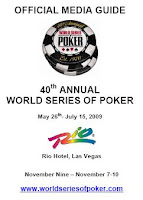
2009 World Series of Poker Official Media GuideThe first event of the 2009 World Series of Poker begins exactly one month from today. In anticipation of the series kicking off, the WSOP put out its “Official Media Guide” last week, a 45-page document with lots of info about the schedule and other matters, along with a buncha tidbits that could occasionally prove useful to those who are planning to cover the sucker this summer.

Was leafing through and found a few items I hadn’t been aware of among the various “Did you know?”-style trivia included in the guide.

Did you know Tom McEvoy has four WSOP bracelets? Did you know Annie Duke has 33 WSOP cashes? Did you know a grand total of 731 gold bracelets have been awarded over the years, and that it wasn’t until 1975 that all event winners were given bracelets (not just the Main Event winner)? Except in 1982, when they all got gold watches?

Nations represented at the WSOP, 2004-2009Like I say, there are a few other things in there of which I hadn’t necessarily been aware. In 2008 there were a total of 124 countries represented at the WSOP. I knew there had been over a hundred represented, but didn’t realize what a jump that number represents since 2004 when players came from 24 countries. Indeed, the progression over the last five years, humbly represented in a little Microsoft graph, is amazing to consider, really.

On the news front, the guide includes this year’s ESPN telecast schedule for the WSOP, which I don’t remember having been publicized previously. Looks like a total of 32 hours of coverage is planned, starting July 28 and running through the two-hour packaged final table show scheduled for Tuesday, November 10.

When the TV schedule was announced last year, I wrote a post about it that noted how most of the coverage (about two-thirds) was devoted to the Main Event. There were a total of five other bracelet events that got some air time last year.

This year, if the schedule is followed as proposed, there is almost zero coverage of preliminary events planned. If my math is correct, a total of 26 of the 32 hours will be focused on the Main Event. And only one other WSOP bracelet event will be getting any coverage at all, that $40,000 buy-in 40th Annual No-Limit Hold’em event (Event No. 2).

So you’ll have to get yr coverage elsewhere if you want to follow those other 55 bracelet events. (Got yr Twitter account yet?) Also, I think this schedule probably ends the debate over whether mainstream television networks (or the general public) is interested in any game other than no-limit hold’em. No surprise there.

There will be two other events covered by ESPN, both non-bracelet events. They’re planning two hours on the Ante Up for Africa charity event which will attract celebs, athletes, and a few big names from the poker world. Then there will also be two hours on that “WSOP Champions Invitational,” the announcement of which is another piece of news one finds in the guide.

To commemorate the 40th year of the WSOP, all of the living Main Event champs have been invited to participate in a tournament near the beginning of the schedule (May 31-June 1). There is no cash prize (nor a bracelet), but the winner will receive something called the “Binion Cup” as well as a new car.

According to the guide, there are 34 total ME champions over the history of the WSOP, and 27 of those are still living. That means if they all show up, they’ll be staging a three-table sit-n-go (no word on the structure). Should be pretty interesting stuff, I’d imagine.

Russ Hamilton at the 1994 WSOP Main Event final tableOf course, the question that immediately popped up on the forums was whether or not disgraced 1994 Main Event champion Russ Hamilton would be there. The only person ever technically implicated in the UltimateBet insider cheating scandal (by the dubious Kahnawake Gaming Commission), Hamilton has yet to face any punishment for his misdeeds. Other than the occasional unsolicited phone call from 60 Minutes or getting harrassed on the golf course by Raw Vegas TV every now and then, that is.

The media guide speaks of how “the winner of the Main Event has gone on to serve as the reigning world champion of poker in the year after their [sic] victory and carried himself as an ambassador of the sport of poker.” Some champs have fit that bill more than others, to be sure. But it appears none less so than Hamilton.

So, yea, I think the chances are not so good that you’ll see all 27 of those former champs at the invitational. Will be interesting to watch, nonetheless. Almost the only thing to watch, actually, other than the Main Event.

Labels: ,

Friday, April 24, 2009

Shamus in Vegas: Episode 5 -- Finding Yr Calling

Finding Yr CallingHad originally planned to title this last episode “The Writer’s Life,” but during the week I found a different, better title. As anyone who has ever been the least bit serious about writing knows, there’s always room for revision.

My last two days in Vegas were taken up with a good deal of running around, meeting various folks while also pursuing a particular writing project. The meetings were all fun and fruitful, and the project did get completed. All the back-and-forthing meant I didn’t get to play anymore poker after that brief session at the Gold Coast I wrote about yesterday. Though, to be honest, I wasn’t all that bummed about it.

You could say those last couple of days illustrated fairly clearly that when it comes down to it, I’m really more of a poker writer than a poker player. As much as I love to play, if given the choice, I have to admit I would rather write. Which is a good thing, as I’m probably better at writing than playing. I know my ROI tends to be better there.

The Center for Gaming Research, UNLVMet with David Schwartz early Friday afternoon over at the Center for Gaming Research at UNLV. Wound my way up to the third floor of the Lied Library where David and I spent a while talking about the CGR and its fellowship program. Then I spent an hour or so looking through their catalog and perusing the small part of the collection they have out on the shelves. Had numerous ideas for various poker-related writing projects, and would love to spend more time over there taking advantage of the Center’s resources.

Then, as I wrote about last week, I made it over to the Wynn later that afternoon to spend a couple of hours visiting with Dan Michalski (Pokerati, The Poker Beat). While waiting to make the connection, I spent a good while watching some poker at the Wynn poker room, which was especially active that afternoon.

Dan and I talked a lot about the blogging game, podcasts, and the upcoming WSOP. I shared with Dan some of what I have been thinking about lately with regard to the writing thing -- how it is starting to become much more than just a sideline and is in fact seriously threatening to take over as my primary occupation. Goes without saying that freelance writers -- in poker or anywhere -- face a lot of uncertainty, work-wise. Of course, these days most of us are facing a lot of uncertainty work-wise, but freelance writers probably a bit more than most, as jobs are usually short-term/temporary. And there’s the whole benefits thing to fret about, too.

So while I’m still not quite ready to chuck it all and give myself over to writing full time, I do know that when I’m writing I’m happy. And life is too short not to be happy as much as possible. As Justin Shronk says in answer to one of Matt Waldron’s Random Questions “What is the meaning of life in eight words or less?” -- “Don’t be sorry.” One shouldn’t spend the majority of it doing something that isn’t totally rewarding. And happy-making. Just because you’ve started down one path, life-wise, you don’t have to continue in that direction. There’s always room for revision.

I mentioned last week how I’d forgotten to take my cell phone to my meeting with Pokerati Dan, which led to some silliness as I tried to survive a couple of hours “off the grid.” Part of that writing project I mentioned above concerned me meeting up with someone for an interview, and all week I was basically worrying over whether or not that person would call me. So that was another reason why I was a little anxious about not having my phone with me for a while on Friday afternoon.

However, once I got it back there were no messages indicating I’d missed a call. Vera and I then met some dressage folks for dinner over at Caesars Palace. We ate at Wolfgang Puck’s Spago. As we had arrived about a half-hour before our reservation time, the group split up and sauntered around a bit, and at one point I had wandered into the nearby Apple store where I spent a little while goofing around with iPhones and laptops.

Shamus takes a callFor fun, I picked up one of the iPhones and dialed my cell, just to see if the iPhone was in fact working. My phone buzzed in my pocket, indicating that it was. I made a mental note that if ever I was stuck without my cell again, I could find the nearest Apple store and perhaps make a needed call there.

A little while later we were seated for dinner and my phone buzzed again. Perhaps it was the person whose call I’d been expecting. But when I looked my phone was just signalling to me I’d missed a call. I looked at the number and didn’t recognize it, but thought it very likely it was the all important call.

Dammit! How did I miss it? I basically fretted over it all through dinner and even into Saturday morning. Vera kept telling me not to worry about it, but I couldn’t help it. We were only going to be in Vegas for one more day, and it looked like I’d screwed up the project.

It was actually Saturday morning before it finally hit me. I realized who it was who had called from before.

It was me.

The call I’d missed had been the one I’d placed on the iPhone at the Apple store. Vera and I had a good laugh, enjoying the absurdity created by my absent-mindedness. Seemed a little symbolic, too, the idea of missing a call to oneself. What was it that I had wanted to tell me?

In any event, like I say, all turned out just fine as far as the meeting and writing project was concerned. And, as I mentioned in my post on Monday, Vera and I had a lot of fun at the Thomas & Mack on Saturday night watching the dressage final of the World Cup. Flew back Sunday and life resumed this week as scheduled.

It was definitely fun to get back to LV like that -- to think about last summer, and to consider what might lie ahead.

Speaking of, whaddya say we put a hold on all this navel gazin’ and start talkin’ WSOP here soon? (Is it really nearly a month away?) Stay tuned.

Labels: , , , , , ,

Newer Posts
Older Posts

Copyright © 2006-2021 Hard-Boiled Poker.
All Rights Reserved.