Wednesday, February 05, 2014

Hachem on the State of the Game

2005 World Series of Poker Main Event champion Joe Hachem delivered an interesting interview at the Aussie Millions to BLUFF’s Thomas Keeling (SrslySirius) this week that is getting a decent amount of attention.

Actually Keeling’s style is usually only to show his subjects talking -- i.e., not to interject himself asking the questions -- which works pretty well, especially when the interviewee has something interesting to say. Here Hachem is shown commenting for more than five minutes about the state of poker today, in particular addressing the role WSOP Main Event champions have as ambassadors of the game and how in his opinion those who came after him haven’t done as much in that effort as he would have liked.

Hachem starts out saying he’s “very saddened,” then states fairly bluntly that “personally, if I'm going to be honest, I think that between Jamie Gold and Jerry Yang, they destroyed the legacy of the world champion.”

He doesn’t go on to specify exactly how the 2006 and 2007 WSOP Main Event champions failed in his estimation. Instead he moves on to talk about the last half-dozen champs (from 2008-2013) all being under 25 and thus perhaps exempt for a couple of reasons from being targeted by his censure.

One reason that Peter Eastgate, Joe Cada, Jonathan Duhamel, Pius Heinz, Greg Merson, and Ryan Riess are to be given some slack for not being as active when it comes to the ambassador role is their age and relative lack of experience outside of poker. “They haven't established themselves a family and maybe aren’t ready to be that ambassador that me, Greg Raymer, and Chris Moneymaker were,” says Hachem.

The other reason -- not explicitly stated by Hachem, but understood from his opening -- that the latter group gets a pass is because after Gold and Yang failed in his view to continue the pattern established by the 2003-2005 champs, the responsibility to be that ambassador for the game wasn’t as apparent for those that came after. At least that seems to be an implied point Hachem is making.

He goes on from there to talk about how honored he was -- and still is -- to have won in 2005 and subsequently to be in a position “to spread the word and reputation of the game [he] love[s].” He then circles back to the idea of being “saddened” and how in his view too many in poker are too focused on making money and not participating in (and thus helping to nurture) a larger community.

“I think poker is dying, and the reason that it is dying is that it is no longer fun for people to play,” says Hachem.

There is more, and rather than summarize it all I’d suggest you check out the clip yourself to hear the rest of Hachem’s argument. But the theme running through all of his comments -- at least as I hear them -- is the way poker has in his view been overrun by players whose self-interest too greatly outweighs any other concerns for the community as a whole.

Hachem’s not all bleak, noting at the end how there are some players who are starting to exhibit what he thinks are appropriate attitudes towards the game and those who play it -- i.e., being more sociable and inviting and thus helping in small ways promote poker as an enjoyable and fun activity. (I know for some the occasionally ornery Hachem’s comments about civility read ironically, but I’m setting aside that aspect of his observations to respond to the points he makes in their own right.)

There’s some extra drama in the clip, what with all the sadness and destroying and dying and all, but judging from some of the responses there’s probably some truth in what Hachem’s saying, too.

As I’ve written about here before -- in fact, as far back as 2006 -- I’ve never thought the WSOP Main Event champ should be thought to owe anything to the community, although I understand the idea that the champ does have some influence, and thus probably can matter somewhat when it comes to shaping how the game comes to be perceived by the larger culture.

The larger point about how everyone involved in poker bears some responsibility to help make the game fun and thus inviting to others is more persuasive to me -- that the community as a whole is necessarily going to thrive or suffer depending on how individuals within it treat one another. And thus while anyone who says “the money isn’t everything” in poker automatically sounds ingenuous, I get the point and don’t disagree with it.

What do you think of the former champ’s speech on the state of the game?

Labels: , , , , ,

Friday, July 01, 2011

2011 WSOP, Day 31: In Which I Lose to Joe Hachem in Chinese Poker

Chinese Poker1,400th post here, folks. Damn does the time fly.

Was another full day yesterday at the World Series of Poker. Work-wise, I was helping cover Event No. 51, the $1,500 Pot-Limit Omaha/8 event. But it seemed like every moment -- even during the breaks -- was crammed with activity for your humble scribbler.

The days are invariably long here. Or so my watch says. But I’m keeping so busy, they seem to fly by. I sit down, get the laptop fired up, and next thing I know they are announcing it is time to bag up chips.

PLO/8 events are always kind of curious to cover, both because the game is kind of a strange one and because the players who enter it come to it with such wildly varying degrees of expertise. One of those games where it is probably the case that only a small percentage of the players are genuinely well-versed in PLO/8 strategy, yet a high percentage believe they are stronger at the game than everyone else -- and willingly say so, too.

Anyhow, the day went by rather fast as the field rapidly shrunk from a whopping 946 down to just 134.

Along the way I finally met Alex Outhred, a.k.a. @alexpokerguy, who is playing in the event and returns today to an above-average stack. I think I first became aware of Alex in 2007 when he turned up as a contestant on that show “Are You Smarter Than a Fifth Grader?” where I believe he won a big chunk of change. Then in 2008 he made a deep run at the WSOP Main Event, finishing 54th.

I know also that Outhred has spent some time on the poker media side of things, too. If you follow him on Twitter, you know he’s a very sociable, friendly guy with lots of interesting, funny, and provocative things to say. Was fun to follow him in the event yesterday, too.

On the dinner break I ran into the Ante Up! guys, Chris Cosenza and Scott Long, each of whom I’d met separately at previous WSOPs before. Their poker podcast -- one of the first -- continues to run weekly, and their Florida-based magazine, started about three years ago, has recently gone national.

We chatted about a few things, including how I kind of saw something similar in the paths we had all taken, career-wise. Like me, both Chris and Scott had full-time jobs outside of poker (for them, in journalism), then saw their interest in the game take them into a new profession -- taking an avocation, as they say, and making it a vocation.

When the night was over I stopped in briefly at the Gold Coast bowling alley to visit with some of the bloggers as well as Heath Chick and his wife. They are in town for a few days to play a couple of events before taking a trip to New York for what sounds like it will be a fun vacation. Was great catching up with them.

Joe HachemOne other memorable moment from yesterday to share. During one of the breaks I was sitting to the side with Ben Ludlow (with whom I was covering Event No. 51) and Harley Stoffmaker (another blogger who was off yesterday), when Harley pulled out a deck of cards and suggested playing some Chinese poker. As he dealt, Joe Hachem -- who was playing in our event -- passed by. “Joe, you want in?” called Harley, and the 2005 WSOP Main Event champ said he did.

We set our hands, the champ took the top and middle while I managed to make the best bottom with kings full. “Pass the sugar,” he said, and then ran around the Pavilion room holding an Australian flag aloft.

Okay, perhaps that isn't quite what happened. But I now have something in common with Steve Dannenmann, although he won $4.25 million for finishing second to Hachem while I won a story.

Incidentally, we were playing with Harley’s Full Tilt Poker deck of cards, and did get a chuckle about having the PokerStars pro play with them. Lot of buzz at the Rio about the Full Tilt Poker shutdown on Wednesday, then the news of FTP being sold to a group of European investors (reported in the Los Angeles Times) which most seem to be taking as signifying U.S. players will finally be getting their funds back. I’m too buried in everything else at the moment to follow the story closely, so it has been primarily just tweets -- and not too many deets -- for me regarding what is happening.

Today it’s back for more PLO/8 for me. The Ladies Event begins today as well, and I may go over there during my breaks to see how Day 1 of that one goes, too.

Looks like another packed day ahead. Should go by quickly -- especially good because tomorrow Vera Valmore will be arriving to visit for a few days.

Gonna try to slow down some while she’s here, though. Don’t want time to fly by too quickly during those days, for sure.

Labels: , , , , , ,

Friday, May 20, 2011

Talk About the Passion

Talk About the PassionMentioned yesterday that “Inside SCOOP” show, the daily web program hosted by Joe Stapleton and Nick Wealthall throughout PokerStars’ Spring Championship of Online Poker. I’ve gotten a big kick out of following the show these last couple of weeks, surprised, really, that a show about an online poker series -- one in which I cannot even participate, no less -- is not just holding my attention, but making me laugh repeatedly, too.

For those of you who’ve watched it, you know what I mean about the funnies. If you haven’t, I’m not really going to try to explain why the show is so entertaining, but rather just recommend you check it out yourself. I will, however, mention one of my favorite parts of the show is when the pair offer faux strategy advice during the “Tough Spot” hands they present and at other moments here and there.

One great exchange came a few episodes ago when they were discussing upcoming events, one of which was pot-limit Omaha. “Omaha is great,” said Stapleton. “Four cards, a million combinations... you literally can play every hand!”

“You literally cannot go wrong,” deadpanned Wealthall in response.

Each episode also features brief interviews, often with Team PokerStars Pros but also with others who are having success in SCOOP events. On the 5/18 show the pair had 2005 WSOP Main Event champion Joe Hachem on, and he was asked a question about what it has been like to have been an “ambassador” for poker for the last six years. In his answer, Hachem made an observation about how the poker world has changed over that period that I found interesting and thus thought worth sharing.

“From the very outset for me it was... I hate to sound corny, but it was like an honor, you know?” said Hachem, responding to the question. He added that he considered it a “privilege” to have been put into the position of having to represent poker, because he loved the game so much.

Stapleton cracked that Hachem was giving the “perfect ambassador answer,” but Hachem interrupted him, wanting to clarify what he meant.

“Let me tell you something fellas,” he began. “I think a lot has changed in the last few years in poker.... Most of the people who are in poker today are in poker for the wrong reason.” Hachem then made a distinction of sorts between his generation of players -- or at least those who had come into poker at some point prior to the “boom” of 2003-2006 -- and those who have come into the game more recently.

“We came into poker because we love the game,” said Hachem. “And eventually it turned into something that we could make money out of, like real money. [However,] a lot of the people who come into the game today are coming in strictly because... their friends told them they can make money out of it if they do A-B-C-D -- you know, they’ll be a profitable player [if they follow certain steps]. Where’s the passion in that?”

Joe HachemThe show’s somewhat rapid-fire format didn’t really allow for the trio to discuss the point further, and thus they moved on to a different topic. But I found myself thinking afterwards about what Hachem was saying.

It was kind of an odd-seeming statement, essentially suggesting that getting into poker for the money was somehow a less-than-honorable reason for doing so. If I understand his meaning correctly, I think his point was to emphasize the value of competition and challenging oneself -- that is, to think constructively about the game in terms that aren’t necessarily financially-based.

I don’t think Hachem was dismissing the goal of earning money altogether, just demoting it from its position as an all-encompassing goal -- i.e., pointing out that there is a lot else about poker to be enjoyed and from which we can benefit than making ourselves some cabbage. As he says, the “love” or “passion” for the game came first for him (and others like him), and only later did it “turn into something that we could make money out of.”

Some might recall an earlier, somewhat similar statement by Hachem about the young generation of players near the end his deep run in the 2009 Main Event (in which he finished 103rd). Kind of got blown up a bit, but Hachem was complaining about some players’ predilection for overly aggressive bluffs and risk-taking, even going so far as to say things like “these guys have no right being at the World Series” and “should be playing $2 sit-and-gos online.”

Hachem would scale back those criticisms somewhat the next day after he busted from the ME, referring to his genuine love for the game and how being so “passionate” caused him to be a little less than rational with his commentary the day before. “Everyone has the right to play poker however they want,” said Hachem, sort of recasting his previous comments inside the context of his petitioning for “respect for the game.”

All of that from a couple of years ago was perhaps a bit dubious, and while I think Hachem’s comments on “Inside SCOOP” were not unrelated, I feel like he’s was really making a different point there about what it means to be “passionate” about poker.

Hachem may well be correct to some extent when he says there are those who get into poker -- either as players or in other ways -- who aren’t necessarily in it because they love the game but for other reasons. And while there might be something lamentable about that, we all have to accept the fact that just as everyone has the “right” to play poker however he or she wishes, people can get into poker for all sorts of reasons, too.

In any case, as I say, I found that brief discussion on “Inside SCOOP” interesting enough to think about afterwards -- a momentary bit of seriousness amid the show’s shenanigans.

I dunno... I guess I am always intrigued when I hear someone talk about their passion. I’m sure Hachem knows, though, that not everyone can carry the weight of the world...

Labels: , , , , ,

Saturday, August 05, 2006

In the Money

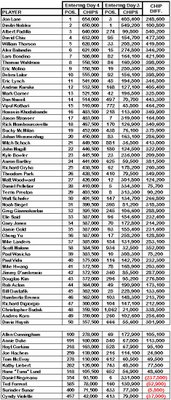
Chip Counts entering Day 4 -- Top 50 plus other notablesThey've reached the money at the 2006 WSOP Main Event. Of the 8773 who entered, 481 remain. The top 873 places paid. I happened to have been watching online last night as the bubble burst. With about three to go before they were down to 873, a player found himself in the big blind with less than 30,000 in chips. The table folded to the small blind, who put in a raise that would force the big blind player all in. The big blind called, and as he showed the table his pocket aces he announced that was the only hand with which he would have even considered calling. The small blind showed a pair of sixes. The flop came A65, giving both players sets. The turn brought the only card in the deck that could eliminate the big blind -- the case six. What agony.

If you click on the picture you'll get an Excel file that lists the top 50 chip stacks heading into Day 4. I've added columns that show where these players stood entering Day 3. I've also added other notables at the bottom of the list. Incidentally, these chip counts were culled from a couple of different sources, neither of which was CardPlayer (who currently lists a different player atop the leaderboard). CardPlayer, the "official content provider" of the WSOP, has been pretty erratic, frankly, when it comes to providing clear chip counts (a topic of discussion over on the Card Clubs Network Forums as of late).

It is interesting to see how much movement occurs from day to day. Of these top 50, only 16 were in the top 50 heading into Day 3. Most of this group features players who were able to make tremendous moves, the most dramatic probably being Christopher Budak who started yesterday with a meager 21,000 chips (sitting 1,062nd out of 1,159). Today he has 359,500 chips and finds himself in 48th place. Albert Padilla's Day 3 was more than a little impressive as well -- he built 99,800 chips up to 640,000, moving from 274th to 3rd.

None of the name pros are among the top fifty, but Allen Cunningham (100th, 278,000), Annie Duke (191st, 180,000), Hoyt Corkins (218th, 163,000), Joe Hachem (259th, 139,000), Tom McEvoy (278th, 130,000), and Kathy Liebert (282nd, 126,000) all certainly have enough chips to make something happen. The blinds will start today at 2,000/4,000 (with a 500 ante), so none of these players have an "M" ratio below 10 just yet. However, they will all certainly be looking to make moves. Meanwhile pros like Hans "Tuna" Lund (318th, 105,500), Daniel Negreanu (354th, 93,500), Ted Forrest (385th, 78,000), Surindar Sunar (400th, 71,500), and Cyndy Violette (457th, 42,000) have all slipped down into Harrington's orange or red zones and thus will be pushing right away when play resumes today at noon PDT. I imagine about half of the field will be gone after today, but there will still be another five days of play before they reach the end.

I wonder how they plan to fit $12 million cash on a single poker table . . . .

Labels: , , , , , , , ,

Friday, August 04, 2006

Counting 'em Down . . .

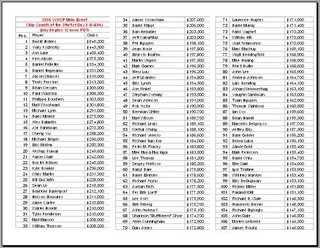
Click on image to see the entire list as a Word documentTook me awhile to find these, so I thought I’d share ’em here -- the consolidated chip counts heading into Day 3 of the 2006 WSOP Main Event. 1159 players remain (out of 8773). Click on the image to see the entire list as a Word document -- it prints out on 11 pages. Or click here to view or download an Excel version of the list (24 pages).

Scanning the list, there aren’t that many recognizable names. Near the top there’s Daniel Negreanu in 6th place with a whopping 331,000 chips, Allen Cunningham in 69th with 172,900, and Ted Forrest in 160th with 130,900. Four former Main Event bracelet winners remain alive: 2005 winner Joe Hachem (216th, 114,100), 2001 winner Carlos Mortensen (429th, 77,600), 1983 winner Tom McEvoy (612th, 60,500), and 2000 winner Chris “Jesus” Ferguson (671st, 55,200). Other notables left include David Pham (223rd, 112,300), Josh Arieh (359th, 85,600), Cyndy Violette (413th, 79,000), Surinder Sunar (433rd, 77,300), Hoyt Corkins (528th, 67,900), Annie Duke (540th, 67,000), Freddy Deeb (572nd, 64,500), Kathy Liebert (743rd, 48,500), Phil Ivey (1032nd, 23,400), Tex Barch (1079th, 19,800), and Layne Flack (1084th, 19,500). Unless I’m missing somebody, the rest are names most of us probably don’t immediately recognize. Of course, that’ll be changing soon for a select few of these. You can count on it.

Labels: , , , , , , , ,

Sunday, June 04, 2006

Dead Reckoning

Finally took the plunge a couple of weeks back and laid down the requisite number of pesos for a copy of Poker Tracker. Anticipating such a decision, I’d been hoarding all of my hand histories since New Year’s and by now have entered the lot. I plan to write something about the program once I get a better handle on how best to read and utilize the numbers. For now I’m just sittin’ here wide-eyed and mouth agape as I gaze at the sheer amount of dope this here program churns out. (Those of you who’ve picked it up know what I’m talkin’ about. What’s your VP$IP? How about your PFR%?)

For me getting Poker Tracker was an extension of an already borderline-obsessive attitude about record-keeping. When I opened my first cash account (at Stars), I had little clue about the value of record-keeping. (I had little clue about a lot of things poker-related, actually. Still do, for that matter, but I’m trying.) Through a combination of good fortune and blood simple fear of playing for more than nickels, I managed to preserve my initial $50 deposit for three months or so. I know I dipped as low as $20-25 at one point, but somehow I never bottomed out. I was sitting on $66.86 when I finally decided to start keeping a log book of how I was doing. I chose one of those little black moleskin notepads with the elastic band and graph paper. Kind of thing a shamus might actually use.

I began by simply noting how much I’d made or lost in a given day, also writing in totals at the end of each week and each month. Eventually I began recording how much I’d made or lost in a given session, as well as what game I had played and on which site. When I look back today I see that the first four days of such reporting didn’t go so well for me (I’d slipped back down under $50). I recovered a bit, but the first full week saw a loss of $6.59. From there began the nice, steady, slow climb that has characterized my poker career (thus far). I was playing mostly NL then (although I didn’t record that fact at the time), and made $21.19 the second week and $50.79 the third. Most weeks after that were in the black (thought not all), as were most months (but not all). About a month after I began the log I cashed my first $100, as indicated by my note of having done so.

Some time after I began noticing pros recommending keeping records. I heard a CardPlayer interview with WSOP Main Event winner Joe Hachem in which he talked about the importance of keeping records as a way to improve your game. “If you don’t keep tabs on yourself,” he said, “you can’t judge whether you’re winning or losing.” He goes on to tell a humorous story of a “hopeless” friend of his, a fellow who is “such a losing player, it’s not funny.” This poor palooka claimed to keep records of his play. The way he explained it, he’d start each month tallying his wins, then if he had three losing sessions he’d wipe the month off and start fresh the next month. (Poker provides endless opportunities for self-delusion . . . .)

Frankly I can’t imagine not keeping records, though I suspect the majority of players don’t bother. Besides being able to help you see whether you’re winning or losing, keeping records has other advantages. Doing so helps you spot trends in your game (e.g., what games/levels are winners for you, whether you do better playing 1-2 hrs. than when you play 5-6 hrs., etc.) from which you can benefit. You also get frequently to revisit the “big picture” and see how, say, one losing session fits into a winning week or month or year. For me there’s also something positive about the routine of taking down the totals insofar as it has become one of several actions (like listening to Frank Zappa or chomping on ice cubes) that help put me in a “comfort” zone when I play.

Anyhow, I recommend keepin’ for yourself a regular reckoning of your play. It won’t automatically make you a winner (unless you keep records the same way Hachem’s friend does), but it will add to your knowledge of the game -- most importantly, of your game.

Poker Tracker’s something all right. Have I been losing nearly half a BB on average every hand I play Q9-suited? Can I really have made a net of $40 playing J4-suited, including 85% of my showdowns with that garbage? Gonna have to investigate . . . .

Labels: , , , ,

Wednesday, May 03, 2006

Like an Open Book

Everyone knows about the "Hammer" (72 offsuit). However, when 73 offsuit became the hand that won $7.5 million last July, the quickly-anointed “Hachem” emerged as a new favorite for sneaks looking for ways to send opponents tiltward by cracking their premium holdings with obvious trash.

Not too long ago, I was in a game of six-handed limit hold ’em ($0.50/$1) when a mostly-tight player, Archer, opened with a preflop raise from the cutoff. The button and SB folded to me in the BB where I’d been dealt said Hachem. Now I’m a reasonable fellow. Not too bright, mind you, but reasonable. And it was the not-too-bright part that had me hesitating, oddly contemplating putting in the dollar to call.

Now there are a few sad sacks who hate hate hate to give up their blinds, no matter how unreasonable a defense appears to be. Not I, said the fly. I’ll happily donate my cabbage when such obvious weakness warrants doing so. For some reason, though -- perhaps just “to stir things up,” as Hammett’s Op might say -- I broke routine and made the call.

In a December 2005 CardPlayer column on “Defending Blinds,” Matt Matros notes how in heads-up situations such as the one I faced, one can be marginally more liberal with the calls, although one must be cognizant of other factors as well. One does get 3.5-to-1 to call here, with $1.75 already in the pot awaiting my additional $0.50 to make a flop happen. And, as Matros points out, one can virtually guarantee a postflop continuation bet from the raiser, thus, in a sense, making the odds 4.5-to-1. However, as Matros also explains, opening raises from the cutoff generally mean more strength than do button raises. The opponent’s tendencies (as far as one has a line on them) are essential to consider as well.

Of these three pieces of advice, then, only one (the first) could possibly be twisted into something resembling a recommendation to call. In other words, I’d crawled out on this limb all by myself, and yes I was more than vaguely aware what I looked like out there.

But there I was. And there was the flop. A real looker, in fact. Ace-seven-trey, all different suits. I check-raised Archer who after a bewildered pause called. Two more crying calls and I’d scooped an $8 pot when my two pair bested Archer’s ace-queen.

Now the gist of this here parable ain’t to supply the world with yet another example of the cold unfairness of our existence. Nor is it to prove any sort of special prescience at the table for your humble whatever. Rather, the crux of the matter is in what came next, when a suddenly-vocal Archer fumes to no one in particular

Archer: who calls a raise with 7 3?

A reasonable question, to be sure. No one at the table rushed to offer our crestfallen comrade any assistance with his query. So Archer tried again:

Archer: wtf
Archer: u r one lucky FISHHHH
Archer: ****er


And so forth. Within 40-50 hands, Archer’s once handsome stack of $35 had been reduced to $11 when one player after another pushed him off pots and/or showed down two pair, trips, straights, and flushes to his unfortunate run of second-best hands. As for me, I mostly stayed on the sideline, paring my fingernails and whistling, unable to take any real advantage of the new table image I seemed to have created for myself.

Although Archer may well have loosened up his starting hand requirements somewhat (e.g., limping from UTG w/A7o, etc.), I wouldn’t describe his subsequent play as overtly tiltish. And while his temporary slide certainly involved some more bad luck, it nevertheless appeared that everyone at the table had become suddenly able to take advantage, suddenly able to know when to reraise him, when to show down hands against him, when to fold to him. Archer had become an “open book,” so to speak. I wondered if perhaps a principle of poker might be hidden somewhere in the machinations I was witnessing. Something along the lines of

WITH EVERY COMPLAINT ABOUT OTHERS’ PLAY, YOU ANNOUNCE TO THE TABLE SOMETHING ABOUT YOUR OWN.

By articulating his frustration at having been called and beaten with 73o, Archer effectively broadcasted to everyone his own tendency to play “by the book” (and, even more significantly, his yearning for others to do the same). Indeed, his complaints communicated this message much more explicitly than did his play in the actual hand, which, if one had paid attention, might well have seemed unorthodox (calling down two more big bets after a check-raise to a board with no obvious draws). Such is a consequence of which “table coaches” don’t always seem aware.

The moral? You should know I don’t go in for morals very much. Let’s just say defend your blind with seven-trey only on special occasions. When heads-up in the WSOP main event, for instance. And think twice before complaining when someone else does.

Labels: , , , , , , ,


Older Posts

Copyright © 2006-2021 Hard-Boiled Poker.
All Rights Reserved.