Monday, March 07, 2016

When Nixon’s Ace in the Hole Turned Into a Blank

Following last night’s debate between Democratic presidential candidates Hillary Clinton and Bernie Sanders, CNN aired what will be the first of a series of shows called Race to the White House looking at past elections, in this case focusing on the 1960 race between John F. Kennedy and Richard M. Nixon.

I’m currently teaching my course “Tricky Dick: Richard Nixon, Poker, and Politics,” and in fact we were just reading about and discussing the 1960 race, including watching lengthy excerpts from the first JFK-RMN debate. I made sure to let my students know about last night’s program, then, for a couple of reasons.

For one, since we had only just gotten through discussing the race I thought they’d find it interesting to compare what we’d learned with what was included in the hour-long show. Secondly, I like reminding them how even though we’re studying people and events from a half-century ago, many are still interested in these things and believe them to be relevant today -- as indicated by CNN giving an hour of prime time to the ’60 race.

The ads for last night’s show made it seem as though the focus would be on the historic first debate (of four) between Kennedy and Nixon that took place on September 26, 1960, a notion furthered by the fact that the show was being paired with the Dems’ debate. In truth, though, the debate only earned a tiny bit of attention during the hour, fleetingly discussed for just a few minutes during the latter half of the show.

The rest of the hour was spent covering the respective candidates’ campaigns via commentary from a few academics and others, the showing of numerous clips from 1960, and some fleeting reenactments employed to enhance the story. Kevin Spacey -- evoking his House of Cards role as U.S. president -- is the narrator for the series, and was heard at the start of the hour suggesting (somewhat misleadingly) that Nixon was hopelessly outmatched by Kennedy as a politician and campaigner.

“You think you know the rules,” he says as we watch an actor portraying Nixon in shadowy profile. “But what happens when you discover you don’t even know how to play the game?”

Following such a line, it isn’t surprising to see a lot of emphasis thereafter on Kennedy’s right moves and Nixon’s wrong ones during the campaign. That said, the show provides some balance as well, illustrating in a necessarily cursory way pros and cons for both candidates. Near the end it is emphasized that JFK was as adept as RMN was when it came to “dirty tricks,” although the show doesn’t really dwell on too many examples (other than alluding to possible voter fraud in Illinois and Texas tilting the election JFK’s way).

Nixon’s eagerness to debate Kennedy is correctly presented as a misstep. During the quick presentation of the first debate, Nixon’s five-o’clock shadow and flop sweat is of course highlighted, and in fact there’s even a quick pre-debate clip of Nixon saying “think I better shave.” The much-repeated line about those listening on radio thinking Nixon “won” the debate while TV viewers favored JFK is uncritically repeated again, something that started as a few anecdotes and got blown up into some sort of ultimate signifier of not just the debate but the entire campaign and election.

Other more meaningful moments from the 1960 campaign are highlighted, including JFK’s address to the Greater Houston Ministerial Association, Martin Luther King’s arrest in Georgia and JFK’s phone call to Coretta, and a couple of Nixon’s “bad luck” moments including being hospitalized for two full weeks at the end of August and beginning of September.

Nixon’s hospitalization resulted from an infection that resulted from his banging his knee on a car door during a stop in Greensboro, NC in mid-August, part of his foolhardy effort to visit all 50 states during the campaign -- something he insisted on doing even after his injury and hospitalization.

In his discussion of the 1960 campaign in Six Crises (written shortly afterwards), Nixon concludes with a list of 16 things he “should have” done, all decisions which in his mind likely contributed to costing him the election. He does not include campaigning in all 50 states among the list of items, though he does lead it off with “I should have refused to debate Kennedy.”

For the second item on the list, and perhaps the second-most important one in retrospect, Nixon says “I should have used Eisenhower more in the campaign.” There is brief reference to Ike having been largely absent from the campaign near the end of the CNN program. With less than a week to go before the election, Spacey’s narration suggests the Nixon campaign had been cleverly waiting to use Eisenhower at the very last to produce a greater effect.

“Nixon has one last card to play,” he says, “his old boss, ex-General and President Dwight D. Eisenhower.” Despite the card-playing metaphor, no indication is made to the fact that both Ike and Nixon were poker players.

We see shots from the ticker tape parade of November 2nd in which Ike finally appeared with Nixon, an event which is said to have given Nixon a late boost as Election Day drew near. I anticipated another turn in the story here -- one explaining how this “one last card” wasn’t nearly as effective as it might have been. But the program moved in a different direction.

This might have been the biggest omission from the show, actually. Not only was Eisenhower mostly absent from the campaign, but in late August 1960 (just a week after Nixon bumped his knee in Greensboro), Eisenhower infamously concluded his weekly press conference with a line that would greatly hurt RMN in the weeks leading up to the debate.

“We understand that the power of decision is entirely yours, Mr. President,” began a reporter, leading up to what would be the last question of the presser. “I just wondered if you could give us an example of a major idea of his [i.e., Nixon's] that you had adopted in that role, as the decider and final, uh....”

About to leave, Eisenhower said “If you give me a week, I might think of one. I don’t remember.”

Afterwards Eisenhower would say he didn’t mean to suggest he actually needed a week to come up with an idea of Nixon’s his administration had found useful. Rather he was just referring to the fact that he’d be giving another press conference a week later and they could continue the discussion then.

But the damage was done. In fact, in that first debate a month later Nixon would be asked early on about Eisenhower’s statement, putting RMN on the defensive right away. And not long after that, the Kennedy campaign built a television ad around Ike’s line -- take a look:

I was a little surprised CNN didn’t touch on this part of the story of the 1960 campaign, the moment when Nixon’s “ace in the hole” suddenly turned into a useless blank. Still, for those unfamiliar with the 1960 race there was enough in the program perhaps to whet your appetite to learn more.

Image: Graphic from CNN advertisement, Race for the White House, 3/6/16 episode.

Labels: , , , , , , , , , , ,

Wednesday, August 01, 2012

A Complicated Deal: Reporting on the Stars-DOJ-FTP Agreement

A Complicated DealStill experiencing a kind of delayed amazement at yesterday’s news. I suppose after years and years of the bad, it’s hard to know how to react to something that appears undeniably good.

The agreement reached between PokerStars and the U.S. Department of Justice involving Stars’ acquisition of Full Tilt Poker’s assets, its intention to reopen FTP to much of the rest of the world, and the plan to refund U.S. players’ FTP balances as well as make those balances available for withdrawal by ROW (rest of world) players is easily the most positive development we’ve seen in online poker since Black Friday. Heck, it’s probably the best news we’ve had since the Unlawful Internet Gambling Enforcement Act of 2006 became law.

For many players the recovery of bankrolls long thought to be forever lost is the main reason for excitement. But looking at the larger picture, this turn certainly seems to help pave the way for a brighter future for online poker in the U.S. -- one that could even theoretically include PokerStars once again, although as I noted yesterday much will have to happen first for that possible future to unfold.

This morning I perused a few mainstream reports on the story. As always seems to happen, the imprecision of reporting on anything having to do with online poker -- not to mention outright inaccuracy -- can be remarkable.

The worst example of such comes in today’s New York Times where we find Michael Schmidt reporting “2 Poker Sites Will Forfeit Millions.”

Even the headline of that one is misleading. Whereas PokerStars will indeed forfeit $547 million to the U.S. government over a three-year period, Full Tilt Poker is mostly forfeiting assets, various “property,” rights, records, data, and so forth. Of course, FTP will also forfeit whatever its various companies have left in all of those many bank accounts they had, but I haven’t read any specific numbers stating how many “millions” FTP might be handing over. Furthermore, as the DOJ’s release spells out, PokerStars ultimately will be acquiring those “Forfeited Full Tilt Assets,” which means the headline sloppily simplifies the nature of the transactions.

The 'NYT' tries to correct a mistakeWorse, though, is the howler that originally appeared in the third paragraph stating “The $547 million will be available to victims of PokerStars activities and another $184 million will be made available from PokerStars to foreign victims of the Full Tilt Poker site.”

For one, not all $547 million is going to the “victims.” And secondly... “PokerStars[’] activities”? (Italics -- and the needed apostrophe -- added.)

A correction was later affixed to the end of the piece awkwardly clarifying that “an earlier version of this article misidentified the company that had taken money from the accounts of bettors and distributed it to its owners, according to court papers. It was Full Tilt Poker, not PokerStars and Full Tilt Poker.” However, the original “victims of PokerStars[’] activities” phrasing remained in the web version of the article until just a short while ago. (It made it into today’s print version of the NYT.)

There’s other evidence in the report that Schmidt probably hasn’t been on the Black Friday beat for more than a day or so, particularly when he leans on the “according to court documents” attributor to share facts that have been known for a year or more. But we’ll just shake our heads and move on.

The story also made the front page of CNN’s Money section late last night. There we read “Full Tilt... resolved allegations that it operated a Ponzi scheme,” which makes it sound as though all charges against the site and individuals associated with it have been dropped (they haven’t).

That story also originally featured the following picture as illustration...

Hey, it's all cards, right? So what if it isn't poker.


...which this morning was revised to this one:

Oh, right, right... this is a poker story, not blackjack.


DUCY?

Meanwhile Australia’s Daily Telegraph is reporting that “Online Poker Sites Full Tilt Poker, Absolute Poker Fined $700 Million.” No less than three errors in that headline -- not (simply) a “fine,” wrong sites, wrong amount. Please.

Mainstream reporting on the story isn’t all bad, though. Nathan Vardi of Forbes -- who has been reporting on Black Friday-related matters (in particular Full Tilt Poker) for quite some time -- does a good job reporting yesterday’s news while providing some historical context. He also looks forward a bit to speculate in an informed way about what the future might hold for online poker in the U.S.

Alexandra Berzon of The Wall Street Journal (who has also been reporting on the story for a while) does well, too, to present the salient facts in her piece from yesterday, although her headline (“Poker Site Pays $731 Million Fine”) also kind of glosses over things. I should note that having written for newspapers before, I realize in many instances the reporters don’t write the headlines for their articles, a practice which can often create unintended problems if those who do aren’t reading the articles carefully enough.

I also appreciate Ryan Faughnder of the Los Angeles Times starting his explanation of the agreement with the qualifying clause “In a complicated deal....” ’Cause it is complicated, and really none of these guys are going to be able to explain it all in the 500-700 words or so most are given with which to try.

It’s interesting to consider how even correctly reported versions of the story may not necessarily translate into “good news” about online poker for a mainstream audience. After all, regardless of how well or poorly the specifics are being related, the story essentially boils down to a similarly-themed narrative that (1) online poker is bad/illegal, (2) criminals were arrested for trying to offer it, and (3) criminals were punished and/or appear to have admitted guilt and settled their cases.

Those of us inside this little online poker bubble know there is a lot more to the story than that, of course. But it’s obviously still going to be a long while before online poker might exist in the larger culture as something other than “criminal.” Especially if the mainstream media isn’t willing to look at it specifically enough to describe what’s happening accurately.

Labels: , , , , ,

Tuesday, November 22, 2011

Far from Super

FailureWell, everybody’s disappointed in the “super committee” it seems. This despite the fact that most appear never to have held out much hope to start with that the sucker would produce anything, anyway.

Yesterday the specially-appointed, 12-member bipartisan Joint Select Committee on Deficit Reduction announced it had been unable to complete its charge to issue a recommendation for reducing the nation’s deficit by $1.2 trillion over the next ten years. (They’d started out talking about $1.5 trillion, but scaled that back.) Apparently the group of senators and representatives were still meeting as late as yesterday, leading some to think they may in fact come through with legislation that would then be voted on by the House and Senate. But alas, they did not.

Not even taking an “incomplete” here, to draw a campus-related analogy. No, this is “withdraw/failing.”

If I am not mistaken, now that the “super committee” has failed, “automatic” budget cuts will start happening -- including cuts to defense spending -- although they don't start up until 2013. Meaning Congress can still step in to change their minds on that, too. As Sen. John McCain has said, “Congress is not bound by this. It’s something we passed. We can reverse it.”

Such is the life of the rule-makers. You can withdraw with a failing grade. But you can keep retaking the course, too, as long as you keep your seat.

When the “super committee” was first created by in August -- a consequence of that debt ceiling crisis from the summer -- there had been some talk that a provision to license and regulate online poker as a new revenue source might pop up as part of the recommendation the group would be making. Last week’s leaked story that Sen. Harry Reid and Sen. Jon Kyl are perhaps looking to co-sponsor some sort of online poker legislation faintly revived that hope once again for some, as Kyl was on the Joint Select Committee and Reid had appointed the three Democratic senators who served.

But all of the commentary this morning seems to indicate that the “super committee” was a doomed enterprise all along. And some are connecting its failure to come to terms with a larger one characterizing the U.S. 112th Congress.

Wendy Schiller, an Associate Professor of Political Science and Public Policy at Brown University, told CNN today that the committee’s failure was not just theirs -- apparently they’d tried to cut deals with others in Congress to get something together, “but were rebuffed by their party leaders” -- but a “failure of political leadership on both sides of the partisan aisle.”

“Both parties chose their own electoral livelihoods over the good of the country, and it is outright shameful,” added Schiller. “This might be the most self-serving, mediocre, and uncaring set of legislators in Congress in the last 50 years.”

Schiller suggests that the current Congress is perhaps unique in the extent of its self-interestedness and collective failure to lead. But we know that when it comes to legislating online gambling in the U.S., every action made in the past -- on the state or federal level -- has been “self-serving” to the legislators who made it. As such will be the case for whatever comes next, if anything.

Meanwhile, as citizens with a desire to play our favorite card game against each other online, we just have to hope what serves the political interests of our overlords happens to overlap a little with what serves our own.

Sure, they represent us in theory. But in practice the arrangement is not so super.

Labels: , , , ,

Wednesday, October 19, 2011

Republican Candidates’ Cards on the Table

GOP presidential candidates as playing cardsHappened to catch that debate of the Republican presidential candidates last night on CNN. Seems like they’ve had about 10 of these suckers already.

Last night’s debate, dubbed the “Western Republican Leadership Conference (WRLC)/CNN Debate,” was held in Las Vegas at the Venetian, and thus it wasn’t surprising to see the opening montage search the setting for metaphors to introduce the show.

Check out the first couple of minutes:


Was kind of uncanny, actually, to switch over there and during that opening sequence hear all of those echoes from my “Poker in American Film and Culture” class.

We’ve spent much of the first half of the semester learning about the history of poker -- and American history, too. Thus we have discussed at length how the game spread westward, kind of absorbing and illustrating all of those “American frontier” themes that the country’s expansion out west in the 19th century often evokes. And we’ve also talked some about the many U.S. presidents who were poker players, and how some have argued the game actually offers a genuinely meaningful proving ground for would-be leaders.

In fact, media/political commentator Jeff Greenfield made that latter point after last week’s debate in which the candidates actually sat around a circular table. “Next time, have the moderator deal cards,” said Greenfield “Then watch them play a few hands of poker. (Not Texas Hold ’Em—unfair advantage to Texas Gov. Rick Perry.) Few better measurements of shrewdness and temperament than how someone plays cards.”

From the earlier GOP debate (10/11/11)I missed Jon Stewart on “The Daily Show” making a similar poker reference in his breakdown of last week’s GOP debate, but B.J. Nemeth told me on Twitter last night how Stewart had said it looked like “the world’s most boring poker game.” (That pic is from that 10/11/11 debate; last night they were at podiums again.)

In that opening montage last night, there were initial references to the western U.S. as “the American frontier” and how the west represented “a historic land of opportunity.” Then came the Vegas-related references, “a city where dreams are made... and crushed.”

There was the Stratosphere and the “Welcome to Vegas” sign and a roulette wheel providing predictable imagery. Then, when the seven candidates were introduced, we saw cards and chips and what looked like a poker table.

GOP presidential candidates as playing cardsThe narration referred to a “dramatic reshuffling of the pack” pushing Herman Cain up among the “leaders of the pack” with Rick Perry and Mitt Romney. Meanwhile Newt Gingrinch, Ron Paul, and Michele Bachmann were characterized as “wild cards,” while Rick Santorum was “eager to beat the odds.”

The candidates’ faces appeared on the cards themselves. When I noted on Twitter that the debate was being introduced via poker metaphors, Oskar Garcia who covers gambling/Vegas for the Associated Press responded to say the imagery also evoked other gambling games such as blackjack or baccarat. A good point, but I’d bet those compiling the little sequence (and most viewers) were probably thinking poker.

Poker actually was evoked by the candidates themselves at an earlier debate during an exchange between Romney and Perry. When the subject of Texas’ relative growth during Perry’s tenure as governor came up at that debate, Romney suggested Perry had been dealt a good hand, so to speak, and thus had succeeded more because of luck than skill.

“If you’re dealt four aces, that doesn’t make you necessarily a great poker player,” said Romney of Perry. I wrote about that exchange in one of my “Community Cards” columns over on the Epic Poker blog, if you’re interested to read more.

So we keep hearing about poker at these debates, with the many references further proving the point of my class that poker is, in fact, an important part of American culture. But despite the hopes of some in our little poker community, the game itself -- particularly the topic of possibly legislating online poker -- isn’t really being discussed.

No, poker itself isn’t being addressed, although the game keeps providing metaphors and symbols that others -- and even the candidates themselves -- are using to try to distinguish them from one another.

That said, they all mostly still seem like a pack of cards.

Labels: , , , , ,

Monday, July 25, 2011

Now What? Online Poker in the U.S., ca. late July 2011

Bad planningVery much enjoying being back home and settling into the more familiar routines. Spent the weekend mostly relaxing. And not writing about poker (for a change). I did play a little online, though, over on Hero Poker where I have a small roll.

As was the case the last few summers, while away at the WSOP I hardly played online at all, just logging on a couple of times the entire time I was there, and then only for brief sessions. Of course, this year was different insofar as like other Americans my options for playing have been reduced markedly. I hadn’t been playing that much even before I went, so during the weeks I was in Vegas there really wasn’t much change as far as my online play was concerned.

I mentioned some time back how I’d gotten myself a bankroll of sorts on Hero not by depositing, but by winning a freeroll back in May which got me a nifty hundy over there with which to play. Been piddling around with that, building it up a bit but mostly just treading water at the PLO10 tables.

I think I also said something at some point about winning a smaller freeroll on Carbon, another Merge skin, which got me started with a whole dollar. Built that up to more than five bucks via sit-n-go’s and some PLO, and felt like a genius. Then I went busto in short order, and felt like a doofus. Actually, to be wholly accurate, I’m not utterly busto. I have exactly $0.01 on there now, the penny sitting there, taunting me for my poor bankroll management.

Bad planning, I guess. Of course, we’ve seen a lot of that sort of thing in online poker.

Of course, when I say “I did play a little online” I’m referring to something decidedly different from the hobby I pursued for many years before. I no longer look forward to or plan sessions. It has been a good while since I’ve studied the game or my play with any real earnestness. And I can’t say I feel part of that larger community of poker players -- extending from recreational, casual types to the most serious grinders -- like I always did when playing online before.

When in Vegas I had several conversations with various people about playing online. Often I found myself awkwardly caught between past and present tense when discussing the subject. Since I still play (a little), present tense seemed correct. But I realized as I spoke that most of what I was talking about with regard to the experience of playing online was over and done with, relegated to the past. For now, anyway.

Because it has all changed for us here in the U.S. as far as online poker goes. Black Friday hit. We got our money back from PokerStars. We wait and wonder about Full Tilt Poker. We wonder a little less about Absolute Poker and UB, whom many of us wrote off long before.

But years of habit mean we still instinctively think of those sites when we think of online poker. And now, as far as playing goes, the great majority of us are either sorta kinda playing once in a while (like me), or not bothering at all. For some (like me), the WSOP distracted us for much of the summer. But now we are back home and thinking about playing again. And realizing the game isn’t really there for us at the moment.

A feature over on the CNN Business page from yesterday asked the question “Will the online poker business become a ‘busted flush’?” The headline writer was no doubt eager to apply the game’s lingo to describe the situation of unrealized potential presently characterizing online poker in the U.S. But it works. As far as online poker in the U.S. goes, a lot of heavy betting on the come was going on (to apply some more lingo), and the river blanked.

The gist of the piece is to point out that healthy turnouts at this summer’s WSOP should not be taken as an indicator that here in America the prospects for poker generally speaking or online poker in particular are healthy as well -- that, in fact, the WSOP numbers “put a misleading gloss on an industry still mired in controversy.”

Our buddy F-Train is quoted in the piece (under his less jazzy-sounding moniker, “David Behr”) describing how Black Friday and the frustrations caused by Full Tilt Poker’s continued inability to pay back (or even communicate clearly with) U.S. players “put a damper on the whole Series,” muting some of its “pageantry” even if it didn’t affect numbers too greatly. F-Train goes on to suggest that the “steep drop” most predicted would happen at this year’s WSOP is more likely to occur in 2012.

I’m inclined to agree with F-Train on both points.

Looking back, the mood at the Series this summer -- at least for the final four weeks when I was there -- was certainly toned down a bit from year’s past. Still a lot of excited folks about, and some genuine drama marking both the prelims and the Main. But the whole “last hurrah” thing (mentioned in the CNN piece) weighed fairly heavily, I thought, affecting the players and perhaps some of the media a bit, too.

(By the way, on that latter point the Wicked Chops guys recently suggested a “nasty, toxic atmosphere among poker media” at this year’s WSOP. I get where they are coming from, but my personal experience working with and alongside others didn’t suggest that at all, once again being very positive and marked by a lot of mutual support and camaraderie. The fact is, I’ve worked in environments which were a whole helluva lot more “nasty” and “toxic,” to be sure.)

Looking ahead (to address F-Train’s other observation), even if some sort of legislation is soon passed to license and regulate online poker in the U.S., we’re still facing a mighty lengthy ramp-up period -- one likely to take much longer than the 10 months or so before the start of the 2012 WSOP.

As I tried to explain to my “Poker in American Film and Culture” class in late April, poker took a huge hit in the U.S. on April 15. Many will still play, of course, but without the online option fewer new players will find the game going forward. And a lot of us -- again, like me -- will find ourselves playing less frequently and less seriously, the likelihood of our becoming part of the fields at WSOP events decreasing as a result.

Am starting to miss online poker. And I know others are missing it a lot more than I am. I mean the game we used to play, the one where everyone (essentially) was invited. Poker will endure, no doubt. But right now it seems that years’ worth of growth and momentum has been seriously slowed or even halted -- that poker in America will recede from the cultural spotlight for a while, perhaps to return to the dark corners where it mostly dwelled for so many decades before.

Plan accordingly, I guess.

Labels: , , , , ,

Tuesday, January 13, 2009

A Game for All Situations

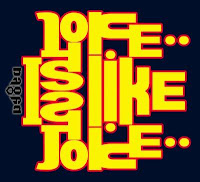
Life is like a jokeLast week, the Poker Shrink wrote a post in which he shared a few “random thoughts,” one of which was to say he is “not a big fan of the ‘Poker is like Life’ books and articles.” His primary objection has to do with the fact that such comparisons are usually “too general to carry any more wisdom than a dribble glass.”

I’m with the Shrink on this one. I even claim over in my long-outdated profile that readers will not be finding any “of that dizzy ‘poker-is-like-life-because’ applesauce” on the blog, followed by an explanation that “Nothing is ‘like’ life, by the way -- either it’s living or it ain’t.”

About a year ago, I wrote a post in which I tried to explain further what I meant by that bit of sass. In that post, I joked about seeing a house for sale being advertised as “close to everything,” arguing that one gets about as much meaning out of saying poker -- or anything, for that matter -- is “like life.” Gonna have to be a little more precise than that, friend, to say anything at all.

Of course, that isn’t to say I won’t sometimes use poker analogies to explain particular non-pokery phenomena. Who doesn’t? Was kinda-sorta doing as much yesterday with that post about running that included a couple of indirect comparisons of my new exercise routine to poker.

But that’s a much more specific exercise (pun intended).

For example, over the last couple of days I’ve found myself in a few conversations about the Carolina Panthers’ shockingly awful playoff performance against the Arizona Cardinals this past Saturday. You might have missed it. The Panthers were big favorites and playing at home, and got crushed 33-13, with quarterback Jake Delhomme throwing five interceptions and losing a fumble, too. Just miserable. (And on his friggin’ birthday, too!)

Jake DelhommeAfter the second or third interception, Delhomme pretty obviously had come altogether unglued. He hardly seemed able to function. He kept stubbornly firing balls to receivers who were double- and triple-teamed. In other words, he’d become the football equivalent of someone on tilt. And frankly, the poker metaphor was so apt it seemed (to me, at least) to shed genuine light on what had happened Saturday night.

Basically, before he’d even gotten warmed up, Delhomme had lost a couple of big ones and gotten unsettled. Then he started playing emotionally, making poor decisions and acting desperately in order to get it all back as quickly as possible. And, as often happens to guys who play that way, such rash, undisciplined behavior just made it worse.

Speaking of using poker analogies to describe non-poker situations, yesterday I was watching CNN’s “The Situation Room” (where situations are always sure to be situated) and heard Wolf Blitzer reporting on how Roland Burris, the man picked by embattled Illinois governor Rod Blagojevich to fill president-elect Obama’s now-vacant senate seat, was in fact going to able to take the seat sometime this week. That despite the Democrats’ obvious desire not to allow Blagojevich -- who presently faces federal arrest charges accusing him, among other things, of soliciting bribes in exchange for the very senate seat appointment -- to be allowed to make such a decision.

The Situation RoomBlitzer then spoke to Dana Bash, CNN’s correspondent on Capitol Hill. Blitzer asked Bash to explain how the Democratic leadership so quickly changed their tune after many of their highest-ranking members had said last week they wouldn’t allow the appointment to be made. Bash responded by saying “the bottom line is that Rod Blagojevich, the governor of Illinois, called the bluff of the Democratic leadership” by going ahead and selecting Burris.

Bash then went on to tell a “quick anecdote” about a conversation she’d had yesterday morning with a “senior Democratic senator” concerning the Burris situation. “I was talking to him getting into the elevator,” said Bash. “And this senator said, look, when you’re dealt a losing hand, you skip to the end. And that is precisely why you have seen this turnabout inside the Democratic leadership. And they’re going to seat Roland Burris later this week.”

Blitzer responded with a clarification: “When you are dealt a losing hand, you quickly fold. And that’s what they apparently did.”

Of course, in this case, it sure seemed like the Dems put in a hefty raise and stuck around a street or two with their losing hand before dumping it, but no matter. We get the idea. Thanks, poker.

Poker may not be not “like” life, but it sometimes helps in the explainin’.

Labels: , , ,


Older Posts

Copyright © 2006-2021 Hard-Boiled Poker.
All Rights Reserved.