Monday, June 03, 2013

Linking Out

Dealing with an overstuffed inbox at the moment, so I thought I’d post something today linking out to a few items worth checking out elsewhere.

Brad Willis penned an interesting op-ed for the PokerStars blog today titled “Before the bubble” occasioned by the anniversary of his playing his first ever WSOP event back in 2005. Brad does a nice job recounting the wonder associated with that experience, then moves into some observations about the current status of both his own poker playing and the tourney scene, generally speaking.

It’s a thoughtful piece that gives poker players much to consider regarding some of the reasons why we got into this game in the first place, and why it’s important now and then to remember those reasons particularly when encountering others just coming into the game as we once did.

Also worth reading is James McManus’s review for The Wall Street Journal of Ben Mezrich’s new book, Straight Flush, which weirdly celebrates the fraudster founders of Absolute Poker.

Last August I wrote about having seen Mezrich pop up on CNBC for a brief segment in which he previewed his plans to write the book, noting then how worrisome it seemed that he apparently either misunderstood or was willfully diminishing the frankly villainous behavior of his story’s principals, people responsible for the first major online poker cheating scandal (and cover-up), who caused the loss of millions by investors, who committed bank and wire fraud, who violated the UIGEA, and who failed (along with UB) to return player funds post-Black Friday.

I’ve yet to read Straight Flush, but from McManus’s review it sounds as though Mezrich has followed through on his plans to champion the “brilliant kids” of AP. As McManus states in his review, it’s “a story of failure, tendered as almost its opposite.” The review is titled “Bluffers and Bandits” -- probably a more appropriate title for the sordid saga -- and ultimately calls out Mezrich for being motivated by an ethically compromised greed not unlike that of his subjects.

Haley Hintze is also working through in greater detail several problem areas presented by Mezrich’s book in a multi-part series over on Flushdraw that is doing a great job explaining both the AP story as it actually happened and Mezrich’s numerous deviations from it.

Finally, BLUFF Magazine this afternoon debuted a new video feature called “Stump the Kevmath” featuring our favorite poker Twitterer doing his best to take on some WSOP-related trivia challenges. Guaranteed to produce a few grins.

Okay, now I have filled your inbox... get to it.

Labels: , , , , , , , , ,

Wednesday, May 01, 2013

Whose Turn Is It, Again?

What a weird week already, and it’s only Wednesday. And I guess it’s May already, too, which means the World Series of Poker is just around the corner to start distracting us all even further.

Been trying to follow all of the online poker-related developments, although it’s starting to feel a little like I’ve accidentally sat down at a table where they’re dealing some brand new variant with multiple flops and extra streets where I’m not sure about hand values and I don’t even really know how many betting rounds there are.

Kind of makes me want to sit back and take a hand or three off, just to avoid playing out of turn or any other missteps.

On Monday I was writing about the current troubles at Lock Poker, the latest issue to emerge symbolizing the confusing and highly uncertain world of so-called “rogue” offshore U.S.-facing online poker sites. Easy enough to draw a conclusion there to steer clear of Lock and other such sites, although it’s still a bit headachy trying to delve into the specifics of what is happening with the communications and cashouts (or lack thereof) and ever-shifting landscape for players.

Then yesterday came the sudden launch of Ultimate Poker, which created some huge buzz and various conversations and commentary throughout the day and night.

Again, lots of questions linger as the site moves into its second day of offering actual U.S. licensed and regulated real money games to players in Nevada. PokerScout reported a peak of 136 players on the site during its first day of dealing, and a quick check of the “Hand ID” numbers at the moment suggest more than 25,000 hands have been dealt at the cash tables and in sit-n-gos.

Amid all of the talk of triangulation -- a word that always sounds short of breath -- and other matters related to players’ attempts to get up and running on Ultimate Poker, I wondered some more about how quickly the sucker went live, with only a few hours in between players being able to make initial deposits and the games getting underway. (No free play games, either, to test out things beforehand.)

But like the great majority of those talking about Ultimate Poker right now, I’m not actually playing on the site as I am not in Nevada. Thus am I hesitant to say much at all regarding how things appear to have gone during UP’s first day, although I have been following with interest the various posts, forum comments, tweets, and other talk about what’s happening.

Then last night came what appeared to be another item of apparently uncertain significance as Alexandra Berzon of The Wall Street Journal reported that the deal between PokerStars (or, rather, the Rational Group) and the Atlantic Club Casino Hotel (or, rather, Colony Capital LLC) had reached an impasse thanks to the passing of an important deadline established between the two entities.

According to Berzon, the deal had been contingent on Rational obtaining a Preliminary Casino Authorization (i.e., a temporary license) to operate in NJ by last Friday. That day came and went, and thus the agreement between the two parties expired. While the significance of the news was initially unclear -- neither side had offered any on-the-record comments for Berzon’s article -- this morning it sounds like the deal is well and truly nixed, as the Atlantic Club’s CEO is confirming that to be the case. Though again, it is hard to pin down what it all means for New Jersey and/or PokerStars going forward. (Hard for me, anyway.)

Finally, there was one more item popping up this morning over on Politico suggesting that yet another federal online gambling bill was about to be proposed by House Rep. Peter King (R-NY). Actually that item initially suggested another Congressman (Jay Rockefeller) was to propose the legislation before a correction soon followed.

Of course, it seems like just about every story we’re hearing at present having to do with online poker seems in need of correction. Or at least revising to add further clarification. And the fact that half of these stories are hidden behind pay walls doesn’t make it any easier for the majority of us wanting to know what’s up.

I’ve made the analogy before here about how reporting on poker -- like poker itself -- is often a “partial information game,” although when I have it has been in the context of reporting on tourneys in which those of us on the side cannot see hole cards or know players’ thoughts, entire shared history, and so on.

Such a characterization seems appropriate with regard to stories about the status online poker in the U.S. at present, too. Like I was saying above, the whole scene regarding online poker’s present and future in the U.S. is getting so muddled it’s becoming increasingly difficult even to follow the order of play.

Makes the game more unpredictable, I guess, and thus more apt to surprise us. Even so, I think I might just sit out and watch for a while before getting further involved.

Labels: , , , , , , , ,

Friday, December 07, 2012

Re-Entry: Atlantic City

Limited space to scribble this morning, as I’m heading off for another poker-related voyage.

I actually have two tourneys I’ll be reporting from coming up here in rapid succession, both up in the northeastern part of the country. The first takes me to Atlantic City for the World Series of Poker Circuit event at Harrah’s (a $1,675 buy-in event, with re-entries). Then I’ll be headed to the Sands in Bethlehem, Pennsylvania for the Main Event of their Sands Bethlehem Deepstack Extravaganza (a $2,500 event, also with re-entries).

This’ll be a return trip to AC for me, as I was there previously for the WSOP-C back in March 2011. Was a memorable trip and tourney, in part because it was won by Brian Ali (who I was able to meet and play with this past summer in Vegas), and Ali knocked out most of the players at the final table, including one named Ellis Frazier (much to the delight of pun-seeking bloggers).

Yesterday the poker world’s attention was suddenly focused on Atlantic City thanks to the Wall Street Journal’s report that PokerStars is looking to purchase the Atlantic Club Casino Hotel in AC, a deal that is in limbo while New Jersey continues to debate an online gambling bill that would allow casinos to operate sites. The article explains how if such a bill were passed, Stars would likely move to obtain a license to operate in New Jersey.

Speaking of that NJ online gambling bill currently under consideration (Assembly Bill A2578), that bill was recently revised to remove language that might have prevented PokerStars from returning to the U.S. because of its so-called “bad actor” status (i.e., for having taken U.S. customers post-UIGEA). Haley Hintze explained that change and its possible implications in an article for PokerFuse yesterday.

Put together with PokerStars’ deal with the DOJ (and purchase and relaunch of Full Tilt Poker), all of this adds up to a possibility that Stars could well find its way back to the U.S., with Atlantic City the avenue through which such re-entry would occur.

All very interesting to consider as I plan for my own re-entry into Atlantic City a little later today.

Will be curious to see how AC is holding up after Hurricane Sandy barrelled through six weeks ago. I’ll probably hop back on here starting Sunday to file some travel reports along the way. Meanwhile, have a good weekend, everyone!

Labels: , , , , , ,

Wednesday, August 01, 2012

A Complicated Deal: Reporting on the Stars-DOJ-FTP Agreement

A Complicated DealStill experiencing a kind of delayed amazement at yesterday’s news. I suppose after years and years of the bad, it’s hard to know how to react to something that appears undeniably good.

The agreement reached between PokerStars and the U.S. Department of Justice involving Stars’ acquisition of Full Tilt Poker’s assets, its intention to reopen FTP to much of the rest of the world, and the plan to refund U.S. players’ FTP balances as well as make those balances available for withdrawal by ROW (rest of world) players is easily the most positive development we’ve seen in online poker since Black Friday. Heck, it’s probably the best news we’ve had since the Unlawful Internet Gambling Enforcement Act of 2006 became law.

For many players the recovery of bankrolls long thought to be forever lost is the main reason for excitement. But looking at the larger picture, this turn certainly seems to help pave the way for a brighter future for online poker in the U.S. -- one that could even theoretically include PokerStars once again, although as I noted yesterday much will have to happen first for that possible future to unfold.

This morning I perused a few mainstream reports on the story. As always seems to happen, the imprecision of reporting on anything having to do with online poker -- not to mention outright inaccuracy -- can be remarkable.

The worst example of such comes in today’s New York Times where we find Michael Schmidt reporting “2 Poker Sites Will Forfeit Millions.”

Even the headline of that one is misleading. Whereas PokerStars will indeed forfeit $547 million to the U.S. government over a three-year period, Full Tilt Poker is mostly forfeiting assets, various “property,” rights, records, data, and so forth. Of course, FTP will also forfeit whatever its various companies have left in all of those many bank accounts they had, but I haven’t read any specific numbers stating how many “millions” FTP might be handing over. Furthermore, as the DOJ’s release spells out, PokerStars ultimately will be acquiring those “Forfeited Full Tilt Assets,” which means the headline sloppily simplifies the nature of the transactions.

The 'NYT' tries to correct a mistakeWorse, though, is the howler that originally appeared in the third paragraph stating “The $547 million will be available to victims of PokerStars activities and another $184 million will be made available from PokerStars to foreign victims of the Full Tilt Poker site.”

For one, not all $547 million is going to the “victims.” And secondly... “PokerStars[’] activities”? (Italics -- and the needed apostrophe -- added.)

A correction was later affixed to the end of the piece awkwardly clarifying that “an earlier version of this article misidentified the company that had taken money from the accounts of bettors and distributed it to its owners, according to court papers. It was Full Tilt Poker, not PokerStars and Full Tilt Poker.” However, the original “victims of PokerStars[’] activities” phrasing remained in the web version of the article until just a short while ago. (It made it into today’s print version of the NYT.)

There’s other evidence in the report that Schmidt probably hasn’t been on the Black Friday beat for more than a day or so, particularly when he leans on the “according to court documents” attributor to share facts that have been known for a year or more. But we’ll just shake our heads and move on.

The story also made the front page of CNN’s Money section late last night. There we read “Full Tilt... resolved allegations that it operated a Ponzi scheme,” which makes it sound as though all charges against the site and individuals associated with it have been dropped (they haven’t).

That story also originally featured the following picture as illustration...
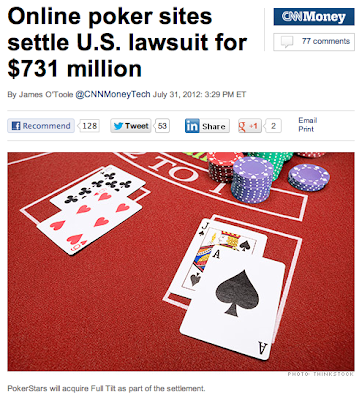
Hey, it's all cards, right? So what if it isn't poker.


...which this morning was revised to this one:

Oh, right, right... this is a poker story, not blackjack.


DUCY?

Meanwhile Australia’s Daily Telegraph is reporting that “Online Poker Sites Full Tilt Poker, Absolute Poker Fined $700 Million.” No less than three errors in that headline -- not (simply) a “fine,” wrong sites, wrong amount. Please.

Mainstream reporting on the story isn’t all bad, though. Nathan Vardi of Forbes -- who has been reporting on Black Friday-related matters (in particular Full Tilt Poker) for quite some time -- does a good job reporting yesterday’s news while providing some historical context. He also looks forward a bit to speculate in an informed way about what the future might hold for online poker in the U.S.

Alexandra Berzon of The Wall Street Journal (who has also been reporting on the story for a while) does well, too, to present the salient facts in her piece from yesterday, although her headline (“Poker Site Pays $731 Million Fine”) also kind of glosses over things. I should note that having written for newspapers before, I realize in many instances the reporters don’t write the headlines for their articles, a practice which can often create unintended problems if those who do aren’t reading the articles carefully enough.

I also appreciate Ryan Faughnder of the Los Angeles Times starting his explanation of the agreement with the qualifying clause “In a complicated deal....” ’Cause it is complicated, and really none of these guys are going to be able to explain it all in the 500-700 words or so most are given with which to try.

It’s interesting to consider how even correctly reported versions of the story may not necessarily translate into “good news” about online poker for a mainstream audience. After all, regardless of how well or poorly the specifics are being related, the story essentially boils down to a similarly-themed narrative that (1) online poker is bad/illegal, (2) criminals were arrested for trying to offer it, and (3) criminals were punished and/or appear to have admitted guilt and settled their cases.

Those of us inside this little online poker bubble know there is a lot more to the story than that, of course. But it’s obviously still going to be a long while before online poker might exist in the larger culture as something other than “criminal.” Especially if the mainstream media isn’t willing to look at it specifically enough to describe what’s happening accurately.

Labels: , , , , ,

Tuesday, October 04, 2011

Rush Poker, Multi-Entry Tourneys, and Now... “Equity Stakes”!

Shamus' 'Equity Stakes'There’s a new item in The Wall Street Journal regarding last Friday’s news that Groupe Bernard Tapie has signed an agreement to acquire Full Tilt Poker, an agreement that has many conditions, one of the foremost being the site successfully negotiating its way out of the various legal troubles it faces with the U.S. Department of Justice.

The article specifically addresses another significant hurdle that must be overcome for the deal to occur -- taking care of the $300 million-plus the site currently owes its players, money which FTP doesn’t appear to have on hand.

Sounds like an idea being considered is “offering equity stakes” to some players. You heard that right. Thought it sounded funny that someone might actually want to buy Full Tilt Poker? Well, now it sounds like they’re thinking of selling some of FTP to you, too.

Gotta admit, that is inspired.

You’ll recall how the amended DOJ civil complaint described the site owing players “approximately $390,695,788” on March 31, 2011, yet only having “approximately $59,579,413 in its bank accounts.” The amended complaint also shared some internal communications from over the summer in which both Ray Bitar and Howard Lederer suggested the site couldn’t handle even $5 million worth of withdrawals.

The amended complaint went on to allege that nearly $444 million had been funneled into those several “FTP Insider Accounts.” No way to know how much of that money remains in those accounts, although a few days after the amendment the DOJ also issued warrants to seize accounts belonging to Lederer, Bitar, Chris Ferguson, and another Swiss account reportedly connected to Rafe Furst. Late last week Bitar filed a claim against the seizure of that particular account as well as against the seizure of a couple of other accounts that occurred back on Black Friday.

Then came last week’s report by the Alderney Gambling Control Commission -- the one they offered as an explanation for their decision to revoke Full Tilt Poker’s licenses to operate -- which also made mention of FTP’s financial woes, including referring to considerable sums seized by the DOJ from FTP -- “approximately $331 million” from June 2007 to June 2010.

All of which is to suggest what we already knew, namely, that anyone considering buying Full Tilt Poker also must have some idea about how to deal with the big ol’ debt the site currently has to its players.

In an interview last Friday, Laurent Tapie noted how the group “want[s] to find ways where we don't have to put in all the money and will be talking to the US Department of Justice next week.” Many took that to indicate that perhaps the group was going to try to get the DOJ to offer some of the seized funds to help pay players, an idea the DOJ had itself suggested as a possibility in its statement last week. There the DOJ said that “the return of forfeited funds to victims of the alleged fraud may be possible, but will depend on several factors,” among them the successful resolution of the indictment and civil complaint, just how much money there is available, and everyone involved cooperating with the DOJ at each step of the way.

Plan FIn this new WSJ article, an attorney for Laurent Tapie is said to have confirmed that the group “may address Full Tilt’s liabilities by offering equity in a revived company to poker players owed the most money.” I’m guessing I wouldn’t be included among that group, given that Full Tilt Poker only owes me $279.85. (Not that Americans would ever be part of this discussion, anyhow.)

Other conditions mentioned in the piece include securing a new license to operate as well as having the existing owners also investing in the “revived company” (although not participating in its management). One wonders how, exactly, the old owners are going to be investing in the new company, if not with money that already should be considered as belonging to the players.

Oh, and the DOJ will have to give its blessing to all that, too.

Seems a little wacky to imagine a new “revived” Full Tilt Poker going forward with the players owed the most money having equity in the site -- being, in a sense, part-owners of the sucker. As Seth Meyers would say on SNL, “Really!?!”

To me it all sounds like we’re in the dizzying realm of hypotheticals within hypotheticals here, with the likelihood of this “equity stakes” idea ever getting to the table being necessarily slim. Posters over at Two Plus Two are understandably befuddled by it all, with most expressing well-founded skepticism.

My favorite comment over there I’ve seen so far comes from the poster “bingobars”. He says that “As an investor in FTP I for one will be overpaying myself by an incredible margin.”

Hard to come up with an analogy to describe the scenario.

How about I run a red light and smash into your car, damaging both to the point that neither can be driven. They aren’t totaled, though, as both can be repaired and gotten back on the road at considerable expense. Well, maybe. I mean we’ll have to see once they get in the shop.

I have no insurance, nor any means to pay for the repairs. But I can promise to let you drive my car if and when it gets fixed.

Sound good? No?

Labels: , , , ,


Older Posts

Copyright © 2006-2021 Hard-Boiled Poker.
All Rights Reserved.